After five months of waiting, Abxylute has finally revealed when its N6 controller for the Nintendo Switch 2 will launch. The controller will arrive alongside the GameCube-like N9C controller that was unveiled a few weeks ago.
A wild Galaxy S26 Plus has surfaced over a week before its release. Sporting Samsung's rumoured redesign, the device was allegedly being sold for a whopping $1,650 ahead of its official debut.
David Jaffe finds the more tame Kratos depicted in God of War: Sons of Sparta unrecognizable. The franchise’s creator also takes issue with a lackluster story that slows down the action. Fans have been more positive about the PS5 game, even with stiff metroidvania competition.
Casio has launched the LTP1234PDC-7B women’s watch in the United States. The new model features a simple and timeless design aimed primarily at women who prefer understated elegance. Its rectangular case and clean lines give it a classic tank-style appearance, making it a versatile accessory for everyday wear.
Design Details
The watch has a polished silver-tone finish that enhances its sleek and minimalist look. The rectangular case includes softly rounded edges and straight lugs that connect seamlessly to a stainless steel bracelet.
Casio designed the watch to be lightweight and comfortable, measuring 32 x 21 x 7.4 mm and weighing only 56 grams. The bracelet features a one-touch 3-fold clasp, ensuring ease of use.
The dial stands out with a white base that contrasts sharply with bold black numerals. Casio positioned the oversized numerals around the outer edge of the dial to maximize legibility.
The dial also features a smaller inner rectangle that frames the center, adding a layered visual effect. Fine printed details along this inner section add subtle depth without complicating the overall design. The watch features slim silver‑tone hour and minute hands complemented by a minimalist seconds hand.
The LTP1234PDC-7B offers essential features, including water resistance and an approximate three-year battery life powered by an SR626SW battery. The watch face is protected by mineral glass, and the stainless steel band fits wrist sizes ranging from 125 mm to 185 mm. Casio claims the watch maintains an accuracy of ±20 seconds per month.
Pricing and Availability
The LTP1234PDC-7B is priced at $69.95, making it an affordable yet stylish choice for women seeking a classic timepiece. It is now available for purchase in the US.
Acemagic has announced the N3A NAS mini PC, a compact system built to handle storage, computing, and multimedia tasks. The company has already shared some key specifications in a blog post on its global website.
Acemagic N3A NAS Specifications (Teased)
The device functions as both a NAS and a mini PC, and it is very similar to Beelink ME Pro NAS, which launched in December last year. The N3A NAS is powered by AMD’s Ryzen 7 3750H processor, based on the Zen+ architecture. It features four SATA drive bays and two M.2 NVMe slots, providing a solid mix of performance and storage flexibility.
The Ryzen 7 3750H processor features 4 cores and 8 threads with a boost clock of up to 4.0GHz. It delivers a 35W TDP, ensuring energy-efficient performance for 24/7 operation. The integrated Radeon RX Vega graphics support 4K@60Hz display output, making the system suitable for media playback and display-oriented tasks.
The N3A offers four SATA drive bays for high‑capacity 3.5‑inch HDDs, giving users ample space for storing photos, videos, and work files. Its dual M.2 NVMe slots support high‑speed system drives or caching setups to enhance data transfer rates and overall responsiveness. The device also includes two DDR4 memory slots, supporting up to 64GB of RAM for multitasking and future expansion.
The mini PC measures 270 x 150 x 185 mm, making it compact enough for flexible placement in home or office settings. It includes a single Gigabit Ethernet port for multi‑device connectivity and cross‑platform file sharing. The system also supports private cloud deployment, enabling centralized data management while delivering reliable performance for simultaneous file access and containerized workloads such as Docker.
Acemagic has not revealed an exact release date and pricing, but has stated that the N3A NAS mini PC is expected to launch soon.
For more daily updates, please visit our News Section.
Fast charging has become one of the biggest competitive headlines in phones today. Brands like Xiaomi, OPPO, and others boast numbers as high as 200W and even 240W, promising a full charge in minutes. But how does ultra-fast charging compare with more moderate speeds like 65W when it comes to battery health after two years of regular use? The short answer? There is a trade-off.
Battery Degradation
Unlike rapid top-ups you might do daily, battery cycle life is the best proxy for long-term wear. Industry standards generally consider a battery still healthy at 80% capacity after 800 cycles, meaning it retains 80% of its original capacity and performance. However, ultra-high-watt charging changes that equation. Devices using 65W charging tech tend to degrade less over time. But after about the same 800 cycles, batteries charged at 65W can retain approximately 91% of their original capacity.
Xiaomi’s 200W Fast Charging Solution
So, you get a solid performance that means noticeably longer lifespan and less capacity loss after two years of typical use. On the other hand, phones that support faster charging speeds, like 200W charging, show faster degradation. Evidence suggests these batteries can fall to around 80% capacity after just 800 cycles, which aligns with the minimum baseline for acceptable battery health, but it hits this mark much earlier than models with 65W charging support.
What These Percentages Mean in Real Use
When we talk about 80% vs 91 % capacity after two years, the difference is more than just a number on paper:
80% Battery Capacity: You’ll likely notice shorter screen-on time, faster drainage during heavy use, and more frequent mid-day charging. The battery feels more tired, especially after a couple of years.
91% Battery Capacity: The battery still feels closer to “new,” retains longer endurance, and delivers steadier performance throughout the day.
Realme GT 3 with 240W Charging Support
In practical terms, a device with 200W charging might need battery health conservation strategies earlier. This could include limited full charges, enabling optimized charging, or reducing high-watt charging use.
Why Faster Charging Affects Battery Health
It might seem counterintuitive that faster charging could be worse for battery health, but the mechanisms are rooted in electrochemistry:
Heat: Ultra-fast charging creates more heat inside the battery during the charge process. Heat is one of the main accelerators of battery ageing, which speeds up internal chemical reactions that degrade the electrode materials over time.
Charge Stress: Charging at higher wattages pushes more current into the battery at once. This can increase stress on the lithium-ion cells, leading to faster capacity loss across many cycles.
Thermal Management: Modern phones use advanced cooling and thermal throttling, like graphite layers, vapor chambers, and smart charging algorithms help reduce heat and mitigate degradation. However, these systems only reduce the long-term impact, not eliminate it entirely. So while a phone with 200W charging won’t immediately fail, the battery will show signs of ageing sooner than a phone that uses 65W charging under the same usage pattern.
OPPO’s Surprising Case
Interestingly, real-world testing has shown that in some cases, a 150W charging implementation (like OPPO’s) can outlast an even faster 240W solution. In some scenarios, it even managed to achieve up to double the cycle life (approx 1,600 cycles) before reaching similar degradation levels. This highlights how fast charging is implemented (software control, cell chemistry, thermal design) matters as much as the wattage itself.
Should You Avoid Fast Charging?
Ultra-fast charging isn’t inherently bad. In fact, it’s extremely convenient, especially if your lifestyle demands quick top-ups between meetings or when you’re travelling. Considering the massive upgrades in battery tech in recent years, these devices have also retained good battery capacities even after a few years. Faster charging does accelerate capacity loss compared to more moderate speeds, so here’s how you can balance conveniencewith longevity:
Use standard charging (like 30–65W) for overnight/top-off charging.
Reserve super fast charging for when you really need speed.
Enable battery care features and Super OTA battery management options if available.
Avoid extreme thermal environments (like charging in hot cars or under direct sunlight)
For more daily updates, please visit our News Section.
Caviar has introduced a new Valentine’s-themed customization series for the iPhone 17 Pro. The collection, called Garden of Eden, includes three limited-edition designs inspired by traditional symbols of love and loyalty. Prices start at $10,000, and each model is limited to 14 units worldwide.
Design Details
The Garden of Eden lineup includes Charming Lotus, Goldfish, and Wings of Love. Caviar uses 24K gold, jewelry enamel, engraving, diamonds, and sapphires across the designs. The models are available for both the iPhone 17 Pro and iPhone 17 Pro Max, including configurations with up to 1TB of storage.
Charming Lotus draws inspiration from the lotus flower, which holds cultural meaning in India, China, and Ancient Egypt. In Indian tradition, the lotus represents spiritual refinement and inner clarity. In Chinese culture, it symbolizes faithful love and harmony in marriage. The design features gold elements and detailed enamel work influenced by floral patterns. This variant starts at $19,630, making it the most expensive in the series.
Charming LotusGoldfishWings of Love
Goldfish centers on a pair of golden fish arranged in a circular motion. In Buddhist symbolism, two fish represent unity and harmony between partners. In Chinese tradition, goldfish also reflect prosperity and fertility. The design includes gold-plated sculptural elements accented with sapphires. Pricing for this model starts at $10,490.
Wings of Love features swallow birds in flight. The swallow has long symbolized loyalty and safe return in European and Asian cultures. In Ancient Greece, it was associated with Aphrodite, the goddess of love. The design highlights the idea of devotion across distance. This model starts at $10,340.
Caviar will also include a Valentine’s-themed gold coin with each purchase. Each unit ships in premium packaging.
Choosing between the Samsung Galaxy Watch Ultra and the Apple Watch Series 11 isn’t just about specs; it’s about lifestyle. One is built like a survival tool for the outdoors, designed to handle extreme workouts and long adventures. The other feels like a refined digital companion, blending premium design with seamless everyday intelligence. While official pricing positions them differently, it’s worth noting that Amazon often lists both at discounted rates, which can shift the value equation. If you’re stuck between rugged endurance and polished performance, this decision deserves a closer look.
Please Note: When you buy something using the links in our articles, we may earn a small commission at no cost to you.
Design and Display
Build and Feel
The Galaxy Watch Ultra embraces a rugged, adventure-focused design with sapphire crystal protection and a titanium frame that feels engineered for durability. It is clearly positioned for outdoor enthusiasts and athletes who demand resilience. The Apple Watch Series 11, while also premium in materials, presents a more refined and versatile aesthetic. It blends into professional and casual settings with ease, offering a smoother visual identity. One feels purpose-built for endurance and harsh conditions, while the other feels thoughtfully designed for daily wear and style-conscious users.
Display Quality
Samsung’s Super AMOLED panel offers vibrant contrast and strong outdoor readability, making fitness stats easy to view in bright conditions. Apple’s LTPO3 OLED display pushes higher peak brightness and delivers exceptionally fluid animations, giving the interface a polished and responsive feel. The Apple screen often feels more immersive due to tighter software optimization, though Samsung’s display remains sharp and bold.
Verdict
For rugged durability and bold presence, Galaxy Watch Ultra stands out. For display brightness and refined everyday usability, Apple Watch Series 11 feels more balanced.
Specifications Including Battery
Performance
The Galaxy Watch Ultra runs on Samsung’s advanced chipset paired with Wear OS, delivering strong multitasking capability and smooth Android integration. It feels powerful and responsive, particularly within Samsung’s ecosystem. The Apple Watch Series 11, powered by Apple’s latest silicon and watchOS, prioritizes efficiency and seamless animation. The experience feels cohesive and highly optimized, with transitions that appear effortless. While both are fast, Apple’s software harmony often creates a slightly more fluid daily interaction.
Battery and Charging
Samsung equips the Galaxy Watch Ultra with a larger battery designed for extended endurance. It is better suited for long tracking sessions, outdoor trips, and users who prefer fewer charging interruptions. Apple focuses on efficient power management and fast charging, making it convenient for daily routines. While it may not last as long on a single charge as Samsung’s model, quick top-ups reduce downtime significantly.
Verdict
Galaxy Watch Ultra leads in battery longevity and endurance. Apple Watch Series 11 excels in efficiency and fast recharge convenience.
Camera
Main and Secondary Lenses
Neither smartwatch includes a built-in camera, choosing instead to dedicate internal space to health tracking sensors and smart functionality.
Selfie Camera
There is no selfie camera on either device. This absence allows both watches to prioritize battery capacity, structural durability, and advanced biometric sensors rather than rarely used imaging hardware.
Verdict
This category remains a tie. Both smartwatches appropriately focus on health, connectivity, and performance instead of camera features.
Pricing
Galaxy Watch Ultra is officially positioned at a significantly higher price tier compared to the Apple Watch Series 11 in both the US and Indian markets. Apple’s model enters the market at a notably lower starting point, making it more accessible to a wider audience.
Is the Price Justified?
The Galaxy Watch Ultra’s higher pricing aligns with its rugged build, titanium construction, enhanced durability certifications, and larger battery capacity. It targets users who prioritize toughness and extended endurance. The Apple Watch Series 11, despite being priced lower, delivers premium materials, excellent display brightness, and highly optimized performance. This makes it feel like a strong value proposition for everyday users within Apple’s ecosystem.
Verdict
For overall affordability and value balance, Apple Watch Series 11 feels more approachable. Galaxy Watch Ultra justifies its higher positioning primarily through durability and battery advantages.
Conclusion
The Galaxy Watch Ultra distinguishes itself with durability-focused engineering, advanced GPS support, and extended battery endurance tailored for outdoor lifestyles. It is clearly designed for users who demand resilience in demanding conditions. The Apple Watch Series 11 shines with exceptional display brightness, seamless ecosystem integration, and refined health tracking features such as highly accurate temperature sensing and Ultra Wideband support. One emphasizes toughness and stamina, while the other prioritizes polish and daily usability.
Verdict
For Android users and adventure-driven buyers, the Galaxy Watch Ultra offers rugged confidence and longer endurance. For iPhone users seeking refined performance at a lower entry cost, the Apple Watch Series 11 delivers stronger overall value. The best choice ultimately depends on ecosystem preference and whether durability or affordability carries more weight.
New data tracking CPU sales on Amazon US shows a sharp year-over-year decline in January 2026. According to figures compiled by analyst TechEpiphany, just 26,100 processors were sold during the month. That might not sound terrible on its own, but it represents a steep 51% drop compared to January 2025.
That’s a significant contraction for one of the largest online retailers, and it adds to a broader downward trend that’s been visible in recent months.
At the same time, prices are moving in the opposite direction. The average selling price of CPUs rose from $227 in January 2025 to $305 in January 2026, a jump of roughly 34%. That suggests buyers who are still upgrading may be choosing higher-end chips, or simply paying more across the board.
Despite the slowdown, AMD continues to lead by a wide margin. The company reportedly sold 23,050 Ryzen CPUs in January, accounting for more than 88% of total units. Revenue share was nearly identical. Intel, by comparison, moved just 3,050 units.
What’s interesting is where demand seems concentrated. AMD’s newer Zen 5-based Ryzen 9000 series performed well, but older Zen 4 (Ryzen 7000) and even Zen 3 (Ryzen 5000) chips continue to sell in meaningful numbers.
Building or upgrading a PC right now means paying more for nearly every major component. Memory prices have climbed noticeably in recent months, affecting both DDR4 and DDR5 kits. SSD pricing has also increased. Graphics cards haven’t helped the situation either. Even mid-range options have seen pricing pressure.
When RAM, storage, and GPUs all cost more, the appeal of upgrading “just the CPU” weakens. Most enthusiasts don’t upgrade in isolation; it’s usually part of a broader platform refresh. And right now, that refresh isn’t cheap.
Between higher component costs, platform transition expenses, and general economic caution, many consumers seem comfortable holding onto existing systems a little longer.
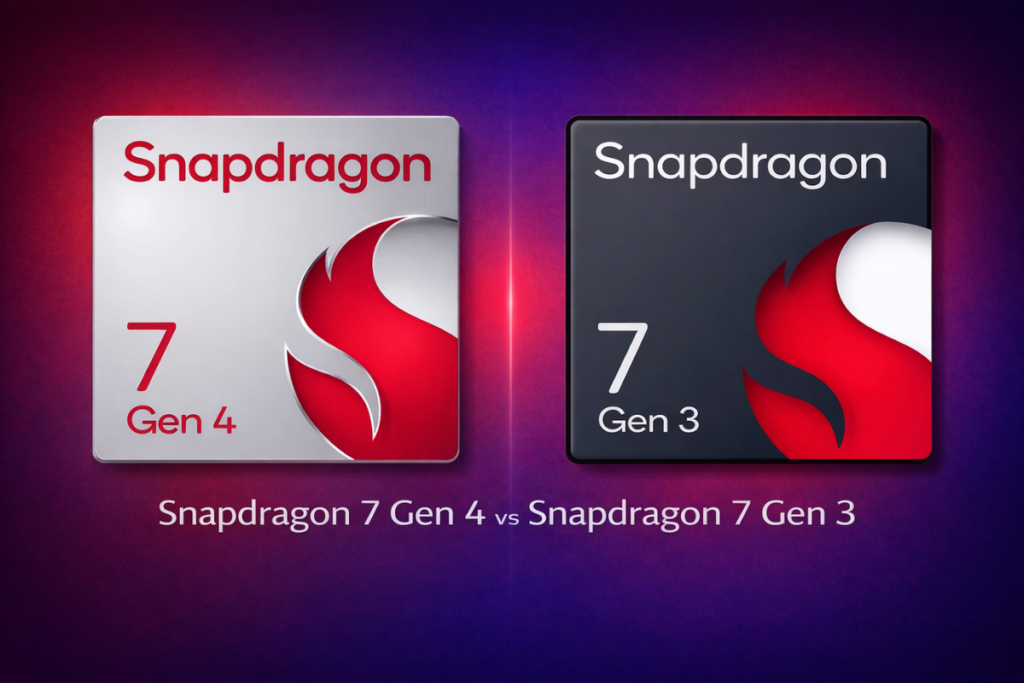
Snapdragon 7 Gen 3 has been a popular choice among mid-range phones for offering excellent performance, power efficiency, and a reliable gaming experience. Its successor, the Snapdragon 7 Gen 4, takes everything a step ahead with notable advancements to CPU, GPU, and connectivity.
The Snapdragon 7 Gen 4 will offer better performance, but the real question is: how big an upgrade is it? Is it just a new name with minor changes, or are there some serious upgrades? Let’s look at the benchmark scores and key differences to find out.
Here’s the spec sheet to begin with:
Snapdragon 7 Gen 4
Snapdragon 7 Gen 3
Announced
May 2025
November 2023
Process node
4nm (TSMC)
4nm (TSMC)
CPU
1 x 2.8GHz — Cortex-A720 4 x 2.4GHz — Cortex-A720 3 x 1.84GHz — Cortex-A520
1 x 2.63GHz — Cortex-A715 3 x 2.4GHz — Cortex-A715 4 x 1.8GHz — Cortex-A510
GPU
Adreno 722 Snapdragon Elite Gaming features
Adreno 720 Snapdragon Elite Gaming features
NPU
Qualcomm Hexagon NPU
Qualcomm Hexagon NPU
Memory
LPDDR5x, up to 4.2GHz
LPDDR5, up to 3.2GHz
Storage
UFS 4.0
UFS 3.1
Camera
Qualcomm Spectra ISP (Triple AI-ISPs, 12-bit) up to 200MP single camera up to 64MP single camera with zero shutter lag up to 32+21MP dual cameras with zero shutter lag up to 21MP triple cameras with zero shutter lag up to 4K/60fps video recording
Qualcomm Spectra ISP (Triple CV-ISPs, 12-bit) up to 200MP single camera up to 64MP single camera with zero shutter lag up to 32+21MP dual cameras with zero shutter lag up to 21MP triple cameras with zero shutter lag up to 4K video recording
Snapdragon X63 5G modem (sub‑6GHz) download speed: 5Gbps (peak speed) Wi-Fi 6E (peak speed: 2.9Gbps) Bluetooth 5.4
Snapdragon 7 Gen 4 vs 7 Gen 3: Benchmark scores
[Note: For the benchmark results, the tests were performed on the Vivo T4 Pro (powered by Snapdragon 7 Gen 4) and OnePlus Nord CE 4 5G (powered by Snapdragon 7 Gen 3).]
Geekbench score
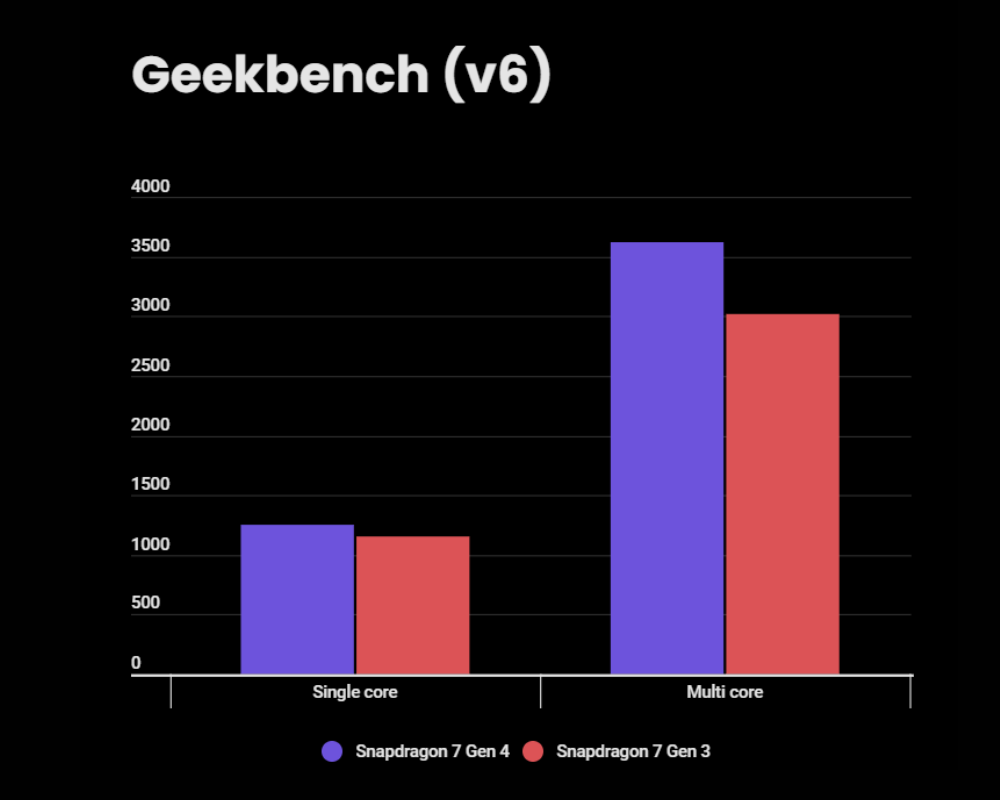
The Vivo T4 Pro, powered by the Snapdragon 7 Gen 4, has achieved 1,252 points in the single-core performance, which is about 8% higher than the 7 Gen 3. The gap widens in the multi-core performance, where the 7 Gen 4 leads with 20% higher score (3620 vs 3018).
Snapdragon 7 Gen 4
Snapdragon 7 Gen 3
Single core
1,252
1,154
Multi core
3,620
3,018
Geekbench v6
Geekbench results suggest devices powered by Snapdragon 7 Gen 4 will perform better than those powered by 7 Gen 3, especially in tasks that require multiple cores to work together.
AnTuTu score
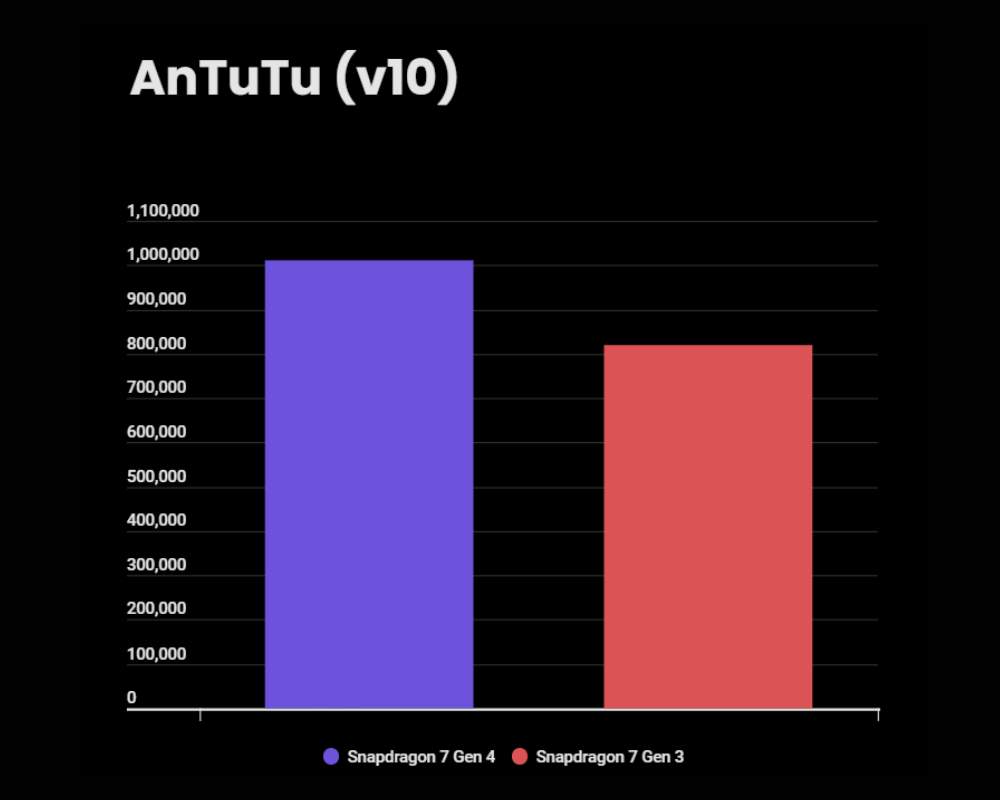
In the AnTuTu benchmark, the Snapdragon 7 Gen 4 scores over 1 million, while the 7 Gen 3 scores 819K. That’s a 23% higher score for the newer chip, which also reflects in every single test on the platform.
The Snapdragon 7 Gen 4 delivers 14% higher CPU and 26% higher GPU scores than the Snapdragon 7 Gen 3. The memory and UX scores also favor the newer chip.
Snapdragon 7 Gen 4
Snapdragon 7 Gen 3
AnTuTu score
1,010,864
819,655
CPU
309,273
269,334
GPU
323,797
256,584
Memory
182,776
129,961
UX
195,019
163,776
AnTuTu v10
Benchmark scores suggest a notable performance boost for the Snapdragon 7 Gen 4, but they don’t reveal improvements to the camera, connectivity, or other key areas. So, let’s discuss them in the following section.
Snapdragon 7 Gen 4 vs 7 Gen 3: What are the upgrades?
CPU, GPU, and NPU
The Snapdragon 7 Gen 4 features an upgraded (1+4+3) core configuration, which replaces an efficiency core with a performance core. On top of this, the CPU uses a newer instruction set and newer cores, which offer better performance and power efficiency than the Snapdragon 7 Gen 3.
Additionally, the prime core in the Snapdragon 7 Gen 4 runs at a higher frequency, further improving the chip’s performance. Qualcomm claims a 27% performance uplift in CPU over the 7 Gen 3.
For graphics rendering, the Snapdragon 7 Gen 4 relies on the Adreno 722 GPU, which brings higher capabilities than the 7 Gen 3’s Adreno 720 GPU. The newer chip also benefits from some additional gaming optimizations, such as Qualcomm Adaptive Performance Engine 4.0 and Snapdragon Adaptive Game Configuration. Qualcomm says the newer GPU does 30% faster rendering.
The Snapdragon 7 Gen 4 also features an upgraded Hexagon NPU, which delivers 65% better AI performance. It’s also the first in the lineup to support Stable Diffusion 1.5, enabling real-time image generation in seconds.
Camera and imaging
The camera specs are largely unchanged, but there are a few upgrades worth paying attention to. The Snapdragon 7 Gen 4 is an AI ISP that enables AI-powered autofocus, auto white balance, and auto exposure.
The Snapdragon 7 Gen 4 is the first in the series to feature hardware-enabled electronic image stabilization (EIS) and adds real-time Video Super Resolution. Additionally, it significantly improves multi-frame noise reduction, resulting in clearer, crisper capture.
Connectivity
The Snapdragon 7 Gen 4 features more robust connectivity, thanks to an upgraded 5G modem that implements the latest 3GPP Release 17 standard. Unfortunately, though, the 7 Gen 4 features a lower peak download speed over 5G. On the plus side, it features twice the download speed over Wi-Fi as the 7 Gen 3.
The Snapdragon 7 Gen 4 also benefits from Wi-Fi 7 and Bluetooth 6.0 implementation. It’s the first chip in the series to feature Qualcomm Expanded Personal Area Network (XPAN) technology, which keeps earbuds connected over Wi-Fi ultra-clear, untethered audio.
Snapdragon 7 Gen 4 vs 7 Gen 3: Which is a better choice?
The Snapdragon 7 Gen 4 is a real upgrade rather than a new name slapped to minor improvements. It has a performance-focused CPU and a newer GPU with faster rendering and additional gaming-centric features. The upgraded NPU is faster and more capable.
The newer Snapdragon chip also features an AI-ISP with advanced camera capabilities like hardware-enabled electronic image stabilization (EIS) and real-time Video Super Resolution. It also offers more modern, robust connectivity features, such as Wi-Fi 7, Bluetooth 6.0, and Qualcomm’s XPAN technology.
The Snapdragon 7 Gen 4 is clearly the better choice here. But it will come with a higher price tag than 7 Gen 3-powered devices. In short, the Snapdragon 7 Gen 3 gives you an excellent value for money, whereas the newer 7 Gen 4 pushes for higher performance and modern features for a slightly higher price.
Xiaomi Redmi Note 15 Pro+ and Redmi Note 15 Pro may look almost identical on paper, but the real story lies in the upgrades. A faster Snapdragon chip, dramatically quicker 100W charging, upgraded connectivity, and a sharper selfie camera separate the Pro+ from the already impressive Pro.
For buyers trying to decide whether the extra $100 (₹8,000) is truly worth it, this comparison breaks down exactly how those upgrades affect gaming performance, daily charging convenience, long-term durability, and overall value. If choosing between smart savings and smarter speed feels confusing, this is the comparison that makes the decision clear.
Major Upgrades:
Feature
Redmi Note 15 Pro+
Redmi Note 15 Pro
Upgrades
Processor
Snapdragon 7s Gen 4 (Adreno 810)
Dimensity 7400 Ultra (Mali-G615 MC2)
Pro+ – Better GPU efficiency and more stable gaming performance long term
Charging Speed
100W wired (0–100% ~40 min)
45W wired
Major Upgrade – Dramatically less charging time; more convenient daily use
Selfie Camera
32MP
20MP
Pro+ – Sharper selfies and better detail for social media/video calls
Wi-Fi Support
Wi-Fi 6E
Wi-Fi 6
Pro+ – Faster and more future-ready connectivity (region dependent)
Build Materials
Fiber-reinforced structure options
Plastic frame
Pro+ Feels More Premium – Slightly better durability and premium in-hand feel
Please Note: When you buy something using the links in our articles, we may earn a small commission at no cost to you.
Design and Display
Build and Feel
Both phones feature Gorilla Glass Victus 2 protection and IP68/IP69K durability, making them equally resistant to dust and water. However, the Redmi Note 15 Pro+ steps ahead with a more premium structural finish using fiber-reinforced materials alongside eco-leather options. The standard Pro uses a plastic frame, which is solid but slightly less refined.
That upgrade in material subtly improves long-term durability and gives the Pro+ a sturdier, more flagship-like feel. For buyers planning to use their device for several years, that added structural strength can make a real difference in day-to-day confidence.
Display Quality
Both devices share the exact same 6.83-inch AMOLED panel with 120Hz refresh rate, HDR10+, Dolby Vision, and 3200 nits peak brightness. Visual experience is identical, ultra-bright outdoors, smooth scrolling, and rich contrast.
There is no display upgrade on the Pro+, meaning buyers get the same flagship-grade viewing experience regardless of which model they choose.
Verdict
Design durability slightly improves with the Pro+, but display quality remains equal. The upgrade here is subtle, not transformative.
Specifications
Performance
The biggest upgrade comes in performance. The Redmi Note 15 Pro+ uses the Snapdragon 7s Gen 4, while the Pro runs on the Dimensity 7400 Ultra. The Snapdragon chip typically delivers better GPU efficiency and more stable gaming performance.
For buyers, this means smoother high-frame-rate gaming, better long-term optimization, and potentially stronger resale value. Casual users may not notice a massive difference today, but heavy gamers and power users will benefit from the Pro+ over time.
Battery and Charging
Battery size is nearly identical, but charging speed is not. The Pro+ supports 100W fast charging, compared to 45W on the Pro. This is a major lifestyle upgrade.
In real life, this means dramatically shorter charging sessions. A quick top-up before heading out becomes practical with the Pro+. That convenience adds up daily.
Verdict
Performance tuning and 100W charging are meaningful upgrades that directly improve long-term usage and daily convenience.
Camera
Main and Secondary Lenses
Both phones feature the same 200MP OIS main sensor and 8MP ultrawide camera. Photo quality in daylight and 4K video performance will be very similar. There’s no hardware upgrade here for rear photography.
Buyers won’t miss out on imaging quality by choosing the standard Pro.
Selfie Camera
The Pro+ upgrades the front camera from 20MP to 32MP. This brings sharper detail in selfies and better clarity for video calls and content creation.
For social media users or vloggers, this is a practical upgrade. For occasional selfie users, the difference may feel minor.
Verdict
Rear cameras are equal, but the upgraded 32MP selfie sensor gives the Pro+ a noticeable advantage for content-focused buyers.
Pricing
Redmi Note 15 Pro+ costs around $450 (₹38,000), while the Redmi Note 15 Pro is priced at $350 (₹30,000). That $100 (₹8,000) gap pays for a faster Snapdragon processor, 100W charging, Wi-Fi 6E support, upgraded GPS precision, and a better selfie camera.
For many buyers, the Pro already offers a flagship-level display, a 200MP OIS camera, an IP rating, and a massive battery at a lower cost. It delivers most of the experience without the premium.
The Pro+ justifies its price if performance and charging speed are daily priorities.
Verdict
The Pro is stronger on value; the Pro+ is stronger on performance-driven upgrades.
Disclaimer: Prices are approximate and may vary based on country, region, and applicable taxes.
Conclusion
Both devices share standout features like IP68/IP69K protection, 120Hz Dolby Vision AMOLED displays, 200MP OIS cameras, and large silicon-carbon batteries. The Pro+ introduces meaningful upgrades: Snapdragon 7s Gen 4 performance, 100W charging, Wi-Fi 6E, and a 32MP selfie camera.
These upgrades directly impact gaming smoothness, charging convenience, and front-camera quality. The Pro, however, retains nearly the same flagship core experience at a lower price, making it highly competitive.
Final Verdict
The Redmi Note 15 Pro is the smart buyer’s choice, it delivers almost everything at a lower price.
The Redmi Note 15 Pro+ is for those who hate waiting, game more seriously, and want their phone to feel a little more future-proof. The upgrades aren’t cosmetic, they improve speed, charging time, and front-camera clarity in ways that everyday users can actually feel.
Magnetic power banks have become essential for anyone who needs portable charging solutions. In 2026, the market offers a wide range of options with advanced features like Qi2 wireless charging, high-capacity batteries, and compact designs.
These power banks are ideal for keeping devices like iPhones, AirPods, and even tablets charged throughout the day. Here are the top magnetic power banks available this year, along with their standout features.
Anker Nano Power Bank
Price: $59.99
Capacity: 5,000mAh
Anker designed the Nano Power Bank to prioritize portability and convenience. At just 0.34 inches thick and weighing 4.3 ounces, this power bank fits easily into a pocket or bag. It charges iPhones with 15W MagSafe-compatible wireless charging and supports 20W USB-C wired charging.
The device recharges itself in under two hours and can charge an iPhone 16 Pro to 25% in 42 minutes. Its skin-friendly back panel and curved edges make it comfortable for daily handling.
This power bank is best for users who need a slim and lightweight option for quick top-ups. However, its 5,000mAh capacity may not be enough for multiple charges or extended use.
Anker MagGo Power Bank
Price: $79.86
Capacity: 10,000mAh
Anker built the MagGo Power Bank to offer both power and functionality. It features 15W Qi2-certified wireless charging and a USB-C port capable of 20W output.
The built-in foldable stand allows users to prop up their phones while charging, making it convenient for video calls or media viewing. The smart display provides real-time information about battery levels and charging times.
This power bank works well for users who need a higher capacity for multiple devices or longer trips. Its weight of 8.82 ounces makes it less portable compared to slimmer models, but the added features justify its size.
Baseus PicoGo AM61
Price: $64.99
Capacity: 10,000mAh
Baseus focused on speed and versatility with the PicoGo AM61. It delivers 25W Qi2.2-certified wireless charging and 45W USB-C wired charging.
The built-in USB-C cable and additional charging port allow users to charge up to three devices at once. Strong magnetic alignment ensures stable wireless charging, while the graphene cooling system prevents overheating.
This power bank is ideal for users who need fast and efficient charging for multiple devices. Its compact design and powerful performance make it a great choice for travelers and heavy users.
Sharge Icemag 3
Price: $67.90
Capacity: 10,000mAh
Sharge designed the 3rd generation of its Icemag power bank with a transparent case and dynamic RGB lighting. It supports 25W Qi2 wireless charging and features a side-mounted USB-C cable for 35W wired charging.
It also features a built-in micro-fan that actively cools the device, ensuring consistent wireless charging performance. The integrated kickstand allows for hands-free use while charging.
This power bank targets users who want a stylish and high-tech charging solution. The active cooling system and RGB lighting set it apart from traditional designs.
Ugreen MagFlow
Price: $89.99
Capacity: 10,000mAh
Ugreen created the MagFlow to provide reliable power with advanced safety features. It delivers 25W Qi2 wireless charging and 30W USB-C output through a built-in cable. The real-time LED display shows battery levels, and the 13-layer safety system protects against overheating and overcharging.
This power bank works well for users who prioritize safety and high performance. Its built-in cable doubles as a strap, making it easy to carry during travel or daily commutes.
Baseus PicoGo AM31 Mini
Price: $59.99
Capacity: 5,000mAh
Baseus designed the PicoGo AM31 as a compact option for users who need a lightweight power bank. It measures just 3.4 x 2.3 inches and weighs 4.8 ounces. The device supports 15W Qi2 wireless charging and 20W wired output. It also features a built-in kickstand that provides hands-free viewing while charging.
This power bank is best for users who need an ultra-portable solution for short trips or quick top-ups throughout the day. Its smaller capacity limits its usefulness for extended charging needs.
Belkin BoostCharge Pro
Price: $59.95
Capacity: 5,000mAh
Belkin created the BoostCharge Pro as a versatile and user-friendly charging solution. This power bank supports fast wireless charging up to 15W and is Qi2-certified for MagSafe compatibility. The built-in foldable kickstand lets users switch between pad and stand modes, making it convenient for FaceTime calls, streaming, or multitasking while charging.
Weighing 5.3 ounces, the BoostCharge Pro is compact and travel-friendly. It provides up to 16 hours of extra battery life and includes a USB-C to USB-C cable for fast wired charging. Belkin offers the device in multiple colors, such as Deep Purple, Teal, Pink, and Black, to suit different tastes.
This power bank works well for iPhone users who value convenience and style. Its foldable design and reliable performance make it a great choice for on-the-go use.
Xiaomi UltraThin Magnetic Power Bank
Price: $50
Capacity: 5,000mAh
Xiaomi has recently introduced the UltraThin Magnetic Power Bank, which measures only 6 mm thick, making it one of the slimmest magnetic power banks available. It supports 15W wireless charging for Xiaomi 17 devices and 7.5W for iPhones. For faster charging, it offers 22.5W wired charging through its USB-C port.
The power bank features a high-density silicon-carbon battery housed in an aluminum alloy shell with a fire-resistant fiberglass phone-facing side. Four LED indicators display the remaining battery, and a power button lets users control charging. Xiaomi has introduced the device in select global markets, with additional countries expected to follow soon.
This power bank is perfect for users seeking an ultra-slim and lightweight option for daily use.
The Xiaomi 17 Ultra has finally entered the DxOMark rankings, and unsurprisingly, it’s among the top camera phones on the market right now. However, Xiaomi still has some work to do to reach the top of the leaderboard.
According to DxOMark, the Xiaomi 17 Ultra scored 166 points for its camera, placing it in 6th position overall.
DxOMark says the device delivers well-balanced photography across all focal lengths. From ultra-wide shots to telephoto zoom, performance is consistent.
The lab also highlights natural subject exposure, rich detail, and stable white balance in most scenes. Color reproduction is described as accurate, too, along with controlled noise, even in low light.
Xiaomi 17 Ultra ranks among the best camera phones per DxOMark
The hardware, of course, plays a big role here. The phone features a 50MP main camera with an f/1.7 aperture, 23mm focal length, dual-pixel phase detection autofocus, and optical image stabilization.
There’s also a 50MP ultra-wide camera at f/2.2 and 14mm. The standout on paper is the 200MP telephoto lens, offering a variable f/2.4–3.0 aperture, 75–100mm focal length, PDAF, OIS, and 3.2x to 4.3x optical zoom.
DxOMark gave the device 170 points for overall photo performance. Breaking that down further, the main camera earned 171 points, bokeh scored 175 points, the ultra-wide scored 160 points, and zoom scored 169 points.
The telephoto performance, in particular, is said to be high-level, which delivers strong detail at longer focal lengths and natural-looking background separation in portrait shots.
Video, however, is where the Xiaomi 17 Ultra shows some limitations. The overall video score stands at 157 points. The main camera’s video performance scored 164 points, while the ultra-wide and telephoto video results were lower at 144 and 132 points, respectively.
DxOMark notes that while brightness and exposure are generally good indoors and outdoors, low-light video still struggles more than the best devices in its class. Zoom transitions during video recording can also appear noticeable.
There are a few other trade-offs, like group photos can sometimes result in foreground subjects appearing slightly out of focus. And although texture and noise are well balanced in photos, low-light video doesn’t maintain the same consistency.
In terms of competition, the Xiaomi 17 Ultra didn’t overtake the Huawei Pura 80 Ultra at the top of the rankings. Still, it managed to outperform several high-profile devices, including the Magic 8 Pro, Pixel 10 Pro XL, and iPhone 16 Pro Max.
For more daily updates, please visit our News Section.
Lenovo has just teased its 5th Gen Legion Y700 once again. The fresh teaser posters have confirmed that the gaming tablet will arrive with various AI powered tools that help improve the network connectivity and offer better eye protection. So here’s what we know.
Lenovo Legion Y700 2026 Teased
Lenovo Legion Y700 (2026)
The Chinese brand announced that the Legion Y700 2026 will arrive with multiple eye protection modes and adaptive ambient light adjustment. Lenovo has backed this with a TÜV Rheinland certifications for low light emission and flicker-free performance. Based on the previous teasers, the Legion Y700 5th Generation sports a relatively compact 8.8-inch display with a 3040 x 1904 resolution, a 165Hz refresh rate, a 2640Hz instant touch sampling rate, a 480Hz multi-finger sampling rate, and 800 nits of peak brightness.
Alongside the screen enhancement, Lenovo is also teasing “Super Internet 3.0” connectivity features for the Legion Y700. This suite of tools includes cross-ecosystem functions like iOS drag-and-drop game asset uploads, immersive game notification sharing, and the ability to convert a PC into a secondary gaming screen with minimal setup. For multiplayer titles and competitive play, AI Network Acceleration promises to cut lag and smoothing out connections in complex network environments.
Lenovo Legion Y700 (2026) display-
Other rumored features include a 50MP main camera on the rear, RGB lighting, a massive 9,000mAh battery pack with 68W wired fast charging support, dual USB-C ports, and Qualcomm’s latest and greatest Snapdragon 8 Elite Gen 5 SoC with up to 24GB of RAM and 1TB of internal storage.
For more daily updates, please visit our News Section.
Choosing between two nearly identical smartphones can be harder than picking between completely different models. The OPPO Reno 15 5G and Reno 15c 5G share the same chipset, cameras, battery size, and display specs, yet there’s a noticeable price gap between them. That raises an important question: are the premium touches on the Reno 15 worth the extra money, or does the Reno 15c quietly deliver the better deal?
This comparison breaks down where the real differences lie and which one truly makes more sense for your budget in 2026.
Major Features:
Feature
OPPO Reno 15 5G
Oppo Reno 15c 5G
Winner
Build Quality
Gorilla Glass 7i + aluminum frame
Scratch-resistant glass
Reno 15 – Premium materials feel more refined and durable.
Please Note: When you buy something using the links in our articles, we may earn a small commission at no cost to you.
Design and Display
Build and Feel
Both phones share a premium, symmetrical design language with IP68/IP69 protection and a sleek profile. The Reno 15 5G stands out with Gorilla Glass 7i protection and an aluminum frame, giving it a slightly more refined, flagship-leaning feel. The Reno 15c 5G keeps things sturdy with scratch-resistant glass and the same durability ratings, but without the added premium materials. In hand, the Reno 15 feels a touch more polished, while the 15c focuses on practicality without losing visual appeal.
Display Quality
Each device features a 6.59-inch AMOLED panel with 1B colors, 120Hz refresh rate, and strong brightness levels. Resolution and color reproduction are identical, delivering sharp visuals and smooth scrolling. The Reno 15 supports HDR10+, adding a slight edge in streaming quality, while the Reno 15c includes 3840Hz PWM dimming for better eye comfort. The difference is subtle, but HDR support makes the Reno 15 feel more premium for media lovers.
Verdict
Reno 15 5G offers a more flagship-style build and HDR support, while Reno 15c delivers similar visuals at a lower cost.
Specifications
Performance
Both smartphones are powered by the Snapdragon 7 Gen 4 paired with UFS 3.1 storage and run Android 16 with ColorOS 16. Performance is virtually identical, smooth multitasking, stable gaming, and efficient thermal management. The Reno 15 offers more RAM variants, including 8GB options, while the Reno 15c starts at 12GB RAM. Day-to-day performance will feel equally fast, and most users won’t notice a difference in real-world speed.
Battery and Charging
Each device packs a 6500mAh battery with 80W wired charging support. Charging standards and speeds are nearly identical, promising a full charge in under an hour. The Reno 15 confirms 100% in 50 minutes, offering clearer expectations. Endurance on both models is excellent, easily lasting a full heavy-use day. The Reno 15c uses a silicon-carbon battery, which may offer long-term efficiency benefits.
Verdict
Performance and battery are evenly matched, with the Reno 15 having a slight edge in charging clarity and variant flexibility.
Camera
Main and Secondary Lenses
Both phones feature identical triple-camera setups: 50MP main with OIS, 50MP telephoto with 3.5x optical zoom and OIS, plus an 8MP ultrawide. Image processing, video capabilities (4K up to 60fps), and stabilization features are the same. Daylight shots should be detailed and vibrant, while the telephoto zoom adds genuine versatility. With no hardware difference, photography performance will feel nearly identical across both devices.
Selfie Camera
Each model includes a 50MP ultrawide front camera with autofocus and 4K recording. Selfies are expected to be sharp with good dynamic range, making both suitable for content creators and video calls. Autofocus on the front camera is a notable strength in this segment.
Verdict
Camera performance is essentially identical. Neither device has a real advantage here.
Pricing
The Reno 15 5G is priced around $500 / ₹46,000, while the Reno 15c 5G comes in at approximately $400 / ₹35,000. That ₹11,000 gap is significant considering the hardware similarities. Both devices share the same chipset, cameras, display specs, and battery capacity. The Reno 15 justifies its higher price with Gorilla Glass 7i, HDR10+, and confirmed fast-charge timing. However, the Reno 15c delivers nearly the same experience for substantially less money.
For buyers focused on performance and camera value, the Reno 15c feels like the smarter purchase. The Reno 15 positions itself slightly closer to flagship territory, but the gap in real-world experience is minimal.
Verdict
Reno 15c 5G offers stronger value for money, while Reno 15 5G appeals to those wanting premium build refinement.
Disclaimer: Prices are approximate and may vary based on country, region, and applicable taxes.
Conclusion
The Reno 15 5G differentiates itself with Gorilla Glass 7i, HDR10+ support, eSIM capability, and broader RAM configurations. It targets users seeking a more premium finish and added flexibility. The Reno 15c 5G counters with Wi-Fi 6 support, silicon-carbon battery tech, and a noticeably lower price while keeping the same performance and camera hardware.
The real-world user experience between the two remains extremely close. Everyday tasks, gaming, streaming, and photography performance should feel nearly identical.
Verdict
If premium materials and HDR streaming matter, Reno 15 5G makes sense. For most buyers, Reno 15c 5G delivers nearly the same flagship-like experience at a far better price, making it the more balanced choice overall.
TECNO has officially introduced the POVA Curve 2 5G, expanding its popular POVA lineup. The phone was announced on February 13, 2026, in Hong Kong and will be available in India later this month. The device is also being showcased at Mobile World Congress 2026 (MWC 2026).
The company confirmed that the smartphone will receive two major Android OS upgrades, ensuring longer software support.
Slim Yet Powerful Design
One of the biggest highlights of the POVA Curve 2 5G is its slim profile. The device measures just 7.42mm thick and weighs 195g, despite packing a massive 8000mAh battery, the largest ever in a TECNO phone. It is claimed to be among the slimmest smartphones in its segment with such a large battery.
The phone features a curved AMOLED display and a futuristic design inspired by interstellar spacecraft. It comes in three color options: Melting Silver, Storm Titanium, and Mystic Purple.
For durability, the device carries IP64 dust and water resistance, SGS-certified 1.5m drop protection, and Corning Gorilla Glass 7i. It is also designed to operate in extreme temperatures ranging from -20°C to 60°C.
Massive Battery with Fast Charging
The POVA Curve 2 5G houses an 8000mAh high-density battery, which is 2500mAh larger than its predecessor. It supports 45W fast charging and includes bypass charging technology to reduce heat during gaming or while plugged in.
The battery is TÜV SÜD certified and is engineered to maintain performance for up to six years, according to the company.
Smooth Performance and Display
Powering the device is the MediaTek Dimensity 7100 processor, offering 5G connectivity and stable performance. The phone sports a 144Hz curved AMOLED display for smoother scrolling and enhanced gaming visuals.
Connectivity is improved with dual-signal enhancement chipsets, helping users get stronger cellular and Wi-Fi signals in weak or crowded network areas. The device also supports offline voice, text, and image communication up to 1.5km.
AI Features and Smart Tools
Running on HiOS 16, the smartphone introduces several AI-powered tools. These include AI content summarization, writing assistance, call noise reduction, and automatic photo enhancement.
It also offers productivity features like FlashMemo for capturing on-screen content instantly and Mind Hub to organize saved insights. Region-specific features such as AI-powered Muslim prayer reminders are included as well.
The Ella assistant provides personalized support and natural voice interaction across various tasks.
With its large battery, slim design, and gaming-focused features, the POVA Curve 2 5G continues the POVA series’ identity of delivering power with comfort.
Lava has introduced a new entry-level smartphone in India, the Lava Yuva Star 3, and it’s clearly aimed at buyers who just want a simple, reliable phone without spending much.
Priced at ₹7,499 for the single 4GB + 64GB variant, the device will be available in Indus Black and Siachen White. Sales are expected to begin in March 2026 through offline retail stores.
The Yuva Star 3 features a 6.75-inch HD+ LCD panel with a 90Hz refresh rate. In daily use, the higher refresh rate should make scrolling and basic navigation feel smoother. There’s a waterdrop notch at the top housing a 5MP front camera.
Powering the device is the Unisoc SC9863A processor. It’s designed to handle basic tasks like calling, WhatsApp, YouTube, and light apps.
The phone runs Android 15 Go Edition, Google’s lightweight version of Android designed specifically for entry-level hardware. If Lava keeps it close to stock, that could actually improve long-term usability.
The Yuva Star 3 packs a 5,000mAh battery with 10W charging via USB-C. The charger is included in the box.
On the back, there’s a 13MP main camera along with a secondary depth sensor. For selfies, you get a 5MP front shooter. This setup is basic and clearly meant for casual photography rather than anything serious. Interestingly, Lava claims an IP64 rating for dust protection and resistance to water splashes. For security, there is a side-mounted fingerprint sensor
At ₹7,499, the Yuva Star 3 isn’t trying to compete with mid-range devices. Instead, it focuses on essentials: a smooth display, clean software, solid battery life, and service support. For anyone looking for a secondary phone, this could be a practical option.
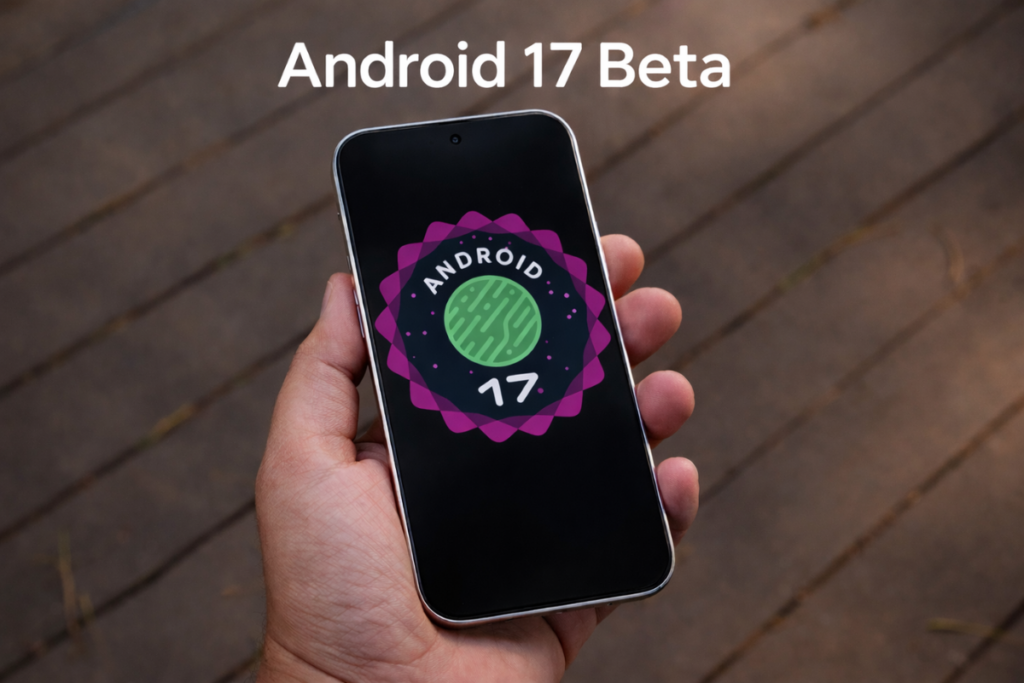
Just three days ago, Google confirmed that Android 17 Beta 1 is coming, and now it’s here. We weren’t expecting the first beta to be released so quickly, but it’s here with improvements to privacy, security, and performance. There are some significant changes as well, which we’ll discuss in the article, along with the eligible devices list and installation steps.
Which devices are eligible for Android 17 beta?
Google Pixels are the first in line to receive the latest beta update, and this year is no different. For now, Android 17 Beta 1 is available for Google Pixels, and it will soon be available on devices from other brands.
So, here’s a list of Google Pixel devices eligible for Android 17 beta:
Pixel 6
Pixel 6 Pro
Pixel 6a
Pixel 7
Pixel 7 Pro
Pixel 7a
Pixel Tablet
Pixel Fold
Pixel 8
Pixel 8 Pro
Pixel 8a
Pixel 9
Pixel 9 Pro
Pixel 9 Pro XL
Pixel 9 Pro Fold
Pixel 9a
Pixel 10
Pixel 10 Pro
Pixel 10 Pro XL
Pixel 10 Pro Fold
In short, if you have a Pixel 6 or older, you can install the Android 17 Beta 1 build and get a taste of the latest features and all the upgrades without waiting months for the stable rollout.
How to install Android 17 Beta 1 on Google Pixels?
If your Google Pixel is running Android 16 QPR3 Beta 2.1 and you haven’t exited the beta program, you should automatically receive the Android 17 Beta 1 update. The update should be available at Settings > System > Software Updates > System Updates. Other users should follow the process as mentioned below.
If you’re not already part of the beta program, visit google.com/android/beta and “Opt in” on your selected device. Make sure you’re logged into the website with the same Google account. After opting in, you should be able to install the latest beta update on your Google Pixel from the Software Updates section in the Settings app.
Before installing any beta update, it’s advised to back up important data to another device or a cloud storage for added safety.
Android 17 Beta 1: What’s new and what’s improved?
The first beta of Android 17 is mostly developer-focused and marks the transition from the traditional “Developer Preview” model to a continuous “Android Canary” program. The Canary channel offers faster access to features and APIs, quicker stability, and eliminates the need for manual flashing.
As for the changes, the first beta enforces stricter requirements for app behaviour on large-screen devices (smallest width ≥ 600dp), preventing apps from opting out of resizability and orientation changes. These changes do not affect smaller devices (sw < 600dp).
Furthermore, apps running on larger screens, such as tablets, foldables, or desktop windowing environments, must now support landscape and portrait layouts and adapt to resizable windows.
Android 17 introduces several low-level changes to improve app efficiency and system health, including a Lock-free MessageQueue to reduce missed frames, Generational Garbage Collection to reduce the CPU cost and duration of full-heap collections, and Strict “Static Final” Fields to allow the runtime to apply more aggressive performance optimizations.
The update also includes important camera upgrades, including Dynamic Camera Sessions to enable seamless transitions between modes, Constant Quality Recording for extended control, and Versatile Video Coding (VVC) on devices with supported hardware.
Additionally, the latest beta build includes an improved audio framework, enhanced VoIP call history (supporting avatars and privacy controls), and Wi-Fi Ranging updates (Proximity Detection and 11az secure ranging). The CompanionDeviceManager now features two new profiles, Medical Devices and Fitness Trackers, for streamlined permission handling and device identification.
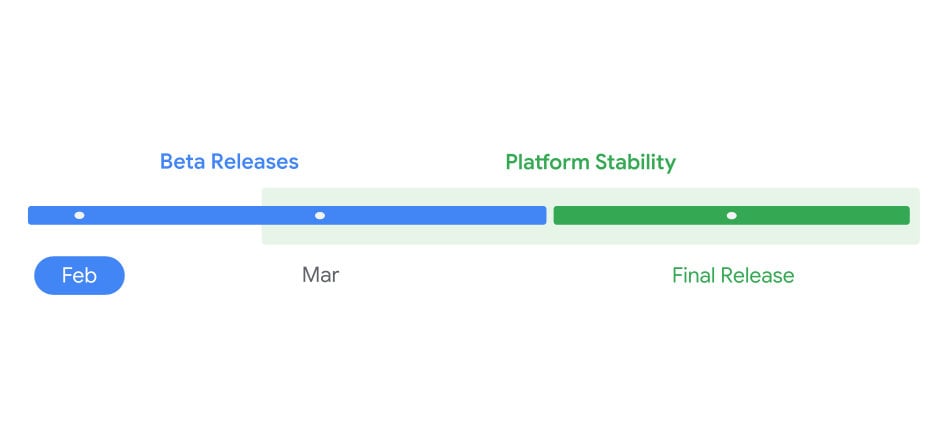
According to the official timeline, the “Platform Stability” phase begins next month. At this point, SDK/NDK APIs and app-facing behaviors will be finalized. The stable release could arrive sometime in Q3 2026.
We’ll continue to update you with fresh developmenets in our Android 17 section. You can visit it regularly for the latest updates. Or, join our Telegram channel to get instant notifications about the latest happenings in tech.
LG has expanded its xboom audio range in partnership with nine-time Grammy winner will.i.am. The company has introduced two new true wireless models, the LG xboom Buds Plus and the LG xboom Buds Lite. These earbuds were initially released in South Korea in September 2025 and are now rolling out more widely. Both models are part of the “xboom by will.i.am” lineup, with will.i.am closely involved in tuning and shaping the sound profile.
According to LG, the earbuds are tuned to deliver balanced warm tones that reflect will.i.am’s sound preferences. The new models were presented at the FYI Visionaries event, where the expanded xboom lineup was showcased.
LG xboom Buds Plus
The Buds Plus are designed as the most advanced model in the lineup. They feature a UVnano+ charging case that uses UV-C light to reduce bacteria on the earbud speaker mesh. Independent testing shows that the UVnano system eliminates 99.9 percent of Escherichia coli, Staphylococcus aureus, and Klebsiella pneumoniae within ten minutes of charging when the case is connected to a power cable. Users can also set the UV function to activate automatically whenever the earbuds are placed inside the case and the lid is closed.
Active Noise Cancellation is supported through a three-microphone system that improves noise detection and reduction. With ANC turned off, the earbuds provide up to 10 hours of continuous playback. The charging case adds up to 20 more hours, bringing total playback to up to 30 hours. Actual battery life depends on usage and settings.
The Buds Plus also support 3D Spatial Audio for a wider soundstage and multi-point connection for switching between devices without disconnecting. Users can adjust sound through customizable EQ settings. The earbuds carry an IPX4 rating under IEC 60529 standards, meaning they are resistant to splashes of water. They should be dried before use and must not be charged while wet. The charging case is not IPX4 rated.
A built-in Bluetooth transmitter allows the Buds Plus to connect wirelessly to devices that have a headphone jack, such as in-flight entertainment systems or treadmills. Compatibility may vary depending on the device.
LG xboom Buds Lite
The Buds Lite focus on portability with a compact and lightweight design. They deliver up to 11.5 hours of continuous playback from the earbuds. With the charging case, total playback reaches up to 35 hours when ANC is turned off. Actual performance varies based on usage.
The Buds Lite use a single microphone to monitor ambient noise, which results in a different ANC experience compared to the three-microphone system on the Buds and Buds Plus. They also include customizable EQ settings and carry an IPX4 water resistance rating for protection against splashes.
The LG xboom Buds Plus are priced at $179.99 and are available now on LG.com and through LG authorized retailers across the United States. The LG xboom Buds Lite are priced at $69.99 and are also available online and at authorized retailers nationwide.
Sharge, a brand known for bold power solutions and eye-catching tech accessories, has just announced a new power bank that brings impressive specs packed in a futuristic design. The Shargeek 300 Power Bank just debuted as a next-gen portable charger that pairs serious output with a transparent body. So here are all the details.
Shargeek 300 Power Bank Specifications
Under the hood, the Shargeek 300 packs a massive 24,000mAh capacity, which sits right at the upper limit for airline-safe power banks. That kind of muscle means it can keep smartphones, tablets, laptops and more powered up without needing a wall socket for a long stretch, making it ideal for travel, work setups, and outdoor use. Sharge’s new power bank doesn’t just store a lot of juice, it moves it fast too. The unit delivers a combined maximum output of 300W, which is spread across two USB-C ports, a USB-A port, and a DC output.
Shargeek 300 Power Bank
Each of the USB-C ports can push up to 140W, which is enough to charge some power-hungry laptops as well. Meanwhile, the DC output can be tuned between 25W and 140W for flexible use with gear like monitors, routers, or even small home electronics. A standout feature is the Shargeek 300’s semi-transparent body and RGB accent lighting, giving it a look more aligned with futuristic hardware than traditional power banks.
This also gives you aglimpse into the internal components and a built-in smart display that shows key data like remaining battery capacity, input/output wattage, and temperature. You also get support for up to 140W fast charging for fast top-ups. The Shargeek 300 has just launched on Kickstarter, with early-bird pricing starting at about $149. After the initial discount, the estimated backing price during the crowdfunding period is around $159 before its expected delivery around May 2026.
For more daily updates, please visit our News Section.
OnePlus has commenced the global rollout of OxygenOS 16 (based on Android 16) for the OnePlus Pad Lite, beginning with Indian users. The update (versions OPD2481_16.0.3.500 and OPD2480_16.0.3.500) introduces substantial performance improvements and AI-powered features across the operating system.
OnePlus Pad Lite
Performance Updates
The Trinity Engine optimizes workload distribution in real-time, improving storage read/write operations and RAM compression. Background resource management has been updated to reduce power drain during intensive tasks, and power-saving modes now adjust performance based on battery levels. Apps launch faster from the home screen, with improved scrolling and touch responsiveness.
Parallel processing updates include animations for text selection magnifiers, status bar transitions, and audio playback controls. Swipe-back gestures now show previews of previous pages with motion tracking, and the Luminous Rendering Engine adds light field motion effects.
AI Features
The Photos app has updated navigation with clearer categories and personalized sorting. Video editing now includes splitting, merging, speed adjustment, transitions, and background music. Users can swipe up to view photo details.
Notes include block editing mode for formatting and repositioning text, images, tables, and documents. Text highlighting, font switching, and quick formatting access via “/” command are now available. Notes can be shared as single links containing all media types.
Interface Changes
The Flux Home screen uses light field styling for icons and has optimized grid layouts and customizable folder configurations. Users can remove icon labels, add more dock apps, and access drawer organization with category sorting and app suggestions.
Lock screen customization includes custom text and configurable corner shortcuts. Flux themes adjust icon styles to match wallpaper colors, with dark mode options available.
Connectivity and Additional Changes
OnePlus Connect groups device settings by type. My Devices appears in Quick Settings and home screen widgets for device management. AI LinkBoost updates kernel scheduling for app connectivity.
Other changes include earbuds-only ringtones, redesigned Smart Sidebar, faster iOS data migration, and updated notification management with Quick Settings customization.
WhatsApp has pushed a new beta update for Android, version 2.26.6.9, through the Google Play Beta Program. This update doesn’t have big changes yet, but it looks at a new feature that will make it easier to see status updates.
The new feature under testing is showing status updates in the top app bar. Right now, if you want to see who posted a status, you have to tap the profile icon or scroll through all your chats.
With this new feature, status updates from people you chat with most will appear at the top of the screen in the Chats tab. This makes it quicker to see updates without leaving your chat list.
Image via WABetaInfo
In addition to the top bar, scrolling down in the Chats tab will show a row of all contacts’ status updates. You can scroll horizontally to view them, just like in the old Status tab. Any contacts you have hidden will not appear here.
The feature is currently under development, so WhatsApp may make changes before it’s officially released. At the moment, this feature is only available in the WhatsApp beta for Android 2.26.6.9. Regular users will not see it yet.
Once testing is done, WhatsApp plans to gradually roll out the feature to all users. This will allow people to quickly check status updates right from the Chats tab without extra steps.
If you’ve been waiting to upgrade your smartphone, Amazon has a deal you don’t want to miss. The SamsungGalaxy S25 Ultra is now available at a special discounted price, but for a limited time.
The 256GB variant of the Galaxy S25 Ultra, in the stylish Titanium Silverblue color, is originally priced at $1299.99. Right now, you can grab it for just $1045. That’s a big saving on one of Samsung’s most advanced smartphones.
This offer is exclusive to the Titanium Silverblue 256GB variant, so it’s perfect for anyone who wants huge storage for apps, photos, videos, and more.
Samsung Galaxy S25 Ultra is a powerful phone. It has a powerful Snapdragon processor for fast performance, a high-quality camera for clear photos and videos, and a bright, colorful screen. Its Titanium Silverblue color looks stylish and modern.
This is a good chance to get a premium phone at a lower price. You can get this phone on Amazon. Don’t wait too long, because this offer may not last. Grab your Samsung Galaxy S25 Ultra 256GB Titanium Silverblue today and enjoy a top-quality phone at a great price.
Scientists found a candidate planet that is similar to Earth. This candidate planet is possibly rocky like Earth, and it likely takes about one year to complete a revolution around its star. But unlike Earth, the candidate planet is freezing cold — no higher than 90° Fahrenheit.
Garmin system software 13.25 is rolling out to users of some of the brand’s smartwatches. This update fixes a problem with the recently added Smart Wake Alarm feature. Plus, this update for the Instinct 3, Instinct E and Instinct Crossover wearables brings an update for translations.
This week we found some huge discounts on foldable phones that go up to $500 off. Don’t worry, though, there are plenty of bar phones to go around if you are not a fan of foldables.
The Google Pixel 10 Pro Fold is $300 off at the moment, which makes it cheaper than the Samsung foldable at equal storage levels. The Pixel is down on performance (Tensor G5 vs. Snapdragon 8 Elite), but it does have more RAM than most Z Fold7 configurations (only the 1TB model has 16GB of RAM).
The main 48MP camera on the Pixel 10 Pro Fold has a disappointingly small 1/2.0” sensor, which looks insufficient...
Samsung became the top smartphone brand in Southeast Asia again in 2025, according to new data from Omdia. This happened even though the overall market was slightly weaker than last year.
In total, 100 million smartphones were shipped in Southeast Asia in 2025. This was 1% lower than in 2024. Sales were slow in the first three quarters of the year. But in the last three months, the market improved. Shipments in the fourth quarter rose 2% compared with the same period last year. This helped Samsung finish the year strongly.
Samsung shipped 17.9 million phones in 2025. This was 5% more than the year before. The company captured 18% of the market, which makes it number one in the region. While some other brands saw their sales fall, Samsung was able to grow.
In the fourth quarter, Samsung also did very well. It shipped 4.2 million phones during that period, up 19% year-on-year. This gave it a 17% market share for the quarter.
Image via Omdia
One main reason for Samsung’s success was its Galaxy A17 series. These phones offer better features than the earlier Galaxy A16 models but are still affordable. In Southeast Asia, most smartphones sold cost less than US $200.Because of this, strong low-cost models are very important.
Looking ahead to 2026, Samsung may face higher production costs. Prices for memory and storage parts are rising. Even so, Samsung’s strong product updates and good performance in late 2025 show it is in a good position to stay on top.
Deal | Ocean's Heart is a 2D RPG in which you embody Tilia, who seeks her father in a world with multiple environments. Face numerous enemies, gather resources, and unravel all the mysteries of this world to discover the truth.
Garmin system software 13.25 is rolling out to users of some of the brand’s smartwatches. This update fixes a problem with the recently added Smart Wake Alarm feature. Plus, this update for the Instinct 3, Instinct E and Instinct Crossover wearables brings an update for translations.
Casio has released the new LTP1234PDC-7B watch at its online store in the US. This is an analog watch with a simple design and a stainless steel casing. It is also water resistant to 200 m and has an estimated battery life of three years.
Samsung is reportedly working on a wide Galaxy Z Fold, and last year, some speculative renders showed us what this foldable smartphone could look like. However, thanks to One UI 9, we are now getting our best look yet at the wide Galaxy Z Fold.
One UI 9 test builds for Samsung's unannounced Galaxy Z Fold8 and Galaxy Z Flip8 recently popped up, and those included a couple of animations, giving us our first sort of official look at the wide Galaxy Z Fold.
These animations don't reveal much, but their presence in the One UI 9 builds confirms that Samsung is working on a wide Galaxy Z...
Deal | The Ryzen 7 9850X3D was launched a few weeks ago, on January 29, and Newegg is already offering a big discount on it. While it normally costs $499, Newegg has knocked $100 off.
PS5 owners may want to free up storage space before the Resident Evil Requiem pre-load goes live. Capcom’s survival horror title will require a larger install than any previous Resident Evil game. A generous campaign length and upgraded graphics could explain the hefty file size.
More than six months prior to the purported iPhone 18 Pro launch this September, it already seems fairly clear how the iPhone 18 Pro generation will differ from the current iPhone 17 Pro and iPhone 17 Pro Max flagship models. An analyst has now summarized the expected changes and upgrades.
Different companies have already increased the prices of their products due to the ongoing memory crisis, and it seems like Acer is the next one to raise prices.
Samsung has confirmed that the Galaxy S26 series will launch on 25 February 2026. Ahead of the official release, the company has shared a new teaser video revealing an interesting feature – Privacy Display.
In the teaser, Samsung shows how the new Privacy Display feature works. The Galaxy S26 series will include a special zero peeking mode. This means that when the feature is turned on, people sitting beside you will not be able to see what is on your phone screen.
The privacy display hides some of the pixels through a collaboration between the hardware and software. With a hidden side view, only the front user can view the on-screen content.
Image via Samsung Mobile US (X)
The Privacy Display feature works through a combination of hardware and software. It hides certain pixels on the screen in a smart way. When you look at the phone directly from the front, you can clearly see everything on the screen. However, if someone tries to look at your phone from the side, the screen appears dark or black. This helps protect your personal information in public places.
The teaser video shows three people sitting next to each other in a public place. The person in the middle is using her Galaxy S26 phone, while the two people sitting beside her can easily see her screen. She then turns on the Privacy Display feature.
For your eyes only. Get ready for the next level of privacy. Can your phone do that? #GalaxyAI
Once it is activated, the side view of the screen becomes dark. The two people next to her can no longer see what is displayed. From their angle, the screen looks completely black, while the main user can still see everything clearly from the front.
Can your phone do that? No, as Samsung is going to release the Privacy Display feature with the Galaxy S26 series in February 2026. You can reserve for the Galaxy Unpacked 2026 now. Stay tuned.
Samsung is getting ready to launch the Galaxy Buds 4 and Galaxy Buds 4 Pro soon. We have already seen many leaks and rumors about these upcoming earbuds. Now, a new detail about the Samsung Galaxy Buds 4 Pro has appeared online.
According to the tipster, @TarunVats, the Samsung Galaxy Buds 4 Pro has been spotted inside the Tips section of Samsung phones. This new information shows that Samsung may make it easier for users to manage their earbuds.
Samsung’s Tips section suggests that users will be able to control their Galaxy Buds directly from the phone’s main Settings app. This means you may not need to open the Galaxy Wearable app every time you want to change something. Instead, important controls could be available right inside the phone’s settings.
Image via Tarunvats
This would make things much simpler and faster. Right now, if you want to change features like sound settings, touch controls, or noise cancellation, you usually have to open the Galaxy Wearable app. With One UI 8.5, those options could appear automatically in the Settings menu when the earbuds are connected.
The Tips section also explains that Galaxy Buds settings will only show up when the earbuds are connected to the phone. There will also be a “Go to Settings” option in the Tips section, which makes it easy to find the right page quickly.
Samsung has not officially confirmed these details yet. However, this leak suggests that the Galaxy Buds 4 Pro could offer a smoother and more user-friendly experience. We can expect more information to come out as the official launch gets closer. Stay tuned.
Deal | Humble Bundle has introduced a new bundle — Call of the Wild 9th Anniversary. This new bundle is packed with DLCs and expansions, with only a few games contained in it.
This new rugged smartphone comes with advanced features and 5G connectivity. The Blackview Rock 2 Pro should also be resistant to dust and water, and it runs on Android 16.
Casio has teamed up with streetwear brand Anti Social Social Club to create another G-Shock collaboration watch. This DW-6900 series model has a transparent bezel and strap, featuring a popular design. Plus, the digital watch offers a multifunctional alarm, a precise stopwatch and 200 m water resistance.
Reanimal is a new horror adventure game from the developers of the well-acclaimed Little Nightmares series. It launched on Steam on February 13, 2026, and within 24 hours, it reached a peak concurrent player count of over 24,000.
Smalth has launched the Titanium Pro in the global market with a slimmer 7.6 mm design, ECG monitoring, and up to 12 days of battery life in light use. The smart ring offers a titanium shell, SpO2 and heart monitoring, and app-based controls. Plus, it carries a 10 ATM water resistance rating.
Samsung has released a new update for its LockStar Good Lock module, which helps users customize their phone’s lock screen. The new update comes with version 8.5.00.10.It does not bring big changes, but it adds a few small improvements that make the app better and easier to use.
The fresh update brings improvements to provide a better Galaxy experience. Samsung has adjusted the manual brightness range for full-screen Always On Display. This means users now have better control over how bright or dim the screen looks when AOD is on.
You can increase brightness if the screen looks too dark during the day. You can also lower it at night to make it comfortable for your eyes and save battery.
Image via SammyFans
Moreover, the update adds a new “Swirl” unlock animation.This is a new animation style that appears when you unlock your phone. It gives a smooth and stylish effect when moving from the lock screen to the home screen. It’s a simple but fun way to make your phone feel different.
Samsung has also improved the status bar visibility in the unlock animation edit screen.Now, icons like battery level and network signal are easier to see while editing animations.
LockStar lets users change how their lock screen looks. You can move the clock, adjust notifications, and choose different unlock effects. It gives more freedom to personalize your Galaxy phone. You can download the update via Galaxy Store or directly from the Good Lock app.
Deal | Humble has launched another solid bundle. This one is called Overwhelmingly Positive, and it focuses on quality rather than quantity. It offers eight games in total, and you can take them home for just $15.
Google is set to unveil the Pixel 10a on February 18, and it has already shown us the phone's design. Not that we didn't know what the Pixel 10a would look like, but it's still good to have an official confirmation ahead of its unveiling. What Google hasn't revealed, though, is the Pixel 10a's specs sheet. While rumors claimed the Pixel 10a would just be a Pixel 9a in different colors, a new leak suggests that won't be the case entirely.
German blog WinFuture claims to have retailer data that reveals the Google Pixel 10a will be almost identical to the Pixel 9a, with the Pixel 10a's...
The Viewsonic VX27G26-2K-3 is a new gaming monitor that has been introduced in China. It's a 27-inch Fast IPS gaming monitor with a 360Hz refresh rate and QHD resolution. Launch and pricing details are yet to officially emerge.
After launching several controllers with an Xbox layout, GameSir is ready to release one with a PlayStation layout. The manufacturer says the new controller will launch under the Tarantula series.
Unihertz has revealed more details about its BlackBerry lookalike. An alternative to the Clicks Communicator, the Titan 2 Elite features two rear-facing cameras and will be available in a striking finish unlike many modern smartphones.
Samsung Galaxy S26 lineup’s pricing doesn’t seem favorable this year. The devices adopting the camera bump in a major design overhaul, getting Privacy Display and next-gen application processors this year.
Why Samsung Galaxy S26 pricing isn’t favorable
Galaxy S26 family is tipped to launch roughly 100,000 won (about $70) higher than the S25 lineup. This move pushes the base model north of 1.2 million won (around $835), with the Ultra hitting up to 2.2 million won (about $1,525).
Camera, which was the most anticipated segment, remains boring. The cameras used in the Galaxy S26 and S26+ are just a replica of what was used in the S25 and S25+. The S26 Ultra has a smaller telephoto zoom camera.
Counterpoint Research expects memory prices to jump 80 to 90 percent in the first quarter alone versus the previous quarter. That’s not background noise, but a shockwave through the Bill of Materials, or BoM.
TSMC has increased the costs of chip manufacturing, directly affecting Qualcomm and ultimately Samsung. Rising costs of DRAM and NAND flash memory chips played a crucial role in spiking the bill of materials cost this year.
BoM costs for smartphones already climbed 10 to 25 percent from early last year to year-end, with another 10 to 15 percent increase expected by Q2. Global smartphone average selling prices are projected to rise just 6.9 percent this year.
Next Galaxies to go pricier
Memory shortages are expected to persist into next year. After the Galaxy S26, Samsung must fast-track the launch of the Galaxy Z8 foldables, the Galaxy A57, and the Galaxy S26 FE, a Fan Edition version of the Galaxy S26 lineup.
The MX Division can absorb some cost at the top end, where Ultra buyers are already conditioned to premium pricing. The situation is difficult: raise prices too aggressively and volume drops, hold prices steady and margins erode.
Samsung is both supplier and victim of the same supply shock.
Google released the Beta 1 update of Android 17 and disclosed the development roadmap. Skipping the Developer Preview, the new mobile OS has entered the Beta Program ahead of its final release in the second quarter of the year.
This year, the Android Canary Program has replaced Developer Preview. This move is aimed at assisting developers and OEMs with the latest changes to the OS. Pixel users are eligible to upgrade to the new operating system.
Android 17 Beta
Google launched the Android 17 Beta 1 rollout on February 13. As per the roadmap, Google plans to bring the Android 17 Beta 2 update in March 2026. April may see the rollout of Beta 3, as the final release isn’t happening anytime soon.
What to expect:
Beta 1 – February 13, 2026 (Released)
Beta 2 – March week 2 (most likely)
Beta 3 – April 2026 (likely)
Beta 4 – May 2026 (may or may not arrive)
It’s expected that the OS would hit the “Platform Stability” milestone with the third Beta update. It means the software will stop significant internal changes. That’s where optimization will kick off at a larger scale by OEMs.
Image – Android 17
Android 17 Final release
Google wouldn’t jump early to the final release from the Beta Program. February marked the first Beta, with at least three more to be provided. The official upgrade would arrive sometime in June 2026, just like the previous year.
Android 16 landed on Pixel phones around the world in early June. It was a little later than the anticipated timeline, though not too late. Android 17 would follow the suite and arrive in the early days of June this year.
Android 17 will first arrive on Pixel phones. Samsung would have been playing a crucial role in the development and testing of the new OS. Note that Samsung will be the first brand to launch devices with Android 17 preinstalled.
Image – Development cycle of Android 17 operating system
Deal | Amazon Luna is giving away 10 free games throughout February 2026, and in the first round, two became available to Prime members. Now, two more have unlocked: Hexguardian and Around the World: Travel to Brazil Collector's Edition.
Researchers in China have developed a fully photonic processor capable of running large-scale AI models at speeds and efficiencies orders of magnitude beyond traditional silicon hardware.
A few days ago, Google said it would soon release the first Android 17 beta, and it did, but it was also quick to halt the release without any explanation. Well, the good news is that Google has resumed releasing Android 17 Beta 1, and it's now available for Pixel devices.
Google says this build continues its work for more adaptable Android apps and brings significant enhancements to camera and media capabilities. Additionally, the Android 17 build includes expanded profiles for companion devices and new tools to optimize connectivity.
Google has also replaced Developer Previews...
Samsung Galaxy S26 series will be equipped with Exynos and Snapdragon processors, with the former beating the latter in a key aspect: ray-tracing-based GPU benchmark.
The South Korean tech giant is set to launch its new flagships on February 25. The new devices will be available for purchase starting March 11. European users may have one less reason to complain about the Exynos adoption this year.
Early benchmarks suggest Exynos-powered Galaxy S26 phones are no longer behind their Snapdragon counterparts. The CPU performance gap has narrowed significantly, and the GPU is surpassing the benchmark.
“In Vitro” benchmark of Basemark revealed Galaxy S26’s ray-tracing-based stats. The device has scored 8,262 points, 10 percent higher than the Snapdragon 8 Elite Gen 5-powered Android flagship phones.
Source – Powerboard Basemark
Exynos 2600 features Xclipse 960 GPU, which is based on AMD’s RDNA 4 architecture. GPU alone isn’t the engine behind this impressive performance. It’s backed by two key hardware-level technologies, including:
Heat Path Block packaging tech ensures better heat dissipation on the chipset. Qualcomm seems interested in this solution and future Snapdragon chips, even if manufactured at TSMC, would also feature HPB packaging tech.
Galaxy S26 series is unveiling on February 25 in California. Reservations are already live, offering up to $900 savings upon trade-in plus a $30 free credit. You also automatically enter a giveaway of $5000 in the United States.
Samsung may keep Galaxy S26 prices unchanged in the US. Meanwhile, Koreans could be facing total heat of DRAM and NAND flash cost burden. Reports suggest a $70 increase in base prices, going up to $120 for Ultra.
The LG Xboom Buds Lite and Buds Plus earbuds, tuned by musician will.i.am., are now available for purchase. The earbuds use graphene-coated drivers and come with adaptive EQ for optimal sound quality. The Plus case can be used as a Bluetooth transmitter.
The global version of Honor's Magic7 Pro is finally being blessed with an update to MagicOS 10, the company's skin based on Android 16. Sure, it comes eight months after Google released Android 16, but better late than never, right?
[#InlinePriceWidget,13480,1#]
The update is MagicOS 10.0.0.121, and it arrives over-the-air as a 3.27GB download, so it's best grabbed over a fast enough network. You of course also need to make sure you have plenty of free space for it to download, extract, and install.
The rollout is most likely happening in batches, as is always the case, so if you...
The Acemagic N3A is a mini PC and NAS hybrid that has been newly presented. It features an old AMD processor that can smoothly handle day-to-day tasks, and the system has four SATA drive bays and two M.2 SSD slots.
The Acemagic Retro X5, which was introduced earlier in February 2026, has been launched in China. This AMD Strix Point mini PC features the Ryzen AI 9 HX 370 and a NES-inspired design. The launch starting price is CNY 6,499, around $941.
Beatbot has expanded its lineup with the Sora 70, a versatile robot designed to clean floors, walls, and water surfaces in a single cycle. Featuring a 10,000 mAh battery and smart obstacle avoidance, the device is available now in North America for $1,499.
July 2026 is the timeframe Samsung Health users need to circle. If you import Galaxy phones, especially US models used outside the country, this one could hit hard.
Until now, Samsung Health decided your service region based on the country assigned to your device at the time of purchase. It looked at the phone’s original market; a US Galaxy stayed “US” in Samsung Health, even if you used it in India or Europe.
With the in-app notice issued earlier this week, Samsung has confirmed that starting around July 2026, the Samsung Health app will change how it determines your “Service Country.”
From July 2026 onward, Samsung Health will determine your Service Country based on your Samsung Account country, not your device’s original market. Samsung is moving from hardware-based tracking to account-based tracking.
Because many users mix and match. They buy a US Galaxy model for Snapdragon, bring it to another country, and log in with a local Samsung account.
So far, that setup has worked fine for most features. But once Samsung Health switches to account-based region detection, your features will follow your account’s country.
ECG and Blood Pressure could be restricted
Samsung Health and Samsung Health Monitor features like ECG and Blood Pressure are regulated differently in each country. Samsung states that if your Service Country changes after the update, some features may be restricted.
If your Samsung Account is set to a country where ECG or Blood Pressure is not approved, those features could disappear. If you are using an imported Watch with ECG enabled through a compatible region, this is where you need to pay attention.
The good news is you can check your account region right now.
On your Galaxy phone:
Open Settings
Tap your Samsung Account at the top
Go to Profile Information
Look for Country and Region
That is the country Samsung Health will use starting July 2026.
Android 17 has embarked on its journey, with official release slated in the next quarter. Samsung, on the other hand, began internal Android 17 Beta testing, which will arrive on Galaxy devices with the One UI 9 update.
Android 17
If you own a Pixel phone, Android 17 is available for download today. You need to install the first Beta build through official steps. The next Beta is scheduled to be pushed in March 2026, followed by the final release in Q2.
Since the Android Canary Program is underway, Google may have already trimmed down the number of Beta updates. Beta rollouts may not just be capped at two releases; we might see even more builds through stability.
Beta 1 was released on February 13.
Beta 2 is expected in March 2026.
Final release is scheduled for the April-June period
Image – Development cycle of Android 17 operating system
Last year, Google released stable Android 16 to Pixel phones on June 10. The update came within the given timeline of the second quarter. Things remain unchanged this year, and we should expect the full rollout this June.
One UI 9
Samsung will offer Android 17 update with One UI 9 on Galaxy devices. It will be built on the Android framework, but the user interface will have signature Galaxy aesthetics.
Hours before Google released Android 17, Samsung uploaded early One UI 9 builds based on the new OS for its upcoming foldable phones, including the Galaxy Z Fold 8, Flip 8, and Wide Fold.
The company went beyond by leaking the One UI 9 for the Galaxy Z Fold 7. We may soon see the build getting spotted for the Galaxy Z Flip 7, one of the primary contenders for the Beta Program.
One UI 8 Beta, based on Android 16, was announced on May 28, 2025. Samsung later expanded the Beta Program beyond the Galaxy S25 series to the S24 series as well as Z Fold 6 and Z Flip 6.
With internal tests progressing quickly, Samsung may bring One UI 9 Beta early. Galaxy S26 series is expected to spend merely two or three months on One UI 8.5, as Beta could go live in May 2026.
Concordia researchers have unveiled "proximal sound printing," a 10× more precise acoustic 3D-printing technique that could revolutionize medical sensors and soft robotics.
GF Securities analyst Jeff Pu has come out with a new research note, and in it he's outlined five upgrades coming to the iPhone 18 Pro and iPhone 18 Pro Max later this year.
First, the Dynamic Island will be smaller, since the flood illuminator used for Face ID will be moved under the display. Next, the 48MP main camera will come with variable aperture.
iPhone 18 Pro rumored colors
Pu also details three chips coming to the Pro series. The A20 Pro will be powering the devices, and it will be made using TSMC's first-gen 2nm process and a new packaging design. The N2 chip will be the...
Samsung is working on the Galaxy A27 5G smartphone. Last year, the company launched Galaxy A26 alongside the Galaxy A36 and A56. 2026 felt different until the first sign of the A27 emerged on the internet.
Galaxy A27 5G is under development and Samsung would bring it to the US and the Global market. In a recent development, the device was spotted (via Erencan Yılmaz) with model numbers SM-A276B/DS and SM-A276U.
The B suffix is the Global model, while U refers to the US version. It seems the Global version retains support for dual physical SIMs. It’s a 5G-supported handset, while the listing doesn’t detail band-related information.
The phone will succeed the Galaxy A26 5G, which Samsung unveiled in 2025. Like other models, the Galaxy A27 will also feature a camera island on the back. It remains to be seen whether the U-shape notch stays or goes.
Galaxy A26 5G was launched in March 2025.
It measures 7.7mm thick and weighs 200 grams, while boasting a 5000mAh battery. It features a 6.7-inch Super AMOLED screen with 1a 20Hz refresh rate. Under the hood, the device gets Exynos 1380 in Global and Exynos 1280 in Latin America.
Source – Erencan Yılmaz (@erenylmaz075/X)
Rumors claimed Samsung could launch the Galaxy A37 and A57 in late January or early March. We have noticed related developments as well. However, there seems to be a change in strategy with a focus on flagships.
Galaxy A27 may also be a reason behind the delay in the sales of the other two. Samsung may launch three Galaxy A phones in one go. The devices could go on sale in April, as March should be centered at Galaxy S26 series.
Samsung is heading into the Galaxy S26 cycle with an uncomfortable whisper in the background: lack of interest. The company is reportedly targeting 34 million units across the lineup, which seems difficult to achieve.
Galaxy S26 is facing a lack of interest
That phrase, attributed to tipster @SPYGO19726, is not something you hear often about Samsung. Supply chain inputs (via wccftech) point to a softer pre-order cadence and even canceled reservations in key channels.
Samsung announced the launch date for the Galaxy S26 earlier this week. The Unpacked is set to take place on February 25 in San Francisco. The official sale is expected to begin on March 11 in various parts of the world.
The Korean tech giant is banking on its Privacy Display, branded internally as Flex Magic Pixel, to carry the conversation. The tech promises improved viewing angle control, something fans may appreciate on a wide scale.
Whether that translates into mass market excitement is another matter.
Qi2 magnets are missing, and that absence stings more than Samsung likely expected. Accessory ecosystems are sticky, and consumers notice when their premium phone lacks a standard that competitors are embracing.
A reported 99,000 won increase pushes the starting tag to around 1,254,000 won. DRAM and NAND flash costs are climbing, and margin pressure is real. Still, asking consumers to pay more for what looks familiar is a sheer gamble.
In a cycle defined by bold moves from rivals, Samsung’s biggest risk may not be technical weakness. It is the creeping sense that the giant is playing it safe when the market wants surprise.
A new leak allegedly reveals a Galaxy S26 Plus test device in live images. The phone is shown in its Black colorway, giving us another look at the upcoming handset.
The Galaxy S26 Plus, as shown in live images, is a functional unit that keeps the identifier on the back panel. The smartphone’s back has a device identifier ID printed, one at the upper side, second at the bottom side.
The device has symmetrical bezels that are pretty thin. This isn’t a spec upgraded this year, but borrowed from the Galaxy S25 series. The cutout for the selfie camera seems slightly larger than the previous Galaxy flagships.
On the back, there is a prominent camera bump, which incorporates three sensors, including ultrawide, main, and telephoto. Next to the camera island is an LED flashlight, which doubles down as a torch when required.
Samsung is also departing from the Saturn camera ring design. The Galaxy S26 series returns to the rings made of metal that look sharp yet smooth. Camera durability has also enhanced, thanks to the adoption of camera island.
Source – @Kakooli98/X
The live images may be an early test unit or may be fake. The official reveal is just a few days away, but it’s no brainer seeing these pictures. A total of four shots were leaked, and you can have a look at the two others here (@Kakooli98/X).
Samsung is set to launch the Galaxy S26 series on February 26. The company has also started accepting reservations for the next Galaxy. You can score a free $30 Samsung Credit and up to $900 in trade-in savings.
A new Poco smartphone, the C81 Pro, is on the way. This was revealed because it was just certified for sale in Thailand by NBTC. It has the model number 25128PC17G, and the certification confirms that it's going to lack 5G support. That and the fact that it's a member of Poco's entry-level C-series means we should expect a low-end device.
It was also certified in January by SDPPI in Indonesia, but at the time it was identified as the Poco C81. In the meantime, it seems to have gained the Pro suffix - this is the same device. It's also expected to be sold in some markets as the Redmi A7...
MagMod wants to make photographers’ lives easier with "revolutionary" light stands. The new MagStand is supposed to be particularly stable and easy to use thanks to an innovative design, but this new construction also makes the MagStand comparatively heavy.
A new update from a Capcom insider would be welcome news for horror fans. Dusk Golem anticipates the publisher prioritizing Resident Evil Requiem DLC, potentially featuring Alyssa Ashcroft. The Resident Evil 10 release date could also be on a fast track, with 2029 as a possibility.
The tech industry may be heading toward a new supply chain problem. Specifically, the back-end production of processor chips could run into capacity limits because of a product that most consumers have probably never heard of.
A new campaign has launched over on Kickstarter to bring the benefits of daily activity to the perpetually stationary. Known as the ARCH, this wearable uses an array of mini actuators to force blood-pumping action.
Huawei launched the FreeBuds Pro 5 in China in late November, and now the company is almost ready to offer them globally. Huawei is currently teasing the international launch of the earbuds, which is taking place on February 26.
The teaser video you can see below was posted to Huawei's official Instagram account. At the end of the video the February 26 unveiling date is clearly listed.
The event is taking place in Madrid, Spain, the week before MWC takes place in Barcelona, which is definitely an interesting choice of location and timing. At the same event, the company...
Casio has added a sleek new model to its classic digital lineup in the United States, blending retro styling with everyday features and a genuine leather strap for a more refined look. It is the Casio Vintage LA680WEL-1, which was previously announced in Japan.
Casio’s Vintage Digital Watch Goes Global
The Casio Vintage LA680WEL-1 US release follows its recent debut in Japan and brings a vintage-inspired design to a fresh generation of watch buyers. This model pairs a streamlined digital face with a silver-colored chrome-plated resin bezel and a black genuine leather band that has an embossed pattern for added character. The design nods to Casio’s heritage while giving it a slightly more upscale finish suitable for everyday wear.
Casio Vintage LA680WEL-1 Watch Launch with Leather Straps
The watch measures just 15 grams, making it a compact and lightweight wearable piece. So it’s perfect for wrists that find many modern smartwatches too bulky. Under the polished exterior, Casio hasn’t skimped on useful features. The LA680WEL-1 includes a digital display offering 12/24-hour time formats, an automatic calendar to stay accurate, a daily alarm, 1/100th second stopwatch, an amber LED backlight, and water resistance.
What makes this release stand out from other Casio digital classics is its genuine leather strap. It is a notable departure from the usual resin or metal bands for many digital models. That leather band gives the LA680WEL-1 a slightly dressier edge, making it easier to wear with both casual and business outfits. This contrasts with Casio’s longstanding tradition of resin-strapped digital watches, but fans of retro designs with a modern twist should appreciate the aesthetic here. Casio has listed the Vintage digital watch at its official US online store for 54.95 US Dollars.
For more daily updates, please visit our News Section.
Xiaomi‘s latest flagship smartwatch could finally be getting a release outside of China. A fresh leak has suggested that the Xiaomi Watch 5 is rolling out in the global market. The wearable first debuted in the brand’s home market back in December 2025, so here’s what we know about its wider launch.
Xiaomi Watch 5 Global Launch
After the initial announcement alongside the Xiaomi 17 Ultra, recent leaks suggest that the premium smartwatch could launch beyond its home market with premium specs, robust health tracking, and Google Play support. Unlike the China-only version that currently runs Xiaomi’s local software layer and HyperOS integration, the global Watch 5 is tipped to switch to WearOS. This would mark Xiaomi’s return to a broader smartwatch ecosystem with direct access to Google’s app store, Tiles, assistants and more.
Xiaomi Watch 5
In other words, the smartwatch would likely compete directly with the likes of the Google Pixel Watch and Samsung Galaxy Watch series that also run on WearOS. Early details from European price leaks point to the Watch 5 being listed in Czechia for around 7,990 CZK (roughly 390 US Dollars). The earlier listing also reveals the smartwatch in two color options, Black and Juniper Green. This is for the 47mm case, and hints at an imminent launch.
While specs for the global model are expected to mirror what’s already on offer in China, here’s what buyers are likely to get:
1.54-inch AMOLED display
Dual-chip architecture with Snapdragon W5
Advanced health sensors (ECG, SpO2, and more)
Stainless steel body
5ATM water resistance
Battery life details suggest multi-day endurance, offering around six days in smart mode and over 18 days in the power saving mode.
For more daily updates, please visit our News Section.
Hisense has released its M7 Mini-LED TV series in the United States, targeting budget-conscious buyers seeking premium display technology. The lineup includes 50-inch, 55-inch, and 65-inch models, with the smaller two sizes already available at Walmart for $278 and $298, respectively.
The M7 Series delivers 4K UHD resolution at 3,840 × 2,160 pixels with a 60Hz refresh rate. Mini-LED backlighting enhances contrast by producing deeper blacks and brighter highlights than traditional LED displays. Hisense’s Hi-QLED Color technology aims to improve color accuracy and maintain visibility in well-lit environments.
The TV supports Dolby Vision, HDR10+, and HLG formats. An AI-powered 4K upscaler analyzes textures and edges in lower-resolution content to reconstruct detail for improved sharpness. AI Smooth Motion reduces blur in fast-moving scenes, which can benefit sports and action content.
For gaming, the M7 includes Game Mode Plus with Variable Refresh Rate and Auto Low Latency Mode on the 60Hz panel. These features are designed to reduce input lag and screen tearing. A built-in Game Bar provides access to real-time performance settings.
The M7 runs Google TV, providing access to major streaming platforms including Netflix, YouTube, and Disney+. Google Assistant enables voice control, while Google Cast supports wireless screen mirroring from compatible devices.
Connectivity options include Wi-Fi, Bluetooth, and multiple physical ports: four HDMI 2.0 inputs, USB 2.0 Type-A, Ethernet, optical audio output, cable/antenna input, and a 3.5mm AV composite jack.
For more daily updates, please visit our News Section.
Xiaomi is preparing to launch the new TV S Mini LED 2026 lineup globally soon, bringing its next generation Mini LED TV to markets outside of China. The new smart TV is set to debut with ultra high resolution, Google TV support, and much more. So here’s what we know.
Xiaomi TV S Mini LED 2026 Global Launch
The upcoming 2026 TV S Mini LED was just spotted on the Chinese tech giant’s international website. Xiaomi’s new series spans a wide range of screen sizes and packs smart TV features/ The 2026 TV S Mini LED family will be available in multiple screen sizes, namely 55-inch, 65-inch, 75-inch, 85-inch and even a massive 98-inch option. Every size delivers 4K UHD resolution (3,840 × 2,160), and the platforms run Google TV, giving users access to top streaming apps and smart assistants such as Google Assistant, Google Cast and Apple AirPlay.
Xiaomi TV S Mini LED 2026
All models also come with dual 15 W built-in speakers, connectivity options like Wi-Fi and Bluetooth, and broad port support for HDMI and USB. The TV S Mini LED 2026 lineup steps up picture quality with Mini LED backlighting. All four size options arrive with a peak brightness of around 1,200 nits, 94% coverage of the DCI-P3 color gamut, and support for popular HDR formats such as HDR10+ and HLG.
When it comes to fluid motion and gaming, the 85-inch and 98-inch variants stand out with a native 144Hz refresh rate. This makes it ideal for action sports, movies, and video games. Meanwhile, the smaller sizes (55″, 65″, 75″) feature 60Hz refresh rates with robust HDR support. Other notable features include MEMC support, WiFi 5, Bluetooth 5, HDMI, and HDMI 2.1 ports on the three smaller options. Meanwhile, the 85 inches and 98 inches models get WiFi 6, Bluetooth 5.2, and more HDMI 2.1 ports.
For more daily updates, please visit our News Section.
As the Year of the Dragon festivities kick off in China, Xiaomi has given its camera app a festive twist with three new limited-time camera watermarks for devices running HyperOS 3. These themed overlays add a holiday vibe to your photos. So let’s check it out.
Xiaomi HyperOS 3 Update Brings Chinese New Year Watermarks
As the Year of the Dragon festivities kick off in China, Xiaomi has given its camera app a festive twist with three new limited-time camera watermarks for devices running HyperOS 3. These themed overlays add a holiday vibe to your photos. But keep in mind, this new addition isn’t permanent. The Chinese tech giant is only offering these special watermarks for a limited time.
Xiaomi HyperOS 3 Chinese New Year Watermark
These are currently region-exclusive and available in devices running on the latest HyperOS 3 build. The new watermarks lean into traditional Chinese New Year symbolism and are designed to give your snapshots an auspicious feel. There are three new options available, which include:
Red Koi Fish: A vibrant red koi motif that represents luck, perseverance, and prosperity, with its tail elegantly arched in motion.
Traditional Lion Dance: A stylized lion dance figure that reflects classic folk customs, embodying celebration and joyful energy.
Horse + Ruyi Pattern: A horse motif intertwined with the auspicious ruyi pattern, symbolizing good fortune and balance.
Notably, these designs aren’t just static overlays. Xiaomi’s camera product manager notes that they can be customized and tweaked within the camera settings to fit your shots and personal aesthetic. Xiaomi is only making them available from February 10 through March 9. Unfortunately, the Chinese New Year watermarks aren’t currently available on global HyperOS builds and are specific to devices in China.
For more daily updates, please visit our News Section.
BenQ has launched the GW90TC Series monitors in India. The lineup includes four models: GW2490C, GW2490TC, GW2790C, and GW2790TC. These monitors are built for office work, study, and home setups, with high refresh rates, IPS panels, and USB-C support on select models.
The GW2490C and GW2490TC feature a 23.8-inch IPS panel with LED backlight, Full HD 1920 × 1080 resolution, 250 nits brightness, 178-degree viewing angles, and 99 percent sRGB color coverage. They offer a 16:9 aspect ratio, 16.7 million display colors, 93 PPI, matte screen coating, and HDCP 1.4 support.
The GW2790C and GW2790TC come with a 27-inch IPS LED panel, Full HD 1920 × 1080 resolution, 300 nits brightness, 178-degree viewing angles, and 99 percent sRGB. These models provide a 16:9 aspect ratio, 16.7 million colors, 82 PPI, matte coating, and HDCP 1.4. The GW2790TC also supports gamma adjustment from 1.8 to 2.6 and AMA.
All four monitors support a 144Hz refresh rate and 5ms response time. Available color modes include Standard, Game, ePaper, Care, and Cinema. AMD FreeSync is supported. Audio is handled by dual 2W speakers and a headphone jack.
Connectivity options include 1 HDMI 1.4 port and 1 DisplayPort 1.2 port on all models. The C variants include 1 USB-C port with DisplayPort Alt Mode and data support, but no power delivery. The TC variants include 1 USB-C port with DisplayPort Alt Mode, data, and up to 20W power delivery.
The TC models offer full ergonomic adjustment with tilt from -5 to 35 degrees, swivel of ±45 degrees, 90-degree pivot, and 150 mm height adjustment. The C models support tilt from -5 to 20 degrees.
Eye-care features include Flicker-Free, Low Blue Light Plus, Color Weakness mode, and ePaper mode. Certifications include TUV Eye Comfort 3.0, EyeSafe 2.0, Low Blue Light, and Energy Star. All models support 100 × 100 mm VESA mounting.
Pricing & availability
Pricing in India starts at Rs. 9,589 for the GW2490C, Rs. 12,750 for the GW2490TC, Rs. 11,989 for the GW2790C, and Rs. 14,990 for the GW2790TC.
Leaks around the Samsung Galaxy S26 Ultra are picking up pace, and the latest one gives us a closer look at the phone in a White finish, thanks to a newly surfaced dummy unit.
The clip, shared by tipster Phonenurd, doesn’t show the display powered on, so it’s unclear whether this is a functioning unit or simply a realistic-looking dummy with camera lenses and premium finish details. Non-functional mockups are typically used by accessory makers to prepare cases ahead of launch. But even as a dummy, it reveals quite a bit about the design direction Samsung may be taking this year.
The White variant looks surprisingly clean. While Cobalt Violet is reportedly the hero color for the lineup, this white finish feels understated and premium.
One noticeable change is the shape of the corners. The S26 Ultra appears to lean even further into rounded edges compared to the Samsung Galaxy S25 Ultra, which had already softened the sharp, boxy look seen in earlier Ultra models.
If this holds true in the final version, it could make the device more comfortable to hold without sacrificing the Ultra’s premium feel. It’s a subtle change, but ergonomics matter.
The camera setup also seems to be evolving. Since the Samsung Galaxy S22 Ultra, Samsung has stuck with a relatively clean look: individual camera rings sitting directly on the rear panel. The S26 series, however, introduces a more noticeable camera bump across the lineup.
It’s a shift from minimalism toward something slightly more aggressive. Some fans may prefer the older floating-lens aesthetic, but this new approach does give the device a stronger visual identity.
The Galaxy S26 lineup is expected to arrive in four standard colors: Violet (likely Cobalt Violet), Black, Blue (possibly Sky Blue), and White. Samsung is also likely to introduce a few online-exclusive shades.
If these early looks are accurate, the Galaxy S26 Ultra doesn’t reinvent the design, but it does refine it in a few meaningful ways.
Now the real question is whether those tweaks will be enough to stand out in an increasingly competitive flagship market.
Google Pixel 10a’s full specifications have surfaced online ahead of its expected launch next week. The leak gives a clearer picture of the upcoming budget Pixel, highlighting minor refinements rather than major design changes. Here is everything revealed so far about the device and how it differs from its predecessor.
Google Pixel 10a full specifications
Google Pixel 10a color options
According to Winfuture.de, the Google Pixel 10a is expected to feature a 6.3-inch OLED display with a 120Hz refresh rate and a resolution of 2424 x 1080 pixels. The panel is protected by Corning Gorilla Glass 7i, indicating improved durability compared to previous models. The overall design of the Pixel 10a is almost the same as its previous generation.
The device is said to be powered by the Google Tensor G4 processor paired with the Titan M2 security chip. It may arrive with 8GB LPDDR5X RAM and UFS 3.1 storage options of 128GB and 256GB, without microSD expansion. A 5,100mAh battery is expected, now supporting faster wired charging speeds up to 45W, along with wireless charging support.
In terms of cameras, the Pixel 10a is tipped to retain a 48-megapixel primary camera with dual-pixel autofocus and optical image stabilisation, alongside a 13-megapixel ultrawide camera offering a 120-degree field of view. A 13-megapixel front camera is also expected for selfies and video calls.
The Pixel 10a is expected to ship with Android 16 and will receive up to seven years of software and security updates. Its other features include an in-screen fingerprint sensor, an IP68-rated dust and water-resistant body, dual speakers, Bluetooth 6, Wi-Fi 6e, dual SIM support including eSIM, NFC, USB Type-C, satellite emergency calling, and multiple navigation systems such as GPS, Galileo, GLONASS, QZSS, and BeiDou.
5 key changes compared to Pixel 9a
Google Pixel 9a color variants
While the overall hardware appears familiar, five notable changes separate the Pixel 10a from the Pixel 9a:
45W wired charging support | Pixel 9a supported 23W charging
Satellite emergency call feature added | Not available on Pixel 9a
Bluetooth 6 support | Pixel 9a featured Bluetooth 5.4
New colour options: Obsidian, Fog, Lavender, Berry | Pixel 9a came in Obsidian, Porcelain, Iris, Peony
Also, the Pixel 10a measures 153.9 x 73 x 9 mm and weighs 183 grams. In comparison, the Pixel 9a has 154.7 x 73.3 x 8.9 mm dimensions and weighs 186 grams.
Google Pixel 10a variants, price and launch timeline
The report suggests that the Google Pixel 10a will be available in two storage variants: 128GB and 256GB. Pricing is expected to start at €499, with reports indicating a promotional offer where the 256GB version may initially be available at the same price as the base model instead of its regular €599 cost. It will be available for purchase across different markets starting Feb. 18.
For more daily updates, please visit our News Section.
Honor has introduced the Honor Pad X8b in global markets, expanding its affordable tablet lineup with a focus on entertainment and everyday productivity. Key highlights include an 11-inch eye-comfort display, Snapdragon processor, quad-speaker setup, and a large 10,100mAh battery. Here is a closer look at its specifications, features, and pricing details.
Honor Pad X8b specifications and features
Honor Pad X9b
The Honor Pad X8b has an 11-inch TFT LCD panel with a resolution of 1920 x 1200 pixels, 207ppi density, and support for a 90Hz refresh rate. The display reaches up to 500 nits brightness and carries TÜV Rheinland certifications for reduced blue light and flicker-free viewing.
The X9b is powered by the Snapdragon 680 chip, 4GB of RAM, and 128GB of internal storage. The tablet supports expandable storage up to 2TB via microSD.
The X9b’s camera hardware includes a 5-megapixel rear camera with autofocus and a 5-megapixel front camera designed for video calls and basic photography. It houses a massive 10,100mAh battery, but there’s no word on its fast charging capabilities. However, it promises a standby time of up to 97 days.
The tablet runs MagicOS 10 based on Android 16, with Honor’s software enhancements including parental controls, eye-comfort features, and AI-based tools. It comes with Honour Sound-tuned quad speakers, Wi-Fi 5 support with dual-band frequencies, Bluetooth 5.0, and USB Type-C charging. The tablet measures 7.25mm in slimness and weighs around 496 grams.
Honor Pad X8b price and availability
In Saudi Arabia, the Honor Pad X8b is priced at 649 SAR (~$175) for the 4GB+128GB (Wi-Fi-only) variant. It comes in a single Space Gray shade. There’s no clarity about which other markets will be receiving the X9b.
For more daily updates, please visit our News Section.
Mosseri, who leads Instagram, is among the first major tech executives to testify in a growing wave of cases accusing platforms of harming young users. The current case targets Meta, Instagram’s parent company, along with YouTube. Similar lawsuits have also been filed against TikTok and Snap.
At the center of this particular trial is a 20-year-old plaintiff, who says she began using Instagram and YouTube heavily as a child. Her legal team argues that the platforms’ design encouraged compulsive use that contributed to depression, anxiety, and suicidal thoughts.
Mosseri did not deny that excessive use can happen. But he pushed back strongly against the term “clinical addiction.”
When attorneys pointed to testimony that the plaintiff sometimes spent up to 16 hours a day on Instagram, Mosseri described it as “problematic use,” not addiction in a medical sense. He compared it to binge-watching a TV series.
“I’m sure I’ve said I was addicted to a Netflix show after staying up too late,” he told the court. “But that’s not the same thing as clinical addiction.” In his framing, personal factors and broader lifestyle patterns play a significant role, not just platform mechanics.
That distinction is central to the defense. Plaintiffs are trying to show that the platforms’ design directly contributed to psychological harm. Meta’s position, at least as articulated in court, is that heavy use alone does not equal medically recognized addiction, and that correlation should not be confused with causation.
Critics argue that this minimizes growing evidence linking prolonged social media use to mental health challenges among teens. US Surgeon General advisories and multiple academic studies have found associations between extended daily use and higher rates of anxiety, depression, sleep disruption, and body image concerns.
Meta, for its part, says it has introduced parental controls, time-management reminders, and youth safety features, and that it tests new features with younger audiences in mind.
As the case moves forward, the debate remains less about screen time alone and more about responsibility. Are these platforms simply tools that some users overuse? Or are they engineered in ways that exploit developing brains?
Samsung’s upcoming foldable devices have appeared in early software testing leaks, hinting that the company has already begun working on One UI 9. Firmware sightings linked to unreleased models suggest that development is progressing alongside preparations for next-generation foldables expected later this year.
One UI 9 testing spotted on upcoming foldables
Samsung Galaxy Z Fold 7
Recent reports indicate that internal One UI 9 builds have been detected for multiple upcoming foldable smartphones, including the Galaxy Z Fold 8 and Galaxy Z Flip 8. Firmware versions such as F976USQU0AZB1 and F776USQU0AZB1 have surfaced through test servers, pointing toward early-stage software testing.
Another mysterious device carrying the model number SM-F971U has also been seen running similar firmware, suggesting Samsung may be working on an additional foldable model alongside its usual Fold and Flip lineup. Leakers claim that One UI 9 will be based on Android 17 and could debut directly on new foldable devices once they launch.
Reports also mention that testing has extended to current foldable hardware like the Galaxy Z Fold 7, indicating that Samsung is preparing the update for both new and existing devices simultaneously. This early testing phase highlights Samsung’s strategy to accelerate software readiness ahead of hardware launches.
Galaxy Z Fold 8, Z Flip 8: What to expect?
While details about the hardware remain limited, early rumors suggest that the Galaxy Z Fold 8 could feature a triple-camera system, including a 200-megapixel main sensor, a 50-megapixel ultrawide camera, and a 12-megapixel telephoto unit. The Galaxy Z Flip 8 is tipped to run on a next-generation chipset, possibly built on a 2nm process, though confirmation is still pending.
Samsung is also believed to be developing a wider foldable device internally codenamed H8, which may adopt a different form factor compared to existing models. The next foldable lineup is expected to arrive later this year, potentially making these devices the first to ship with One UI 9 out of the box, while the Galaxy S26 series may debut with One UI 8.5 before transitioning to the newer software.
For more daily updates, please visit our News Section.
While the One UI 8.5 release is yet to happen, Samsung is already laying the groundwork for its next major release, One UI 9. A few Galaxy devices have been spotted on Samsung’s test servers with new build versions pointing to One UI 9.
The Galaxy Z Fold 8 and Galaxy Z Flip 8 were the first phones to show up on the server with One UI 9 test builds (1, 2). Both foldables will launch around July 2026 with One UI 9 right from the box.
Perhaps the most intriguing is the appearance of a mysterious third device with the modem number SM-F971U running the build version F971USQU0AZB1. This could mean Samsung might also launch a third foldable phone alongside the Fold 8 and Flip 8 in the second half. We don’t know what it would be called, but rumors say this could be the Galaxy Wide Fold.
Alongside these three upcoming foldable phones, the One UI 9 test build has also been spotted for the Galaxy Z Fold 7. This is kind of surprising, as the Galaxy Z Fold 7 hasn’t even received the One UI 8.5 update.
So, here’s a list of Samsung devices that are currently under One UI 9 testing:
Galaxy Z Fold 8
Galaxy Z Flip 8
Galaxy Wide Fold (name unconfirmed)
Galaxy Z Fold 7
The list is currently small, as Samsung began testing One UI 9 just recently. It will grow in the coming days, especially after the One UI 8.5 release, when more of the company’s focus will shift towards One UI 9.
It’s important to highlight that One UI 9 testing is happening internally, so you can’t download and test the firmware on your Galaxy device. The presence of such test builds on the server indicates that the company is testing the firmware behind closed doors to ensure a stable, smooth rollout in the future.
While Samsung has begun development of One UI 9 for its Galaxy devices, its primary focus will be the Galaxy S26 series, which is launching later this month with One UI 8.5. In late April, we might see One UI 8.5 rolling out to older Galaxy devices. You can check the list of eligible devices here.
We’ll continue to update you with the latest One UI news in our Samsung section. Visit it regularly to stay up to date. Or, join our Telegram channel to get instant notifications about the latest happenings in tech.
The Poco X8 series, which includes the Poco X8 Pro and X8 Pro Max, has been gradually receiving new certifications. In the latest development, the Pro Max edition has received approval from the Indonesian TKDN certification platform. While it has not revealed any technical details, it marks another hurdle cleared before launch.
Poco X8 Pro Max TKDN certified
Poco X8 Pro Max TKDN listing
The TKDN listing of the Poco X8 Pro Max reveals 5G support and nothing else. The handset carries the model number 2602BPC18G, which has already surfaced on other certification platforms, including IMDA in Singapore, BIS in India, and the EEC, suggesting preparations for availability across multiple markets.
While the above-mentioned listings only revealed the model number, a previously seen IMEI listing helped confirm the device’s final marketing name. In all likelihood, the Poco X8 Pro Max and the X8 Pro may debut in March across different countries.
Poco X8 Pro Max specifications (rumored)
Poco X8 Pro Max
Although official details remain undisclosed in certifications, leaks based on Xiaomi’s HyperOS 3 code provide a clearer picture of what to expect. The Poco X8 Pro Max is tipped to feature a large 8,500mAh battery along with support for 100W wired charging. In all likelihood, it will be a tweaked version of the China-exclusive Redmi Turbo 5 Max, with one major difference being in the battery department. To put this into context, the Redmi model packs a massive 9,000mAh battery.
The Poco X8 Pro Max is expected to feature a 6.83-inch AMOLED display with a resolution of 1280 x 2772 pixels, combined with a 120Hz refresh rate, 3,840Hz PWM dimming, and peak brightness of up to 3,500 nits. It is likely to be powered by the MediaTek Dimensity 9500s chipset, paired with 12GB or 16GB RAM and storage options reaching up to 512GB. Camera hardware is rumored to include a 50-megapixel primary sensor with OIS, supported by an 8-megapixel ultrawide lens and a 20-megapixel front camera.
For more daily updates, please visit our News Section.
Apple’s upcoming iPhone 17e has surfaced in a fresh leak by FrontPageTech, offering an early look at its expected design changes, hardware upgrades, and positioning within the company’s lineup. The leak reveals that it could arrive sooner than usual, possibly through a press announcement later this month, signalling Apple’s renewed push in the affordable premium segment.
iPhone 17e key specifications, design
iPhone 17e render by FPT
According to FPT, the iPhone 17e may drop the traditional notch in favor of Dynamic Island, aligning its appearance more closely with higher-end models. The device is expected to feature a 6.1-inch display, although reports indicate it may retain a 60Hz refresh rate, which could remain one of its compromises.
Apple appears to be targeting users looking for a relatively accessible entry into the iOS ecosystem, especially in markets where mid-range competition is strong. The handset is also tipped to introduce an upgraded 18-megapixel front camera with Centre Stage functionality, improving video calls and content creation.
iPhone 17e render by FPT
On the rear, a single 48-megapixel Fusion camera is likely to continue, relying on improved processing from the newer chipset to deliver better imaging results rather than major hardware changes. Its rear design is almost identical to the previous generation.
Internally, the iPhone 17e is said to run on a lower-binned A19 processor paired with 8GB RAM, enabling support for Apple Intelligence features. Connectivity improvements may come via Apple’s C1X networking chip, while MagSafe charging is reportedly making its way to this tier for the first time.
iPhone 17e render by FPT
Pricing is said to start at around $599, keeping it in line with its predecessor. Standard Black and White color options are likely, with a possible Lavender variant under consideration.
For more daily updates, please visit our News Section.
Huawei is set to break its recent streak of China-only flagship launches with the global debut of the Mate 80 Pro. The company unveiled this premium phone a couple of months ago, and it is finally making its way outside of China. So here’s everything you need to know.
Huawei Mate 80 Pro Goes Global on Feb 26
The Chinese tech giant has confirmed that it will be unveiling its latest Mate series premium phone on 26th February 2026. The company will make the official announcement during an event in Madrid, Spain. In this conference, Huawei will also showcase new TWS earbuds and its latest smartwatch. To recall, the Mate 80 Pro was first introduced in China in November 2025, and its international debut marks a significant step as Huawei continues to re-establish flagship momentum outside its home market.
Huawei Mate 80 Pro
The global press event is dubbed the “Global Innovative Product Launch”, which will launch the Mate 80 Pro, FreeBuds Pro 5 TWS, and Watch GT Runner smartwatch. Based on the earlier release, the Mate 80 Pro stands out with its Dual Space Ring design, which adds a bold visual identity that surrounds the rear camera array with a large circular camera module and a secondary ring below it.
Huawei’s teaser poster shows the upcoming phone in refined colour options such as Dawn Gold and Aurora Blue, paired with a near-edge-to-edge front display and slim bezels. On the front is a 6.75-inch LTPO AMOLED panel with FHD+ resolution and a 1–120Hz dynamic refresh rate. Other notable features include an advanced triple camera with large sensors and the brand’s XMAGE imaging algorithm.
For more daily updates, please visit our News Section.
Xiaomi has quietly expanded its accessory lineup with a new 45W Mini GaN Charger that aims to make fast charging more portable, powerful and affordable. Instead of a bulky charging brick, the company’s latest charging accessory uses Gallium Nitride (GaN) technology to deliver quick power in a much smaller footprint.
Xiaomi 45W Mini GaN Charger Specifications
Despite its tiny size, Xiaomi’s new charger pumps out up to 45W of power, which is enough to juice up most modern phones quickly. Using GaN tech, Xiaomi has managed to shrink the charging adapter, since the materials run cooler and more efficiently than traditional silicon. The Chinese tech giant’s tiny charger is ideal for travel or everyday carry. You get support for universal fast charging standards like PD 3.0 (Power Delivery), QC 3.0 (Quick Charge), and PPS (Programmable Power Supply).
Xiaomi 45W Mini GaN Charger
This means it works not just with Xiaomi and Redmi phones, but also with many iPhones, Samsung Galaxy models, tablets and even lightweight laptops or portable devices that support higher-wattage USB-C charging. The charger’s single USB-C port makes it straightforward to use, and the inclusion of the USB-C cable in the box saves buyers from needing to buy one separately. Xiaomi has also built in multiple protection layers, including over-voltage, over-current, short-circuit and over-temperature safeguards, so the charger is designed to keep your device safe while powering up.
The brand has released the Xiaomi 45W Mini GaN Charger in the Indian market for Rs 1,799, arriving in a clean white finish. Unlike many lower-wattage GaN chargers that don’t include a cable, Xiaomi’s decision to package a USB-C to USB-C cable adds extra value and convenience for users. This accessory is currently available for purchase via the brand’s official website, the official Xiaomi India online store and offline retail outlets.
For more daily updates, please visit our News Section.
The affordable 5G segment is getting more competitive, and that’s exactly why the Samsung Galaxy A17 5G and OPPO K14x 5G are being compared. Both target buyers in the ₹15,000–₹20,000 range, but they take completely different approaches. Samsung focuses on a refined experience with a Super AMOLED display, OIS-backed camera, and long-term software support. OPPO, on the other hand, pushes aggressive value with a massive battery, faster charging, and a lower expected price.
For buyers trying to choose between display quality and battery endurance, long-term reliability and immediate power, this comparison highlights which phone truly delivers the better overall value in 2026’s crowded budget 5G market.
MajorFeatures:
Feature
Samsung Galaxy A17 5G
OPPO K14x 5G
Winner
Display Quality
6.7″ Super AMOLED, 90Hz, Full HD+ — vibrant colors, deep blacks
Please Note: When you buy something using the links in our articles, we may earn a small commission at no cost to you.
Design and Display
Build and Feel
The Galaxy A17 5G uses Gorilla Glass Victus on the front with a fiber-reinforced plastic back and IP54 protection. It feels slightly more refined and durable for daily use. The OPPO K14x 5G offers IP64 dust-tight protection, which adds a practical edge against dust exposure. However, its plastic-heavy build makes it feel more utility-focused than premium. Samsung’s cleaner finish gives it a more polished everyday appeal.
Display Quality
Samsung features a 6.7-inch Super AMOLED panel with 90Hz refresh rate, Full HD+ resolution, and 800 nits brightness. Colors are richer, blacks are deeper, and clarity is noticeably sharper. OPPO counters with a 6.75-inch IPS LCD, 120Hz refresh rate, and higher peak brightness, but its HD+ resolution lowers overall sharpness. While OPPO feels smoother, Samsung looks more vibrant and refined.
Verdict
Samsung wins on display quality and overall visual experience, while OPPO offers better dust resistance and smoother scrolling.
Specifications
Performance
The Galaxy A17 5G runs on the Exynos 1330 (5nm) with up to 8GB RAM and promises six major Android upgrades. That long-term support adds serious value. The OPPO K14x 5G uses the Dimensity 6300 (6nm) with up to 6GB RAM and UFS 2.2 storage. Both are capable of daily tasks, but Samsung’s extended software support makes it feel like a safer long-term investment.
Battery and Charging
OPPO clearly focuses on endurance with a massive 6500mAh battery and 45W wired charging, plus reverse charging support. It’s built for users who hate frequent charging. Samsung offers a 5000mAh battery with 25W charging, which is reliable but not exciting. OPPO’s charging speeds and larger battery make it more future-ready.
Verdict
OPPO wins in battery and charging. Samsung holds an edge in long-term software reliability.
Camera
Main and Secondary Lenses
Samsung provides a 50MP main sensor with OIS, along with 5MP ultrawide and 2MP macro lenses. Optical stabilization gives it an advantage in steadier shots and low-light clarity. OPPO features a 50MP main camera and an auxiliary lens but lacks OIS. While both deliver solid daylight shots, Samsung’s OIS makes photos feel more consistent and dependable.
Selfie Camera
The Galaxy A17 5G includes a 13MP front camera capable of 1080p recording. OPPO offers a 5MP selfie camera. The resolution difference is noticeable in detail and sharpness. Samsung clearly prioritizes better front-camera performance.
Verdict
Samsung wins comfortably in overall camera versatility and selfie performance.
Pricing
The Galaxy A17 5G is priced at approximately $200 (₹19,500). The OPPO K14x 5G is expected to cost around $170 (₹15,000), though it has not officially been out for sale yet. OPPO undercuts Samsung in pricing while offering a larger battery and faster charging, which makes it very attractive for budget buyers.
Samsung justifies its higher price with a Super AMOLED display, OIS camera, Gorilla Glass Victus protection, NFC support (region dependent), and extended software updates. Those features make it feel more premium and future-proof.
Verdict
OPPO offers stronger value for budget-focused buyers. Samsung justifies its higher price with better display and camera hardware.
Disclaimer: Prices are approximate and may vary based on country, region, and applicable taxes.
Conclusion
Samsung stands out with its Super AMOLED display, OIS-enabled camera, Gorilla Glass Victus protection, NFC support, and long-term Android upgrade promise. These elements make it ideal for users prioritizing display quality and camera stability.
OPPO shines with its 6500mAh battery, 45W charging, reverse wired charging, 120Hz refresh rate, Bluetooth 5.4 with aptX HD, and a lower entry price. It feels built for heavy battery users who want maximum endurance without spending much.
Verdict
Overall, the Samsung Galaxy A17 5G stands out as the better all-around smartphone. While the OPPO K14x 5G impresses with its larger battery, faster charging, and lower expected price, Samsung delivers a more complete experience with its Super AMOLED display, OIS-backed camera system, sharper selfie performance, and long-term software support. For users wanting a balanced phone that feels more refined and future-proof, the Galaxy A17 5G is the stronger overall choice.
Tecno has launched the Pova Curve 2 5G in India, introducing a curved AMOLED display, a large 8,000mAh battery, Dimensity 7100 chipset, and Android 16 OS. The device aims to deliver strong battery endurance and smooth performance in the mid-range segment. Here’s a closer look at its specifications, features, and pricing.
Tecno Pova Curve 2 5G specifications and features
Tecno Pova Curve 2
The Tecno Pova Curve 2 5G has a 6.78-inch curved AMOLED display with a Full HD+ resolution and a 144Hz refresh rate, offering fluid visuals for gaming and everyday use. The panel supports peak brightness of up to 4,500 nits and is protected by Corning Gorilla Glass 7i, enhancing durability while maintaining a premium appearance.
Under the hood, the MediaTek Dimensity 7100 chipset paired with 8GB LPDDR5x RAM. The handset is available with 128GB and 256GB of UFS 2.2 storage options, along with 8GB virtual RAM expansion for improved multitasking.
A standout highlight is the 8,000mAh battery, supported by 45W fast charging. With a full charge, the phone can easily last for up to two days. While it packs a huge battery, it is ultra-thin at 7.42mm and weighs just under 200 grams.
The phone runs on Android 16 with HiOS 16 on top. For photography, it features a 50-megapixel primary rear camera accompanied by a 2-mgeapixel secondary sensor, while the front houses a 13-megapixel camera for selfies and video calls.
The Pova Curve 2 packs other features, such as an in-display fingerprint scanner, an enhanced display protection for everyday reliability, an IR blaster, a single speaker with Dolby Atmos support, and an IP65-rated dust and splash resistance.
Tecno Pova Curve 2 5G price and availability
The Tecno Pova Curve 2 5G starts at Rs 27,999 (~$310) for the 8GB+128GB variant, while the 8GB+256GB model is priced at Rs 29,999 ($330). The device comes in Storm Titanium, Melting Silver, and Mystic Purple color options. Sales begin on February 20 at 12pm (local time) via Flipkart. Launch offers include bank discounts of up to Rs 3,000 (~$33) for eligible buyers.
For more daily updates, please visit our News Section.
In September, Xiaomi may unveil the Xiaomi 18, 18 Pro, and 18 Pro Max in China. These devices will replace the Xiaomi 17, 17 Pro, and 17 Pro Max, which were announced in the same month last year. Well before the expected launch, a Chinese tech blogger has shared a render of the Xiaomi 18. Before reading ahead, readers are advised to take this report with a grain of salt, as the authenticity of the design could not be confirmed.
Xiaomi 18 render
Xiaomi 18 render
The above image showcases a square-shaped camera module for the Xiaomi 18 with rounded corners and a minimalist aesthetic. The triple cameras are arranged in a triangular layout, complemented by subtle Leica branding and an LED flash. This design is more in line with the recently unveiled Oppo Reno 15 series.
Xiaomi 18 specifications (rumored)
According to a recent leak by tipster Digital Chat Station, Xiaomi may increase the display from 6.3 inches to 6.4 inches on the Xiaomi 18. A bigger display means the device will internally have more space to accommodate advanced specs.
Therefore, while the Xiaomi 17 came with a massive 7,000mAh battery, it is likely that the Xiaomi 18’s battery could be even bigger than its predecessor. Under the hood, the device is said to feature the next-generation Snapdragon 8 Elite Gen 6 chipset.
DCS also revealed that the entire Xiaomi 18 lineup will have a 200-megapixel periscope telephoto camera. Hence, the Xiaomi 18 may also include a 200-megapixel periscope camera. Like the previous generation, it may continue to feature a 50-megapixel main camera and a 50-megapixel ultra-wide lens. Considering the phone is scheduled to launch later this year, it is expected to ship with Android 17 and a new version of HyperOS.
For more daily updates, please visit our News Section.
Xiaomi has begun rolling out the February 2026 security patch to its devices. While the update doesn’t include new features or improvements, it’s still important because it ensures the devices have fixes for the latest security vulnerabilities. Fortunately, Xiaomi isn’t prioritizing newer devices, as the February update has already started rolling out to HyperOS 2 (Android 14) devices, alongside many HyperOS 3 devices.
The latest security patch doesn’t include any critical “zero-day” vulnerabilities or high-level severity, according to the official Android Security Bulletin. This appears to be a standard maintenance release focused on bug fixes and improvements to system stability.
List of Xiaomi devices receiving the February 2026 security update
HyperOS 3 (Android 16) devices getting the February update:
Xiaomi 15
Global: OS3.0.6.0.WOCMIXM
Taiwan: OS3.0.3.0.WOCTWXM
Xiaomi 15T
Global: OS3.0.9.0.WOEMIXM
EEA/Europe: OS3.0.10.0.WOEEUXM
Xiaomi 15T Pro
Global: OS3.0.11.0.WOSMIXM
EEA/Europe: OS3.0.13.0.WOSEUXM
Xiaomi 14T
Indonesia: OS3.0.2.0.WNEIDXM
POCO F6 Pro/Redmi K70
Global: OS3.0.7.0.WNKMIXM
POCO X7/Redmi Note 14 Pro
Global: OS3.0.9.0.WOOMIXM
EEA/Europe: OS3.0.3.0.WOOEUXM
POCO X7 Pro
Turkey: OS3.0.5.0.WOJTRXM
Global: OS3.0.9.0.WOJMIXM
EEA (Europe): OS3.0.5.0.WOJEUXM
India, Indonesia, Russia, Taiwan
POCO M6/Redmi 13/Redmi 13X
Global: OS3.0.6.0.WNTMIXM
EEA/Europe: OS3.0.3.0.WNTEUXM
HyperOS 2 (Android 15) devices getting the February update:
Xiaomi 12T
Global: OS2.0.212.0.VLQMIXM
Russia: OS2.0.207.0.VLQRUXM
Taiwan: OS2.0.207.0.VLQTWXM
Redmi Note 15 Pro 4G
EEA/Europe: OS2.0.207.0.VPFEUXM
Redmi Note 15 Pro 5G
India: OS2.0.203.0.VPPINXM
Turkey: OS2.0.202.0.VPPTRXM
Redmi Note 12S
Turkey: OS2.0.208.0.VHZTRXM
Russia: OS2.0.209.0.VHZRUXM
Taiwan: OS2.0.209.0.VHZTWXM
Redmi Note 12 4G
Global: OS2.0.205.0.VMTMIXM
Redmi Pad 2 4G
India: OS2.0.209.0.VOWINXM
Redmi Pad 2 Pro 5G
Russia: OS2.0.203.0.VPXRUXM
Redmi 13C 5G, Redmi 13R
Taiwan: OS2.0.203.0.VGQTWXM
EEA: OS2.0.209.0.VGQEUXM
POCO Pad, Redmi Pad Pro
EEA: OS2.0.208.0.VNSEUXM
Russia: OS2.0.207.0.VNSRUXM
Redmi Pad Pro 5G
India: OS2.0.207.0.VFSINXM
EEA: OS2.0.208.0.VFSEUXM
HyperOS 2 (Android 14) devices getting the February update
Redmi Note 12 series (Explorer, Pro, Pro+)
Turkey: OS2.0.8.0.UMOTRXM
India: OS2.0.10.0.UMOINXM
Indonesia: OS2.0.12.0.UMOIDXM
Taiwan: OS2.0.8.0.UMOTWXM
POCO X5 Pro 5G/Redmi Note 12 Pro Speed
Indonesia: OS2.0.13.0.UMSIDXM
The above list has been shared by Xiaomi Time, which also includes some Xiaomi devices running Android 14. It’s good to see the brand expanding the update to older devices alongside newer models. We’ll update the list regularly as Xiaomi expands the update to more devices.
If your Xiaomi device is on the list and you live in a region where the update is already rolling out, you can upgrade to the latest security patch by navigating to Settings > My Device and tapping the HyperOS logo at the top.
Be sure to visit the Xiaomi section regularly for the latest updates. Or, you can join us on Telegram to get instant notifications about the latest HyperOS updates, along with the biggest tech headlines.
A new accessory kit developed in collaboration with accessory maker Telesin is designed specifically for the Honor Magic 8 Pro, turning the flagship into something that feels closer to a compact camera. While the Porsche Design variant already has its own official kit, the Magic 8 Pro didn’t. This new “Professional Photography Grip Kit” fills that gap.
The Magic 8 Pro already has solid camera hardware. It features a 200MP periscope telephoto sensor and a 50MP main camera with a bright f/1.6 aperture. On paper, it’s more than capable. What this kit changes is how you interact with it.
The kit starts with a custom protective case that supports standard 67mm screw-on filters. That means users can attach ND filters, polarizers, and other accessories typically reserved for dedicated cameras. There’s also a mounting point for a wrist strap and magnetic support for quick attachments.
The more interesting piece is the detachable grip. It magnetically snaps onto the case and adds physical controls, including a prominent red shutter button, a zoom slider, and additional shortcut keys. One button handles quick video recording, while another can act as a power switch or programmable function key. A front dial allows for exposure adjustments or other manual tweaks. It’s clearly aimed at users who prefer tactile controls instead of tapping a screen.
The package also includes a 200mm teleconverter lens attachment. It connects via an adapter ring and effectively increases the phone’s optical reach. Combined with the Magic 8 Pro’s existing periscope camera, it should help with distant subjects like wildlife or sports.
As with most clip-on or add-on lenses, real-world performance will depend on alignment and optical quality. But in theory, this gives the phone a bit more versatility than stock hardware alone.
Honor and Telesin have been teasing the kit ahead of a full reveal at Mobile World Congress 2026, where pricing and broader availability are expected to be confirmed.
For Magic 8 Pro users who want more control without carrying a separate camera, this kit could make sense. For everyone else, it’s at least a reminder that smartphone photography still has room to evolve beyond just bigger sensors and software processing.
Ultra smartwatches are no longer just fitness trackers; they’re built as rugged companions for extreme workouts, outdoor adventures, and everyday productivity. The Apple Watch Ultra 3 and Samsung Galaxy Watch Ultra represent the very best from Apple and Samsung, blending premium materials with serious health and performance features. But with similar durability claims and flagship specs, and now a much wider price gap, choosing the right one isn’t simple. This comparison breaks down where each watch truly excels and which one offers the best overall value.
Please Note: When you buy something using the links in our articles, we may earn a small commission at no cost to you.
Design and Display
Build & Comfort
Apple Watch Ultra 3 features a 49mm titanium (grade 5) frame with sapphire crystal protection and a ceramic/sapphire back. It carries IP6X dust resistance, 100m water resistance, 40m dive certification, and MIL-STD-810H compliance. At 61.6g, it feels solid and purpose-built for rugged adventures.
Samsung Galaxy Watch Ultra uses grade 4 titanium with sapphire protection and a ceramic/sapphire back. It offers IP68, 10ATM (100m) water resistance, and MIL-STD-810H durability. At 60.5g, it is slightly lighter and more compact on the wrist.
Display Brightness & Visibility
Apple’s 1.98-inch Retina LTPO3 OLED reaches an impressive 3000 nits peak brightness, making it extremely readable under harsh sunlight.
Samsung’s 1.5-inch Super AMOLED delivers sharp 480×480 resolution and excellent contrast, but brightness levels are lower than Apple’s peak output.
Verdict
Apple dominates outdoor visibility with its ultra-bright 3000-nit panel. Samsung feels slightly more compact and balanced for daily wear. For extreme environments, Apple has the edge.
Health and Fitness Tracking
Sensors & Tracking Accuracy
Apple Watch Ultra 3 includes heart rate, ECG (region dependent), SpO2, VO2 max, body and water temperature sensing (0.01˚ accuracy), depth gauge (±1m), always-on altimeter, and satellite Emergency SOS. Its depth and diving tools make it particularly appealing to serious explorers.
Samsung Galaxy Watch Ultra offers heart rate, ECG, SpO2, body and water temperature, BioActive sensor suite, barometer, and altimeter. It covers all essential health metrics with reliable performance for everyday athletes.
Workout Modes
Both watches support extensive fitness tracking with multi-GNSS positioning (L1+L5 GPS support). Apple leans toward adventure and diving precision, while Samsung integrates tightly with broader Android fitness ecosystems.
Verdict
Apple stands out for advanced depth tracking and satellite safety tools. Samsung remains comprehensive for mainstream fitness users.
Performance and Software
UI Smoothness
Apple Watch Ultra 3 runs watchOS 26 (upgradable to 26.3) powered by the Apple S10 dual-core chip. Animations are fluid, and system optimization is typically seamless within Apple’s ecosystem.
Samsung Galaxy Watch Ultra runs Wear OS 5 (upgradable to 6.0) with One UI Watch 8 on the 3nm Exynos W1000 penta-core chipset. Multitasking benefits from up to 2GB RAM and 64GB storage options.
App Support & Features
Apple offers 64GB storage and strong ecosystem integration with iPhone, plus UWB (Gen 2) support.
Samsung provides 32GB or 64GB storage options and deep integration with Android devices. Wear OS brings broader Google app compatibility.
Verdict
Apple delivers refined ecosystem cohesion, while Samsung offers stronger hardware versatility and Wear OS flexibility. Choice largely depends on smartphone pairing.
Battery and Connectivity
Battery Life
Apple packs a 599mAh battery with wireless charging reaching 0–80% in 45 minutes. Fast top-ups are convenient for active users.
Samsung houses a 590mAh battery with 10W wireless charging. Capacity is similar, and efficiency depends on OS optimization.
GPS, Bluetooth, LTE
Both support eSIM for LTE connectivity. Apple includes GPS (L1+L5), GLONASS, GALILEO, BDS, QZSS, Bluetooth 5.3, dual-band Wi-Fi, NFC, and satellite Emergency SOS.
Samsung supports GPS (L1+L5), GLONASS, GALILEO, BDS, Bluetooth 5.3, dual-band Wi-Fi, and NFC.
Verdict
Battery capacities are nearly identical. Apple adds satellite connectivity and QZSS support, giving it a slight advantage for remote travel.
Pricing
Apple Watch Ultra 3 is priced around $800 / ₹89,900. Samsung Galaxy Watch Ultra now comes in at approximately $500 / ₹45,000.
Verdict
The price gap is substantial. Samsung undercuts Apple by roughly $300 globally and over ₹40,000 in India. While Apple offers brighter display tech and satellite features, Samsung delivers flagship durability and performance at a dramatically more accessible price. In terms of pure value, Samsung clearly wins.
Disclaimer: Prices are approximate and may vary based on country, region, and applicable taxes.
Conclusion
Apple Watch Ultra 3 suits adventurers, divers, and dedicated iPhone users who want maximum outdoor capability and advanced safety tools.
Samsung Galaxy Watch Ultra is ideal for Android users seeking premium durability and flagship performance without paying ultra-premium pricing.
Final Verdict
Overall, the Apple Watch Ultra 3 remains the more feature-rich and adventure-focused smartwatch. However, with Samsung’s aggressive pricing, the Galaxy Watch Ultra becomes the smarter buy for most people. It delivers flagship durability, strong performance, and comprehensive health tracking at a significantly lower cost. Unless satellite SOS and extreme brightness are must-haves, Samsung offers the better overall value.
The Nothing Phone (4a) series launch is drawing near. While the company is mum about its launch date, it is expected to go official globally next month (March). Recently, the Phone (4a) was spotted on the Geekbench benchmarking platform, confirming that it is powered by the Snapdragon 7s Gen 4 chip and 12GB of RAM. The latest leak that has emerged now reveals the Phone (4a) series’ configurations and color options.
Nothing Phone (4a) series configs, color variants revealed
According to tipster Sudhanshu Ambhore, the Nothing Phone (4a) and Phone (4a) Pro will arrive in two configurations: 8GB+128GB and 12GB+256GB. Both phones will come in a common black color, while the Phone (4a) will also have a white variant, and the Pro edition could also be available in a silver edition.
Reports have claimed that the Phone (4a) series will also have blue and pink editions, but this leak does not mention their existence. Speculation is rife that the brand will announce the Headphone (a) over-the-ear headphones on March 12. It remains to be seen whether the company launches the Phone (4a) alongside the Headphone (a) or separately.
The Nothing Phone (4a) Pro was recently spotted on the EPREL certification platform, revealing a rated battery of 5,088mAh and 50W charging. The company has also confirmed that the (4a) series will offer upgraded UFS 3.1 storage. The other specifications of both phones are under wraps.
In related news, Nothing has no plans to launch the Nothing Phone (4a) flagship phone in 2026. Instead, it will shift its focus to bring flagship-level features on the Phone (4a) lineup.
For more daily updates, please visit our News Section.
After showing off a wave of concept and commercial PCs at CES 2026, Lenovo is now preparing its next business machine to show off at MWC.
A new report from Windows Latest reveals a series of renders of what’s said to be the upcoming Lenovo ThinkPad X13 Detachable. According to the report, the device will debut at Mobile World Congress 2026, which runs from March 2nd to 5th in Barcelona.
Here’s your first look at Lenovo ThinkPad X13 Detachable
Visually, the most noticeable change is in the display. Lenovo has trimmed down the bezels compared to the ThinkPad X12 Detachable while making the screen a tad bigger from 12.3 inches to 13 inches.
As a ThinkPad, there’s no denying the laptop is made with business users in mind. The renders show the ThinkPad X13 Detachable with USB-C charging ports on both sides. The laptop also keeps the good ol’ 3.5mm headphone jack and a Kensington lock slot.
Interestingly, we can see four visible screws on the bottom panel, which suggests that repairability hasn’t been ignored. That’s notable in a detachable category where many devices are sealed tightly.
Performance details remain unclear, though. The previous generation shipped with Intel’s Core Ultra 7 processor, so it’s safe to expect Intel Panther Lake chips to power this version.
Now, the thing that gives it the “detachable” name is its detachable keyboard. However, unlike the Microsoft Surface Pro keyboard that lies flat, the X13 Detachable’s magnetic keyboard attaches at a slight angle.
Lenovo is also keeping the signature TrackPoint and physical buttons. The stylus slot has reportedly been redesigned to take up less space.
On the security front, the device includes a front-facing camera with a mechanical privacy shutter, along with a circular fingerprint reader next to the touchpad. Combined with an infrared camera, the system supports dual Windows Hello authentication.
For more daily updates, please visit our News Section.
As China prepares to celebrate its most important annual holiday, Xiaomi is pressing pause on HyperOS software updates.
According to XiaomiTime, the company is entering a roughly two-week slowdown for the Chinese New Year that runs from February 17 through March 3. During this stretch, Xiaomi will not roll out any new HyperOS update, and work on internal test builds will also stop temporarily.
Xiaomi 17 Pro New Year Collection Wallpaper
As a result, don’t expect any new features or bug fixes in the coming days. The report also suggests the usual stream of bug reports and progress summaries will also go dark for the duration of the break.
XiaomiTime suggests the slowdown has already started behind the scenes. Xiaomi reportedly began winding down development several days ago, with internal test builds largely halted around four to five days back. Any updates that are currently reaching users were actually compiled weeks earlier, before the holiday freeze took effect.
Xiaomi isn’t alone in this
This kind of extended break may seem unusual compared to New Year holidays in Europe or the United States, where companies typically shut down for only a few days. But in China, the Lunar New Year is a major cultural event.
It’s common for businesses across industries to close for an extended period, giving employees time to travel home and spend time with family. For many workers, it’s the only long holiday of the year.
As such, you can guess Xiaomi isn’t alone in this. Other major China-based smartphone makers like Oppo, Vivo, and OnePlus follow similar schedules during this time, slowing development and pausing non-essential operations.
Regular update cycles are expected to resume once the holiday period ends in early March. Until then, HyperOS users shouldn’t expect much movement.
For more daily updates, please visit our News Section.
Huawei may be getting ready to refresh its fitness band lineup again. Almost a year after introducing the Huawei Band 10 in March, signs of a new model have quietly appeared inside the company’s own software.
The listing for something called the Huawei Band 11 Pro has appeared in the Huawei Smart Life app. Tapping on it redirects users to the Huawei Health app, where the interface — particularly in the HarmonyOS version — reveals the band’s final design. Huawei hasn’t said anything publicly yet, but the software trail makes the product hard to ignore.
Huawei Band 11 Pro shows up on the Huawei Health app
From the images visible in the app, the Band 11 Pro adopts a noticeably refined look. The frame appears to feature curved edges around the perimeter, paired with what looks like a metallic finish.
The display is surrounded by evenly sized bezels on all four sides. Also, the screen edges on the left and right are slightly curved, though the curvature looks subtle enough that this is probably still a flat panel.
Huawei will offer at least two strap options for the Band 11 Pro: braided and silicone. There’s also a physical button on the side, which is expected to handle common tasks like switching between function pages or waking the display.
So far, Huawei hasn’t shared any official details about the Band 11 series. Still, as an iterative update, the new model will likely build on the foundation laid by Band 10.
The previous generation supported customizable watch faces, including different styles and color options. It also offered Always-On Display (AOD), average HRV-based sleep tracking, and hundreds of sports modes. Those features are now fairly standard in this category, so it would be surprising if they didn’t return.
What makes this launch more notable is the “Pro” branding. It’s been four years since Huawei released a Pro model in this lineup. The last one was the Huawei Band 6 Pro, which added a temperature sensor and body temperature tracking features. It will be interesting to see what new feature Huawei will bring with this one.
For more daily updates, please visit our News Section.
ASUS India has started pan-India sales of its new AI-powered laptops, including the Zenbook S16 (UM5606GA), Zenbook 14 (UM3406GA), Vivobook S16 (M3607GA), Vivobook 16 (M1607GA), Vivobook 15 (M1502NAQ), and Vivobook 16 (M1605NAQ). The launch follows last week’s pre-booking phase. The lineup covers both premium and everyday use segments.
All models are powered by AMD Ryzen AI 400 Series processors with AMD XDNA NPUs delivering up to 50 TOPS of AI performance. These chips support on-device AI tasks, Copilot+ PC features, and ASUS apps such as MyASUS, StoryCube, AI Noise Canceling, WiFi SmartConnect, TaskFirst, and system-level tuning tools.
Zenbook S16 (UM5606GA)
The Zenbook S16 runs on the AMD Ryzen AI 9 465 processor with 10 cores and 20 threads. It comes with 32GB LPDDR5X RAM and a 1TB M.2 NVMe PCIe 4.0 SSD. The laptop features a 16-inch 3K OLED touchscreen with 2880 x 1800 resolution, 16:10 aspect ratio, 120Hz refresh rate, and 0.2ms response time. It offers 500 nits brightness, 1000 nits HDR peak brightness, 100 percent DCI-P3 color coverage, 1,000,000:1 contrast ratio, PANTONE validation, stylus support, and eye care certification.
The aluminum chassis comes in Antrim Gray and measures 35.36 x 24.30 x 1.19 to 1.29 cm. It weighs 1.5 kg. Connectivity includes WiFi 7, Bluetooth 5.4, one USB-A port, two USB-C ports, HDMI 2.1, a 3.5mm audio jack, and an SD 4.0 card reader. It packs an 83Wh 4-cell battery with a 68W USB-C adapter. Security features include Microsoft Pluton. It also meets MIL-STD 810H durability standards and offers a 1-year warranty.
Zenbook 14 (UM3406GA)
The Zenbook 14 is powered by the AMD Ryzen AI 5 430 processor with 4 cores and 8 threads. It includes 16GB LPDDR5X RAM and a 1TB M.2 NVMe PCIe 4.0 SSD. The 14-inch FHD+ OLED touchscreen has a 1920 x 1200 resolution, 16:10 aspect ratio, 60Hz refresh rate, and 0.2ms response time. It delivers 400 nits brightness, 500 nits HDR peak brightness, 100 percent DCI-P3 coverage, 1,000,000:1 contrast ratio, glossy finish, reduced blue light, TÜV Rheinland and SGS eye care certification, stylus support, and an 87 percent screen-to-body ratio.
The aluminum chassis comes in Jade Black and measures 31.24 x 22.01 x 1.49 cm. It weighs 1.28 kg. It supports WiFi 6E tri-band 2×2 and Bluetooth 5.4. Ports include one USB-A, one USB 3.2 Gen 2 Type-C, one USB 4.0 Gen 3 Type-C, HDMI 2.1, and a 3.5mm combo jack. It houses a 75Wh 4-cell battery with a 68W USB-C adapter supporting 45W to 68W charging. Security is handled by Microsoft Pluton. The laptop also includes McAfee for 1 year.
Vivobook S16 (M3607GA)
The Vivobook S16 runs on the AMD Ryzen AI 7 445 processor with 6 cores and 12 threads. It comes with 16GB DDR5 onboard memory, a 1TB M.2 NVMe PCIe 4.0 SSD, one DDR5 SO-DIMM slot, and one M.2 PCIe 4.0 slot. The 16-inch FHD OLED touchscreen has a 1920 x 1200 resolution, 16:10 aspect ratio, 60Hz refresh rate, and 0.2ms response time. It offers 300 nits brightness, 1,000,000:1 contrast ratio, 1.07 billion colors, glossy finish, reduced blue light, and TÜV Rheinland certification.
The aluminum body comes in Cool Silver and weighs 1.7 kg. It measures 35.70 x 25.06 x 1.59 to 1.79 cm. It includes WiFi 6 dual-band 2×2, Bluetooth 5.4, two USB-C ports, two USB-A ports, HDMI 2.1, and a 3.5mm combo jack. It has a 70Wh 4-cell battery with a 68W USB-C adapter. Security features include firmware TPM and BIOS boot password protection.
Vivobook 16 (M1607GA)
The Vivobook 16 uses the same Ryzen AI 7 445 processor with 16GB DDR5 onboard memory, a 512GB M.2 NVMe PCIe 4.0 SSD, one DDR5 SO-DIMM slot, and one M.2 PCIe 4.0 slot. It features a 16-inch FHD+ LED display with 1920 x 1200 resolution, 16:10 aspect ratio, 60Hz refresh rate, anti-glare coating, and 300 nits brightness.
The aluminum chassis is available in Quiet Blue and Cool Silver. It measures 35.70 x 25.06 x 1.79 to 1.99 cm and weighs 1.88 kg. It supports WiFi 6 dual-band 2×2 and Bluetooth 5.4. Ports include two USB-C, two USB-A, HDMI 2.1, and a 3.5mm combo jack. It packs a 42Wh 3-cell battery with a 68W USB-C adapter. It meets MIL-STD 810H durability standards.
Vivobook 15 (M1502NAQ) and Vivobook 16 (M1605NAQ)
The Vivobook 15 (M1502NAQ) is designed for office and business use. It features a 15.6-inch Full HD display with 1920 x 1080 resolution. The screen has a matte finish, uses an IPS panel, and supports a 60Hz refresh rate. It is powered by an AMD Ryzen 7 150 processor with 6 cores and a base frequency of 3.30 GHz. The laptop comes with 16GB DDR5 RAM, expandable up to 24GB. Storage includes a 512GB PCIe NVMe SSD. Graphics are handled by AMD Radeon 660M Graphics with dynamic shared memory.
Pricing and Availability
The Zenbook S16 starts at Rs. 1,69,990. The Zenbook 14 starts at Rs. 1,15,990. The Vivobook S16 starts at Rs. 1,04,990. The Vivobook 16 (M1607GA) starts at Rs. 87,990. The Vivobook 15 (M1502NAQ) starts at Rs. 62,990. The Vivobook 16 (M1605NAQ) starts at Rs. 65,990.
The Zenbook S16, Vivobook S16, and Vivobook 16 (M1607GA) are available through ASUS Exclusive Stores, ASUS Eshop, Amazon, and authorized retailers. The Zenbook 14 is available via Amazon and ASUS Eshop. The Vivobook 15 is available through ASUS Stores, ASUS Eshop, Amazon, Flipkart, and authorized retailers. The Vivobook 16 (M1605NAQ) will go on sale in the first week of March.
For more daily updates, please visit our News Section.
Sony Electronics has expanded its WH-1000XM6 flagship wireless noise-cancelling headphones with a new Sand Pink color option, joining Black, Platinum Silver, and Midnight Blue variants at $459.99 USD and $599.99 CAD.
Originally launched in May 2025, the WH-1000XM6 represents Sony’s latest premium offering, featuring the HD Noise Canceling Processor QN3, which is seven times faster than previous generations. The advanced active noise cancellation system employs twelve microphones working with an Adaptive NC Optimizer that continuously analyzes environmental conditions and wearing patterns to adjust noise reduction across different settings.
Sony redesigned the driver unit specifically for enhanced audio performance, collaborating with mastering engineers from Sterling Sound, Battery Studios, and Coast Mastering for precise tuning. The headphones support LDAC high-resolution audio and include Edge-AI with DSEE Extreme upscaling technology.
Design improvements include a vegan leather headband, soft stretchable earpads, and a reinstated foldable mechanism that enables a more compact carrying case with magnetic buckle closure. Control options combine a touch panel with tactile buttons and a dedicated mute function.
Feature highlights include Auto Ambient Sound mode for environmental awareness, Game EQ optimized for shooters, and Cinema 360 Reality Audio Upmix for immersive film experiences. Battery performance reaches 40 hours with ANC disabled.
The WH-1000XM6 utilizes Sony’s Integrated Processor V2, which powers the Adaptive Noise Canceling Optimizer to maintain consistent performance regardless of environmental changes or how the headphones sit on the user’s head.
The Sand Pink model is immediately available through Sony’s direct channels, Amazon, Best Buy, and authorized retailers.
For more daily updates, please visit our News Section.
Sony has launched the WF-1000XM6 wireless earbuds, claiming a 25 percent noise cancellation improvement over the WF-1000XM5, particularly in mid-to-high frequencies encountered in everyday settings.
The earbuds deploy Sony’s HD Noise Canceling Processor QN3e and Integrated Processor V2. Each earbud now houses four microphones instead of three, paired with an Adaptive Noise Canceling Optimizer that continuously analyzes external noise and fit conditions. The system compensates for sound leakage from imperfect ear tip seals. New Noise Isolation Earbud Tips come in four sizes, and the earbuds are 11 percent slimmer, conforming to inner ear anatomy. A ventilation structure reduces internal noise from movement and chewing.
Audio processing uses dual processors with enhanced DAC amplification and 32-bit support. The driver unit combines a soft edge for bass response with a rigid dome for high-frequency extension. The package includes Hi-Res Audio Wireless, DSEE Extreme upscaling, 360 Reality Audio, 10-band EQ via the Sound Connect app, head tracking, and Background Music Effect. Sony consulted mastering engineers Randy Merrill, Chris Gehringer, Mike Piacentini, and Michael Romanowski for sound tuning.
Call quality relies on bone conduction sensors, dual microphones with AI beamforming, and AI-based noise reduction per earbud. Connectivity improvements include antennas 1.5 times larger than the previous generation. The earbuds support LE Audio and deliver up to eight hours of playback, extending to 24 hours with the charging case. Qi wireless charging is included.
The WF-1000XM6 launches at $329.99 USD ($429.99 CAD) in Black and Platinum Silver.
For more daily updates, please visit our News Section.
Google has begun rolling out Android 17 Beta 1 to eligible Pixel devices. The beta was supposed to launch on Wednesday, February 11, but it was delayed for a couple of days. Google didn’t explain the reason for the delay, only saying the update was “coming soon.” Now, the beta is finally available for users who are enrolled in the Android beta program.
Android 17 is codenamed “Cinnamon Bun”.This beta update brings several improvements and some visual changes. One of the changes is that apps targeting Android 17 must now use adaptive layouts. This makes apps look good on all screen sizes and ensures a smoother experience on different Pixel devices.
The update also adds new camera features, which fix problems like video glitches or skipping when switching between camera modes. This should make recording videos smoother and more reliable.
Image via Android Authority
There are also some design updates. The brightness icon has been updated, and the location indicator is now slightly darker to make it easier to see.The Gemini screen shrink animation can now be used from a corner swipe, without needing to activate the overlay from the power button.
Moreover, the Settings menus are now more compact. The volume overflow icon has been changed from three dots to a settings icon, which turns into a waveform when media plays.
If you have a recent Pixel device, including the Pixel 6, 6a, 7, 7a, 8, 8a, 9, Pixel Fold, or Pixel Tablet, you can get Android 17 Beta 1 via an OTA update. If you are not enrolled yet, you can sign up through Google’s Android beta website.
This first beta allows users to try out Android 17 early. It is the start of testing for new features, and feedback from beta users will help make the final version more stable and polished. Stay tuned for more information.
A complete table showing the PL1, PL2, PL3, and PL4 power limits of Intel Nova Lake has leaked online. The figures leaked show a PL2 of close to 500 W for the dual-compute-tile high-end/flagship Nova Lake CPUs.
Even after multiple Nintendo lawsuits, a bevy of Switch emulators survived. The company is now concentrating on GitHub, which is home to many of these open-source programs. DMCA notices sent to the developers accuse the emulators of facilitating copyright infringement.
Hubble provided the clearest image yet of the youngest and closest pre-planetary nebula ever discovered. It is called the Egg Nebula. Hubble’s image is providing more insight into understanding the late stages of a star’s life.
Samsung is finally unveiling the Galaxy S26, S26+, and S26 Ultra on February 25 (missing the opportunity to align with the names and the year and have it take place on February 26). Ahead of that, the company is now in full teaser mode.
Today, Samsung's US arm posted the video teaser you can see below to its X account.
No spotlight needed. Can your phone do that? 🔆 Get ready for the next level of Nightography with #GalaxyAI to light up any occasion.Reserve now: https://t.co/dTlilFNoHy pic.twitter.com/hTRTenNLjL— Samsung Mobile US (@SamsungMobileUS) February 12, 2026
The teaser is...
Samsung is getting ready to launch its new Galaxy Buds 4 and Galaxy Buds 4 Pro. Before the official launch, new images of the earbuds have been found in leaked One UI 9.0 software. These pictures give us another early look at the design of the Galaxy Buds 4 Pro.
The images have been discovered inside the Galaxy Wearable app by Sammobile in leaked firmware for the Galaxy Z Fold 7. This means Samsung has already added the official images of the earbuds into its system. When people buy the new Galaxy Buds 4 or Buds 4 Pro and connect them to their phone, they will likely see these same images during setup.
Samsung will officially show the Galaxy Buds 4 series on February 25 at its first Unpacked event of 2026. Many leaks have already revealed the design, and these new images confirm how the earbuds will look. The design appears clean and modern, similar to recent Samsung earbuds.
Reports say Samsung has improved the sound quality in the new models. The company is also fixing problems that users faced with the Galaxy Buds 3 Pro. Some people had issues with charging and uneven paint on the earbuds. Samsung has decided to remove these lights in the new version to avoid this issue.
With better sound, improved quality, and no price increase, the Galaxy Buds 4 series could be a good choice for people looking for new wireless earbuds. Stay tuned for more information.
Beatbot has expanded its lineup with the Sora 70, a versatile robot designed to clean floors, walls, and water surfaces in a single cycle. Featuring a 10,000 mAh battery and smart obstacle avoidance, the device is available now in North America for $1,499.
Deal | Scarlet Nexus is an RPG set in a futuristic universe where creatures are invading your world. You will have to fight them with your unique abilities, while using the environment around you as a weapon. And currently, it enjoys an 84% discount on Steam.
The LG Xboom Buds Lite and Buds Plus earbuds, tuned by musician will.i.am., are now available for purchase. The earbuds use graphene-coated drivers and come with adaptive EQ for optimal sound quality. The Plus case can be used as a Bluetooth transmitter.
Google announced the Pixel 10a in the first week of February with per-orders starting from February 18. A new leak ahead of its launch has suggested that the phone will come with a major upgrade, as well as a small reduction in weight.
A leaker has shared fresh details about Insta360's first vlogging camera. Launching before July as the Insta360 Luna, the vlogging camera should offer a 3x zoom module with two ISPs to maximise image quality.
The Honor Pad X8 was announced in 2022, and now the Honor Pad X8b has quietly been launched in Saudi Arabia. We won't even try to make sense of the naming scheme and why, three and a half years after the X8, the X8b has arrived.
The new tablet has an 11-inch 1920x1200 IPS LCD screen with a 90Hz refresh rate, a 5MP rear camera, a 5MP front camera, and a 10,100 mAh battery. The Honor Pad X8b is powered by the Snapdragon 680 SoC, paired with 4GB of RAM and 128GB of storage. It runs Android 16 with MagicOS 10 on top, it's 7.25mm thin, and weighs 496g. It comes with a charger in the box, at...
Samsung is preparing a new feature, Now Nudge, for One UI 9.0. It uses Galaxy AI to help users get things done faster. The feature can understand what is on your phone screen and give useful suggestions.
Now Nudge is not in the One UI 8.5 beta for the Galaxy S25 series. But it has been found in leaked One UI 9.0 software for the Galaxy Z Fold 7. This shows Samsung is working on it for the next big update.
A reliable tipster @thatjoshguy69 has spotted a list of tasks in One UI 9 testing firmware that Now Nudge can help with. These include rides or car rentals, flights, government services, location info, medical information, phone services, movies, and more. Samsung may add even more tasks before launch.
The feature works by noticing what you are doing on your screen. Like, if you are filling out a form online, it can suggest shortcuts for each section. This saves time and makes tasks easier.
Samsung is likely to improve the feature even more before its official release. Some functions might appear earlier in One UI 8.5. We will know more when the Galaxy S26 series launches on February 25.
Now Nudge looks like a very useful tool.By giving smart suggestions at the right time, it can make daily tasks faster and simpler. Samsung users can expect a feature that helps them get more done with less effort in One UI 9. Stay tuned for more information.
The new addition to Samsung’s foldable lineup is believed to be a wider aspect ratio book-style phone that is being dubbed the Wide Fold. This phone will likely be a cheaper alternative to the Galaxy Z Fold 8, possibly even the Galaxy Z Fold 7.
Casio has released the new Vintage LA680WEL-1 watch in the US, following its recent launch in Japan. This digital watch has a streamlined face, surrounded by silver colored casing and accompanied by a genuine leather strap. Features include a precise stopwatch, an alarm and an automatic calendar.
The Cury by Shelly smart diffuser is now available in Europe. This smart home device is designed to fragrance your home, and can also help repel mosquitoes. Features include dual scent compartments, customized scheduling and scent intensity via the app, and support for voice commands.
Garmin is rolling out software version 16.28 to some of its running smartwatches. This stable release brings a range of new features to users, including a battery performance glance and more training plans. Plus, insights have been added to the sleep glance, and there are more alarm sounds to choose from.
The Hisense C3 Smart Mini Projector 4K has been released in Europe. This model has a tricolor laser light source, an integrated gimbal stand and built-in speakers. Other features of the home theater projector include automatic focus, a boosted refresh rate for gaming, and support for Dolby Vision.
The Xiaomi Poco X8 Pro Max has begun surfacing at regulatory bodies worldwide. Confirming the device's impending global release, the Poco X8 Pro Max should combine an 8,500 mAh battery with a MediaTek Dimensity 9500s chipset and an ultra-bright AMOLED display.
A drink driving sentence has been issued in one of the first cases that punishes tricking an autonomous driving system into thinking there is a person behind the wheel. The system usually nags the driver to pay attention.
We had the chance to test the performance of the new Intel Core Ultra 5 338H including the Arc B370 GPU with 10 Xe cores in some benchmarks. The results are very promising and the performance difference to the Arc B390 is small.
Early evidence of a new Huawei fitness tracker has surfaced online. Featuring a redesigned exterior, the Huawei Band 11 Pro will be available in multiple colours and could debut globally before the end of February 2026.
Huawei is gearing up to hold a major launch event later this month and we’ve now gotten our first look at one of the new wearables that’s set to make its debut.
The Huawei Band 11 Pro appeared inside the Huawei Smart Life app, giving us our first look at the device. We can see it will offer a refined look compared to the Band 10 with a curved screen and a metal casing with rounded corners.
Huawei Band 11 Pro
We can see two color options, with one featuring a bright green braided strap and another sporting a silicone strap in a more toned-down light blue option. There are no...
Sony was an early entrant into the open wear stereo (OWS) earbuds market with its original LinkBuds back in 2022 and its latest addition takes a different stylistic approach. The LinkBuds Clip arrive on the scene with the trendy clip-on design alongside claims of refined audio quality and up to 37 hours of continuous usage between the bud and its case.
Let’s take a closer look at what comes with the LinkBuds Clip.
They are packaged in the typical recycled cardboard box that you get with all recent Sony headphones and earbuds. You’re greeted by the charging/carrying case, which...
Samsung is getting ready to launch a new foldable phone, and we finally have our first look at it. Early test versions of One UI 9 include animations of a device believed to be the “Wide” Galaxy Z Fold. This is the first official hint about its design, thanks to Android Authority.
The animations show a foldable phone that looks wider than the current Galaxy Z Fold. Both light and dark mode versions of the animation are included.
The device is connected to model number SM-F971U and codename H8, which were linked to the Wide Fold in earlier rumors. This makes it very likely that the phone shown is the new wider foldable.
These animations mainly show the shape and folding motion of the device. They do not include full details, like the camera design. It’s expected that the final phone will still have a normal camera setup on the back.
Image via Android Authority
The wider design may give a bigger outer screen and a better viewing experience for users. The presence of the Wide Fold in One UI 9 suggests it could launch soon.
Samsung often releases new foldable phones during this time. The Wide Fold might come alongside the Galaxy Z Fold 8 and Galaxy Z Flip 8. While we wait for official photos, this leak gives us the clearest first look at Samsung’s possible new foldable.
The Xiaomi 18 has been tipped to depart from its predecessor's design in a crucial area. Surprisingly, Xiaomi's next compact flagship could look more like recent Pro iPhones than the current iPhone 17.
A team of researchers in China has developed a new class of chips called "FLEXI" which combines high-durability silicon with on-device AI to enable sub-dollar, medical-grade health monitoring.
The Asus ExpertBook B5 G2 builds on the ExpertBook B5 from 2025. Available in 14 and 16-inch sizes, it can be configured with up to an Intel Core Ultra 7 366H and 64GB of RAM, alongside a larger battery than the previous model.
Following the God of War announcements at State of Play, an insider has shared information about another God of War title. This is said to be the mainline sequel that is being developed by Santa Monica Studios under Cory Barlog.
Corsair has a new strategy to curtail fraudulent returns and sellers intent on scamming buyers. Revamped packaging for Vengeance DDR5 RAM makes it more challenging to hide fake memory inside. Despite the change, there have been claims of Corsair itself exploiting the shortage.
The Sharge 300, which was previewed in mid-2025, has now launched on Kickstarter. This new Shargeek power bank can offer combined 300W fast charging, and recharge at 140W. The current early bird offer knocks it down to $149.
Astronomers have detected a star turning into a black hole in the Andromeda galaxy. Although it is difficult to observe due to its size, this could lead to the discovery of new black holes in the universe.
Apple is obviously facing significant hurdles with the development of its own AI-powered Apple Intelligence and the upgraded virtual assistant Siri. The company first announced Apple Intelligence during WWDC 2024, but failed to deliver. On top of that, Mark Gurman reported that the upgraded Siri won't make it into the iOS 26.4 update later this year, due to issues that came out during internal testing.
However, that story was based on an internal report by one of Apple's employees. A company executive was asked about this by CNBC and the answer was simple yet reassuring: "Still on...
Samsung Internet’s new Ask AI feature has appeared in action. It lets you ask questions about webpages while browsing. First spotted in One UI 9 testing, SammyGuru shows it fully working, including its settings graphics.
February 13
Samsung is working on a big update for its Internet browser app. This update will come with One UI 9, even though One UI 8.5 has not fully launched yet. Early test software has leaked online, which gives us a first look at new features. The main highlight of One UI 9 Internet Browser is a new AI tool.
One UI 9 is expected to arrive later this year with foldables. Even though it is months away, the early details are already creating excitement. The new AI feature could change how people browse the web.
According to Android Authority, the leaked firmware reveals a feature – Ask AI. This tool will let users ask questions directly inside the Samsung Internet browser. You can ask about the webpage you are reading or even other general topics. The aim is to make browsing more helpful and interactive.
Image via Android Authority
The report also says that Ask AI will allow follow-up questions.This means users can continue asking more things in the same chat.It will feel more like talking to a smart assistant. This could make it easier to understand difficult content online.
Samsung Internet already has AI tools under a feature called Browsing Assist. It can translate pages, give short summaries, and highlight news.However, Ask AI seems more advanced and more interactive.
The leaked details also suggest Samsung may use your browsing history for better answers. This can help the AI give more personal results.Users may get options to control how long their activity is saved. A “Session only” option was seen in the test version.
One UI 9 is expected to launch in the middle of the year. The company has not officially announced details yet. More information should be shared closer to launch. Stay tuned for more information.
Samsung is reportedly working on a new kind of foldable phone. New information from the One UI 9 test software shows that a new “Wide” Galaxy Z Fold could be coming. This phone might fold differently from the current Z Fold models.
The software code spotted via @Assemble Debug includes a new label – WideFoldModel. Samsung already has two foldable types in its software: TYPE_FOLD, which is the normal foldable that opens like a book, and TYPE_MULTIFOLD, which is likely for phones that fold in more than one way, like the Galaxy Z TriFold.
Now there is a third type, WideFoldModel, which suggests Samsung is working on a phone that opens sideways instead of up and down. The code also has a check called isWideFoldModel, which means the phone may be built to work in landscape mode.
A landscape-style fold could be better for watching videos, playing games, and using apps side by side. It could also make typing easier because the keyboard would be wider.Many people have said the current Galaxy Z Fold has a narrow outer screen, and a wide fold could solve that problem.
We don’t know when this phone will come out or what it will be called. But the fact that Samsung added a new foldable category in its software shows they are preparing for a new design. Stay tuned for more information.
In our review, the Xiaomi Poco Pad X1 performed well despite minor flaws and even managed to outperform Apple's best-selling iPad in most areas. We compared both products.
The Hisense M7 MiniLED TV has been launched in the US. This is a relatively cheap model, currently offered in sizes up to 60 inches. Features of this entry-level TV include Google TV, an integrated speaker with support for Dolby Atmos and the brand’s Game Mode Plus.
Konami has unveiled the Metal Gear Solid Master Collection Vol. 2 with a corresponding announcement trailer. The collection includes two main entries and a Game Boy Color spinoff. The retro collection is set to launch this summer.
Garmin has begun offering what appears to be the final update in its latest beta cycle for multiple high-end smartwatches. Rolling out with Aviation, Dive and ECG features enabled, the new beta should transition to stable System Software 21.25 soon with dozens of new features and improvements over Garmin's current stable software.
We had the chance to test the performance of the new Intel Core Ultra 5 338H including the Arc B370 GPU with 10 Xe cores in some benchmarks. The results are very promising and the performance difference to the Arc B390 is small.
According to these rumors, the Apple iPhone 17e will be officially unveiled in just a few days. A usually fairly reliable leaker has already revealed the design, price and key specs of the next-generation "budget iPhone" ahead of time.
The Legion Y700 Gen 5 is set to launch soon as a new flagship gaming tablet, and Lenovo is slowly revealing its core features. With a new teaser, the company shares that the device will come with Super Interconnect 3.0, enabling "smooth cross-ecosystem" collaboration.
Early evidence of a new Huawei fitness tracker has surfaced online. Featuring a redesigned exterior, the Huawei Band 11 Pro will be available in multiple colours and could debut globally before the end of February 2026.
Deal | Brigandine The Legend of Runersia blends classic turn-based battles with detailed unit management and large-scale conquest, delivering a deep experience tailored to fans of demanding strategy RPGs. The game is currently available on Steam at its lowest price to date. An 80% discount brings it down to just under $8 until February 26.
With the OPT100 NeoFilm, the popular Kodak Charmera gets another competitor. The tiny digital camera looks like a 35mm film roll but it sports a display, microSD card slot, and an 8MP CMOS sensor, all of which make the camera fully functional.
The Nothing Phone (4a) and Nothing Phone (4a) Pro are expected to launch as early as March. A Geekbench listing is already providing clues about the flagship model’s processor, while a leaker has revealed details about the available configurations.
Xiaomi's new TV S Mini LED 2026 is on the way to markets worldwide. Recently spotted on the brand's global website, this 4K QD-Mini LED model will be offered in sizes from 55 to 98 inches. Features across all sizes include Google TV and integrated speakers, and the two larger versions have a 144 Hz native refresh rate.
Sony has introduced a new color for its flagship wireless WH-1000XM6 headphones. Not to be confused with the recently launched WF-1000XM6, which are the in-ear model.
The WH-1000XM6 will now be available in Sand Pink. This is a very light, pastel shade of pink that really challenges the notion of what pink really is. You get the same soft-touch matte texture all over with a fine speckled finish when viewed up close. Completing the look are rose gold highlights around the hinges.
The Sand Pink is the fourth color option for these headphones, which were previously...
Samsung's Galaxy A37 and Galaxy A57 are now listed in the Google Play Console, a sure sign that their official launch is very near. The listings confirm that the Galaxy A37 is powered by Samsung's Exynos 1480 SoC, paired with 6GB of RAM in one variant (though more will undoubtedly be offered). The phone will run Android 16 out of the box, unsurprisingly. Here it is in the official image revealed by the listing.
The Galaxy A57 is powered by the Exynos 1680 SoC, paired with 8GB of RAM in one version. This one runs Android 16 too. A past Geekbench run revealed that it would have a 12GB...
SamsungGalaxy S26 series is already getting attention before its official launch. Samsung has opened pre-reservations for ₹999 ahead of its February 25 Unpacked event. The company says this will help users lock in current trade-in values and get special benefits. Still, many people are unsure about upgrading.
The reason behind this uncertainty for the pre-reservation is the low trade-in value of the Samsung Galaxy S25 Ultra. The phone launched in January 2025 at a starting price of ₹1,41,999. But now, some users say they are getting exchange offers of around ₹52,130 for the 512GB model. Many feel this price drop is too big in such a short time.
Users believe a premium phone should keep its value for longer.When the resale value falls quickly, it makes people think twice about buying the next model. Some customers are now questioning whether upgrading every year is really worth it.
Source – DUXDUCIS
One user shared that he sold his older Samsung Galaxy S23 Ultra for ₹44,000. He feels the difference between the resale value of the S23 Ultra and the newer S25 Ultra is not very big. Because of this, he does not see a strong reason to upgrade again so soon.
Some people say selling the phone privately can give better returns. A few users claim they can get up to ₹80,000 if the phone is in good condition.However, personally selling a phone to someone takes time and effort, and not everyone wants to handle that process.
For now, many users feel the Galaxy S25 Ultra is still powerful and works very well. Instead of rushing to buy the Galaxy S26 series, some may choose to keep their current phone longer.
Anthropic’s Head of AI Security, Mrinank Sharma, has stepped down with immediate effect. He cited ethical concerns as the reason for his departure – raising urgent warnings that extend beyond the field of artificial intelligence.
After years of anticipation, the release date for the Gothic 1 remake has finally been announced. The reveal was accompanied by a new trailer showcasing the revamped combat system, improved animations, and cinematic cutscenes.
An early leak has revealed Lenovo's next attempt at building a ThinkPad-branded 2-in-1. Tipped to feature Intel Panther Lake processors, the ThinkPad X13 Detachable Gen 1 could be more repairable than the Microsoft Surface Pro without compromising on other classic ThinkPad details either.
The Pokémon Company has unveiled a new collector’s item designed to excite fans – an animatronic Pikachu described as the most lifelike version of the iconic Electric-type mascot to date.
Diablo II: Resurrected Hotfix 1 (3.1.0.1) fixes cross-region game joining and Steam promo item delivery. Xbox listings also show the PC version included with Game Pass.
Apple’s new affordable iPhone is rumored to launch later this month, with one leak pointing to a February 19 announcement. While nothing has been confirmed, YouTuber Jon Prosser has shared what appears to be the first look at the upcoming iPhone 17e.
The video shared by the YouTuber showcases the iPhone 17e with a Dynamic Island and MagSafe charging support.
However, most recent leaks and reports have suggested that Apple won’t be including the Dynamic Island on the upcoming iPhone. Instead, it’s likely to stick to the notch present on the iPhone 16e.
In terms of design, the...
With the Galaxy S26 series, Samsung is further expanding AI smarts, and the scope has even expanded to official teasers.
Recently, Samsung showcased Galaxy S26 phone’s camera improvements in new teasers, one of which was made using AI. It isn’t a discovery of finding, but the company itself revealed the fact through a footnote.
The most recent Galaxy S26 teaser that displayed the phone’s low-light camera was generated with artificial intelligence. Samsung hasn’t revealed whether the idea is derived from AI or the video is made using Gen AI.
The video keeps a footnote, “This content was generated with the assistance of AI tools,” from the beginning to the end. It seems the video is completely made using AI, based on the improvements realized during lab testing.
It’s good that Samsung itself revealed the teaser’s credibility. If someone else had found the roots, it would have become a massive controversy. Samsung has just safeguarded itself from a potentially hefty debacle.
Since AI is expanding across marketing, even official stuff can’t be considered authentic. This video alone is an AI footnote, and we may have seen many more teasers that could have been generated using AI tools as well.
This is what makes genuine reviews a must post-launch. Marketing stuff can be misleading, and we don’t usually focus on hidden notes. Improvements are literally there, but not the ones shown in the latest camera-centric teaser.
Samsung is set to hold the Galaxy S26 launch event on February 25 in San Francisco. South Korea is reportedly seeing a price hike of up to $100. A recent leak revealed the S26, S26+, and S26 Ultra in all colors, without watermark.
A dummy leak showcases the upcoming Galaxy S26 Ultra in its gorgeous White colorway as we await early hands-on pictures and videos.
Cobalt Violet is the hero color of the Galaxy S26 Ultra, but the White is pretty much beautiful, with a leaked dummy clip giving us a closer look at the design (via Phonenurd).
Don’t take these images as the final shots, as it’s a dummy unit, not the real device. Samsung’s commercial model would be way more beautiful. The camera bump also features a transparent layer, which will be visible in the real device.
Galaxy S26 Ultra corners have turned even more rounded than before. The Galaxy S25 Ultra was the first to drop the boxy form factor. Now, the Galaxy S26 Ultra is further refining the design to elevate overall experiences.
Camera bump is the second major change in the Galaxy S26 design. Previous flagships, starting from the S22 Ultra, feature a clean design, with sensors aligned vertically without any prominent covering in the surrounding.
You will see the camera bump on all three models: base, Plus and Ultra. The Ultra version will have two rings separate, like the previous ones. One of them boast ToF sensor, while the second holds the 3x Telephoto sensor.
Via – Yash (Phonenurd/X)
Galaxy S26 series will launch in four standard and two online exclusive colors. The basic color palette includes Violet, Black, Blue and White. Base storage is 256GB across the lineup, with Ultra going up to 1TB with 16GB RAM.
The Asus ProArt Mouse MD301 has been launched in China. With the launch price being CNY 599, around $86.8, this wireless mouse stands as an affordable rival to the Logitech MX Master 4. The global launch timeline is still unclear.
A team from the Chinese Academy of Sciences has addressed the limitations of solid-state refrigerants by integrating cooling and heat transfer into a single fluid, offering a potential solution for cooling data centers and homes.
Provider routers are convenient—but that’s exactly their biggest problem. Poor Wi-Fi coverage, limited control, questionable privacy, and technical limitations are everyday issues for many users. In this new series, I’ll gradually replace my provider’s all-in-one device (the Vodafone Station) with a modular setup using an OpenWRT router, access point, and switch. In part 1, I’ll explain why I’m taking this approach and how the project is structured.
Miyoo might be developing a new clamshell handheld with some interesting design choices. Leaked renders show the handheld not only has a removable battery, but also borrows some features from the TrimUI Brick.
Lava’s Yuva Star 3 brings Android 15 Go Edition, IP64 protection, and a 6.75-inch 90 Hz display to the ultra-budget segment, with retail reporting pointing to ₹7,499 pricing in India.
The latest Amazon US CPU sales data for January 2026 shows a concerning trend. Many consumers are not buying new CPUs, as CPU sales have seen an enormous 51% decline from January 2025 to January 2026. The relative position of AMD Ryzen and Intel Core processors has remained unchanged, as AMD CPUs remain at the top of the sales chart.
Chinese smartphone makers' obsession with Apple and 'emulating' the Cupertino company's designs shows no sign of stopping. Today a new render leaked in China, purportedly showing us the Xiaomi 18, which is only due to be unveiled in September.
There's still a very long time to go until then, which is why you should take this with a grain of salt, but anyway, here it is: the iPhone 16 Pro in all its glory. Sorry, we meant the Xiaomi 18. Take a look:
The comparison with Apple's device from 2024 is pretty much inevitable. The design of the camera island is very close, even though...
Motorola unveiled the Razr 60 FIFA World Cup 26 Edition last month, which went on sale in the US yesterday. We now hear that Motorola plans to launch two more FIFA-themed smartphones.
The word comes from leakster Evan Blass, who said that a FIFA-themed Razr Fold and Signature are also expected from Motorola, without revealing their launch timeframe.
Motorola Razr 60 FIFA World Cup 26 Edition
The Motorola Razr 60 FIFA World Cup 26 Edition is basically the Razr 60 featuring the FIFA World Cup 2026 logo on its back panel, and it comes with a "curated collection of exclusive FIFA World...
It feels like we just settled into Android 16 and One UI 8.5, and now Google is already jumping to Android 17. From what we’ve heard from the insiders, Android 17 promises better battery and smoother performance.
For Samsung users, this isn’t just another Google Beta; it’s the early foundation for One UI 9. What ships on Pixel today shapes what Galaxy devices refine later, with tighter firmware integration and deeper ecosystem tuning.
Instead of the old Developer Preview structure, Google is rolling out the Android Canary Program. Samsung’s firmware teams rely heavily on upstream Android stability before layering One UI changes on top.
For Galaxy fans, that matters more than it sounds. A more continuous testing cycle at Google should, in theory, reduce sudden surprises when Samsung begins internal One UI 9 optimization for flagship Galaxy devices.
Source – Samsung
Android 17 improves battery and performance
Android 17 Beta 1 reportedly brings CPU efficiency improvements. Less unnecessary processing means lower power draw. It translates to improved battery life, especially during multitasking or heavy notification traffic.
Notifications are being handled more intelligently, which reduces RAM overhead. Better memory discipline with Samsung’s One UI optimizations is expected to realize smoother app transitions and fewer micro stutters under load.
When One UI 9 lands on Galaxy devices, these system-level refinements could amplify silicon efficiency gains even further. The end result should be cleaner performance without excessive consumption of battery juice.
Android 17 introduces what Google calls an adaptive roadmap for resizable apps. In practical terms, developers will be required to support proper resizing behavior across rotations, windowed modes, and large displays.
Samsung’s free TV platform has just hit a massive milestone. Samsung TV Plus has crossed 100 million monthly active users worldwide. The company’s FAST-based streaming service has added 12 million users in just 14 months.
For Samsung, which has ruled the global TV market for 19 straight years, TV Plus hitting 100 million active users is not just growth, but transformation.
Viewing hours on Samsung TV Plus have jumped 25 percent, proving audiences are not just sampling. The South Korean tech giant is also applying its AI muscle to content.
Through its All-in-One AI Integrated Channel, classic 2000s dramas are being remastered into high definition with improved picture and sound.
Interactive features are pushing engagement further. FanVote events, including live experiences like the Jonas Brothers concert, allow viewers to participate in real time.
For Galaxy users, this matters. Samsung is weaving together TVs, smartphones, and services into one ecosystem powered by One UI and shared intelligence. The same company refining your Galaxy camera is now curating your living room.
Pre-installed on Samsung Smart TVs, it offered instant, free access to live channels without registration, payments, or extra devices.
With 4,300 channels and 66,000 on-demand titles across 30 countries, Samsung TV Plus now operates at a scale comparable to major global broadcasters.
Deal | From February 12 through February 19, the cyberpunk detective game Nobody Wants to Die is available for free on the Epic Games Store. If you claim the title within that time frame, it will remain in your library permanently. Here’s what the game is about and how it’s been received so far.
The Chinese Lunar New Year is around the corner, and Xiaomi is apparently planning to take a break from rolling out HyperOS updates during this holiday period. This hiatus will reportedly start on February 15 and expire on March 03, 2026.
The hype about the new Panther Lake CPUs has been mostly about the more expensive variants. Lenovo has now started to turn their attention towards the lower priced models, expanding the price range of Panther Lake with more affordable models like the Lenovo ThinkBook 14 G9 IPL and ThinkBook 16 G9 IPL.
Fresh from the success of Silent Hill: F, the newly released Townfall trailer highlights a refreshed radio concept, and a shift from 3rd-person to first-person perspectives, perhaps taking cues from the recent Resident Evil releases.
The Musnap Ocean C is a new e-reader featuring a 7-inch Kaleido 3 colour display. The optional stylus lets you take handwritten notes with the tablet, whilst the combination Android and Google Play Store ensures broad support for third-party apps.
The Asus ProArt Mouse MD301 was initially introduced at CES 2026, and with a new video, the company has now given another in-depth look at the MX Master 4 rival. There's still no concrete word on availability and pricing yet.
Nothing recently began teasing its upcoming Phone (4a) series, which is expected to launch as early as next month. While details about the devices remain scarce, CEO Carl Pei has confirmed that the (4a) lineup will bring major improvements over the Phone (3a) series.
A tipster has now revealed the storage and color options for the Nothing Phone (4a) and Phone (4a) Pro.
Nothing Phone (3a) and Phone (3a) Pro
The Phone (4a) and Phone (4a) Pro are tipped to arrive in 8GB/128GB and 12GB/256GB configurations. Nothing has also confirmed that the upcoming models will use UFS 3.1 storage,...
Samsung is not waiting around for the industry to catch up. While LPDDR6 has yet to see widespread commercial deployment, Samsung is already sampling LPDDR6X dynamic RAM to Qualcomm.
According to a new report from The Bell, Samsung Electronics has supplied early LPDDR6X dynamic RAM units for testing with Qualcomm’s next-generation AI250 accelerator, a chip targeted for a 2027 launch window.
The JEDEC standards body only recently finalized LPDDR6 specifications. Baseline LPDDR6 is designed to deliver up to 14.4Gbps per pin and roughly 38.4GB per second of bandwidth, depending on configuration.
LPDDR6X pushes beyond that ceiling.
Exact speeds are not public yet, but the X suffix historically signals higher signaling rates and tighter voltage optimization. Expect more bandwidth, better efficiency curves, and stronger thermal behavior under sustained AI inference loads.
Samsung moving to 6X sampling before LPDDR6 even hits mainstream adoption suggests confidence in its roadmap. If Qualcomm is validating 6X now, both companies are aligning around post 2026 AI workloads.
Qualcomm’s AI200 accelerator marked its first serious entry into data center AI inference. The upcoming AI250 is expected to scale that platform further, targeting enterprise servers and automotive AI systems.
By providing LPDDR6X samples for AI250 testing, Samsung is positioning itself as the memory backbone of Qualcomm’s AI roadmap. Instead of treating LPDDR as a mobile-only solution, Samsung is expanding it to AI.
Colorful has officially listed new product pages for its 2026 EVOL P15 gaming laptops, featuring Nvidia's latest-generation RTX 5060 and RTX 5050 Blackwell GPUs.
PlayStation and Santa Monica Studios announce that the original God of War trilogy will get a remake, fixing the only real complaint fans had about the Norse mythology series.
The latest Dell XPS 14 thin-and-light Windows laptop is a success from almost all angles. However, the Intel Panther Lake Core Ultra X7 358H powering the laptop is the true star of the show with fast GPU performance and excellent power efficiency. In fact, the Dell XPS 14 has incredible battery life.
Deal | The LG C5 4K OLED TV is now available on eBay at up to 65% lower than the list price. Available in 42, 48, 55, and 65-inch screen sizes, the LG C5 OLED on sale offers tremendous value for money, courtesy of its high-refresh-rate WOLED panel, excellent brightness, and incredible color performance.
The Tecno Pova Curve 2 has been launched in India. It comes with a curved display and is claimed to be the slimmest phone with an 8,000mAh battery. It also gets a refreshed design over the original Pova Curve.
At the front, the Pova Curve 2 gets a 6.78-inch curved AMOLED display that offers a 1.5K resolution and a refresh rate of 144Hz. The panel offers up to 4,500 nits of peak brightness as well.
The display is protected by Corning’s Gorilla Glass 7i, whereas the phone offers an IP64 rating as well as SGS certified drop protection.
You’ll find a dual camera setup at the back...
The Nothing Phone (4a) has run the Geekbench AI benchmark today. The phone has the model number A069, runs Android 16, and the prototype running the benchmark has 12GB of RAM, though we assume there will be lower amounts of memory offered as well.
The benchmark run has revealed that the Nothing Phone (4a) is powered by the Snapdragon 7s Gen 4 SoC. According to previous rumors, the Phone (4a) will launch alongside the Phone (4a) Pro in early March.
At least one of them will use UFS 3.1 storage, up from UFS 2.2 on the Nothing Phone (3a) and Nothing Phone (3a) Pro. The new models will...
OnePlus is rolling out a massive February 2026 OxygenOS update, bringing powerful new video editing tools and an enhanced AI Eraser to its smartphone lineup. The update rollout has already begun for eligible devices ranging from the new OnePlus 15 series down to the OnePlus 8.
The fact that it might actually be nothing more than a re-released Pixel 9a hasn't stopped Google's upcoming Pixel 10a from leaking like crazy in the past few weeks, ahead of its full unveiling that's taking place on February 18.
Today we've already seen the Pixel 10a's EU Energy Label revealing its IP68 dust and water resistance rating, A rating for drops, B rating for repairability, and the fact that its battery will charge for 1,000 cycles before losing more than 20% of its initial capacity. Now, we have more leaked images, showing the phone in all colorways from a lot of...
The Infinix Note 60 was already spotted in the Geekbench online database, and today the Note 60 Ultra ran the benchmark too, with the model number X6877. As you can see, it managed a single-core score of 1,609 and a multi-core score of 6,762 in Geekbench 6.6.
The Note 60 Ultra is powered by the MediaTek Dimensity 8400 SoC, which is a bit of a shame since the Dimensity 8500 was made official recently. Anyway, this was paired with 12GB of RAM in the prototype which ran the benchmark.
The phone will run Android 16 from day one, with Infinix's XOS 16 on top. It's designed by...
Android 17 Beta is almost official, and it just sealed a big future for Samsung Galaxy Z Fold and Flip foldable phones.
For years, Galaxy Fold/Flip users have lived in a strange reality. The hardware was revolutionary, but the software support from third-party apps was not, with some apps stretched awkwardly, some refused to resize, and others broke multitasking.
One UI quietly kept things usable through brute force engineering and clever window management. Now Google is stepping in with something that feels long overdue.
Android 17 will elevate Samsung foldable phones
With Android 17, Google introduces (via PhoneArena) adaptive roadmaps, pushing developers toward consistent layouts across phones, tablets, and foldables.
It also brings forced resizability rules; if an app refuses to behave properly on large or unusual screens, the OS can override it. Samsung has effectively been doing this for years inside One UI through Multi Window, Flex Mode, and Pop-up View.
It was Samsung building the safety net while Google debated policy. Android 17 is not a revolution for Galaxy users. It is the platform catching up to what One UI has already normalized.
Historically, that kind of shape has been risky. App compatibility becomes unpredictable. Developers optimize for common ratios first, with wild/experimental form factors coming later, if ever.
Android 17’s forced resizability rules change the equation. With system-level enforcement, apps will have to behave across dynamic aspect ratios.
It gives the Galaxy Z Fold 8 and the Wide Fold a serious structural advantage heading into 2026, especially with the rumored foldable iPhone looming on the horizon.
The Poco X8 Pro got certified last month in Thailand, and now the X8 Pro Max has been certified in Indonesia by TKDN. The Poco X8 Pro Max has the model number 2602BPC18G, which was recently tied to the X8 Pro Max name by an IMEI database listing. The Poco X8 Pro Max was also certified by IMDA in Singapore and the EEC in the past.
The Indonesian certification doesn't reveal any of its specs, but a leak in late January, based on information from code in Xiaomi's HyperOS 3, told us that the X8 Pro Max will have an 8,500 mAh battery, while the Poco X8 Pro will go with 'just' 6,500 mAh. Both...
Ahead of Galaxy Unpacked on February 25, Samsung is lighting up 17 major global landmarks with massive 3D giant screens, teasing the creative Gen AI power of the Galaxy S26 and its next-gen Galaxy AI experience.
This is not a small teaser trailer, but Samsung is projecting the future onto the skyline. Starting February 11, Samsung began rolling out 3D visuals across cities including London, Los Angeles, Seoul, Tokyo and Ho Chi Minh City.
It looks impressive on a skyscraper-sized display.
From the early footage, Samsung is emphasizing effortless photo creation. Objects flow naturally, backgrounds reshape, scenes transform. It is Samsung flexing AI as a creative partner, not just a feature checklist item.
The billboards shout Galaxy AI, but fans already know that the real story is unfolding inside One UI 8.5. Agentic AI is also set to take over the Galaxy AI, which understands context, anticipates needs, and executes actions across apps.
Source – Samsung Newsroom
This campaign is not just about flashy 3D visuals. It is about positioning the Galaxy S26 as the next step in Samsung’s AI journey. The Galaxy S26 could mark a turning point in how smartphones handle creativity and productivity.
Locations for the 3D video billboards:
LA, The Moxy
London, Piccadilly
London, Outernet Now Vista
Warsaw, Marriott
Jeddah, King’s Tower
Hong Kong, Entertainment Building
Chengdu, Tai Koo Li
Shanghai, Paramount
Taipei, Light Corner
Melbourne, Emporium
Bangkok, The Panoramix CTW
Ho Chi Minh, Sunwah Tower
Kuala Lumpur, Elite Pavilion
Tokyo, Omotesando
Tokyo, Shibuya Station Front
Seoul, K-POP Live at Coex
Seoul, KT square
Galaxy Unpacked
Galaxy Unpacked 2026 kicks off on February 25, streaming live via Samsung.com, Samsung Newsroom and YouTube at 10 a.m. PT, 1 p.m. EST, 6 p.m. GMT and 7 p.m. CET.
Samsung has opened Galaxy S26 reservations, and the perks are solid:
Samsung today released two new teasers, one of which highlights the Galaxy S26 lineup’s low-light camera capabilities. Another teaser targets the software side, which is packed with newly designed apps and services.
The new teaser sheds light on the Galaxy S26 series’ stunning low-light camera performance. Samsung terms it “Vibrant nights even in low light” as the phones bring upgrades to photo and video modes.
The short clip likely boasts camera samples right from the Galaxy S26 devices. The former part displays a video that looks dull, lacking proper light. The latter part changes the game by addressing the lack of light and colors.
This upgrade is driven by software optimization and AI. There is no difference in the camera specifications between the Galaxy S25 and S26 series. That said, the new camera algorithm and AI perks are paying off positively.
Source – Samsung/X
Galaxy S26 Camera Specs
Galaxy S26 and S26 Plus are equipped with a 50-megapixel primary, a 12-megapixel ultrawide and a 10-megapixel 3x telephoto camera. The Galaxy S26 Ultra has a superior camera setup, featuring a quad-sensor setup:
a 50-megapixel ultrawide
a 200-megapixel primary
a 50-megapixel 5x periscope
a 10-megapixel 3x telephoto
The Galaxy S26 trio comes with a 12-megapixel front camera. This is a pretty impressive sensor that lets stunning selfies be captured on Samsung flagships. The next-gen Galaxy S phones will also pack new algorithms and AI smarts.
Galaxy S26 series is set to be unveiled on February 25 in San Francisco. Event invites are already out, and fans around the world can watch the launch livestream.
Samsung dropped the first official One UI 8.5 teaser, showcasing redesigned apps. The latest teaser comes in a short/reel aspect ratio and hints at major changes coming to at least four core apps, including Messages, Game Booster, Camera and Wallet.
This year, Samsung’s marketing efforts ramped up significantly. The company is focusing on key features and the software streak has begun too.
In the first installment, Samsung released the official One UI 8.5 teaser, which highlights “The new One UI is coming!!”
Samsung Messages is getting prioritized years after Galaxy phones replaced it with Google Messages. Game Booster is also getting tweaked, and we expect new features to assist power gamers in their gameplay.
The stock Camera app will be receiving fruitful changes for the Galaxy S26 series. We will discuss them one by one as soon as Samsung rolls out the new devices. Samsung Wallet is also in highlight, expanding digital footprints.
One UI 8.5 is not new; it’s already available in Beta, but the version tailored for the Galaxy S26 series will be something different. Samsung wants you to be hyped for that version, debuting with the next-gen Galaxy phones.
Samsung is launching the Galaxy S26 series on February 25. The live event will take place in San Francisco, United States. The first sale is expected to start on March 11, which will mark the release date of One UI 8.5.
Recently, Samsung released the One UI 8.5 Beta 4 update for the Galaxy S25 series. Preparations to provide the fifth Beta firmware have also begun. The Stable deployment will likely start sometime in April, starting with the S25 lineup.
The Xiaomi Watch 5 launched in China in late December, and now it's headed to international markets, including the EU, according to a new report from Czechia. The global version of the watch will run Wear OS, and the price in Czechia will allegedly be CZK 7,990, which right now translates into approximately €329. The watch will apparently be offered in Juniper Green and black.
While this price applies to the model without data connectivity, a Polish comparison site suggests the version with eSIM is also headed to the EU.
Xiaomi Watch 5
The Xiaomi Watch 5 has an insanely big...
Infinix made the Note Edge official last month, and now we know when it will finally launch in India: on February 18 at 12 PM local time. This information comes courtesy of a Flipkart microsite that went live for the device. This obviously also tells us that the Note Edge will be sold in India by Flipkart.
The microsite reveals that Flipkart will be offering the device in Lunar Titanium, Stellar Blue, and Silk Green. The Note Edge will be India's first smartphone equipped with the MediaTek Dimensity 7100 SoC.
It has a 6.78-inch 1208x2644 AMOLED screen with 120Hz refresh rate and...
Citizen USA has launched a new Promaster Navihawk timepiece - the CA4664-60E - a 40 mm black sunray pilot chronograph. Powered by the B620 Eco-Drive caliber, it features a sapphire crystal, 200 m WR, and an MSRP of $595.00.
The Squanch Games CEO reveals why High on Life 2 isn't releasing as an Xbox exclusive. Despite the first shooter debuting on Microsoft’s consoles, it was most successful on PlayStation. The executive also suggests that Xbox Game Pass has lost subscribers after price increases.
Motorola unveiled the Razr 60 FIFA World Cup 26 Edition smartphone in early January, and today it's become available to purchase from the company's official website.
[#InlinePriceWidget,13749,1#]
It will set you back $699.99. It comes unlocked, with 256GB of storage. Spec-wise, it's identical to any other Razr 60, but it does come with a special colorway inspired by the game, featuring gold tone Motorola and FIFA World Cup 26 logos on the back. You also get exclusive wallpapers and a ringtone of the official tournament jingle.
The phone comes with a 6.9-inch LTPO AMOLED folding...
A new rumor indicates that Samsung may ship a freebie with Galaxy S26, S26 Plus, and S26 Ultra during the pre-order phase to increase early customers’ interest.
Specifically, the phone lineup is rumored to ship with a 60W super-fast charger. Samsung has been offering 45W support for all of the recent flagship phones. However, the premium lineup no longer ships with a charger inside the retail box, and users will have to buy it separately.
Since the phone also supports backward charging, such as 25W, many of the users don’t bother buying a new brick for the sake of faster charging sessions. As for me, I had a 45W charger, and it makes the charging experience a lot faster.
However, Samsung is reportedly launching 60W wired charging support for the Galaxy S26 series. This will further boost the charging speed. Besides charging, the high-end model – the Galaxy S26 Ultra is likely to retain the 5,000mAh battery capacity, which Samsung has been using for a long time now. So, why would Samsung pack a 60W charger for pre-ordering customers?
The situation lies around the current supply chain conditions, especially those created by the memory suppliers. Samsung is also part of the problem, since it’s no longer producing DRAM and other memory chips in order to increase HBM production.
This situation has created a lack of memory and storage chip supplies in the tech industry. Thus, increasing prices and making final products more expensive.
Last year, Samsung offered a free storage upgrade at the cost of a lower-end version. For example, users can claim a 512GB version of S25 Ultra at the price of the 256GB variant. The new supply chain constraint may have caused the company to shift away from this pre-order offer and offer another freebie instead.
Cost-efficient
Though it’s a rumor, Samsung could ship a 60W charger with the Galaxy S26 series pre-order campaign without sustaining a major loss.
A 45W charger costs around $50 on Samsung’s official store. So, the 60W charger should be priced around $60-$70, which is still a fair deal to trade for the early Galaxy S26, S26 Plus, or S26 Ultra pre-order customers. Therefore, offering a free charger won’t be a bigger expense than giving away a free storage, at least in the current scenario.
On the other side, users won’t have to buy this accessory on their own and experience a better charging rate, which will ease their day-to-day experience with the newly released models. If true, this will compensate well for losing the free storage upgrade offer.
Samsung will launch the Galaxy S26 series on February 25, 2026, at the Unpacked event.
Sony has officially announced the PlayStation Plus Game Catalogue lineup for February 2026. This month appears to be a strong one for members, as a total of 10 games are being added.
During State of Play, Sucker Punch Studios announced a new free DLC for Ghost of Yotei. It's called Legends, and it will be available for all players on PS5 starting March 10.
The leaks keep pouring in and we now have even more official renders of the Galaxy S26 and S26+ thanks to Evan Blass. The pair of upcoming Samsung flagships are shown in Black, Sky Blue and White colors. The two devices look basically identical to thier predecessors.
Here’s the Galaxy S26:
Galaxy S26 in Black
And the Galaxy S26+:
Galaxy S26+ in Black
Galaxy S26+ in Sky Blue
Galaxy S26+ in White
Samsung’s Galaxy S26 and S26+ will be powered by the Exynos 2600 SoC in most regions, and offer the same screen sizes as their...
Samsung is preparing to launch two new Galaxy A series smartphones, the Galaxy A37 and Galaxy A57. We have already seen renders, leaks, and rumors about these devices. Now, more details about these phones have appeared online.
The Galaxy A37 and Galaxy A57 phones have surfaced on the Google Play Console list of supported devices. This shows that Samsung is testing them and that the launch is near.
The Galaxy A37 has the code “a37x,” and the Galaxy A57 has the code “a57x”. Several model numbers have also been listed. The Galaxy A37 has SM-A3760, SM-A376B, SM-A376E, SM-A376U, SM-A376U1, and SM-A376W, while the A57 has SM-A5760, SM-A576B, SM-A576Q, SM-A576U1, SM-A576W, and SM-A576Z. These models show the global launch of these phones, along with the US.
Credits – Android Headlines
With all these listings and leaks, Samsung seems close to officially launching the Galaxy A37 and A57. Fans of Samsung’s Galaxy A series can look forward to new options with updated designs and performance.
Recently leaked renders show that Samsung is experimenting with Key Island. The Galaxy A57 will have the Key Island like other Galaxy models, while the Galaxy A37 will use a slightly different design with a single-frame bump.
Early reports also suggest that both phones will come with a 5,000mAh battery and support 45W fast charging. Samsung may include new 50-megapixel cameras, with sensors supplied by both Sony and Samsung. More details are expected as the launch approaches. Stay tuned.
Deal | Craft The World is a strategy game that allows you to explore a vast world filled with riches, but also dangers. You must lead a tribe of dwarves and build a fortress to defend yourself against numerous creatures.
Highguard turned out to be a failure for Wildlight Entertainment, and according to the former Lead Tech Artist at Wildlight, the game was labeled a failure before it ever had a fair chance.
A new report from Mark Gurman claims that Apple's inventory of some devices is running low. More specifically, people looking to buy certain custom MacBook Pro configurations, Apple TV, iPad Air and iPhone 16e are facing delays or trouble finding units at Apple's physical stores.
This, in turn, could mean one thing in Apple's world - an upgrade is coming. This corroborates Mark Gurman's earlier reports that the company is gearing up to announce a new iPhone 17e and upgrade the iPad Air.
Of course, low inventory doesn't always mean that, but the iPhone 16e was launched exactly a year...
Casio has officially released the GMWBZ5000D-1, GMWBZ5000BD-1, and GMWBZ5000GD-9 G-Shock watches in the US market. These models first debuted in Japan in November 2025 and now expand availability to global buyers. The new lineup continues the brand’s 5000-series legacy with a full-metal construction and updated internals.
Design Details
Each watch in the series features a square stainless steel case, measuring 49.3 x 43.6 x 13 mm, and a solid metal bracelet with a three-fold clasp. The GMWBZ5000D-1 uses a natural silver finish, the GMWBZ5000BD-1 adopts a black ion-plated treatment, and the GMWBZ5000GD-9 is coated in a gold ion-plated finish. All three watches maintain the signature G-Shock design but introduce a redesigned internal structure developed through AI-assisted design processes.
Casio created a new shock-resistant structure after studying decades of G-Shock performance data. Using AI, the company designed a case extension that connects with the lugs to minimize shock transmission. Inside, a resin protector absorbs impacts while preserving the strength of the full-metal exterior.
The watches use a high-contrast, full-dot Memory in Pixel (MIP) LCD for improved readability and energy efficiency. Casio enables eight display modes across two font styles, with options for dual time, day-date, and triple time layouts. The LCD offers wide viewing angles and remains visible even in direct sunlight.
Connectivity features include Bluetooth support through the Casio Watches app and Multi Band 6 radio signal calibration. Casio includes its Tough Solar charging system, which powers the watch from ambient light. The battery can run for up to 22 months in power-saving mode after a full charge.
Other functions include 38 world time zones, a 1/100-second stopwatch, a countdown timer, five daily alarms, an LED backlight, and a full auto-calendar valid through 2099. The watches are water-resistant to 200 meters and feature a screw-lock case back for added durability.
Pricing and Availability
Casio has priced the GMWBZ5000D-1 at $660, while the black and gold models retail for $720. All three models are now available through Casio’s official US channels, select online stores, and authorized jeweler-exclusive outlets.
In related news, Casio has recently launched the premium G-Shock MRGB2100D-2A in the US, featuring a titanium build and Bluetooth connectivity. The company has also introduced its latest Baby-G series with playful pastel tones and translucent straps.
For more daily updates, please visit our News Section.
COLORFUL Technology has announced the EVOL P15 gaming laptop series. The new lineup brings NVIDIA GeForce RTX 50 series Laptop GPUs to a 15.6-inch form factor. The series will be available in two variants with GeForce RTX 5060 and RTX 5050 Laptop GPUs. Both models come with Windows 11 Home and WPS Office pre-installed, with support for Word, Excel, and PowerPoint file formats.
The EVOL P15 RTX 5060 model comes in a Carbon Grey chassis. It supports up to an Intel Core i7 14650HX processor with 16 cores and 24 threads. Graphics are handled by the NVIDIA GeForce RTX 5060 Laptop GPU with 8GB VRAM and DLSS 4 support.
It features a 15.6 inch IPS display with 2560 × 1440 resolution, a 165Hz refresh rate, and 100 percent sRGB color coverage. The laptop uses an Ice Cooling System with dual fans and five heatpipes. It supports up to 16GB DDR5 5200MHz memory and includes a 512GB PCIe Gen3 M.2 SSD. There is also an additional M.2 slot for storage expansion. Connectivity includes Wi Fi 6E, and it has an RGB LED keyboard.
The EVOL P15 RTX 5050 model comes in a Cloud White chassis. It supports up to an Intel Core i5 13420H processor with 8 cores and 12 threads. It is paired with the NVIDIA GeForce RTX 5050 Laptop GPU with 8GB VRAM and DLSS 4 support.
This version features a 15.6 inch IPS display with 1920 × 1080 resolution, a 144Hz refresh rate, and 100 percent sRGB color coverage. Cooling is handled by Ice Cooling System 3.0 with dual fans and four heatpipes. It supports up to 16GB DDR5 5200MHz memory and includes a 512GB PCIe Gen3 M.2 SSD with an additional M.2 slot. It supports Wi Fi 6 and includes an RGB LED keyboard.
The EVOL P15 series will launch in Q1 2026 with a two-year warranty. Pricing will be announced closer to release.
For more daily updates, please visit our News Section.
Xiaomi’s 2026 flagship lineup already has four members. Now the company is reportedly adding a sixth in the form of the Xiaomi 17 Max. That’s a lot of phones in one series. But based on what has surfaced so far, the 17 Max will have its own distinguishing feature in the lineup.
Most of what we know so far comes from a steady stream of rumors, along with a few related reports. Nothing is official yet, but the details have been consistent enough to sketch a fairly clear picture of what Xiaomi might be planning.
An 8,000mAh battery is the headline feature
If there’s one spec that defines the Xiaomi 17 Max right now, it’s the battery.
According to multiple leaks, the phone will pack an 8,000mAh battery. That’s bigger than the already substantial 7,500mAh unit inside the Xiaomi 17 Pro Max.
More importantly, none of the flagships from brands like Samsung or Apple come close to this capacity. So it’s not difficult to imagine Xiaomi marketing this around multi-day usage, heavy gaming, or extended video streaming without worrying about a charger.
Xiaomi could pair this with 100W wired charging and 50W wireless charging. These numbers are in line with the Pro Max model, which also supports 100W wired and 50W wireless charging, along with 22.5W reverse wireless charging.
Big display, flat panel
The “Max” name also points to a large screen, and leaks back that up. According to reports, it will feature a flat OLED display measuring either 6.8 inches or 6.9 inches. For context, the Pro Max also features a 6.9-inch 2K 120Hz OLED panel.
One of the clearer differentiators within the Xiaomi 17 lineup is the presence of a secondary rear display on the Pro and Pro Max models. The 17 Max, despite its name, will not include this feature.
This decision likely serves two purposes. First, it helps Xiaomi maintain a clear hierarchy in the lineup. The Pro Max can keep its more experimental design elements, while the Max focuses on battery and scale. Second, it probably keeps costs and complexity down.
Snapdragon 8 Elite Gen 5 inside
Under the hood, the Xiaomi 17 Max is likely to use the same chipset as the rest of the Xiaomi 17 series, i.e., the Snapdragon 8 Elite Gen 5. That would place it on equal footing with the Xiaomi 17, 17 Pro, and 17 Pro Max in terms of raw performance.
For users, that means the 17 Max should handle demanding games, heavy multitasking, and AI features just as well as its siblings. The real differences will likely come down to battery capacity, camera configuration, and design.
Cameras
As for the optics, early leaks suggest that the Xiaomi 17 Max might borrow the OmniVision Light Fusion 950 primary camera from the standard Xiaomi 17, while improving overall photography performance. It was also tipped to include a periscope telephoto lens that could outperform most models in the series, excluding the 17 Ultra.
More recent information, however, suggests that the 17 Max could feature a 200-megapixel Samsung ISOCELL HPE main sensor (1/1.4-inch), paired with a 50-megapixel Sony IMX8-series periscope telephoto sensor (1/1.953-inch) and a 50-megapixel ultrawide lens.
If accurate, this would be a noticeable step up from the vanilla Xiaomi 17, which reportedly uses three 50-megapixel sensors for main, telephoto, and ultrawide shots. There’s also mention that Xiaomi’s partnership with Leica will continue on the 17 Max.
It’s worth noting that these two sets of camera leaks don’t perfectly match. Either Xiaomi adjusted the prototype configuration over time, or one of the reports reflects an earlier engineering sample.
Until official confirmation arrives, it’s safest to assume the 17 Max will sit above the standard 17 in camera capability, but below the 17 Ultra.
Where it fits in the lineup
Even with five models in the lineup, Xiaomi has a way to create specific identities for each device.
The Xiaomi 17 is the standard flagship.
The 17 Pro and 17 Pro Max add design elements like the secondary rear display.
The 17 Ultra likely remains the photography-focused halo product.
The 17 Max might prioritize battery capacity and scale, while still offering high-end performance and strong cameras.
In some ways, the 17 Max feels like a hybrid between the standard model and the Pro Max. It may inherit much of the Pro Max’s hardware — including the Snapdragon chip and fast charging — but with a more restrained design and an even larger battery.
Launch timeline and availability
As for timing, the Xiaomi 17 Max is rumored to launch in China in Q2 2026, likely in April. The timeframe places it alongside other expected flagship launches in China, including devices like the Vivo X300s and Oppo Find X9s.
Global availability is less certain. Current speculation suggests Xiaomi may only bring the Xiaomi 17 and Xiaomi 17 Ultra to international markets. If that holds, the 17 Max could remain a China-exclusive model.
For more daily updates, please visit our News Section.
Xiaomi’s next flagship phones may already have a price tag in India, months before their expected debut. According to tipster Abhishek Yadav, the series could start at Rs 80,000 for the standard Xiaomi 17, while the Xiaomi 17 Ultra may land at Rs 1,25,000 in the country.
No surprises, Xiaomi hasn’t confirmed these numbers, and as with most early leaks, they should be taken cautiously. Still, the pricing suggests Xiaomi is preparing to move further into ultra-premium territory in India.
For context, the Xiaomi 15 Ultra launched at Rs 1,09,999 for the single 16GB + 512GB variant. The regular Xiaomi 15, meanwhile, had a starting price of Rs 64,999 for the 12GB + 512GB model.
If the leak is true, the standard Xiaomi 17 would see a 23% increase over its predecessor, while the Ultra model would see a 14% hike.
What could Xiaomi be thinking?
Xiaomi has spent the last few years refining its premium image in India, particularly with its Ultra lineup. At ₹1,25,000, the Xiaomi 17 Ultra wouldn’t just be competing on specs; it would be competing on brand perception, software polish, long-term updates, and ecosystem value. Those are areas where Samsung and Apple have historically had an edge.
Another factor affecting the price is the ongoing memory shortage that has driven up consumer device prices. Phones, of course, are one of those commodities.
Meanwhile, the Xiaomi 17 itself appears to be confirmed for India. The device recently surfaced on the Bureau of Indian Standards (BIS) certification database, a common sign that a launch is in the pipeline.
As for timing, the Xiaomi 17 and Xiaomi 17 Ultra are expected to follow a similar launch window to last year’s Xiaomi 15 series. According to earlier information from the same tipster, Xiaomi could unveil the new models around March 2026.
For more daily updates, please visit our News Section.
Nothing has begun setting the stage for its next midrange phones. The company recently confirmed the Phone (4a) series through CEO Carl Pei, and shortly after that, it teased new color options. Now, the standard Nothing Phone (4a) has appeared on Geekbench ahead of the launch.
Nothing Phone (4a) Geekbench
The benchmark reveals that the Phone (4a) will run on Qualcomm’s Snapdragon 7s Gen 4, just a step up from the Snapdragon 7s Gen 3 on its predecessor.
The chip features an octa-core CPU setup with one core clocked at 2.71GHz, three cores at 2.40GHz, and four efficiency cores running at 1.80GHz. Meanwhile, graphics duties are handled by the Adreno 810 GPU.
Moreover, the tested unit on Geekbench comes with 12GB of RAM. But of course, Nothing may offer lower RAM variants at launch. Software-side is handled by Android 16 out of the box.
As for the benchmark score, the Phone (4a) ran the AI benchmark with a single-precision score of 707, a high-precision score of 1077, and a 1265 quantized score.
At this point, Geekbench results don’t tell the whole story. They don’t reveal anything about the display, camera system, battery size, or charging speeds. But they do confirm that Nothing is sticking with a capable midrange chip and pairing it with a relatively high amount of RAM.
The Phone (4a) will launch with the (4a) Pro and even an affordable pair of headphones, called the Headphone (a).
Unfortunately, though, there’s talk of a price increase this time around. Previous reports suggest upcoming Nothing phones could be 30% more expensive due to the ongoing DRAM shortage.
We will know more when the device launches. Speaking of which, the new products are expected to launch in March, though Nothing hasn’t officially confirmed the date yet.
Gmktec has launched the NucBox G3 Pro mini PC for global markets, following its earlier debut in China. The compact desktop targets users looking for an affordable and efficient system for everyday productivity, media consumption, and home server use.
Gmktec NucBox G3 Pro Specifications
The NucBox G3 Pro runs on a 10th Gen Intel Core i3-10110U processor with two cores and four threads. The chip clocks at 2.1GHz and reaches up to 4.1GHz with Turbo Boost. Gmktec allows power tuning with three thermal profiles: Silent Mode at 8W, Balanced Mode at 10W, and Performance Mode at 15W. The CPU is paired with Intel UHD Graphics, which enables dual HDMI output at up to 4K resolution.
The mini PC is available in several configurations. The barebone model ships without RAM or storage, while prebuilt variants include 8GB RAM with a 256GB SSD and 16GB RAM with a 512GB SSD. It houses two SO-DIMM DDR4 slots supporting up to 64GB of memory and dual M.2 slots for storage expansion. One M.2 slot supports PCIe 3.0 x4 drives up to 8TB, and the other supports SATA 3.0 drives up to 1TB.
For connectivity, the G3 Pro includes Wi-Fi 6 (RTL8852BE), Bluetooth 5.2, and a 2.5G Ethernet port (Intel i226). The front panel includes two USB 3.2 Gen1 ports and a power button. The rear panel features two more USB 3.2 Gen1 ports, dual HDMI 1.4 outputs, a 3.5mm audio jack, and a DC input.
For cooling, the device comes with a single-fan and copper heat pipe cooling solution to maintain low temperatures during use. The mini PC supports dual 4K output at up to 24Hz and comes in a small chassis measuring 114 x 106 x 44mm.
The unit weighs around 280 grams and includes VESA mount support. Gmktec states the fan noise stays below 38dB during use. The NucBox G3 Pro supports Windows 11 Pro and major Linux distributions.
Pricing and Availability
The NucBox G3 Pro starts at $169.99 for the barebone model (regularly $309.99). The 8GB + 256GB version is priced at $239.99, and the 16GB + 512GB configuration sells for $299.99.
In related news, Thunderobot has recently launched the Mix Pro II Mini PC featuring Intel Core Ultra 200H processors, a glass design, and ARGB lighting, while Beelink has unveiled the SER10 Max Mini PC powered by the Ryzen AI 9 HX 470 chip, offering 86 TOPS of AI performance, DDR5 memory, and USB4 connectivity.
For more daily updates, please visit our News Section.
If you’ve ever wanted a no-nonsense Windows laptop that feels as sleek and sharp as a MacBook Air but with a dash of futureproof AI acceleration, the Asus Vivobook S14 (M3407KA) might be exactly what you’re looking for.
I’ve been using this machine, powered by the AMD Ryzen AI 7 350, for everything from work to light gaming, and I can say with confidence: this is a seriously competent ultraportable that doesn’t just chase trends. It builds a practical, intelligent foundation for the next generation of computing.
Design and Build Quality
The Vivobook S14 might not be the flashiest device in the room, but it blends in well. The Matte Gray finish on my unit looks subdued and classy, with a CNC-engraved chrome Asus Vivobook logo that adds a bit of character without drawing too much attention. The overall design feels clean and minimal, and it does not attract fingerprints the way some glossier ZenBooks tend to.
It weighs just 1.4 kg and measures about 15.9 mm in thickness, which makes it easy to carry around in a backpack. Despite the lightweight design, the build feels solid. There is no flex in the keyboard deck, no noticeable screen wobble, and the hinge supports a full 180-degree lay-flat design. Asus also meets MIL STD 810H military-grade durability standards, which adds confidence when using the laptop in cafes or during travel assignments.
Display
The 14-inch OLED panel with thin bezels on this laptop looks excellent. Asus labels it as a Lumina OLED display, a panel technology used across several of its professional laptops. The 1920×1200 resolution, combined with a 16:10 aspect ratio, works well for productivity. Text appears sharp, colors look vibrant without appearing exaggerated, and black levels are deep, as expected from an OLED panel.
Asus claims support for 1.07 billion colors and full 100% DCI P3 color gamut coverage, making the display suitable for casual creative work such as photo editing and light color grading. Since this model is not aimed at gaming, it features a standard 60Hz refresh rate.
For eye comfort, the display supports low blue light hardware certification and DC Dimming. This avoids PWM flicker at lower brightness levels and helps reduce eye strain during extended work sessions or nighttime use.
Brightness peaks at around 300-400 nits, which is suitable for indoor use and remains usable outdoors as long as direct sunlight is avoided. The display uses a glossy finish, so reflections are visible at times, but Asus includes an anti-reflective coating to reduce glare.
To be honest, the Vivobook S14’s display is class-leading for its segment. Many competitors at similar prices offer only IPS LCDs (often lower resolution or lower color gamut), whereas Asus has made OLED more accessible. The only trade-offs to be aware of are the typical ones with OLED: potential image retention if static content is left for hours. However, Asus mitigates this with pixel shifting and a screensaver timeout.
But this is a minor issue in day-to-day use. Having such a high-quality panel on a laptop geared at students and working professionals means you get an ultra-portable device that’s excellent for watching movies, doing creative hobby work, or simply enjoying a beautiful Windows UI every day. It’s a big selling point for the Vivobook S14.
Ports and Connectivity
Asus equips the Vivobook S14 with a well-balanced selection of ports. It includes two USB-C 3.2 Gen 1 ports that support both charging and DisplayPort output, along with two USB-A ports for older peripherals, a full-size HDMI 2.1 port, and a 3.5 mm audio jack.
The laptop omits an SD or microSD card slot, which could disappoint creators and photographers, but overall, it covers the essentials without the need for extra adapters.
Wireless performance is equally solid. With Wi-Fi 6E and Bluetooth 5.3, I didn’t face any hiccups during my use, whether it was pairing devices or maintaining a stable connection across tasks.
Keyboard and Trackpad
Typing on this laptop feels comfortable and precise. The keyboard provides 1.7 mm of travel, which is impressive for a thin and light device. Each key offers a quiet yet tactile response, and the deck feels solid enough to support extended writing sessions without flex. I have typed entire articles, including this one, without needing an external keyboard. It also includes a backlight for easier use in dim environments.
The trackpad is spacious, smooth, and highly responsive. Its large surface area takes a little getting used to, and I initially experienced a few accidental palm touches, though it quickly became manageable. Palm rejection could use minor improvement, but it does not interfere with regular use. Clicks feel slightly firm near the edges, while tap-to-click functions accurately. Multi-finger gestures such as three-finger swipes, four-finger taps, and pinch to zoom are well supported and work seamlessly.
Benchmarks
Here’s how the Vivobook S14 (Ryzen AI 7 350, Radeon 860M) performed in my benchmarking suite:
PCMark 10: 7,490 overall – Fast and fluid in day-to-day use.
3DMark Time Spy: 1,961 overall – OK for integrated graphics.
3DMark Steel Nomad Light: 1,452 – Shows limitations for modern AAA gaming.
Geekbench AI (quantized): 7,935 – Impressive for on-device AI tasks.
CrystalDiskMark: 6,752 MB/s read / 3,683 MB/s write – Fast Gen 4 SSD, no slowdowns.
These numbers put it in solid upper-midrange territory, above budget machines and well into premium thin-and-light territory without costing flagship money.
AI and Performance
This is where the Vivobook starts to separate itself. The Ryzen AI 7 350 features an XDNA NPU capable of 50 TOPS, and that matters, especially as Windows 11 leans into AI integration. Copilot, background blur in video calls, real-time translation, and local AI summarization all run smoother and more efficiently on this chip than on older CPU or GPU-bound systems.
And it is not just theoretical. I used AI-powered features in Office apps, Windows Studio Effects, and several local applications that benefit from NPU offload, and they consistently performed without any issues. The advantage lies in the quiet and efficient operation, as AI tasks happen seamlessly in the background without draining the battery or triggering fan noise.
In terms of raw performance, the laptop never felt limited during everyday workloads. It handled heavy Chrome sessions, 1080p video editing, large WordPress dashboards, and even moderate gaming with ease.
Gaming
No, this isn’t a gaming laptop. But the Radeon 860M GPU with RDNA 3.5 architecture is surprisingly capable for an integrated chip. I tested a few titles:
Valorant: 170-230 fps (Low settings, 1080p)
Genshin Impact: 60 fps (Low), 20-25 fps (High)
PUBG: ~50 fps (Lowest settings)
These aren’t groundbreaking numbers, but for an ultrabook? Very respectable. If you’re into casual gaming, this can hold its own.
Thermal and Fan Performance
Asus has done an excellent job with thermal management on this laptop. Even during benchmarks or light gaming, the fans never became noticeably loud. Most of the time, they stayed silent, especially when running in Standard or Whisper mode. When pushed in Performance mode, fan noise hovered around 38 dB, producing a low whoosh rather than a distracting sound.
Temperatures remained in the 75s °C range under load, with very little heat buildup across the chassis. After a Valorant session, the keyboard area felt only slightly warm, and the palm rest stayed cool. This efficiency comes from the dual fan cooling system that Asus adapted from its higher wattage designs, which provides more cooling headroom than the chip actually requires.
Battery Life, Sound, and Camera
Asus claims up to 23 hours of battery life, and while I did not reach that exact figure, I consistently achieved around 10 to 12 hours in real-world use. For my workflow of writing, browsing, streaming music, and light photo editing, I only needed to charge it every other day. When recharging was necessary, the 65W USB-C fast charging brought the battery back to 50% in under 40 minutes.
Audio performance is solid for a thin and light laptop. The stereo speakers deliver clear sound at high volume levels without noticeable distortion. Bass is limited, as expected, but the output remains crisp enough for calls, videos, and casual music playback. Asus’s Audio Booster tuning adds a bit of warmth and depth. For critical listening, headphones are still preferable, but the built-in speakers perform well for everyday use.
The 1080p webcam also performs well. It supports Windows Hello facial recognition through an IR sensor, enabling quick and reliable logins. Video quality is good enough under good lighting conditions, and the built-in microphone array captures voices clearly for online meetings. It may not rival dedicated webcams in sharpness, but with AI background blur and enhancements, it handles video calls effectively and without any issues.
Storage and Upgradability
The Vivobook S14 delivers impressive storage performance with its PCIe Gen 4 SSD. The review unit I tested featured a 512GB NVMe PCIe 4.0 drive, while Asus also offers a 1TB option depending on the configuration. Sequential read speeds exceeded 6,700 MB/s, and write speeds reached around 3,600 MB/s in testing. These results translate into fast app launches, smooth multitasking, and quick file access.
For memory, the laptop comes with 16GB of DDR5 RAM onboard, which is fast and efficient for daily productivity and creative workloads. Unlike many ultrabooks, Asus includes a DDR5 SO-DIMM slot for future upgrades, allowing users to expand memory beyond 16 GB if required.
The storage is also user accessible via a standard M.2 2280 PCIe 4.0×4 slot, making it possible to replace or expand the SSD later. This mix of soldered and upgradable components gives the Vivobook S14 more flexibility than most thin and light laptops in its class.
Verdict
After spending more than two weeks with the Asus Vivobook S14 (M3407), it is clear that this is one of the most balanced ultrabooks in its category. It does not aim to be a creator’s workstation or a gaming powerhouse, but it delivers strongly on the essentials: productivity, portability, battery life, and AI readiness.
The combination of Ryzen AI 7 350 processor and its integrated NPU makes it future-ready for AI-assisted tasks, while the OLED display and comfortable keyboard make daily use enjoyable and efficient.
It starts at Rs. 78,990 for this variant in India, and for students, bloggers, professionals, and anyone who values responsiveness, battery endurance, and a great screen over high-end graphics performance, this laptop is a strong fit.
For more daily updates, please visit our News Section.
Infinix appears to be preparing the launch of the Note 60 Ultra, the top-end model in the upcoming Note 60 lineup. The device was recently listed on the Carlcare service platform, which revealed its model number X6877, and now the same handset has surfaced on Geekbench. Here’s a look at the details that have emerged through the listing.
Infinix Note 60 Ultra Geekbench listing
As per the Geekbench listing, the device is powered by the Dimensity 8400 Ultimate chipset. As usual, the chipset’s name is not mentioned in the listing, but the technical details available in it are sufficient to state that it features the said chipset. The processor configuration includes one core clocked at 3.25GHz, three cores operating at 3GHz, and four efficiency cores running at 2.10GHz. For graphics, it features the Mali-G720 MC7 GPU.
In terms of benchmark performance, the phone achieved 1609 points in the single-core test and 6762 points in the multi-core test on Geekbench 6.5. The listing also confirms that the device includes 12GB of RAM and runs Android 16 out of the box.
Infinix Note 60 Ultra specifications (rumored)
Rumors surrounding the Infinix Note 60 Ultra suggest it may feature a 144Hz AMOLED display and a 200-megapixel primary camera, along with Infinix XOS 16 software. The handset is also expected to include a 7,000mAh battery supporting 100W wired charging and 30W wireless charging.
Additionally, reports hint that the Note 60 Ultra will support two-way satellite communication. Infinix’s collaboration with Italian design house Pininfarina indicates that the device may adopt a more premium design approach compared to previous Note series models. The Carlcare service platform listing has also revealed that the Note 60 Ultra could arrive in two storage configurations, namely 12GB+256GB and 12GB+512GB.
The Note 60 series also include the Note 60 and Note 60 Pro. Previously seen Geekbench listings have indicated that these devices will be powered by the Dimensity 7400 Ultimate and Snapdragon 7s Gen 4 chipsets respectively, positioning the Ultra variant as the most powerful option in the lineup.
For more daily updates, please visit our News Section.
Xiaomi is preparing to launch its first Bluetooth item tracker, the Xiaomi Tag, with retail listings already appearing across European markets before official confirmation.
As reported by WinFuture, the Xiaomi Tag has surfaced on Xiaomi’s UK and France online stores and through third-party retailers. French pricing stands at €17.99 per unit, though some sellers offer it below €15. A four-pack costs €59.99, reducing the per-unit price to approximately €15.
The tracker measures 7.2mm thick and operates on a replaceable CR2032 battery rated for one year of use. Its plastic housing will launch in white only, according to current listings.
The Xiaomi Tag supports Bluetooth 5.4 and NFC connectivity, integrating with both Apple’s Find My network and Google’s Find Hub. This dual-platform compatibility allows iOS and Android users to track tagged items through their respective ecosystems.
Current specifications notably exclude UltraWideBand technology, despite earlier evidence suggesting UWB support in HyperOS software code. This omission has prompted speculation about a potential premium variant featuring UWB for enhanced precision tracking.
Xiaomi has not announced a launch date, though the Tag could arrive alongside new hardware ahead of MWC 2026 in early March.
The tracker’s compatibility with established networks from Apple and Google removes barriers to adoption, allowing users to leverage existing infrastructure rather than relying on a proprietary Xiaomi network.
Asus is stepping a little outside its usual gaming headset formula with the new ROG Kithara. Instead of focusing on RGB lighting or wireless features, this one leans heavily into sound quality, and it does so with help from HIFIMAN, a brand better known in audiophile circles than esports arenas.
The Kithara is an open-back headset built around large 100mm planar magnetic drivers. That alone makes it unusual in the gaming space, where dynamic drivers are far more common. At $299, the Kithara is clearly aimed at enthusiasts rather than casual players.
The headset uses a fully open-back design, which helps create a wider, more natural soundstage. That can be useful for competitive games where spatial awareness matters, but it also means there’s no isolation.
Asus claims a frequency response of 8Hz to 55kHz, which is wider than human hearing, but the real takeaway is likely the tuning. It’s expected to offer a fairly balanced sound signature with good separation between bass, mids, and treble. In theory, that should make footsteps and directional cues easier to pick out without muddying everything with exaggerated low-end.
Unlike many gaming headsets, the Kithara includes a 4.4mm balanced connector, alongside standard 3.5mm and 6.3mm options, plus a USB-C adapter. The detachable boom mic uses MEMS technology and covers a typical 20Hz to 20kHz range.
The frame uses metal in key areas, including hinges and headband supports, and extra earpads are included in the box. At around 420 grams, it’s not lightweight. That’s often the trade-off with planar designs. Whether it feels comfortable over longer sessions will depend on head shape and tolerance for weight.
Reportedly, there’s no wireless mode, no active noise cancellation, and no flashy lighting. That may disappoint some ROG fans, but it seems intentional. Asus seems to be prioritizing sound over features this time.
A Different Direction for ROG
The ROG Kithara feels less like a traditional gaming headset and more like a crossover product. It’s positioned somewhere between an audiophile headphone and a competitive gaming too
OPPO has added a new set of features and improvements to ColorOS 16 for February 2026. This is not a major software upgrade, but a feature update focused on the Photos app and productivity tools. The goal is to improve editing, document handling, and file security.
The Photos app gets several upgrades. The new Popout feature creates a layered effect by separating the main subject from the background. This makes people or objects stand out more clearly in a photo. It works directly inside the gallery, so users do not need any third party apps.
The AI Eraser has also been improved. It now removes unwanted objects with fewer visible marks left behind. Edited areas look cleaner and more natural. The Remove Reflections tool has been upgraded as well. It reduces glare in document photos and portraits, including reflections on glasses, for clearer results.
OPPO has also introduced a limited time New Year Watermark themed around the Year of the Horse. Users can find it by going to Photos App > Select Photo > Edit > Watermark. The feature is available from February 6, 2026 to March 3, 2026. It requires OS version 13.1 and above, and Photos App version 15.75.0 and above. The feature is available in Indonesia, Malaysia, and the Philippines. The Photos app can be updated through the App Market if needed.
On the productivity side, ColorOS 16 now supports PowerPoint translation. Users can translate entire presentations into multiple languages while keeping the original formatting. The feature allows users to view the original and translated text side by side and export the translated file.
The Private Safe feature has also been improved. Adding images and files is now faster, making it easier to store sensitive content securely.
These February 2026 features will roll out in phases from February 6 to February 28. Supported devices include OPPO Find X9 Pro, OPPO Find X9, OPPO Find X8 Pro, OPPO Find X8, OPPO Find N5, OPPO Reno14 Pro 5G, and OPPO Reno14 5G. Rollout timing may vary by device and region.
For more daily updates, please visit our News Section.
Samsung has unveiled the new Galaxy A07 5G, bringing smart features and reliable performance to more people. This latest phone in the Galaxy A series makes everyday tasks easier and helps users stay connected with powerful tools and a long-lasting battery.
The Galaxy A07 5G has a 6.7-inch screen with a 120Hz refresh rate, ensuring smooth scrolling and visuals. High Brightness Mode adjusts automatically for clear viewing even in bright sunlight. It offers a large 6,000mAh battery, 120% larger than the previous model, enabling longer video playback and uninterrupted use.
Photography is easy with this new phone as it comes with a 50MP wide and 2MP depth rear camera setup, and an 8MP front camera for clear selfies. It is built to last with IP54 dust and water resistance and a strong back panel made of glass-fiber-reinforced polymer to reduce cracks.
Source – Samsung
The Galaxy A07 5G comes with AI features like Google Gemini and Circle to Search. By pressing the side button, users can activate Gemini to handle tasks quickly and easily across Galaxy apps and some third-party apps. Gemini Live can answer questions and provide useful insights, while Circle to Search lets users explore anything on their screen, including images, music, or text.
Samsung also offers long-term support with up to six OS upgrades and six years of security updates. Samsung Knox Vault adds extra safety with Theft Protection and Auto Blocker features.
The Galaxy A07 5G will be available in select regions starting January 30. It comes in three colors – Black, Light Violet, and Light Green. With its smart features, strong battery, clear display, and durable design, the Galaxy A07 5G is a practical choice for users who want a reliable and easy-to-use smartphone.
The Cube 2 Pro is a projector that features a fairly stylish design and an integrated stand. The stand allows flexible placement, including projecting onto a ceiling. Image adjustments are handled automatically.
The Kodak Charmera is getting competition from Japan in the form of the Haru Mini retro camera, which is modeled after a classic SLR camera. Despite its tiny size and low weight of 2.4 oz, the camera is fully functional and even sports a small display on the back.
The Honor Magic8 Pro is one of the more interesting camera flagships thanks to a 200MP periscope telephoto camera and a 50MP f/1.6 main camera with a large sensor. Telesin has now introduced a camera kit that is intended to turn the smartphone into a more ergonomic as well as more versatile camera.
Despite advancements, cloud gaming still has downsides compared to playing titles locally. A Sony patent balances both approaches, leading to smaller PS5 and PS6 game installations. Executables would run on a console, minimizing latency and the need for storage upgrades.
With iOS 26.3, Apple is rolling out one of the biggest iPhone updates since iOS 26 launched last fall. The patch supposedly improves privacy and makes it easier to get out of Apple’s closed ecosystem.
As the Galaxy S26 series launch draws closer, leaks are picking up pace. A tipster has now shared official-looking press renders of the Galaxy S26 Ultra, showcasing the phone from all angles in four colors.
The images come courtesy of tipster Evan Blass (@evleaks) and show the Galaxy S26 Ultra in Black, Cobalt Violet, Sky Blue, and White color options.
The Galaxy S26 Ultra’s design closely resembles its predecessor, the Galaxy S25 Ultra, but features slightly more rounded corners and a redesigned rear camera module. The S Pen also appears to have received a subtle refresh.
Here’s...
Samsung is getting ready to launch new foldable phones this year. Along with the Galaxy Z Fold 8, the company is also working on another Galaxy Z Fold model. New inforamation show that Samsung has already started software development work on this new Fold.
The first software build for this new Fold has been spotted. The firmware version is F971USQU0AZB1. This confirms that Samsung has started working on the phone’s software. The device is expected to run Android 17 with One UI 9 right out of the box.
The new Fold is internally codenamed “H8.” According to rumors, it may come with a wider design, similar to what Apple is expected to introduce with its first foldable iPhone. Although full specifications are not available yet, the device is expected to share many features with the Galaxy Z Fold 8.
Source – Samsung Mobile Press
This second Fold device is believed to be a slightly more affordable option. Reports also say that Samsung plans to launch this device globally.
In addition, the first One UI 9 firmware has been seen for the Galaxy Z Fold 8 and Galaxy Z Flip 8. This suggests that Samsung’s upcoming foldable phones will be the first to feature the new software. Along with them, the major One UI update development has also begun for last year’s Galaxy Z Fold 7.
One UI 9 will be Samsung’s next major software update based on Android 17. The new foldable phones will likely launch with it pre-installed. Stay tuned for more information.
Deal | The Epic Games Store is continuing this month's spout of giveaways with a new freebie for mobile gamers. Available between February 12 and February 19, A Fumble in the Dark is the second game in The Darkside Detective series. The game also has excellent ratings across Android and iOS.
Samsung Display has announced plans to release new high-end OLED monitors this year. Falling under new QD-OLED Penta Tandem branding, the new monitors will join recent 27-inch and 32-inch examples that already benefit from its five-stack and EL 3.0 technologies.
The new version of the Zepp app for Amazfit smartwatches is now available for Android. Version 10.0 was recently added to the Google Play Store. It brings these users a new Badges feature, designed to add another level of motivation to their workouts. Plus, there is a BioCharge related improvement and a range of design changes.
It's been over two years since Sony’s last flagship earbuds came out and it was about time for an update. Enter the WF-1000XM6, still sporting an absurdly long name, these feature an updated design alongside claims of even better sound tuning and noise cancellation.
The earbud version of the WH-1000XM6 gets two more microphones compared to its predecessors with promises of even better call quality and adaptive noise cancellation. Sony actually claims these earbuds inherited their adaptive noise canceling from the over-ear XM6s alongside an optimized antenna structure for better...
Samsung Display has introduced its new Penta Tandem OLED technology. It is designed to make screens brighter and last longer than before.
The word “Penta” means five.This technology uses five layers of light-emitting material inside the screen. Before, Samsung used four layers.By adding a fifth layer, the screen spreads out the energy better. This reduces wear on the screen and makes it last longer. Samsung says this new structure doubles the expected lifespan of its panels.
Penta Tandem OLED is especially useful for high-resolution monitors and TVs, where each pixel is smaller and needs to shine brightly. Samsung’s 27-inch 4K monitors with this technology reach 1,300 nits of brightness, while TVs can hit 4,500 nits under certain conditions.The extra layer also helps manage heat, which is important for dense screens.
Image via Samsung
Samsung’s new panels have also earned recognition. Their 31.5-inch UHD monitor is the only one of its size to meet the VESA DisplayHDR True Black 500 standard. This certification shows the screen can produce very deep blacks while keeping brightness high.
Penta Tandem OLED first appeared in gaming monitors, but now Samsung is using it in more products. This includes 34-inch ultrawide monitors, a 49-inch Dual QHD monitor, and high-end TVs introduced since 2025.
Ahead of the One UI 8.5 stable release, Samsung has started developing One UI 9 based on Android 17. It will arrive on the upcoming Galaxy foldables later this year. In addition to new devices, Samsung has also begun preparing the One UI 9 update for the latest Galaxy foldable, the Galaxy Z Fold 7.
Just recently, a first testing build of One UI 9 has been spotted via @Alfaturk for the Galaxy Z Fold 7. The build number is F966USQU8CZB3, and it shows that Samsung has started testing this update for the US version of the phone. Currently, the device is running One UI 8 and is not part of the One UI 8.5 Beta program.
Before One UI 9, Samsung will release the stable One UI 8.5 update. The company plans to roll it out first with the Galaxy S26 series on 25 February 2025. After that, other Galaxy devices, including the Galaxy Z Fold 7, will receive the update.
Source – Samsung Mobile Press
Even though Samsung is already preparing One UI 9, the company has not officially announced any details yet. The update is likely to come first to new foldable phones. Samsung Galaxy Z Fold 7 and Galaxy Z Flip 7 phones might be part of the One UI 9 Beta program before the stable release.
So far, there is no exact timeline for when One UI 9 will be available for the Galaxy Z Fold 7, but testing has clearly started. Users who own the device can expect the new features and improvements that One UI 9 will bring. Stay tuned for more information.
Sony has kicked off 2026 by refreshing one of its popular pairs of over-ear wireless headphones. Arriving without a price increase over its original MSRP, the new model adopts a Sand Pink finish to distinguish itself from Sony's initial releases.
The next-gen HBM4 stacks exceed JEDEC and Nvidia specifications with speeds up to 13 Gbps and bandwidth of 3.3 TB/s, while delivering higher energy efficiency, improved thermals, and up to 36 GB capacity per 12‑layer stack. This is the priciest memory Nvidia has ever ordered for AI data center cards, though.
Deal | The Innocn 49Q1R OLED gaming monitor is often on sale but this time it has dropped to its lowest price ever. The monitor is already a budget friendly offering at its MSRP, but now, the value proposition is significantly higher.
The penultimate batch of PC free games that are set to be available on Epic Games Store has been revealed. This lineup includes one game, Return to Ash, and a content pack for an already free-to-play title, Stalcraft: X Starter Edition.
After months of leaks floating around online, Sony has finally launched the WF-1000XM6 earbuds. They are available to order now and come in two color options.
The Xiaomi 17 Ultra is one of the best-equipped camera phones on the market, as Xiaomi offers a 200MP periscope telephoto camera with a continuous-zoom lens and a 50MP main camera with a 1-inch sensor. However, the flagship cannot take the top spot in DxOMark’s rankings.
It looks like Samsung is already testing the next One UI OS on its next generation foldables, including the mysterious new Fold that might be a cheaper alternative to the Z Fold 8. The company is expected to announce the new devices in September this year.
In 2020, the comet C/2019 Y4 (ATLAS) was supposed to offer a unique spectacle, but it fragmented shortly after its discovery. And astronomers are looking for one of these fragments that could still be in our solar system.
The incredible success of DJI's Osmo Pocket 3 vlogging camera has prompted other companies to create their own entrants into this market. vivo recently confirmed that it's working on a vlogging camera of its own, and now Insta360 has teased the Luna, which will compete in the same market.
The Insta360 Luna has two cameras, much like DJI's upcoming Osmo Pocket 4 Pro. One of them is a telephoto camera. If it launches before DJI's next-gen Osmo Pocket, then it will be the first vlogging camera with telephoto abilities.
Speaking of the launch window, Insta360 has so far only confirmed...
A new leak has revealed fresh details about Vivo's new X300 Ultra smartphone. Reportedly launching in March, the Vivo X300 Ultra should offer satellite connectivity out of the box, too.
An online retailer is promising customers a free copy of GTA 6 if their baby is born on the same day Rockstar’s next open-world blockbuster launches. Fittingly, the marketing campaign is kicking off a little over nine months before the planned release.
Garmin has pushed a new update, beta version 13.24, to some of its smartwatch users. This release arrives shortly after beta version 13.23. It tackles an issue linked to the Smart Wake alarm feature experienced by some users of the Instinct 3, Instinct E, and Instinct Crossover wearables.
Honor has confirmed that its MagicPad 4 tablet will be launching globally. Already showcased across several official pictures, the MagicPad 4 features a large display with a Qualcomm Snapdragon 8 chipset and a five-figure battery. By the looks of things, the Honor MagicPad 4 will launch months before Samsung gets the Galaxy Tab S12 series out the door.
TP-Link has released the Tapo C710 2K Pan/Tilt IP65 Floodlight Camera in the US. This model combines a pan/tilt security camera with a motion-activated floodlight offering up to 1,500 lumens brightness. Other features include a free AI human, vehicle and pet detection feature, and alarms to deter intruders.
The model is open-source and features 4.7 billion parameters designed to standardize physical intelligence. By separating the robot's thinking process from its movement control, the system eliminates common delays and allows for smooth, human-like actions in real-time.
The world’s first solid-state battery standard sets performance, safety, and categorization benchmarks as automakers and cell manufacturers race to commercialize hybrid or all-solid-state electrolyte technologies. Targeting production EVs from 2027 onward, the effort aims to accelerate deployment of safer cells with high energy density while bringing order to a rapidly evolving and strategically important battery technology.
It is now reported that the price of the Nvidia GeForce RTX 5060 Ti 16 GB has increased quite a lot in Germany. The GPU is now much closer in price to the RTX 5070 than at launch. The RTX 5070 has reportedly also seen a sharp price hike.
High-end Intel Nova Lake-S desktop CPUs are shaping up to be quite power hungry. According to recent reports, the flagship 52-core Intel Core Ultra 400 Nova Lake CPU could have power consumption in line with HEDT processors. However, even with an enforced PL2, Intel Nova Lake might still consume considerably more than Arrow Lake.
After a two-year hiatus, Sony finally announced a new pair of flagship wireless earbuds. The WF-1000XM6 arrive on the scene as the replacements to the WF-1000XM5, and Sony is confident that these are its best earbuds to date.
So what’s new?
Sony is bringing an updated version of its Integrated Processor V2, which now features 32-bit audio processing, up from the XM5’s 24-bit depth. Thanks to this change, Sony claims the XM6 offers improved clarity, dynamic range and detail.
WF-1000XM6 in black
The buds are equipped with 8.4mm dynamic drivers and get custom sound tuning from...
Samsung has already delivered the first shipments of HBM4 memory to its customers and announced that it has begun mass production of the new standard.
HBM4 chips are fabbed on a 6th generation of a 10nm-class DRAM process called “1c”. Note that DRAM isn’t like a CPU core, so the nodes aren’t comparable. The HBM4 products also use a 4nm logic base die for higher performance.
To put some numbers to it, HBM4 can deliver speeds of 11.7Gbps – per pin! This surpasses the industry standard, which is set at 8Gbps, by 46%. Since there are 2,048 pins the total bandwidth is a massive 3.3 terabytes...
Along with the launch of the Galaxy S26 series, Samsung is now focusing on its next foldable phones – the Galaxy Z Flip 8 and Galaxy Z Fold 8. These new foldable series usually come with a new version of One UI software. Now, a new report suggests that Samsung has started One UI 9 development for the upcoming Galaxy Z series phones.
A reliable tipster, @Tarunvats, has spotted the first software build for the Galaxy Z Flip 8 on a testing server. The build version, F776USQU0AZB1, suggests that early firmware preparation is underway. This indicates that Samsung is actively working on One UI 9 for its next-generation foldables.
Samsung usually unveils its Galaxy Z series smartphones in the middle of the year, and they usually ship with the new version of One UI out of the box. This year, the Galaxy Z Flip 8 and Galaxy Z Fold 8 are expected to launch with One UI 9 based on Android 17, bringing new features, performance improvements, and enhanced foldable-specific optimizations.
Source – Samsung Mobile Press
Meanwhile, Samsung is still in the process of finalizing One UI 8.5. The update is currently in the beta testing phase and is expected to roll out in stable form alongside the Galaxy S26 series on February 25, 2026. Following the flagship launch, the update will gradually expand to other eligible Galaxy devices.
Although specific details about One UI 9 remain under wraps, early development shows that Samsung is regularly working on its software. More information about features and improvements is expected to surface in the coming months as the foldable launch approaches. Stay tuned.
Samsung may soon play an important role in a new AI project linked to ByteDance, the parent company of TikTok. Reports say ByteDance is planning to build its own artificial intelligence chip and is in talks with Samsung to help make it.
According to the information, ByteDance is working on a chip – SeedChip. This chip would be designed for AI inference, which means helping AI systems use what they have learned to give answers, make decisions, or recommend content.
Samsung is reportedly the company that could manufacture the chip and also supply important memory parts. Memory chips are very important for running AI systems smoothly, and they are currently in high demand worldwide.
Reports also say ByteDance hopes to get sample chips by late March. The company may produce at least 100,000 units this year and could later increase production to 350,000 units.
One big reason for this move could be U.S. export restrictions. These rules have made it harder for Chinese companies to buy advanced AI chips from American firms. By building its own chip, ByteDance could rely less on companies like Nvidia.
Other Chinese tech companies, such as Alibaba and Baidu, are already developing their own chips. ByteDance may be trying to keep up with them. The project is also said to be part of a larger $22 billion AI investment plan for 2026, which still includes buying Nvidia chips while its own chip is being developed.
While ByteDance has called these reports “inaccurate,” sources claim the project is real and already in progress. If true, this would be a big step for the company as it looks to grow its AI power.
The GMKtec G3 Pro is now available globally, and the affordable mini PC is enjoying launch promo discounts. It currently starts at $169.99, which can be knocked down to $149.99 with the G3PV20 coupon code.
The launch of the Galaxy S26, S26 Plus and S26 Ultra is less than a fortnight away. In the meantime, a report from South Korea has identified that the Galaxy S26 series will officially retail for significantly more in one of Samsung's key markets.
A leak has revealed the key specs of the Anbernic RG Vita Pro handheld. The device will have marginally better specs than the standard version, and is expected to be released after the Chinese New Year holiday.
The Casio G-Shock x Hardies NYC DW-6900HH-5 watch is now available in various European countries. Launched in the US earlier this year, this digital watch has been designed in collaboration with the skate and streetwear brand. Features of the Triple Graph model include a daily alarm and 200 m water resistance.
Handheld gamers are impatient about the status of upcoming FromSoftware titles. A new financial statement alleviates some fears about The Duskbloods and Elden Ring Switch 2 release dates. Fans have seen few promising updates since an April 2025 Nintendo Direct.
Deal | Wolfenstein 3D is widely regarded as a pioneer of the modern shooter genre. More than 30 years after its debut, the World War II classic is now available on Steam at its lowest price yet. With an 80% discount running until February 15, the game costs less than $1.
Video | Who makes the best smartphone for photography right now?
Well, the answer might surprise you, and even though not all of our contenders are available globally, the iPhone 17 Pro faces very serious competition from the Honor Magic8 Pro, Xiaomi 17 Pro Max, Oppo Find X9 Pro, and the Vivo X300 Pro.
The Vivo X300 Max has been detailed across several leaks. Allegedly featuring a flagship processor and IP69 certification, the X300 Max has been confirmed to surpass rivals with 90 W wired charging capabilities.
In Next Life is a survival RPG with a strong online multiplayer focus that has recently exited Early Access on Steam and is now free to play. The core concept is simple: each round represents an entire lifetime. Players are born as the child of another player, grow up within a tribe, take on responsibilities, and eventually die. A new life then begins, while overall progress carries over, allowing the civilization to evolve gradually.
The Epson EB-XQ2030B 4K laser projector has been revealed. This model, designed for business use in larger venues, is said to deliver up to 30,000 lumens brightness. It is relatively compact, with the company claiming that its product is a world first.
It is 2026 already, but Lenovo clearly believes there is still life left in the Intel Lunar Lake platform that originally came out in 2024. Lenovo is releasing two new 16-inch models with Lunar Lake that previously were not available with the efficient Intel CPUs: The ThinkPad E16 Gen 3 and ThinkPad T16 Gen 4.
Earlier this week, a report suggested that Apple would introduce parts of its upgraded Siri in the iOS 26.4 update. However, a new report now suggests the release has been delayed.
According to Bloomberg’s Mark Gurman, Apple reportedly ran into multiple issues with the new Siri during internal testing.
Gurman notes that the new and improved Siri will likely be included in the iOS 26.5 update, which is expected to be rolled out in May. Other features are still said to be only available in iOS 27 in September.
The report adds that internal testers encountered multiple issues while...
Huawei is gearing up to hold a product launch event on February 26 where we’ll see the brand’s next Watch GT Runner smartwatch but that won’t be the only device announced in Madrid.
Huawei just confirmed the event will also mark the Mate 80 Pro’s global debut. The flagship was announced in China in November and features a 6.75-inch LTPO OLED (FHD+ 120Hz), Huawei’s Kirin 9030 chipset and a 5,750mAh battery with 100W wired and 80W wireless charging.
Find your rhythm. Now is your run🏃🏻 #HUAWEILaunch pic.twitter.com/W7oYqyWRmj— Huawei Mobile SA (@HuaweiZA) February 12, 2026
The phone is...
Samsung is getting ready to launch its new Galaxy S26 series on February 25, 2026. Before the official event, images of the Galaxy S26, Galaxy S26 Plus, and Galaxy S26 Ultra have surfaced online, which give fans an early look at the design and color options.
Renowned tipster Evan Blass has shared detailed images of the Galaxy S26, Galaxy S26 Plus, and Galaxy S26 Ultra, showcasing the devices in multiple stunning finishes.
Galaxy S26 Ultra
The Galaxy S26 Ultra is the top model in the series. It is shown in four colors: Black, Cobalt Violet, Sky Blue, and White. The Ultra model will be the most premium phone in the lineup.
Image via Evan Blass
Galaxy S26 Plus
The Galaxy S26 Plus is also shown in the same four colors: Black, Cobalt Violet, Sky Blue, and White. It has a similar design to the Ultra but without an additional camera and S Pen. It looks sleek and modern.
Image via Evan Blass
Galaxy S26
The standard Galaxy S26 comes in the same color choices as well. Even though it is the base model, it still looks stylish and premium. It will feature similar specs to Galaxy S26 Plus, only the size of the display and battery is different.
Image via Evan Blass
With the launch just days away, fans are excited to see what Samsung officially reveals about the Galaxy S26 series. Stay tuned for more information.
The IKEA Dubbelkisel Driver has been spotted in a Thread database. This upcoming product is expected to replace the existing IKEA Trådfri Driver for wireless control. It would allow users to remotely control integrated lighting, such as under-cabinet LEDs, with support for the Matter standard.
The Xiaomi 45W Mini-GaN Charger is now available in India. This accessory shares many similarities with a product released in China at the end of 2025. It supports a range of protocols and has a relatively compact and lightweight body thanks to GaN technology.
A new leak from the ever-reliable Evan Blass has offered the clearest look yet at Samsung's next flagship smartphones. Launching in four main colours, the Galaxy S26, Galaxy S26 Plus and Galaxy S26 Ultra feature harmonised designs with a few tweaks to distinguish the Ultra from its siblings.
For the 2026 FIFA World Cup, police in Guadalupe, Mexico, will deploy robot dogs to support security operations. Four quadruped robots, believed to be Unitree Go2 models, are set to assist officers during the tournament.
At least 1,200 Ubisoft employees are on strike from February 10 to 12, 2026, protesting what the company has labeled a “final” round of cost-cutting measures. The union has sharply criticized management’s approach and outlined a clear set of demands.
Deal | The Epic Games Store is continuing its February giveaways with new freebies for PC gamers. Available between February 12 and February 19, Nobody Wants to Die is a Blade Runner and Cyberpunk-inspired game with LA Noire elements thrown in. The Darkside Detective: A Fumble in the Dark is available to claim this week, too.
The Xiaomi 18 isn't expected to feature the Snapdragon 8 Elite Gen 6 Pro, but per Digital Chat Station, it will come with a larger display than the predecessor. This change is likely due to the integration of "advanced components," such as a 200 MP periscope camera.
A new leak has confirmed final details about the Sony WF-1000XM6 before its global release. With up to 8 hours of battery life and a new driver, Sony's latest pair of wireless earbuds are also said to deliver 25% better ANC than the WF-1000XM5 with improved comfort, too.
As is often the case with Google's upcoming releases, we already know many details surrounding the Pixel 10a way before it launches. In fact, Google officially revealed the design weeks ahead of the announcement on February 18.
Google Pixel 10a EU energy label
Now, the EU's energy label provides additional details like battery endurance and ingress protection. The label claims the battery can last 53 hours and 14 minutes on a single full charge, and it's rated at 1,000 charging cycles before dropping below 80% of its original capacity.
The phone also carries an IP68 certification...
Speculations on what the Steam Deck 2 might be like have been put on pause – people are now more focused on what is going on with the current generation Steam Deck – it is out of stock in several regions.
Valve hasn’t come out with an official statement yet, but last night the Steam stores in the US and Canada started showing all three variants of the Deck as “Out of Stock”. This is not a surprise for the LCD model, which was discontinued in December and may have sold out. But the two OLED versions (512GB and 1TB) still represent the current (and now only) model of the Steam Deck.
It’s...
Official Galaxy Unpacked invite is not just a calendar reminder. It is a quiet confession; Samsung is telling us what matters for the Galaxy S26, without spelling it out. The signature feature, colors, shapes, and symbols, all do the talking.
The February 25, 2026, date is locked in. The real story is everything wrapped around it.
Privacy Display
Samsung officially announced Privacy Display technology. Now, the Unpacked invite indicates that Privacy Display is being highlighted as a signature feature of the Galaxy S26 series.
The idea of things being hidden in plain sight ties neatly into the rumored Privacy Display feature, which selectively dims content when someone is looking over your shoulder.
Samsung Unpacked 2026 privacy display teaser
Galaxy S26 signature color
The first thing that jumps out is the color. That deep blue-purple tone is not accidental. It looks very close to what we have been hearing internally described as Cobalt Violet, possibly Ultraviolent, depending on market naming.
Source – Android Headlines
One UI 8.5 design evolution
Look closely at the invite’s design language, soft gradients, clean edges, and subtle depth. This looks suspiciously like a preview of One UI 8.5. A late February Unpacked suggests one thing. Extra time was needed, not for hardware, but for software.
Image source – SammyFans
Agentic Galaxy AI
The box in the invite matters. Galaxy Unpacked has always played with the idea of opening something new, but this time the box feels different.
More deliberate, almost functional, and we read this as a metaphor for agentic AI, the next step beyond chat-based assistants. Samsung has been hinting that Galaxy AI is moving from answers to actions.
Source – Samsung Mobile Press
If this lands as promised, your phone stops feeling like an app launcher and starts behaving more like an assistant that actually earns its name.
The invite was never just an invite, but a decoder ring. It is telling us the Galaxy S26 is aiming higher than incremental upgrades.
Apple launched a pretty useful feature called “Transfer to Android” that lets users shift their data from iPhone to Android or Samsung Galaxy effortlessly.
Transfer to Android feature has arrived on Apple iPhones with the iOS 26.3 update. It works like a system-level framework that finally treats Android migration like a first-class citizen.
The iPhone maker knows the Android ecosystem (especially Samsung’s One UI) has closed the gap on everything from camera processing to app continuity. So they built something that works.
The process starts with a QR code pairing between your iPhone and your Galaxy device. Both phones need to be on the same Wi-Fi network with Bluetooth enabled.
Scan the code on your Android screen, or manually punch in the Session ID and Pairing code if the camera fails. The tool reportedly works more reliably with Samsung and Pixel devices than with some Chinese OEMs.
What gets moved?
Photos (including Live Photos, which retain their motion data), messages, apps, and your eSIM. eSIM migration used to be a nightmare, but thanks to Apple, the iPhone now transfers automatically as part of the setup flow.
Apple stayed quiet about this in the official iOS 26.3 release notes, which is typical for them. Why advertise an exit ramp? But the feature is live, buried under Settings > General > Transfer or Reset iPhone.
You’ll find “Transfer to Android” right there next to the usual iCloud backup options.
Image – iOS 26.3 brigs “Transfer to Android” feature
The Chuwi CoreBook Air is a compact and attractively priced notebook aimed at budget-conscious users. Equipped with an AMD Ryzen 5 6600H, 16 GB RAM, and a slim 14-inch format, the device promises solid everyday performance without a major cost factor. Our test shows how the lightweight budget notebook performs in everyday use - and where buyers will have to make compromises.
The latest Dell XPS 14 thin-and-light Windows laptop is a success from almost all angles. However, the Intel Panther Lake Core Ultra X7 358H powering the laptop is the true star of the show with fast GPU performance and excellent power efficiency. In fact, the Dell XPS 14 has incredible battery life.
Following a debut at CES 2026, TDM has now launched on Kickstarter its Neo headphones that are capable of twisting into a portable speaker. The headphones have received a discount for early bird buyers, but won't ship until the second half of the year.
A new rumor from a Chinese leaker suggests that Apple’s C2 modem which is expected to be featured inside the iPhone 18 Pro series will support 5G satellite connectivity. The rumor claims the C2 modem will offer support for New Radio Non-Terrestrial Networks (NR-NTN) connectivity. This means devices with the new modem will be able to connect to low-Earth orbit satellites for direct internet access in areas without traditional cellular coverage.
This is not the first time we’re hearing about Apple’s push into NR-NTN, as Cupertino has been rumored to bring the feature for some time now....
Lava launched its Yuva Star series for first-time buyers in August 2024, and today, it expanded the lineup with the introduction of the Lava Yuva Star 3.
The Lava Yuva Star 3 is powered by the Unisoc SC9863A SoC, runs bloatware-free Android 15 Go, and has 4GB of RAM and 64GB of storage, expandable up to 256GB.
The Lava Yuva Star 3 features a 6.75" 90Hz HD+ LCD on the front with a notch for the 5MP selfie camera. Around the back is a dual-camera setup, headlined by the 13MP primary camera. The secondary camera is a depth sensor with a 0.08MP resolution.
Fueling the Lava Yuva...
Deal | The LG C5 4K OLED TV is now available on eBay at up to 65% lower than the list price. Available in 42, 48, 55, and 65-inch screen sizes, the LG C5 OLED on sale offers tremendous value for money, courtesy of its high-refresh-rate WOLED panel, excellent brightness, and incredible color performance.
The Oppo Find X9 Ultra is rumored to debut in China this March. Several leaks detailing the device have already surfaced ahead of its launch. The latest rumor has now revealed the phone’s battery and display specs.
According to a tipster, the Find X9 Ultra is being tested with a BOE OLED display with a 2K resolution and a refresh rate of 144Hz. However, the tipster claims that the retail unit may offer a 120Hz panel.
The phone is also tipped to feature a 7,050mAh battery. If accurate, this would be a big jump from the 6,100mAh cell in the Find X8 Ultra. Notably, in December last...
Deal | Humble Bundle is currently holding a special game discount event, the Lunar New Year Winter Sale 2026. This limited-time event is offering heavy discounts on many games, and a handful of well-rated Steam Deck-playable titles have dropped under $5.
Microsoft warns that 2011 Secure Boot certificates expire in June 2026. Is your PC ready? We look at the OEM roadmap and how to verify your firmware status.
The lower-end configurations were originally planned for a launch on February 19, but Dell is ahead of schedule this time to catch competitors off guard.
A Reddit user claims Iraqi authorities seized the art book that came with his copy of Clair Obscur: Expedition 33 because it resembled a historic artefact. The book has been sent to the Minidsty of Culture and Antiquities to be assessed further.
Deal | A tense indie puzzle game has just become free to claim on Steam. Called Lost in Anomaly, it promises to offer a short but deliberately unforgiving experience that's built entirely around observation. It will remain a freebie until February 16, 2026.
Deal | The 65-inch Hisense U8 Mini-LED TV has slid down to its lowest price ever on Amazon. Now less than $900, the 43% discount has made the Hisense U8 an excellent value, since the TV is highly rated. However, the discount is only available for a limited time.
Hardware Canucks has tested the Qualcomm Snapdragon X2 Elite, and the resulting performance is quite impressive. Not only has Qualcomm reportedly managed to increase multi-core performance by quite a large margin, but the Snapdragon X2 Elite is also much faster in gaming.
Casio is giving three of its budget-friendly staples a striking refresh with the new Green Face series. The lineup pairs practical functionality with rich green accents across digital, analog, and analog-digital designs. And with prices starting at £29, it’s an easy way to add some color to your everyday rotation.
Resident Evil games have a devoted following who can’t resist collector’s items. Sadly, Amazon is nullifying Resident Evil Requiem Deluxe Edition pre-orders, making the steelbook elusive. Irritating gamers, scalpers are reselling the Capcom title on eBay for handsome profits.
The Tecno Pova Curve 2 is significantly thinner and lighter than the Apple iPhone 17 Pro, but it still sports a battery that is twice as large. Tecno has now revealed the unusual design and some hardware details shortly ahead of launch.
The BYD Atto 3 Evo is a major update for the compact SUV. Charging speed is significantly higher thanks to the new 800-volt architecture, while its WLTP range increases to more than 310 miles.
Asus has launched a new gaming headset, which is supposedly designed for people with high expectations in terms of audio quality. Audio sources can be connected to the device in several ways, and a microphone is built-in.
The latest version of the OM System OM-3 was developed specifically for astrophotography. A modified infrared filter and new color profiles are intended to capture cosmic nebulae more vividly than conventional cameras, while the autofocus can automatically focus on stars.
The Asus XG34WCDMTG is now available to order, featuring a 34-inch WOLED panel and smart TV features. Also with a 240Hz refresh rate, GeForce Now, and 1,000 nits peak brightness, it offers high-end gaming and movie watching, plus plenty of space for multitasking.
In a new blog post, Arm has confirmed Samsung’s upcoming Exynos 2600 SoC will support its SME2 instruction set out of the box. It will allow the chip to process on-device AI tasks, such as object detection, faster.
The Arc B390 may be powerful, but it can't quite outperform the 2024 XPS 14 GeForce RTX 4050 in many applications outside of synthetic 3DMark benchmarks.
Deal | Ancestors: The Humankind Odyssey immerses you in the early days of humanity, where you must evolve while facing numerous dangers. There are different environments to explore, and you must meet the needs of your clan.
Meant to protect younger players, Microsoft’s age verification measures are affecting other UK gamers. Some players can’t finish a multiplayer match without having to relog into their Xbox accounts. The company is working on a fix, but hasn’t provided an ETA for a solution.
It is now reported that the price of the Nvidia GeForce RTX 5060 Ti 16 GB has increased quite a lot in Germany. The GPU is now much closer in price to the RTX 5070 than at launch. The RTX 5070 has reportedly also seen a sharp price hike.
Google has reportedly delayed the first Android 17 beta which was expected to arrive today. The company had confirmed on the official subreddit that the update was around the corner, though without an exact time for launch.
[Oshi No Ko] season 3 shifts into its “Scandal Arc,” promising a darker, emotionally charged exploration of the entertainment industry’s obsession with image, media scrutiny, and personal fallout.
Deal | Humble has launched a new bundle called Love You To Death. This one comes packed with nine Steam Deck-compatible games, and you can score them for only $12.
Tomb Raider is set to launch on iPhone and iPad on February 12, 2026, continuing the recent wave of AAA titles arriving on Apple devices. Early performance testing suggests the port includes multiple graphical presets and optimisation options, with performance and visual quality varying depending on device generation.
The Garmin beta version 16.28 update has arrived for several smartwatches. It is said to bring new alarm sounds to these wearables and a range of bug fixes. Plus, users of the Venu X1, Venu 4 and vivoactive 6 can now delay smart notifications until after an activity has ended.
Casio’s G-Shock GMWBZ5000D-1, GMWBZ5000BD-1, and GMWBZ5000GD-9 watches are now available at the brand’s online and physical stores in the US. Also selling at some department stores, these models have a metal casing and straps, an MIP LCD and Bluetooth connectivity.
GitLab has released urgent patch updates for its Community and Enterprise editions, addressing multiple high-severity vulnerabilities including an 8.0-rated Web IDE flaw that could allow token theft and unauthorized access to private repositories.
With iOS 26.3, Apple is rolling out one of the biggest iPhone updates since iOS 26 launched last fall. The patch supposedly improves privacy and makes it easier to get out of Apple’s closed ecosystem.
Insta360 has officially presented its first vlogging camera. Launching as the Insta360 Luna, the DJI Osmo Pocket 4 series rival is said to be more than just 'another Pocket' by Insta360's CEO. The company has confirmed when the Luna will be launching, too.
According to a new report, Xiaomi is preparing to release another Wear OS smartwatch globally. The first since the Watch 2 Pro, pricing for the global version of the Xiaomi Watch 5 has leaked, too.
TrimUI is working on a clamshell retro handheld. Positioned as a smaller alternative to the Retroid Pocket Flip 2, the handheld is said to have a 4.7-inch display and may be as little as 15 mm thick.
The first sighting of a new smartwatch range by Polar has emerged online. Called the Polar Street X, the unreleased wearable has already been pictured by the FCC in an unusually detailed leak.
With memory shortages and high prices pushing the tech industry into constant uncertainty, the future of affordable consoles seems bleak. A well-known industry analyst has now shared some thoughts on what the Steam Machine could cost and what the next Xbox is heading towards.
The smartphone market is clearly dominated by Apple and Samsung, as both companies each have more than a billion active smartphone users. In total, eight companies surpass 200 million users according to the latest data from Counterpoint Research.
BenQ has announced two new glossy monitors targeted at Mac users, including one potential Apple Studio Display alternative. With 5K and 4K options, they offer Mac-tuned colors, Thunderbolt 4, and deeper macOS integration.
A new beta update, version 16.28, is rolling out to a couple of the brand’s smartwatches. This release includes a golf course related improvement, as well as bug fixes for cycling and skiing workouts. Plus, users of the Forerunner 570 and Forerunner 970 smartwatches are also getting updated translations.
The Huawei Diabetes Risk Study smartwatch feature has been announced. On the way to the Watch GT 6 Pro, this tool uses the PPG sensor to assess your risk of diabetes or prediabetes. It is also expected to be pushed to other Huawei smartwatches in future updates.
Amazfit’s upcoming Active 3 Premium smartwatch has appeared for a second time. Having been spotted in the code behind the brand’s app, it has now also been found in an FCC filing. A drawing of the packaging for the wearable confirms some details, including a bigger battery than some of its predecessors.
Pebblebee has announced two new colors for its Clip 5 Bluetooth tracker. The new colors are in fulfillment of its plan to release two limited edition colors for the tracker every 12 weeks.
It is 2026 already, but Lenovo clearly believes there is still life left in the Intel Lunar Lake platform that originally came out in 2024. Lenovo is releasing two new 16-inch models with Lunar Lake that previously were not available with the efficient Intel CPUs: The ThinkPad E16 Gen 3 and ThinkPad T16 Gen 4.
Garmin is offering a new beta update to many of its high-end smartwatches, including the Fenix 8 Pro. Rolling out now, Beta Version 21.24 should be one of the final v21.xx updates that Garmin offers on its Beta Program before moving to a long-awaited stable build.
The smartphone market is expected to suffer greatly from the DRAM crisis in 2026. The latest report from TrendForce estimates that production could be reduced by up to 15% following the tripling of RAM costs compared to last year.
Following the somewhat disappointing debut of Pokémon Scarlet and Violet and Pokémon Legends: Z-A, Nintendo is set to release two of the best Pokémon classics for the Nintendo Switch and Nintendo Switch 2. Despite a new convenience feature, the games will be available without a subscription.
A video posted on a Chinese streaming platform shows an MSI RTX 5090 GPU catching fire on first boot. Unfortunately for the user, not being an officially sold RTX 5090D card may have rendered the GPU a complete loss.
The Xiaoxin Pro GT13 is one of the new tablets that Lenovo is working on. While there's no word on when this tablet will launch, new teasers have showcased the pad's design and revealed its display specs.
Xiaomi has lifted the lid on its long-awaited Bluetooth tracker. Already listed in Europe with pricing confirmed, the Xiaomi Tag relies upon Bluetooth and NFC to support Apple's Find My and Google's Find Hub networks.
By combining several images, the Hubble telescope has managed to obtain the clearest image to date of the Egg Nebula, located approximately 1,000 light-years away. And this could help astronomers better understand these structures.
Buyers who were procrastinating about purchasing a Valve gaming handheld are feeling regretful. The Steam Deck OLED has disappeared from the U.S. storefront, with stock levels sporadic elsewhere. Facing component shortages, the manufacturer may be considering a price increase.
Nioh 3 was released on February 6, and according to a new report, the game has already sold over 700,000 copies across Steam and PlayStation 5. This translates to over $50 million in gross revenue.
Deal | If you’ve been eyeing Google’s latest flagship, now’s a pretty good time to make your move. The entire Pixel 10 lineup is seeing discounts, with up to $300 off across virtually all configurations.
Garmin has delivered a new update for many of its older high-end smartwatches. The first of its kind, Beta Version 26.02 introduces a new feature while also addressing numerous outstanding bugs.
The Xiaomi Pad 8 and Xiaomi Pad 8 Pro have passed a key hurdle before being released globally. Unlike their Xiaomi 17 and Xiaomi 17 Ultra counterparts, Xiaomi's new high-end tablets will be available internationally with the same hardware as in China.
On February 10, the Battlefield 6 development team released an in-depth community update on the upcoming Season 2. The post has since amassed more than 240,000 views and over 380 comments – figures that highlight not only continued interest in the game, but also a divided community.
According to official information, Android 17 – codenamed “Cinnamon Bun” – is set to launch shortly. This comes as a surprise, as a developer preview is usually released before the beta phase begins. However, Google appears to be skipping that step and is expected to roll out the beta to the first Pixel devices in the coming days.
Garmin has started issuing a new update for one of its recent LTE smartwatch releases. Rolling out globally, Software Version 16.23 contains several new features and addresses multiple outstanding bugs.
Nintendo Switch emulator Kenji-NX has been updated, and it's a major one. The latest version brings a range of changes, and improvements for the Snapdragon 8 Elite phones are among the highlights.
The Sharp P Series laser projectors for commercial use have been launched in the US. The company highlights two models, the XP-P621U-W and the XP-P701U-W, with the latter offering up to 7,000 lumens brightness. Other features of these WUXGA projectors include an integrated speaker and an HDBaseT input.
The Gigabyte GO27Q24G is a new 1440p glossy WOLED monitor with a 240Hz refresh rate and USB-C. Promising sharper and clearer images than matte OLED panels, it's now available in China for under $400, with a global release expected later.
A new Garmin smartwatch beta update, version 13.23, is being pushed to users of some of the brand’s smartwatches. This release fixes a heart rate data related issue, which could cause the wearables to crash. According to a forum post, this release is now available for all beta testers with an Instinct 3, Instinct E, or Instinct Crossover smartwatch.
Deal | Black Myth: Wukong is one of 2024’s biggest gaming hits and, until now, had received only a single discount. The action RPG is finally getting its second price cut, with the full version now available for around $45 for the first time.
The Husqvarna Automower Aspire R6V, Automower 308V, and Automower 312V have been unveiled in Europe. These robotic mowers use similar technology, but are designed for different lawn sizes. They offer wire-free installation, a range of app-based controls and a smart weather-related feature.
Casio has launched its G-Shock Spring Package 2026 watches in its home market, Japan. The two Baby-G models have a white and pink design, each featuring light background digital displays. They offer features like Multiband 6, Tough Solar charging and water resistance to 100 m.
A leaker has shared Qualcomm Snapdragon SM8950 and SM8975 release plans. Allegedly arriving as Elite Gen 6 and Elite Gen 6 Pro variants, only the latter is tipped to support LPDDR6 RAM. The Snapdragon 8 Elite Gen 6 Pro could be overlooked for cheaper and smaller flagships like the Xiaomi 18, too.
Mewgenics, a turn-based Roguelite made by the creator of The Binding of Isaas, launched to over 65,000 concurrent players on Steam. As its name suggests, the game is themed around breeding cats.
The Oppo Find X9 Ultra is rumoured to be receiving a global launch later this year. In the meantime, a leaker has revealed early battery and display details about Oppo's next Ultra-branded flagship.
The Gigabyte GO27Q24G is a new 1440p glossy WOLED monitor with a 240Hz refresh rate and USB-C. Promising sharper and clearer images than matte OLED panels, it's now available in China for under $400, with a global release expected later.
Another Amazfit smartwatch, the T-Rex 3 Pro 51 mm, appears to have been leaked. Shown in an unboxing video from one of the brand’s ambassadors, this could be the largest model in the current T-Rex series. However, the watch shown in the video matches leaked images that were attributed to another rumored model: the T-Rex Ultra 2.
Toyota won't be releasing a Highlander hybrid and is instead going straight for battery power. This makes the 2027 Highlander its first 3-row SUV with an all-electric powertrain.
Sony will be releasing its WF-1000XM6 earbuds on February 12. In the meantime, The Walkman Blog has posted comparison photos highlighting the differences between the WF-1000XM6 and its two direct predecessors.
GameSir has announced a special edition of the G7 Pro controller that is based on Koei Tecmo's Nioh 3. The PC controller, which has a custom design and features an 8K polling rate, is now available to pre-order.
The Amazfit T-Rex 3 Pro smartwatches are receiving another update: firmware version 4.4.2.3. The two sizes of the wearable, 44 mm and 48 mm, have slightly different updates. While both are getting map-related improvements, one model has an additional optimization linked to the flashlight.
The Motorola Edge 70 Fusion is expected to be one of the upcoming mid-range phones from Lenovo, and a recent report has already shared the possible core specs of the smartphone. Now, a leak has showcased the device through multiple official promo pictures.
Microsoft’s February 2026 Windows 11 updates (KB5077181 and KB5075941) add security patches, bug fixes, and new Secure Boot rollout signals ahead of certificate expirations starting in June 2026.
With two weeks to go, Samsung has now invited fans to reserve vouchers and pre-order deals redeemable against its Galaxy S26 flagships. The company has indicated availability for the Galaxy S26, Galaxy S26 Plus and Galaxy S26 Ultra, too.
High-end Intel Nova Lake-S desktop CPUs are shaping up to be quite power hungry. According to recent reports, the flagship 52-core Intel Core Ultra 400 Nova Lake CPU could have power consumption in line with HEDT processors. However, even with an enforced PL2, Intel Nova Lake might still consume considerably more than Arrow Lake.
Xiaomi is now selling the Self-Install Smart Lock in Europe. Currently available at the brand’s online store in one EU country, this model was previously only available at a couple of third-party retailers. It is designed to turn a standard lock into a smart lock, with fingerprint unlocking and app-based controls.
Philips Hue has officially released an upgraded version of its Flourish Table lamp. The refreshed model is brighter than its predecessor, and offers white and colored lighting effects. Plus, the smart home product has a dome-shaped, handcrafted glass shade.
Seiko's newly launched Prospex Speedtimer collection with three new solar chronographs: the SSC961 (white), SSC963 (pale pink), and SSC965 (mint green) just went live for retail. Powered by the V192 solar caliber, these 39 mm watches feature sapphire crystals and 100 m water resistance.
The Oppo K14x is a new mid-range Android smartphone for the Indian market. However, it shares several of its features with the recently launched Samsung Galaxy F70e, making both devices rivals vying for the same buyers.
The Legion Y700 Gen 5 gaming tablet is set to launch soon in China, and Lenovo has already showcased the design and revealed the display specs of the pad. Now, with a new teaser, the brand has teased the device's AI network acceleration tech.
Android 16 QPR3 Beta 2.1 is rolling out to Pixel devices with CP11.251209.009 builds, the 2026-01-05 patch level, and Google Play services 25.47.33, according to Google’s official release notes.
Zeiss has unveiled the Aatma series, a new lineup of full-frame cinema prime lenses designed for professional filmmaking. The lenses were announced at the British Society of Cinematographers Expo and focus on combining stylised optical rendering with modern production workflow support. Zeiss says orders are now open through authorised dealers, with deliveries expected to begin in June 2026.
Update | Steam is full of voxel survival games inspired by Minecraft. Even so, Microsoft believes that Allumeria violates copyrights by using all-too-familiar graphics or gameplay. Now delisted, its developer is considering how to respond to the DMCA takedown. Update: DMCA strike removed Feb 11th.
The U.S. Cybersecurity and Infrastructure Security Agency (CISA) has issued a warning after a cyberattack targeted renewable energy facilities in Poland. The incident shows security weaknesses in internet-connected systems used in energy infrastructure and has prompted global agencies to advise operators to improve their cybersecurity protections.
Dawn over Kovir, a bold new story mod for The Witcher 3: Wild Hunt, has recently been released. It introduces a completely new region and allows players to step into the role of Ciri.
The ThinkPad T16g Gen 3 is a large 16-inch workstation and Lenovo includes pretty much any feature you can think of. However, when it comes to the performance, the new laptop can be a bit disappointing and it is actually the slowest GeForce RTX 5080 we have tested so far.
Beelink has now released its first AMD Gorgon Point mini-PC globally. Offered with up to 64 GB of RAM, the Beelink SER10 Max also comes packed with USB4 and 10 Gbps Ethernet in a compact metal housing.
Anker has listed the Prime Power Bank (20K, 220W) Black Myth: Wukong Limited Edition at its Amazon storefront in some EU countries. Recently released in the US and the UK, this version of the accessory has a striking black and gold design. It can be used to power up to three devices simultaneously, with charging information shown on the integrated display.
Webb found the earliest and most distant galaxy ever observed — MoM-z14. In this observation, Webb is seeing the galaxy as it was 280 million years after the Big Bang. The observation is reshaping our understanding of what our universe looked like in its early years.
The Tecno Pova Curve 2 is significantly thinner and lighter than the Apple iPhone 17 Pro, but it still sports a battery that is twice as large. Tecno has now revealed the unusual design and some hardware details shortly ahead of launch.
Xiaomi has now given the 2K Monitor A27Qi 2026 its first release. Preceding a full global launch, the new 2K Monitor A27Qi features several significant upgrades over its 2025 predecessor without costing much more in the process.
A new and well-equipped smartwatch is supposed to stand out with its materials and very extensive feature set. The wearable is made of titanium, which should result in decent durability.
With a high-resolution touchscreen and a keyboard, this new device is intended to provide solid input options but also make it easy to use a computer setup with a secondary display. Compared to the first generation, the KeyGo Gen 2 has a higher resolution, and the keyboard sports RGB lighting.
Digital Foundry compared how the Final Fantasy 7 Rebirth Switch 2 port fares against other platforms. While sacrificing detail, some visuals are crisper than in the PS5’s performance mode. Nintendo’s console could also have an edge on the Steam Deck, which often fails to maintain 30fps.
Deal | Everspace is a space shooter in which you must survive numerous dangers. You will face various enemies, use multiple weapons, and collect numerous resources in a world with procedurally generated levels.
The Baseus PicoGo AM52 Qi2.2 power bank has been launched in the US and Europe. This new accessory snaps onto recent iPhones and compatible smartphones for up to 25W wireless charging. Also with a 45W USB-C port, it promises faster charging without overheating.
Casio has finally released the G-Shock MRGB2100D-2A watch in more countries across North America and Europe. Launched at the start of 2026, this premium model has a blue and silver design, with titanium casing and strap. Its features include radio control, Bluetooth connectivity and Tough Solar charging.
Microsoft has issued new guidance warning that 2011 Secure Boot certificates begin expiring in June 2026. Windows updates are rolling out 2023 replacement certificates, with some PCs requiring OEM firmware updates.
Sony has confirmed that it will be releasing a new version of the WH-1000XM6. Coinciding with the arrival of the WF-1000XM6, the new WH-1000XM6 release will mirror an equivalent refresh of the older WH-1000XM5, too.
New iQOO and Vivo tablets have been spotted in early leaks. Rumoured to be the iQOO Pad6 Pro and the Vivo Pad6 Pro, the pair are rumoured to combine 'massive' batteries with large displays, charging upgrades and flagship performance to boot.
Orico’s two new NAS devices are supposed to stand out with built-in AI features and a sleek metal case that still allows quick drive access thanks to a magnetic front cover.
More than six years after its launch, the Fujifilm X-Pro 3 remains one of the most unusual cameras on the market. With a small secondary display on the rear of the main screen and a hybrid viewfinder, the X-Pro 3 sets itself apart from basically all competitors. Now, rumors reveal additional details regarding the launch timeframe of its successor.
Ayaneo has started selling its first AMD Strix Halo-powered gaming handheld. Rivalling the OneXPlayer X1 Pro and GPD Win 5, the Ayaneo Next II attempts to surpass both with a 9.06-inch and 1,155-nit OLED display combined with a huge 116 Wh external battery pack.
The interior of the upcoming electric Ferrari has been spruced up by Jony Ive's renowned skeuomorphism, or design with a human feel. Apple's former design chief is not a fan of Tesla's cold, practical approach to EV interiors.
A new leak has provided full spec sheets for the Galaxy S26, Galaxy S26 Plus and Galaxy S26 Ultra. Arriving before the trio's official releases later this month, the leak has a few surprises in store for those choosing between Samsung's upcoming flagships.
Deal | If you've always wanted to create your own role-playing game but never took the time to learn coding, RPG Maker MZ could be exactly what you need. The latest version is free to try on Steam until February 23.
Prices for DRAM and flash memory are rising fast, while TSMC’s advanced 2nm chip manufacturing is expected to be significantly more expensive than the 3nm processes. Despite these higher costs, an analyst is predciting stable prices for the Apple iPhone 18 Pro and iPhone 18 Pro Max.
A YouTube channel has shared the battery consumption differences between Wi-Fi and 5G connections. The test shows how different activities impact battery life based on the type of connection.
Digital Chat Station has shared early details about Honor's upcoming next upper mid-range tablet. Possibly a successor to the MagicPad 3 or Pad GT2 Pro, the Honor 'Yongle' could be one of the first tablets to ship with Qualcomm's Snapdragon 8 Gen 5 chipset.
The British audio specialist Bowers & Wilkins is refreshing its compact 707 S3 speakers. The Prestige Edition adds a glossy finish and is supposed to produce more detailed sound and a wider soundstage thanks to some minor hardware upgrades.
Baseus’ Security X1 Pro Outdoor Dual Camera has been officially released in North America and Europe. This security camera was initially crowdfunded and was briefly available at a US retailer at the end of 2025. Its features include a 3K resolution, two cameras which can operate independently, and AI motion tracking.
The latest version of the OM System OM-3 was developed specifically for astrophotography. A modified infrared filter and new color profiles are intended to capture cosmic nebulae more vividly than conventional cameras, while the autofocus can automatically focus on stars.
Sony is expected to reveal the PlayStation Plus Game Catalogue lineup for February 2026 soon. However, a few games from the lineup have already leaked ahead of the announcement.
By analyzing decades-old data, scientists have discovered a potential lava tunnel under the surface of Venus, which may have been caused by volcanic eruptions. However, further observations will be needed to determine its true size.
HMD has now released the Terra M feature phone in Europe. Offering IP69K dust and water resistance, the Terra M also offers a glove-friendly touchscreen with up to 10 days of standby time from its 2,510 mAh battery.
The long awaited and highly anticipated game, Crimson Desert, is nearing its release on March 19. The developers are working with AMD to provide a free copy of the game to those who are shopping for select AMD CPUs, GPUs, and AMD powered laptops.
The GTA 6 marketing campaign could be high-impact, but relatively condensed. A reliable insider anticipates a new trailer to premiere in August, before a Take-Two earnings call. Some critics think that the Rockstar Games title deserves more attention than three months' worth of advertising.
The Home Assistant app for iOS has been updated to version 2026.2. The change log for this release lists 14 new features, improvements and bug fixes. These are linked to entities and the entity picker, the quick search functionality and Assist, the brand’s voice assistant technology.
Rumors on X claim that the next iteration of Apple's AirPods Pro may sport embedded infrared cameras. These cameras would be able to "see" the environment around the wearer to aid in spatial audio, particularly in conjunction with the Apple Vision Pro.
Leaked renders of Casio’s upcoming GBX-H5600 suggest the brand is merging its surf-focused G-Lide design with full-fledged G-Squad fitness tracking. The square watch appears set to add heart rate monitoring, solar power, and Bluetooth connectivity to Casio’s growing sports lineup.
After launching multiple special editions of its G7 Pro flagship controller, GameSir has announced a new variant will be launching soon. It has also provided an early look at the controller ahead of its launch on February 11.
The Baseus EnerGeek 67W 3-in-1 power bank is a new addition from the company, and it has a relatively affordable launch price in China, around $58. It sports a long retractable cable, has a built-in display, and features a rated capacity of 10,000mAh.
Deal | New publisher sale has seen the hit strategy game XCOM 2, return to its lowest price on Steam — dropping to $2.99 is a 95% discount sale. This deal will expire on February 19, 2026.
Xiaomi has revealed a new speaker with Bluetooth 6.0 connectivity. Also sporting IP66 certification and up to 10 hours of battery life, the Xiaomi Bluetooth Speaker Essential comes in two colours with multi-pairing functionality too.
A fourth version of the Anker Nano Charger (45W, Smart Display, 180° foldable) is now available in the US. This portable accessory offers fast charging, with real-time information shown on an integrated display. Plus, it is relatively compact thanks in part to folding pins.
A new Sharge power bank is in the works. It has been billed as a successor to the Shargeek 140, which was launched in 2024. The company recently shared a customer survey asking fans to provide feedback on various design elements, including the choice of ports, power output, and battery capacity.
PocketBook has introduced the InkPad One, a new e-reader which, in addition to a 10.3-inch E-Ink Mobius display, also features a note-taking function and an open system.
The Logitech G Pro X2 Superstrike is one of the most unusual gaming mice in the world, featuring inductive mouse buttons with haptic feedback as well as actuation and reset points that can be freely adjusted.
Featuring a colorful casing with a dedicated camera shutter button, a camera module in the style of the Apple iPhone 17 Pro, and a dot-matrix secondary display somewhat reminiscent of the Nothing Phone (3), the Infinix Note 60 Pro is an unusual mid-range smartphone.
Deal | Epic Games Store recently made its Winter Sale 2026 go live, and it will run until February 23. While this special event has discounted many recently released games, there are many not-so-new titles that are available under $10.
The Musnap Ocean C is a new e-reader featuring a 7-inch Kaleido 3 colour display. The optional stylus lets you take handwritten notes with the tablet, whilst the combination Android and Google Play Store ensures broad support for third-party apps.
While researching alternatives to Acer’s NitroSense and PredatorSense software, we came across two tools: NotebookFanControl and Fan Control. Both are open-source applications, primarily distributed via GitHub. Unfortunately, neither of them meets our requirements.
In this article, we’ll examine the elements that set the Motorola Moto G57 Power’s aesthetic apart from the generic design of many smartphones, including its vegan leather back cover, striking Pantone colours, and integrated camera bump. We’ll also explore how Motorola’s highly uniform design language contributes to a polished and sturdy feel, while making it difficult to differentiate individual models.
Intel's next-generation Nova Lake desktop CPUs are expected to land by the end of 2026. When the Core Ultra 400 desktop processors do release, the flagship 52-core CPU is reported to consume an absurd amount of power under full load.
The Anker soundcore Nebula X1 Pro 4K Projector has been released at the brand’s online stores in Europe. Launched via a Kickstarter crowdfunding campaign in 2025, this is an unusual mobile theater, with a triple laser light source and a partially detachable 7.1.4 sound system supporting Dolby Atmos.
Anker has released the soundcore Nebula P1 portable projector in Europe. Already available in the US, this model is said to be the first of its kind thanks to a pair of detachable battery-powered speakers. Other features include an integrated gimbal stand, Google TV, and a range of ports such as HDMI.
Deal | The 65-inch Hisense U8 Mini-LED TV has slid down to its lowest price ever on Amazon. Now less than $900, the 43% discount has made the Hisense U8 an excellent value, since the TV is highly rated. However, the discount is only available for a limited time.
A recent report from prominent leaker Digital Chat Station hinted that the Xiaomi 18 series will come with 200 MP cameras. It seems that the same will somewhat be true for the Redmi K100 series, which will eventually be rebranded as Poco F9 phones in the global market.
Grand Seiko is adding two new watches to its Heritage Collection - the SBGX359 and SBGX361. These 33 mm quartz references are scheduled for continuous production beginning in April 2026. These models feature "Snowflake" and "Skyflake" dial textures and use the high-precision Caliber 9F51.
Researchers at the Swiss Federal Institute of Technology Lausanne (École polytechnique fédérale de Lausanne) have developed a new system called Stable Video Infinity (SVI) to tackle the drifting in video generation models.
Xiaomi is expected to release two new devices: the sub-flagship Redmi K90 Ultra and the compact tablet called Redmi K Pad 2. Ahead of an official announcement, a leak suggests both devices will use speakers with Bose tuning.
Lenovo’s North American President is unusually candid about the AI boom's impact. In a recent interview, he advised that partners commit to orders before the memory shortage depletes stock levels. Large and small businesses often find that servers, laptops, and desktops sell out within 24 hours.
A low-cost USB dongle is intended to connect the most common controllers to the Nintendo Switch, Nintendo Switch 2, Steam Deck and Steam Machine with very low latency. Hyperlink 2 supposedly offers broader compatibility and makes pairing gamepads easier.
With a maximum output of 5,000 lumens and a range of up to about 669 yards, the Lumstrik is a powerful flashlight. The gadget also sports a modular design, which lets users choose between a more compact setup and longer battery life.
The DB3506 might be a suitable alternative to the Raspberry Pi 5 and sports a wide range of ports. However, there are a few differences, and in practice, this single-board computer targets a different group of users.
Nitecore has released the EDC07, another ETC flashlight with switchable color temperatures of 3,000, 4,500, and 6,500 K. One setting offers a CRI of 97, and this gadget is also very lightweight and relatively affordable.
The shelf lives for the Xbox Series X|S and PS5 may be longer than initially planned. A new report suggests that Microsoft envisions them as lower-cost alternatives to the next Xbox console and PS6. Rising storage and memory prices have inflated the predicted prices of upcoming gaming systems.
Deal | Lake is an indie game set in 1986, in which you embody a woman who returns to her hometown. You will meet many people and discover beautiful landscapes, but you will have to make a crucial decision for your future.
Analogue has begun selling the Analogue 3D Prototype Limited Edition console it recently unveiled. Available in five colors, Analogue is promising that orders will be shipped in 24 hours.
The Casio Edifice EFR-574BL-1AV, EFR-574DC-2AV and EFR-574DE-7AV watches have been listed on the company’s global site. These tachymeter bezel watches have metal casings and straps. Features include triple inset dials, day and date displays and 100 m water resistance.
Samsung is said to be making moves towards bringing a camera feature that it discontinued after the Galaxy S10. This comes after reports of Apple working on the same feature for its iPhone 18 lineup have surfaced.
Philips Hue is rumored to be working on new versions of its Lucca smart lights. The upgraded wall light, pedestal light and path light are said to be brighter than the original products. Other features are thought to include white and colored lighting effects, app-based controls and voice controls.
The Nothing Phone (3a) lineup was only offered in white and black, the most expensive Pro model is also available in blue. In a new teaser, Nothing now suggests that the Nothing Phone (4a) and the Nothing Headphone (a) will be sold in five different color variants.
Fallout’s creator has revealed how technical limitations, licensing setbacks, and a “B-tier” label forced them to adopt inventive solutions that ultimately defined the RPG’s identity.
Asus has started selling the ROG Strix OLED XG32UQDMS. Launching globally before the end of March, the new 32-inch gaming monitor features a 4K and 240 Hz OLED panel as well as a USB hub for connecting peripherals.
In the midst of promoting his latest film during an AMA, Gore Verbinski was asked about the BioShock project he was tapped to helm, prompting a very detailed answer from the director.
Asus is not due to release the ROG Strix OLED XG27UQDMS in most countries until the spring. However, the company is already offering its new 4K, 240 Hz and 27-inch gaming monitor in the UK. The ROG Strix OLED XG27UQDMS also provides up to 1,000 nits peak brightness when HDR is enabled (APL 3%).
The Razer Boomslang is one of the most unusual gaming mice on the market. With a transparent chassis featuring RGB lighting and faux-leather mouse buttons, Razer puts flagship hardware in a retro-futuristic shell. However, the mouse costs more than some gaming laptops.
The Mix Pro II is a new mini-PC from Thunderobot. Eschewing Nvidia GeForce laptop GPUs found in last year's Mix G2, the new mini-PC turns to Intel's Arrow Lake H series, which Thunderobot complements with a vapour chamber cooling system and up to 64 GB of RAM.
A newly released indie free game, D1AL-ogue, is climbing the Steam trending chart fast. Released on February 05, 2026, in just a few days, this cyberpunk-themed title has received over 600 reviews, with 95% of them currently being positive.
8BitDo has refreshed one of its popular wireless controllers with new versions. Also sporting Bluetooth connectivity, the new releases all feature translucent finishes but are subject to significant catches at launch.
Deal | Epic Games Store has announced its Winter Sale, offering 50% discounts on critically acclaimed titles such as Kingdom Come: Deliverance 2. It is live now and will run until February 23, 2026.
During its first public presentation, Iron – the humanoid robot from Chinese carmaker XPeng – unexpectedly fell over. The company’s CEO called it a natural part of the learning process, while the community mostly responded with humor.
Deal | Erenshor feels like a classic MMO, but instead of real players, it's populated by AI-controlled SimPlayers. The game runs entirely offline and works smoothly on the Steam Deck. It’s currently 30% off, lowering the price to $13.99.
Casio has listed two of its Vintage A158 series watches, the A158WEA-1 and the A158WEA-9, on its global website. While they are marked here as February 2026 releases, they were launched some time ago. Features of the model include a rectangular digital display, a precise stopwatch and a daily alarm.
According to a recently discovered Geekbench 6 listing, the upcoming Core Ultra 5 250K appears to pack a modest improvement over its predecessor in single-core performance. The CPU's multi-core performance, as per the early benchmark run, however, is rather disappointing.
Discord will soon force all users to complete ID verification or be shut out from age-restricted servers and features. In March, chatters must upload a video showing their faces or other qualified IDs. The company outlined privacy protections following an attempted October 2025 data breach.
LightSolutions’ Hilux DS8 Tilt 360 ShellyX LED downlight, a Powered by Shelly product, is now available at the Shelly online store in various European countries. The smart ceiling light does not require a hub, with two connectivity options. Users can adjust the angle of the LED light source, as well as its brightness and color temperature.
The extent of Xiaomi's camera upgrades for the Xiaomi 18 series could stretch to more devices than previously anticipated. According to a reliable leaker, even the Xiaomi 18 could feature dual 200 MP cameras with Leica tunings.
The manufacturer AWOL is launching a new projector, which will debut with significant discounts on Kickstarter. It’s supposed to sport a high contrast ratio and particularly low latency.
A gamer appears to have purchased a PNY RTX 5080 gaming GPU with a massive $437 discount at Walmart, having found the deal in the store's clearance section. However, as pointed by commenters, there appears to be more to the story than just sheer good luck.
Huawei has equipped its M-Pencil Pro with some impressive capabilities, including more than 16,000 levels of pressure sensitivity, gesture controls, and a selection of interchangeable tips. We took a closer look at the stylus during our review of the MatePad 11.5 S (2026).
Citizen has released its new Promaster Land GMT BJ7150-09L watch in some countries in North America and Europe. This Traveller GMT watch has a textured navy blue dial and a gray colored nylon strap. It features an Eco-Drive movement, an accent GMT hand and a basic date display.
The Philips Hue app has gained a new automations-related feature. While this tool was announced in previous updates for the Hue Bridge and Hue Bridge Pro, it was rolled out in a recent app update without being noted in the change log. The functionality should make it even easier to control the automations linked to a particular room or zone.
Samsung has selected 10 global Solve for Tomorrow Ambassador teams tied to Milano Cortina 2026, highlighting Sport & Tech and Environment projects ranging from wearable AI accessibility concepts to e-waste battery upcycling.
The Phawx has delivered an early review for the Anbernic RG Vita. While clearly inspired by the PS Vita, Anbernic's latest retro handheld is not powerful enough to emulate many games from the Vita library. The same is true for GameCube, Saturn, PSP and PlayStation 2 emulation for the most part too.
The launch of the X Fold6 is approaching. While Vivo has not confirmed anything about its new foldable smartphone yet, a leaker has outlined that two major camera upgrades are in order for Vivo's next X Fold release.
Sega has unveiled two new 65th Anniversary Seiko Collaboration watches in Japan. Available in black and silver, these limited edition watches use the videogame brand’s official font, and also feature Sonic the Hedgehog. The analog watches have a stopwatch function and are water resistant to 100m.
Samsung seldom experiments with different materials for its phones, mostly sticking to glass or plastic, but once in a while, it announces a smartphone with a leather finish. The Galaxy F70e is the latest model to launch with a leather back, and it will be available to buy in India later this month.
Nearly 20 years later, the Nintendo DS is still receiving new hardware integrations, and with good reason. Given its superior form factor and sprawling homebrew community, the only thing missing seemed to be a little Raspberry Pi integration. Enter the DSpico flashcart.
The global launch of the Oppo Find N6 is almost upon us, according to a reputable leaker. Apparently coinciding with the device's debut in China, the global launch should see the Find N6 arriving with the Snapdragon 8 Elite Gen 5 months before Samsung is ready to introduce the competing Galaxy Z Fold8.
A new report from Overclockers says Nvidia could launch a new graphics card this year. The source explicitly stated it is not related to the RTX 50 Super lineup, which was widely believed to launch in 2026.
The Trump T1 Phone has been available for preorder since last June, but early buyers who’ve already paid a deposit may end up with a device that not only looks vastly different but also features altered specs compared with what was originally advertised. Trump Mobile has finally revealed the phone’s current design.
A new official hands-on video of the Anbernic RG Vita has revealed some of the handheld's key details. The video also shows the RG Vita running a handful of video games including those made for the PlayStation 2.
Instead of going to Mars, a feat that Elon Musk now says is not as feasible as he was envisioning, SpaceX will focus on something way closer to Earth. Something that he himself called a 'distraction' from the Mars mission.
Hardware Canucks has tested the Snapdragon X2 Elite, and the resulting performance is quite impressive. Not only has Qualcomm reportedly managed to increase multi-core performane by quite a large margin, the Snapdragon X2 Elite is also much faster in gaming.
The next-generation Lenovo Legion Y700 is confirmed to launch as a compact performance-centric Android tablet. Lenovo has now officially revealed the tablet's display specifications, while a new leak has disclosed additional information.
Scientists thought that this star would soon turn into a supernova, mainly because of its declining brightness. But new observations show a completely different fate and a surprising discovery.
Windows Central says the next Xbox console will essentially double-up as a fully-functional Windows machine. Alongside Microsoft’s console, third-party OEMs will work on delivering a similar experience across all price segments.
Lifting off from the Gobi Desert on Saturday, China's classified reusable spaceplane aims to verify new technologies, continuing a program seen as a direct rival to the X-37B operated by the U.S. Space Force.
Google is rolling out updates to the Google Home app (including version 4.8) that aim to improve Nest camera “close-to-live” playback reliability and reduce “Video not available” errors when opening recent clips from notifications.
Windows Central says the next Xbox console will essentially double-up as a fully-functional Windows machine. Alongside Microsoft’s console, third-party OEMs will work on delivering a similar experience across all price segments.
YouTube Music appears to be restricting full-lyrics access for some free users, with multiple reports showing a “Unlock lyrics with Premium” prompt after a limited number of lyric views.
Researchers have developed a highly stable organic molecule that can store twice as much energy as conventional alternatives, potentially revolutionizing how we store wind and solar power for months at a time.
It's arguable that Dell should have never implemented touch-sensitive Function keys in the first place as Lenovo had already tried many years ago before promptly switching back.
Deal | Vtoman’s Jump 1500X compact yet portable power station can now be picked up with a significant 32% discount, thanks to the Valentine’s Day sale. The power station features an 828 Wh LiFePO₄ battery capacity, which is expandable up to 2,376 Wh via extra battery. On top of this, it also doubles as a car jump starter with 2000 A peak current.
Ayaneo will return to crowdfunding platforms for its premium Windows handheld, the Next 2. Available in two processor variants, the handheld will start at $1799 and max out at $3499 for early backers.
Elon Musk’s company SpaceX is reportedly developing a smartphone that can access the internet directly via the Starlink satellite network, allowing the phone to communicate worldwide with a single plan.
Two new Casio Sheen watches, the SHW-5300CGL-7A and the SHW-5300PGL-7A, have been launched in Japan. This is a radio-controlled model with Tough Solar charging and 100m water resistance. Each version has an ion-plated metal casing and a genuine leather strap with an embossed pattern.
The latest round of Mini Apps for Amazfit smartwatches has been announced. The line-up includes a mini golf game, a speedometer and a tactical radar app. Plus, the most popular new release according to Zepp Health’s weekly downloads chart is the HZ-Engine Launcher.
The Baseus EnerGeek GR11 Power Bank with Retractable Cable 25000mAh 200W has launched in China. Building on an older model, this device can be used to charge up to four devices on the go. Features include a built-in retractable cable, a second detachable cable, and an integrated display.
Fiio has released the petite Snowsky Disc digital audio player, with high-resolution audio and balanced headphone support. The DAP runs a custom version of Linux and can store up to 2 TB of music on a microSD card.
Amazfit is rolling out another update for the Helio Strap: firmware version 3.11.0.1. This release brings improvements to the sleep recognition algorithm, which could increase the number of detected awake periods. Plus, there is an optimization for activity recognition, and a Bluetooth-related bug fix.
Audiences are embracing the Blizzard shooter formerly known as Overwatch 2. After announcing a new storyline and fresh heroes, the Overwatch player count is matching 2023 highs. The free-to-play game recorded more participation on Steam than Battlefield 6 and Black Ops 7.
A YouTuber has confirmed a key detail about Anbernic's PS Vita-inspired gaming handheld. Surprisingly, Anbernic has turned to a chipset last used three years ago to power the RG Vita. A global release is on the horizon, too.
The Xiaomi Self-Install Smart Lock is now available at some retailers in Europe. Designed to work with a standard key or knob lock, this product can enable you to open your door with a fingerprint or voice commands. Plus, it can be remotely controlled via an app and supports the Matter smart home protocol.
The Casio G-Shock BA-110PD-2A, BA-110PD-4A and BA-110PS-7A watches have arrived in Japan, and are set for release in other markets. Each model in this new series features a polarized bezel, dial and band, with one featuring a transparent strap. This hybrid watch supports world time and comes with tools like a stopwatch and alarms.
The Home Assistant 2026.2 release is now available. It comes with a new default Home Dashboard, a power distribution card and a Quick search function. Plus, there are a series of new integrations, including Cloudflare R2, and a tweak to make the separation between add-ons and integrations clearer.

 Login
Login