Reading view

UB Price Breakout Gains Steam After OKX Listing Sparks Volatility

SPK

The post UB Price Breakout Gains Steam After OKX Listing Sparks Volatility appeared first on Coinpedia Fintech News

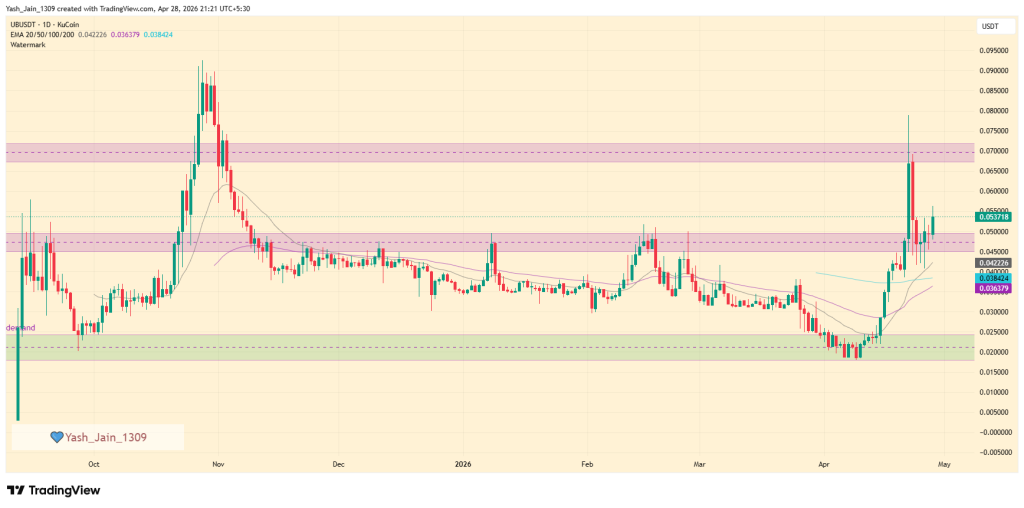
The UB price just is on fire in April that many altcoins still dream about, today after a pull back it woke up again, broke resistance, and reminded traders it still has a pulse. Sitting around $0.0537, the move comes right after the OKX perpetual contract listing news, and yes, the timing isn’t subtle.

A clean breakout, a leverage catalyst, and suddenly everyone’s paying attention again.

Resistance finally cracks after months of pressure

For months, the $0.045–$0.048 zone acted like a brick wall. Price poked it, tested it, got rejected and repeat cycle. Until now.

The UB price has finally pushed through that ceiling and, more importantly, closed above it on the daily timeframe. That’s not just a random spike, basically, it’s a structural shift. Former resistance now flips into support, at least in theory.

But let’s be real. Breakouts are easy. Holding them? That’s where things get messy.

EMA crossover hints at momentum shift

Now here’s where the technical crowd starts nodding.

The 20-day EMA has crossed above the longer-term averages, signaling a clear momentum flip. Short-term trend? Bullish. No debate there.

And price isn’t just above these EMAs but it’s stretched well beyond them. That usually screams strength… or exhaustion. Sometimes both.

So yeah, momentum is here. But it’s not exactly subtle.

Next targets sit higher, but not easy

So, what’s next?

The immediate upside target lands in the $0.068–$0.072 supply zone. That’s where sellers previously stepped in, and chances are, they’ll show up again. If momentum keeps pushing, the longer-term objective sits near $0.090 which is the late October highs.

Sounds clean on paper. But here’s the kicker, since Unibase price doesn’t move in straight lines, especially not after news-driven spikes.

Perpetual listing brings volatility, not stability

Let’s talk about the real catalyst: leverage. The OKX perpetual contract listing isn’t just another headline, as it introduces a whole new layer of volatility. Traders now get to amplify positions, and that usually means sharper moves in both directions.

The 15% intraday surge reflects optimism, sure. But it also sets the stage for classic “sell the news” behavior.

UB Price Breakout Gains Steam After OKX Listing Sparks Volatility

If that kicks in, the UB price could easily wick back toward the $0.050 region. And if things cool further, that freshly broken $0.048 level becomes the line in the sand. Hold it, and bulls stay in control. Lose it, and the breakout starts looking… questionable.

So yeah, momentum is real. Structure is improving. But with leverage entering the chat, things are about to get a lot less predictable.

Galaxy S27’s Exynos 2700 may pack new SBS cooling tech and bandwidth

Exynos 2700 chip might finally solve the one problem that’s quietly followed Samsung’s in-house chips for years, the cooling segment, by leveraging SBS technology.

The Exynos 2700, expected to be utilized inside next year’s Galaxy S27 series, is reportedly built around a side-by-side architecture designed to keep temperatures in check better than Snapdragon chips.

Most chips use a stacked design, with RAM sitting directly on top of the SoC. Two hot components pressed against each other, and heat was trapped between them.

SBS flips the script

Instead of stacking, Samsung places the RAM beside the SoC using a Fan-out Wafer-Level Packaging process. Think of two heating components side by side instead of one sitting on top of the other.

Shorter interconnects mean memory bandwidth is expected to jump somewhere between 30 and 40 percent, with power efficiency improving too.

This shift addresses multiple problems at once, which is exactly the kind of engineering bet Samsung needs to make right now.

Exynos 2600 benchmarks against the Snapdragon 8 Elite Gen 5 show Samsung’s chip running more stably under sustained load.

The Exynos 2700 has already surfaced on Geekbench. Early numbers are underwhelming, but that’s completely normal at this stage in development.

It remains to be seen how the new Exynos chip handles the cooling segment in the next year’s Galaxy flagships.

The post Galaxy S27’s Exynos 2700 may pack new SBS cooling tech and bandwidth appeared first on Sammy Fans.

Humanity Protocol (H) Price Surges as AI Narrative Fuels Breakout Momentum

Humanity Protocol (H) Price Declines After 20% Surge—Is a Fresh Move Forming

The post Humanity Protocol (H) Price Surges as AI Narrative Fuels Breakout Momentum appeared first on Coinpedia Fintech News

The Humanity Protocol price this week showed remarkable rise and broke the weeks of bearish trend that was dragging through consolidation, H token price suddenly woke up, printing nearly 20% intraday gains and stacking over 65% since 21st April. That’s not random noise. That’s capital coming with intent. And yes, there’s a narrative doing the heavy lifting here.

Demand Zone Bounce Flips Market Structure Fast

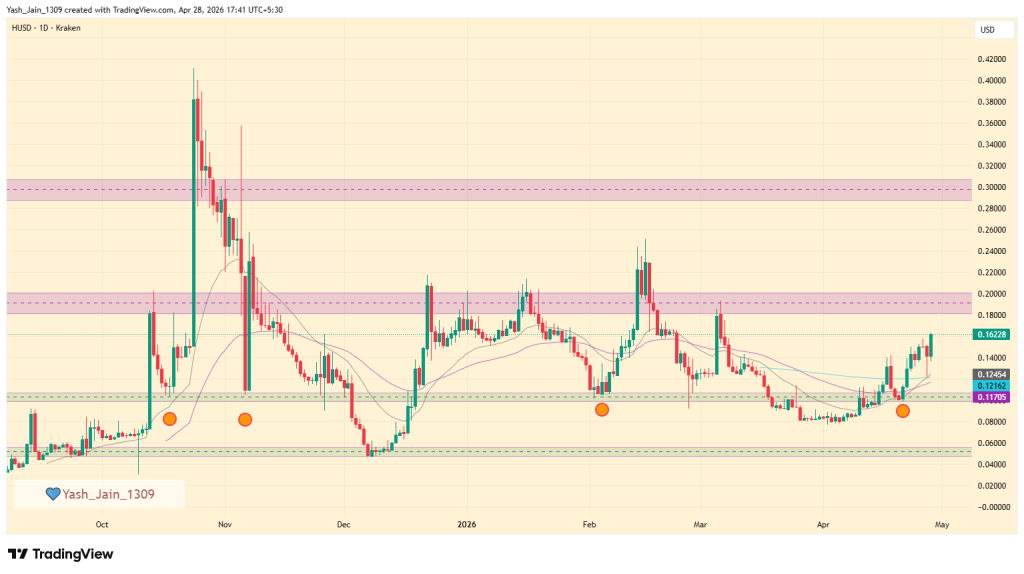
It all started at the $0.100 level. Clean, respected, and more importantly defended area. The Humanity Protocol price bounced sharply from that horizontal demand zone and followed it up with a higher low around April 21. 

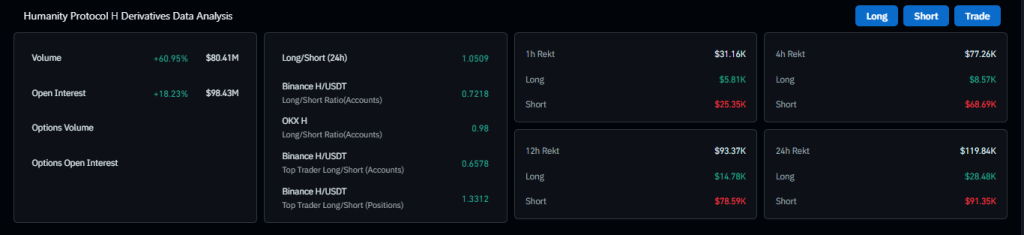
But here’s where it gets interesting. This wasn’t just spot-driven enthusiasm. Open Interest jumped 18.23% to $98.43M, which means derivatives traders showed up too. Fresh money, not recycled hype.

Volume didn’t stay quiet either which is also up 60.95% to $80.41M. So yeah, this isn’t a sleepy move.

Humanity Protocol (H) Price Surges as AI Narrative Fuels Breakout Momentum

AI Execution Narrative Gives Bulls New Ammunition

Now, let’s talk about the elephant in the room thats “AI”. The latest push isn’t coming from vague “AI integration” buzzwords. It’s sharper than that. The idea? AI isn’t just influencing anymore but it’s executing. Autonomous actions, no clear human behind them. That’s a problem. A big one.

And that’s exactly where Humanity Protocol (H) is trying to wedge itself in as a verifiable identity layer. Anti-fraud infrastructure for an internet that’s starting to lose track of who’s actually responsible.

When AI executes the attack, there's no attacker to trace.@Terencekwok on why verifiable identity has to come before autonomous crime scales beyond attribution 👇 pic.twitter.com/nY9D7YBFBV

— Humanity (@Humanityprot) April 21, 2026

It’s a compelling pitch and Traders seem to agree on it and this weeks momentum clearly represents that..

Humanity Protocol Price Resistance at $0.200 Now Becomes Battleground

But let’s not get carried away just yet. The Humanity Protocol price is now pushing into a heavy resistance zone between $0.180 and $0.200. This isn’t some minor hurdle but it’s a multi-month ceiling. Breaking it cleanly would flip the entire structure bullish and potentially open a run toward $0.300. That’s the optimistic case.

But, The cautious one? The market is leaning long. Hard. The Long/Short ratio sits at 1.3312, which means a lot of traders are already positioned for upside. That’s confidence but at the same time it’s also risk. If this level rejects, things could unwind quickly.

Humanity Protocol (H) Price Surges as AI Narrative Fuels Breakout Momentum
Source: H/USD TradingView

Long squeeze risk quietly building underneath rally

If the Humanity Protocol price fails to hold above $0.180, a retracement toward $0.117–$0.124 becomes likely. That’s where the market would need to reset, absorb selling, and decide if it actually believes this rally.

Because right now, it’s still proving itself. Momentum is strong. Narrative is stronger. But sustainability? That depends on one thing whether buyers can turn $0.200 from resistance into support. Until then, this rally is impressive… but not untouchable.

Polkadot (DOT) Price Prediction 2026, 2027 – 2030: Can DOT Price Reach $60?

Polkadot Price Prediction

The post Polkadot (DOT) Price Prediction 2026, 2027 – 2030: Can DOT Price Reach $60? appeared first on Coinpedia Fintech News

Story Highlights

  • The live price of the Polkadot crypto token is  $ 1.22328900.
  • Price predictions for 2026 range from $2.50 to $5.00.
  • Structural adoption and interoperability narratives could push DOT toward $60 by 2030.

Polkadot (DOT) remains one of the few Layer-0 blockchain networks focused on interoperability. Its architecture allows multiple blockchains to operate together while sharing security.

Recent changes to tokenomics and infrastructure, including Agile Coretime and a supply cap update in March 2026, have altered the network’s economic model. These developments shape expectations for DOT’s price outlook through 2030.

What Is Polkadot?

Polkadot is designed as a multi-chain network. It uses a central Relay Chain to connect independent blockchains called parachains.

This structure allows:

  • Cross-chain communication
  • Shared security across networks
  • Parallel transaction processing

The introduction of Agile Coretime enables more flexible allocation of network resources. This replaces earlier slot-based systems with an on-demand model.

Polkadot Price Today

Cryptocurrency Polkadot
Token DOT
Price $1.2233 down -0.92%
Market Cap$ 2,056,770,089.14
24h Volume$ 127,038,573.6086
Circulating Supply1,681,344,379.2843
Total Supply1,681,344,379.2843
All-Time High$ 55.0050 on 04 November 2021
All-Time Low$ 1.1303 on 06 February 2026

Polkadot Price Prediction May 2026

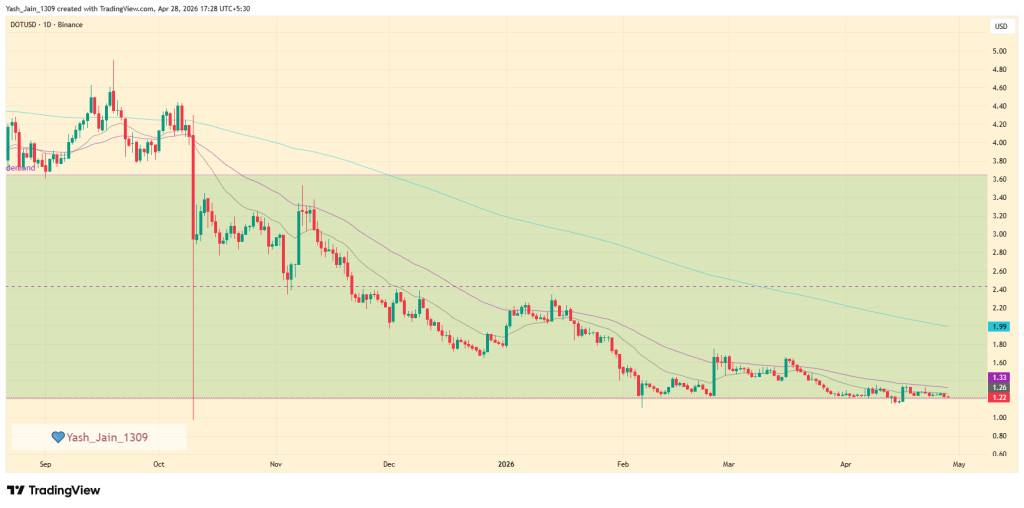
In late 2025, the price of Polkadot (DOT) faced significant selling pressure, causing it to decline into a long-term demand zone between $1.20 and $3.65.

Unfortunately, this downward trend resulted in a breach of the crucial $2.50 middle-band support in the first quarter. The bearish momentum continued into early 2026, pushing the price toward the $1.20 range floor in February, where it ultimately established a stable base. This led to a consolidation phase in March, resulting in a muted first quarter.

However, this muted behavior didn’t end in the first quarter; April in the second quarter displayed similar patterns, and May is just around the corner. If this lack of price movement persists, there is a risk of dropping below the $1.20 mark, which would break the rectangle box formed by the long-term trading range.

Conversely, if demand returns in May, the price could potentially rise toward the 200-day EMA band at $2.00 and possibly aim for the $2.50 level.

Polkadot Price Prediction May 2026

Recent news/opinion

On March 9th, DOT announced that the first Polkadot U.S. ETF, trading as TDOT via 21Shares, has officially launched on the Nasdaq exchange. This milestone provides a regulated investment vehicle for the asset, though investors are encouraged to conduct thorough independent research, as this announcement does not constitute financial advice.

Polkadot (DOT) Price Prediction 2026

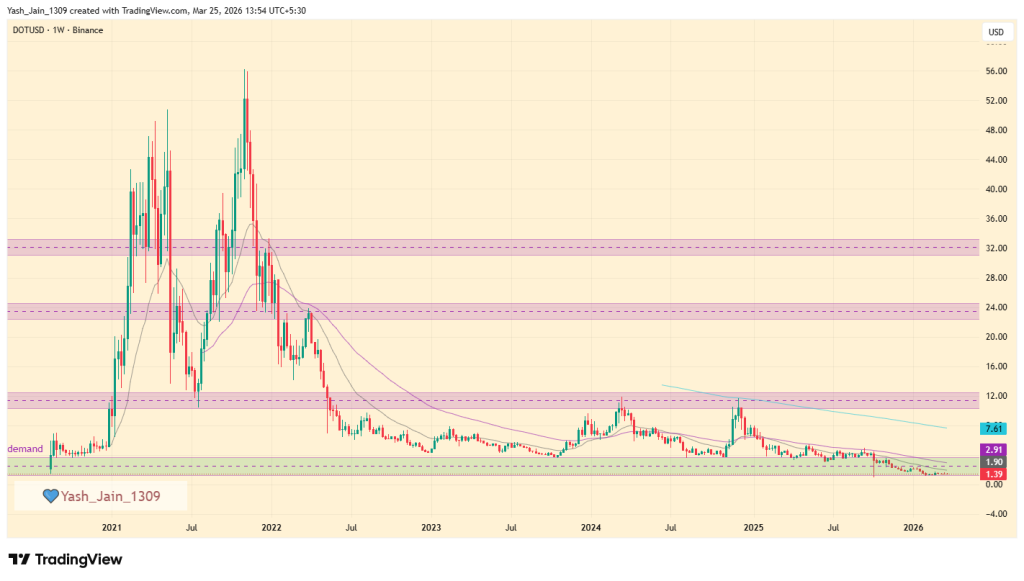
The long-term trajectory of Polkadot price (DOT) reveals a classic “boom and bust” market cycle of massive proportions. Between late 2020 and late 2021, the asset underwent an extraordinary bullish expansion, surging from a low of $1.50 to an all-time high of approximately $56.

This move represented a rally of over 3,500%, establishing a dominant bullish structure on the weekly timeframe. However, the peak in late 2021 marked the beginning of a structural shift, as the market transitioned into a prolonged corrective phase.

Polkadot (DOT) Price Prediction 2026

The chart shows that the bearish reversal intensified throughout 2022, characterized by the loss of critical psychological and technical support levels at $32 and $24. While a mid-2022 drop to $6.30 was initially perceived by many as a potential market bottom, it wasn’t, and the decline proved more persistent. The downward momentum eventually dragged the price to a low of $3.57 by late 2023. 

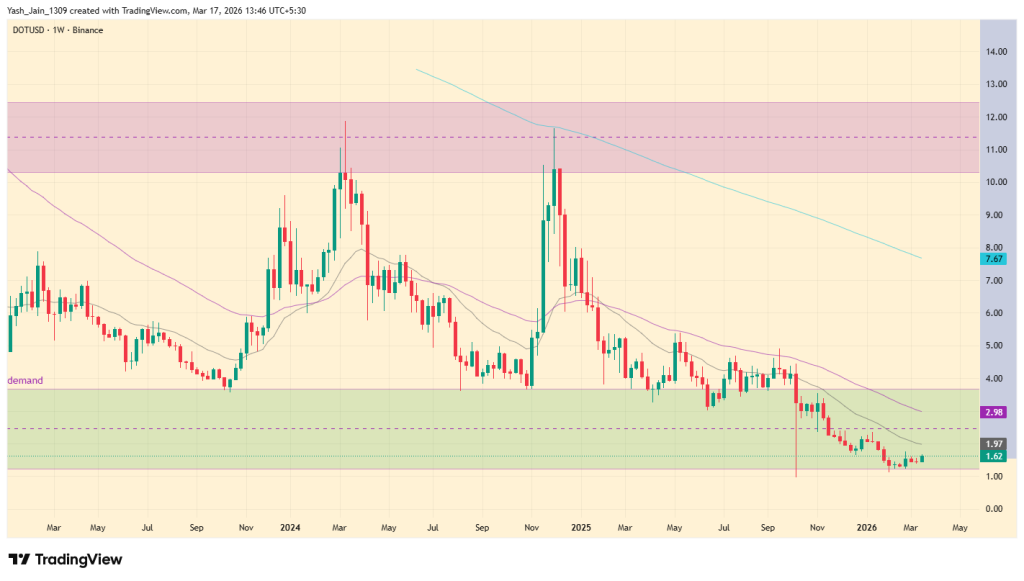
Despite two notable recovery attempts in early and late 2024, the bulls were unable to reclaim the $12 supply zone, which acted as a heavy ceiling and confirmed the continuation of the macro-downtrend into 2025.

Now in 2026, all these past occurrences make sense, as by the first quarter of 2026, the correction reached a significant milestone as DOT touched a new multi-year low of $1.20. Paradoxically, this price action has brought the asset back close to the “Demand Zone” that ignited the original 2020 bull run.

Polkadot (DOT) Price

Currently, DO/USD appears to be entering a phase of deep accumulation, confined within a weekly range of $1.20 to $3.57. This historical symmetry suggests that if the price can successfully consolidate and eventually break above the $3.57 resistance, it may pave the way for a new cyclical uptrend. However, given the depth of the current range, this recovery process is likely to be time-intensive, requiring significant patience before a definitive trend reversal emerges.

Polkadot Onchain Analysis

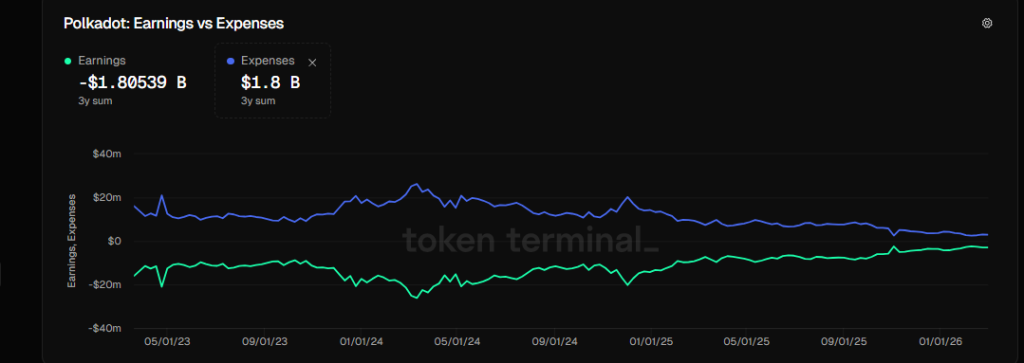
Recent on-chain data from Token Terminal reveals a significant shift in Polkadot’s financial trajectory. After years of deeply negative earnings, the network has successfully curtailed its aggressive spending to stabilize its balance sheet. 

Polkadot Earnings Vs Expenses

While the earnings graph is showing a clear recovery from previous lows, net figures remain slightly below the $0 threshold as the ecosystem balances its disinflationary tokenomics with ongoing operational costs.

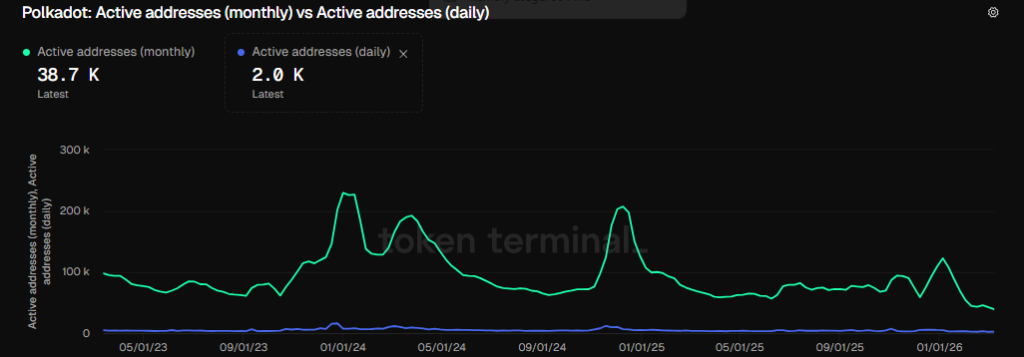
Polkadot Active Adresses

Despite this fiscal recovery, the network faces a challenge in user retention, as active addresses have continued a general downward trend. This decline in unique users suggests that Polkadot is currently struggling to regain retail momentum, leaving it susceptible to market volatility despite its improved fundamentals. 

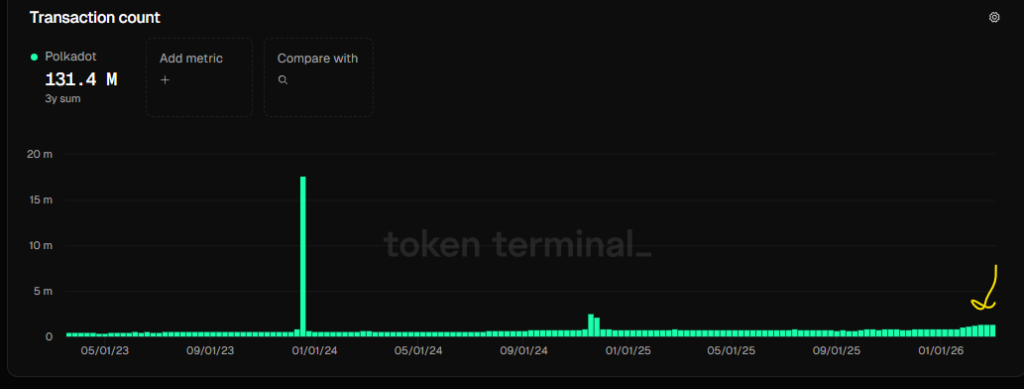
Polkadot Transaction Count

However, there is a glimmer of optimism in the latest usage metrics: transaction counts have begun to see a notable uptick in Q1 2026, indicating that while the user base may be smaller, the remaining participants are engaging more deeply with the ecosystem’s growing list of parachains.

Polkadot Crypto Price Prediction 2026 – 2030

YearPotential Low ($)Potential Average ($Potential High ($)
20274.007.2010.00
20286.508.0015.00
202910.0014.0025.00
203025.0050.0060.00

Polkadot Crypto Price Prediction 2027

Polkadot (DOT) price range can be between $4.00 to $10.00 during the year 2027. 

Polkadot Prediction 2028

In 2028, Polkadot is forecasted to potentially reach a low price of $6.50 and a high price of $15.00.

Polkadot Coin Price Prediction 2029

Thereafter, the DOT price for the year 2029 could range between $10.00  and $25.00.

Polkadot (DOT) Price Prediction 2030

Finally, in 2030, the price of Polkadot is predicted to maintain a steady and positive. It may trade between $25.00 and $60.00.

Polkadot Price Prediction 2031, 2032, 2033, 2040, 2050

Based on the historic market sentiments and trend analysis of the largest cryptocurrency by market capitalization, here are the possible DOT price targets for the longer time frames.

YearPotential Low ($)Potential Average ($)Potential High ($)
203150.0060.0080.00
203270.0090.00110.00
2033100.00130.00150.00
2040180.00200.00270.00
2050250.00320.00400.00

DOT Price Prediction: Market Analysis

Year202620272030
Changelly$2.50$3.00$7.00
CoinCodex$3.00$3.50$6.00
Digital Coin Price$5.00$7.00$10.00
Never Miss a Beat in the Crypto World!

Stay ahead with breaking news, expert analysis, and real-time updates on the latest trends in Bitcoin, altcoins, DeFi, NFTs, and more.

FAQs

What is Polkadot (DOT) and why is it called a Layer-0 blockchain?

Polkadot is a Layer-0 network that connects multiple blockchains, allowing them to share security and data through parachains.

What is the Polkadot (DOT) price prediction for 2026?

Polkadot could trade between $2.50 and $5.00 in 2026, depending on market recovery, ecosystem growth, and adoption of its Polkadot 2.0 upgrades.

How much will 1 Polkadot be worth in 2030?

Price forecasts indicate 1 DOT could trade between $25 and $60 by 2030, depending on adoption of Polkadot 2.0 upgrades and broader crypto market growth.

What will Polkadot be worth in 2040?

Long-term projections suggest Polkadot could reach $180 to $270 by 2040 if the ecosystem grows steadily and blockchain interoperability becomes widely adopted.

What could Polkadot be worth in 10 years?

Over the next decade, Polkadot could trade between $60 and $150+ if cross-chain adoption expands and its interoperability model becomes a core part of Web3 infrastructure.

Is Polkadot a good long-term investment?

Polkadot is seen as a long-term infrastructure project focused on interoperability, though price performance depends on adoption, ecosystem activity, and market trends.

What factors could influence Polkadot’s price in the future?

Key factors include Polkadot 2.0 upgrades, parachain growth, tokenomics changes, institutional adoption, and overall crypto market sentiment.

Google Wallet expands digital ID support to India, Singapore, Taiwan and Brazil

Google quietly expanded digital ID support in Wallet to four new markets: India, Singapore, Taiwan, and Brazil. The company announced it through a blog post, opening up a feature that could genuinely matter to hundreds of millions of people.

In India, the integration runs deeper than a passport scan.

Google built on its existing UIDAI partnership to let users save Aadhaar Verifiable Credentials directly on-device. That’s your national identity, digitized, sitting in your phone.

Early partners include PVR INOX for age verification at cinemas, BharatMatrimony for verified profile matching, and Atlys for auto-filling visa applications with a single tap.

Mygate and Snabbit are coming soon, targeting residential security and gig worker verification.

Brazil, Singapore, and Taiwan get something slightly different.

Users there can generate an ID pass built from passport data and store it in Wallet. It’s designed for both in-person and online situations where age or identity verification is required.

Signing into accounts, proving you’re old enough to watch an R-rated film, that sort of thing. The privacy architecture here is worth understanding.

Google is leaning on a concept called selective disclosure, where only the specific fields needed for a given transaction get shared. You don’t hand over your full identity just to confirm you’re over 18.

Google Wallet Digital ID

The post Google Wallet expands digital ID support to India, Singapore, Taiwan and Brazil appeared first on Sammy Fans.

Next Galaxy S26 Ultra update to fix 24MP close-up camera bug

Samsung has yet to fix the Galaxy S26 Ultra close-up camera problem, and we have another response from the camera moderator. This time, the timeline is more precise, and affected users can have a breath of peace.

If your Samsung Galaxy S26 Ultra has been acting weird while shooting close-up shots at 2x zoom, you’re not imagining things. A growing number of users have been flagging a strange capture delay and inconsistent results.

Camera moderators on Samsung’s Korean Community forums have confirmed the bug is real. According to the most recent response, the issue specifically affects the 24-megapixel mode when using 2x zoom in close-up scenarios.

If you compose your shot and wait for a few seconds before pressing the shutter, the camera pipeline misbehaves. Think of it as a brief viewfinder hang that throws off post-processing once the image is captured.

This looks like a timing issue between the preview pipeline and the final image processing stack. The camera likely re-evaluates focus, exposure, or sharpening during that idle window, then fails to sync properly when the shutter is pressed.

Samsung says the fix is already in development and will roll out with the next firmware build. The expected target is the May 2026 security patch. The moderator explicitly pointed to a future release window, not anything currently rolling out.

Right now, Verizon users are receiving a second April update for the Galaxy S26 lineup. While it brings its own set of tweaks and fixes, this camera issue is almost certainly not part of that build.

Until the May patch lands, the workaround is simple. Don’t wait too long before hitting the shutter in 24MP 2x mode, especially for close-ups.

The post Next Galaxy S26 Ultra update to fix 24MP close-up camera bug appeared first on Sammy Fans.

Samsung pushing second April 2026 update to Galaxy S26 and S25

Samsung silently released the second April 2026 update for the Galaxy S26 and S25 phones in the US. Verizon has updated its software page, listing fresh new builds for the devices.

Users of the Galaxy S26 and S25 series have already received one update in April 2026 but Samsung has one more to offer.

Samsung is shipping the AZDG update to the Galaxy S26 series, whereas Galaxy S25 (including S25 Edge) users are getting the BZCL update.

Galaxy S26 users are awaiting fixes for camera problems, while Samsung is gearing up to kick off the stable One UI 8.5 rollout to the Galaxy S25 series.

If you are in the US, check if your Galaxy phone may have a new software update pending for installation. If it isn’t, waiting is the only thing left for now.

April 2026 SMR brings 47 fixes to Android and One UI as CVE and SVE items. Meanwhile, US users get four fewer patches, which are exclusive to the Exynos chipset.

Check for updates through Settings > Software update > Download and install.

Galaxy S25 users may begin receiving the stable One UI 8.5 update starting May 4 in the Global market, following the initial drop in South Korea on April 30.

The post Samsung pushing second April 2026 update to Galaxy S26 and S25 appeared first on Sammy Fans.

Galaxy Tab S11’s One UI 8.5 Beta 3 adds new AI features and DeX tools

Samsung Galaxy Tab S11 and Tab S11 Ultra tablets have started to receive the One UI 8.5 Beta 3 update. The fresh build introduces new AI features and DeX improvements.

One UI 8.5 Beta 3 for the Galaxy Tab S11 series can be identified via PDA build version ending with ZZD7. The release also brings April 2026 security patches.

The highlight is the continued push of AI features borrowed from the Galaxy S26 lineup.

Call Screening gets further improvements, making it more reliable in filtering unknown calls and handling them smoothly in the background.

Creative Studio, another AI-powered tool, sees several fixes. Issues like overlapping elements, incorrect sizing while creating stickers, and glitches when working on invitations or sketches have been cleaned up.

Samsung DeX also gets attention in this beta. A bug affecting the Cmd + F shortcut in Guest mode has been fixed, and settings like font size and screen zoom now save properly in DeX Guest mode.

There are also stability improvements when switching between standalone DeX and Second Screen mode, which should make multitasking more consistent.

Lastly, there’s a minor but useful fix for the Weather app, resolving an issue that prevented users from modifying notification settings.

The post Galaxy Tab S11’s One UI 8.5 Beta 3 adds new AI features and DeX tools appeared first on Sammy Fans.

Galaxy S23 FE and S24 FE get new One UI 8.5 Beta with Privacy Alerts feature

Samsung just pushed the latest One UI 8.5 Beta update for Galaxy S23 FE and S24 FE. The former is getting the second Beta build, while the latter is picking up the third release.

The company has included crucial bug fixes, covering calling, proximity sensor, display and camera. In particular, the Galaxy S23 FE is seeing the addition of the Privacy Alerts feature, which gives users better visibility into how apps access sensitive data.

Alongside the new addition, Samsung has focused heavily on stability, addressing several long-standing issues that affected daily usability, especially around calls, camera performance, and system reliability.

The update fixes a frustrating bug where incoming calls sometimes showed a delayed or black screen, while also correcting inconsistent proximity sensor behavior during active calls.

Camera improvements include a fix for green line artifacts appearing during 4K HDR video recording in certain apps, a problem that had been reported by beta users recently.

Samsung has also resolved Bluetooth crash issues and improved multi-touch accuracy after using accessibility zoom, making the overall experience smoother and more consistent across different usage scenarios.


[Galaxy S23 FE] One UI 8.5 Beta 2 changelog – ZZDP

  • Added Privacy Alerts feature
  • Fixed an issue where the incoming call screen appeared late or showed a black screen in certain situations
  • Fixed an error with proximity sensor behavior during calls
  • Fixed an issue where green lines appeared when recording 4K HDR videos in certain apps
  • Fixed Bluetooth crash issues
  • Fixed multi-touch malfunction after using accessibility zoom feature

[Galaxy S24 FE] One UI 8.5 Beta 2 changelog – ZZDP

  • Fixed delayed or black incoming call screen issue in certain situations
  • Fixed proximity sensor behavior during calls
  • Fixed green line issue when recording 4K HDR video in certain apps
  • Fixed Bluetooth crashes
  • Fixed multi-touch errors after using accessibility zoom

The post Galaxy S23 FE and S24 FE get new One UI 8.5 Beta with Privacy Alerts feature appeared first on Sammy Fans.

Exynos 2600 boosts Galaxy S26 GPU with AI neural sampling tech

Exynos 2600, the chip powering the Galaxy S26 standard and Plus models, marks the first time Samsung has shipped its own AI-based graphics optimization tech in a mobile processor.

Samsung calls it ENSS, short for Exynos Neural Super Sampling, and it’s a two-part system that does something genuinely interesting.

ENSS breaks down into two components.

NSS, or Neural Super Sampling, uses AI to reconstruct low-resolution images into sharper output.

NFG, Neural Frame Generation, predicts and synthesizes frames that don’t exist yet.

Together, they cut the GPU’s workload while keeping visual quality high.

In the Steel Nomad Lite graphics benchmark, the Exynos 2600 scored roughly 15% higher than competing chips.

On Basemark Power Board, a platform that serious GPU nerds actually trust, the chip’s ray tracing performance surfaced at number one.

Ray tracing is the technique that simulates how light bounces, bends, and cuts through objects. It’s demanding. Doing it well on a phone in 2026 is genuinely hard.

The Exynos 2600 is also the world’s first 2nm mobile chip built on Samsung Foundry’s Gate-All-Around process.

Samsung has also revealed early details of the Exynos 2700. The follow-up chip is expected to place the mobile AP and DRAM side by side on the same substrate.

ENSS support is planned to expand across future products, though Samsung may be unsure about timelines, citing “product and software conditions.”

The post Exynos 2600 boosts Galaxy S26 GPU with AI neural sampling tech appeared first on Sammy Fans.

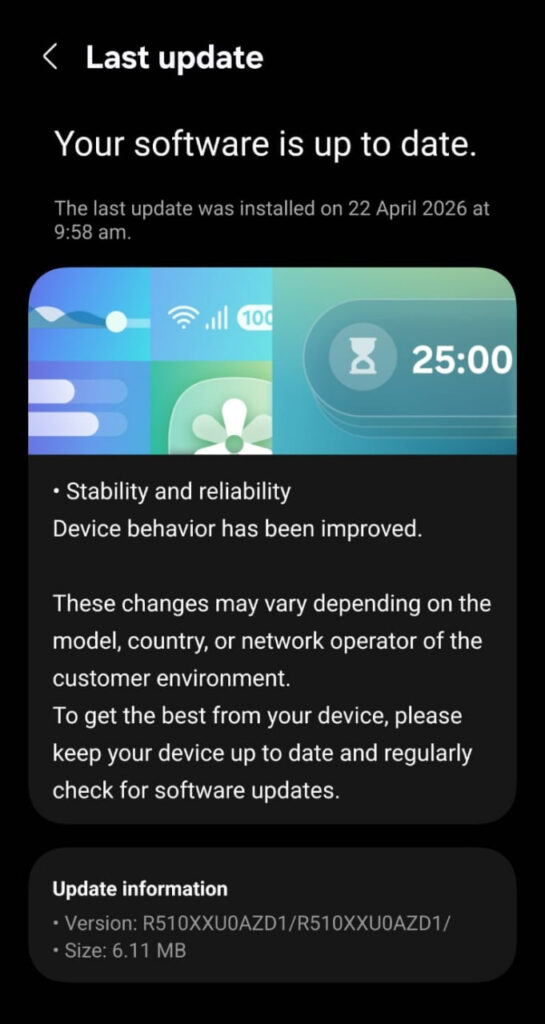
Samsung Galaxy Buds 4 getting April 2026 stability improvement

Samsung is rolling out a fresh firmware update for the Galaxy Buds 4 and Galaxy Buds 4 Pro this April 2026, continuing its steady push to refine the user experience across its wireless audio lineup.

The latest update, carrying version AZD2, doesn’t introduce new features but focuses on stability improvements that aim to enhance overall device operation.

Samsung has applied a stabilization code related to device performance. These types of updates are often subtle, but they play an important role in ensuring smoother functionality.

Samsung Galaxy Buds 4 April 2026 Update

The exact impact of the update may differ depending on factors like region, device variant, and network environment, meaning users could notice varying degrees of improvement.

Samsung continues to recommend that users keep their devices up to date to maintain optimal performance. It includes regularly checking for new software updates through the Galaxy Wearable app.

Updates like this highlight Samsung’s ongoing commitment to polishing the core experience, ensuring the Galaxy Buds 4 series remains reliable.

The post Samsung Galaxy Buds 4 getting April 2026 stability improvement appeared first on Sammy Fans.

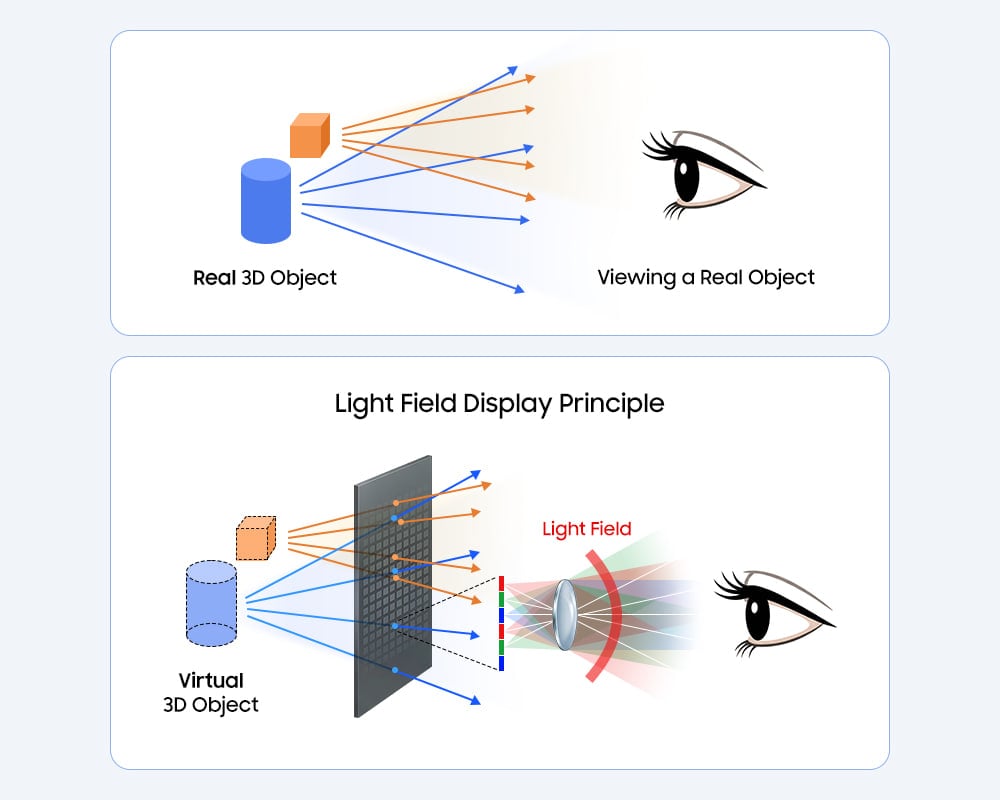
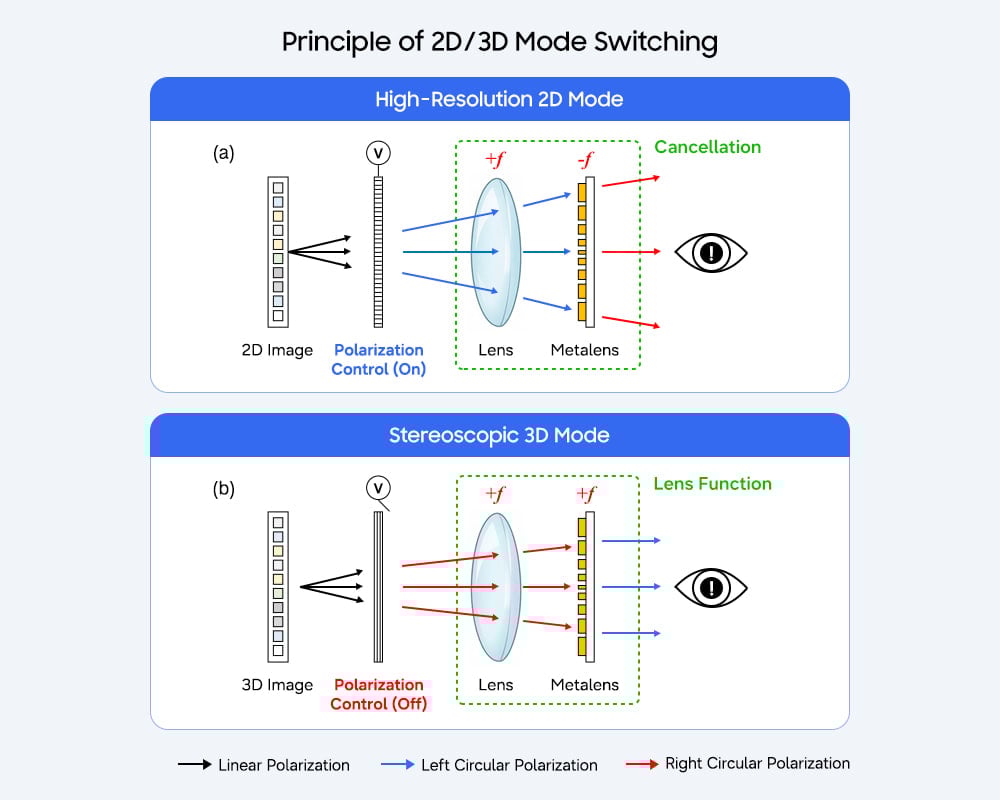
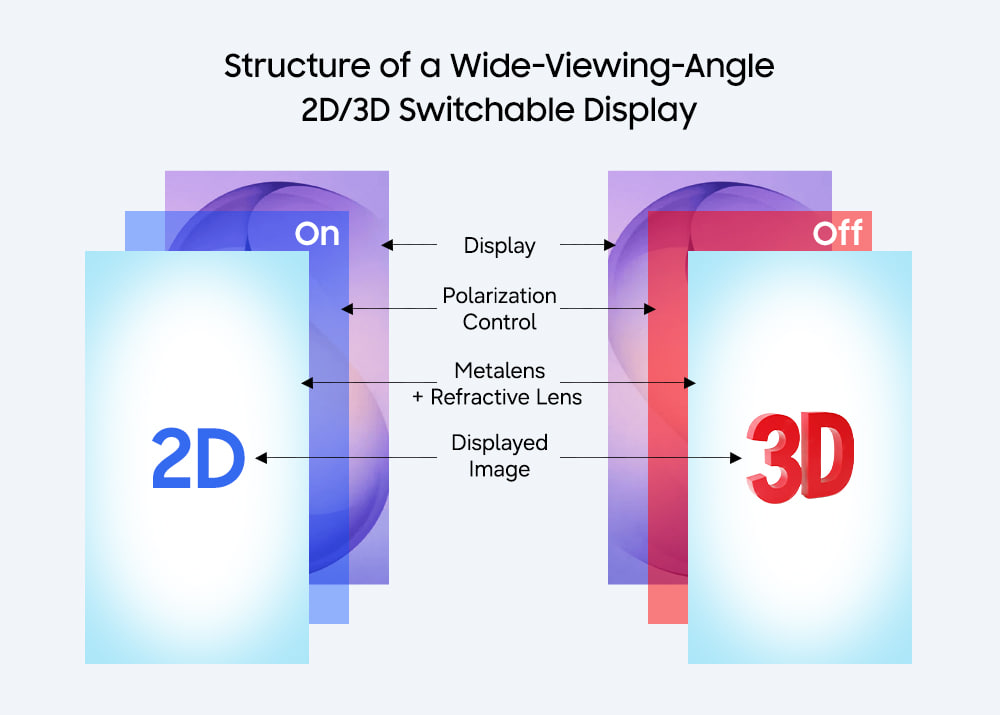
Samsung launches 32-inch Spatial Signage display with glasses-free 3D

Samsung today launched a 32-inch Spatial Signage display, a compact version of the 85-inch version that went on sale earlier this year.

The South Korean tech giant has been quietly building out its glasses-free 3D signage lineup for a while now. Today, it got serious about the smaller stuff.

Same core trick: no glasses required, full cinematic depth, 360-degree product rotation. The compact size fits on a shelf, which changes the game entirely.

The 32-inch model packs FHD resolution at 1,080 x 1,920 in portrait orientation, weighs 8.5 kg, and measures just 49.4 mm thick. It’s compatible with standard VESA mounts and installs like normal signage.

In addition, the company’s patented 3D Plate technology uses binocular parallax, sending different images to each eye to create genuine depth perception.

Target application: Retail shelves, hotel lobbies, campus commons, entertainment venues, anywhere close-up visibility matters.

Samsung VXT, the cloud platform tied to all of this, picked up some genuinely useful updates alongside the hardware announcement.

Scheduling now extends to screen presets, so brightness, volume, and on/off timers can be pushed across connected displays on a fixed schedule, even overnight. Smart Download lets some screens pull content and pass it to others on the same network.

The AI Studio app does something worth paying attention to. Drop in a single product image, add a text prompt, and it generates signage-ready video, and the output can be upscaled to 4K at 60fps.

Samsung also announced that a 55-inch model is coming.

Samsung 32-inch spatial signage

The post Samsung launches 32-inch Spatial Signage display with glasses-free 3D appeared first on Sammy Fans.

Samsung’s Galaxy Z Fold 7, XR and more become Red Dot Design Award winners

Samsung walked out of the Red Dot Design Award 2026 with 16 wins out of 16 submissions. The company also took home two Best of the Best honors, the award’s highest distinction.

Two ‘Best of the Best’ wins in Product Design

Samsung won the top ‘Best of the Best’ awards in the Product Design category for:

  • The OLED TV ‘S95H’
  • The Bespoke AI laundry appliance series

The OLED TV S95H earned Best of the Best. Its slim display floats visually above the main body, framed in silver metal that reads more like gallery hardware. The Bespoke AI laundry lineup took the other top prize.

Products such as:

  • Bespoke AI washer and dryer
  • ‘Bespoke AI One Body’ (a vertically integrated washer and dryer)
  • ‘Bespoke AI Combo’ (an all-in-one washer-dryer)

were highly rated for their ability to blend seamlessly with users’ home interiors.

A washer, a dryer, an integrated One Body unit, and the all-in-one Combo all carry a unified design language while still feeling distinct. The 7-inch touchscreen controlling SmartThings and AI features didn’t hurt either.

All 16 of Samsung’s submitted products were selected as Red Dot Design Award Winners.

Award-winning products include:

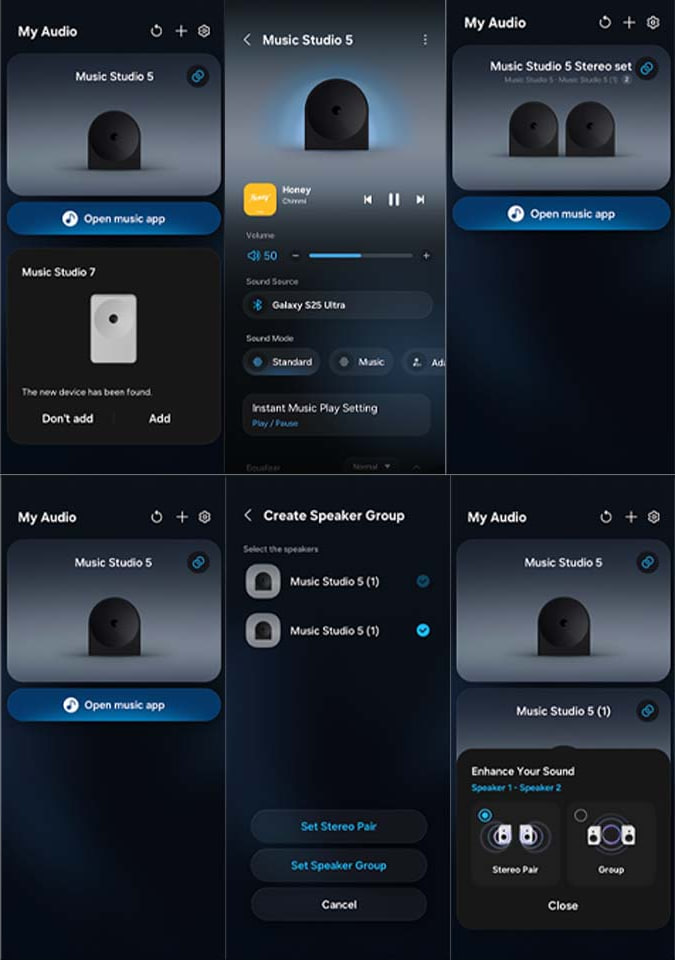
  • Wi-Fi speaker ‘Music Studio 5’
  • Portable screen ‘The Moving Style’
  • ‘Bespoke AI Family Hub’ refrigerator
  • Bespoke AI AirDresser
  • Bespoke AI water purifier and ice water purifier
  • ‘AI WindFree Combo Pro Wall-mounted’ air conditioner
  • ‘Bespoke AI WindFree Combo Gallery Pro’ standing air conditioner
  • ‘Bespoke AI Steam Ultra and Plus’ robot vacuum
  • ‘Jet Fit’ cordless stick vacuum

Additionally, innovative products delivering new user experiences also received awards, including:

  • Galaxy Z Fold 7
  • Galaxy XR
  • 5G Street Radio solution
  • Glasses-free 3D display ‘Spatial Signage’
  • Portable SSD T7 Resurrected

“Expressive Design is our way of putting people at the center, celebrating their identity, emotions and diversity,” said Mauro Porcini, President and Chief Design Officer (CDO) of the Device eXperience (DX) Division at Samsung Electronics. “We design not only to function, but to create meaning and connection. Our ambition is to enrich people’s lives through experiences that are both purposeful and deeply human.”

The post Samsung’s Galaxy Z Fold 7, XR and more become Red Dot Design Award winners appeared first on Sammy Fans.

Samsung Galaxy S27 may launch with camera spec and design overhaul

The Galaxy S27 series is reportedly under internal review for a rear camera overhaul. This is not just a minor tweak. We are talking about a possible shift in camera placement itself, something Samsung has barely touched in years.

Samsung has a habit of sticking with a design long after it stops feeling fresh. Same camera layout, same visual identity, year after year. Now, supply chain rumors suggest that might finally change, but not without the usual caveats.

Sources say Samsung is evaluating both the physical positioning and camera specs together.

It’s also being reported that a similar design language may debut earlier on another upcoming device. That said, the company’s design revamp strategy may be previewed on a device earlier.

The camera reshuffle is not just about looks; it could be tied directly to Qi2. If this lands, Galaxy users could finally get native magnetic accessory support without relying on cases.

Rising RAM and storage costs are reportedly forcing Samsung to rethink timelines. A full redesign, combined with Qi2 integration, is not cheap. Samsung has not exactly been shy about trimming costs in recent lineups.

Meanwhile, there is a real chance the Galaxy S27 sticks with the current camera layout, kicking the overhaul down the road. If that happens, Qi2 magnets may also be pushed to the Galaxy S28.

For now, this feels like a classic Samsung situation. Plans are big on paper but lack confirmation and a guarantee. If history repeats itself, the Galaxy S27 could end up as another iterative upgrade, while the real shift gets saved for the S28.

Samsung Galaxy S26 Ultra SG26U camera

The post Samsung Galaxy S27 may launch with camera spec and design overhaul appeared first on Sammy Fans.

Gemini adopting Now Brief-like ‘Daily Brief’ feature

Google is quietly reshaping one of Gemini’s upcoming features. What was previously known as “Your Day” inside Gemini is now being referred to as “Daily Brief.”

The new Gemini experience is bracing “Daily Brief,” which is much more sensible than the previous “Your Day” term. The information comes from a credible Telegram tipster, backed by earlier findings from AndroidAuthority.

“Your Day” always sounded like a placeholder. “Daily Brief” feels tighter, more purposeful, and closer to how these features are actually used.

Samsung has already been pushing similar ideas with its Now Brief and Now Bar features, which aim to surface contextual, proactive information throughout the day. And now, Gemini appears to be heading down a very similar road.

The upcoming Daily Brief feature inside Gemini is designed to pull data from across Google’s ecosystem, including Search activity, Gmail, and even Gemini chat history. The goal is simple: show you what matters before you even ask.

Daily Brief isn’t just a name change. It’s part of a broader push to make Gemini more proactive. Earlier leaks revealed sections like “Top of mind” and “Active goals,” which hint at how the feature will structure your day.

It’s also expected that more clues could surface in the coming days as we get closer to I/O. Additional UI elements, maybe even a soft rollout in beta builds.

Google Gemini Daily Brief

The post Gemini adopting Now Brief-like ‘Daily Brief’ feature appeared first on Sammy Fans.

2nd One UI 8.5 Beta for Galaxy Z Fold 5, Flip 5 brings fixes for call quality, UI glitches, and Camera errors

Samsung has rolled out the 2nd One UI 8.5 Beta for the Galaxy Z Fold 5 and Galaxy Z Flip 5, carrying build version ending in ZZDN. The latest software update focuses largely on bug fixes and usability refinements.

Stable One UI 8.5 may begin rolling out this week, with the Galaxy S25 series awaiting as the first candidate. As for the older phones and foldables, Samsung may kickstart the update distribution by the end of May 2026.

One of the more noticeable improvements targets call performance. Samsung has addressed low speakerphone volume and poor audio quality issues that users experienced during calls, particularly in driving scenarios.

The firmware update also fixes a frustrating bug where saved contacts failed to display their image and details when placing calls. This should restore a more consistent and expected calling experience across the system.

Samsung has also corrected a subtext error in the “Show brief pop-ups even when screen is off” setting. While minor, this fix improves clarity within system menus and reduces confusion during customization.

Another fix resolves a screen transition glitch that occurred after saving a contact while a folder was closed.

Lastly, the company has fixed an operational error tied to launching the Camera app. This should eliminate occasional hiccups and ensure the camera opens reliably when needed.

Here’s the 2nd One UI 8.5 Beta changelog for Galaxy Z Flip 5 and Fold 5

  • Improved low speaker phone volume and poor call quality during driving
  • Fixed an issue where contact image and information were not displayed when making calls from saved contacts
  • Fixed a subtext error under the “Show brief pop-ups even when screen is off” menu
  • Fixed a screen transition issue after saving a contact while a folder is closed
  • Fixed an operational error when launching the Camera app

The post 2nd One UI 8.5 Beta for Galaxy Z Fold 5, Flip 5 brings fixes for call quality, UI glitches, and Camera errors appeared first on Sammy Fans.

UMXM Price Explodes as Manadia’s AI Narrative Fuels Breakout

SPK

The post UMXM Price Explodes as Manadia’s AI Narrative Fuels Breakout appeared first on Coinpedia Fintech News

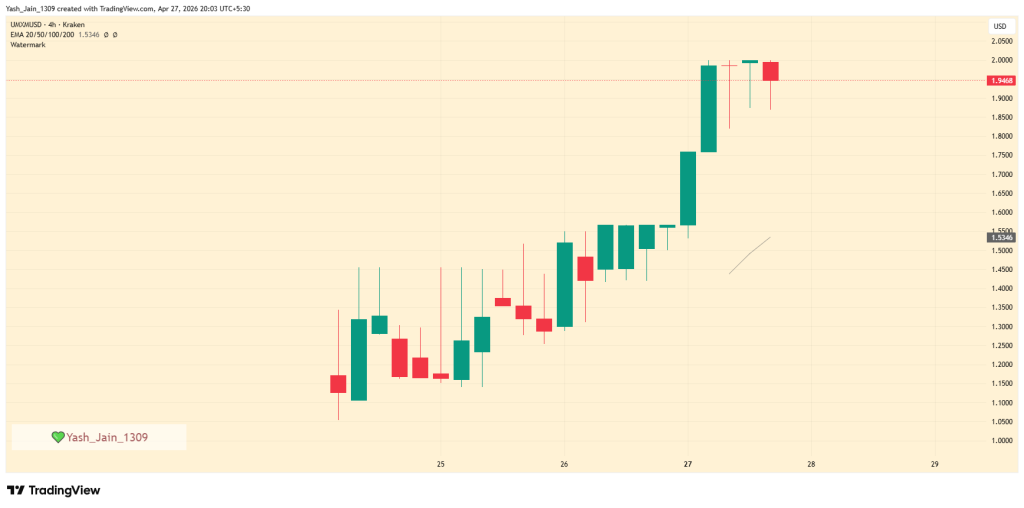
The UMXM price is sprinting today. In a market that usually needs weeks to build momentum, Manadia managed to compress that into days, pushing from roughly $1.15 to the doorstep of $2.00. That’s not organic drift. That’s aggressive demand kicking the door open.

And yeah, there’s a story behind it because there’s always a story when price moves this fast.

AI narrative meets liquidity, market bites fast

Manadia isn’t pitching itself as another forgettable Web3 token. It’s going after something bigger which is an AI infrastructure. Specifically, a data settlement and coordination layer that lets AI agents interact with both on-chain and off-chain systems through verifiable execution.

Sounds ambitious. The market seems to think it’s investable. The timing didn’t hurt either. A listing this week on Kraken on April 23, 2026 injected the kind of liquidity these moves usually need. Then came Bitget, where UMXM casually grabbed the 1st spot top gainer. That’s retail attention, plain and simple.

Throw in the “paywithmana” integration which is tying autonomous AI coordination with verifiable data settlement and suddenly the narrative has teeth. Not proven, but compelling enough for traders to pile in.

UMXM price hits psychological resistance at $2 level

Now here’s where things get interesting. The UMXM price has slammed straight into the $2.00 psychological barrier. It briefly tapped near that level before easing back to around $1.9468. That tiny red candle? That’s not weakness but it’s hesitation. Profit-taking. Reality checking hype.

But let’s not sugarcoat it. Big round numbers like $2.00 tend to act like magnets and walls at the same time. Breaking them cleanly usually requires sustained demand, not just a burst of enthusiasm. So far, the market’s knocking. Hard. 

UMXM Price Explodes as Manadia’s AI Narrative Fuels Breakout

Parabolic rally leaves EMA far below price

Here’s the part bulls don’t like hearing. The rally has gone vertical, and the EMA which is sitting around $1.5346 is still lagging way behind. That gap? It’s a classic sign of overextension. Price moved too far, too fast.

Now, that doesn’t mean it crashes tomorrow. But it does mean the market is stretched.

In these setups, one of two things usually happens. Either price consolidates sideways to let the EMA catch up, or it snaps back down toward that mean. There’s no polite way markets handle imbalance.

Momentum strong, but sustainability still uncertain

So, what now? If demand keeps flowing probably fueled by the AI + Web3 narrative then the odds suggests that the UMXM price could break above $2.00 and enter a clean price discovery phase. That’s where things tend to get irrational, fast.

But let’s be real. Moves like this rarely go straight up forever. A pullback toward the $1.50 zone wouldn’t be surprising in fact it would be healthy.

Right now, the trend is bullish. No debate there. But sustainability? That’s still being negotiated in real time.

XCN and LUNC Price Surge as Listings and Lawsuits Flip Market Structure

icp price

The post XCN and LUNC Price Surge as Listings and Lawsuits Flip Market Structure appeared first on Coinpedia Fintech News

The XCN and LUNC price action are today in focus as they snapped today. Two completely different catalysts, one common outcome that’s bullish price action one saw freedom from long-dead bearish trends getting steamrolled in a matter of hours that’s XCN for you.

On the other token, you’ve got a courtroom narrative breathing life this week into Terra Classic. So, there are different stories, but same chaos. And markets love chaos when it pays.

Legal drama ignites LUNC price breakout momentum

Let’s start with LUNC, because this one’s less about charts and more about unfinished business.

The trigger? A lawsuit filed by the Terraform Labs Plan Administrator against Jane Street, alleging market manipulation tied to the infamous 2022 de-pegging event. That single move flipped sentiment from passive despair to something closer to cautious optimism that’s boosting its price this week.

Call it a “justice rally,” call it hope either way, it worked. And results are constructed on chart.

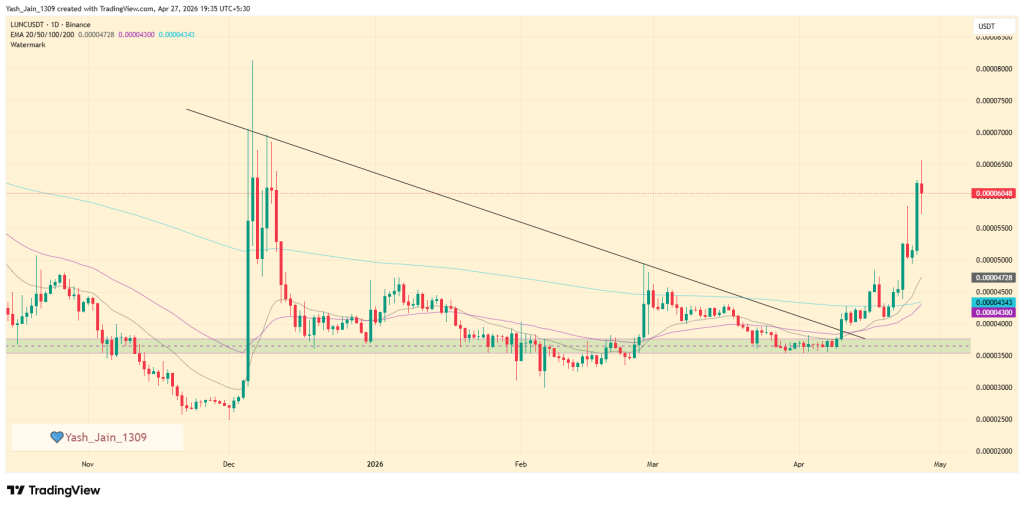
Price didn’t hesitate. LUNC price blasted through a descending trendline that had been weighing it down since late 2025. No slow grind, no hesitation just a breakout slicing through every major EMA in sight mostly got power post mid-april.

Now trading around $0.00006048, the token has done something technically significant: it turned the 200-day EMA at $0.00004728 from resistance into support. That’s not noise. That’s a shift.

Sure, the move looks overheated in the short term. It usually does after vertical candles like that. But if this legal narrative sticks around, the market’s already eyeing that $0.00008000 zone from late 2025.

XCN and LUNC Price Surge as Listings and Lawsuits Flip Market Structure

Upbit listing sends XCN price into frenzy

Now flip the script. While LUNC leans on courtroom drama, XCN went full throttle on liquidity. The Upbit listing, one of the most famous listing news that has brought results on most crypto’s that it listed in past couple of months, for instance today’s listing of XCN in KRW and USDT pairs waked up.

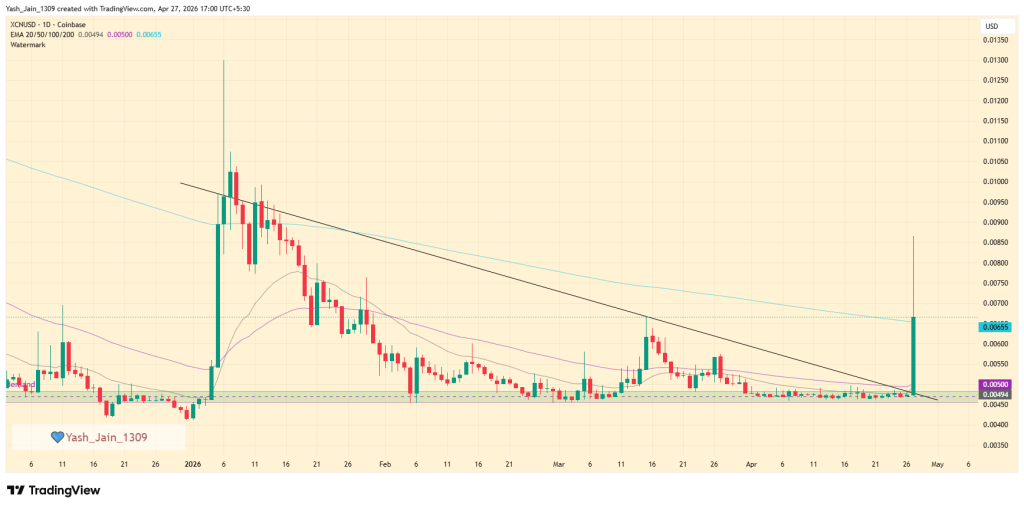
And when it woke up, it ran. From $0.0048 to $0.0085, the move was sharp, fast, and honestly, predictable if you’ve seen enough “Upbit pumps.” These listings don’t gently nudge price as they reset entire structures.

The XCN price reaction followed the textbook playbook: sudden breakout, heavy volume, and a complete shift in short-term sentiment.

XCN and LUNC Price Surge as Listings and Lawsuits Flip Market Structure

Short squeeze chaos confirms XCN structural shift

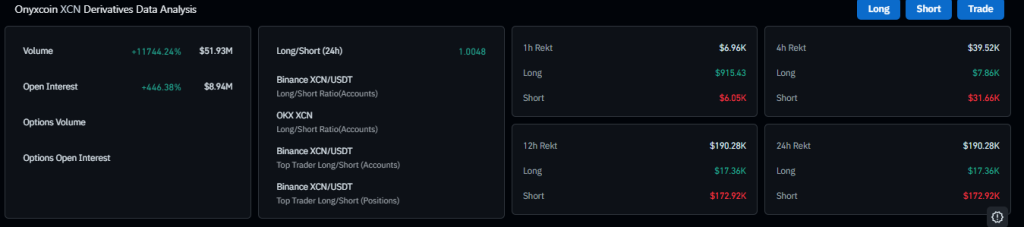
But here’s where it gets interesting. Derivatives data shows volume exploding by over 11,000%. That’s not organic growth but clearly that’s a flood. Open positions piled in, and then came the squeeze.

XCN and LUNC Price Surge as Listings and Lawsuits Flip Market Structure

Roughly $172.92K in short liquidations got wiped out as price surged past the 20 and 50-day EMAs. Traders betting against the move didn’t just lose they got forced out.

Now XCN/USD is staring down its 200-day EMA around $0.0065, a level that tends to separate hype from actual trend reversal.

XCN and LUNC price shifts rewrite near-term outlook

So, what’s the takeaway? Well, not a clean one. The XCN and LUNC price moves aren’t driven by the same fundamentals, but they’re telling a similar story and that is localized catalysts are overpowering broader market direction.the 

LUNC has a narrative. XCN has liquidity. Both now have momentum. Whether that momentum sticks? That’s where things usually get messy.

Samsung making four-sided curved display for Apple iPhone

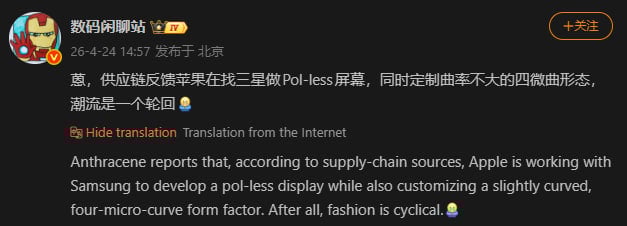
Apple’s two-decade iPhone milestone could coincide with a notable shift in display engineering. Supply chain inputs indicate that the 20th anniversary Apple iPhone may adopt a custom OLED panel developed by Samsung, built around a pol-less architecture and a four-sided curved display.

Samsung-Apple display relationship has remained steady since the first OLED iPhone. Now, Weibo leaker DCS claims that Apple and Samsung are collaborating on the development of a pol-less four-sided curved display for the 20th anniversary iPhone.

A four-sided curve pushes the screen-to-body ratio closer to a true edge-to-edge finish. It is something Apple has approached incrementally over several generations.

The reported move to a polariser-free OLED points to Color Filter on Encapsulation, or COE integration, a method Samsung has been refining for its own premium panels.

By eliminating the traditional polariser layer, the stack becomes thinner and allows more emitted light to pass through. The result is improved brightness at a lower power envelope, a balance.

For Apple, the anniversary iPhone is an opportunity to reset expectations. Edge gestures become more fluid when the transition from frame to display is less abrupt.

From a strategic standpoint, the shift underscores Samsung Display’s continued role at the high end of the OLED supply chain.

Apple iPhone Pol-Less OLED Display

The post Samsung making four-sided curved display for Apple iPhone appeared first on Sammy Fans.

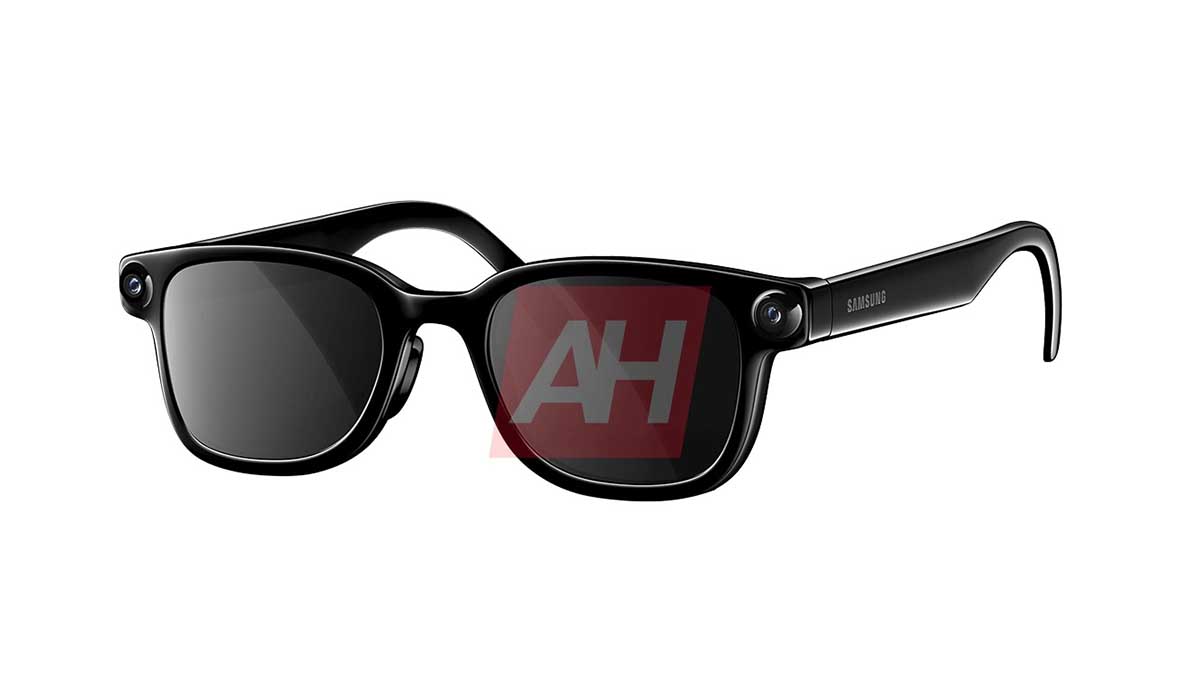
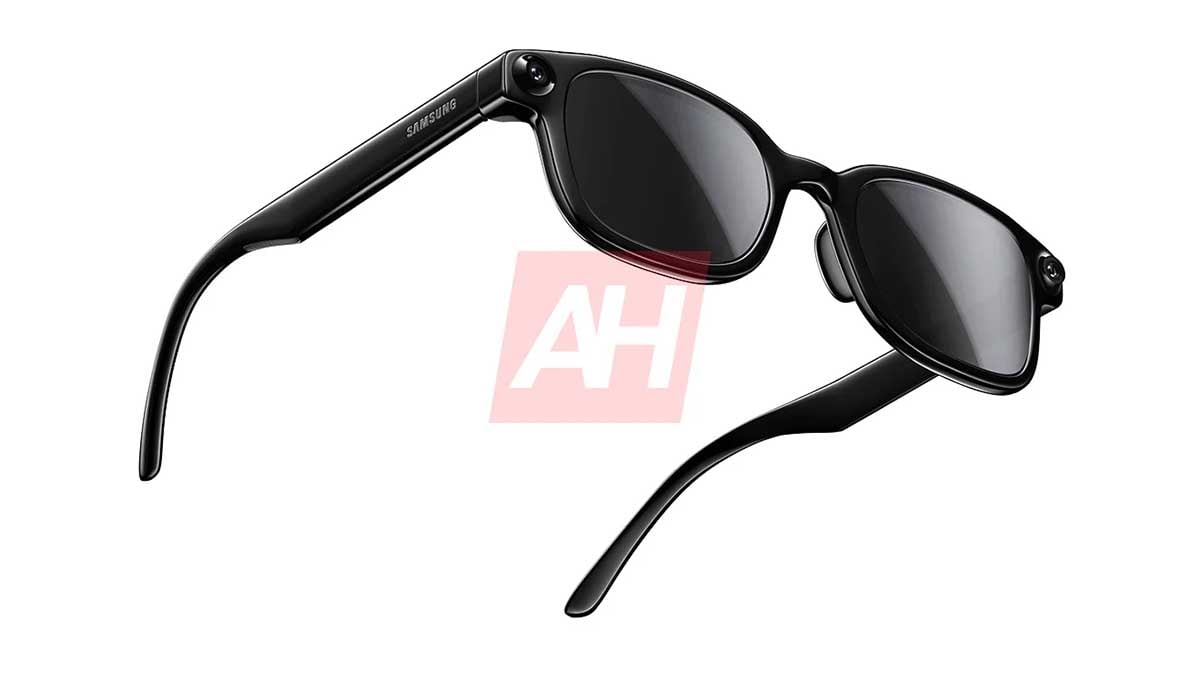
First look at Samsung Galaxy Glasses highlights AI-first design approach

We may have got our very first look at the Samsung Galaxy Glasses. The company is working on a new wearable platform, which will be unveiled without an integrated display, but will highlight the AI-first design approach and Gemini.

Samsung isn’t trying to reinvent eyewear overnight. It’s trying to sneak AI onto your face without you noticing. That’s the real story behind the first Galaxy Glasses leak, via Android Headlines.

The “Jinju” model, which you’re looking at here, skips the display entirely. At first glance, that sounds like a compromise, but it’s it’s a calculated move in reality.

With Android XR running underneath and Google’s Gemini doing the heavy lifting, the glasses become a voice-first, context-aware layer. Translate a sign, snap a quick photo through a discreet 12MP Sony sensor, or pull directions without touching your phone.

Samsung Galaxy Glasses

Design matters just as much. Samsung partnering with names like Gentle Monster and Warby Parker is no accident. Tech companies have missed the boat before by making wearables look like prototypes, which don’t scream “gadget.”Samsung Galaxy Glasses

Looking ahead, the 2027 “Haean” variant with a micro-LED display is where things get ambitious. Think of it as the pro model, once users are comfortable with AI living on their face. Until then, Jinju is the Trojan horse.

Meta has the lead in numbers, Apple is circling, but Samsung’s ecosystem play, especially with Gemini baked in, gives it a real shot at closing the gap. In this market, being right isn’t enough; you also have to not be late.

The post First look at Samsung Galaxy Glasses highlights AI-first design approach appeared first on Sammy Fans.

Samsung Members and Digital Wellbeing adopt One UI 8.5 design

Ahead of One UI 8.5 rollout, Samsung is bringing the design tweaks to the Members and Digital Wellbeing apps. The company is rolling out new updates to the two apps so they match the appearance of the upcoming upgrade.

Samsung Members and Digital Wellbeing adopted One UI 8.5 design. The experience has also been streamlined to elevate the UX. Rolling out sequentially, the updates are available for download on Galaxy Store and Play Store.

The Members app has replaced the header and navigation bar with new iterations. The hamburger menu has turned floating menu with bottom elements. You can see the Ambient Design language, offering extended screen estate.

Samsung Members One UI 8.5 Design

Source – Alfaturk

Coming to the Digital Wellbeing. Similar to other Samsung apps, this core application has been optimized with newer design components. The header carries floating buttons that occupy less space for max visibility.

UI tweaks have been made across various pages and menus.

Digital Wellbeing One UI 8.5 Design

Source – Aptivi

Over the past couple of months, Samsung has updated various apps with a newer design language. Members and Digital Wellbeing are the latest to receive visible improvements right before the full rollout of One UI 8.5 kicks off.

Galaxy S25 users in Korea may begin to receive One UI 8.5 on April 30. Following the initial rollout, Global users may join the party on May 4. Meanwhile, the availability may vary depending on region, carrier, and variant.

Even though the Stable rollout is near, Beta Program may continue on older flagship and mid-range models. Samsung is actively working on Stable builds, too, which should be available in May 2026, for plenty of models.

The post Samsung Members and Digital Wellbeing adopt One UI 8.5 design appeared first on Sammy Fans.

Bittensor (TAO) Price Prediction 2026, 2027 – 2030: Is TAO the Next AI Crypto to Explode?

Bittensor Price Prediction

The post Bittensor (TAO) Price Prediction 2026, 2027 – 2030: Is TAO the Next AI Crypto to Explode? appeared first on Coinpedia Fintech News

Story Highlights

  • The live price of the TAO crypto is  $ 250.14492008.
  • Bittensor Price could show a reversal to $500 be H1 2026.
  • TAO’s long-term outlook targets $1,000–$3,000 by 2030

Bittensor (TAO) has gained attention as a decentralized protocol focused on artificial intelligence. The network enables participants to build, share, and evaluate machine learning models through a blockchain-based system.

The project combines AI infrastructure with token incentives. This model positions TAO crypto within a growing segment of crypto tied to AI development. TAO price outlook depends on both technical patterns and network activity.

Bittensor Price Today

Cryptocurrency Bittensor
Token TAO
Price $250.1449 up 1.68%
Market Cap$ 2,715,166,901.18
24h Volume$ 158,139,899.9545
Circulating Supply10,854,375.5369
Total Supply21,000,000.00
All-Time High$ 767.6797 on 11 April 2024
All-Time Low$ 30.4010 on 14 May 2023

Bittensor (TAO) Price May 2026 Outlook

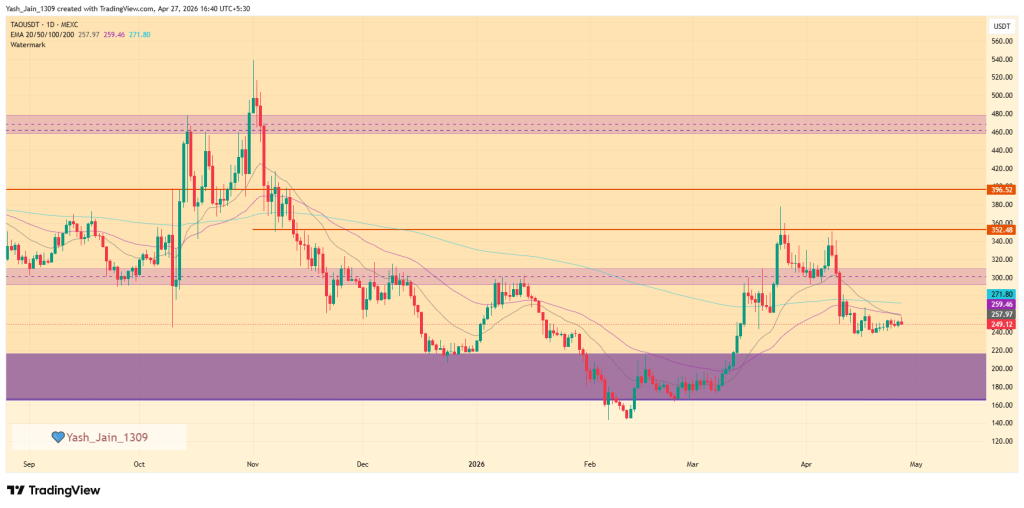
The daily chart for TAO/USDT shows that April saw a decline after March’s recovery. Currently, TAO is positioned below a “death cross” formed between the 20-day and 50-day EMA bands. The price is hovering below $260 and struggling to find the liquidity needed to trigger a reversal. 

Without a significant influx of fresh demand to reclaim the 200-day EMA and subsequently challenge the psychological $300 level, the bearish grip on the market is expected to strengthen as we move into May.

Looking ahead in May, the outlook depends on whether TAO price can maintain its current local floor around $240. If it fails to spark a relief rally toward the $300 resistance zone, we may see the downtrend continue toward the primary demand block between $160 and $210. 

Therefore, Investors should monitor a decisive daily close above the immediate EMA cluster, as this could signal a trend shift. Otherwise, the market appears set to test levels below $200 before a meaningful bottom is established.

Bittensor (TAO) Price May 2026 Outlook

Also Read : Bittensor (TAO) Price Holds Strong Amid Market Correction—Is a $350 Rebound Still on the Table?

Recent news/opinions

On April 10th, Covenant AI a major project on TAO announced they are leaving bittensor and reportedly sold 37,000 $TAO worth over $10 million.

On March 16th, Grayscale posted about its Bittensor Trust for private placement, offering eligible accredited investors direct exposure to the TAO ecosystem. This move underscores growing institutional interest in decentralized AI, as Grayscale highlights the protocol’s role in leveraging economic incentives for open-source development.

Coinpedia’s Bittensor (TAO) Price Prediction 2026

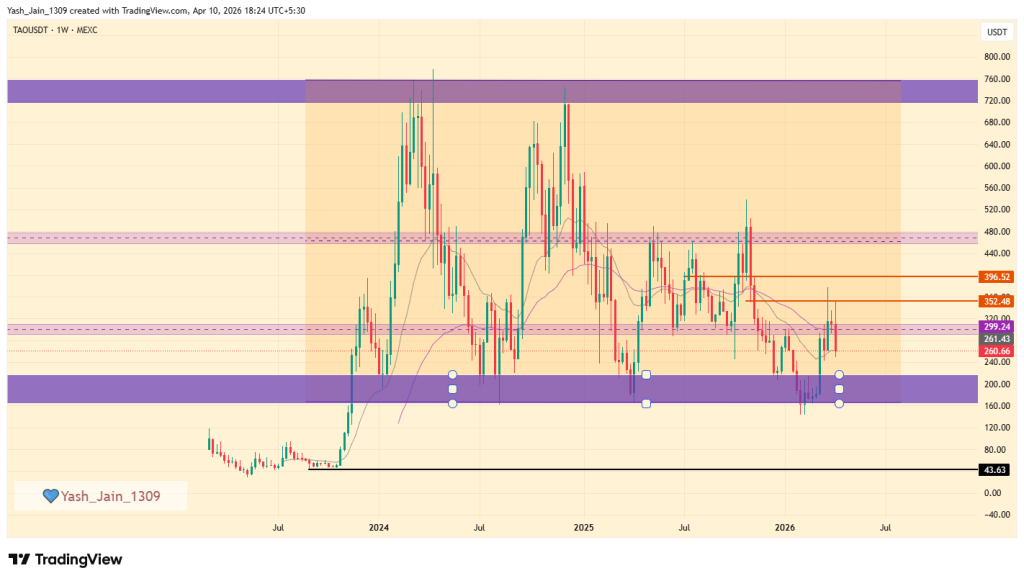
The weekly chart for Bittensor (TAO/USDT) reveals a well-defined long-term range that has governed price action since the network’s explosive growth in 2024. This structural parallel channel is anchored by a significant accumulation floor near $160–$200 and a formidable overhead supply ceiling around $720–$760.

In Early 2024 saw TAO price reached its All-Time High (ATH) of approximately $760. Despite a volatile year, the price repeatedly cycled between the channel’s borders, demonstrating high demand at the lower bounds and aggressive profit-taking at the upper extremes.

But throughout 2025, market momentum shifted into a lower-intensity regime. The price largely remained capped under the $500 psychological barrier. A brief Q4 2025 rally attempted to reclaim the upper range but was rejected at $535, leading to a sharp retracement back to the primary demand zone by early 2026.

By Q1 2026, the price has successfully defended the $160–$200 support zone for the third time in two years. This “triple-bottom” characteristic suggests strong institutional interest at these valuations, and the rally to $352 was proof of that.

Coinpedia's Bittensor (TAO) Price Prediction 2026

But, it has faced resistance in Q2’s April and has slipped below the $300 demand area. Now, it did fall on the news, but from a price-action perspective, it looks like a short red candle after 3 months of a rally. So the chances are that it’s a healthy dip for its bullish structure to be maintained for months ahead. But if it’s a healthy dip, it needs to jump back above $ 300; if it doesn’t, it might crash lower, revisit $160-$200 support, and spend the entire Q2 there consolidating, or could seek even deeper levels.

If the TAO price can maintain above $300, then $352 and $396 during this period would be revisited before the first half of 2026 concludes, clearing the technical path for a retest of the $500 supply area. A sustained close above the mid-range would then signal long-term extension in the rally, possibly to the upper border of this parallel channel by year’s end.

Also read: Top 10 Bittensor Subnets to Watch as TAO Surges 90% 

Bittensor Onchain Analysis

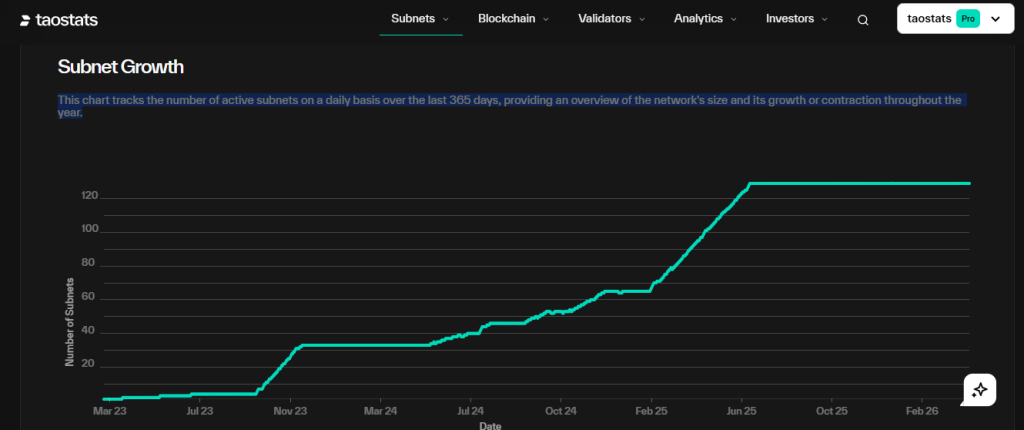
Data from Taostats, the primary ecosystem tracker for Bittensor, highlights a period of aggressive expansion in the network’s infrastructure. From March 2023 through June 2025, the number of active subnets experienced a parabolic climb, ultimately reaching a peak of 129. This growth underscores the rapid scaling of Bittensor’s decentralized AI architecture and its ability to attract diverse, specialized compute layers.

Over the last 365 days especially, the chart reveals a shift from rapid expansion to a phase of high-level stability. While the total number of subnets has plateaued at its upper limit, the network has maintained a consistent and active presence throughout the year. 

This steady horizontal trend is significant, as it demonstrates a matured ecosystem where the network size remains robust and functional, providing a reliable foundation for the protocol’s ongoing operations.

Bittensor Onchain Analysis

Bittensor Crypto Price Prediction 2026 – 2030

YearPotential Low ($)Potential Average ($Potential High ($)
20274007201000
20286008201200
202980011502000
2030100018003000

Bittensor (TAO) Price Prediction 2027

As per the Bittensor Price Prediction 2027, Bittensor may see a potential low price of $400. The potential high for Bittensor price in 2027 is estimated to reach $1000.

TAO Crypto Price Prediction 2028

In 2028, Bittensor price is forecasted to potentially reach a low price of $600 and a high price of $1200.

Bittensor Price Forecast 2029

Thereafter, the Bittensor  (Bittensor) price for the year 2029 could range between $800 and $2000.

Bittensor (TAO) Price Prediction 2030

Finally, in 2030, the price of Bittensor is predicted to remain steadily positive. It may trade between $1000 and $3000.

Bittensor Price Prediction 2031, 2032, 2033, 2040, 2050

The long-term projection assumes Bittensor sustains relevance in enterprise blockchain use cases, with growth moderating over time as the asset matures.

YearPotential Low ($)Potential Average ($)Potential High ($)
2031120018003000
2032160023003300
2033190034004000
2040320058007800
20506500850010000

Bittensor Crypto Price Market Analysis

Year202620272030
Changelly$620.00$850$1200
CoinCodex$540.00$900$1400
WalletInvestor$760.00$950$1550
Never Miss a Beat in the Crypto World!

Stay ahead with breaking news, expert analysis, and real-time updates on the latest trends in Bitcoin, altcoins, DeFi, NFTs, and more.

What Is Bittensor?

Bittensor operates as a decentralized marketplace for machine intelligence. It uses a system of subnets where contributors train and validate AI models.

The protocol runs on a mechanism known as Yuma Consensus. This system distributes rewards based on the usefulness of contributions rather than computing uptime alone.

The TAO token serves several functions:

  • Secures the network through staking
  • Provides access to AI services
  • Rewards contributors

The total supply is capped at 21 million tokens, similar to Bitcoin.

FAQs

What is Bittensor (TAO) and how does it work?

Bittensor is a decentralized AI network where users share and train models. TAO tokens reward valuable contributions and enable access to AI services.

What is the price prediction for Bittensor (TAO) in 2026?

TAO is expected to trade between $160 and $500 in 2026, with a potential retest of higher resistance if bullish momentum continues.

How much will Bittensor (TAO) be worth in 2030?

By 2030, TAO could trade between $1000 and $3000, supported by growing demand for decentralized AI and sustained ecosystem expansion.

What is the price prediction for TAO in 2040?

TAO may reach between $3200 and $7800 by 2040 if adoption of decentralized AI accelerates and the network maintains long-term relevance.

How high can TAO price go by 2050?

By 2050, TAO could climb as high as $10,000, assuming strong global AI demand, continued innovation, and consistent network growth.

Is Bittensor (TAO) a good long-term investment?

TAO shows long-term potential due to its AI focus and token utility, but investors should consider market risks and evolving competition.

What could drive Bittensor (TAO) price growth?

Key drivers include AI adoption, subnet expansion, institutional interest, and increased demand for decentralized computing resources.

Sei (SEI) Price Prediction 2026, 2027-2030: Will the Sei Giga Upgrade Trigger a Bullish Breakout?

SEI Price Prediction 2026,2027 – 2032

The post Sei (SEI) Price Prediction 2026, 2027-2030: Will the Sei Giga Upgrade Trigger a Bullish Breakout? appeared first on Coinpedia Fintech News

Story Highlights

  • The SEI live Price is  $ 0.06290456.
  • Sei (SEI) remains in a bearish trend in 2026, with price approaching the $0.020 demand zone. A strong rebound could push SEI back toward $0.10–$0.20 by year-end.
  • Long-term projections remain bullish for Sei, with analysts forecasting steady growth that could push SEI toward the $1.26–$1.45 range by 2032.

Originally recognized as the first sector-specific Layer 1 blockchain, Sei has evolved into a powerhouse of parallelized execution. While its initial mission focused on optimizing decentralized exchanges (DEXs), the 2024-2025 “V2” upgrade transformed Sei into the Parallelized EVM. This pivot allowed the network to combine the vast developer ecosystem of Ethereum with the blazing-fast performance typically reserved for non-EVM chains like Solana.

As we move through 2026, the network is undergoing its most ambitious technical overhaul yet: the Sei Giga upgrade. By implementing the “Autobahn” consensus and asynchronous execution, Sei aims to support over 200,000 transactions per second with sub-400ms finality. From institutional real-world asset (RWA) tokenization to high-frequency gaming and AI-agent economies.

Planning on investing in this crypto project but concerned about its prospects? Fear not and scroll down, as in this article, we have uncovered the market trends of SEI price prediction from 2026 up until 2032.

Sei Price Today

Cryptocurrency Sei
Token SEI
Price $0.0629 up 4.45%
Market Cap$ 438,794,248.03
24h Volume$ 44,422,610.3362
Circulating Supply6,975,555,555.00
Total Supply10,000,000,000.00
All-Time High$ 1.1417 on 16 March 2024
All-Time Low$ 0.0080 on 15 August 2023

Sei (SEI) Price Prediction May 2026

As the first quarter closed on a bearish note, investors are now looking for opportunities in the second quarter.

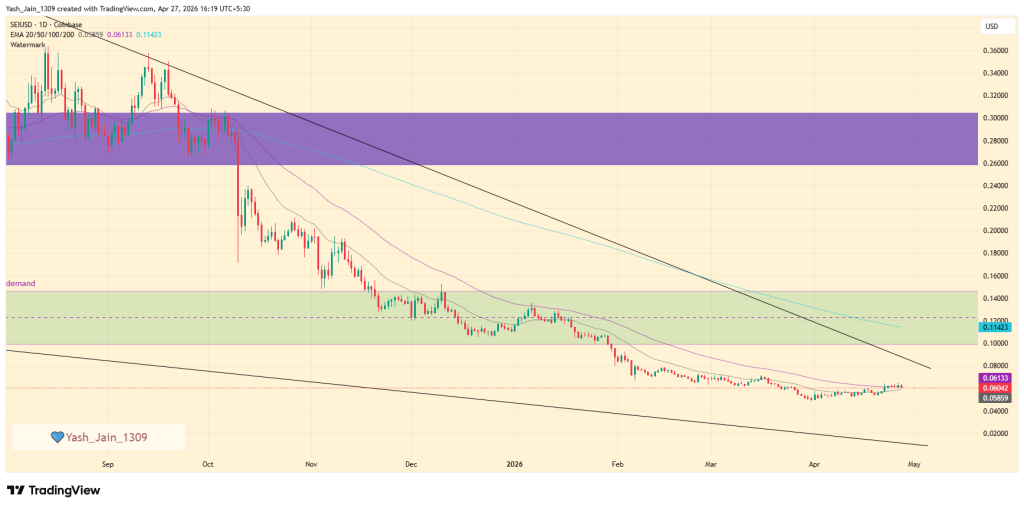
The first quarter has extended the downturn from 2025 into 2026, with the January-to-March period presenting ongoing challenges. Notably, the SEI price fell below the $0.100 threshold, indicating a continued bearish trend, and by March, it even reached a low of $0.050.

However, in April, signs of gradual bullish strength are emerging. If the SEI price experiences further bullish development, it could rise in May to retest the upper edge of the existing falling wedge pattern. 

On the other hand, this sustained downward movement could lead to additional declines if market conditions remain unchanged, raising concerns about approaching the lower boundary of a falling wedge pattern in May.

Sei (SEI) Price Prediction May 2026

Recent News/Updates

  • Coinbase has officially integrated the Sei EVM, transitioning all SEI network transactions to the new standard for enhanced compatibility and performance. This significant update, which enables native EVM support for all sends and receives on the platform, was publicly announced by the Sei Network team on April 14.
  • Sumvin, Inc. officially launched on February 26, 2026, utilizing Sei’s sub-second finality for AI-powered financial execution.
  • Coinbase Markets announced on February 27th that Sei will transition from Cosmos-based transactions to an EVM-only architecture. They will be facilitating this migration to the Sei EVM, which will take place from April 6-8, 2026.

Coinpedia Sei (SEI) Price Prediction 2026

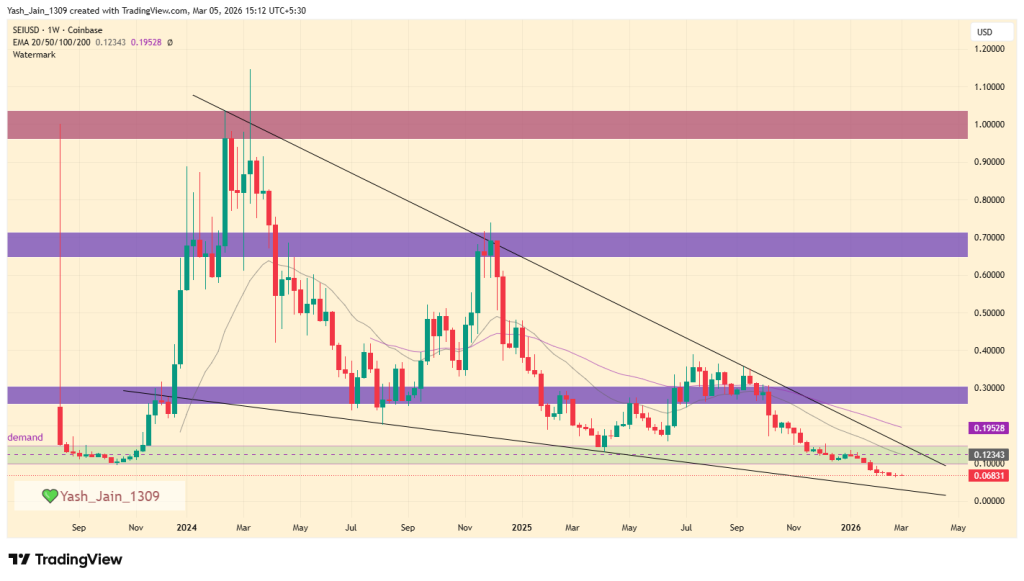
The technical outlook for Sei (SEI) in 2026 reflects a challenging macroeconomic trend defined by a persistent descending structure. Looking back at the weekly chart, 2024 was marked by two significant but ultimately capped rallies: an explosive surge to the $1.00 mark in the early months, followed by a secondary peak near $0.70 late in the year 2024. Both movements highlighted intense bearish pressure, as sellers consistently utilized these rallies to exit positions, effectively constraining the price within a tightening range.

This market structure deteriorated further in 2025 when the SEI price failed to hold the critical $0.30 demand zone. The breakdown confirmed that the SEI asset had abandoned traditional horizontal support levels and is favoring a massive falling wedge pattern. 

This technical formation has been dictated by three clear resistance touches, the most recent occurring in September 2025. While analysts initially hoped the early 2023 demand floor would exhaust the selling pressure, the first quarter of 2026 saw a continuation of the slide, with the price slipping beneath the psychological $0.10 support area.

Current price action suggests that the SEI price is now gravitating toward the lower boundary of the falling wedge. This decline is expected to persist through mid-2026 until the price meets the primary demand area situated around the $0.020 mark. This level represents a deep value zone where selling exhaustion is highly probable.

If buyers successfully defend this floor, the resulting spike in demand could ignite a trend reversal, potentially driving the SEI token price back toward the $0.10 and $0.20 levels. Under a highly bullish recovery scenario, a retest of the $0.30 breakdown point remains a possibility before the year concludes.

Sei (SEI) Price Prediction 2026

Sei (SEI) Long-Term Price Projections: 2027 – 2032

YearMinimum Price ($)Maximum Price ($)Average Price ($)
20270.24500.29400.2500
20280.35500.42600.3650
20290.52400.61900.5350
20300.78500.90500.8060
20310.89001.10000.9950
20321.26001.45001.3210

Sei (SEI) Price Prediction 2027

The SEI price forecast maintains an upward climb throughout 2027. Market analysts project the SEI token will fluctuate between $0.2450 and $0.2940, centering on an annual average SEI/USD price of $0.2500.

Sei Crypto Price Prediction 2028

Growth is expected to accelerate in 2028 as ecosystem maturity attracts deeper liquidity. SEI crypto price is projected to trade within a bullish corridor of $0.3550 to $0.4260, maintaining a robust year-round average of $0.3650.

SEI Token Price Prediction 2029

By 2029, SEI token’s price movements are anticipated to reach a significant peak of $0.6190. On the lower end, strong support is expected at $0.5240, leading to a projected average trading cost of $0.5350.

SEI Price Prediction 2030

Entering the new decade, SEI Crypto’s valuation is expected to be driven by global market recognition. Projections suggest a price range of $0.7850 to $0.9050, with an expected average price of $0.8060.

SEI/USD Prediction 2031

The bullish momentum continues into 2031, with the high target set at $1.1000. While retracements may dip toward $0.8900, the overall market equilibrium is expected to sit near $0.9950.

Sei (SEI) Price Prediction 2032

Based on current expert modeling, 2032 represents a major milestone for the token. SEI is estimated to range between $1.2600 and $1.4500, with an average valuation of $1.3210.

Never Miss a Beat in the Crypto World!

Stay ahead with breaking news, expert analysis, and real-time updates on the latest trends in Bitcoin, altcoins, DeFi, NFTs, and more.

FAQs

What is the Sei (SEI) price prediction for 2026?

SEI may drop toward $0.020 before recovering. If demand returns, it could rebound to $0.10–$0.20, with a bullish case targeting $0.30 by year-end.

How high can Sei (SEI) price go by 2030?

By 2030, SEI could reach between $0.7850 and $0.9050, with further upside possible if ecosystem growth and adoption accelerate

What is the Sei Crypto price prediction for 2040?

By 2040, SEI could exceed $2–$3 if long-term adoption, scalability, and real-world use cases expand, though such projections remain speculative.

Is Sei (SEI) a good long-term investment?

SEI shows long-term potential due to its high-speed infrastructure and upgrades, but it remains a high-risk asset dependent on adoption and market trends.

Leaked One UI 8.5 changelog for Galaxy S23 Ultra shows upgrades and missing AI features

Leaked changelog reveals the Stable One UI 8.5 for the Galaxy S23 Ultra focuses more on refinement than headline-grabbing additions. It brings a noticeable design refresh and a handful of practical upgrades across the system.

Samsung is leaning into a cleaner, more layered design with transparent blur effects and floating UI elements. It feels closer to a polish pass than a redesign, but the improved depth and readability make navigation smoother, via TarunVats.

Lock screen customization also gets better, with smarter wallpaper fitting, new clock styling options, and downloadable interactive wallpapers.

On the AI front, the Stable update expands existing capabilities rather than introducing the newest Galaxy AI tools. Photo Assist now supports continuous image generation without forcing users to save each version.

Bixby has also been improved to better understand natural language commands and provide quicker answers, along with an accessible conversation history panel.

Several newer AI features seen on the Galaxy S26 lineup are absent. There’s no sign of Call Screening, Creative Studio, upgraded AI Audio Eraser, Notification Highlights, or Now Nudges in this build, suggesting Samsung is keeping those exclusive.

Camera changes are relatively minor, limited to a few new portrait filters. The Weather app adds precipitation graphs and a pollen index, while the Clock app introduces weather-based alarm backgrounds.

Here’s the complete One UI 8.5 update changelog

Visual design

Fresh new look

One UI seamlessly integrates into your daily routine by combining immersive visuals with meaningful personalization for a more refined and sophisticated design. Transparent blur effects add depth and make content easier to navigate, while floating elements react organically to your workflow for a more focused experience. Through familiar and intuitive data visualization, One UI delivers a design that feels both personal and relatable, helping you focus on what matters.

Galaxy AI

Continuous image generation

Keep creating without stopping. Photo Assist now lets you generate AI images using different features from the results screen without saving each iteration. When you’re done, you can review all your creations in your history and pick your favorites.

Bixby

Smarter device control

Talk to Bixby in your own words. Bixby is now better at finding the setting or feature you need, even if you don’t use exact commands or feature names. Just say what you need and let Bixby do the rest.

Ask anything, anytime

Whether you need a quick answer or detailed information, just ask Bixby for an instant response. There’s no need to spend time on multiple searches or switching between apps.

Conversation history

Looking back at past conversations with Bixby is easier than ever. You can now access your conversation history from the side panel in the Bixby app.

Camera

New portrait filters

Three new filters are available to add vibrant film-like effects to your pictures.

Home and Lock screens

Automatic Lock screen layout

Wallpapers with pictures of people or pets now fit perfectly every time. When you choose a photo for your Lock screen, the photo will automatically be adjusted to best fit your clock and widget layout.

New downloadable wallpapers

Discover new wallpapers featuring interactive elements. Wallpapers are downloadable so they don’t use up your storage space when not in use.

More customizable clock fonts

Personalize your Lock screen clock. You can now adjust the thickness of more font styles to match your preferred look.

Weather

Enhanced weather widget

Quickly check upcoming precipitation in the Weather widget on your Home screen. The widget now shows a graph if precipitation is expected in the next few hours.

Pollen index

Check how much pollen is in the air to help manage your allergies. You can check pollen levels for trees, grass, and ragweed.

Communication

Direct voicemail

Can’t answer right now? Let callers record a voice message directly on your phone that you can listen to later. The message will appear on your screen as it’s being recorded so you can answer at any time.

Clock

Weather alarm backgrounds

Wake up to an alarm that gets you ready for the day’s weather. Your alarm screen can now show the current weather conditions as a background when it rings.

Time zone converter

Compare time zones at a glance. The new slider in the Clock app makes it easy to check the time difference between places around the world.

Connectivity

Storage Share

Access your files anywhere. Files from your other Samsung phones, tablets, and PCs are available in the My Files app on your phone. You can also access your phone’s files on other Samsung devices, even your TV.

Auto Hotspot

Share your phone’s internet connection more easily. You can now share your hotspot with your Samsung account family group, or create your own hotspot sharing group with anyone you choose.

Family device sharing

Easily connect and share files, screens, cameras, storage and more with your family. Family device sharing lets you use features like Quick Share, Camera Share, Storage Share, Auto Hotspot, and Multi control with Galaxy devices that belong to your family members.

Quickly connect to Smart View devices

Connect to your favorite display faster. You can now add a shortcut on your Home screen to instantly mirror your phone’s screen to a TV or other display device.

Enhanced Auracast features

It’s easier than ever to listen to and broadcast sound with Auracast. Options for both broadcasting and listening are now located in the Audio broadcast menu in Settings.

Voice broadcasts

Broadcast your voice to people around you with Auracast. In addition to media sound, you can now broadcast your voice using your phone’s built-in microphone.

Quick Share

Avoid unwanted sharing requests

You can now set Quick Share to only receive files from other devices signed in to your Samsung account or Google account.

Samsung Health

Enhanced weekly reports

See a fuller picture of your health each week. Weekly reports now include data from your medication tracker and mindfulness sessions.

Upgraded sharing experience

Share your workouts your way. Mix and match your exercise stats with photos from your workout to create the perfect social media post.

Start meditations from your watch

Find calm right from your wrist. You can now start favorite or recommended meditations directly on your Galaxy Watch without picking up your phone.

Antioxidant measurements from your watch

Check your antioxidant levels anytime. Measure directly from your Galaxy Watch, even if it’s not connected to your phone. Works with Galaxy Watch8 and Galaxy Watch Ultra.

Battery and power

Revamped battery info

See your battery use more clearly. The redesigned Battery settings screen makes it easier to check remaining time, charging status, and daily usage over the past week.

Improved Power saving

Use Power saving to make your battery last longer without charging. Choose Standard for moderate savings and customizable limits, or choose Maximum to turn off all non-essential features and make your battery last as long as possible.

Security and privacy

Privacy alerts

Stay informed about your privacy. You’ll now get alerts when an app’s permissions could put your personal data at risk along with suggestions for what you can do about it.

Theft protection

Keep your phone and data safe in case it is lost or stolen. Turn on Failed authentication lock to automatically lock the screen in case there are too many failed attempts to verify your identity using your fingerprints, PIN, pattern, or password. Identity check also protects even more settings than before.

Turn off Auto Blocker temporarily

If you need to temporarily disable Auto Blocker’s security protection, a new option lets you turn it on automatically 30 minutes later so you don’t forget.

Check the security status of your devices

Keep all your devices protected. Knox Matrix now shows when any of the supported devices signed in to your Samsung account need a software update for the latest security protections.

Accessibility

Easily control Bluetooth hearing aids

Access settings for your Bluetooth hearing aids directly from the Accessibility shortcut. A pop-up will appear that lets you change your hearing program, turn Ambient sound on or off, and more.

Control magnification with mouse or keyboard

Keep what you need magnified in view with these new options. You can make the magnified area follow the cursor as you type or move when you change focus using the keyboard. When using a mouse, you can make the magnified area shift as you move the pointer to the edge of the screen.

Dwell action and Corner actions

The Auto action after pointer stops feature has been divided into two features. Dwell action lets you set custom actions when your mouse stops moving for a certain amount of time. Corner actions let you set a different action for each corner of the screen.

Even more improvements

More customizable quick panel
Arrange your quick settings just the way you like them. You can now add, remove, reorder, and reorganize controls in the quick panel.

Early alerts for reminders

Get alerts before reminders are due to make sure you don’t forget important tasks. You can choose how far in advance to get an alert for each reminder.

Insert tables in Samsung Notes

Organize information in your notes with tables. You can adjust column widths, colors, and border designs while the auto calculation feature helps you stay productive and save time.

Redesigned New tab page

The page that appears when you open a new tab in Samsung Browser has been redesigned to help you quickly access the websites and features you need the most. The New tab page now shows the current security status as well as open tabs from Samsung Browser on other devices.

Partial screen recording

Include only what you need in your screen recordings. You can now select only the part of the screen that you want to record.

Calculator nudges

Save time on calculations. Numbers and formulas copied to your clipboard will be suggested when you open Calculator so you can enter them with a quick tap.

Keep window sizes in DeX

DeX now remembers your app window sizes and positions. When you open an app again, it appears just as you left it.

Triple Zero service enhancement

Software enhancement to provide an additional layer of connectivity to Triple Zero services during emergency service outages.

The post Leaked One UI 8.5 changelog for Galaxy S23 Ultra shows upgrades and missing AI features appeared first on Sammy Fans.

Galaxy A36, A55 and A35 get One UI 8.5 Beta 2 with bug fixes and performance improvements

After the Galaxy S23 series, Samsung pushed the One UI 8.5 Beta 2 update to the Galaxy A36, Galaxy A55 and Galaxy A35. The software is now available for Beta participants in India.

It is a cleanup-focused update, targeting a few noticeable annoyances from the first build. Users can identify the update via the PDA build version ZZDC/7/9, which also carries the latest April 2026 security patch.

The most important fix addresses Bluetooth behavior. Autoscan wasn’t triggering properly when users entered the Bluetooth menu, which could make device discovery feel broken.

Performance tuning is also part of this build, as spotted by Mohammed Khatri. Samsung has worked on reducing the lag when pulling down the Quick Panel, which should make everyday interactions feel smoother and more responsive.

On the UI side, there’s a fix for an issue where the message input field would overlap with the navigation bar. It’s a small bug, but one that directly impacts usability while typing.

Lastly, Samsung has patched System UI ANR (probably App Not Responding) issues that appeared after FOTA (firmware over-the-air) updates. This should improve overall stability and reduce random freezes tied to system processes.

Overall, Beta 2 doesn’t bring new features, but it tightens up performance and fixes some rough edges from the initial release.

One UI 8.5 Beta 2 changelog for Galaxy A36, A55 and A35

  • Fixed an issue that Bluetooth Autoscan did not work when entering Bluetooth
  • Improved the Sluggish/Delay when lowering the Quick Panel
  • Fixed an issue that overlaps the message input window with the navigation bar
  • Fixed System UI ANR issues after FOTA

The post Galaxy A36, A55 and A35 get One UI 8.5 Beta 2 with bug fixes and performance improvements appeared first on Sammy Fans.

One UI 8.5 Beta flags touch delay issue on Galaxy S25

Samsung is days away from pushing the stable One UI 8.5 build, but the latest Beta is still flagging optimization and touch delay issues on the Galaxy S25 series.

While testing Beta 10 on the Galaxy S25 Ultra, I ran into a system-level warning that should not be showing up this late in the cycle. A pop-up appeared stating that “One UI Home isn’t optimized for the latest version of Android.”

What followed was more concerning.

Touch input started lagging, not outright freezing, but delayed enough to break interaction flow, with some taps not registering at all.

The issue became more obvious when using the search. Triggering it caused a full launcher crash; the UI didn’t reboot cleanly either.

Instead, the system entered a half-responsive state. The Quick Panel could still be pulled down, which suggests the system UI thread was alive, but actions inside it were dead. Tapping “Start Recording” or similar toggles did nothing.

Samsung One UI Home Bug One UI 8.5 Beta

There is a workaround, and it’s oddly manual, via MojoTrick. Repeatedly swiping back to the home screen eventually restores responsiveness. That lines up with a temporary blockage in the launcher or UI rendering pipeline.

This bug sits in an uncomfortable spot. The fact that it’s tied to One UI Home optimization suggests something isn’t fully aligned between One UI 8.5 and the underlying Android build.

With the stable rollout expected this Thursday, the question is simple: Does Samsung already have a patched build ready, or is this slipping into release firmware unnoticed?

The post One UI 8.5 Beta flags touch delay issue on Galaxy S25 appeared first on Sammy Fans.

Samsung offers Spotify Premium freebie in select American countries

Samsung is sweetening the deal on its mid-range phones in South America, quietly rolling out a Spotify Premium bundle for buyers of select Galaxy A series devices in the region.

Spotify Premium is being offered to Samsung Galaxy buyers across countries in South America, reports ETNews. It’s a smart play, and it tells you a lot about how nervous Samsung actually is.

Buyers of the Galaxy A57, A37, A17, and A07 pick up three months of Spotify Premium at no cost. Existing subscribers aren’t left out either; they can snag up to two bonus months depending on conditions.

Benefits of Spotify Premium include ad-free streaming, offline downloads, and curated recommendations. Samsung fans buying Galaxy A phones are getting free access, and it should be available globally.

Latin America shipped 140.5 million phones last year, and Samsung held the top spot with 46.9 million units. Omdia reported that the Korean company’s shipments were carried largely by a 32% surge in entry-level A0x and A1x models.

South Americans consume content, including music, video, and social media, eagerly. Attaching a streaming benefit to a phone purchase isn’t random. It’s targeted at a behavior that already exists, just redirected toward the Galaxy ecosystem.

Rising memory costs are squeezing manufacturers across the board this year, and inventory strategies in the region are tightening. Bundling Spotify is the move you make when a race to the bottom stops being an option.

Samsung Spotify

The post Samsung offers Spotify Premium freebie in select American countries appeared first on Sammy Fans.

Samsung had a way to shrink the S26 Ultra selfie cutout, Galaxy S27 Ultra may use it

Selfie camera cutout is a major thing remaining to be innovated on mobile displays, and it looks like Samsung is already on it. It seems Samsung had a way to reduce the Galaxy S26 Ultra selfie camera cutout, but S27 Ultra may adopt it.

Galaxy S26 Ultra was introduced in February 2026, and in particular, it brings a bigger selfie camera hole over its predecessor. The shift results in a wider field of view on the front camera to improve group selfies.

Samsung seems to have had a new technology to shrink the selfie camera cutout, which was skipped on the Galaxy S26 Ultra, reportedly debuting with the Galaxy Z Fold 8 and potentially expanding to the Galaxy S27 Ultra.

Recently, tipster IceUniverse revealed that Samsung could use a new technology in the Galaxy Z Fold 8’s cover screen. The new solution significantly reduces the diameter of the hole of the front camera on the display.

With under-display camera tech, which isn’t favorable for premium phones, it’s great to see the hole is getting smaller. Galaxy Z Fold 8 may bring the innovation, which could potentially head to the S27 Ultra next year.

Ice Universe today posted a handful of images of the Galaxy S26 Ultra with its actual selfie camera cutout (4.0mm) and how it could have looked if the Fold 8’s tech (2.5mm) was adopted in it. The difference is big; big enough to flip the script.

That said, the Galaxy Z Fold 8 may bring a preview of the Galaxy S27 Ultra’s possible selfie camera hole. The Unpacked is likely to take place in late July in London, while the Galaxy S event may take place early next year.

Samsung Galaxy S26 Ultra Camera Hole

The post Samsung had a way to shrink the S26 Ultra selfie cutout, Galaxy S27 Ultra may use it appeared first on Sammy Fans.

Galaxy S23 family’s One UI 8.5 Beta 2 fixes a green line problem

Samsung’s One UI 8.5 Beta 2 update has started rolling out to the Galaxy S23 series. The latest software update carries the PDA version ZZDP, which brings fixes for key issues linked to the display, calling, camera, and more.

The update improves call reliability, addressing cases where the screen would turn black or respond late when receiving a call. It also fixes problems with the proximity sensor during calls, which could behave inconsistently.

Camera stability gets a boost too, with a fix for green line issues that appeared while recording 4K HDR videos in some apps. Samsung has now addressed it, so video recording should be cleaner.

One of the notable fixes targets the “green line” problem, but this isn’t the display defect some users worry about. Instead, it was a camera-related glitch that could show green lines while recording 4K HDR videos in certain apps.

On top of that, Samsung has improved Bluetooth stability to prevent crashes. The update also resolves a multi-touch issue that could occur when certain accessibility settings were enabled, making overall touch response reliable.

One thing that caught my attention is the continuity of security patch. Samsung should have included the May 2026 security patch. Instead, the second Beta retains the current security patch dated April 5, 2026.

Get the latest Beta update through Settings > Software update > Download and install.

Earlier, Samsung started the One UI 8.5 Beta Program and delivered the first Beta. The opportunity opens access to the upcoming software. Beta is limited to select markets, and Stable rollout may start by the end of next month.

Samsung Galaxy S23 One UI 8.5 Beta

The post Galaxy S23 family’s One UI 8.5 Beta 2 fixes a green line problem appeared first on Sammy Fans.

Samsung expands OpenAI partnership for ChatGPT Edu

Samsung SDS quietly expanded its OpenAI partnership this week, locking in reseller rights for ChatGPT Edu and targeting educational institutions across Korea.

According to SBSBiz, Samsung is already running a proof of concept with the Korea National Open University, which has roughly 90,000 students, faculty, and staff.

Real numbers, real stakes; if that deployment goes live, it signals Samsung SDS has stopped treating education as a secondary market and started treating it as a priority.

ChatGPT Edu

ChatGPT Edu is a version of ChatGPT built specifically for universities and research organizations. Conversations don’t feed back into OpenAI’s training data.

That matters enormously when you are talking about student records, unpublished research, and faculty work. Arizona State, Cal State, and Harvard are already running it globally, with Korea catching up fast.

Samsung SDS is bringing its one-team model to these deployments, folding AI consulting, development, cloud infrastructure, and security into a single framework.

Additionally, LG CNS signed a similar reseller deal and is already running seminars at major Seoul-area universities. It operates through something called the OpenAI Launch Center.

Samsung SDS and LG CNS are racing to own the institutional AI stack. The security angle is the real battleground. Schools won’t touch AI tools that compromise student data, and both sides know it.

Samsung SDS head of strategic marketing Lee Jung-heon said the goal goes beyond reselling, pointing toward full deployment and operational support.

ChatGPT Edu

The post Samsung expands OpenAI partnership for ChatGPT Edu appeared first on Sammy Fans.

AI-first phones may be next; OpenAI seems to be considering one

The Galaxy S24 series was introduced at AI Phone, with Samsung continuing its efforts on each iteration. Meanwhile, OpenAI could be considering entering the market with AI-first phones if plans make strategic sense.

The current smartphone model is built around apps, but that abstraction is starting to break. What users actually want is task completion, not app navigation. That shift is where OpenAI’s “AI agent” concept fits in.

Instead of hopping between services, an agent-centric interface collapses intent, execution, and response into a single layer. It changes how silicon is designed, how operating systems behave, and how data flows between device and cloud.

OpenAI’s reported partnership with MediaTek and Qualcomm signals a deliberate move into silicon co-development. Luxshare sits in a critical position as the exclusive system co-design and manufacturing partner.

The 2028 mass production target aligns with a typical custom silicon cycle. Specifications are expected to be locked by late 2026 or early 2027, as reported by MingChiKuo.

Key design priorities are already clear:

  • Continuous context awareness, which demands ultra-efficient low-power compute blocks
  • Memory hierarchy optimization, since AI agents rely heavily on fast data access rather than raw peak performance
  • Hybrid execution, where smaller models run locally and larger inference workloads are offloaded to the cloud

OpenAI AI first phones

The so-called Zebrafish comparison is tied to Google’s TPU collaboration with MediaTek. In simple terms, a single advanced AI chip program can generate revenue equivalent to tens of millions of smartphone processors.

The next smartphone battleground may not be cameras or displays. It will be the one who owns the primary interface between user intent and execution.

The post AI-first phones may be next; OpenAI seems to be considering one appeared first on Sammy Fans.

Galaxy Z Fold 8, Wide and Flip 8 appear in realistic dummy images

Samsung’s next-gen foldables have already been revealed in CAD renders. Taking early looks to the next level, early dummy units made of aluminum give us a clearer look at the Galaxy Z Fold 8, Galaxy Z Fold 8 Wide, and Galaxy Z Flip 8.

The eighth-generation Samsung foldables will be unveiled this July. The company is adding a new form factor to the portfolio, rather than bringing a sequel to the Fan Edition flip phone.

Leaker SonnyDickson posted pictures of the Galaxy Z Fold 8, Z Fold 8 Wide, and Z Flip 8 aluminum dummy units on X. The images give us an idea of how the actual phones would look and appear in the real-world experience.

What we see from leaked dummies

Samsung’s Galaxy Z Fold 8 and Galaxy Z Flip 8 continue the legacy design language. The biggest shift you see in the Galaxy Z Fold 8 Wide, the additional model, which seems to be a replica of Google’s first Pixel Fold.

The Fold model is tall when folded, and the cover screen tries to act like a slab phone. The Flip version keeps its roots of portability, featuring a full-view cover screen and a slab phone experience when unfolded.

The Wide Fold looks like a passport when folded. Unlike the Galaxy Folds, it’s smaller in height and wider in width. Unfolding the device turns it into a mini tablet, with a screen ratio favorable for browsing and entertainment.

Following the aluminum dummy units, we may soon see more mature dummies in the near future.

Samsung Galaxy Z Flip 8, Fold 8 and Fold 8 Wide Dummy

Samsung is expected to hold the Unpacked event on July 22 in London. The next-generation foldable phones will be introduced along with the Galaxy Watch 9 and Watch Ultra 2 as well as the Android 17-based One UI 9.

The post Galaxy Z Fold 8, Wide and Flip 8 appear in realistic dummy images appeared first on Sammy Fans.

Samsung’s Ocean Mode camera gains global recognition

Samsung “Coral in Focus” campaign, built around Ocean Mode, the underwater imaging feature baked into newer Galaxy phones, has picked up a stack of Global industry recognition.

The biggest gets: Gold in the “Best Sustainability or Conservation Initiative” category at Engage for Good’s 2026 Halo Awards, a Coastal and Island Culture Award at the 23rd International Ocean Film Festival for the companion documentary, and a spot on Fast Company’s 2026 Most Innovative Companies list.

Samsung, nonprofit Seatrees, and the Scripps Institution of Oceanography at UC San Diego have spent real time doing actual field work.

Partners and local communities across Costa Rica, Fiji, the Galapagos Islands, Indonesia, and the United States have been handed Ocean Mode-equipped Galaxy devices and underwater housings.

They use them to capture high-resolution underwater imagery, which then feeds into 3D photogrammetric reef models. Practical. Scalable. Cheaper than dragging DSLR rigs into the ocean.

Samsung, Seatrees, and Scripps have driven meaningful impact across restoration sites. Over 20,000 coral fragments have been planted to date, and over 80 3D reef models have been built to support monitoring and research efforts.

Ocean Mode is now available through Expert RAW, opening the feature to a wider Galaxy user base. Expensive diving equipment has historically kept serious reef documentation locked behind institutional budgets.

Samsung Ocean Mode

Samsung has framed all of this under its broader “Our Journey: Galaxy for the Planet” sustainability push, which also covers recycled materials in device manufacturing.

The post Samsung’s Ocean Mode camera gains global recognition appeared first on Sammy Fans.

This is the only feature I want from Samsung in One UI 9

I’ve used Samsung phones long enough to remember when TouchWiz felt like a chore. Laggy transitions, bloated features, inconsistent design. It was functional, but never polished. Fast forward to 2026, and One UI 8.5 is a different story. Clean, responsive, and surprisingly thoughtful in places; Samsung deserves that credit.

However, there’s still one part of the experience that feels stuck in the past. You don’t really get to say no.

You can delay updates, you can swipe away the notification, hit “later,” but try ignoring it long enough, and it turns into something else entirely. A persistent nudge, then a routine interruption; eventually, it starts to feel like a reminder.

Stable is better than new

Samsung’s update policy looks great on paper. Years of Android upgrades, monthly security patches, and faster rollouts with each generation. Enthusiasts asked for this, and Samsung delivered, but the reality is messier.

Not every update improves things. Some introduce battery drain. Others tweak performance in ways that don’t always land well. Thermal behavior shifts. Camera tuning changes.

If you’ve used multiple Galaxy devices over the years, you’ve likely seen this pattern. A phone that felt perfect out of the box slowly changes over time, not always for the better.

That’s why many users have adopted a simple rule: if it works, don’t touch it, yet One UI doesn’t let you live by that rule.

Not everyone wants Samsung’s timeline

Samsung’s current model assumes everyone wants to stay up to date. The latest version is always the best version. Those new features, like expanded Quick Share support that finally plays nicer with ecosystems outside Android, are universally desirable.

But that’s not how people actually use their phones.

Some updates immediately, some wait weeks, and others skip versions entirely. A lot of long-time users only install major Android upgrades and ignore everything in between.

Right now, Samsung treats all of those users the same. The update arrives, the notification appears, and the system keeps pushing until you give in.

It only takes one accidental tap on “Install now” to lose the setup you were happy with.

When updates feel like a risk

Over the years, there have been enough reports of updates causing battery degradation, overheating, or inconsistent performance that many users approach new firmware with caution.

Samsung updates are also a primary culprit behind the famous green line problem. Users update software and just a few hours or days later, their phone develop a green line, requiring a paid display replacement.

All I want from Samsung in One UI 9 is a simple toggle: “Pause updates indefinitely.”

Don’t hide it behind developer settings or bury it under layers of warnings. Just a clear option that lets users lock their current version until they decide otherwise.

Security patches could still be offered separately. Critical fixes could still be highlighted. But the final decision would rest with the user, not the notification system.

Samsung Software Update

The post This is the only feature I want from Samsung in One UI 9 appeared first on Sammy Fans.

Galaxy S25 vs Galaxy S26: A few features still separate the two flagships

Samsung’s 10th One UI 8.5 Beta for Galaxy S25 series is impressive enough, but there are still some features that separate it from the Galaxy S26 series.

Back in February, Samsung introduced the Galaxy S26 series and highlighted its best features, such as Now Nudge, AI-enhanced notifications with Summarise and Prioritise functions, 24MP mode to native camera and Horizon Lock.

Over the past couple of weeks, Samsung has brought various new features from the Galaxy S26 series to the Galaxy S25 series. It includes AirDrop connection, Call Screening, Creative Studio as well as enhanced Audio Eraser and Photo Assist.

Meanwhile, some of the best features are still absent, and there’s no scope for an imminent rollout anytime soon.

Now Nudge

AI-powered Now Nudge is what shows how Samsung is pushing into proactive AI in a serious way. Your phone starts suggesting actions before you even think about them. Not always perfect, but when it works, it feels one step ahead.

Samsung Galaxy S26 Ultra SG26U Now Nudge

AI-enhanced notifications

Galaxy S26’s new Prioritise notifications and Summarise notifications fix something that’s been broken for years. When enabled, the Galaxy phone decides what matters and cleans up the rest in the notification panel.

Samsung One UI 8.5 Prioritise and Summarise Notifications

24MP camera mode

The 24MP camera mode is a quiet upgrade that actually makes sense. Not everyone wants 200MP shots eating storage. This sits right in the middle of the full 200-megapixel resolution and the cropped 12-megapixel.

Shots taken with 24MP mode occupy less storage in the phone’s memory, while preserving details equivalent to the 50MP mode. Bringing it to the native camera app will benefit Galaxy users, especially those who shoot more often.

Samsung Galaxy S26 Ultra SG26U 24MP camera

The Galaxy S25 hasn’t been ignored entirely

Call Screening is genuinely useful, especially in markets where spam calls are a daily headache. Creative Studio pushes AI editing beyond gimmicks. The AirDrop-style sharing is long overdue and works well.

Additionally, the recent expansion of Samsung’s enhanced Audio Eraser and Photo Assist shows that Samsung isn’t holding everything back. However, the core Galaxy S26 experience is currently limited to only those models.

Everything so far suggests Samsung is keeping those headline AI features exclusive, at least for now. If they ever land on the Galaxy S25, it’s more likely with One UI 9, and even that’s a maybe.

The post Galaxy S25 vs Galaxy S26: A few features still separate the two flagships appeared first on Sammy Fans.

Samsung to prolong One UI 8.5 Beta beyond Galaxy S25

Samsung is expected to wrap up One UI 8.5 Beta for the Galaxy S25 series, and prolong for older models such as the Galaxy S24 series.

The Korean company commenced the One UI 8.5 Beta Program in December 2025. The Galaxy S25 series was the first to join the Beta testing. March and April marked the testing activity’s expansion to more Galaxy lineups.

Samsung is said to start the One UI 8.5 rollout on April 30 in South Korea and on May 4 in the Global markets. Users of the Galaxy S25 series will shift to Stable version, while the testing will continue for older models.

Over the past couple of days, new Beta builds surfaced on the internet. The updates will be rolled out to the users of the Galaxy S24 series and the Z Fold 7 and Z Flip 7.

Beyond that, Samsung would also release new Beta updates for the Galaxy S23 series and mid-range phones that have joined the Beta Program in April 2026.

Samsung will be busy with the Galaxy S25 series in May 2026. However, we may see the update rolling out for select older flagships too, such as the Galaxy Z Fold 7 and Galaxy Z Flip 7.

Once the stability of the firmware is verified through the Galaxy S25 series, expansion should progress swiftly. The end of May and the beginning of June will be important for users who are awaiting the One UI 8.5 update.

The post Samsung to prolong One UI 8.5 Beta beyond Galaxy S25 appeared first on Sammy Fans.

Galaxy S25 and S24 update appears to trigger battery drain

Samsung’s April 2026 security update was supposed to be routine, but it’s turning into another battery drain headache for Galaxy S25 and S24 series users, and it’s happening far too soon after the Galaxy Watch mess.

Reports started surfacing days after the update hit the Galaxy S25 lineup in early April, first in South Korea, then elsewhere. Devices that used to last a full day are now dropping from 70 or even 90 percent to zero in a matter of hours.

Users are also noticing higher device temperatures during regular use, not heavy gaming or camera sessions. Some are even running into charging irregularities, where the phone either charges unusually slowly or heats up while plugged in.

Right now, there’s no official explanation from Samsung, which leaves users piecing things together. Two suspects keep coming up:

  1. Knox Matrix
  2. Mobile Services

Knox Matrix was updated quietly as part of the patch, and some users believe it’s triggering excessive background activity, possibly tied to cross-device syncing or security checks.

Linking to Mobile Services, a few users tracked unusually high data usage from these system apps after the update, suggesting something is constantly communicating with Samsung’s servers.

Users have tried the usual troubleshooting steps.

Booting into Safe Mode, clearing the cache partition, enabling battery saver, even rolling back or disabling certain services. Some report temporary relief. Others see no change at all.

Some users claim Safe Mode helped reset whatever was misbehaving, but once back to normal mode, the drain often returns. Samsung will likely push a follow-up patch.

Related article:

The post Galaxy S25 and S24 update appears to trigger battery drain appeared first on Sammy Fans.

ORCA Price Explodes 40% as Regulatory Push Sparks Breakout

Whales Turn Bearish on This Popular Altcoin—Will it Plunge by 35% This Month?

The post ORCA Price Explodes 40% as Regulatory Push Sparks Breakout appeared first on Coinpedia Fintech News

The ORCA price detonated today with a 40% intraday surge sending the token flying from a quiet base near $0.93 to a sharp peak around $1.30 before coming to $1.22, this surged wiped out March month’s boredom in a single, aggressive move. One candle. Clean break. No hesitation and this move didn’t came random but came with a reason.

ORCA price breakout crushes long-term downtrend resistance

ORCA was stuck. Trapped under a descending trendline, capped since mid-February, grinding sideways with no real conviction. Then came the move today a full-bodied breakout candle that sliced through resistance like it wasn’t even there.

The so-called “god candle” didn’t just clear horizontal resistance; it invalidated the broader downtrend structure entirely. Price is now trading well above the 200-day EMA near $1.2282, which, in technical terms, flips the narrative from neutral-to-bearish into something far more… optimistic.

ORCA Price Explodes 40% as Regulatory Push Sparks Breakout

But let’s not pretend this was purely technical. Because it wasn’t. 

Regulatory narrative fuels institutional-grade positioning shift

Interestingly, Orca price didn’t just ride market momentum but it helped create it. The project joined over 120 organizations pushing for U.S. Senate action on market structure legislation, aligning itself with groups like the Blockchain Association and Crypto Council for Innovation.

Sounds boring? But, it’s not. Basically, per observation this is the kind of move that signals a pivot from just another decentralized exchange to something aiming for institutional relevance. The message is simple: clear rules enable serious capital. And markets, as always, react fast when “institutional-grade” gets thrown into the mix.

Well, this isn’t about hype cycles. It’s about positioning ahead of regulatory clarity. That’s a different game entirely.

Market structure legislation is foundational to how onchain capital markets develop.

Orca joined 120+ organizations urging the Senate to advance this work because clear rules enable serious infrastructure to be built with confidence.

Thank you @BlockchainAssn and… https://t.co/RiiGry8tGE

— Orca 🌊 (@orca_so) April 24, 2026

Indicators flash strength but warn of cooling ahead

Now, technically speaking, everything is screaming bullish… and slightly overheated.

The RSI is sitting at 75.01, deep in overbought territory. That’s not subtle. It reflects aggressive buying pressure, sure but also hints that a cooldown or retest might be around the corner.

ORCA Price Explodes 40% as Regulatory Push Sparks Breakout

MACD? Bullish crossover, expanding green histogram. Momentum is clearly accelerating. The Awesome Oscillator flipped hard into positive territory, reinforcing that shift. And the CMF at 0.08 confirms something important this isn’t just a low-volume spike. There’s actual capital flowing in.

Still, after a 40% move, expecting straight-line continuation is… optimistic at best.

New support forms as ORCA price resets structure

So, the clear focus is on the $1.17–$1.20 range, which is near the 200-day EMA band. This level has previously rejected prices but has now been reclaimed, indicating a significant structural shift. The question remains: can this level hold and sustain above the 200-day EMA band?

In the short term, consolidation seems likely if the price intends to continue moving upward. Markets don’t sprint forever. However, if we take a broader view, the situation begins to look different because a clean breakout, strong inflows, and a narrative centered on regulatory infrastructure rather than mere speculation.

This is the aspect that people might be underestimating. If this shift holds, the ORCA price is not just responding to market conditions; it is undergoing a repricing and if its not then it will be simply collapse as simple as that.

BSB Price Explodes 60% Intraday as RWA Narrative Turns Structural

SPK

The post BSB Price Explodes 60% Intraday as RWA Narrative Turns Structural appeared first on Coinpedia Fintech News

The BSB price didn’t just move but it snapped this week and recent 60% intraday surge is another impressive run. What we observed is an staggering 300% climb in just 14 days of April, from $0.156 to $0.621, this is the kind of move that forces even the most jaded market watchers to pay attention. And no, this wasn’t random. There’s a narrative brewing here and for once, it’s not just hype.

RWA Shift Becomes Structural, Not Speculative

At the Hong Kong RWI Summit, the tone wasn’t your usual buzzword bingo. It was sharper. More technical. Almost… serious. The core message? The first wave of real-world asset (RWA) adoption won’t touch obscure, illiquid junk. It’ll focus on financial assets clean, tradable, and liquid.

Tokenized equities are leading that charge which makes sense. They already have demand. They even trade frequently. But here’s the catch the liquidity is scattered across chains, issuers, and platforms. Fragmented, messy, inefficient.

That’s where the narrative pivots. Instead of issuing more assets into an already cluttered ecosystem, the focus is shifting toward controlling how those assets actually move. Distribution over creation. Execution over existence. It’s less about minting tokens and more about making them usable.

Staking Mechanics Add Fuel To BSB Rally

Now layer in staking, because of course there’s staking. Block Street rolled out its staking model with a twist since participation matters more than passive holding. Users stake BSB into a global lock, with voting power scaling up over time, reaching 4x after a year. Governance participation drives rewards, not just balance size.

And importantly, rewards aren’t inflation-driven. They come from pre-defined ecosystem allocations. No guarantees. No fixed payouts. No dividend promises. Just structured incentives tied to engagement.

Well, this kind of design subtly shifts user behavior. It nudges holders to stay, participate, and commit. And markets love commitment… at least in the short term.

BSB Price Momentum Signals Market Repricing Phase

So, what’s actually driving the BSB price? It’s not just the summit talk. It’s not just staking. It’s the combination.

A narrative shift toward execution-layer dominance in RWAs. A staking model that rewards long-term alignment. And a market that’s clearly willing to reprice fast when those two collide.

BSB Price Explodes 60% Intraday as RWA Narrative Turns Structural

But let’s be real parabolic moves come with baggage. The recent rally shows strength, sure, but also raises the usual question: how much of this is sustainable versus reflexive momentum?

Still, one thing’s clear. The BSB price isn’t moving in isolation anymore. It’s riding a broader structural shift, one where tokenized assets stop being experiments and start behaving like actual markets.

Ethereum (ETH) Price Prediction 2026, 2027 – 2030: Can ETH Reach $10k?

Ethereum (ETH) long-term price prediction for 2026-2030 exploring the $10,000 target - Coinpedia Analysis

The post Ethereum (ETH) Price Prediction 2026, 2027 – 2030: Can ETH Reach $10k? appeared first on Coinpedia Fintech News

Story Highlights

  • The Ethereum price today is  $ 2,344.26251483.
  • The asset could reach a high of $6100 by the end of 2026.
  • The price of Ethereum could reach a high of $15,575 by 2030.

Since its launch in 2015, Ethereum has evolved from a pioneering smart-contract platform into the primary settlement layer for the global digital economy. What began as a space for experimental decentralized applications (dApps) has now transformed into a robust ecosystem attracting significant institutional interest. This shift is largely driven by Ethereum’s “Business Ready” infrastructure, which is designed to support high-assurance financial applications and large-scale tokenization initiatives.

The successful rollout of the Pectra and Fusaka upgrades has significantly improved Ethereum’s scalability and fee efficiency. These upgrades addressed long-standing network bottlenecks, making the platform more practical and cost-effective for enterprise adoption and high-volume blockchain activity.

As the ecosystem progresses through 2026, the narrative surrounding Ethereum has shifted from simple utility to institutional-grade resilience and infrastructure. With a well-defined roadmap emphasizing censorship resistance, modular scalability, and long-term sustainability, Ethereum is increasingly positioned to support the next generation of decentralized finance (DeFi) and global capital markets.

In this Ethereum price prediction for 2026–2030, we examine whether these structural improvements, combined with evolving macroeconomic conditions, could push ETH toward new valuation milestones over the coming years.

Ethereum Price Today

Cryptocurrency Ethereum
Token ETH
Price $2,344.2625 down -1.95%
Market Cap$ 282,927,455,511.27
24h Volume$ 20,158,492,015.42
Circulating Supply120,689,322.8558
Total Supply120,689,322.8558
All-Time High$ 4,953.7329 on 24 August 2025
All-Time Low$ 0.4209 on 21 October 2015

Ethereum Price Prediction April 2026

In the first quarter of the year, Ethereum’s price faced significant challenges, dropping from the $2,800 support level to a low of $1,750 in early February. But in February, there were some stabilization efforts, and by March, the price rose to $2,370. However, by late March, ETH dipped below $2,000.

Even in April, ETH attempted to retest the $2,390 level, reaching $2,460 in mid-April. Despite this increase, it failed to surpass $2,390 and fell back below it. 

Currently, the ETH price is experiencing bearish pressure after taking liquidity above $2,390. It is holding at the 50-day EMA band; if it falls below this level, a return to $2,000 is likely. However, if the 50-day EMA holds, there could be a strong upward breakout above $2,390 in May.

Ethereum Price Prediction April 2026

Ethereum Price Prediction 2026

The Ethereum price currently exhibits a compelling long-term technical structure on the monthly timeframe, anchored by a multi-year 45-degree ascending trendline that has guided price action since 2020.

Historically, this trendline has served as a critical pivot point, with the market oscillating between periods of aggressive upward expansion above the line and phases of strategic consolidation below it.

Notably, when ETH trades beneath this trendline, it often forms a secondary short-term ascending channel lasting a few months. These channels act as accumulation zones, where price fluctuates until sufficient demand builds, eventually leading to a high-momentum breakout once bullish conditions are met.

In the current 2026 market environment, Ethereum appears to be following a familiar structural pattern, albeit with increased volatility and a broader trading range. The ongoing ascending channel, which began in 2025, aligns with the multi-year trendline but is significantly wider compared to previous cycles. While the price action indicates recovery potential, the market has not yet reached the specific demand threshold required to trigger a definitive vertical surge.

Overall, Ethereum’s multi-year trendline combined with the current ascending channel suggests a measured accumulation phase, setting the stage for a potential strong bullish breakout in the months ahead.

Ethereum price prediction 2026

From a volume perspective, the anchored volume profile suggests that Ethereum (ETH) is finding significant support around key high-volume zones. These areas, particularly the ranges between $1,700–$1,900 and $1,200–$1,400, have historically attracted institutional interest, creating a solid floor that bears are unlikely to easily break.

If buyer demand strengthens at these levels, ETH could follow a recovery trajectory with an initial target near $2,878. A successful breach of this level would then pave the way for a retest of the $4,076 psychological resistance, signaling renewed bullish momentum.

However, a cautious approach remains warranted. If the market fails to generate sufficient demand at these support zones, the current consolidation phase below the multi-year trendline is likely to continue. In this bearish scenario, ETH would remain trading within its 2025 ascending channel, extending the accumulation period before a decisive trend emerges.

The interplay between this short-term ascending channel and the long-term trendline will ultimately determine whether Ethereum’s next move is a bullish continuation or a prolonged sideways consolidation.

ETH On-Chain Analysis

Ethereum’s price is currently stabilizing and 30-days On-chain data shows major whale transaction counts beyond $1 million has been rising in past 30-days. This is signaling “smart money” accumulation near the $2,000 support. 

Ethereum On-Chain Analysis

Moreover, the fundamentals of the network are growing. Since January 2025, the value of tokenized real-world assets (RWAs) on the blockchain has reached $20.4 billion. The Ethereum ecosystem now has 146 active Layer 2 networks, with a total value of $38.2 billion locked in these networks. Together, Ethereum’s mainnet and Layer 2 networks show that stablecoins account for over 60% of the market share, totaling about $179 billion.

Stablecoin TVL

This indicates a significant amount of liquidity in the ecosystem. Additionally, the number of ETH tokens on centralized exchanges is falling, meaning fewer ETH tokens are less available on CEX platforms meaning bullish pressure increasing.

Ethereum Price Prediction 2027-2030

YearPotential Low ($)Potential Average ($)Potential High ($)
20277,071.0814,142.1621,213.24
202810,606.6221,213.2431,819.86
202915,909.9331,819.8647,729.79
203023,864.9047,729.7971,594.69

Ethereum (ETH) Price Prediction 2027

The Ethereum 2027 forecast expects the ETH coin price to make a new all-time high at $21,213.24. However, a correction based on market shortcomings may drive the ETH crypto to $7,071.08, with an average of $14,142.16.

ETH Price Prediction 2028

In 2028, the chances of Ethereum dominating the crypto market rise as the ETH price potentially makes a new high at $31,819.86. On the other hand, the altcoin might fall to $10,606.62, making an average of $21,213.24.

Ethereum Price Forecast 2029

Approaching its all-time high of $47,729.79 in 2029, the Ethereum price is expected to surpass the psychological barrier of $40,000. In case of a correction, $ETH may reach a low of $15,909.93, with an average price of $31,819.86.

Ethereum Price Prediction 2030

As per our Ethereum Price Prediction 2030, the ETH crypto price is projected to reach a new all-time high of $71,594.69 in 2030, with a potential low of $23,864.90 and an average price of $47,729.79.

Ethereum (ETH) Price Prediction: Market Analysis?

Year202620272030
Changelly$5,800$7,500$25,000
CoinCodex$6,300$7,850$28,200
WalletInvestor$5,940$7,450$21,500
Never Miss a Beat in the Crypto World!

Stay ahead with breaking news, expert analysis, and real-time updates on the latest trends in Bitcoin, altcoins, DeFi, NFTs, and more.

FAQs

What is the Ethereum price prediction for 2026?

Ethereum could reach $6,200 in 2026 if accumulation strengthens and demand at key support levels increases.

What will be the price of Ethereum in 2027?

ETH may hit around $21,200 in 2027, with potential lows near $7,071 depending on market conditions.

How much will 1 Ethereum be worth in 2030?

By 2030, 1 ETH could reach a new all-time high of $71,500 under strong adoption and network growth.

Could Ethereum reach $100,000 by 2040?

If adoption and blockchain integration continue rising, Ethereum could theoretically approach $100,000 by 2040.

How high will Ethereum go in 2050?

Long‑term, Ethereum could exceed $150,000–$200,000 by 2050 with widespread global adoption, DeFi and tokenization.

Is Ethereum a good investment?

Ethereum remains a strong long-term investment due to growing DeFi use, Layer 2 adoption, and rising institutional interest.

Binance Coin (BNB) Price Prediction 2026, 2027 – 2030: Will BNB Price Hit $2000?

Binance Coin (BNB) Price Prediction

The post Binance Coin (BNB) Price Prediction 2026, 2027 – 2030: Will BNB Price Hit $2000? appeared first on Coinpedia Fintech News

Story Highlights

  • Binance Coin Price Today is  $ 633.81409622.
  • Expanding exchange-ecosystem demand could lift BNB price toward $2000 by the end of this year.
  • Long-term network usage growth may extend BNB price toward $10,000.

Binance Coin (BNB) suggests a fundamental shift in how the asset responds to broader market dynamics. In 2026, the token’s performance increasingly reflects on-chain utility and ecosystem liquidity rather than mere speculative volatility. This transition from reactive price swings to a more structured price action indicates a maturing market environment.

As the ecosystem stabilizes, the technical narrative centers on long-term accumulation and the absorption of supply within established demand zones. Sustained network activity across the Binance Smart Chain provides a foundational backdrop for this consolidation, potentially setting the stage for a period of extended price discovery. By focusing on fundamental network health and institutional integration, the outlook for the next several years leans toward organic growth and structural resilience within the global digital asset landscape.

So, what’s next for the BNB price in the rest of 2026 and beyond? What can be the future price movements? Let’s get into the Binance Coin (BNB) Price Prediction 2026–2030.

BNB Price Today

Cryptocurrency BNB
Token BNB
Price $633.8141 down -1.37%
Market Cap$ 85,429,548,643.09
24h Volume$ 1,756,385,075.6957
Circulating Supply134,786,444.72
Total Supply134,786,444.72
All-Time High$ 1,370.5460 on 13 October 2025
All-Time Low$ 0.0961 on 01 August 2017

Binance Coin (BNB) Price Prediction April 2026

In the third quarter of 2025, we witnessed an impressive rally, soaring 125% from the $600 support level to an exhilarating $1,375. However, by the fourth quarter of 2025 and into the first quarter of 2026, the BNB price retreated back to the $600 demand zone, erasing those remarkable gains. 

Since February, we have observed a steady accumulation around this vital $600 level, a trend that has continued into March, so Q1 was tough. But, as Q2 began with April and still consolidating, implied that this level appears to have solidified as a robust support point, suggesting that bullish momentum could very well resume in May month.

Despite prevailing market challenges, the BNB price has demonstrated remarkable resilience, remaining above $600 throughout Most of April. Should bullish pressure intensify in May, then we may see a potential retest of $750; otherwise, further consolidation may continue throughout the month.

Binance Coin (BNB) Price Prediction April 2026

Recent News/ Opinions

  • On April 1, 2026, Binance Earn launched new Yield Arena offers, providing limited-time opportunities to earn up to 35% APR. This weekly update spans across multiple products, including Simple Earn, ETH and SOL Staking, and Dual Investment.
  • On March 27, 2026, binance shared that equity and commodity perpetual futures on Binance surpassed $150 billion in cumulative trading volume. This milestone was supported by an immense processing of over 110 billion trades in one quarter, highlighting the growing crossover between traditional finance and digital markets.
  • A recent ruling news on March 7th came from the US federal court that it has positively dismissed all anti-terrorism claims against Binance, alleviating a significant legal burden. In the Southern District of New York, a judge concluded that the plaintiffs, comprising 535 individuals citing 64 attacks from 2017 to 2024, did not establish sufficient evidence to demonstrate that Binance had assisted or conspired with terrorist organizations. This decision marks a commendable step forward for Binance, affirming its commitment to compliance and integrity.

Binance Coin (BNB) Price Prediction 2026

Based on the technical structure of the BNB/USD weekly chart, the price action reflects a long-term ascending channel (or wedge) that has defined the asset’s trajectory since the massive demand surge from the $40 level in early 2021. This multi-year uptrend culminated in a new all-time high of approximately $1,375 in late 2025, validating the token’s utility and its position within the Binance ecosystem. Currently, the market is witnessing a convergence of horizontal price levels with channel’s dynamic trendline support, which reinforces the technical significance of the current price zone.

As of Q1 2026, BNB price is testing a critical turning support zone around the $600 horizontal support, which aligns precisely with the lower boundary of the primary ascending channel. This area is currently serving as a consolidation floor, suggesting a period of institutional accumulation. Historical precedent highlights the importance of this trendline; a similar touchpoint in late 2023 at the $200 range served as the launchpad for a massive rally, though it took roughly 238 days to reach the channel’s median line.

Binance Coin (BNB) Price Prediction 2026

Looking ahead through 2026, the primary bullish thesis anticipates a recovery toward the $1,000 psychological level. If the recovery pace mirrors previous cycles, BNB/USD could reach the channel’s middle band by Q3 2026. However, if consolidation extends further into the year, the recovery might be more gradual, stretching toward the year-end. 

Conversely, a decisive break below the $600 footing would invalidate the current setup, significantly increasing the probability of a deeper correction toward the major $200 demand zone.

BNB On-Chain Analysis

Recent on-chain data highlights the network’s resilience, with daily transactions stabilizing at 15 million in Q1 2026 despite market fluctuations. This sustained utility, paired with total unique addresses nearing the 800 million mark, signals a consistent rise in global adoption. These fundamental metrics suggest a robust foundation for long-term ecosystem growth and structural asset valuation.

BscScan

Binance Coin Crypto Price Prediction 2027 – 2030

YearPotential Low ($)Potential Average ($Potential High ($)
2027120014201800
2028160019502300
2029210032503900
2030250038004500

Binance Coin Price Prediction 2027

As per the Binance Coin Price Prediction 2027, Binance Coin may see a potential low price of $1200. The potential high for Binance Coin price in 2027 is estimated to reach $1800.

BNB Price Prediction 2028

In 2028, Binance Coin price is forecasted to potentially reach a low price of $1600 and a high price of $2300.

Binance Coin Price Forecast 2029

Thereafter, the Binance Coin  (Binance Coin) price for the year 2029 could range between $2100 and $3900.

Binance (BNB) Coin Price Prediction 2030

Finally, in 2030, the price of Binance Coin is predicted to remain steadily positive. It may trade between $2500 and $4500.

Binance Coin Price Prediction 2031, 2032, 2033, 2040, 2050

The long-term projection assumes Binance Coin sustains relevance in enterprise blockchain use cases, with growth moderating over time as the asset matures.

YearPotential Low ($)Potential Average ($)Potential High ($)
20316000980012000
203280001030015000
2033109001240018000
2040132002580038800
2050220003500050000

Binance Coin (BNB) Price Prediction: Market Analysis?

Year202620272030
Changelly$1600.00$2200$5200
CoinCodex$1800.00$2900$6400
WalletInvestor$2260.00$2500$5550
Never Miss a Beat in the Crypto World!

Stay ahead with breaking news, expert analysis, and real-time updates on the latest trends in Bitcoin, altcoins, DeFi, NFTs, and more.

FAQs

What is the BNB price prediction for 2026?

BNB could recover toward $1,000 in 2026 if the $600 support holds and Binance ecosystem demand grows, supported by rising network usage and liquidity.

What will be the BNB price in 2030?

BNB could trade between $2,500 and $4,500 by 2030 if blockchain adoption grows and the Binance ecosystem maintains strong network activity.

How high can BNB price go by 2040?

Long-term projections suggest BNB could reach $13,000–$38,000 by 2040 if the network expands globally and maintains strong adoption across DeFi and Web3.

What factors influence Binance Coin’s price?

Price depends on exchange network usage, liquidity, adoption trends, historical support/resistance zones, and institutional participation.

Is Binance Coin (BNB) a good long-term investment?

BNB is often viewed as a strong long-term asset due to exchange utility, token burns, and ecosystem growth, though crypto investments always carry risk.

One UI 9 expands Now Brief with richer Weather view

Samsung appears to be quietly reworking one of the most overlooked parts of its software experience, and this time, it could actually matter in daily use. One UI 9 is apparently upgrading Now Brief with extended Weather details.

According to a new leak from Tarun Vats, the Now Brief in One UI 9 is getting an extended weather view that shows the entire week at a glance.

The latest leak from One UI 9 shows a more practical weather card embedded directly into the Now Brief feed, with the latest version stretching into a full weekly forecast.

Temperatures, rain probability, and visual indicators are all packed into a single card that feels designed for quick scanning rather than deep interaction.

Samsung Now Brief Weather One UI 9

In One UI 7, the Now Brief concept leaned heavily on “right now” data. Weather was present, but it was basic, often requiring a tap into the full app for anything beyond immediate conditions.

One UI 8 refined the layout and added a bit more context, but it still stopped short of offering a true planning tool. One UI 8.5 also improves the experience, but One UI 9 seems to change that mindset.

It may sound like a small tweak on paper, but in practice, this kind of refinement is what separates a good software experience from one that actually sticks.

If Now Brief continues in this direction, it could quietly become one of the most useful features on Galaxy devices, not because it is flashy, but because it gets the basics right.

The post One UI 9 expands Now Brief with richer Weather view appeared first on Sammy Fans.

Samsung begins Galaxy Watch Ultra 2 firmware development

Samsung has reportedly begun the firmware development for the Galaxy Watch Ultra 2. The company is working on two premium smartwatches for 2026, including a Galaxy Watch 9 and a Galaxy Watch Ultra 2.

The new smartwatches will likely be unveiled alongside the Galaxy Z Fold 8, Z Flip 8, and Z Fold 8 Wide in July this year. Galaxy Watch 8 will get a successor as usual, but the Classic model may be on hold in the year 2026.

Previously, the internal firmware of Galaxy Watch 9 was spotted on Samsung’s server, indicating the beginning of development. Now, the initial firmware for Galaxy Watch Ultra 2 (BT and 4G/5G) has appeared, via Aptivi.

  • Watch Ultra 2 (Bluetooth) – L710XXU0AZDB
  • Watch Ultra 2 (LTE/5G) – L715NKOU0AZDB

Qualcomm recently introduced the Snapdragon Wear Elite chipset for next-gen Wear OS devices. The company also confirmed that the next-gen Samsung watches will be equipped with its advanced wearable platform.

Galaxy Watch Ultra 2 is said to launch with 5G network compatibility for the first time. However, the availability may be limited and vary by region.

Samsung has been using Exynos W series chips in the Watch for recent years. The company may not entirely dump its evolving portfolio for Qualcomm. That said, we could see the Galaxy Watch 9 adopting the Exynos W platform.

The next Unpacked is rumored to take place on July 22, 2026. The venue could not be Seoul or San Francisco, but London. Samsung eyes the European smartphone market and that’s how the event is considered in the UK.

The post Samsung begins Galaxy Watch Ultra 2 firmware development appeared first on Sammy Fans.

Samsung Keyboard patch fixes battery drain on Galaxy phones

You may have been noticing a battery drain problem on Galaxy phones, but never suspected that Samsung Keyboard could be the culprit.

Users of Galaxy phones reported a battery drain problem in the Community forum, and Samsung Keyboard turned out to be the cause. The company’s moderator confirmed it to multiple users, but there’s good news, too.

Samsung phones are decent at battery life, but a software-driven bug can ruin everything. The same happened with the Samsung Keyboard app. Well, the problem has been addressed, and an update is rolling out through Galaxy Store.

The moderator advised Samsung users to update the Keyboard app to version 5.9.30.81. This build carries a fix for the problem that was draining the battery.

This rollout reiterates why Samsung reminds users to keep updating system apps to the latest versions for an optimal experience. Phones don’t just play with operating system, but apps play a key role in providing the experience.

Samsung has also rolled out the April 2026 security update to Galaxy devices. The patch includes fixes for forty-seven CVE and SVE items. Updating the Keyboard app will further elevate security and battery life on Galaxy.

So, whether you’ve encountered a battery drain or not, it’s recommended to update the Samsung Keyboard app on your Galaxy device. Open Settings of Samsung Keyboard or Galaxy Store to install the latest version of the app.

April 30 could mark the beginning of the Stable One UI 8.5 update rollout. It will first appear for the Galaxy S25 series, probably in South Korea, with Global expansion reportedly taking place starting the 4th of next month.

The post Samsung Keyboard patch fixes battery drain on Galaxy phones appeared first on Sammy Fans.

US lawsuit demands ban on Samsung foldable phones

A new legal challenge in the US is targeting Samsung foldable phones, with claims that could have serious implications if they hold up in court.

Lepton Computing LLC has filed a patent infringement lawsuit (via SeoulWire) against Samsung Electronics and its US subsidiary in the US District Court for the Eastern District of Texas.

The complaint alleges that Samsung Galaxy Z Fold and Z Flip foldable phones, along with its new Galaxy Z TriFold, infringe on a portfolio of nine patents tied to foldable smartphone technology.

The patents cited in the filing cover a wide range of enabling technologies that define modern foldables. This includes hardware structure, hinge design, and display protection, but also software behavior.

One key example is App Continuity, where an app seamlessly transitions between the outer and inner displays depending on whether the device is folded or unfolded.

The complaint also details how internal components are arranged within tight spatial constraints. Sensors, magnets, cameras, and speakers must all coexist with a flexible OLED panel that bends within a controlled radius.

Lepton positions itself as an early pioneer in foldable devices. It also points to a prototype device called the “Lepton Flex,” which it describes as the first foldable smartphone developed in the US.

The company is targeting newer generations, starting from the Galaxy Z Fold 3 and later.

All of these remain allegations and requests. The court has not made any determination yet. For Samsung, this is another high-stakes legal battle in a category it effectively brought into the mainstream.

US Samsung Foldable Phones Lawsuit

The post US lawsuit demands ban on Samsung foldable phones appeared first on Sammy Fans.

Samsung labor strike could influence smartphone price

Samsung is on the verge of facing an 18-day labor strike over a bonus dispute, which could potentially make RAM and memory even more expensive. Internal estimates put potential strike losses at up to 30 trillion won (about 20.32 billion).

Rising AI demand has already made general-purpose DRAM and NAND flash memory chips pricier, and a potential Samsung labor union strike could worsen the situation further.

The strike

The Samsung Electronics branch of the Samsung Group Super Enterprise Labor Union held a rally at the Pyeongtaek campus on the 23rd, with around 40,000 people showing up.

The union, which now counts more than 76,100 members and represents the first majority union at Samsung, is demanding that 15% of annual operating profit be distributed as performance bonuses.

The potential damage

Here’s the part the headlines aren’t emphasizing: 18 days is probably a floor, not a ceiling.

If cleanroom operations and equipment maintenance halt for any significant stretch, engineers say it takes over a month just to restore normal operating conditions.

During a memory supercycle, when the entire industry is sprinting to ship as much product as possible, a month-long slowdown compounds into something much uglier.

SK Hynix and Micron are watching this closely. If Samsung’s production stumbles, both stand to collect a premium on high-performance server DRAM and enterprise SSDs

Union leader Choi Seung-ho said Samsung would see the production losses in numbers if it kept treating workers like figures on a spreadsheet.

The post Samsung labor strike could influence smartphone price appeared first on Sammy Fans.

Samsung may revive curved display phones if iPhone 20 does

Don’t be surprised if you see the Galaxy S28 Pro and/or Ultra launching with a curved display, as Apple is reportedly exploring this radical redesign for the iPhone 20.

According to Weibo leaker DigitalChatStation, Apple plans to use a quad-curved display in the iPhone 20 next year, and Samsung might consider bringing it to the Galaxy S28 Pro or Ultra, just an assumption.

Apple surprised the industry with the 10th anniversary iPhone, and the next shock is being planned for the 20th anniversary model. iPhone 18 Pro is coming this year, and Apple will bring iPhone 20 in 2027, skipping iPhone 19.

The Cupertino giant is collaborating with the Korean company to develop a four-sided micro-curved display panel. The idea is currently in an early phase, and we may see a shift too, as the tentative launch is more than a year away.

Apple plans to bring a bezel-less design to the iPhone 20. The company has actively trimmed the thickness of bezels, but the next year’s model may completely eliminate that letdown by featuring quad-curved display tech.

Apple iPhone 20 Curved Display Design Rumor

Additionally, the iPhone’s screen may ditch the legacy polarizer layer for a pol-less design. This technological shift could offer extended brightness. Besides, the thickness of the screen will be reduced, and efficiency will improve.

Samsung is accused of blindly copying Apple in recent years. Removal of the charging adapter, adoption, and elimination of titanium frame are recent examples. The display redesign may also be explored for the following Galaxy model.

The post Samsung may revive curved display phones if iPhone 20 does appeared first on Sammy Fans.

One UI Tizen 9 update rolling out widely for Samsung TVs

Following the initial drop, Samsung’s Tizen 9 update, officially branded as One UI Tizen, is spreading to 2023 TV models across more regions.

The headline feature is a redesigned interface that pulls Samsung’s phone design language onto the TV. Fonts, icons, pop-ups, settings menus, all of it has been reworked to feel consistent with One UI on your Galaxy device.

Every UI element in Tizen 9 shrunk compared to what came before it, and on a modest-sized Samsung TV or from a sofa ten feet back, parts of the interface can become genuinely difficult to read.

To Samsung’s credit, an accessibility fix is already baked in (via SamMobile). Go to Settings, then All Settings, then General and Privacy, then Accessibility. From there, enable Zoom Menu and Text, which enlarges most interface elements fast.

Shipping a major UI update where the default experience breaks readability for a chunk of your user base isn’t a proud moment.

Head to Settings, then All Settings, then Support, then Software Update, then Update Now. Don’t expect much, as the rollout has been uneven, with neighbors owning identical TVs reporting wildly different availability.

Worth knowing: Samsung’s 2026 TV lineup ships with a newer One UI Tizen version out of the box, with agentic AI features baked in from the start.

The post One UI Tizen 9 update rolling out widely for Samsung TVs appeared first on Sammy Fans.

Galaxy Z Fold 8 Wide design compared to Huawei Pura X Max shows a clear shift

Ahead of Samsung and Apple, Huawei unveiled a new foldable with a wide display design. Samsung’s reveal is anticipated in July 2026, but a tipster just leaked a design comparison of the Galaxy Z Fold 8 Wide with its Huawei counterpart.

For years, Samsung stuck to a tall and narrow cover display. That approach had its logic, but it never felt fully natural in daily use.

With the Galaxy Z Fold 8 Wide, Samsung is finally stepping away from that identity. When you line it up against Huawei’s latest attempt, the shift becomes obvious – via Ice Universe.

Huawei Pura X Max

  • Width 166.5 mm | Height 120.0 mm
  • Thickness unfolded 5.2 mm | Thickness folded 11.2 mm
  • Folded width 85 mm
  • Outer display ratio 4.4:3 | Inner display ratio 4.24:3

Galaxy Z Fold 8 Wide

  • Width 161.4 mm | Height 123.9 mm
  • Thickness unfolded 4.3 mm | Thickness folded 9.8 mm
  • Folded width 82.2 mm
  • Outer display ratio 4.7:3 | Inner display ratio 4:3

Huawei still pushes a wider footprint; when folded, the Pura X Max sits at 85 mm, which is closer to a traditional slab phone than Samsung’s 82.2 mm. The Fold 8 Wide is noticeably wider than older Folds, but it stops short of becoming bulky.

Samsung Galaxy Z Fold 8 Wide vs Huawei Pura X Max

Source – Ice Universe

When it comes to thickness, Samsung comes in at just 4.3 mm when unfolded, while Huawei sits at 5.2 mm. This difference changes how the device feels entirely. It feels lighter in the hand, less tablet-like, and more refined.

When folded, Samsung holds the lead at 9.8 mm compared to Huawei’s 11.2 mm. That gap is even more noticeable in your pocket. A thinner foldable is easier to carry, sits flatter, and simply feels less like a compromise.

Samsung’s outer display ratio of 4.7:3 is another big move. Huawei still leans slightly wider with 4.4:3, but Samsung’s tuning feels more intentional. The inner display at 4:3 also signals a cleaner tablet-like experience.

The Galaxy Z Fold 8 Wide might not be the widest foldable out there, but it is arguably the most balanced one yet.

The post Galaxy Z Fold 8 Wide design compared to Huawei Pura X Max shows a clear shift appeared first on Sammy Fans.

Samsung’s Milan Design Week exhibition blends AI, foldables and wearables

Samsung shared exclusive visuals right from its exhibition at the Milan Design Week. The pictures and videos spotlight artificial intelligence, foldables, and wearables.

The company took over Superstudio Piu with 12 immersive zones built around its “Expressive Design” philosophy, and the whole thing reads less like a trade show and more like Samsung trying to convince you it has feelings.

You walk in, and the first thing that hits you is The Welcome Show. Multiple devices, synchronized across a shared performance, each paired with its own screen.

From there, the exhibition moves into Unfold Your Story, a zone dedicated entirely to Samsung’s foldables displayed across a spectrum of colors.

The Wearable Intelligence and Culinary Intelligence zones are exactly what they sound like. Wearables that track your body and AI that helps you cook.

The Forum zone hosts live discussions with Samsung’s design leadership alongside video clips surfacing perspectives that rarely make it into press releases.

Adjacent to it, the XR Experience zone built on Android XR invites visitors into Galaxy XR territory. Transparent Symphony puts Samsung’s transparent Micro LED displays to work, dissolving the boundary between screen and space.

The exhibition closes with The Goodbye Show, where Luna, Samsung’s AI home device, waves you out.

The post Samsung’s Milan Design Week exhibition blends AI, foldables and wearables appeared first on Sammy Fans.

UDC isn’t returning, but Galaxy Z Fold 8 to shrink selfie camera hole

After an innovative back step, Samsung appears to be in the mode of course correction. Samsung is developing the Galaxy Z Fold 8 foldable smartphone, and the cover screen features a smaller camera hole than the Z Fold 7.

Samsung insider IceUniverse just revealed that the Galaxy Z Fold 8 selfie camera hole is just 2.5mm (diameter). It’s significantly smaller than the 3.7mm of the Galaxy Z Fold 7, with CAD rendering showcasing the difference.

The source hints at a technological shift inside Samsung, which may have led the hole to shrink. This change will offer even more functional estate on the cover screen of the upcoming Galaxy Z Fold smartphone this year.

Samsung introduced an under-display camera with the Galaxy Z Fold 3. The technology evolved gradually until the Galaxy Z Fold 6. However, Samsung removed it, starting with the Z Fold 7, and the Z Fold 8 may follow the legacy.

Samsung Galaxy Z Fold 8 Selfie Camera Hole

Image – Z Fold 7 (Top) | Z Fold 8 (Bottom)

The CAD image aims to show the difference in the camera hole’s diameter. If other aspects are true, the Galaxy Z Fold 8 will feature thinner side bezels. The camera system design may remain the same as the Galaxy Z Fold 7.

Samsung is expected to unveil three foldable phones this year. A new Galaxy Z Fold 8 Wide could join the Z Fold 8 and Z Flip 8 this July. The company may hold an Unpacked event on July 22 in London, a strategic shift in venue.

Related article:

The post UDC isn’t returning, but Galaxy Z Fold 8 to shrink selfie camera hole appeared first on Sammy Fans.

Qualcomm’s 16-year Snapdragon recap ends with a Galaxy S27 hint

Qualcomm posted a video on X recapping every Samsung flagship that ran on Snapdragon, which ends up teasing the potential Galaxy S27 Ultra chipset.

Sixteen years is a long time in this industry, and Qualcomm knows it. The video posted by the chipmaker ends with the words, “and there’s so much more to come.”

Samsung has been playing chipset politics for years.

The Galaxy S26 series brought Exynos back to the lineup after a brief exile, though the company kept Snapdragon inside the S26 Ultra. Smart move, given how badly some Exynos launches have gone historically.

With whispers circulating that Samsung could eventually push its in-house silicon into every slot across the S series, Qualcomm clearly felt it was time to speak up, and it chose nostalgia as the weapon.

Samsung Galaxy S27 Snapdragon Chip

Earlier reports already pointed toward Samsung using the Snapdragon 8 Elite Gen 6 Pro, internally tagged as the SM8975, inside the Galaxy S27 Ultra. Samsung won’t unveil the S27 series until early next year, so there’s still runway for plans to shift.

The US chip designer is apparently preparing two variants of its next flagship chip, and the Pro version looks like Samsung’s pick for its top-tier model.

Qualcomm’s posting video at this moment isn’t random. These companies don’t post retrospective timelines out of sentiment. They post them to apply pressure, to signal confidence, to remind a partner publicly that leaving would be a story.

The Ultra has always been where Samsung puts its best foot forward. Qualcomm wants to make sure that the foot is wearing its chip.

Related article:

The post Qualcomm’s 16-year Snapdragon recap ends with a Galaxy S27 hint appeared first on Sammy Fans.

Galaxy Z Flip 7 surfaces with next-gen Android 17 (One UI 9) software

An alleged Galaxy Z Flip 7 has made its debut on Geekbench with Android 17-based One UI 9 operating system. This is the same software Samsung has been developing for the Galaxy S26 series inside its software labs.

Galaxy Z Flip 7 running One UI 9 atop Android 17 scored decent scores on Geekbench. The device reached 2275 in single-core and 7843 in multi-core. It’s said that the Flip phone was running firmware version F766USQU9CZDF.

Geekbench 6.7.0 scores

  • Single-Core Score: 2275
  • Multi-Core Score: 7843

Samsung’s SM-F766U entry is live on Geekbench, but it could also be a spoof listing, as mentioned by tipster MohammedKhatri. Judging from the chip specs, it seems a genuine device, powered by a deca-core Exynos 2600 processor.

Geekbench scores are largely identical to the models running Stable One UI 8. As the development progresses, the scores will improve as well.

Samsung Galaxy Z Flip 7 Android 17 Geekbench

Galaxy Z Flip 7 and Galaxy Z Fold 7 will receive One UI 9 Beta with Android 17 in the near future. The Beta Program will first arrive for the Galaxy S26 series. Meanwhile, the software will make its official debut with the Z8 series.

Google recently released Android 17 QPR1 Beta 1 for Pixel phones. One UI 8.5 is reportedly built on Android 16’s QPR2 version. The next major upgrade may not be actually major, just like the Android 16-based One UI 8.

Galaxy Z Flip 7’s entry follows the Galaxy S26 Ultra on Geekbench. We are actively seeing early visuals from the internal One UI 9 firmware. The development is going well, with the addition of new features also progressing.

The post Galaxy Z Flip 7 surfaces with next-gen Android 17 (One UI 9) software appeared first on Sammy Fans.

Tables arrive in Samsung Notes, joined by pencil and highlighter tools

Samsung Notes app is getting a major update, and that finally adds the long-overdue support for Tables. What makes the update more interesting is the addition of new pen options along with the screen visibility option.

For a long time, Samsung Notes has been solid for quick scribbles and S Pen users, but it lagged behind when it came to structured note-taking.

Tables arrive in Samsung Notes

The biggest addition is table support; it sounds basic, but it completely changes how you can use the app.

You can now:

  • Organize study notes in rows and columns
  • Create simple schedules or planners
  • Compare information without turning your notes into a messy wall of text

Having tables built directly into Samsung Notes keeps everything in one place. Until now, many users had to switch to apps like Excel or third-party note apps just to do this.

New pen tools

Samsung has also added two new pen types:

  1. Pencil
  2. Highlighter

The pencil gives a more textured, sketch-like feel, which is great for rough work or diagrams. The highlighter, on the other hand, is perfect for marking up PDFs or emphasizing key points without ruining readability.

Improved note creation menu: You can now long-press to quickly import PDFs, and there are new note style options. This cuts down a few unnecessary steps when starting a new note.

“Fit to screen” view option: This is one of those features you don’t think about until you need it. Notes now adjust better to your screen, making reading and reviewing content more comfortable, especially on larger Galaxy devices.

Cleaner settings screen: The app settings have been reorganized, which makes navigation less confusing.

Samsung Notes Table, Pen, Fit to Screen

The post Tables arrive in Samsung Notes, joined by pencil and highlighter tools appeared first on Sammy Fans.

Samsung enhances widget list display in new MultiStar update

Samsung MultiStar is getting updated, and the latest release enhances the widget list. Enhancements come through version 10.4.06, and the changelog indicates that the update is aimed at the cover screen of foldable phones.

MultiStar is one of those hidden gems inside the Good Lock suite that quietly upgrades how you use your Galaxy phone.

It focuses on multitasking, letting you push beyond Samsung’s default limits with features like better split-screen control, more flexible pop-up windows, and improved app compatibility.

If you’re someone who juggles multiple apps at once, MultiStar makes the whole experience feel faster, smoother, and far more customizable than stock Android.

With the latest MultiStar update, Samsung is addressing the widget list issue, which was preventing accurate visibility in the cover launcher. Users of Galaxy Z Fold and Galaxy Z Flip phones should notice even better functionality.

  • To update MultiStar, open Good Lock > Plugins > Download.

Samsung foldables running either One UI 8.0 or One UI 8.5, both based on Android 16. One UI version 8.5 is currently in Beta, which is expected to start rolling out to the Stable Galaxy S26 channel, starting May this year.

The major One UI 8.5 update elevates the Good Lock experience. However, the MultiStar module hasn’t received any notable update, so far. Hope Samsung will consider enhancing the multi-window experience even further.

The post Samsung enhances widget list display in new MultiStar update appeared first on Sammy Fans.

Samsung gains traction with Galaxy S26, Apple marks first top-five entry in India

Galaxy S26 helped Samsung retain its smartphone share, with Apple entering the top five in India for the first time in Q1 2026.

India’s smartphone market had a rough start to 2026. Shipments dropped 5% year on year to 30.9 million units in the first quarter, according to Omdia.

vivo held the top spot for a seventh straight quarter, shipping 6.3 million units for 20% market share. Samsung came in second at 5.1 million units and 16% share, with the Galaxy S26 arriving late in the quarter and giving the numbers a jolt.

OPPO, excluding realme and OnePlus, grabbed third place with 4.7 million units and 15% share, making it the fastest-growing vendor in the top five. Xiaomi and Apple rounded out the rankings at 3.8 million and 2.9 million units, respectively.

This is the first time Apple has cracked India’s top five in the first quarter. For a market where the vast majority of volumes still live below INR 20,000, Apple’s placing fifth isn’t a curiosity.

Samsung’s performance here tells a familiar story.

The Galaxy S26 landed toward the end of Q1, meaning its full weight doesn’t really show up in these figures. The mid-range A-series got refreshed; entry-level workhorses like the A07 and A17 kept the volumes honest.

Sanyam Chaurasia, Principal Analyst at Omdia, framed it as a phased approach, where Samsung deliberately avoided blanket price hikes to protect channel absorption and demand momentum.

Omdia is forecasting double-digit shipment declines for India across the full year. Entry-level devices are already seeing price increases of 18 to 20% as memory inflation forces a hard reset of the economics.

Apple Samsung India 1Q26 Smartphone Market

The post Samsung gains traction with Galaxy S26, Apple marks first top-five entry in India appeared first on Sammy Fans.

Samsung reveals new Galaxy S26 offers and Kyrene Edition accessories

On April 24, 2026, Samsung unveiled the Galaxy S26 Family Festa to mark the Family Month in South Korea. It includes offers, cashbacks, and a gaming-themed pop-up on the Galaxy S26 series alongside Kyrene Edition accessories.

According to the announcement, Samsung will give away a KRW 50,000 (~ $35) worth of game item discount coupons. Consumers who make a purchase by May 10 will receive this coupon, which can be redeemed on the Galaxy Store.

Samsung also has a cashback program, which offers KRW 55,000 (~ $38) to Galaxy S26 buyers who subscribe to the “New Galaxy AI Subscription Club.”

Buyers are advised to check the detailed terms and conditions on Samsung.com to ensure their benefits and cashback amount.

As part of strengthening its experiential marketing, Samsung will operate a pop-up store themed around the popular RPG game “Honkai: Star Rail” at Samsung Store Hongdae from April 24 to May 5.

The pop-up is designed as a hands-on gaming experience zone using the Galaxy S26 series. Visitors can take part in various events and stamp missions in spaces decorated with in-game backgrounds and characters.

Additionally, Samsung will also sell 2,000 limited units of the “Galaxy S26 Ultra Kyrene Accessory Edition,” which includes items such as magnet cases, acrylic music boxes, and smartphone stands featuring game characters.

Jung Hojin, executive vice president and head of Korea at Samsung Electronics, said, “To mark Family Month, we prepared a variety of promotions that families can enjoy together,” and added, “We hope you enjoy not only the powerful performance of the Galaxy S26 series but also the additional purchase benefits.”

Samsung Galaxy S26 Family Festa

The post Samsung reveals new Galaxy S26 offers and Kyrene Edition accessories appeared first on Sammy Fans.

The Android Show returns before I/O 2026, with Google teasing a big year for Android

Google debuted The Android Show in 2025, with 2026 bringing the second iteration right before the I/O 2026 event.

The US tech giant has already announced the I/O 2026 keynote scheduled for May 19 and May 20. At this event, Google will introduce the new Android operating system along with many other software and AI advancements.

Now, Google revealed The Android Show is set to take place on May 12 at 10 a.m. PT. The company published a YouTube video, which pulled quickly after, teasing “this is going to be one of the biggest years for Android yet.”

Like last year, this year’s The Android Show will livestream on YouTube. Android enthusiasts will be able to join the event livestream to witness the unveiling live. As said, this is going to be one of the biggest years for Android yet.

This is going to be one of the biggest years for Android yet. Tune in to The Android Show | I/O Edition on Tuesday May 12 at 10 AM PT and be the first to take a look at what the future holds.

Android 16 introduced a major visual upgrade, thanks to Material 3 Expressive. Gemini also received fruitful enhancements to elevate user experiences. Pixel lineup continues to expand depite struggling for market share.

This year, we expect Android 17 to compete with Apple’s Liquid Glass design philosophy. Leaked visuals showcased that Google is on the right path. Quick Share to AirDrop sharing will also be a key highlight at I/O 2026.

The Android Show

The post The Android Show returns before I/O 2026, with Google teasing a big year for Android appeared first on Sammy Fans.

April 2026 One UI 8 update arrives for Galaxy S24 FE and S23 FE

Samsung’s Galaxy S23 FE and Galaxy S24 FE are getting the April 2026 security update. Users in South Korea can now grab the latest firmware, which is readily available for download.

April 2026 update carries forty-seven fixes for Samsung devices, with those applicable to the Galaxy S23 FE and Galaxy S24 FE as well. The SMR is rolling out sequentially, so the availability may vary depending on model and carrier.

PDA build version numbers:

  • Galaxy S23 FE – S711NKSSEDZCH
  • Galaxy S24 FE – S721NKSSBCZD2

Updating software on Samsung phones isn’t a tricky task. Simply open the system Settings, followed by the Software update page. Hit the Download and install button, and the phone will begin fetching the latest firmware from the server.

Samsung updates also wipe out unnecessary and junk files, including cache. Removal of that stuff improves the overall experience of your device. System apps also install alongside the software update for optimal performance.

One UI 8.5 Update

April patch has arrived for users who have not updated through the Beta Program. The patch has already landed on the Fan Edition phones as part of One UI 8.5 Beta, with One UI 8 users can now grab this incremental OTA.

Samsung is preparing to start the Stable One UI 8.5 rollout on April 30. The update may first appear for the Galaxy S25 series in South Korea. Users outside Samsung’s home ground may begin grabbing it, starting on May 4, 2026.

The post April 2026 One UI 8 update arrives for Galaxy S24 FE and S23 FE appeared first on Sammy Fans.

Samsung shifts Galaxy device design toward AI and emotion

Mauro Porcini, the chief design officer at Samsung, revealed a Galaxy design manifesto that signals a hard turn away from hardware obsession. After years of winning on cameras, chips, and folding screens, Samsung is now chasing emotion and AI.

The framework Porcini laid out runs on four tracks.

Live Longer covers health and safety through wearables. Live Better hands routine tasks to AI and robotics. Live Loud pushes tools for creativity and self-expression. And then there’s Live On, which is where things get genuinely strange.

Samsung is openly discussing AI systems that build digital versions of people, instead of avatars and chatbots. Persistent, data-trained representations of actual human beings, their personalities, their knowledge, and presence.

Within a decade, Porcini argues, robots could become the dominant interface inside homes. Samsung is playing across three timelines: short term: it’s refining what already exists, mid term: it’s pushing harder, and long term: it’s trying to redefine what a product even is.

Samsung has announced pivots before, but this one’s different.

If the robots-as-primary-interface bet lands, every smartphone company will be scrambling to catch up to a future Samsung spent a decade building toward while everyone was still arguing about camera bumps.

Related article:

Samsung One UI 7 Design

The post Samsung shifts Galaxy device design toward AI and emotion appeared first on Sammy Fans.

Elon Musk confirms Samsung is working on Tesla AI4+ chip

During the Q1 2026 earnings call, Tesla CEO Elon Musk announced that AI4+, the upgraded version of Tesla’s existing AI4 chip, is headed for production by mid-2027, and the company entrusted Samsung Foundry for production.

AI4+, which Samsung Foundry will produce, is also being called AI4.1 internally, though Tesla hasn’t locked in an official name. The specs are meaningfully better than the current AI4: more memory, wider bandwidth, stronger compute.

Samsung already holds orders for both the AI5 and the upcoming AI6. Tesla completed tape-out on AI5 on April 15, and the company is planning to route it first toward Optimus robots and data centers.

Elon Musk said that AI4 is already capable of human-level autonomous driving. There’s no reason to blow up working production lines chasing a chip that cars don’t actually need yet. AI4+ squeezes more performance out of a proven architecture.

As Musk put it, if AI4 hardware gets too outdated, factory continuity becomes the only argument for keeping it alive. Samsung isn’t just making Tesla’s chips, but making Tesla’s decisions possible.

Elon Musk stated that “It may make sense to transition to AI5 for vehicles at some point, but it’s not urgent right now. If AI4 hardware becomes too outdated, it could end up being the only reason to keep factories running.”

The post Elon Musk confirms Samsung is working on Tesla AI4+ chip appeared first on Sammy Fans.

Galaxy S25 One UI 8.5 changelog leaks days before Stable rollout

Leaked changelog reveals One UI 8.5 stable update for the Galaxy S25 series will bring a noticeable visual refresh, leaning into cleaner layouts, blur effects, and more fluid elements that adapt naturally to how you use the phone daily.

Galaxy AI takes center stage with smarter, more practical tools. From screening calls with Bixby to editing photos using simple text prompts, the update makes AI feel less like a feature and more like part of the experience.

Camera upgrades focus on convenience and control, via TarunVats. Document scanning is faster, dual video recording is easier, and real-time color previews remove guesswork, giving users more confidence before they even hit record.

Everyday usability gets a boost across the system. Lock screen personalization is smarter, weather insights are more detailed, and call handling now includes direct voicemail and context-aware quick replies that actually make sense.

Connectivity and ecosystem features continue to expand. Sharing files across Galaxy devices, and even Apple hardware, becomes smoother, while hotspot access and family-based device syncing feel more polished and reliable.

Security, battery, and accessibility improvements round things off. You get clearer battery insights, stronger theft protection, and better assistive controls, making the update feel balanced between flashy upgrades and meaningful daily improvements.

Galaxy S25 One UI 8.5 changelog

Visual Design

Fresh new look: One UI seamlessly integrates into your daily routine by combining immersive visuals with meaningful personalization for a more refined and sophisticated design. Transparent blur effects add depth and make content easier to navigate, while floating elements react organically to your workflow for a more focused experience. Through familiar and intuitive data visualization, One UI delivers a design that feels both personal and relatable, helping you focus on what matters.

Galaxy AI

Screen calls before answering: Use Bixby Text Call to decide if you want to talk. You can let a call assistant answer for you and ask the caller who they are and why they’re calling.

Edit images with text prompts: Image editing has never been easier. Just describe how you want your image to change. You can change the color of someone’s clothes, add something to an empty table, or anything else you can think of.

Add items from one image to another: Photo assist makes it easy to combine elements from different images. Take an object from one picture and add it to a different picture. Galaxy AI smooths it out and makes it look natural.

Add style to any photo: You can now apply fun styles to any photo with Photo assist, not just pictures of people or pets. In thumbnail view, you can touch and hold to reorder your styles and put your favorites near the front.

Continuous image generation: Keep creating without stopping. Photo Assist now lets you generate AI images using different features from the results screen without saving each iteration. When you’re done, you can review all your creations in your history and pick your favorites.

Create images with Creative Studio: Creative Studio is now available on the Apps screen for easier access. You can use creative studio to create custom wallpapers, unique stickers, and personalized profile images that you can use throughout on your phone.

Now brief on the Lock screen: Get more personalized suggestions on your Lock screen. Now brief will show useful information based on your context.

Enhanced AI select: Start AI select instantly by touching and holding the edge handle. Missed something in a video? Use the Rewind button to go back and select exactly what you need.

Auto language detection in Interpreter: Keep the conversation flowing. After you choose which languages to translate, Interpreter will detect when each one is being spoken, so you don’t need to press the Microphone button each time someone talks.

Bixby

Smarter device control: Talk to Bixby in your own words. Bixby is now better at finding the setting or feature you need, even if you don’t use exact commands or feature names. Just say what you need and let Bixby do the rest.

Ask anything, anytime: Whether you need a quick answer or detailed information, just ask Bixby for an instant response. There’s no need to spend time on multiple searches or switching between apps.

Conversation history: Looking back at past conversations with Bixby is easier than ever. You can now access your conversation history from the side panel in the Bixby app.

Camera

Pro-grade document scans: Scanning documents is now faster and more powerful. A scan button will appear automatically whenever you point your camera at a document. You can easily capture multiple pages into a single PDF file, while the new Remove tool automatically cleans up distracting fingers, folded corners, and unwanted moire for a perfect finish.

Auto motion photos: When set to Auto, your camera will only record a motion photo if it detects movement in the scene. Otherwise, it’s saved as a still image to save space.

Capture both sides of the story: Now you can record yourself and the action in front of you. Just tap the dual recording icon in the video mode quick controls to start filming with the front and rear cameras at the same time.

Log video color previews in real time: Take the guesswork out of filming in Log. You can now apply a cinematic LUT preview while you record, letting you see exactly how your final color-corrected video will look before you even start editing. LUT previews are also available in Gallery and Studio.

New portrait filters: Three new filters are available to add vibrant film-like effects to your pictures.

Home and Lock screens

Automatic Lock screen layout: Wallpapers with pictures of people or pets now fit perfectly every time. When you choose a photo for your Lock screen, the photo will automatically be adjusted to best fit your clock and widget layout.

New downloadable wallpapers: Discover new wallpapers featuring interactive elements. Wallpapers are downloadable so they don’t use up your storage space when not in use.

Add weather effects to wallpapers: Bring your wallpaper to life with the current weather conditions. When you choose your wallpaper, you can add weather effects directly from the preview screen.

More customizable clock fonts: Personalize your Lock screen clock. You can now adjust the thickness of more font styles to match your preferred look.

Weather

Enhanced weather widget: Quickly check upcoming precipitation in the Weather widget on your Home screen. The widget now shows a graph if precipitation is expected in the next few hours.

Pollen index: Check how much pollen is in the air to help manage your allergies. You can check pollen levels for trees, grass, and ragweed.

Communication

Direct voicemail: Can’t answer right now? Let callers record a voice message directly on your phone that you can listen to later. The message will appear on your screen as it’s being recorded so you can answer at any time.

Decline calls with personalized messages: When a call is ringing, new quick decline messages will appear based on your calendar events and other activity. You can tell callers that you can’t answer because you’re in a meeting, exercising, or other reasons even without typing.

Clock

Weather alarm backgrounds: Wake up to an alarm that gets you ready for the day’s weather. Your alarm screen can now show the current weather conditions as a background when it rings.

Time zone converter: Compare time zones at a glance. The new slider in the Clock app makes it easy to check the time difference between places around the world.

Connectivity

Storage Share: Access your files anywhere. Files from your other Samsung phones, tablets, and PCs are available in the My Files app on your phone. You can also access your phone’s files on other Samsung devices, even your TV.

Auto Hotspot: Share your phone’s internet connection more easily. You can now share your hotspot with your Samsung account family group, or create your own hotspot sharing group with anyone you choose.

Family device sharing: Easily connect and share files, screens, cameras, storage and more with your family. Family device sharing lets you use features like Quick Share, Camera Share, Storage Share, Auto Hotspot, and Multi control with Galaxy devices that belong to your family members.

Quickly connect to Smart View devices: Connect to your favorite display faster. You can now add a shortcut on your Home screen to instantly mirror your phone’s screen to a TV or other display device.

Enhanced Auracast features: It’s easier than ever to listen to and broadcast sound with Auracast. Options for both broadcasting and listening are now located in the Audio broadcast menu in Settings.

Voice broadcasts: Broadcast your voice to people around you with Auracast. In addition to media sound, you can now broadcast your voice using your phone’s built-in microphone.

Quick Share

Share with Apple devices: Share with even more devices than before. You can now use Quick Share to seamlessly share photos, videos, and other files with iPhones, iPads, Macs, and other devices that support AirDrop.

Avoid unwanted sharing requests: You can now set Quick Share to only receive files from other devices signed in to your Samsung account or Google account.

Photo sharing suggestions: Share photos with the right people faster. When you share pictures that include friends or family, Quick Share can recognize who’s in them and suggest sharing directly with those people.

Samsung Health

Enhanced weekly reports: See a fuller picture of your health each week. Weekly reports now include data from your medication tracker and mindfulness sessions.

Upgraded sharing experience: Share your workouts your way. Mix and match your exercise stats with photos from your workout to create the perfect social media post.

Start meditations from your watch: Find calm right from your wrist. You can now start favorite or recommended meditations directly on your Galaxy Watch without picking up your phone.

Antioxidant measurements from your watch: Check your antioxidant levels anytime. Measure directly from your Galaxy Watch, even if it’s not connected to your phone. Works with Galaxy Watch8 and Galaxy Watch Ultra.

Battery and power

Revamped battery info: See your battery use more clearly. The redesigned Battery settings screen makes it easier to check remaining time, charging status, and daily usage over the past week.

Improved Power saving: Use Power saving to make your battery last longer without charging. Choose Standard for moderate savings and customizable limits, or choose Maximum to turn off all non-essential features and make your battery last as long as possible.

Security and privacy

Privacy alerts: Stay informed about your privacy. You’ll now get alerts when an app’s permissions could put your personal data at risk along with suggestions for what you can do about it.

Theft protection: Keep your phone and data safe in case it is lost or stolen. Turn on Failed authentication lock to automatically lock the screen in case there are too many failed attempts to verify your identity using your fingerprints, PIN, pattern, or password. Identity check also protects even more settings than before.

Turn off Auto blocker temporarily: If you need to temporarily disable Auto blocker’s security protection, a new option lets you turn it on automatically 30 minutes later so you don’t forget.

Check the security status of your devices: Keep all your devices protected. Knox Matrix now shows when any of the supported devices signed in to your Samsung account need a software update for the latest security protections.

Accessibility

Easily control Bluetooth hearing aids: Access settings for your Bluetooth hearing aids directly from the Accessibility shortcut. A pop-up will appear that lets you change your hearing program, turn Ambient sound on or off, and more.

Control magnification with mouse or keyboard: Keep what you need magnified in view with these new options. You can make the magnified area follow the cursor as you type or move when you change focus using the keyboard. When using a mouse, you can make the magnified area shift as you move the pointer to the edge of the screen.

Dwell action and Corner actions: The Auto action after pointer stops feature has been divided into 2 features. Dwell action lets you set custom actions when your mouse stops moving for a certain amount of time. Corner actions let you set a different action for each corner of the screen.

Dim strobing in videos: A new setting lets you dim strobing effects in videos for more comfortable viewing.

Even more improvements

Continue using apps when folding: Enjoy more seamless app experiences. You can now keep the app you were using on the main screen open on the cover screen when you fold your phone.

More customizable quick panel: Arrange your quick settings just the way you like them. You can now add, remove, reorder, and reorganize controls in the quick panel.

Customize Calendar countdown widgets: Make your countdown widgets look just the way you like. Use Drawing assist to generate a background image, choose an image from Gallery, or go with a solid color.

Early alerts for reminders: Get alerts before reminders are due to make sure you don’t forget important tasks. You can choose how far in advance to get an alert for each reminder.

Insert tables in Samsung Notes: Organize information in your notes with tables. You can adjust column widths, colors, and border designs while the auto calculation feature helps you stay productive and save time.

Redesigned New tab page: The page that appears when you open a new tab in Samsung Browser has been redesigned to help you quickly access the websites and features you need the most. The New tab page now shows the current security status as well as open tabs from Samsung Browser on other devices.

Partial screen recording: Include only what you need in your screen recordings. You can now select only the part of the screen that you want to record.

Calculator nudges: Save time on calculations. Numbers and formulas copied to your clipboard will be suggested when you open Calculator so you can enter them with a quick tap.

Keep window sizes in DeX: DeX now remembers your app window sizes and positions. When you open an app again, it appears just as you left it.

Triple Zero service enhancement: Software enhancement to provide an additional layer of connectivity to Triple Zero services during emergency service outages.

The post Galaxy S25 One UI 8.5 changelog leaks days before Stable rollout appeared first on Sammy Fans.

Galaxy S26 Ultra’s camera crop mismatch fix may take more time to arrive

The Galaxy S26 Ultra camera crop mismatch issue is back in focus, and this time it is tied to Samsung’s Close Focus Enhancement feature. Samsung once again acknowledged the problem, and the fix may take more time to arrive.

Galaxy S26 Ultra users are running into a frustrating camera glitch that refuses to stay subtle. What users see in the Viewfinder does not always match what gets saved after post-processing.

The issue is tied to Close Focus Enhancement

The bug shows up when users shoot ultra-close subjects and the phone switches lenses automatically. Close Focus Enhancement is designed to improve macro shots by shifting to a different sensor and adjusting framing.

You frame a subject tightly, hit the shutter, and the saved image ends up slightly zoomed out or reframed. That inconsistency breaks trust in the shooting experience, especially for users relying on precise composition.

Galaxy S26 Ultra camera crop mismatch

Samsung acknowledges the issue but offers no timeline

A moderator on the official Community forums has now acknowledged the bug, via MojoTrick. According to the moderator, Samsung is aware of the discrepancy and is working on improvements; however, no firmware rollout window has been shared.

Not the first time this problem has surfaced

Many Galaxy S26 Ultra users have already reported the close-up camera problem. Like this time, Samsung moderator acknowledged the problem and pledged to provide a firmware update to fix the glitch upon verification.

For now, users are left to work around the issue. If precision matters, it is safer to double-check framing after capture. Keeping the device updated is also key, as fixes will likely arrive through a future firmware rollout.

The post Galaxy S26 Ultra’s camera crop mismatch fix may take more time to arrive appeared first on Sammy Fans.

Galaxy S28 may feature 3D display you can switch on and off

Samsung’s newly unveiled display tech could offer glasses-free 3D viewing on the Galaxy S28 Ultra. The official press release itself confirms the potential adoption of the screen technology in phones, tablets, and other devices.

A newly published paper in Nature details a collaboration between Samsung’s Visual Technology Team and POSTECH. The focus is on a new display architecture built around something called a Metasurface Lenticular Lens.

Instead of relying on traditional lenticular layers, Samsung uses nanoscale structures to precisely control how light is directed toward your eyes. The system can switch between standard 2D and immersive 3D using voltage control.

The display adjusts polarization states in real time; users can toggle depth effects on demand. Samsung claims a viewing angle of up to 100 degrees, which is roughly six times wider than older glasses-free 3D implementations.

Samsung switchable 2D to 3D display

This eliminates the rigid head positioning that killed earlier attempts. You are no longer locked into a narrow zone where the effect works. Move naturally, share the screen, and the 3D holds up. The entire optical layer comes in at just 1.2mm thin.

This approach of the South Korean tech giant fits into modern OLED stacks without forcing major design trade-offs. The team has already tested the concept on real OLED panels using a fabricated 50x50mm metalens.

Samsung switchable 2D to 3D display

The timing lines up with the Galaxy S28 generation, especially as Samsung continues to push display differentiation beyond brightness, refresh rate and Privacy screen.

A switchable 3D panel fits naturally into that strategy. It also opens doors for the Galaxy Z Fold lineup, where larger screen real estate makes depth effects more meaningful for gaming, media, and even multitasking.

If Samsung gets this right, glasses-free 3D will not feel like a gimmick anymore.

Samsung switchable 2D to 3D display

The post Galaxy S28 may feature 3D display you can switch on and off appeared first on Sammy Fans.

Samsung unveils switchable 2D-3D display for smartphones and other devices

With the demonstration of switchable 2D-to-3D display tech, Samsung is not just refining smartphones, tablets, and commercial displays anymore. It is rewriting how depth itself is perceived on a flat slab of glass.

In a newly published paper in Nature, Samsung, alongside POSTECH, details a switchable 2D to 3D display built around a metasurface lenticular lens. The reveal hints that it quietly solves the problems that killed 3D on mobile long ago.

The new tech allows the display to decide when to behave like a normal panel and when to bend light into a multi-view field. The switch happens through polarization control, effectively toggling the metalens between concave and convex states.

  • In 2D mode, the optics cancel out. Light passes straight through. You get a clean, high-resolution image, no penalties.
  • In 3D mode, the same layer reshapes the light field. Depth appears. Perspective shifts with viewing position; no glasses, no tracking.

Samsung switchable 2D to 3D display

Samsung is pushing the viewing window to 100 degrees. It means multiple people can view the same 3D scene from different angles. Samsung’s metalens sits at just 1.2 mm, thin enough to integrate into an OLED without redesigning the device.

What this means for future Galaxy devices

Expect 3D to emerge as a premium toggle, not a permanent mode. A glasses-free 3D mode on a Fold could turn it into a portable light field viewer. Tablets could quietly become the first mainstream 3D consumption devices.

Samsung switchable 2D to 3D display

The post Samsung unveils switchable 2D-3D display for smartphones and other devices appeared first on Sammy Fans.

Samsung Sound app introduces a new way to manage audio devices

Samsung Sound is a brand-new app from Samsung that facilitates the management of audio devices. The app made its first appearance in February 2026 and is readily available for free download on the Play Store.

After rolling out Hearapy, Samsung followed up with a second app called Samsung Sound. It’s a dedicated tool for controlling Samsung Wi-Fi speakers and soundbars, landing in a slightly awkward spot next to SmartThings.

Samsung Sound looks modern, bringing soft gradients, subtle transparency, and a cleaner layout compared to SmartThings. However, the app hasn’t matched the One UI 8.5 aesthetics yet, which is a major letdown.

The app is arguably cleaner than SmartThings, but the lack of visual consistency stands out. Samsung Sound mirrors the soundbar controls inside SmartThings. You can tweak sound modes, adjust equalizer settings, and manage audio sync.

Meanwhile, there is no IP control, no Auto Power Off toggle, and no Tap Sound shortcut. ou cannot turn the soundbar off from the app. You can power it on remotely, but once it is on, the option to turn it off disappears.

Samsung has placed a large “Open music app” button right on the main screen. However, the button simply launches third-party apps like Spotify, Apple Music, or YouTube Music if they are installed.

Samsung Sound App

Source – Google Play Store

Samsung Sound is an interesting addition. It offers a cleaner interface and a more focused experience for managing audio devices. For users who prefer a dedicated app over the broader SmartThings ecosystem, there is some appeal here.

  • Samsung Sound on Google Play Store – Download

The post Samsung Sound app introduces a new way to manage audio devices appeared first on Sammy Fans.

Samsung’s refurbished Galaxy Z Fold 7 and Flip 7 up for purchase in the US

Galaxy Z Fold 7 and Galaxy Z Flip 7 are entering Samsung’s official refurbished smartphone portfolio in the US. As part of Certified Re-Newed program, Samsung is bringing its latest foldables at a reduced price (not really this time).

On April 22, 2026, Samsung announced the refurbished Galaxy Z Fold 7 and Galaxy Z Flip 7 in the US. The two foldables can now be purchased in like-new condition at a reduced price, with exclusive availability on Samsung.com.

There’s no doubt on the genuineness of the products. Samsung says its Certified Re-Newed devices have been serviced by specialists and repaired with 100% genuine parts. You also get Samsung’s one-year manufacturer warranty.

Every refurbished device ships with a brand-new battery, regardless of the previous condition, which ensures the buyer will have maximum battery life. Other parts are repaired/replaced as per the requirement upon inspection.

Price

  • Galaxy Z Fold7 Certified Re-Newed starts at $1,699.00 for the 256GB storage model.
  • Galaxy Z Flip7 Certified Re-Newed starts at $939.00 for the 256GB storage model.

Save through trade-in

Samsung lets you save up to $580 on a Certified Re-Newed Galaxy Z Fold 7 or Z Flip 7 when you trade in an old qualifying phone.

Samsung Care Plus

Beyond manufacturer’s warranty, you can extend the protection by subscribing the Samsung Care+ plan.

Samsung’s Certified Re-Newed smartphones are eligible for Care+, safeguarding your device against unlimited drops, spills, mechanical breakdowns as well as theft and loss.

The post Samsung’s refurbished Galaxy Z Fold 7 and Flip 7 up for purchase in the US appeared first on Sammy Fans.

Android 17 hits major milestone as Google releases QPR 1 Beta 1

The development cycle of Android 17 has just taken a major turn, with Google starting to roll out QPR 1 Beta 1 update to Pixel phones.

Android 17 has been in Beta status since the beginning of the year. Google released the fourth Beta merely six days ago, and today the QPR 1 Beta 1 of Android 17.

Regarding the QPR 1 Beta 1, Google says it continues to update the platform with fixes and improvements. Changes and improvements deployed throughout the QPR 1 Beta will be provided as part of the September Feature Drop.

Unlike major OS releases, QPR builds don’t include app-impacting API changes. However, this Android Program is limited to Google Pixel phones. Samsung is expected to utilize it as a base for its One UI 9 Beta or Stable release.

Android 17 QPR 1 OTAs and downloads are available for the following Pixel devices:

  • Pixel 6 and Pixel 6 Pro
  • Pixel 6a
  • Pixel 7 and Pixel 7 Pro
  • Pixel 7a
  • Pixel Tablet
  • Pixel Fold
  • Pixel 8 and Pixel 8 Pro
  • Pixel 8a
  • Pixel 9, Pixel 9 Pro and Pixel 9 Pro XL
  • Pixel 9 Pro Fold
  • Pixel 9a
  • Pixel 10, Pixel 10 Pro, Pixel 10 Pro XL
  • Pixel 10 Pro Fold

Top Issues fixed in Beta 1

  • Fixed a crash in the Default Print Service occurring during low ink conditions that prevents users from completing print jobs.
  • The Terminal app triggers an Application Not Responding (ANR) error that results in the application and device becoming unresponsive.
  • Resolved an issue where uncontrollable hardware audio processing on the voice communication path caused distortion and phase cancellation in VoIP applications.
  • Direct audio output may fail to open on devices using the AIDL audio HAL when playing audio streams longer than five seconds.

The post Android 17 hits major milestone as Google releases QPR 1 Beta 1 appeared first on Sammy Fans.

Samsung One UI 9 has a new font for Adaptive Clock

Adaptive Clock was one of the most significant additions of One UI 8, and Samsung’s One UI 9 appears to be bringing a new font style.

Samsung is internally working on Android 17-based One UI 9. It will follow the One UI 8.5 rollout, which is expected to start later this month. Users can expect a Beta Program sometime in the latter half of May 2026.

X user Kailash shared an image, showcasing a new Adaptive Clock in One UI 9. With the current iteration adapts to a wallpaper with an object, the newer applies to landscapes and regular wallpapers as well.

The clock appears in HH:MM format, with the new font showing application to the two characters in the middle. However, the newly added clock font design would adopt the appearance based on the wallpaper.

Design-wise, the new Adaptive Clock font has a similar appearance to an already available clock style, but that’s static. It’s clear that the company is bringing even more ways to tailor the lock screen per your preference.

One UI 9 Adaptive Clock

The new font has been added in the internal version of One UI 9. Since it’s functioning well, its debut in the official version seems sure. Meanwhile, changes can be made throughout the Beta testing program.

One UI 9 is based on Android 17 and it will first debut on the Galaxy S26 series. It will be available as Beta Program and the Stable version will land with the next-generation foldable phones, including the Z Fold 8 and Z Flip 8.

The post Samsung One UI 9 has a new font for Adaptive Clock appeared first on Sammy Fans.

Samsung reportedly leasing a huge warehouse near Taylor chip plant

Samsung is reportedly leasing 140,000 square feet warehouse at the Park79 Commerce Center, an industrial park sitting right on US 79 near its chip plant in Taylor, Texas.

According to TaylorPress, the source had direct knowledge of the deal, while Samsung declined to comment. That’s 40% of the entire Park79 development, locked up by a company that officially won’t admit it’s the tenant.

Samsung’s Taylor fab is inching toward full operation, anchored in part by a reported $16 billion chip contract with Tesla running through 2033.

The Taylor plant was announced in November 2021 with an initial $17 billion investment. By the end of 2026, it’s expected to directly employ around 1,500 people, with hundreds more supplier jobs trailing behind.

Samsung has operated in Texas since breaking ground in Austin back in March 1996. It knows how this state works. Now it’s quietly stitching together real estate around Taylor before the doors are even fully open.

The warehouse lease isn’t a footnote; it’s a signal that Samsung is building something permanent here, and doing it without asking anyone’s permission first.

The post Samsung reportedly leasing a huge warehouse near Taylor chip plant appeared first on Sammy Fans.

Apple wants Samsung data for its case, but US regulators raise concerns

Apple wants internal documents from Samsung to help fight its antitrust case, but the US DOJ just made that a lot harder.

Earlier this month Apple asked a US court for permission to pull documents directly from Samsung Electronics. Apple wants to show that users can jump freely between iPhone and Android, that the so-called walled garden isn’t actually trapping anyone.

US DOJ fired back (via 9to5Mac) in a new court filing, and the core complaint isn’t really about Samsung. The US regulator pointed out that Apple has known for months just how central Samsung’s data is to this case.

Here’s where it gets awkward for Apple: the process required to obtain documents from a foreign company runs through the Hague Convention, a slow-moving international legal mechanism that nobody confuses with fast.

There’s a real chance the Samsung data arrives after the discovery phase has already closed. The DOJ is essentially saying Apple knew all this and stalled anyway.

The DOJ explicitly told the court not to extend deadlines or push the trial back just because Apple is scrambling for evidence. The DOJ’s position is narrower: keep the schedule, don’t let Apple turn a late evidence request into a delay tactic.

Samsung sits at the center of a case it didn’t ask to be in, watching Apple and the US government argue over whether its internal data can arrive on time to save Cupertino from itself.

The irony is that Apple needs Samsung to prove it doesn’t need anyone.

The post Apple wants Samsung data for its case, but US regulators raise concerns appeared first on Sammy Fans.

TM Roh signals rare risk of annual loss for Samsung’s mobile business

Samsung’s mobile business could be heading into unfamiliar territory this year. TM Roh, who leads the company’s Device eXperience division, has internally warned of a possible full-year loss for the MX unit, according to industry sources.

According to MoneyToday, TM Roh internally warned that Samsung’s mobile unit could face an annual loss. If that happens, it would mark the first annual loss since Samsung reorganized its mobile operations under the MX business.

Samsung has already hiked the price of the Galaxy S26 series. The company is also rising prices of existing products that were released in the past. Future products don’t seem to be safe from a price bump, given the current scenario.

At the center of the issue is LPDDR, the low-power memory used in nearly every smartphone. For years, it was a mobile-first component designed for efficiency.

Smartphones ship in millions, but each device uses relatively small amounts of memory. AI infrastructure, on the other hand, consumes massive quantities in a single deployment. As a result, suppliers are prioritizing high-value AI demand.

LPDDR costs nearly doubled in the first quarter compared to the previous one, with expectations of another steep jump in the current quarter. DRAM and NAND are both rising together, amplifying the pressure on manufacturers.

An industry official said, “As the AI industry absorbs even mobile memory, smartphone manufacturers are struggling to secure sufficient supply. Prices have already increased, and further hikes may occur in the second half of the year.”

The post TM Roh signals rare risk of annual loss for Samsung’s mobile business appeared first on Sammy Fans.

Snapdragon 8 Elite Gen 6 and Pro leak hints at Galaxy S27 performance roadmap

Leak season for the next Galaxy S lineup has already begun. A new leak sheds light on specs and features of the Snapdragon 8 Elite Gen 6 and 6 Pro that will potentially power the Galaxy S27 Pro and S27 Ultra globally.

Weibo leaker DCS revealed key specs of Snapdragon 8 Elite Gen 6 and Snapdragon 8 Elite Gen 6 Pro, and the chips powering the Galaxy S27 series may be made by TSMC.

TSMC’s 2nm process node means better efficiency, sustained performance, and improved thermal behavior. Qualcomm is also considering a 2nm Snapdragon chip, but it seems unlikely to be from the 6th generation.

Snapdragon 8 Elite Gen 6 (SM8950) configuration:

  • 2 prime cores
  • 3 performance cores
  • 3 efficiency cores

The Pro variant keeps the same layout but pushes it harder. Higher clocks are expected, but Qualcomm is also stacking more resources around it.

The standard chip reportedly uses 16MB L2 + 6MB SLC cache, while the Pro bumps system-level cache to 8MB SLC. It may sound minor, but SLC plays a big role in reducing memory latency during heavy workloads like gaming and AI tasks.

Graphics processing unit:

  • Snapdragon 8 Elite Gen 6 – Adreno 845, 6 slices, 12MB graphics cache
  • Snapdragon 8 Elite Gen 6 Pro – Adreno 845, up to 18MB graphics cache

Memory support:

  • Gen 6 – LPDDR5X
  • Gen 6 Pro – LPDDR6 (quad-channel 24-bit) or LPDDR5X (quad-channel 16-bit)

LPDDR6 is not just about speed; it is about bandwidth efficiency and power scaling. Both chips still share the essentials: integrated 5G with sub-6 and mmWave, Wi-Fi 7, Bluetooth 6.0, UFS 5.0 storage, and 10Gbps USB-C.

Snapdragon 8 Elite Gen 6 Pro Specs Rumor

The Galaxy S27 and S27+ are expected to use Samsung’s in-house Exynos 2700 in most markets. Meanwhile, regions like the US, Canada, and China could get the Snapdragon 8 Elite Gen 6.

Galaxy S27 Pro and S27 Ultra are tipped to use the Snapdragon 8 Elite Gen 6 Pro globally, which at least brings some consistency at the top end.

Samsung may launch the Galaxy S27 series early next year.

The post Snapdragon 8 Elite Gen 6 and Pro leak hints at Galaxy S27 performance roadmap appeared first on Sammy Fans.

Samsung Now Bar may soon show Google Wallet flight updates

Google Wallet may start showing live flight and travel updates on the Samsung Now Bar. This update will make tracking travel status easier than ever.

Recently, the Google Wallet app silently rolled out support for Live Update. Pixel phones running Android 16 (and Android 17 Beta) have started showcasing flight updates on the lock screen and always-on display.

Android’s Live Update is quite similar to Samsung Now Bar, so expect an imminent Google Wallet support rollout to the latter system.

A flight ticket stored in Google Wallet will trigger tracking of the flight and display status in real time. It will go beyond the existing notification system that alerts you with updates like boarding time changes.

On Pixel phones, the Status bar displays the Google Wallet logo for flight tracking. Expanding it shows the estimated arrival time and airline. On the AOD and lock screen, you see a progress bar that shows flight duration.

The alert is interactive too; when you tap the pill, the system takes you to the Google Wallet app. It’s the usual functionality of Live Update and the Now Bar system to stay linked with roots.

Google Wallet Live Update

Samsung’s Now Bar should feature a similar appearance. When it arrives, Google Wallet will join the existing services, including Sports from Google, Google Finance, and Google Maps.

Google and Samsung closely work to tailor Galaxy experiences. Like existing ones, Google Wallet will be integrated into Now Bar, but the timeline is not known yet.

The post Samsung Now Bar may soon show Google Wallet flight updates appeared first on Sammy Fans.

New Galaxy Buds 2 Pro update brings stability improvements

You may not have minded that your Galaxy Buds 2 Pro earbuds haven’t received a new firmware update lately. Well, Samsung hasn’t forgotten, bringing a new update with stability and reliability improvements.

Galaxy Buds Able are in development with an open-clip design. Samsung has Galaxy Buds 4 and Buds 4 Pro as the latest hearable offering. Meanwhile, the company is also making sure older products function pretty well.

Earlier, Samsung rolled out new firmware to the Buds 3, Buds 3 FE, and Buds 3 Pro. Now, the company is rolling out (via TarunVats) the April 2026 update to the Galaxy Buds 2 Pro (and probably for the Buds 2 as well) in India.

The update carries PDA build version ending with AZD1. Samsung keeps security patches limited to mobile devices; that said, the earbuds are getting “stability and reliability” improvements.

Samsung’s update changelog says these OS-level tweaks improve the device behaviour. Expect an even more fluid experience while accessing your Buds 2 Pro settings through Galaxy Wearable, along with better listening.

The update weighs nearly 6 megabytes, and you can get it through the Galaxy Wearable app. Open the application to access connected Samsung wearables. Here, you need to access Buds settings, followed by Buds software update.

Samsung Galaxy Buds 2 India Update

The post New Galaxy Buds 2 Pro update brings stability improvements appeared first on Sammy Fans.

❌