Reading view

Samsung talks ‘Guinness Record’ as Galaxy S26 approaches 1.5 million preorders

Galaxy S26 Ultra preorders are outpacing everything Samsung has launched before, and by a margin that has the company’s Korea chief casually dropping Guinness references at MWC.

Im Sung-taek, Samsung Electronics Korea’s executive VP, told SK Telecom’s president in Barcelona that Galaxy S26 series preorders are up roughly 15% compared to the S25 launch; the Ultra variant accounts for 70% of that lift.

“This may well be a Guinness,” Im said (via ETNews), which is either confidence or a very blunt admission that Samsung has finally cracked the premium conversion problem it’s chased for years.

The Galaxy S25 series hit about 1.3 million pre-orders last year, a record at the time. Simple arithmetic puts the S26 somewhere around 1.5 million units, and that’s with two days still left in the pre-sale window.

Ultra is eating everything

Here’s the thing: 70% of that 15% bump is Ultra. Samsung’s premium push is succeeding, but it’s succeeding narrowly. The base S26 and S26 Plus aren’t lighting fires, but filling shelf space while Ultra does the heavy lift.

Im Sung-taek, Executive Vice President and Head of Samsung Electronics Korea, met with SK Telecom President Jeong Jae-heon at MWC 2026 in Barcelona, Spain, and stated:

“Galaxy S26 series sales have increased approximately 15% compared to the previous model, with the Ultra model accounting for 70% of that figure.” He added, “This may well be a Guinness [world record].”

Privacy Display

Galaxy S26 Ultra is the world’s first smartphone equipped with Privacy Display, a feature that adjusts visibility based on who’s looking at the screen.

Mobile Agentic AI

Mobile Agentic AI, Samsung’s latest branding exercise for what used to just be called “AI stuff.” This time, the company claims it’s meaningfully more useful in everyday scenarios, not just demos.

Samsung Galaxy S26 Ultra SG26U

The post Samsung talks ‘Guinness Record’ as Galaxy S26 approaches 1.5 million preorders appeared first on Sammy Fans.

Good Lock ecosystem evolves with Privacy Display

Privacy Display is getting incorporated into Good Lock in a new development. Samsung is rolling out an updated version of One Hand Operation + plugin. It brings regular improvements and an add-on specifically to the S26 Ultra.

One Hand Operation + lets Samsung users improve the phone’s accessibility. It unlocks a set of new features that help navigate throughout the interface. It also offers convenient tools that ease handling single-handedly.

The update (via LarrySWhite) primarily resolves the gesture malfunction glitch that occurs upon screen rotation. Samsung also highlights bug fixes and stability improvements as part of its continuous efforts to elevate the usability.

For the Galaxy S26 Ultra, One Hand Operation + adds “Privacy display action.” It expands the feature’s activation set beyond existing options.

Privacy Display can be launched from the Quick Panel and the side button. It has a dedicated page inside the system Settings menu. Double-pressing the side button quickly activates on-device protection without much intervention.

With the tool joining One Hand Operation +, the ease of enabling Privacy Display improves further. The plugin is already popular among Galaxy fans, given its benefits; the latest add-on gives it more reasons to be on the S26 Ultra.

Samsung is already accepting preorders for the Galaxy S26 series. Privacy Display is a hardware-driven feature, exclusive to the S26 Ultra. The tech comes at a cost of reduced display quality and brightness over its predecessor.

One Hand Operation + Update

Credit – @F15Mechanic63/X

The post Good Lock ecosystem evolves with Privacy Display appeared first on Sammy Fans.

Galaxy S28’s chip may borrow a new tech from Exynos Watch SoC

Samsung is pivoting to a smaller panel size for its Fan-Out Panel-Level Package process, and if the timing holds, the Galaxy S28’s Exynos new chip tech could be the first flagship AP to actually use it.

The company is betting hard on a packaging tech that’s been hiding in plain sight. Plans include ditching the 600×600mm panels used for years in favor of 415×510mm, via Jukan.

It will be smaller, more controlled, and less warping, which has been the silent killer of FO-PLP ambitions since day one. Right now, FO-PLP only shows up in Galaxy Watch chips.

Watches got the experimental treatment. Flagship phones stuck with proven methods. Now the 415×510mm panels surface as the compromise that might actually work. Still about 3x more productive than legacy 300mm wafer-based processes.

TSMC’s apparently working on something even smaller, though details remain vague and Samsung’s expected to hit mass production first, likely sometime in 2027.

If Samsung can move flagship APs to this new FO-PLP setup, it frees capacity and cuts costs. Not by a little, but enough that it changes the economics of chipmaking at the high end.

The Galaxy S28’s chip may not ship with a press release about packaging tech. Samsung doesn’t work that way. But if the chip inside boots faster, runs cooler, or costs Samsung less to produce at volume, you’ll know what shifted behind the curtain.

Nothing is confirmed, and the fate of Exynos depends on consumer feedback. Even though the Exynos 2600 has made a comeback, the utilization of future products in flagship models remains uncertain.

Samsung FOPLP Chip Technology

The post Galaxy S28’s chip may borrow a new tech from Exynos Watch SoC appeared first on Sammy Fans.

Android 16 March 2026 Feature Drop rolling out with AI automation, icon redesign and more features

Google’s Android 16 March 2026 Feature Drop just landed, and it’s carrying a lot more weight than the usual incremental stuff.

We’re talking AI-generated icon packs, desktop mode expansion, and automation that’ll actually tap through apps for you while you watch. [Credits – 9to5Google]

Android 16 March 2026 Feature Drop

Pixel 6 and newer devices can now let AI redesign every icon on your homescreen. Google’s offering five styles: Scribbles, Cookies, Easel, Treasure, and Stardust.

Comfort View showed up too, but only on Pixel 10 models. It tones down bright and saturated colors for people sensitive to visual overload.

Pixel 10 flagships received Gemini automation, the same capability Samsung let slip with the Galaxy S26 last week. You tell it to book a ride or order groceries, and it opens the app in a secure window and just does it.

Google’s lock screen At a Glance widget now pulls in real-time sports scores, stock market movers from your Finance watchlist, and live commute updates starting on Pixel 7 and newer models.

My Commute will surface delays and alternate routes without you needing to open an app.

Magic Cue learned a new trick too. When your group chat starts hunting for restaurant options, your Pixel 10 will trigger a search based on what people are saying.

Pixel 8 and newer phones now support desktop windowing through Desktop Mode when you plug in a monitor, keyboard, and mouse via USB DisplayPort. Connected Cameras now works with DSLRs and supported camera apps over cable.

Feature expansion:

  • Scam Detection hit France, Italy, Spain, Mexico, Germany, and Japan.
  • Call Notes launched in India for Pixel 10 owners.
  • Notification summaries added Japanese.
  • Guided Frame, the accessibility feature for blind and low-vision users, has been backported to Pixel 6.

What’s included

The March 2026 update includes bug fixes and improvements for Pixel users – see below for details

Audio

  • Fix for a delay in displaying the speaker icon when adjusting audio settings
  • Fix for issue occasionally causing audio crashes

Camera

  • Fix for an issue that caused the camera service to crash, improving overall camera stability

Display & Graphics

  • Fix for an issue causing system crashes and impacting overall Android stability
  • Fix for device screen freezing that occasionally renders the phone unusable
  • Fix for issues causing occasional fuzzy or incorrect display behavior
  • Fix for the issue where the background blur briefly disappeared in the All Apps screen during search
  • Improvement for Pixel 10 GPU performance by optimizing the OpenCL driver to reduce overhead and increase benchmark scores

Framework

  • Fix for an issue that could cause the UI to freeze in certain conditions
  • Fix for an issue that could cause a temporary freeze or unresponsiveness related to background processing of Android intelligence features
  • Fix for an issue that could cause the device to crash when certain services start up
  • Fix for issues where the device incorrectly reported battery status (e.g., abnormal temperature or missing battery), particularly when using a wireless charger

Telephony

  • Fix for unexpected device instability that could cause temporary loss of cellular service
  • General improvements for network connection stability and performance in certain conditions

User Interface

  • Fix for an issue that could cause an application to get stuck after quickly using recent apps and navigating home
  • Fix for the delay experienced when opening the audio output selector after playing music in the background

The post Android 16 March 2026 Feature Drop rolling out with AI automation, icon redesign and more features appeared first on Sammy Fans.

XRP Price Volatility Explodes as Open Interest Collapses 70%

XRP exchange supply ratio analysis

The post XRP Price Volatility Explodes as Open Interest Collapses 70% appeared first on Coinpedia Fintech News

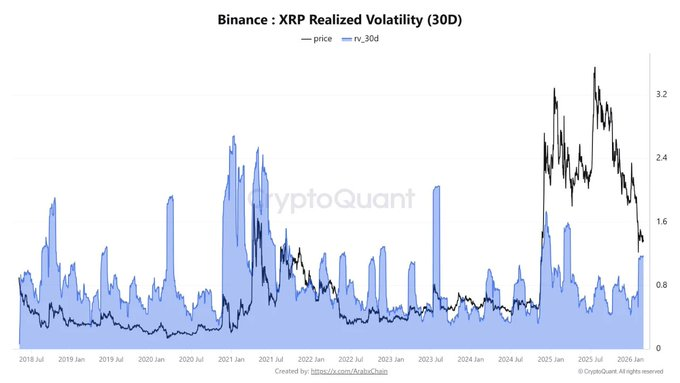
The XRP price is flashing signals that traders can’t afford to ignore. Thirty-day realized volatility has just spiked to levels not seen since March 2025. Historically, when that happens, a massive XRP price move follows. Volatility doesn’t just wake up one morning and stretch like this for no reason. Something is building.

But let’s be real, while volatility expands, price hasn’t been kind. XRP has fallen from $3 to $1.35. That’s not a minor pullback. That’s a structural unwind.

XRP Price Volatility Sends Warning

A spike in 30D realized volatility usually means one thing: compression is over. Every previous time this metric reached similar levels, XRP didn’t drift sideways in fact it moved. Hard.

So what does the current XRP price chart suggest? It shows tension. A coiled spring. Traders tracking XRP price prediction narratives know volatility expansions tend to resolve decisively. The direction, though, is where the debate begins.

XRP Price Volatility Explodes as Open Interest Collapses 70%

Open Interest Wiped Out

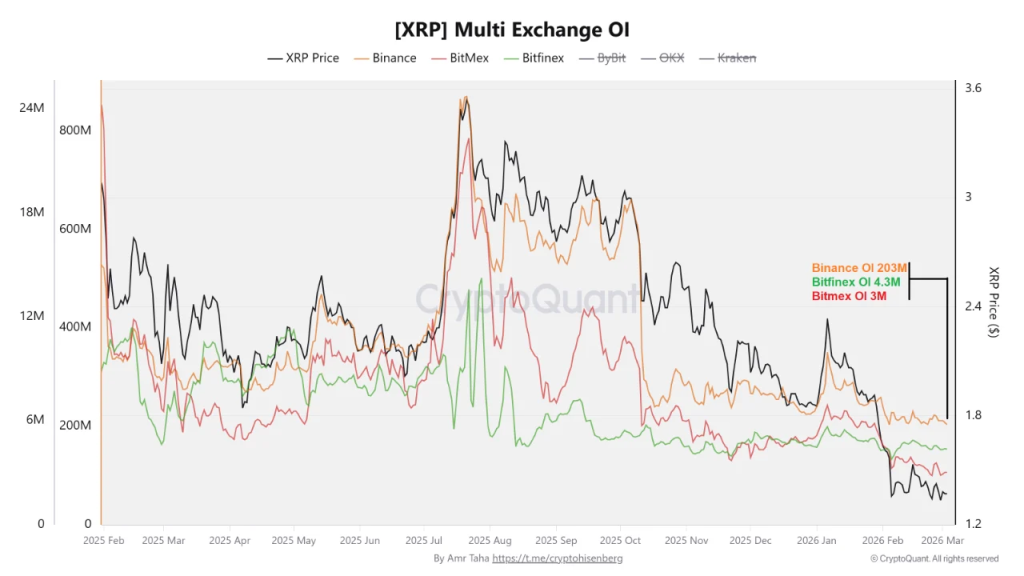
According to analyst Amr Taha, Across major derivatives exchanges, XRP open interest has cratered. On October 6, 2025, total OI peaked at $660 million. As of March 3, 2026, that number sits at $203 million. That’s a $457 million wipeout in five months.

Binance leads the drop. Meanwhile, Bitfinex and Bitmex OI levels have shrunk to $4.3 million and $3 million respectively tiny compared to prior figures.

And here’s a historical nugget: the last time Binance XRP OI fell to similar levels was April 2025, when it hovered around $270 million. Back then, XRP formed a major bottom near $1.80 before rallying. Different price zone now, sure. But the pattern rhymes.

XRP Price Volatility Explodes as Open Interest Collapses 70%

XRP/USD Leverage Flush

Falling open interest combined with a falling XRP price usually signals one thing that positions are getting closed. Either traders are voluntarily cutting exposure, or liquidations are forcing their hands.

When excessive futures positioning gets cleared, markets reset. Historically, those reset phases have aligned with local bottoms. 

So what’s next? With XRP/USD volatility surging and leverage largely washed out, the setup is cleaner than it’s been in months. The XRP price now sits at a crossroads where history suggests big moves follow extreme volatility spikes.

Solana Price Coils at $84: Is Solana Price Ready to Breakout?

Solana Tops Blockchain Revenue Charts as SOL Price Nears $200—Can the Rally Continue?

The post Solana Price Coils at $84: Is Solana Price Ready to Breakout? appeared first on Coinpedia Fintech News

The Solana price is hovering at $84.83, and the market can’t quite decide whether to yawn or brace for impact. Daily volume is pushing past $5 billion. Down 2.18% in the last 24 hours, sure but still up 8.94% on the week. That’s not exactly panic. With 570 million SOL in circulation, the market cap sits at $47.8 billion. In other words, there’s real money parked here, and it’s not flinching.

Solana Price Holds Channel Support

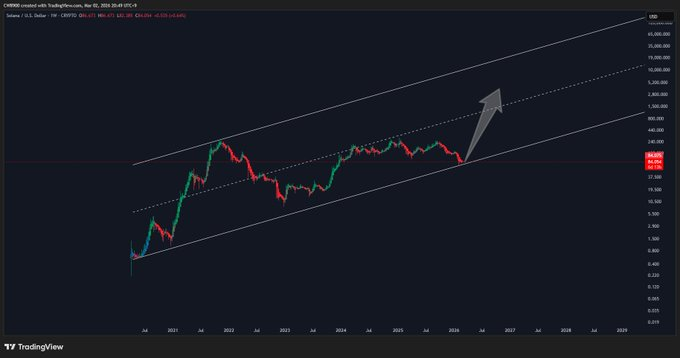
Zoom out to the weekly Solana price chart and things get interesting. Price action continues to respect a long-term ascending channel. The lower boundary, around $80–$85, has historically acted like a trampoline whenever price touches it, then springs higher toward the midpoint.

Right now, SOL is pressing against that same zone again.

Key resistance levels sit at $240, then the bigger psychological hurdles at $500 and $1,000. Stretch the imagination further and the channel’s upper region sits near $3,500 this cycle assuming liquidity shows up and adoption keeps pace. That’s a big “if,” but technically, the structure hasn’t broken.

Solana Price Coils at $84: Is Solana Price Ready to Breakout?

SOL/USD Faces the $90 Test

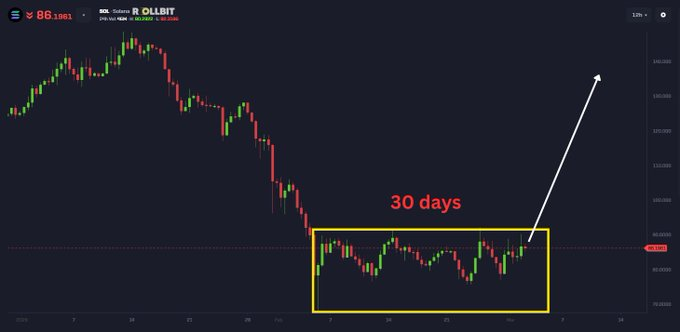
Short term, the SOL/USD pair is trapped in a narrowing range. Repeated rejections at $90 scream overhead supply. At the same time, every dip toward $70 finds buyers waiting.That’s textbook compression.

So, what’s next? A daily close above $90 could open the door to $105–$120 and validate the breakout narrative many traders are eyeing in their Solana price prediction thories. But lose the $80 mid-range support, and $70 gets revisited fast. Markets don’t hesitate when ranges break.

Solana Price Coils at $84: Is Solana Price Ready to Breakout?

Whales Accumulate While Retail Hesitates

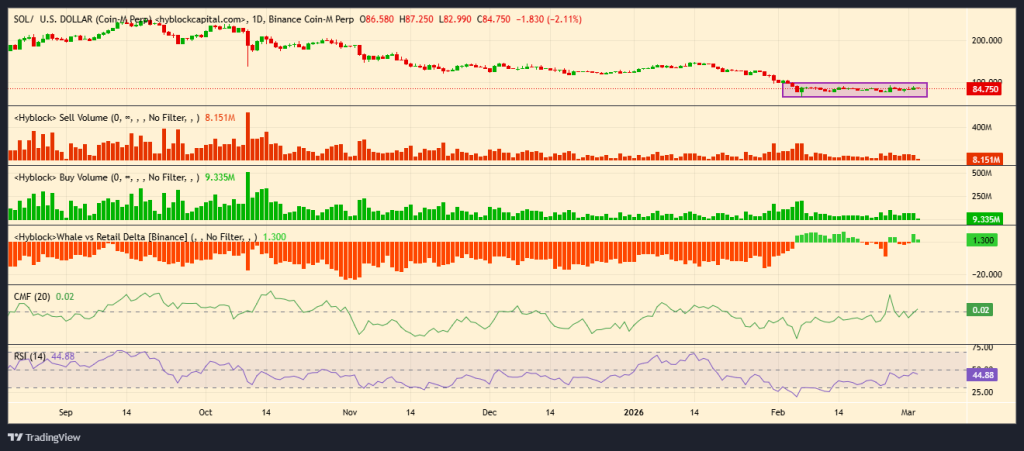
The internal price data suggests bigger players are leaning bullish. The Whale vs. Retail Delta on Binance Perps just printed a strong 1.140 green spike. Translation? Large participants are quietly buying this consolidation zone near $84.62.

Solana Price Coils at $84: Is Solana Price Ready to Breakout?

Volume tells a similar story. Daily buy volume stands at 7.732M versus 6.237M in sell volume roughly 24% more aggressive buying pressure during a sideways grind. That’s not retail FOMO. That’s calculated accumulation.

Meanwhile, Chaikin Money Flow sits at 0.02, signaling steady capital inflows. RSI at 44.74? Neutral. Not overbought, not exhausted. Plenty of room to expand if momentum flips.

The daily chart’s tight consolidation box says volatility is loading. EMA bands are flattening. Price holds above $80.

The Solana price isn’t surging yet, but it’s consolidating, indicating a forthcoming direction.

Samsung lied? Galaxy S26 phones feature artificial 10-bit display, not true hardware

Galaxy S26, S26+, and S26 Ultra don’t use a 10-bit display that Samsung showcased at launch. The correction came after the Unpacked event, after the specs went out, after people started pre-ordering based on what Samsung revealed.

During the Galaxy S26 Ultra launch, Samsung representatives mentioned the upgrade to a 10-bit display. A genuine upgrade, especially when you consider that brands like OnePlus, Xiaomi, and even Oppo have been shipping 10-bit phones for years now.

However, a Samsung spokesperson reached out to SamMobile days later with a quiet walk-back: actually, it’s 8-bit color depth. And that’s not just the Ultra, but the standard S26 and the S26+ are also rocking 8-bit panels.

A proper 10-bit display can render 1.07 billion colors, while an 8-bit display can render 16.7 million. The difference shows up in gradients, less banding, smoother transitions, and more accurate color reproduction.

The Korean tech giant appears to be using frame rate control, or FRC, to simulate 10-bit output on 8-bit hardware. It’s often called “8-bit + FRC” in the industry, and it does reduce banding compared to plain 8-bit.

Ice Universe isn’t panicking about the 8-bit thing. He’s more worried about something else: overall display quality. His advice? Go to a store, set both the S25 Ultra and S26 Ultra to 2K resolution, disable Privacy Mode, and look closely at text rendering, then decide.

Samsung’s the biggest Android player on the planet, and they’re still shipping 8-bit displays while the competition moved on. You can dress it up with FRC and call it good enough, but the fact remains unchanged.

If you pre-ordered based on that 10-bit claim, you’ve got every right to be annoyed.

Samsung Galaxy S26 8-bit display

The post Samsung lied? Galaxy S26 phones feature artificial 10-bit display, not true hardware appeared first on Sammy Fans.

Samsung’s Privacy Display makes Galaxy S26 Ultra dimmer than the S25 Ultra

Samsung’s first-ever Privacy Display feature on the Galaxy S26 Ultra comes with a catch: the screen is actually dimmer than the Galaxy S25 Ultra, even with the privacy tech turned off.

Tom’s Guide just put the Galaxy S26 Ultra through lab testing, and the results reveal that the Privacy Display upgrade has made the screen actually dimmer than last year’s model.

The test revealed that the Galaxy S26 Ultra hits 1,806 nits at peak brightness, while the Galaxy S25 Ultra hits 1,860 nits. Samsung rates the 6.9-inch AMOLED panel at 2,600 nits, but real-world testing shows it falls short.

Tom’s Guide noticed the S26 Ultra looks visibly dimmer from the sides compared to the S25 Ultra, even with Privacy Display completely disabled.

Since the Flex Magic Pixel technology is integrated into the panel structure, this means you’re living with the trade-off, whether you use the feature or not.

When you do flip Privacy Display on, things get rough.

With Maximum Privacy Protection enabled, brightness drops to 586 nits. That’s a 67.6% drop from the 1,209 nits you get with adaptive brightness on. Turn off adaptive brightness entirely, and it’s worse: 248 nits with privacy mode active.

Samsung Galaxy S26 Ultra Privacy Display Test

Source – Samsung Display

Privacy screens have always been dim. Anyone who’s used an aftermarket protector knows this. Unlike privacy screen protectors that stick on permanently, Samsung’s implementation can be toggled, which is the entire point.

You sacrifice brightness when you need privacy, then flip it off and get your flagship experience back. The Privacy Display is genuinely innovative tech, no question, but it shouldn’t have come at the expense of screen brightness.

Related article:

The post Samsung’s Privacy Display makes Galaxy S26 Ultra dimmer than the S25 Ultra appeared first on Sammy Fans.

From Europe to Japan, Samsung expanding its 5G infrastructure

From Europe to Japan, Samsung is expanding its AI-powered 5G network infrastructure. In a recent development, the company has made two big announcements, disclosing evolving partnerships with local carriers.

Vodafone – Europe

Building on the current Open RAN deployment in Germany, the collaboration embraces AI computing platforms and automation.

Samsung, in collaboration with Vodafone, completed Europe’s first call using its virtualized RAN (vRAN) solution powered by Intel’s Xeon 6 SoC.

The test, conducted alongside partners Dell Technologies and Wind River, ran on a single high-performance server supporting 2G, 4G, and 5G networks, with commercial deployment planned for 2026.

To manage this software-driven network at scale, Samsung’s AI-powered CognitiV Network Operations Suite (NOS) enables one-click deployment and streamlined upgrades.

Rakuten – Japan

Samsung powers Rakuten Mobile’s cloud-native 5G network with a comprehensive O-RAN portfolio, accelerating AI and Openness.

Samsung announced it will supply O-RAN-compliant 5G radios to Japan’s Rakuten Mobile. It aims to support and expand its cloud-native Open RAN network, with commercial deployment expected to begin this year.

The company’s radio portfolio for this deal includes low-band (700MHz), mid-band (1.7GHz), and Massive MIMO (3.8GHz) solutions. Both companies expressed ambitions to expand their Open RAN collaboration beyond Japan.

The post From Europe to Japan, Samsung expanding its 5G infrastructure appeared first on Sammy Fans.

February 2026 update arrives for Galaxy Watch 7

Samsung’s Galaxy Watch 7 starts receiving the February 2026 update. It follows the November 2025 security patch, which landed after the One UI 8 Watch switch.

Galaxy Watch models are eligible for a new security update every quarter. Unlike flagship phones, they are not eligible for the latest patches that come every month.

We are already in the month of March, and Samsung just dropped the details of this month’s security patch. It includes fixes for 60 CVEs from Google and 7 SVEs from Samsung to ensure security on Galaxy devices.

Meanwhile, the Galaxy Watch 7 is getting the February 2026 security update. It sounds older, but the reality is the rollout took longer than usual. It should have been here in February only, but it didn’t arrive.

Samsung’s February patch can be identified via PDA build version ending with BZB1. It weighs less than four hundred megabytes, requiring some time to download. Installation can only be processed once the package is extracted on the device.

Last month, Samsung was busy with the Galaxy S26 series. Not many Galaxy phones received the February patch either. The rollout mechanism has now reactivated, and phased distribution is already underway.

Galaxy Wearable is the easiest to install the latest updates on Galaxy Wearables. Open the app, navigate to the Watch settings > Watch software update. Hit the Download and install key to begin fetching, followed by Install now.

Samsung Galaxy Watch 7 February 2026 Update

Source – Samsung Community Korea

The post February 2026 update arrives for Galaxy Watch 7 appeared first on Sammy Fans.

Galaxy A37 and A57 feature iconic colors from S25, S23 and Z Fold4

Samsung’s done with the Galaxy S26 series reveal, and the focus is now being shifted to A-series phones. A credible source has now revealed the potential colors of the upcoming Galaxy A37 and Galaxy A57 phones, and they are not random.

According to RolandQuandt, the Galaxy A37 and Galaxy A57 will be available in five colors. With its 2026 mid-range models, Samsung is bringing some brilliant shades, which were previously debuted with flagship models in the past.

Galaxy A37 colors:

  • White
  • Charcoal
  • Greygreen
  • Lavender
  • Navy

Galaxy A57 colors:

  • Charcoal
  • IcyBlue
  • Grey
  • Lilac
  • Navy

Samsung played it smart with the Galaxy S26 series colors. Now, the company is ready to impress its fans with the Galaxy A37 and A57 color shades. Some of the palettes are inspired by Galaxy S and Z series phones released earlier.

Summary of the connections

  • GreyGreen (A37): This was the standout signature color of the Galaxy Z Fold4 (2022).
  • Icy Blue (A57): Originally the hero color for the Galaxy Z Fold5 (2023), it was recently brought back as a core option for the S25 and S25 FE (2025).
  • Navy (A37/A57): A deep, matte finish that was a primary shade for the Galaxy S25 and S25 Plus.
  • Charcoal (A37/A57): Essentially the evolution of the “Graphite” and “Phantom Black” seen across the S23 and S24 lineups.

Galaxy S26 series is available for preorders, with the release set for March 11. Samsung could launch the A37 and A57 by the end of March or early April. These models are pretty important for Samsung in securing volume.

Samsung Galaxy A37 CAD Render Samsung Galaxy A57

The post Galaxy A37 and A57 feature iconic colors from S25, S23 and Z Fold4 appeared first on Sammy Fans.

Samsung reportedly delays Texas 2nm chip fab to 2027 – What it means for Tesla and Big Tech

Samsung has reportedly delayed its 2nm Texas chip fab to next year, impacting Tesla and Big Tech. Reports emerging from Samsung’s home turf signal a halt in the mass production timeline for the US chip factory.

According to KoreaJoongangDaily, Samsung has postponed the mass production at its Texas chip plant to next year, and it’s going to impact Tesla and Big Tech companies.

Multiple sources with knowledge of the matter have made this claim. For context, the Korean tech giant has decided to kickstart production at the Taylor facility as early as this year.

Now, Samsung’s Taylor, Texas, chip factory has a new deadline of early 2027. This delay is probably fueled by ensuring seamless production and making the jump directly to the 2nm process.

“It appears that even internally at Samsung, the timeline for the start of mass production has not yet been finalized,” a source familiar with developments told the Korea JoongAng Daily. “The schedule has continued to slip, and it is now understood that a full-scale ramp-up for a meaningful volume output could be pushed to early next year.”

Another source at a semiconductor materials firm echoed the setback.

“The plant has begun pilot operations, but full-scale manufacturing has already been significantly delayed,” the source said. “The timeline appears to shift frequently, and there is no clear start-of-production milestone,” he said, adding that there appear to be factory utilization issues with specifying further.

Back in January 2026, Samsung Foundry’s VC disclosed plans to mass produce 2nm chip at Texas fab and develop design infrastructure for the second-generation process targeting mass production in the second half of the year.

The post Samsung reportedly delays Texas 2nm chip fab to 2027 – What it means for Tesla and Big Tech appeared first on Sammy Fans.

Samsung is giving the Galaxy S26 its highest level of protection

Samsung’s March 2026 security update roadmap is out, and for Galaxy S26 buyers, it carries a clear message: your phone is at the highest level of the protection queue.

The Galaxy S26, Galaxy S26+, and Galaxy S26 Ultra have all been placed directly into Samsung’s Monthly Security Update tier. This means the moment a patch drops, these devices are among the first to receive it.

Monthly tier is the gold standard

Samsung’s update program runs on two tracks.

  • The monthly tier covers flagship-grade devices and select enterprise models, receiving patches as soon as they are certified and ready.
  • The quarterly tier, by contrast, bundles updates every three months.

For a device sitting at the $899-plus price point, waiting a full quarter for a known patch to arrive is not an acceptable trade-off. That said, the Galaxy S26 series entering the Monthly tier from day one is not a small thing.

The standard Galaxy S26, the Galaxy S26+, and the Galaxy S26 Ultra are listed as a unit under the monthly schedule. There is no tiered entry here, where the Ultra gets priority and the base model trails behind.

Samsung Galaxy S26, S26+ and S26 Ultra

Samsung has historically kept the core S-series family together on update timelines, and the March roadmap continues that pattern.

Moving down the lineup, Samsung’s March roadmap also brings three new additions to the quarterly security tier. The Galaxy A07 5G, Galaxy M17e 5G, and Galaxy F70e 5G are all newly listed this month.

One detail that often gets overlooked in these monthly roadmap updates: stability. Every single device listed in February 2026 retains its update status in March.

The post Samsung is giving the Galaxy S26 its highest level of protection appeared first on Sammy Fans.

Samsung’s March 2026 update carries 67 urgent patches, details go official

Days after March commenced, Samsung revealed the latest security update details for the third time in 2026. Samsung’s January and February SMR packages seem filler, with the March release containing great improvements.

Together with the March 2026 update details, Samsung has also refreshed the software rollout roadmap, adding six new models. The company hasn’t retired any Galaxy device this month, nor adjusted the release timeframe.

Samsung’s March 2026 update carries 67 urgent patches

Google’s participation has significantly increased this month. The company alone is patching eight critical and fifty-two high-level CVE items.

Android CVE items – 60

Google Patches for the following CVEs from Android Security Bulletin are applied in this Security Maintenance Release – March 2026 Package.

Critical – 8

  • CVE-2026-0006, CVE-2026-0027, CVE-2026-0028, CVE-2026-0030, CVE-2026-0031, CVE-2026-0037, CVE-2026-0038, CVE-2026-0047

High – 52

CVE-2024-31328, CVE-2025-10865, CVE-2025-13952, CVE-2025-2879, CVE-2025-32313, CVE-2025-38616, CVE-2025-38618, CVE-2025-39682, CVE-2025-39946(A-432728472), CVE-2025-39946(A-446648770), CVE-2025-40266, CVE-2025-47384,

CVE-2025-47385, CVE-2025-48544, CVE-2025-48567, CVE-2025-48578, CVE-2025-48579, CVE-2025-48582, CVE-2025-48585, CVE-2025-48587, CVE-2025-48615, CVE-2025-48634, CVE-2025-48636, CVE-2025-48642, CVE-2025-48644, CVE-2025-48653,

CVE-2025-48654, CVE-2025-58407, CVE-2025-58408, CVE-2025-58409, CVE-2025-58411, CVE-2025-59600, CVE-2025-64783, CVE-2025-64784, CVE-2025-64893, CVE-2026-0005, CVE-2026-0011, CVE-2026-0012, CVE-2026-0013, CVE-2026-0024,

CVE-2026-0025, CVE-2026-0029, CVE-2026-0032, CVE-2026-0034, CVE-2026-0035, CVE-2026-20425, CVE-2026-20426, CVE-2026-20427, CVE-2026-20428, CVE-2026-20434, CVE-2026-21385, CVE-2026-21735

Already included in previous updates

  • CVE-2025-47378, CVE-2025-48631, CVE-2026-0026

Not applicable to Samsung devices

  • CVE-2025-48613, CVE-2025-61612, CVE-2025-61613, CVE-2025-61614, CVE-2025-61615, CVE-2025-61616, CVE-2025-69278, CVE-2025-69279

One UI SVE items – 7

Samsung Mobile provides 7 Samsung Vulnerabilities and Exposures (SVE). These improve system stability and core functionalities across the One UI software system.

High

  1. SVE-2025-1906(CVE-2026-20988)
    • Affected versions: Android 16
  2. SVE-2025-2310(CVE-2026-20990)
    • Affected versions: Android 14, 15, 16

Moderate

  1. SVE-2025-1926(CVE-2026-20989)
    • Affected versions: Android 16
  2. SVE-2025-2520(CVE-2026-20991)
    • Affected versions: Android 14, 15, 16
  3. SVE-2025-2847(CVE-2026-20992)
    • Affected versions: Android 13, 14, 15, 16

Some SVE items included in the Samsung Android Security Update cannot be disclosed at this time.

The post Samsung’s March 2026 update carries 67 urgent patches, details go official appeared first on Sammy Fans.

Samsung updates One UI software rollout roadmap – March 2026

Samsung has once again updated its One UI software rollout roadmap, this time in March 2026. The Monthly and Quarterly charts remain largely unchanged for existing devices, with the addition of around 6 models.

The company has also shared the details of its March 2026 security update. Samsung was pretty slow in the February patch rollout. It is expected that Galaxy devices should receive the March patches early this month.

Samsung software rollout roadmap – March 2026

Samsung’s Monthly and Quarterly roadmap has arrived.

Current Models for Monthly Security Updates

The Monthly schedule has added three models: Galaxy S26, S26+, and S26 Ultra. Older devices have been retained from the list of February 2026.

Galaxy Foldable Series

  • Galaxy Z TriFold
  • Galaxy Z Fold4, Galaxy Z Fold5, Galaxy Z Fold6, Galaxy Z Fold7, Galaxy Z Fold Special Edition
  • Galaxy Z Flip4, Galaxy Z Flip5, Galaxy Z Flip6, Galaxy Z Flip7, Galaxy Z Flip7 FE
  • W23, W23 Flip, W24, W24 Flip, W25, W25 Flip, W26

Galaxy S Series

  • Galaxy S26, Galaxy S26+, Galaxy S26 Ultra
  • Galaxy S25, Galaxy S25+, Galaxy S25 Ultra, Galaxy S25 Edge, Galaxy S25 FE
  • Galaxy S24, Galaxy S24+, Galaxy S24 Ultra, Galaxy S24 FE
  • Galaxy S23, Galaxy S23+, Galaxy S23 Ultra, Galaxy S23 FE

Galaxy A Series

  • Galaxy A56 5G

Enterprise Models

  • Galaxy A53 5G, Galaxy A54 5G, Galaxy A55 5G
  • Galaxy Tab Active5 Pro
  • Galaxy XCover6 Pro, Galaxy XCover7, Galaxy XCover7 Pro

Current Models for Quarterly Security Updates

Samsung’s Quarterly roadmap is more like a replica of February 2026. While foldable and flagships remain the same, the Galaxy A, M and F categories have witnessed the addition of one device in each, extending the list further.

Galaxy Foldable Series

  • Galaxy Z Fold3 5G
  • Galaxy Z Flip3 5G

Galaxy S Series

  • Galaxy S22, Galaxy S22+, Galaxy S22 Ultra
  • Galaxy S21 FE 5G

Galaxy A Series

  • Galaxy A04, Galaxy A04s, Galaxy A04e, Galaxy A05, Galaxy A05s, Galaxy A06, Galaxy A06 5G, Galaxy A07, Galaxy A07 5G
  • Galaxy A13, Galaxy A14, Galaxy A14 5G, Galaxy A15, Galaxy A15 5G, Galaxy A16, Galaxy A16 5G, Galaxy A17, Galaxy A17 5G
  • Galaxy A23, Galaxy A23 5G, Galaxy A24, Galaxy A25 5G, Galaxy A26 5G
  • Galaxy A33 5G, Galaxy A34 5G, Galaxy A35 5G, Galaxy A36 5G
  • Galaxy A73 5G

Galaxy C Series

  • Galaxy C55 5G

Galaxy M Series

  • Galaxy M04, Galaxy M05, Galaxy M06 5G, Galaxy M07
  • Galaxy M13, Galaxy M13 5G, Galaxy M14, Galaxy M14 5G, Galaxy M15 5G, Galaxy M16 5G,
  • Galaxy M17 5G, Galaxy M17e 5G
  • Galaxy M23 5G
    Galaxy M33 5G, Galaxy M34 5G, Galaxy M35 5G, Galaxy M36 5G
  • Galaxy M44 5G
  • Galaxy M53 5G, Galaxy M54 5G, Galaxy M55 5G, Galaxy M55s 5G, Galaxy M56 5G

Galaxy F Series

  • Galaxy F04, Galaxy F05, Galaxy F06 5G, Galaxy F07, Galaxy F70e 5G
  • Galaxy F13, Galaxy F14, Galaxy F14 5G, Galaxy F15 5G, Galaxy F16 5G, Galaxy F17 5G
  • Galaxy F34 5G, Galaxy F36 5G
  • Galaxy F54 5G, Galaxy F55 5G, Galaxy F56 5G

Galaxy Tab S Series

  • Galaxy Tab S11, Galaxy Tab S11 Ultra
  • Galaxy Tab S10+, Galaxy Tab S10 Ultra, Galaxy Tab S10 FE, Galaxy Tab S10 FE+, Galaxy Tab S10 Lite
  • Galaxy Tab S9, Galaxy Tab S9+, Galaxy Tab S9 Ultra, Galaxy Tab S9 FE, Galaxy Tab S9 FE+
  • Galaxy Tab S8, Galaxy Tab S8+, Galaxy Tab S8 Ultra
  • Galaxy Tab S6 Lite (2024)

Galaxy Tab A Series

  • Galaxy Tab A11, Galaxy Tab A11+
  • Galaxy Tab A9, Galaxy Tab A9+, Galaxy Tab A9+(2025)

Enterprise Models

  • Galaxy Tab Active4 Pro, Galaxy Tab Active5
  • Galaxy XCover5

Samsung has also revealed the March patch details. The update brings fixes for eight critical and fifty two high level of CVEs. Additionally, Samsung provides seven SVE items linked to the One UI software system.

The post Samsung updates One UI software rollout roadmap – March 2026 appeared first on Sammy Fans.

Samsung’s February 2026 update is more widely rolling out in the US

Samsung’s software update rollout was severely dry last month. Following the Galaxy S26 launch, Samsung has started rolling out the February 2026 update to even more Galaxy devices, with expansion taking place in the US.

According to the info (via DroidLife), Samsung is now rolling out the February 2026 update to older foldable models in the US. If you own a Galaxy Z Fold 5, Flip 5, Fold 4, or Flip 4, it’s time to check for the latest security patches.

February update brings 37 patches to Galaxy phones, foldables, and tablets. The package contains 25 CVE items from Google and 12 SVE items from Samsung. It’s a complete package that improves both Android and One UI.

Software PDA versions:

  • Galaxy Z Fold 5: F946USQS7FZB6
  • Galaxy Z Fold 4: F936USQS9IZB6
  • Galaxy Z Flip 5: F731USQS7FZB6
  • Galaxy Z Flip 4: F721USQS9IZB6

To get the latest OTA, navigate to Software update menu inside Settings. Hit the Download and install key to initiate finding. Once done, let it download and hit Restart now when you are OK with a brief shutdown for installation.


Over the past few days, Samsung provided the February update to a handful of flagships. Starting with the Galaxy S25 series, the OTA was made available to the Galaxy S24 series and recent foldable and clamshell foldable models.

Previous rollouts

  1. Galaxy S25 Ultra: S938USQS8BYLX
  2. Galaxy S25+: S936USQS8BYLX
  3. Galaxy S25: S931USQS8BYLX
  4. Galaxy S25 Edge: S937USQS5BYLX
  5. Galaxy S25 FE: S731USQS5AYLX
  6. Galaxy S24 FE: S721USQSACZB4
  7. Galaxy Z Fold 7: F966USQS8AZB6
  8. Galaxy Z Fold 6: F956USQS3CZB6
  9. Galaxy Z Flip 7: F766USQS8AZB6
  10. Galaxy Z Flip 6: F741USQS3CZB6

The post Samsung’s February 2026 update is more widely rolling out in the US appeared first on Sammy Fans.

Cronos (CRO) Price Prediction 2026, 2027-2030: Is CRO Set for a Major Breakout?

Cronos Price Prediction

The post Cronos (CRO) Price Prediction 2026, 2027-2030: Is CRO Set for a Major Breakout? appeared first on Coinpedia Fintech News

Story Highlights

  • The live price of Cronos crypto is  $ 0.07526590.
  • Cronos coin price is expected to go as high as $0.3000 to $0.3500 in 2026.
  • CRO crypto may cross the $1 mark, with a potential high of $1.3190 by 2029.

Cronos (CRO) serves as the backbone of the Cronos Chain, a high-performance, open-source ecosystem engineered by Crypto.com. Designed to bridge the gap between traditional finance and Web3, CRO acts as a versatile utility token that facilitates instantaneous, low-cost global transactions while powering a vast suite of DeFi applications, perpetuals, and fiat-integrated markets.

Driven by institutional-grade infrastructure and a rapidly expanding global footprint, CRO’s market performance increasingly reflects a surge in investor confidence and real-world utility. As the network matures into 2026, its role in the next generation of digital asset exchange becomes even more pivotal.

In this analysis, we leverage advanced technical indicators and historical performance models to forecast the trajectory of Cronos. Whether you are a long-term holder or a strategic investor, this guide provides essential price projections for 2026 and through to 2035, helping you determine if CRO/USD is the missing piece for your portfolio.

Cronos Price Today

Cryptocurrency Cronos
Token CRO
Price $0.0753 up 0.50%
Market Cap$ 3,091,387,415.96
24h Volume$ 10,967,233.1476
Circulating Supply41,072,882,442.8934
Total Supply98,439,549,730.1517
All-Time High$ 0.9698 on 24 November 2021
All-Time Low$ 0.0115 on 17 December 2018

Coinpedia’s CRO Price Prediction 2026

CRO is currently in a “wait and see” period. If the demand zone at $0.0500 – $0.1000 continues to hold, the convergence of a bullish MACD cross and recovering CMF points toward a gradual climb back to the $0.3000 level. Investors should watch for a definitive close above the supply zone to confirm a long-term bullish reversal.

Cronos Price Prediction March 2026

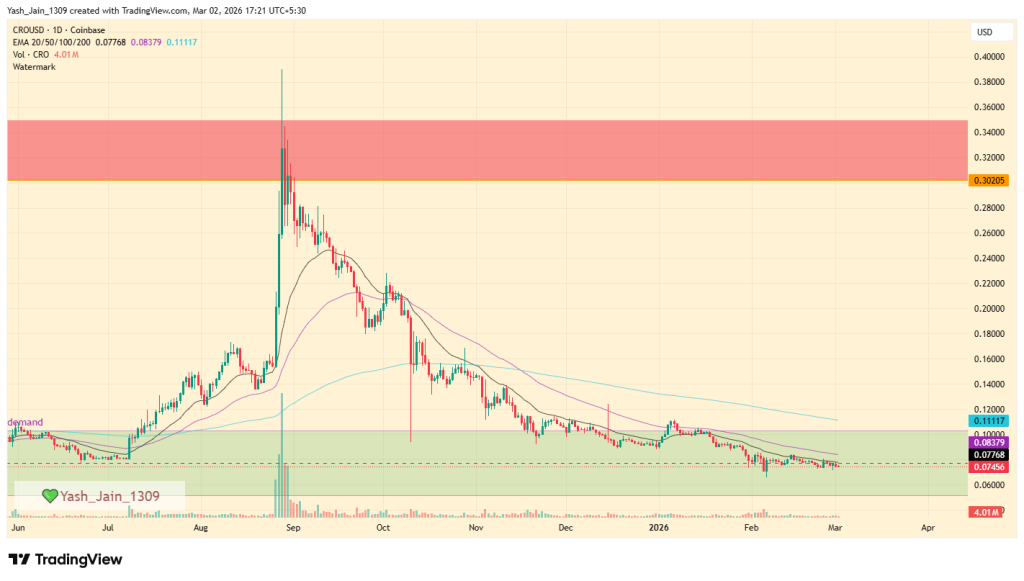
The Cronos price is currently consolidating on the daily chart around the central horizontal line at approximately $0.0777, which marks the multi-year demand range block (indicated in green). This consolidation is showing less momentum, and if it continues on the daily chart, we may see this trend persist into March. 

However, if the price breaches $0.1000, we can expect it to reach the 200-day EMA band around $0.1200 by March. On the other hand, if bearish forces come into play, March could see the price drop to the lower end of the current demand range, potentially hitting a low of around $0.0600.

Cronos Price Prediction March 2026

Recent Updates & Network News

On February 5, 2026, Cronos announced the development of a unified trading platform offering tokenized stocks, commodities, and prediction markets. This expansion is supported by a strategic integration with Fireblocks, providing the secure, institutional-grade custody infrastructure necessary for market makers to trade at scale.

Following this, a post on February 28 announced the Cronos v1.7 Network Upgrade is scheduled for March 10 at 07:00 GMT. This technical maintenance will involve approximately 30 minutes of downtime to align with recent SDK updates and implement RPC performance improvements to ensure long-term chain stability.

CRO Price Prediction for 2026

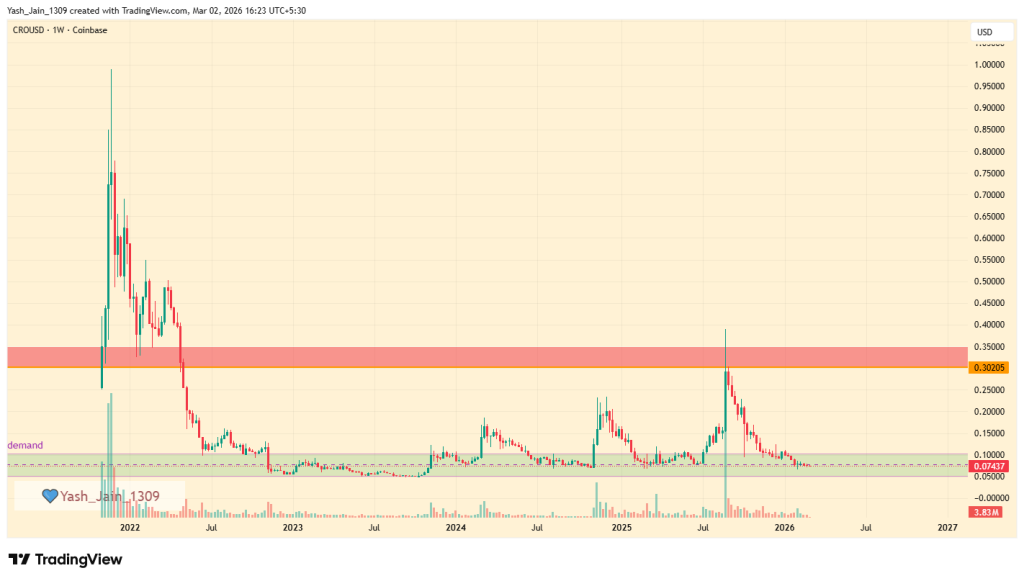
The weekly chart for CRO/USD reveals a persistent long-term structure defined by a well-established accumulation zone. Since late 2023, Cronos has consistently found a floor within the $0.0500 to $0.1000 demand area. This “buy zone” has historically triggered significant rallies, notably in late 2024 and mid-2025, where the price peaked at $0.3900.

As of early 2026, CRO has returned to this familiar base, setting the stage for its next major move.

The current weekly price action suggests a period of base-building. We are seeing a repeat of the historical pattern where CRO enters a deep consolidation phase before a vertical expansion.

Supply Zone: The primary target for a breakout lies between $0.3000 and $0.3500.

The Pivot Point: Simply hitting the supply zone isn’t enough; for a true trend reversal, CRO must flip this resistance into support to reclaim its 2022 highs.

CRO Price Prediction for 2026

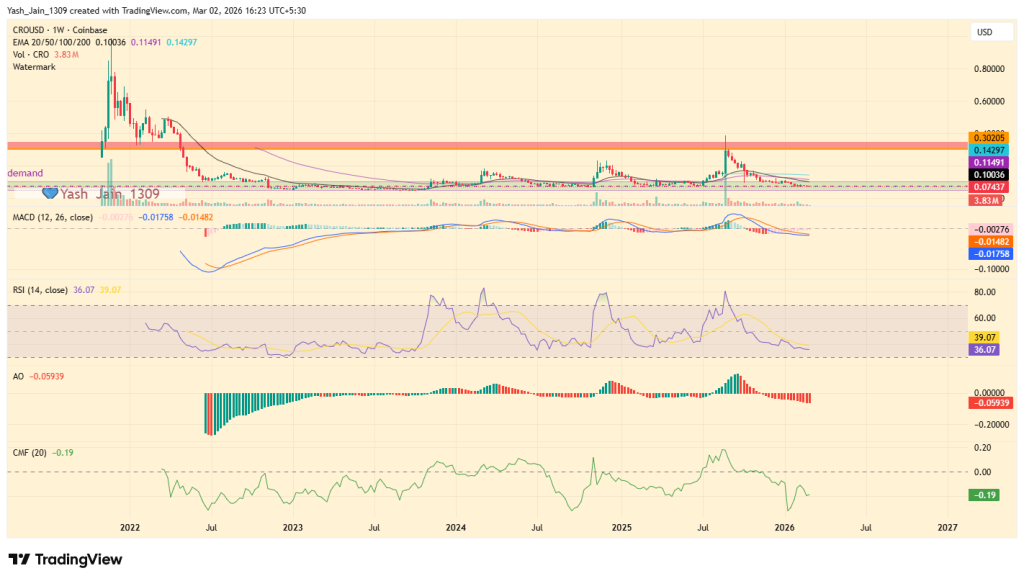
Moreover, While the price remains flat, the underlying “engine” of the market (indicators) is starting to show signs of exhaustion from the bears:

In MACD for instance we are currently approaching a weekly bullish cross. Historically, this cross has served as the starting gun for intensified consolidation that eventually leads to a breakout at later stage.

CMF is the most encouraging sign. The CMF has bounced sharply from a low of -0.32. This move toward the zero line suggests that selling pressure is fading and capital is starting to stabilize within the ecosystem.

RSI & AO, Both indicate that the “cooling off” period is still in effect. This lack of a clear direction in RSI confirms we are in a neutral accumulation phase, which is often known as the quiet before the storm.

CRO price

What Makes CRO Interesting in 2026?

In 2026, Cronos (CRO) stands out as a unique bridge between high-finance and retail utility. The landscape shifted dramatically in late august 2025 when Trump Media Group announced a $6.42 billion CRO Digital Asset Treasury strategy, signaling a massive institutional endorsement of the token’s scarcity.

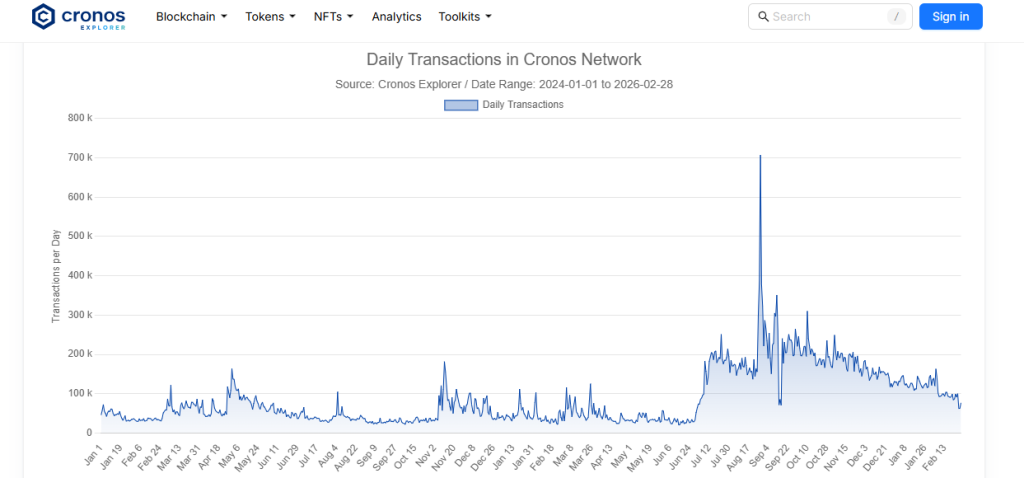
Beyond the headlines, Cronos remains a technical powerhouse with zero downtime over four years. It currently supports 150M+ users via the Crypto.com ecosystem and powers payments for 10M+ merchants. While the broader market has cooled in Q1, Cronos maintains a healthy 100,000 daily transactions, proving its resilience. This blend of “battle-tested” infrastructure and “institutional-grade” liquidity makes it a critical pillar of the 2026 digital economy.

Cronos Daily Transaction

Cronos (CRO) Price Prediction for 2027-2035

YearMinimum Price ($)Maximum Price ($)Average Trading Price ($)
20270.16900.34900.2490
20280.35700.69900.5090
20290.71001.31900.9890
20301.34902.40101.8210
20312.42004.19903.2350
20324.22107.10005.5290
20337.109011.50509.1650
203411.591018.451014.7650
203518.429028.711023.1990

Cronos Token Price Prediction for 2027

By 2027 Cronos token price is expected to trade between $0.1690 and $0.3490. The average expected trading cost is $0.2490.

CRO Price Prediction for 2028

In 2028, CRO price is expected to trade between $0.3570 and $0.6990. The average expected trading cost is $0.5090.

Cronos (CRO) Crypto Price Prediction for 2029

Experts expect Cronos crypto to trade between $0.7100 and $1.3190 in 2029. The average expected trading cost is $0.9890.

CRO Price Prediction for 2030

Based on technical CRO price analysis it is expected to trade between $1.3490 and $2.4010 in 2030. The average expected trading cost is $1.8210.

CRO/USD Price Prediction for 2031

Based on technical analysis by experts, in 2031 CRO/USD is expected to trade between $2.4200 and $4.1990. The average expected trading cost is $3.2350.

Cronos Price Prediction for 2032

Following 2031, in 2032, Cronos price is expected to trade between $4.2210 and $7.1000. The average expected trading cost is $5.5290.

CRO Token Price Prediction for 2033

In 2033, CRO token price is expected to trade between $7.1090 and $11.5050, with an average expected trading cost of $9.1650.Price Prediction for 2034

CRO Crypto Price Prediction for 2034

Based on technical analysis by cryptocurrency experts, in 2034 CRO crypto is expected to trade between $11.5910 and $18.4510. The average expected trading cost is $14.7650.

CRO Price Prediction for 2035

According to technical analysis by top specialists, the CRO price is projected to range from $18.4290 to $28.7110 by 2035. The anticipated average trading price is $23.1990.

Never Miss a Beat in the Crypto World!

Stay ahead with breaking news, expert analysis, and real-time updates on the latest trends in Bitcoin, altcoins, DeFi, NFTs, and more.

FAQs

What is the Cronos (CRO) price prediction for 2026?

CRO is expected to trade within the $0.05–$0.35 range in 2026, with a breakout above $0.30 needed to confirm a bullish reversal.

Can Cronos (CRO) reach $1 by 2030?

Based on long-term projections, CRO could trade between $1.34 and $2.40 by 2030 if adoption and momentum continue.

Is Cronos a good long-term investment through 2035?

Long-term forecasts suggest gradual growth toward higher ranges by 2035, but returns depend on adoption and market cycles.

What could drive CRO price growth in 2026?

Institutional integration, network upgrades, rising utility, and a confirmed bullish MACD cross could support upside momentum.

Ethereum price Crashes While Supply Quietly Vanishes: Is ETH Supply Shock Brewing Now?

Ethereum price Crashes While Supply Quietly Vanishes Is ETH Supply Shock Brewing Now

The post Ethereum price Crashes While Supply Quietly Vanishes: Is ETH Supply Shock Brewing Now? appeared first on Coinpedia Fintech News

The Ethereum price may be flashing red, but beneath the surface, something very different is happening. While traders focus on falling candles, holders are steadily pulling coins off exchanges and not in small amounts.

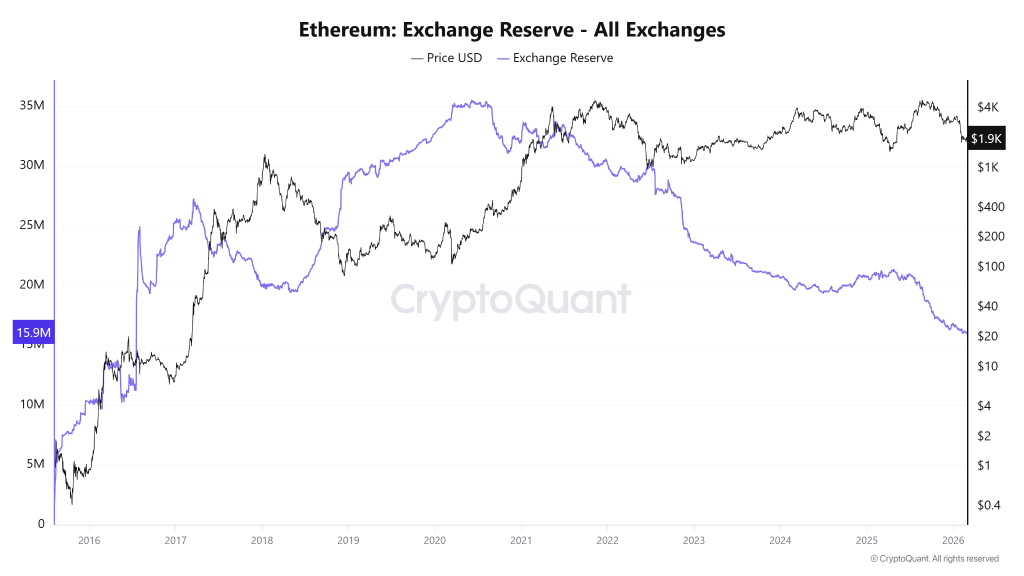
Exchange reserves have dropped to 16 million ETH, down sharply from 23 million in 2023. That’s a multi-year low. And here’s the twist: this decline happened while the Ethereum price dumped.

Normally, price crashes are fueled by panic selling. This time? The coins are leaving exchanges instead of flooding them.

Exchange Reserves Hit Lows

Exchange reserves track how much ETH is sitting on trading platforms, ready to be sold. Less ETH on exchanges generally means less immediate sell pressure.

But let’s be real. the reserves dropping during a rally is one thing. Reserves dropping during a crash? That’s different.

It suggests holders aren’t rushing to exit. They’re withdrawing. To staking. To cold storage. To DeFi. An active choice to hold rather than panic, per an analyst.

When you overlay that dynamic on the Ethereum price chart, the divergence becomes hard to ignore.

Ethereum price Crashes While Supply Quietly Vanishes: Is ETH Supply Shock Brewing Now?

Validator Queue Explodes

If the reserve data raises eyebrows, the staking numbers make them shoot up.

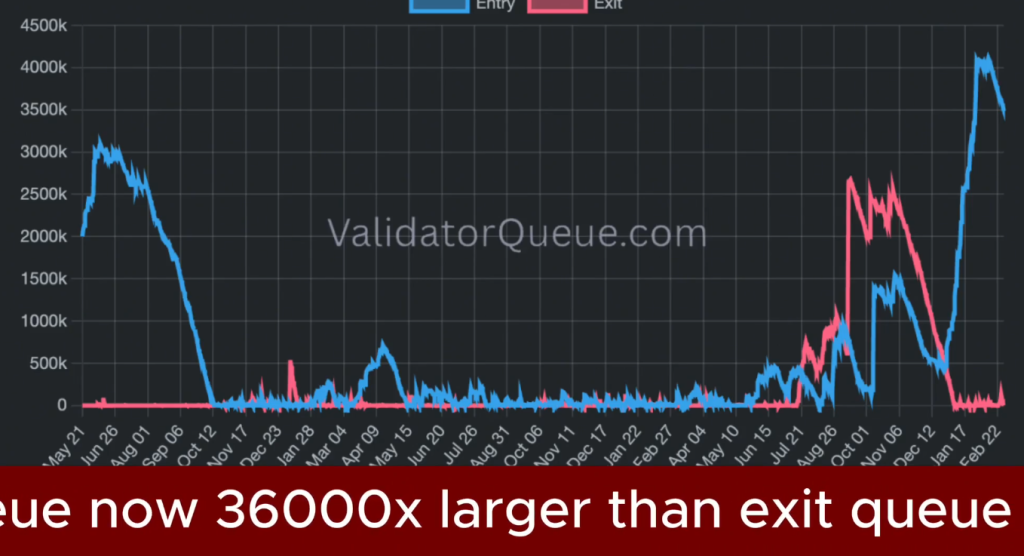
At the time of writing, 3,472,679 ETH is waiting to be staked on the network. Meanwhile, only 96 ETH is queued to exit. Entry requests outpace exits by roughly 36,174 times.

That’s not a typo.

The last time exits exceeded entry requests was in late December 2025. Since then, validator interest has surged. Capital isn’t running from the network, it’s lining up to lock in.

For anyone building an Ethereum price prediction, this imbalance is difficult to dismiss. Supply sitting idle on exchanges is shrinking, while supply being locked away is growing.

Ethereum price Crashes While Supply Quietly Vanishes: Is ETH Supply Shock Brewing Now?

Quiet Accumulation Phase?

Historically, supply shocks don’t begin with fireworks. They start quietly.

Coins disappear from exchanges. Staking participation climbs. Retail sentiment stays cautious. Price action looks weak. And then, eventually, liquidity tightens.

The market right now is clearly nervous. But on-chain data paints a calmer picture. Holders appear to be making deliberate decisions: fewer coins available for immediate sale, more coins committed to long-term positioning.

That doesn’t guarantee a rally tomorrow. It doesn’t invalidate short-term volatility in ETH/USD either.

But if supply keeps contracting while demand stabilizes, the setup shifts. The current Ethereum price may reflect fear yet the structural backdrop suggests something more strategic could be unfolding beneath the surface.

Bitcoin price Flashes 2021 Déjà Vu as NUPL Warns of Deeper Flush

Bitcoin price Flashes 2021 Déjà Vu as NUPL Warns of Deeper Flush

The post Bitcoin price Flashes 2021 Déjà Vu as NUPL Warns of Deeper Flush appeared first on Coinpedia Fintech News

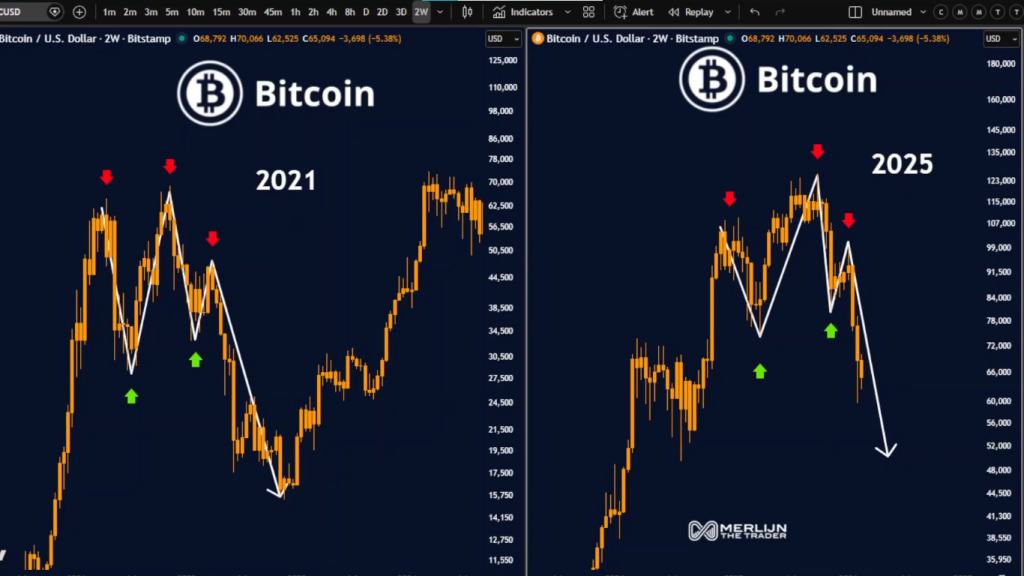
The Bitcoin price is starting to look uncomfortably familiar. Multiple tops. Lower highs. Weak rebounds. If you squint at the current structure and compare it to 2021, the resemblance isn’t subtle but it’s somewhat eerie thats making it hard to slide.

Back then, the pattern ended in a violent capitulation. And now, as 2026 unfolds, charts and onchain are whispering the same word again: flush.

Bitcoin Price Mirrors 2021 in 2026

Pull up the Bitcoin price chart on the 2-week timeframe and the structure stands out. In both 2021 and 2025, price carved out multiple tops before sliding into a series of lower highs. Each bounce looked promising, until it wasn’t.

That staircase down eventually gave way to a sharp breakdown the last time around. The current setup in 2026 is tracing a similar rhythm: rally, rejection, weaker rally, rejection again.

Well, here’s the kicker. According to an analyst, MerlijnTrader, one projection on the chart points toward the $48,000 region if history continues to rhyme into 2026. That’s not a prediction carved in stone, but it’s a scenario traders are clearly watching as the broader Bitcoin price prediction narrative shifts from bullish optimism to defensive positioning.

Bitcoin price Flashes 2021 Déjà Vu as NUPL Warns of Deeper Flush

Weak Rebounds, Heavy Structure

Lower highs are typically not bullish. They signal exhaustion. Buyers step in, but not with conviction. Sellers regain control faster each time. That’s exactly what defined the final stages of the previous cycle peak.

The current Bitcoin/USD structure shows similar hesitation. Instead of explosive recoveries, rebounds are fading quickly. Momentum looks tired.

And while some argue this is just consolidation before another breakout, the historical comparison isn’t comforting. The prior pattern didn’t resolve upward. It resolved violently downward.

NUPL Adds Bearish Weight

If the price pattern feels uneasy, the on-chain data doesn’t exactly calm nerves.

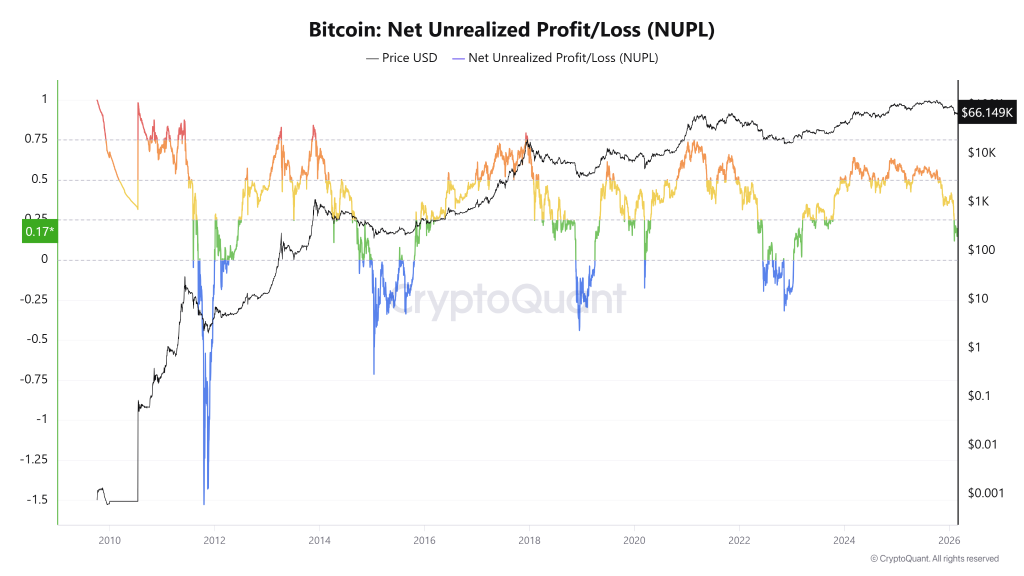
The Net Unrealized Profit/Loss (NUPL) metric currently sits at 0.17 which is above the zero line. That matters. According to the framework, a true bottoming phase typically forms when NUPL dips below zero, remains there for a period, and then rebounds.

Bitcoin price Flashes 2021 Déjà Vu as NUPL Warns of Deeper Flush

Per this chart, We’re not there yet in bottoming phase. At 0.17, the market still holds net unrealized profit. That suggests the kind of deep capitulation seen at cycle lows hasn’t happened yet. In other words, bearish pressure may not be fully exhausted.
So what does that mean? If the structure continues to mirror 2021 and NUPL stays above zero, the Bitcoin price could still face another leg down before a genuine bottom forms. If history rhymes again, 2026 might bring the final washout before a fresh rally can truly begin.

Qualcomm sees 5.3 billion AI wearables market by 2032

Qualcomm is holding a crucial keynote at MWC 2026, where it officially showcased that the market of AI wearables is expected to hit the 5.3 billion mark by 2032.

During the keynote, Qualcomm presented a slide, backed by a prediction from Counterpoint Research, that there is a 5.3 billion opportunity in the market of AI wearables by 2032.

Insider Max Weinbach, reporting live from Qualcomm’s MWC 2026 keynote. He also refers to the potential “Rise of Personal AI,” which would help Qualcomm achieve this massive figure.

In the presentation, Qualcomm showcased a variety of wearable products, including smart glasses, a ring, a smartwatch, an XR headset, headphones, earbuds, and so on.

Qualcomm can’t hit this ambitious goal alone and Samsung will play a crucial role in it. Samsung has a wide range of wearable devices, including watches, buds, headset and glasses are coming.

It is a pretty ambitious figure, which signals a massive surge in the wearable devices in the years ahead. It comes after the US chip designer introduced its next-generation mobile modem, elite Wear OS chipset, and other technologies.

Qualcomm 5.3 Billion Wearables 2032

Image credit – Max Weinbach

Recently, Samsung’s MX Business executive confirmed that the Snapdragon Wear Elite chipset will be used in the next-gen Galaxy Watch. It’s highly likely that the second-generation Galaxy Watch Ultra could use a Snapdragon chip.

Read more:

The post Qualcomm sees 5.3 billion AI wearables market by 2032 appeared first on Sammy Fans.

Did Qualcomm just reveal Galaxy S27 Ultra’s connectivity upgrade?

Qualcomm walked into MWC 2026 with what looks like a modem announcement; looking at the roadmap, it may have quietly previewed the Galaxy S27 Ultra’s biggest under-the-hood connectivity upgrade.

The new Qualcomm X105 modem-RF system is the world’s first 3GPP Release 19-ready platform. Release 19 is not just another incremental 5G Advanced step. It lays the groundwork for early 6G development and testing.

This is the modem that might anchor the Snapdragon 8 Elite Gen 6, or possibly a Gen 6 Pro variant, which makes it the prime candidate for Samsung’s 2027 flagship. It makes Galaxy S27 Ultra the strongest contender for the modem.

Peak download speeds hit 14.8 Gbps, with up to 13.2 Gbps on sub-6 GHz alone. Uplink throughput climbs to 4.2 Gbps, addressing one of the persistent bottlenecks in heavy cloud and creator workflows.

There is the 6nm RF transceiver, which Qualcomm claims has up to 30 percent lower power consumption and a 15 percent smaller board footprint.

The X105 also introduces an integrated fifth-generation AI processor inside the modem itself. The modem can detect and classify traffic types, then optimize them based on the user scenario.

Satellite support is another headline feature.

Qualcomm X105 integrates NR-NTN for video, voice, data, and messaging over satellite. A Galaxy S27 Ultra equipped with this modem could realistically handle satellite video calls in areas with zero terrestrial coverage.

Qualcomm Snapdragon X105 Modem

If Qualcomm’s X105 is baked into Snapdragon 8 Elite Gen 6, then the Galaxy S27 Ultra is shaping up to be less about CPU benchmarks and more about intelligent, AI connectivity that redefines what “always connected” actually means.

Related articles:

The post Did Qualcomm just reveal Galaxy S27 Ultra’s connectivity upgrade? appeared first on Sammy Fans.

Next Samsung Galaxy Watch will integrate Snapdragon Wear Elite; satellite connectivity likely

At MWC 2026, Qualcomm officially launched the Snapdragon Wear Elite chip, and Samsung has formally confirmed that the next Galaxy Watch will integrate this platform.

Years after embracing Exynos W series chips, Samsung is finally expanding the Snapdragon to its Galaxy Watch section, starting with the Snapdragon Wear Elite chip.

Samsung is working on two Wear OS products for 2026, including the Galaxy Watch 9 and Watch Ultra 2. It remains to be seen whether Qualcomm’s chip dominates the supply or System LSI retains some participation.

The US tech giant named Google, Motorola and Samsung as its partners for the new wearable chipset. Qualcomm’s confirmation followed by InKang Song, Executive Vice President and Head of Technology Strategy Team, MX Business at Samsung Electronics.

“Samsung and Qualcomm Technologies share a long history of advancing what’s possible in mobile computing, and we are thrilled to extend this partnership into the wearable category. By integrating the new Snapdragon Wear Elite platform, the next-generation Galaxy Watch will be an even more holistic wellness companion. This marks an important step in our ongoing efforts to deliver more efficient and personalized experiences, right from your wrist.”

Qualcomm’s new Snapdragon Wear Elite chip also unlocks new possibilities for the next-gen Wear OS operating system. It integrates advanced artificial intelligence capabilities as well as satellite connectivity technology.

The chip is backed by 5x improvement on single-core CPU performance and up to 7x faster GPU, for app launching, multitasking, and smoother rendering. Advanced power management enables 30% longer day of use compared to the previous generation.

Continue reading:

Snapdragon Wear Elite Specs and Features

Source – Qualcomm

The post Next Samsung Galaxy Watch will integrate Snapdragon Wear Elite; satellite connectivity likely appeared first on Sammy Fans.

Snapdragon Wear Elite is official: Will Samsung use it in Galaxy Watch 9?

Qualcomm launches Snapdragon Wear Elite chipset for the Wear OS platform. Samsung usually utilizes its Exynos wearable chipset in Galaxy Watch models, and this year’s Watch 9 and Watch Ultra 2 could be no exception.

The new Snapdragon Wear Elite is aimed squarely at flagship watches. Qualcomm says the first Wear Elite devices will arrive in H2 2026. The Galaxy Watch 9, along with the second-generation Watch Ultra, could land this July.

For the first time in years, Samsung faces a genuine decision at the top end of Wear OS. The Snapdragon Wear Elite platform is built on a 3nm process, matching the node Samsung already uses for Exynos W1000.

Qualcomm is using a 5-core CPU setup, one prime core clocked at 2.1GHz and four performance cores at 1.9GHz. It claims a 5x increase in single-threaded performance and a 7x GPU boost over its previous generation.

The US chip designer is promising 30 percent longer battery life and 50 percent charge in 10 minutes. It also supports silicon-carbon batteries, which could allow higher-density cells in the same footprint.

5G RedCap brings lower-power 5G to wearables. Wi Fi 6, Bluetooth 6.0, and even satellite connectivity via NB NTN are on the table. Satellite on a watch may sound excessive today, but Apple has already shown that safety features sell.

This is the first wearable chip from Qualcomm with a dedicated Hexagon NPU. It can handle on-device models up to 2 billion parameters.

Samsung could continue with Exynos W series silicon. There is also the possibility of a hybrid strategy. Samsung could use Exynos in the standard Galaxy Watch 9 and reserve Snapdragon Wear Elite for a Watch Ultra 2.

Snapdragon Wear Elite

The post Snapdragon Wear Elite is official: Will Samsung use it in Galaxy Watch 9? appeared first on Sammy Fans.

How to enter Galaxy S26 Ultra, Buds 4 giveaway in the US; Samsung says it’s easiest

Samsung announced an epic giveaway of Galaxy AI bundle in the US that includes a Galaxy S26 Ultra, a Galaxy Buds 4 and one full year of Spotify Premium subscription.

Fresh off the official debut of the Galaxy S26 Ultra on February 25, 2026, the Korean tech giant is already giving fans a shot at getting it for free. Just a straight-up social media giveaway that feels almost too easy.

Samsung is calling it the 14 Days of Giveaway, and if you are in the US, this is arguably the cleanest path to owning the Galaxy S26 Ultra without paying that $1300 price.

Here is how it works

From February 25 through March 10, Samsung is running daily entry periods across X (Twitter), Reddit, Instagram, and Facebook.

Each day, the official Samsung Mobile US accounts post a prompt. You like the post. You reply with the requested answer. You include the hashtags #GalaxyGiveaways and $GalaxyS26Ultra; that’s it.

Each day is its own drawing; miss one, and you can still jump into the next. Entries do not roll over, so staying active matters. Winners are picked shortly after each entry window closes, and notifications land via direct message or comment.

Samsung is giving away 35 prize bundles in total, with 28 of them being Product Bundles. Each Product Bundle includes:

  • Galaxy S26 Ultra, retail value 1299.99
  • Galaxy Buds4 Pro, retail value 249.99
  • One year of Spotify Premium, valued at 155.88

This giveaway runs until March 10, and each day resets the board. Keep a close eye on X as Samsung moves fastest there.

Guess you’ll need another feature to help you on the dance floor. 🪩 Enter the Easiest Giveaway Ever for a chance to win a Samsung Galaxy bundle including #GalaxyS26 Ultra and #GalaxyBuds4 Pro, plus a one year Spotify Premium membership. Read how to play below. ⬇ #GalaxyAIpic.twitter.com/c6DjA8zkkE

— Samsung Mobile US (@SamsungMobileUS) March 1, 2026

The post How to enter Galaxy S26 Ultra, Buds 4 giveaway in the US; Samsung says it’s easiest appeared first on Sammy Fans.

Samsung and NVIDIA take AI-RAN from lab to launchpad

Samsung has completed a multi-cell validation at its R and D center, pairing its virtualized RAN software with an accelerated computing platform from NVIDIA.

Unlike the demo, it was a realistic, multi-cell setup designed to mirror live network conditions. The company will showcase the milestone at MWC 2026, where AI inside the RAN is expected to dominate operator conversations.

Samsung plans to demonstrate an AI-based downlink performance boost at MWC 2026, specifically an AI MIMO beamformer running on NVIDIA AI Aerial infrastructure.

Simply put, beamforming shapes radio signals toward users. AI enhances that shaping in real time, squeezing more throughput out of the same spectrum.

Under the hood, Samsung vRAN software ran on NVIDIA’s AI infrastructure, including integration with ARC Compact powered by NVIDIA Grace CPU and L4 GPU.

Grace handles general-purpose processing, whereas the L4 accelerates AI workloads. Together, they create a unified CPU and GPU environment that keeps data moving fast between compute engines.

The company already has credibility in commercial vRAN deployments. Thanks to NVIDIA’s AI acceleration and validating it in a multi-cell environment signals seriousness about scale.

“As AI-powered capabilities become integral to meeting the demands of evolving networks and growing traffic needs, Samsung’s vRAN takes center stage with its software-based architecture,” said Keunchul Hwang, Executive Vice President and Head of Technology Strategy Group, Networks Business at Samsung Electronics.

“The successful multi-cell test with NVIDIA is another reinforcement of Samsung’s endeavor and leadership in providing operators with more flexibility and the best performance, with an enriched ecosystem consisting of industry-leading CPU and GPU partners such as NVIDIA.”

The post Samsung and NVIDIA take AI-RAN from lab to launchpad appeared first on Sammy Fans.

Galaxy S26 Ultra vs S23 Ultra: 5 Reasons to upgrade, 4 to skip

Galaxy S26 Ultra is officially available for purchase, and Samsung fans owning the Galaxy S23 Ultra are confused whether to hold or upgrade to the new flagship.

On February 25, Samsung officially launched the Galaxy S26 series. Among the three models, Galaxy S26 Ultra is practically the most important variant. If you want peak performance across segments, Ultra is the strongest option.

Reasons to upgrade

Your purchase decision depends on your expectations, but we highlight some important points to look at before you make your purchase.

1. Handy design without sharp corners

Samsung dropped the Note lineup’s signature design legacy of sharp (angular) corners last year. With the new Galaxy S26 Ultra, the company has gone further by increasing the corner curvature to make the device more handy.

As there’s an option, and you feel no longer comfortable with your S23 Ultra’s sharp, angular corners, S26 Ultra is the best option. Upgrade to the new flagship and bid farewell to the design that is not friendly with either palm or pockets.

Samsung Galaxy S26 Ultra and S23 Ultra

Image: Galaxy S26 Ultra and Galaxy S23 Ultra

2. Sizzling colors

GrayGreen was the signature color of the Galaxy S23 Ultra. It was impressive in its launch year, but now it looks aged next to the eye-catching shades of the Galaxy S26 series.

Available colors include:

  • Online exclusive colors:
    1. Silver Shadow
    2. Pink Gold
  • Standard colors:
    1. Cobalt Violet
    2. Sky Blue
    3. White
    4. Black

Samsung Galaxy S26 Ultra SG26U

Apple promotes iPhone colors as a selling point, and Samsung has also adopted that strategy. If you want a practical visual refresh, Galaxy S26 Ultra is available in four standard and two online exclusive colors, and all are impressive.

BTW, that White shade is my favorite.

3. Advanced camera features

Galaxy S26 Ultra has actual camera differences from the S23 Ultra, but the performance is primarily enhanced by software and artificial intelligence.

Samsung’s S23 Ultra packs a 200-megapixel primary, a 12-megapixel ultrawide, a 10-megapixel telephoto, and a 10-megapixel periscope camera.

Galaxy S26 Ultra has upgraded the periscope camera to 50 megapixels, which features 5x optical zoom and ultrawide to 50 megapixels with sharp details and clarity.

If you’re a creator, traveller, or frequently use a video camera, Galaxy S26 Ultra has one impressive feature called “Horizon Lock” that could alone impact your purchase decision.

Samsung Galaxy S26 Ultra SG26U Camera

4. Faster charging

With the Galaxy S26 Ultra, Samsung has finally improved the charging speed to 60W. It’s a decent improvement over the legacy 45W charging speed.

Samsung’s advertisement and early reviews suggest the new phone charges from 0 percent to 75 percent in roughly 30 minutes. However, it’s not that massive a leap next to the Chinese vendors offering above 100W speeds.

5. Love AI? Go ahead

Galaxy S26 Ultra doubles down on artificial intelligence. Whether it’s Galaxy AI, Google AI, or its in-house Bixby, every aspect has improved significantly. Samsung has also incorporated Perplexity into Bixby for real-time web results.

Reasons to skip

Samsung believes Galaxy S26 Ultra has dozens of improvements over the S23 Ultra; the natural purchase choice would be different. Here’s why S23 Ultra users should hold on.

1. Optical Zoom

Galaxy S23 Ultra was the last to feature 10x optical zoom. Starting with the Galaxy S24 Ultra, Samsung has been using a 50-megapixel periscope camera, which sounds better in megapixels but trimmed optical zoom to 5x.

If long-range camera quality is a decision-making aspect, you may dislike the Galaxy S26 Ultra. Samsung claims the S26 Ultra offers 10x Optical-quality zoom with its periscope, but it can’t match the level of hardware.

2. Lack of a 2nm chip breakthrough

Samsung is using Exynos 2600 in the S26 and S26 Plus, whereas the S26 Ultra is equipped with Snapdragon 8 Elite Gen 5 for Galaxy. Snapdragon is good, but it lags behind Exynos when it comes to the manufacturing process.

Qualcomm is set to manufacture its next Snapdragon chip using TSMC’s 2nm process. This processor would be utilized in the S27 Ultra next year. It will be an even bigger leap over this year’s S26 Ultra in terms of performance.

Snapdragon 8 Eilte Gen 5 for Galaxy

Source – Qualcomm

3. Software support isn’t dead

Galaxy S23 Ultra still has one Android upgrade left in its lifecycle. The device was launched on Android 13, and Samsung guarantees four major OS updates and five years of security patches.

One UI 8.5, based on Android 16, is going to be a major switch, which could bring the majority of the S26 Ultra software perks to the S23 Ultra and a handful of camera features.

Android 17 arrives later this year with One UI 9.0, and One UI 9.5 may also be available. That said, your S23 Ultra won’t be feeling outdated for at least two years from now on.

Samsung One UI 8.5

Source – Samsung

4. Unexciting S Pen

Like the Galaxy S25 Ultra, the new Galaxy S26 Ultra lacks a Bluetooth-supported S Pen. This letdown results in a degraded stylus that doesn’t bring features like Air Actions.

Samsung is gradually phasing out the stylus from its Galaxy S lineup. A recent official confirmation pledged long life for the S Pen, but the way would be decided on a later date.

On the flip side, the Galaxy S23 Ultra comes with a feature-packed stylus. It brings Air Actions and remote control capabilities. If such stylus features are in your daily needs, you should avoid the Galaxy S26 Ultra.

These were just 5 reasons to upgrade and 4 to skip; there are many more for both parts. I hope these would have helped you make a favorable decision.

The post Galaxy S26 Ultra vs S23 Ultra: 5 Reasons to upgrade, 4 to skip appeared first on Sammy Fans.

Galaxy S25 Ultra thrived in 5 AI-forward markets, TM Roh says

Samsung’s TM Roh is impressed by the 5 markets that helped in Galaxy S25 Ultra sales. Following the Galaxy S26 reveal, the Mobile Business Chief shared official insights with media from Southeast Asia and Oceania.

TM Roh discussed the use of AI, strong participation of Galaxy S25 Ultra as well as Galaxy S26 leap in 5 AI-hungry markets, including Thailand, Australia, Vietnam, Malaysia, and Singapore.

AI utilization

Samsung’s internal data, shared by TM Roh, suggests 9 out of 10 young people in Southeast Asia use AI on their mobile devices daily.

“Southeast Asia and Oceania are one of the most dynamic markets in the world and the region that adopts AI innovations the fastest.”

Noting the region’s diverse population and landscape, TM Roh revealed that Samsung is optimizing Galaxy AI for local languages, contexts and environments at three R&D centers in Indonesia, Vietnam, and the Philippines.

Galaxy S25 Ultra

Samsung’s Galaxy S25 Ultra was the highest-selling model of the lineup last year. Roughly 67 percent of buyers of the Galaxy S25 series in Thailand, Australia, Vietnam, Malaysia, and Singapore picked the Galaxy S25 Ultra.

Roh also revealed that sales of the Galaxy S25 series have outpaced those of its predecessor in the regions. The growth didn’t stall throughout the year, with real-time usecase reviews pushed to decent sales across the markets.

Galaxy S26 series

With the Galaxy S26 series now official, Samsung is highlighting the advanced Agentic AI capabilities of the new flagships. Riding the wave of S25 momentum, the company is ambitious for the sales of the Galaxy S26 lineup.

“The Galaxy S26 is built to deliver the most powerful mobile performance to date, elevating the camera experience to the next level and is designed to help users complete daily tasks more quickly and naturally with enhanced Galaxy AI.”

The post Galaxy S25 Ultra thrived in 5 AI-forward markets, TM Roh says appeared first on Sammy Fans.

Samsung and AMD are equipping 5G networks with AI

The latest move of Samsung and AMD, 5G AI-vRAN, is already rolling out to live networks. This is what decides whether your Galaxy phone holds a steady 5G connection in a packed stadium or stutters during a live stream.

With the rollout of 5G AI-vRAN, Samsung and AMD are moving from controlled validation tests to real-world deployments with paying operators.

Samsung has been selected by Videotron to deploy its 5G Non-Standalone and 4G LTE Core gateway solutions in Canada. These are powered by AMD EPYC 9005 Series CPUs, putting Samsung deeper into the Canadian market.

Its cloud native core strategy is now tied tightly to high-performance x86 compute from AMD.

MWC 2026

At MWC, Samsung announces it will demonstrate AI-powered vRAN running on AMD EPYC processors. vRAN replaces specialized hardware with software running on general-purpose servers, reducing hardware dependency.

Samsung says it achieved commercial-grade, multi-cell 5G vRAN performance on AMD EPYC 9005 CPUs without using additional hardware accelerators.

The validation phase happened in Samsung’s R&D labs. Now the results are mature enough for commercial scale. Samsung is also expanding its Network in a Server, or NIS, concept. Powered by AMD CPUs, it brings compute and AI closer to the user.

Edge AI means processing data locally instead of sending everything back to a distant cloud. It benefits with on site video analysis, sensor fusion, radar detection, and Integrated Sensing and Communication use cases.

Samsung AMD

The post Samsung and AMD are equipping 5G networks with AI appeared first on Sammy Fans.

Big News: Samsung aims to equip every Galaxy with Exynos, S26 starts the transition

Galaxy S26 marks the comeback of Exynos and Samsung already has bold ambitions for its in-house mobile SoC.

At a Galaxy Unpacked 2026 briefing in San Francisco, Moon Sung-hoon, Executive Vice President of Hardware at MX Division, made the company’s long game crystal clear. Samsung wants its in-house Exynos SoC across the Galaxy lineup.

“We hope to equip all Galaxy lineups with our own application processor,” Moon said, reports Dealsite (via Jukan). He also stressed that Samsung will continue working with partners to adopt the optimal chip when needed.

Samsung believes the Exynos 2600 is different. This is the world’s first 2-nanometer smartphone AP. In chip manufacturing, shrinking the node improves efficiency and performance by packing more transistors into the same space.

Moon described this year’s Exynos as having “passed the bar on multiple fronts,” with significantly improved power consumption.

Anyone who followed the Galaxy S22 era remembers what happened with the Exynos 2200. Meanwhile, Samsung is now stepping back into its own silicon with the S26 and S26 Plus.

Despite the Exynos chip’s comeback, Samsung retained the Snapdragon chip in the Galaxy S26 Ultra. The official statement also signals that future Galaxy S Ultra models could continue to keep Snapdragon at the heart.

The Galaxy S26 Ultra sticks with the Snapdragon 8 Elite 5th Gen for Galaxy. Its improvements include 39 percent higher NPU performance, 24 percent better GPU performance, and a 19 percent CPU uplift over its predecessor.

For now, the message from San Francisco is clear. Samsung wants Exynos in every Galaxy. The S26 is where that ambition stops being theory and starts facing the real world.

The post Big News: Samsung aims to equip every Galaxy with Exynos, S26 starts the transition appeared first on Sammy Fans.

Does the Galaxy S26 and S26+ support Privacy Display?

Samsung has confirmed that the new Privacy Display feature is reserved exclusively for the Galaxy S26 Ultra. If you are eyeing the standard or Plus model, this is one of the clearest lines Samsung has drawn in this generation.

Privacy Display on the Ultra is not a simple software trick or a rebranded screen protector mode. It is hardware-driven. Samsung is using pixel-level light dispersion technology built directly into the display panel.

Simply put, the Galaxy S26 Ultra screen can control how light spreads from each pixel, dramatically reducing visibility from side angles without dimming the entire display or requiring a stick-on privacy film.

Users can toggle between Partial Screen Privacy and Maximum Privacy Protection. The former limits visibility only within selected apps, think banking or messaging. The latter goes further, restricting shoulder surfing during PIN entry.

Galaxy S26 and Plus lack Privacy Display

The Galaxy S26 and S26+? They simply do not have the underlying display hardware. Samsung clearly sees Privacy Display as a premium feature. It is part of the strategy to widen the gap between the Ultra and the rest of the lineup.

You can still use third-party privacy screen protectors, but that is old school and comes with the usual trade-offs in brightness and clarity.

Most people are not constantly guarding against shoulder surfers in public spaces. But for frequent travelers, corporate users, or anyone handling sensitive information on the go, the Ultra now offers a built-in privacy solution.

Samsung Galaxy S26 Ultra Privacy Display

The post Does the Galaxy S26 and S26+ support Privacy Display? appeared first on Sammy Fans.

Samsung Now Nudge Feature – Everything you need to know

Samsung is clearly betting on contextual intelligence as the next layer of One UI. With the One UI 8.5 on Galaxy S26 series, Samsung introduced a powerful AI feature called Now Nudge that goes beyond what smart suggestions offer.

You are mid chat, plans are forming, someone suggests dinner next Friday, and suddenly you are jumping between calendar, gallery, and browser. This friction is exactly what the Samsung Now Nudge feature is trying to eliminate.

What is Samsung Now Nudge feature

At its core, Now Nudge is a context-aware suggestion system. It looks at what is happening on your screen and offers real-time actions that make sense for that moment.

For instance:

  • You are texting about grabbing dinner next week; it suggests scheduling it.
  • You mention a weekend getaway; it nudges you toward relevant photos or details.
  • You are chatting about an old memory; it can surface images from your gallery.

It requires a Samsung Account login. Also, availability depends on your region and language.

How Now Nudge works

Samsung Now Nudge analyzes what is displayed on your screen, including text conversations and image content. When it detects a relevant trigger, like a date, a location, or a shared memory, it offers a tap-based shortcut.

It can also analyze available image content to suggest photo sharing. If you are discussing an event, it may surface relevant pictures from your gallery. Meanwhile, Samsung itself notes that accuracy is not guaranteed.

Samsung Now Nudge Feature

Image – Samsung Now Nudge Feature

Is it safe – Privacy?

Now Nudge requires you to be logged into a Samsung Account. If you are privacy sensitive and prefer minimal system-level analysis, you may want to review permissions carefully.

If you are comfortable using smart suggestions in messaging apps and sharing contextual data within the Samsung ecosystem, Now Nudge will feel like a natural extension.

Supported apps

The good news is Samsung isn’t limiting Now Nudge to the One UI ecosystem. A context engine is useless if it only works in one or two apps. By integrating with widely used messaging platforms, Samsung has made a great deal.

Text message prompts are supported in select third-party messaging platforms, including Samsung Messages, Google Messages, Google Chat, WhatsApp, WhatsApp Business, KakaoTalk, LINE, Signal, Instagram DMs, Tango, NTT Docomo Messages, and KDDI Messages.

Support can vary by region and language.

The post Samsung Now Nudge Feature – Everything you need to know appeared first on Sammy Fans.

Galaxy S26 Ultra getting an even bigger reveal at MWC 2026

Mobile World Congress is set to be held from March 2 to March 5 in Barcelona. A day before the biggest mobile exhibition kicks in, Samsung revealed its MWC 2026 agenda, which includes Galaxy AI, S26 Ultra, Buds 4, and more.

At Unpacked on February 25, Samsung introduced the Galaxy S26 and Buds 4 series. The event also spotlighted upgraded Galaxy AI and Agentic AI advancements.

Samsung’s MWC 2026 exhibition space is also built on the momentum of Galaxy Unpacked. However, there’s a strategic shift as it goes beyond mobile by demonstrating how Galaxy AI is evolving for the years ahead.

Galaxy S26 series at MWC 2026

Samsung is positioning the S26 Ultra as the most complete expression of Galaxy AI yet. The heart of the device is the Snapdragon 8 Elite Gen 5 for Galaxy. AI features are not treated as foreground gimmicks here.

The company has redesigned the Vapor Chamber inside the S26 Ultra. It is physically larger and restructured to spread heat more evenly across the chassis. Agentic AI has impressive upgrades over the Galaxy AI features.

  • Now Nudge acts like a contextual co-pilot.
  • Now Brief builds on that with a personalized rundown of your day.
  • Samsung is also broadening user choice.
    • Alongside Bixby, third-party agents such as Gemini and Perplexity can be accessed through a unified entry point.
  • Privacy Display limits viewing angles without degrading clarity.
  • Photo Assist enables natural language edits.
  • Creative Studio lets users capture, edit, and share through one integrated workflow.
  • Satellite connectivity is also expanding across select Galaxy models.

The camera remains central to the Ultra identity, with wider apertures bringing in more light. Nightography video has cleaner noise reduction, and Super Steady now includes a horizontal lock mode for more cinematic framing.

Samsung Galaxy S26 MWC 2026

Galaxy AI ecosystem

The new Galaxy Buds4 series integrates with Galaxy AI agents for contextual assistance. The Galaxy Watch8 series pushes more personalized health insights across running, sleep, and mindfulness, feeding data back into Samsung Health.

The Galaxy Book6 line and Tab S11 showcase how AI scales across larger screens. Galaxy XR and TriFold concepts are also available for hands-on previews and Samsung is showcasing its AI-driven factory initiatives and network automation.

The post Galaxy S26 Ultra getting an even bigger reveal at MWC 2026 appeared first on Sammy Fans.

Galaxy S27 Ultra to feature new 200MP camera with LOFIC imaging

Samsung just launched the Galaxy S26 Ultra, and rumors of the Galaxy S27 Ultra LOFIC camera evolution have started to surface. The latest entry signals a breakthrough in imaging capabilities, matching the “king of lenses.”

Leaker Digital Chat Station revealed that Samsung is developing a new 200MP sensor internally labeled HPA. A large 1/1.12 inch sensor with LOFIC technology baked in. In industry circles, it is already being called the “king of lenses.”

Ice Universe stepped in with the part Samsung diehards actually care about. The Samsung insider revealed that the Galaxy S27 Ultra will not use the exact HPA unit; it will use HP6. Meanwhile, there’s more you should know.

The HP6 is essentially the consumer-tuned version of HPA. Slightly smaller at 1/1.3 inch, which sounds like a downgrade if you only read spec sheets, but performance matches the larger 200MP ISOCELL HPA camera sensor.

LOFIC is the real story

LOFIC stands for Lateral Overflow Integration Capacitor. What it really means is better dynamic range. LOFIC allows the sensor to store extra charge when light gets intense, instead of clipping it.

The result should be cleaner HDR without the artificial overprocessing that sometimes makes Samsung photos look overcooked. If Samsung gets this right, it is about image quality that actually competes with the best.

If you are holding an S24 Ultra or older, the S26 Ultra will still be a massive leap. But if you already own the S25 and care deeply about camera innovation, 2027 is shaping up to be the real reset.

Samsung Galaxy S27 Ultra 200MP LOFIC Camera Rumor

Source – Ice Universe and Digital Chat Station (Weibo)

The post Galaxy S27 Ultra to feature new 200MP camera with LOFIC imaging appeared first on Sammy Fans.

Xiaomi 17 Ultra challenges the Galaxy S26 Ultra with giant camera sensor

At MWC 2026, Xiaomi took the wraps off the Xiaomi 17 series for global markets, alongside a new Wear OS watch and a handful of ecosystem devices. The new devices from Xiaomi come as the toughest competitors to the Galaxy S26 and Watch 8.

This is the kind of launch that Samsung’s mobile division studies carefully. Galaxy Watch 8 has been up for purchase since July, and preorders for the Galaxy S26 series are officially open ahead of sale commencement on March 11.

Xiaomi 17 Ultra brings a giant camera sensor

The Xiaomi 17 Ultra introduces Xiaomi’s first 1-inch LOFIC main sensor. LOFIC, short for lateral overflow integration capacitor, increases full well capacity.

Simply put, captures more light without blowing highlights, which means better HDR and more dynamic range in tough lighting.

Samsung has pushed large sensors and pixel binning for years, especially with its 200MP ISOCELL lineup. Now Xiaomi is going after sensor physics more aggressively.

Xiaomi is pairing a 200MP sensor with a 75mm to 100mm mechanical optical zoom, extending to a 400mm equivalent using sensor crop. It is Leica-tuned and built to APO standards to reduce fringing and ghosting.

Xiaomi says:

Xiaomi 17 Ultra breaks new ground with Xiaomi’s first 1″ LOFIC main camera sensor. The Light Fusion 1050L image sensor uses cutting-edge capacitor technology to significantly increase full-well capacity and enable next-generation HDR performance. Another key breakthrough is the Leica 200MP 75–100mm camera, featuring a 75–100mm mechanical optical zoom. Built to Leica APO optical references, the telephoto camera maintains high image quality with minimal ghosting and colour fringing across the entire zoom range, and expands to a 400mm (17.2x) equivalent focal length thanks to advanced sensor technology for outstanding long-range photography.

Samsung’s Ultra models have long defined the Android zoom camera. If Xiaomi’s 200MP telephoto delivers cleaner long-range shots with true optical transitions between focal lengths, the Galaxy S26 Ultra will have real pressure on its hands.

Xiaomi 17 Ultra Camera

Xiaomi 17 series goes global

Xiaomi 17 series first debuted in China as one of the earliest Snapdragon 8 Elite Gen 5 flagships. Now, the Chinese phone maker is bringing it globally, with the Xiaomi 17 starting at €999 and the Xiaomi 17 Ultra at €1,499 in Europe.

Similar to the Galaxy S26 series, Xiaomi 17 series run Snapdragon 8 Elite Gen 5 processor. Theoretically, the performance may draw, but Samsung’s flagship phones are already nailing the benchmarks with impressive scores.

The Xiaomi 17 Ultra boasts a 50MP primary camera, a 200MP telephoto sensor, a 50MP ultrawide camera, and a 50MP selfie snapper. The phone sports a 6.9-inch display, packing 6,000mAh battery with 90W charging and up to 1TB of storage.

Xiaomi Mi 17 Ultra

The post Xiaomi 17 Ultra challenges the Galaxy S26 Ultra with giant camera sensor appeared first on Sammy Fans.

❌