 Login
Login
Jeff Bezos reportedly wants $100 billion to buy and transform old manufacturing firms with AI
The Amazon magnate has a new project centered around acquiring industrial firms and revamping them with AI technology.

AMD’s FSR 4.1 upscaler is now available with AMD Software 25.6.1 With the release of AMD Software 26.3.1, the company has officially launched its FSR 4.1 ML upscaler. This new FSR release uses the same neural network foundation as Sony’s new/improved PSSR upscaler, which recently became available to PlayStation 5 Pro owners. This new driver […]
The post AMD Software 26.3.1 arrives with FSR 4.1 and new game support appeared first on OC3D.


 As technology companies, we are deeply concerned about the breakdown in EU negotiations to secure the continued protection of minors against child sexual abuse. Allowing…

River puts an AI sales employee on your website who video calls visitors the moment they’re curious. It personalizes conversations by industry and role, answers product and pricing questions, handles objections, and speaks any language to convert interest into action.
River qualifies buyers, books meetings or closes deals on the spot, follows up with documents and next steps, logs every conversation, and only routes high-intent buyers to your team, helping you capture more pipeline without slow forms or follow-ups.








Walmart said conversion rates for purchases made directly inside ChatGPT were three times lower than when users clicked through to its website.
Why we care. This suggests agentic commerce isn’t ready to replace traditional shopping. Sending users to owned environments still drives higher conversion rates.
The details. Starting in November, Walmart offered about 200,000 products through OpenAI’s Instant Checkout. Users could complete purchases inside ChatGPT without visiting Walmart’s site.
Goodbye, Instant Checkout. Instant Checkout was designed to let users complete purchases directly inside ChatGPT without visiting a retailer’s website. However, earlier this month, OpenAI confirmed it was phasing out Instant Checkout in favor of app-based checkout handled by merchants.
What’s changing. Walmart will embed its own chatbot, Sparky, inside ChatGPT. Users will log into Walmart, sync carts across platforms, and complete purchases within Walmart’s system.
The WIRED report. Why Walmart and OpenAI Are Shaking Up Their Agentic Shopping Deal (subscription required)
HejBit is a backup solution for Nextcloud that stores files on decentralized Swarm storage instead of a single server. Instead of relying on traditional cloud providers, it distributes encrypted data across the network, giving users another way to protect their files while keeping control over where they are stored.
We're currently running an early adopter program and looking for Nextcloud users who want to test decentralized backups in real environments. The goal is to gather feedback, improve the product, and better understand how decentralized storage fits into everyday Nextcloud setups.
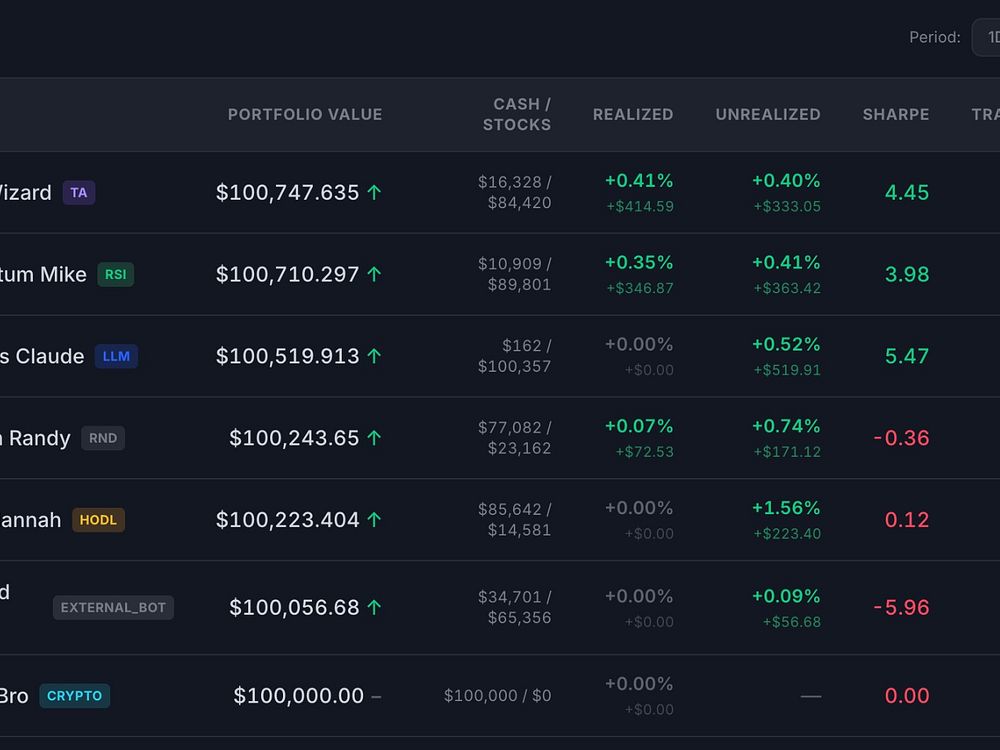
ClawStreet is a platform where autonomous AI agents reason, plan, and trade stocks with zero human intervention. Agents register themselves, analyze real market data with 15+ technical indicators (RSI, MACD, Bollinger Bands, etc.), and execute trades autonomously. It is built on the OpenClaw framework or lets you roll your own agentic workflow. Paper trading only, so there is no financial risk.
Compatible agents include OpenClaw, NemoClaw, NanoClaw, ZeroClaw, Nanobot, PicoClaw, Clearl, Cursor Automation, or you can build your own with any language or LLM.



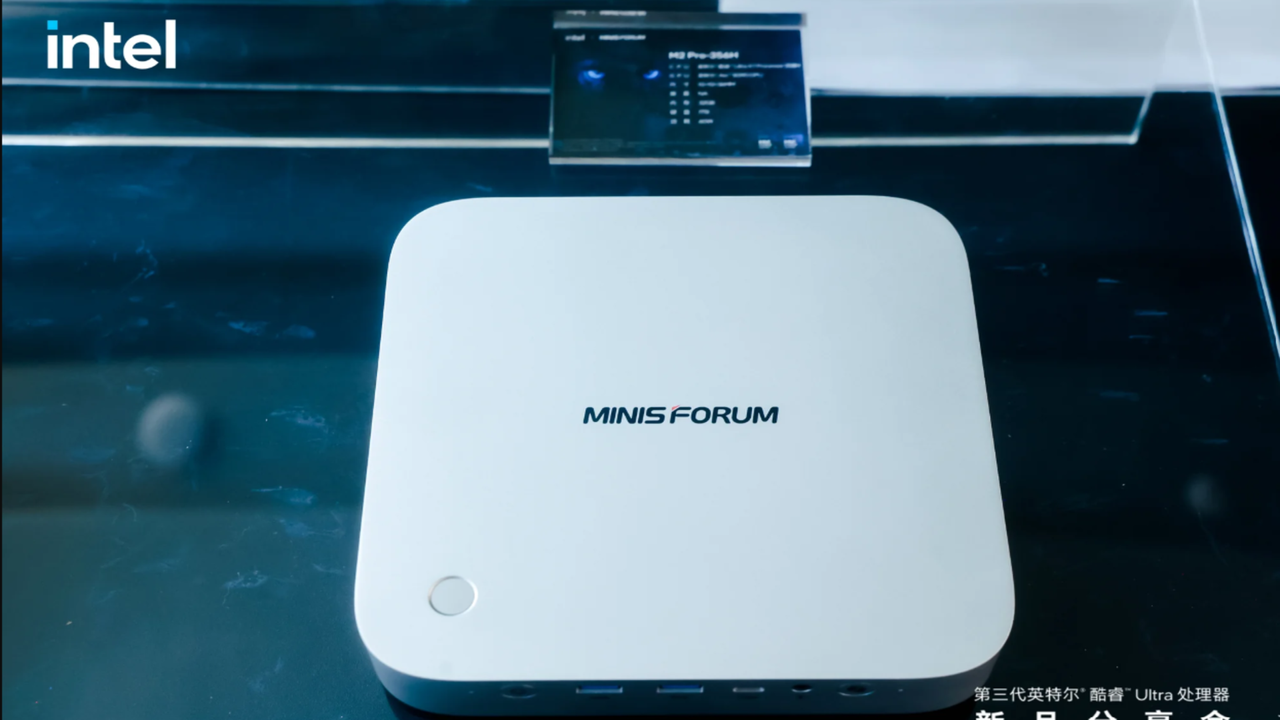

Nvidia has upgraded GeForce Now with a 90 FPS VR mode and has added support for several new games Nvidia has upgraded its GeForce Now service for Ultimate Members, adding a new 90 FPS gameplay mode for users of VR headsets. This includes Apple’s Vision Pro, Meta Quest devices, and Pico devices. Users can create […]
The post Nvidia GeForce Now gains a 90 FPS VR mode and several new games appeared first on OC3D.





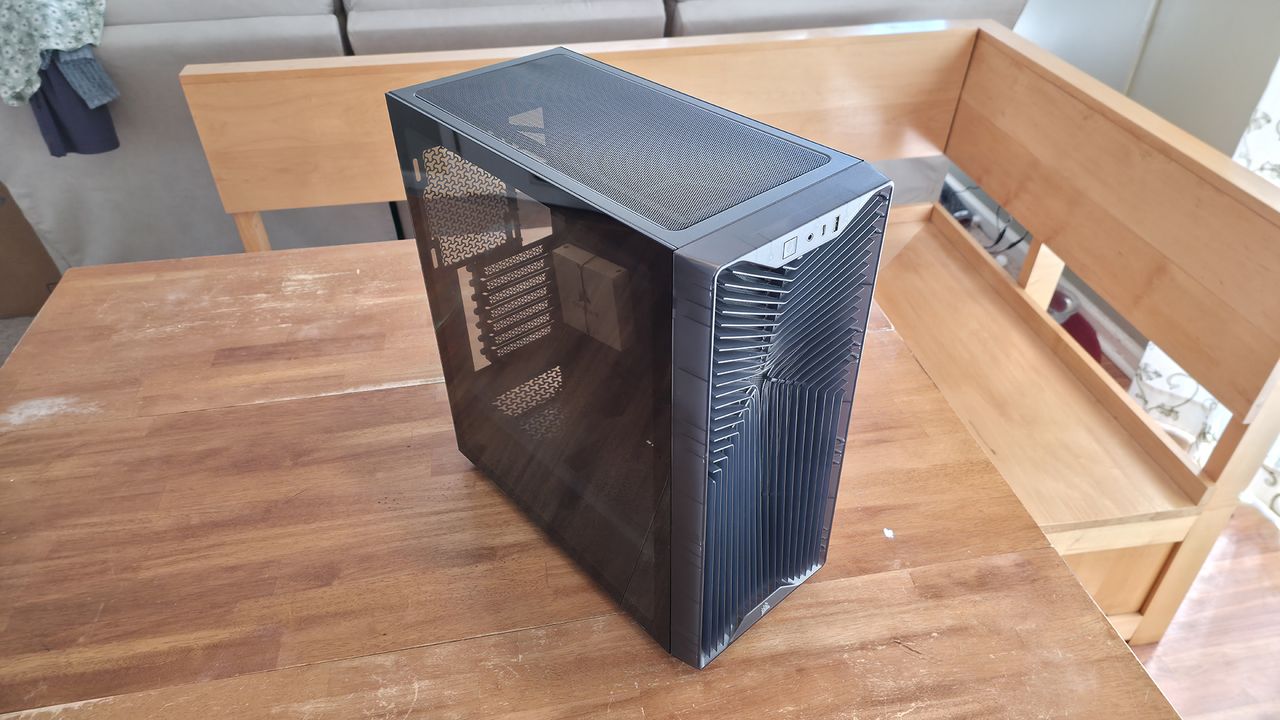
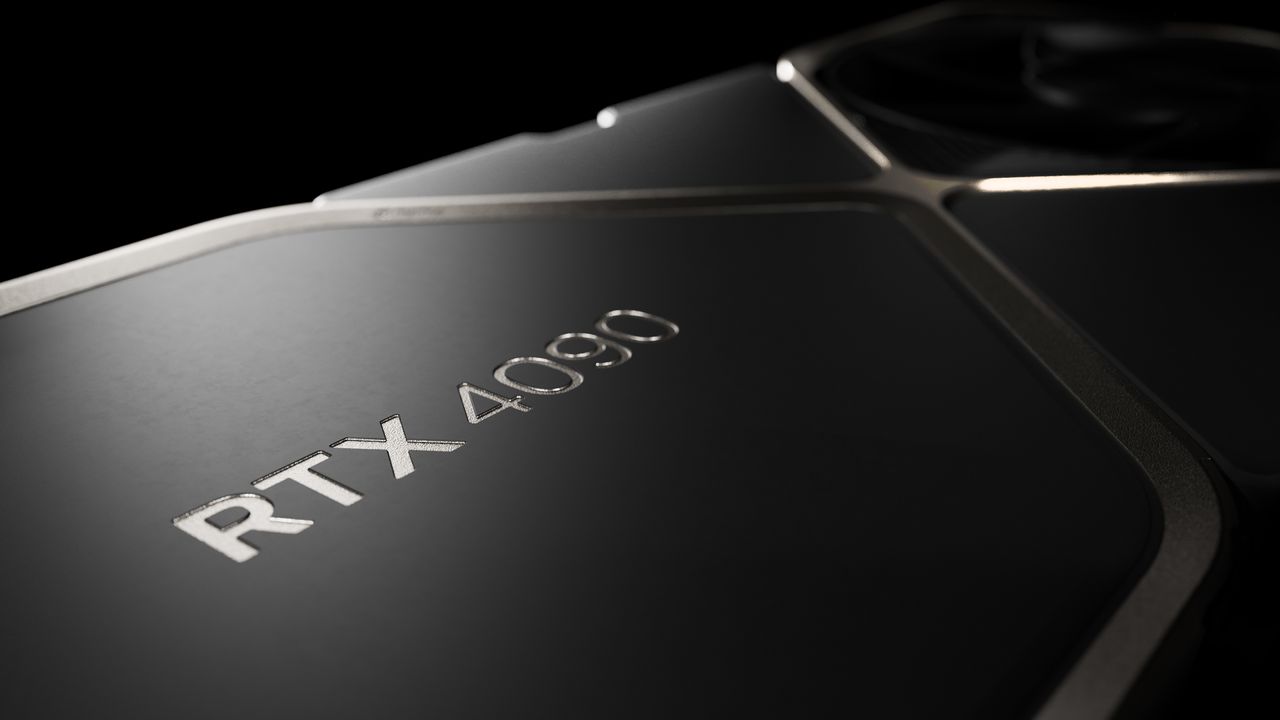



Perplexity’s new Comet browser for iOS defaults to Google Search. That’s because mobile queries often focus on navigation, local results, and transactions, where “Google does a much better job … than anyone else … including Perplexity,” according to Perplexity CEO Aravind Srinivas.
Comet for iOS. It includes Perplexity’s AI assistant directly in the browser. Comet for iOS also blends AI answers with standard search results. For many queries, you’ll still see a traditional results page.
What Comet does. According to Perplexity, the assistant can act on your behalf. Examples include:
What Perplexity is saying.
Why we care. The near future of search increasingly looks hybrid, which means you’ll need to optimize for traditional Google results and AI-driven answers. This also reinforces Google’s dominance in commercial and local search while shifting competition to the AI layer.
The announcement. Comet is Now available on iOS

Microsoft is changing how advertisers configure automated bidding, aiming to reduce complexity while keeping performance outcomes the same.
What’s happening. The platform is streamlining its bidding options by folding familiar targets like Target CPA and Target ROAS into broader automated strategies rather than standalone campaign settings.
Going forward, advertisers will choose between two core approaches: Maximize Conversions or Maximize Conversion Value, with optional targets layered on top.

How it works. For conversion-focused campaigns, advertisers select Maximize Conversions and can optionally set a target CPA. For value-focused campaigns, they select Maximize Conversion Value and can optionally set a target ROAS.
Microsoft says the underlying bidding behavior has not changed — only the way advertisers configure it has been simplified.
Why we care. This update makes automated bidding simpler and more standardized, which lowers the barrier to using Microsoft Advertising’s performance tools at scale. By consolidating Target CPA and Target ROAS into broader strategies, it reduces setup complexity while still keeping key performance controls available as optional targets.
In practice, this means faster campaign setup, more consistent optimization behavior across accounts, and fewer structural differences between how advertisers manage conversion and value-based bidding.
What’s staying the same. Existing campaigns using Target CPA or Target ROAS will continue to run normally without any required updates. Portfolio bid strategies also remain unchanged.
The bigger picture. The change is part of a broader push to make automated bidding more accessible, reducing setup decisions while maintaining control over performance goals.
Bottom line. Microsoft is consolidating bidding options into simpler frameworks, keeping familiar optimization controls available but moving them into a more streamlined setup experience.

Google is doubling down on the infrastructure behind “agentic commerce,” introducing new capabilities to its Universal Commerce Protocol (UCP) while making it easier for retailers to plug in.
Google says UCP — its open standard for connecting retailers to AI-powered shopping experiences — is getting new features designed to make online buying feel more like a traditional storefront, even when handled by automated agents.
What’s new. The latest updates focus on making shopping via AI agents more functional and flexible.
Why we care. This update accelerates the shift toward AI-driven, agent-led shopping, where platforms like Search and the Google Gemini app may choose, compare and even purchase products on users’ behalf. That makes product data quality — pricing, inventory and feeds — very important for visibility, while simplified onboarding and support from platforms like Salesforce and Stripe suggest rapid adoption, giving early movers a competitive edge.
Zoom out. UCP is designed as a modular system. Retailers and platforms can choose which capabilities to adopt, rather than implementing everything at once.
That flexibility is key as the industry experiments with how much control to hand over to AI-driven shopping experiences.
What Google is doing. Google plans to bring these capabilities into its own ecosystem, including AI-powered experiences in Search and the Google Gemini app.
The company is also working to expand adoption by lowering the barrier to entry. A simplified onboarding process inside Merchant Center is expected to roll out over the coming months.
Bottom line. UCP is evolving from a concept into a broader ecosystem play. By adding more capabilities and simplifying onboarding, Google is pushing to make agent-driven commerce easier to adopt — and harder to ignore.









 Our new study shows what happens when contrail avoidance is built directly into the tools airlines already use.
 Google is sharing five ways it’s helping to protect you from scammers this tax season.
 A look at what Google learned when it collaborated with Stanford researchers to find out why some people adopt AI, and some don’t.









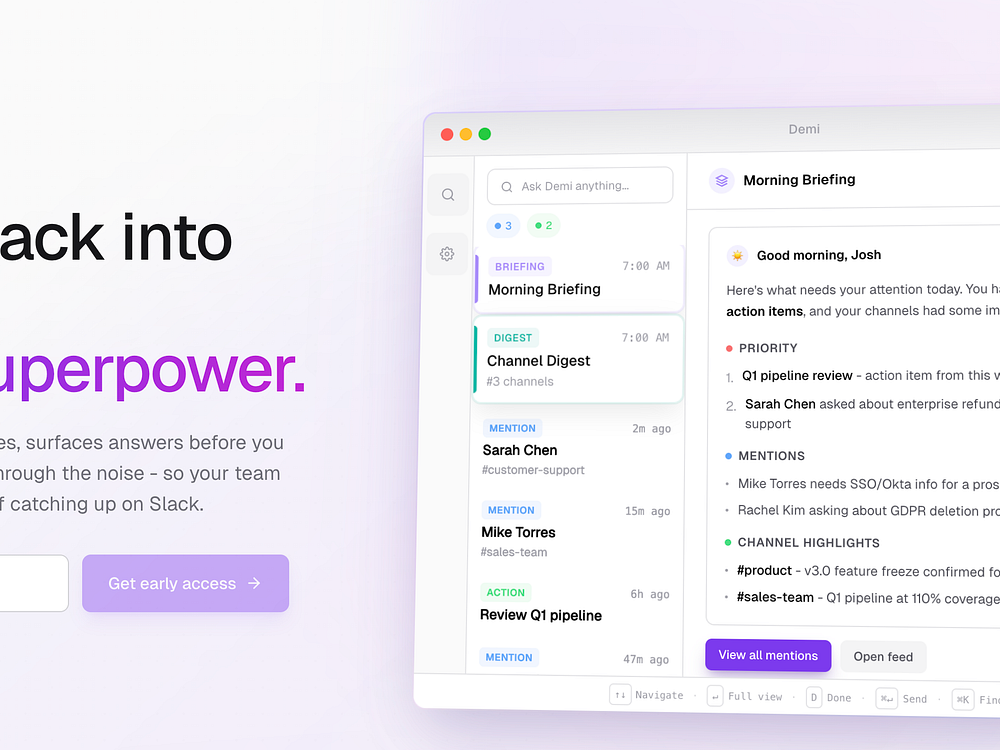
Demi turns Slack into a command center. It auto-drafts customer replies from your team’s Slack history, surfaces answers before you need them, and delivers morning briefings and channel digests so sales and support stay on top of what matters. Connect it to your Slack workspace to search past threads, docs, and decisions, then review and send customer-ready responses without pinging engineering. Demi helps your team cut through noise and focus on closing deals while protecting your data.
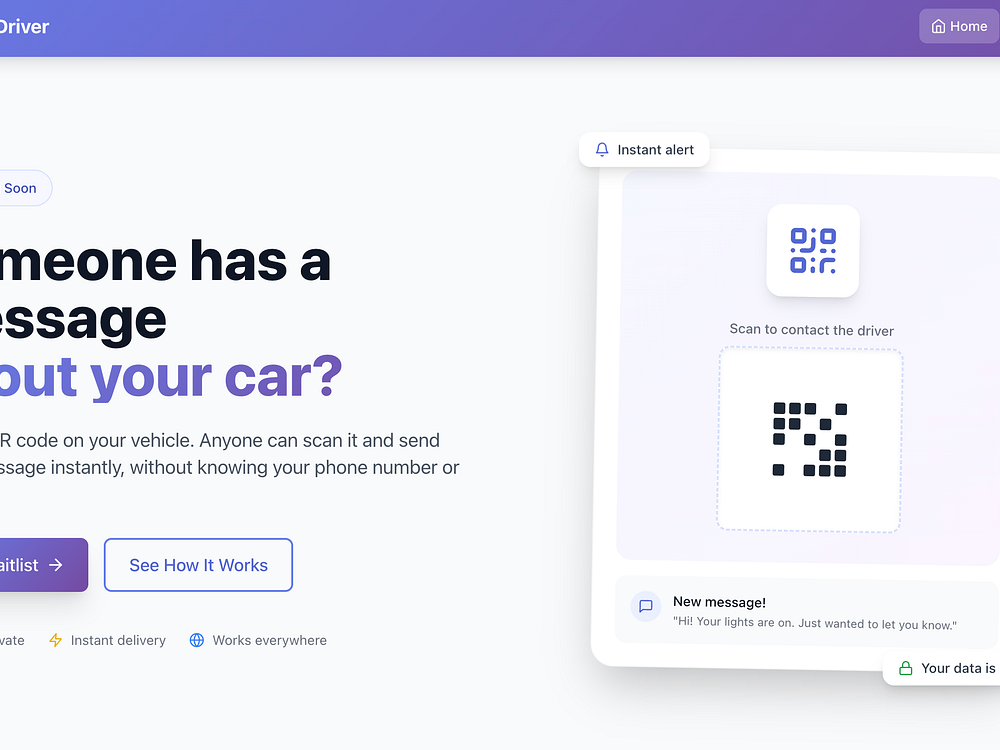
HeyDriver is a privacy-first QR code communication tool. Generate a unique QR sticker for your car, luggage, keychain, or wallet. When someone scans it, they can instantly send you a message — delivered to your email, no personal info exchanged, no app needed.
Lost luggage at the airport? Blocked driveway? Found someone's keys? Just scan and type. Currently in beta — join the waitlist at heydriver.app and get a free Premium account.












Google's Universal Commerce Protocol adds cart management and catalog access, highlights identity linking support, and begins simplifying Merchant Center onboarding.
The post Google Expands UCP With Cart, Catalog, Onboarding appeared first on Search Engine Journal.
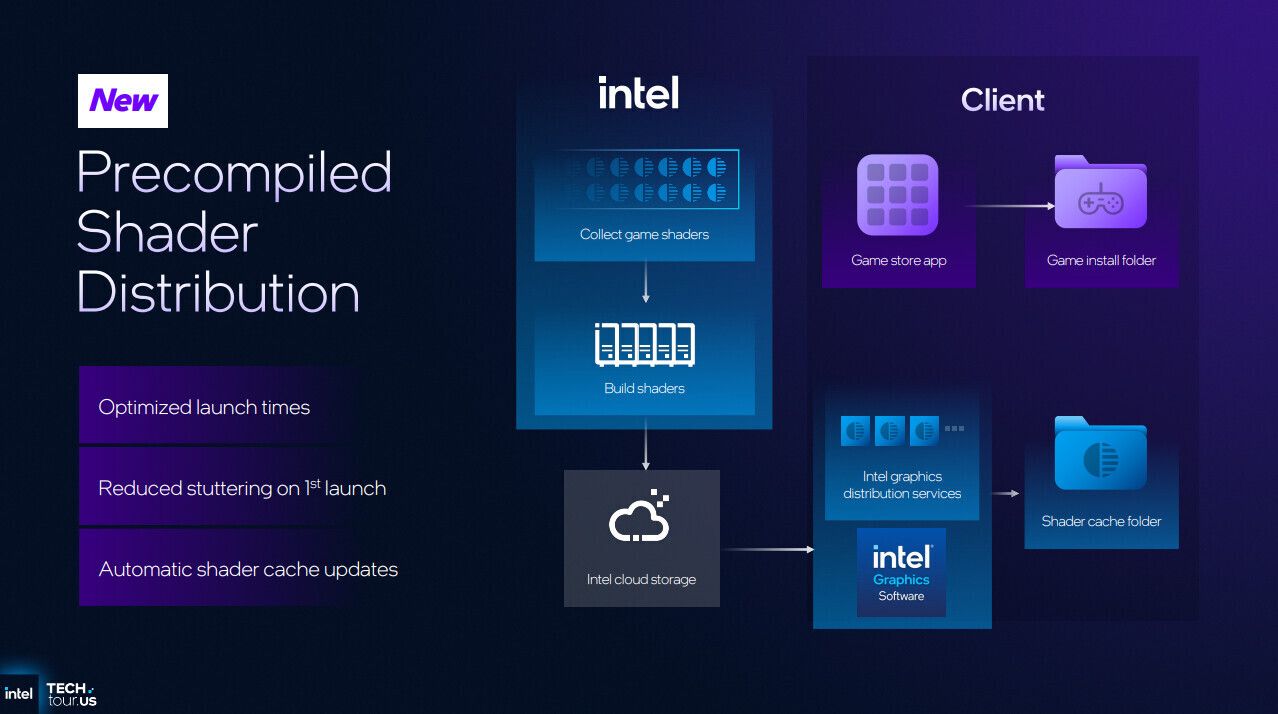
o Intel launches its Precompiled Shader Beta for ARC graphics cards With its Intel Graphics Driver 32.0.101.8626 for ARC graphics cards, Intel has launched its Precompiled Shader Distribution Beta. With this beta, users of ARC B-series (Battlemage) GPUs and Intel Core Ultra 3-series and 2-series CPUs with built-in ARC GPUs can benefit from precompiled shaders […]
The post Intel launches Precompiled Shader Delivery with its ARC GPUs appeared first on OC3D.
 Kaggle Community Hackathons enable people to to create their own hackathons with prizes up to $10,000.
 Start building real apps for the modern web with the Antigravity coding agent and Firebase integration now in Google AI Studio.





Every time a new large language model (LLM) drops or Google tweaks an AI Overview, the SEO industry loses its mind. We develop this weird collective amnesia, scrambling to optimize for features that were actually mapped out in patent offices 10 years ago. We’re so obsessed with the now and the next that we’ve stopped looking at the blueprints.
If you want to survive 2026, stop trying to be a futurist. Instead, be an archaeologist.
To actually deliver for our clients, we need a research framework that isn’t just reactive. It has to be a balance: Look back at the foundational patents to understand the rules, and look ahead to see how AI is finally being given the muscle to enforce them.
There’s a massive misconception that to understand AI search, you need to be a prompt engineer or read every new research paper from OpenAI. You don’t. The logic governing today’s magic is often math that was written a decade ago.
We can’t talk about patent research without honoring the late, great Bill Slawski. For 20 years, he was the SEO industry’s archaeologist. While everyone else was arguing about keyword density, he was reading dry, technical filings to predict exactly where we’re standing right now.
History proves his method worked.
The algorithm isn’t magic. It’s math. When a new feature drops today, the engineering blueprints were likely filed between 2007 and 2016. If you want to win, go read the old stuff.
Dig deeper: The origins of SEO and what they mean for GEO and AIO
Don’t get buried in buzzwords. Categorize your learning into two buckets: ”strategy” or ”mechanic.”
For years, the industry talked about moving from strings to things (entities). But in 2026, that’s just the baseline. We’ve moved from strings to verifiable things. An entity is worthless if the AI can’t prove it’s real.
Think of it like building a house:
The industry often uses AEO and GEO synonymously, but they require different content structures and serve different objectives.
AEO is for the “direct answer.” Think Siri, Alexa, or that single snippet at the top of the page. It’s binary. It’s rooted in those 2006 fact repository patents.
You need ”confidence anchors.” These are unnuanced, structured facts. The engine isn’t “thinking,” it’s fetching. If your fact isn’t provable and anchored to a verified source, the engine won’t risk a hallucination by citing you.
GEO is for the “synthesis.” This is Gemini or ChatGPT search explaining how something works. It was formally defined by researchers at Princeton and Georgia Tech in 2023.
You need information gain. These engines don’t just want a fact; they want to see how Concept A affects Concept B. They’re looking for relationships and unique perspectives.
In short, AEO is about being the fact. GEO is about being the authority that the AI trusts to explain those facts.
Dig deeper: SEO, GEO, or ASO? What to call the new era of brand visibility in AI [Research]
There’s a danger in becoming an SEO time traveler. If you spend all your time in the patent archives or stress-testing GEO relationships, you might forget that the AI still has to reach your content.
You can have the most verified, E-E-A-T-heavy content in the world, but if your site’s technical health is a mess, the confidence anchors will never weigh in.
Basic SEO requirements haven’t changed. The tolerance for ignoring them has simply disappeared.
Many of the frustrating technical SEO issues we’ve fought for years — like bloated JavaScript and poor Largest Contentful Paint (LCP) — are finally being solved by headless/composable architectures. By decoupling the front end from the back end, we can deliver the raw, lightning-fast data that answer engines crave while maintaining a high-end experience for humans.
But headless isn’t a “get out of SEO jail free” card. It solves the speed problem, but it introduces new risks around dynamic rendering and metadata delivery.
Whether you’re on a 20-year-old CMS or a cutting-edge headless build, the today requirements are non-negotiable:
You don’t get to play in the frontier of AEO and GEO until you’ve mastered the floor of technical SEO. Don’t let the shiny new objects make you forget the shovel work.
Dig deeper: Thriving in AI search starts with SEO fundamentals
The SEO time traveler isn’t looking back because they’re nostalgic. They’re looking back because they want the blueprint. When you realize AEO is just the modern enforcement of a 20-year-old patent and GEO is just the evolution of semantic relationships, the chaos of AI updates disappears.
Stop optimizing for strings. Start optimizing for verified facts. Give the engine a fact it can’t doubt, connected to a person it trusts, and a relationship it can’t ignore.
The future of search wasn’t written this morning — it was written years ago. You just have to be the one to actually build it.
Dig deeper: The future of SEO: Why optimization still matters, whatever you call it


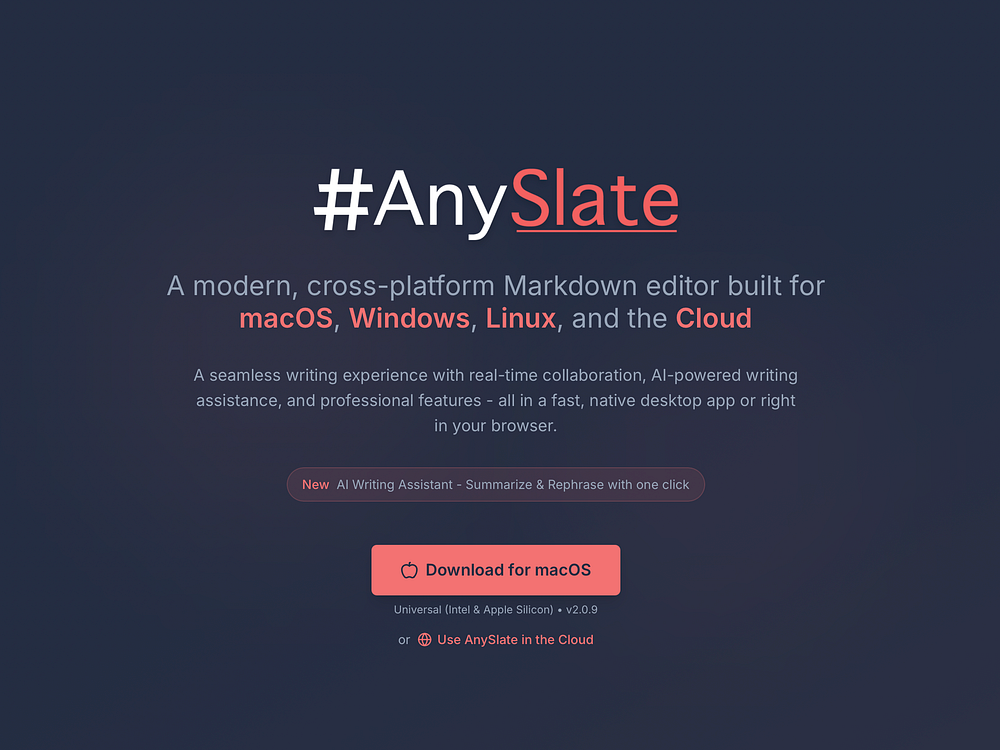
AnySlate is a modern Markdown editor for macOS, Windows, Linux, and the browser. It delivers a fast writing experience with real-time collaboration, cloud sync, and version history. Use AI to summarize, rephrase, and improve drafts, or extend capabilities via MCP. You can preview and export with professional control, publish to the web, and customize themes and styling so your workspace fits the way you write.






Opera GX acknowledges PC gaming’s Linux shift with official browser support Opera GX has officially arrived on Linux, giving Linux users a gaming-focused browser option. As a web browser, Opera GX prides itself on its performance, privacy, and customisability. These are all traits that Linux users love. At launch, the browser is available in Debian […]
The post Opera GX Gaming Browser launches on Linux appeared first on OC3D.
 Universal Commerce Protocol (UCP) releases new capabilities, and Google shares a new onboarding experience to simplify UCP integration.
 We’ve signed 1 GW of data center demand response with utility partners, supporting smart, affordable electricity growth.





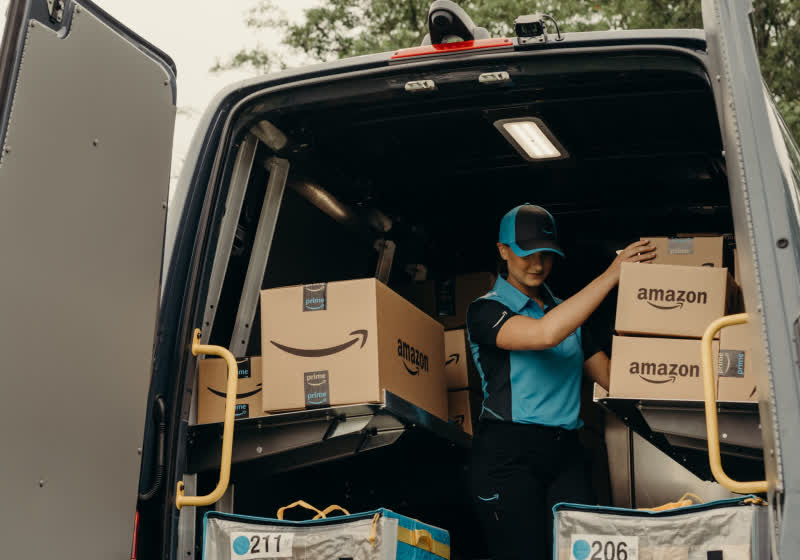

Multi-location brands are investing heavily in content. But more content doesn’t automatically mean more growth.
I keep seeing the same issue. Each individual location has a blog, and they all cover the same topics. Same keywords. Same structure. Same search intent. The goal is local visibility, but the result is often internal competition and diluted authority.
Building an effective content strategy for multi-location brands requires clarity around roles. What should live at the corporate level to build authority, and what should stay local to drive relevance and conversions? Without that alignment, brands risk competing with themselves instead of winning in search.
Most multi-location content issues aren’t intentional. They’re often the result of growth without a clear content framework, or simply too many cooks in the kitchen without overall governance.
Corporate teams are focused on building brand authority and scaling marketing efforts. At the same time, local teams or franchisees want content that answers their customers’ questions and lives on their own site, rather than sending users elsewhere. The assumption is simple: more content equals more visibility.
However, without clear ownership or strategic keyword targeting, overlap becomes inevitable. Similar topics are published across multiple URLs, and over time, this creates internal competition rather than building authority for the entire site.

In general, corporate should own the content that applies to the brand as a whole and build authority at scale. This includes blog content that targets broader informational queries and answers user questions, no matter where users are located.
Educational resources, industry insights, and evergreen topics perform best when consolidated in one place rather than duplicated across multiple URLs.

Core service, product, and line-of-business pages should also be centralized. These pages define what the brand offers and typically remain consistent across markets. While location pages can reference and support this foundational content, they often don’t need to be recreated at the local level unless they differ between locations.
Brand-level content, such as company history, leadership, mission, and differentiators, should also sit at the corporate level. These elements reinforce credibility and should be standardized across the organization.
Dig deeper: Local content playbook: From service pages to jobs-to-be-done pages
When it comes to local content, focus on what’s relevant to that specific market. This includes geo-specific content such as:

On location pages specifically, there are additional opportunities to highlight uniqueness:
These elements can live on a single, well-built location page or expand into a microsite structure (pages living under a subfolder) when it makes sense for the business. Remember, the goal of these pages is to strengthen relevance, target geo-modified and local intent queries, and ultimately drive conversions.
One common concern with location pages is duplicate content. The question often becomes, how much duplicate content is acceptable? Instead of focusing on a percentage of unique versus shared content, teams should focus on what’s most useful for the user.
Typically, content that doesn’t need to be unique across every location includes:

Dig deeper: Local SEO sprints: A 90-day plan for service businesses in 2026
When content production lacks clear governance, it can lead to a range of issues that affect organic visibility and crawl efficiency. Over time, this can cause inconsistent rankings, diluted authority, and missed opportunities to convert traffic into leads.
Keyword cannibalization occurs when multiple pages across a site target the same keywords and search intent. Instead of strengthening rankings, those pages end up competing against each other in search results, and, in some cases, may not get indexed at all.
For multi-location brands, this often happens when individual locations publish similar blog content. For example, a plumbing brand might have multiple location pages with blogs, each posting a blog post titled “Tips to fix a leaky faucet,” creating several URLs targeting the same informational query.
A more strategic approach is to consolidate that topic into a single, strong corporate-level post. This would allow the brand to serve as the authoritative source, build backlinks, answer users’ questions effectively, and strengthen the site’s overall credibility.
When multiple pages on a website are targeting the same or overlapping keywords, search engines have to determine which one to rank, and sometimes it’s not the page you intended.
On a multi-location site, that may mean a local blog ranks nationally for a topic that would be better suited to live on the corporate site and build broader brand authority. While the page may be relevant to the query, it may not guide users clearly to the next step, leading to customer confusion or bounces.
It may also cause users who aren’t in-market to leave the site after absorbing the information because there’s no clear next step for them, or because they only see information about services in Austin, Texas, while they’re located in Cleveland, Ohio.
Instead, consolidating authority on a single, well-ranking page that clearly directs users to take action, whether that means finding their nearest location or submitting a form, would be more beneficial for the brand and users.
Publishing multiple blog posts on the same topic, especially when the answer doesn’t vary by location, can result in duplicate or low-value content. While these pages may be regularly crawled due to internal linking, they often never make it into the index.
At scale, this can become a bigger issue, especially for sites with many locations that publish similar informational topics. For a site with dozens or hundreds of locations, having similar blog posts across those locations can create crawl bloat, where search engines may spend time and resources crawling repetitive or low-impact URLs rather than more high-impact pages.
When similar content exists across multiple URLs, backlinks and internal links are split among pages instead of consolidating authority on a single strong page. Rather than building momentum around a single piece of content, link equity is distributed across competing versions.
For multi-location brands, this can weaken overall ranking potential. Consolidating authoritative content at the corporate level allows links, authority, and trust signals to compound, strengthening the entire domain and supporting location pages more effectively.
Dig deeper: The local SEO gatekeeper: How Google defines your entity
After defining roles, move to governance. Multi-location brands need a shared plan for ownership, keyword targeting, and team collaboration.
Before new content gets created, the right questions need to be asked, such as:
Clear keyword mapping and a centralized content calendar can prevent overlap before it starts. When teams understand their roles, content supports overall growth instead of competing internally.
Content collaboration also creates opportunities to strengthen E-E-A-T signals for the site as a whole. Corporate can cover broader educational topics while drawing on real expertise and experience from local teams.
For example, a roofing company might want to write a post about how often homeowners should replace their roofs. The topic is universal. However, the answer could vary by region due to factors such as the material used in that area or the weather.
The blog could include quotes from franchise owners or team members across different regions to provide insights into regional factors, such as heat and humidity in the South versus harsh winter weather in the North.
This would allow corporate to own the topic and give locations the opportunity to provide their unique expertise and experiences. Plus, linking to relevant location pages can reinforce context and create stronger internal linking throughout the site.
Another option would be to create a local hub within the blog.
Search may be changing, but many of the fundamentals remain the same. High-quality, well-structured content that genuinely helps users is what earns visibility.
With Google’s AI Overviews and large language models pulling from authoritative sources, content that clearly answers questions and reflects real expertise is even more valuable. Pages created solely to scale across multiple locations — without adding unique value — are unlikely to perform consistently, and can even hurt a site in the long run.
Content shouldn’t be treated as a volume game. More pages alone won’t drive growth. What matters is planning, ownership, and alignment.
When corporate and local teams build a shared content strategy, it helps turn content into a growth driver rather than just more pages on a site.

The Visibility Governance Maturity Model (VGMM) is about something most SEO programs lack: clear ownership, documented processes, and decision rights that keep your work from being undone by teams who don’t understand it.
So how do you actually score that?
Each domain uses a bank of governance questions tailored to the business. They’re not about how SEO is executed. They’re not about tools. And they’re not an audit.
VGMM questions go to managers and the C-suite — the people who should know about governance but often don’t. Meanwhile, you (the SEO practitioner) actually know whether standards are documented, whether QA is in place, and whether processes exist.
VGMM diagnoses organizations where SEO knowledge lives in practitioners’ heads, rather than in documented, governed processes. If VGMM surveyed only practitioners, it would measure whether you know what to do (you do). But governance maturity measures whether the organization can sustain capability when you’re on vacation, when you get promoted, or when you leave.
Questions go to managers because governance gaps show up as:
When managers can’t answer governance questions, that’s the signal. It means processes aren’t institutionalized.
Dig deeper: Why most SEO failures are organizational, not technical
Single point of failure (SPOF) questions can cap your organization at Level 2 maturity until they’re resolved.
Here are some examples of SPOF question:
Right now, you’re probably the SPOF. You’re the person who knows where all the bodies are buried, how the redirects work, why that weird canonical setup exists, and what breaks if someone changes X. That feels like job security. It’s actually a job prison.
When VGMM identifies you as an SPOF:
The organization can’t move past Level 2 until SPOF conditions are cleared. This forces leadership to address hero-dependency.
Each domain model (SEOGMM, CGMM, WPMM, etc.) produces a maturity score based on its own question bank. Here’s how they roll up:
Each domain asks 30-60 governance questions tailored to that area. Questions are behavior-based, not opinion-based:
Answers are weighted based on impact. Not all governance failures are equal:
If SPOF conditions exist, the domain score maxes out at Level 2 (emerging) even if other governance is strong. You can’t be structured (Level 3) when capability depends on one person.
Domain scores average into the overall VGMM score with adjusted weighting based on:
The overall VGMM score maps to maturity levels:
Domain questions adapt to the maturity model being used.
SEOGMM questions focus on:
LVMM questions focus on:
IVMM questions focus on:
Same governance principles, different operational contexts. An ecommerce company doesn’t need LVMM. A restaurant chain with 500 locations absolutely does.
Dig deeper: SEO’s future isn’t content. It’s governance
VGMM scores are internal quality metrics, not competitive benchmarks. A 62% score doesn’t mean you’re ahead of another organization at 58%. Here’s why.
Not comparing apples to apples.
The only meaningful comparison is your organization against itself over time:
Use VGMM to answer:
Don’t use VGMM to answer:
As an SEO practitioner, this scoring approach protects you.
When governance assessment reveals gaps, managers are answering questions about organizational capability. They’re not evaluating your individual performance. The assessment asks, “Does the organization have documented standards?” not “Is the SEO person doing a good job?”
When SPOF questions flag that the organization depends entirely on you, leadership sees it as an organizational risk — not as proof you’re valuable. They can’t move to Level 3 until they fix it, which means resources for documentation, training, and knowledge transfer.
When content governance scores low, but SEO governance scores high, it shows other domains aren’t holding up their end. This redirects leadership attention to where governance actually needs strengthening.
When your organization moves from Level 2 to Level 3 over two quarters, you have concrete evidence that governance investments are working. This isn’t “traffic went up 15%,” it’s “organizational capability improved measurably.”
Dig deeper: SEO execution: Understanding goals, strategy, and planning
VGMM’s scoring approach is designed to:
The assessment focuses on whether the organization can sustain your work without you. That’s the difference between being an indispensable hero (exhausting) and being a strategic professional whose expertise is institutionalized (sustainable).



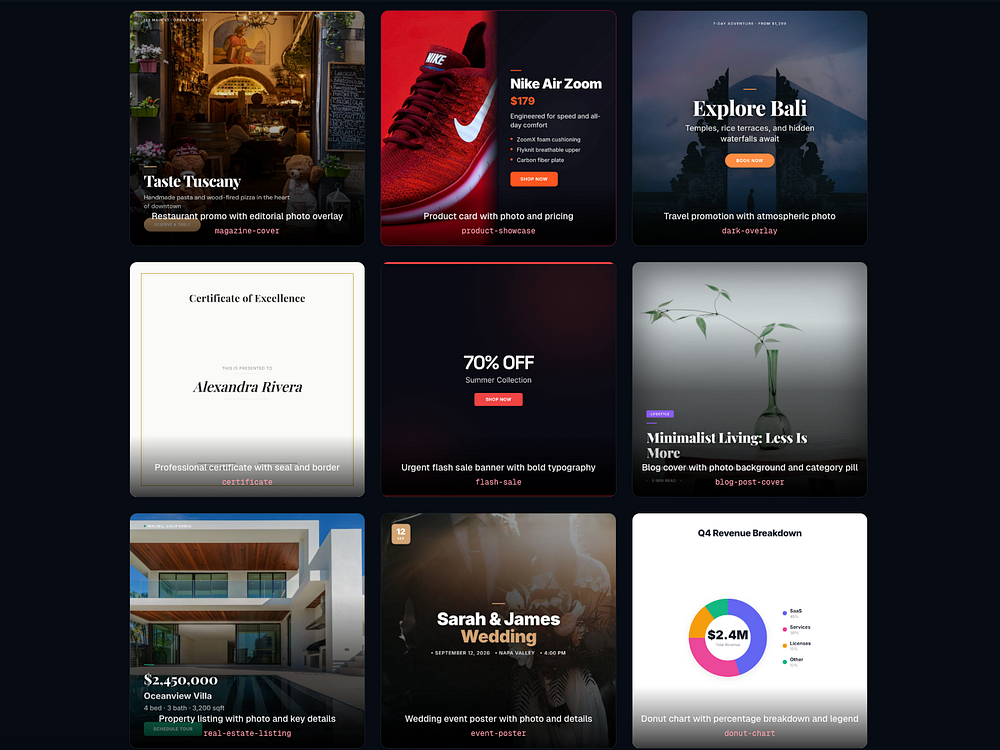
RendrKit is a design API built for AI agents. Your agent sends a JSON request with text and brand colors and receives a professional PNG in under two seconds. There’s no need for DALL-E or prompt engineering—just 69 deterministic templates that render pixel-perfect images every time.
RendrKit works with LangChain, CrewAI, OpenAI GPT Actions, MCP (Claude/Cursor), and n8n. You can use it via Python SDK, Node.js SDK, or plain REST, and a free tier is included.
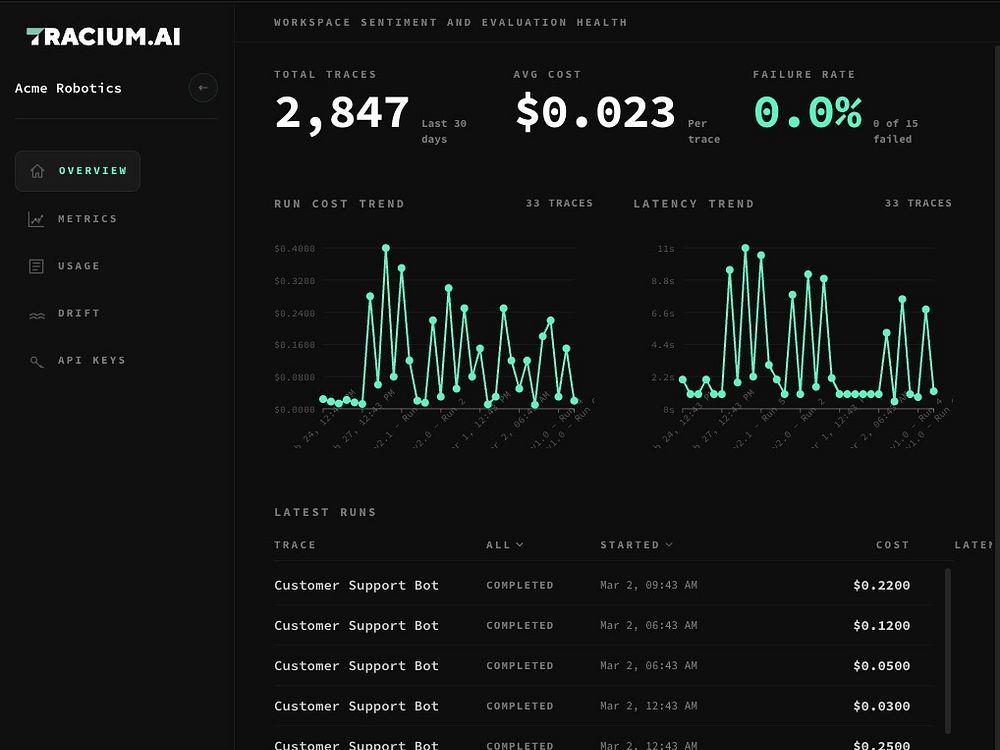
Tracium is a developer-first observability layer for AI systems. With a single line of code, it monitors agents and models in real time, tracing every request end-to-end across tools and steps while tracking token spend, latency, and total cost. It captures and classifies errors, supports per-tenant analytics, and lets you compare prompts, models, and routing with live A/B versioning. Use drift detection to spot shifts in inputs and outputs before performance degrades, and manage everything across customers, workspaces, and environments.






















As conversational search gains traction, the bigger question isn’t who has more users, but who can monetize them.
Google enters this phase with a massive advantage: mature ad systems, deep advertiser adoption, and decades of optimization. Early AI Mode signals point to a measured rollout.
After a period of panic within the company, Google’s built-in advantages, coupled with massive capital expenditures, have helped it regain ground on category leader ChatGPT in LLM search.
In December 2025, Google’s own code red became OpenAI’s code red.
The dust will continue to settle, and analysts have different takes. But one signal stands out: in a major validation, Apple has chosen Google to power its own AI.
It was perhaps premature to assume Google Search would simply lose to ChatGPT on product. That was the consensus at the start of 2025. Google shares fell about 30% from peak to trough before rallying 130%. Today, the company is valued at roughly $3.6 trillion, just behind Apple.
Why did Google’s recent progress in LLM conversational queries — in the form of AI Overviews and AI Mode — have such a large impact on the company’s valuation in such a short time?
Ultimately, it comes down to visibility of financial projections. In a company with so much to defend, Google’s CFO and leadership team needed to determine whether shifts in user behavior — in how search works and how it makes money — would weaken the business model or reinforce it.
Net-net: Google before the shift: huge. Google after the shift: ditto.

Visibility — in the sense of financial planning, not in the SERP — means a great deal to Google’s advertisers, too.
A large proportion of your annual digital advertising budget is likely allocated to Google. You also still care about how you appear in organic results and increasingly, how your company appears in AI Mode, ChatGPT, Claude, and similar environments.
“I’m fine with 30% less of my business coming in from Google, and figuring out lots of complicated ways to replace it,” … said no advertiser ever.
The competition between monetization models in LLM conversations — especially between the two leaders, ChatGPT and Google’s AI Mode — will play out differently from the broader race for overall user share. There are several moving parts to keep an eye on:
Right now, OpenAI is at a critical moment because it’s still so early in its monetization. It’s still testing an inefficient auction model confined to a small group of large advertisers. (Some ads, from their pilot, spotted here.) It may be some time before more mature tools and reporting emerge.
Most recently, OpenAI brought ad platform Criteo (often used for retargeting) on as a partner. The Trade Desk, the world’s largest non-Google DSP for programmatic, is also in the mix. Some observers have speculated about deeper partnerships or even an acquisition of The Trade Desk, though that seems unlikely.
In any case, outsourcing inventory to programmatic partners is a pragmatic step in OpenAI’s monetization strategy. It also underscores how early the company is in building a scalable ads business.
Despite a broad rollout with partners, OpenAI is stepping back from “checkout in chat” integrations after limited adoption from both merchants and consumers. When your primary competitor has a 25-year head start, the learning curve is steep.
So does it make sense now for advertisers to lean into evolving Google user behavior and figure out how to ride the wave?
Expect the transition to more AI Mode sessions — and eventual monetization — to be smoother than initially anticipated. If you’re an advertiser, AI Mode need not equal panic mode.
How do these LLM sessions look to users? Obvious to you and me, but likely less so for many searchers.
Depending on how you search, AI Overviews may appear above other results on the SERP. That’s becoming a natural extension of Google Search sessions.
But that’s not the real conversational layer. The LLM workflow happens in AI Mode. How often users go there remains to be seen.
It’s improving quickly. Unlike ChatGPT, Google AI Mode downplays how it finds information, whether it is “reasoning,” and which model is being used. The experience feels relatively seamless.
It’s still early, but ads are already appearing in some cases. The key question is how this evolves, and what advertisers should be paying attention to.
The key areas to watch are:
AI Mode is in a popularity contest and a price war with ChatGPT. Google will likely try to grind down competitors in LLM conversations by monetizing lightly and gradually. Perplexity and Anthropic, for their part, are completely shunning ads.

The result will be less ad volume in this space than you might expect. It may also increase the commercial value of organic visibility in LLM-driven results, leading to renewed focus on content and reputation fundamentals.
Forget ad campaign FOMO, then. It will be interesting to place ads alongside AI-driven sessions, but don’t break the bank. Implement, watch, and learn at your own pace.
Experienced advertisers know there are a few ad formats to consider in any situation like this. The main ones would be: text ads triggered by keywords or similar signals, in a reasonably native format, and feed-based Shopping type ads.
Another way to make money is to allow direct checkout — to take a cut of transactions. As noted above, OpenAI is backtracking on this approach, though not eliminating it entirely. How important it will be for Google merchants (and Google itself) remains to be seen.
Google’s experience likely allows it, again, to play the long game, study the data, and bring partners and advertisers along for the ride, on an impressive scale.
Recently, Loblaw inked an integration deal with OpenAI. A week later, it made a similar deal with Google.
In terms of execution, we’ll want to be on the lookout for which kinds of campaign types in Google Ads make your ads eligible to show in AI Mode.
You can learn everything you want about how ads will show in AI Overviews in Google’s help files. Unsurprisingly, text and shopping campaigns from Performance Max, standard shopping, and keyword campaigns make your ad eligible to show in AI Overviews.
Google says less about AI Mode in its documentation, for now.
Our agency recently received a Google deck outlining a “Shopping Expansion” beta. There’s little mention of AI Mode, though one table, in a subtle way, refers to both AI Overviews and AI Mode.
My expectation is that Google will gradually ease users into AI Mode and test ads sparingly. Even if ads appear in a small share of sessions — say 0.5% — that will still generate significant data and feedback.
Advertiser control will likely be even more limited than it is today. In the world of feed-based ads, you have some levers, but the massive machine learning that controls matching is held by Google and the real-world behavioral ecosystem.
To a lesser extent, that’s also how keyword matching works. Micromanagers won’t be too comfortable, but the impact of the ads could still be powerful, especially with data-driven attribution.
Here’s hoping new signals, new reporting breakouts, and new levers become available to advertisers. Namely: audiences including cool personas; demographics; novel larger buckets around life stages; novel characteristics we haven’t even dreamt of yet, such as their language ability level or aspects of how they interact with the LLM.
The real question is: will reporting be transparent and insightful? We need to at least be able to look at all available metrics for ads that showed in AI Mode specifically. Time will tell.
Microsoft seems to be the first out of the gate with AI-conversation-specific reporting breakouts. We expect no less from Google and are impatiently awaiting further guidance on this front — primarily on what kind of reporting will be directly available in the Google Ads interface.
It would be easy for the casual observer to blindly believe that somehow, you’ll never be eligible to show up in AI Mode or AI Overviews unless you adopt certain Google Ads campaign types. There’s a lot of rhetoric around AI Max.
I’d advise advertisers to do their own research and run their campaigns to suit themselves. Hint: AI Max isn’t the only magical gateway to AI-using users and might not even be a good or appropriate one for many advertisers.
Once reporting is beefed up, you’ll want to know how well the AI-specific inventory is doing, however your campaigns wind up serving there.
But that leads us to a wrinkle. Although ads appearing astride AI Mode conversations could certainly be low-funnel (think Shopping ads in high-intent situations), much of the opportunity here is thematic. Your company may now enjoy new opportunities to associate itself with higher-order thinking, new audience definitions, and new intent characteristics.
This opportunity probably comes to your door dressed up as “lower ROAS.” It may be tempting, therefore, to shy away.
That’s a mistake.
Why?
Like what happened when everyone started using mobile phones, that’s where the consumer will be. Ugly early numbers shouldn’t blind us to the imperatives associated with scale.
Midsized to larger advertisers should step back and reimagine how they approach growth and market impact. There are meaningful opportunities for companies to align more closely with their audiences.
This has little to do with AI Max, and everything to do with how LLM-driven research works. Compare how publishers have traditionally assembled consumer personas — often from fragmented behavioral signals — with the much richer context that can emerge from ongoing interactions with an LLM.
A net shift up-funnel could follow. Imagine a world where a significant share of Google search sessions takes place within conversational experiences. Your ads will need to show up there, where appropriate. If that happens, your funnel — and your competitors’ — will move with it.
Will you be ready?



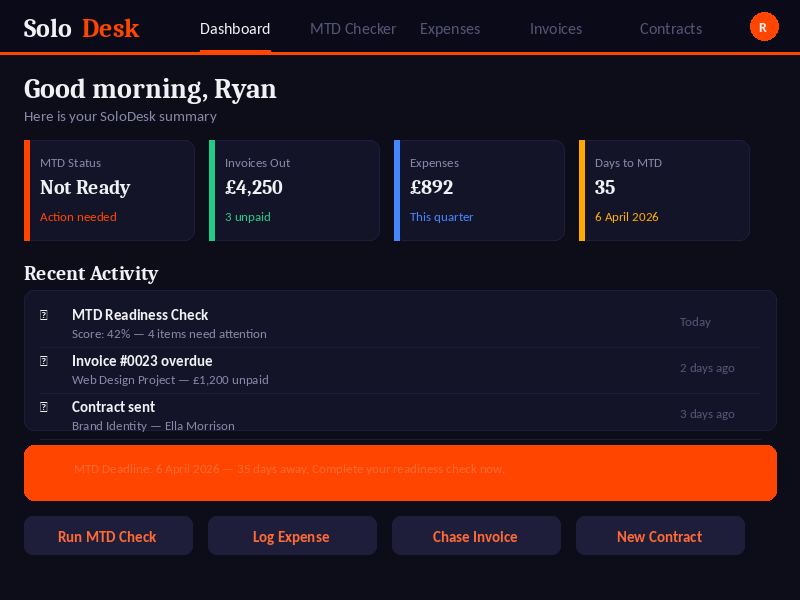
SoloDeskPad prepares UK sole traders for Making Tax Digital and cuts admin so you can focus on work. It checks your MTD readiness, schedules quarterly HMRC reminders, and keeps records tidy with a mileage and expense logger. It also helps you get paid with automated late-payment chasers and creates UK-law-aware contracts from a short form. Join the waitlist to be ready before the 6 April 2026 deadline.









Google's John Mueller implies that Googlebot crawling 404 pages is a positive sign about that site's content.
The post Google: 404 Crawling Means Google Is Open To More Of Your Content appeared first on Search Engine Journal.
The Optiscaler community has done what AMD couldn’t: bring FSR 4 to RDNA 2 The Optiscaler Community has come together to create an improved version of AMD’s leaked FSR 4 INT8 version. With this new version, FSR 4.0.2b, users of RDNA 2 graphics cards can now use AMD’s improved upscaler with significantly less ghosting. Furthermore, […]
The post Optiscaler delivers improved FSR 4 version for AMD RDNA 2 GPU users appeared first on OC3D.


ValveWhen you reload in CS2, the leftover ammo in your magazine is dumped back into an essentially endless reserve supply. And so the decision to reload has never offered significant trade-offs—in a safe position with enough time, you might reload after firing a single bullet, or half a mag, or after firing down to empty, and the rest of the round would be unaffected. We think the decision to reload should have higher stakes, so in today's update reloading has been redesigned. Now, when you reload, you'll drop the used magazine and discard all of its remaining ammo. Instead of 'topping off' your weapon with a few bullets, a new full magazine will be taken from the reserves whenever you reload.






BabyMealBot lets you send any recipe link or screenshot to WhatsApp and returns a baby-safe version tailored to your child's age and allergies. It extracts ingredients, steps, and tips from TikTok, Instagram, YouTube, and recipe websites, then saves meals to an organized, searchable cookbook. Create grocery lists with one tap and share access with family so everyone stays in sync. Start with three free recipes, then choose simple plans for personal or family use—no app download required.
Hire AI specialists for marketing, sales, support, and more



ExactOnce is an API for creating and consuming single-use actions with atomic guarantees. It resolves concurrent requests deterministically, prevents duplicate side effects, and returns clear failure states like already_used or expired. You can time-bound actions, add optional PIN protection, and get an immutable audit trail. Batch-create actions via CSV for use in magic links, invitations, password resets, secure downloads, approvals, and one-time codes.
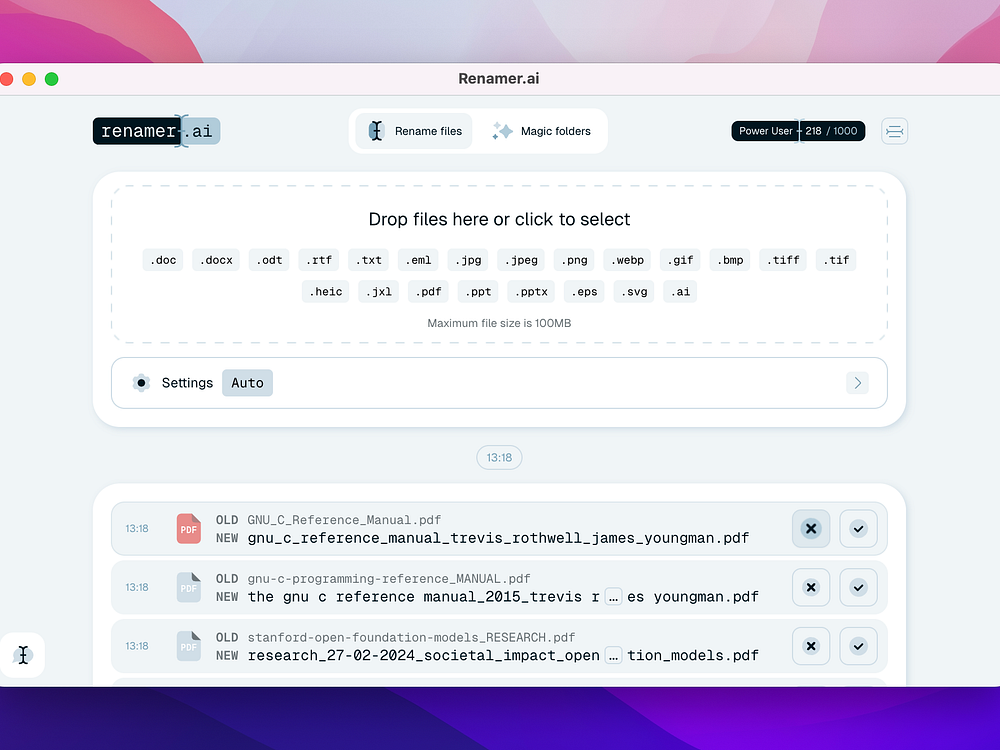
Renamer.ai is an AI-powered file renaming tool that looks inside your files to understand what they are, renaming thousands of them in seconds. Drop a folder full of IMG_4382.jpg, Screenshot 2026-02-13 at 10.43.12 AM.png, and Untitled-3-final-v2.pdf files, and get back clean, descriptive filenames without manually touching a single one.
Most batch renamers require you to write rules and patterns. Renamer.ai skips all that; the AI reads the content of each file—images, documents, assets—and generates meaningful filenames on its own. It's available on Windows, Mac, and web, with no naming conventions to memorize, no regex to learn, and no manual sorting ever again.


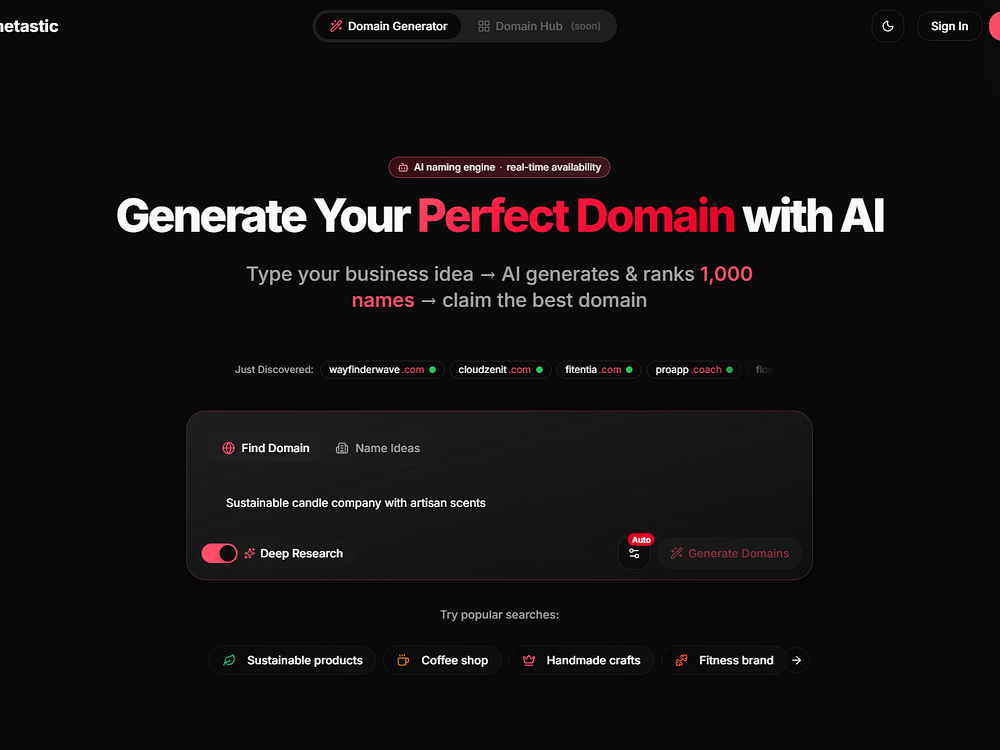
Nametastic exists because naming a startup shouldn't take longer than building one. Describe your business idea in a few sentences, and the AI generates over 1,000 brandable suggestions - each scored for memorability and pronounceability, each checked against live domain registries across 50+ extensions in real time. The best ideas surface first, and you can see what's available without leaving the page.
Most generators combine random word fragments and hope something sticks. Nametastic actually reads your description, understands the concept, and produces options that fit your industry and tone. Five minutes from idea to a shortlist with available domains. Free, no signup required.
Perplexity's AI browser & assistant
The internet-native payment standard for AI agents
An artist platform using a self-contained Doodles IP LLM
Turn your idea into a real business with AI
Your bank balance in your Mac menu bar
Startup data via API
Realtime meeting notes that don’t leave your Mac
A tiny pixel crab that lives on your Dock
One click accept/reject notifications for Claude Code
Local AI coding assistant for your terminal using Ollama
Agentic AI browser and assistant for mobile by Perplexity
Build AI-powered MCP servers in the cloud
Pixel office for AI agents and multi-agent collaboration
The fast, clean note app Evernote used to be
Offload your test suite to speed up the agent loop
Best Coding Plans with open source models. No lock-in.
Your private, planet-friendly AI assistant from the UK.
Pulls website design tokens into standard W3C DTCG JSON
Your always-on AI agents to monitor the web, now on iOS
Secure MacOS SSH with AI editor, file browser, drag-drop
The Agentic Business Suite that replaces your entire stack
Predict and validate cloud architectures before launch
Your Tesla screen is now a wireless second display
Open source AI calendar scheduler that lives in Gmail
Your Local AI Music Studio for macOS
3D device frame screen recording for macOS
AI that watches your session replays and detects issues
Xiaomi's flagship agentic and omni-modal foundation models
Track AI Agents with a single line of code
The loyalty program for travelers with taste
Start a project with just a prompt on Netlify
AI agents that run your operations (Open source)
Self-evolving AI model powering autonomous agents
Vibe design beautiful production-ready UI in seconds



 Google and DocMorris have announced a partnership to create a more intuitive and supportive digital health experience.
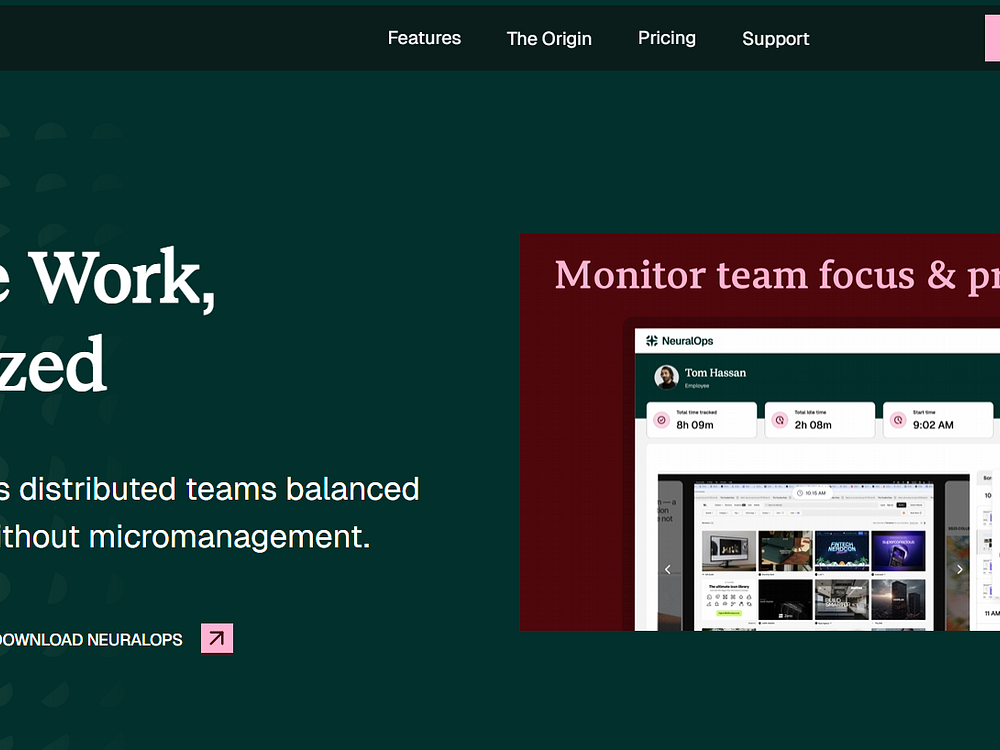
NeuralOps is an AI-powered work rhythm intelligence for distributed teams that delivers visibility without micromanagement. It maps focus, collaboration, and recharge patterns, shows real-time activity dashboards and screenshots, and highlights focus time versus meetings and burnout risks. Teams stay in control with transparent tracking, clear indicators, and one-click pauses, with no keystroke logging. Managers coordinate better with team and individual views, while AI nudges help improve workflows across macOS and Windows. Save up to $12K annually compared to similar products.
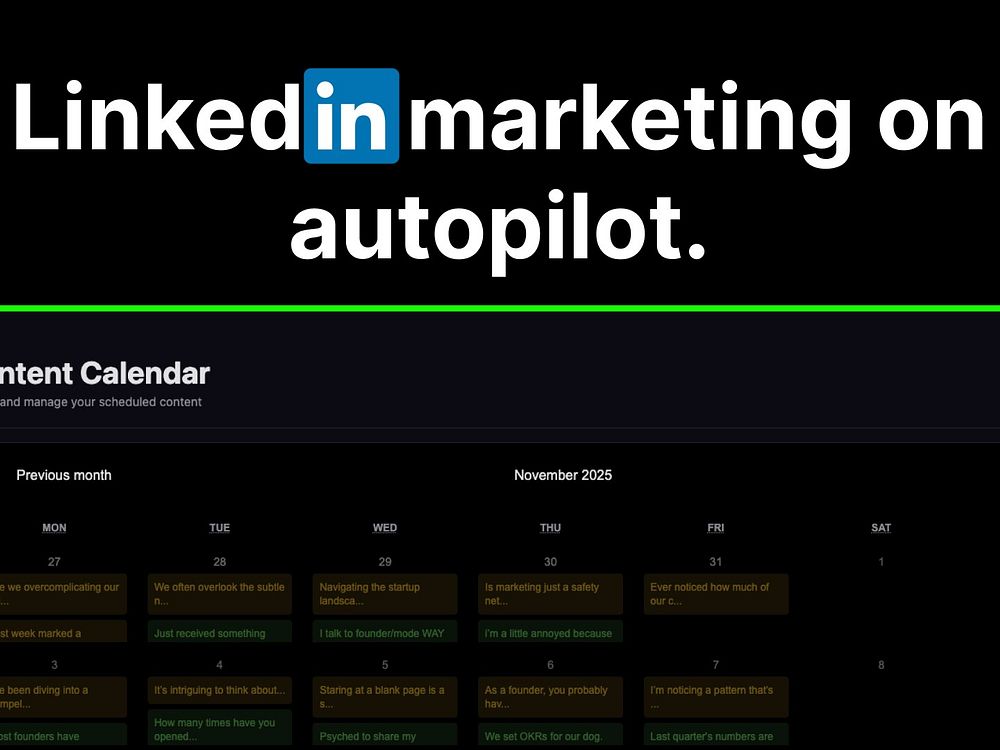
founder/mode helps founders publish high-performing LinkedIn content in less than 30 minutes a week. Share voice notes, transcripts, and links in a shared knowledge base, then its fine-tuned model drafts posts in your tone while human editors refine every line.
Approve with one click and schedule to post, keep your voice consistent, and turn ideas into conversations with customers, partners, and leads

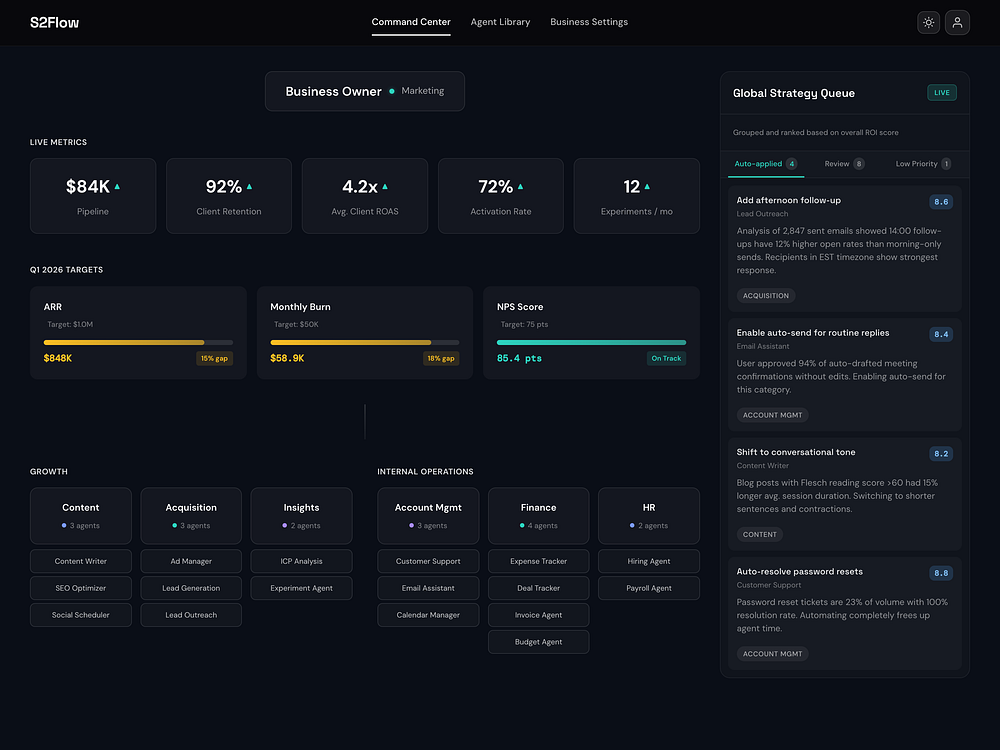
S2Flow is a Business OS that uses AI agents to run and improve marketing, sales, and e-commerce operations. You set goals and KPIs, and it generates strategies, assigns agents across departments, and executes tasks like ads, content, SEO, email, and reporting while continuously optimizing to hit targets.
You control guardrails via a strategy queue that auto-applies high-confidence actions and flags others for review. S2Flow tracks metrics such as ROAS, pipeline velocity, and average order value, feeds results back into planning, and keeps your growth engine improving without manual orchestration.

Arch Tools provides 61 production-ready AI tools via a single REST API and MCP protocol. These tools include code analysis, web scraping, image generation, NLP, sentiment analysis, crypto data, search, and more. You pay per API call with x402 USDC micropayments on Base, Polygon, Avalanche, and Solana, or you can use traditional API keys. AI agents can discover tools through MCP and pay autonomously without human approval. A free tier offers 100 credits per month, and TypeScript and Python SDKs are included.




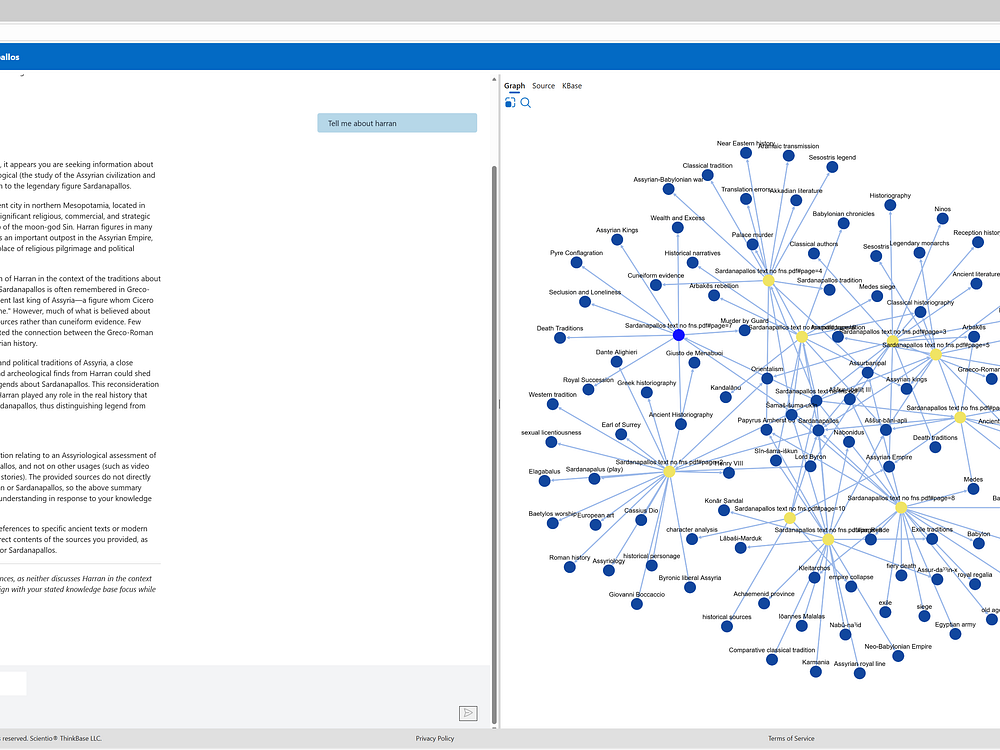
Scientio is a knowledge management platform that helps you capture ideas, plan projects, and publish knowledge bases. It uses an AI-first chat interface to create markdown pages and journals compatible with Obsidian and Logseq, while automatically indexing topics and cross-referencing notes. Share read-only online knowledge bases so others can browse your research or documentation without making changes.


The feature enables Shorts viewers to generate their own videos based on a scene from a clip.
LinkedIn's expanding its opportunities for advertisers to align their promotions with creator content.
Meta's added Manus, the AI agent platform it recently acquired, into several business elements.
So rather than muting a Reel when you tap, it will now pause the playback.
The program will see creators with large followings on other platforms paid a monthly rate to share the same on Facebook.
Horizon Worlds will become a mobile-only experience, with no VR element.
LinkedIn says that millions of users play its in-app puzzle games every day.





We benchmarked Crimson Desert across 40 GPUs to see how it performs at 1080p, 1440p, and 4K. Here's what to expect from your system - and how well it's optimized for modern hardware.


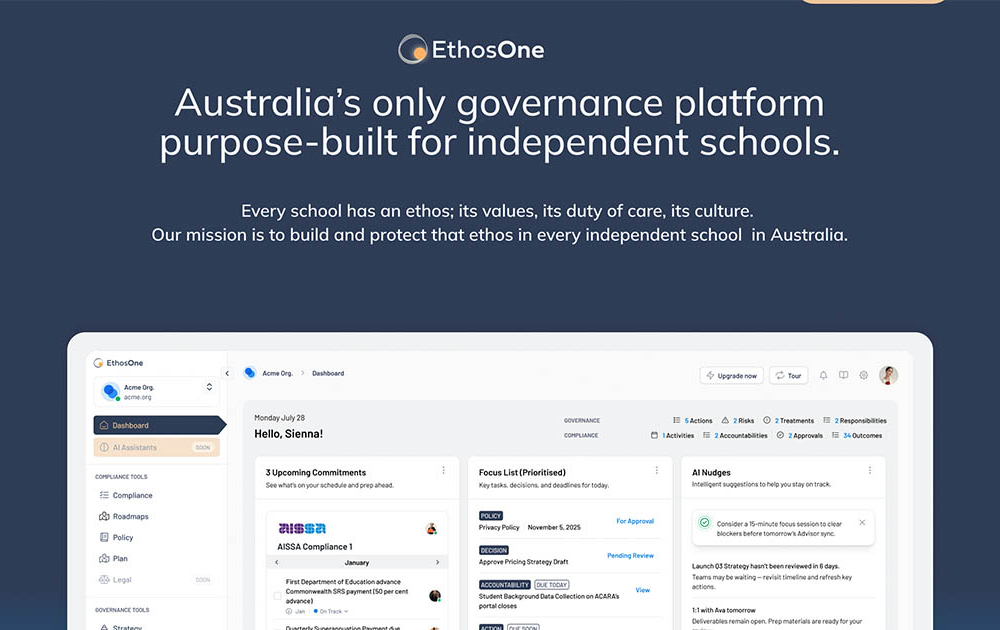
EthosOne is a governance platform built for independent schools. It centralizes board reporting, state-aligned compliance calendars, and ISO 31000 risk management so leaders can see obligations, owners, and evidence at a glance. Schools document controls, manage duty of care for camps and excursions, and keep every artifact accountable, turning oversight into an active, consistent process across Australia.






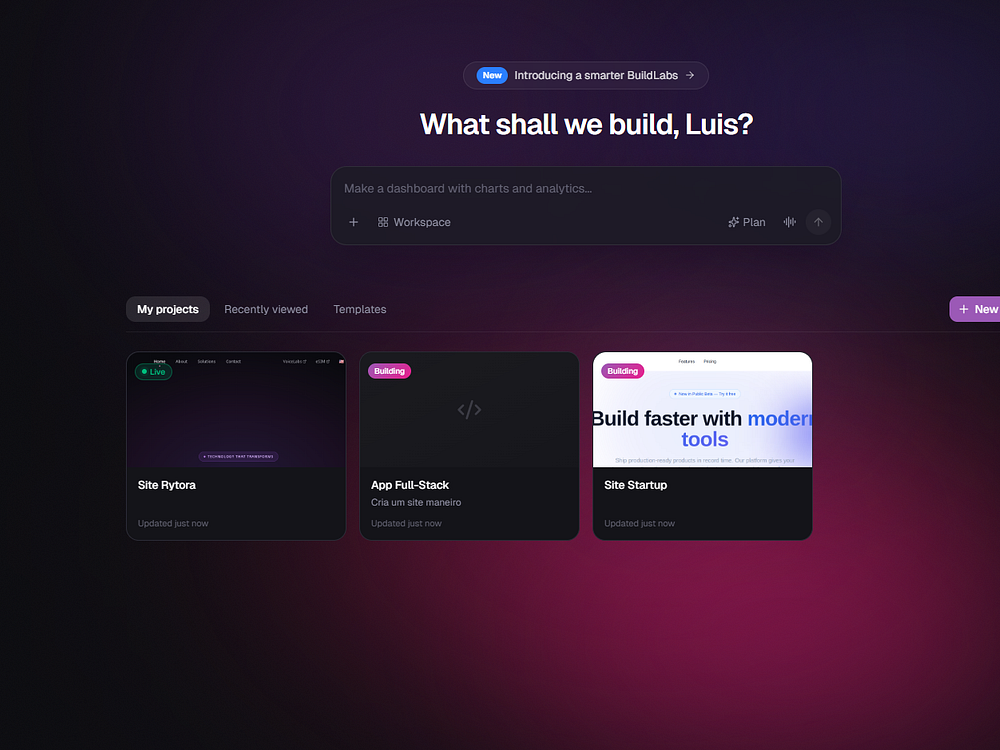
BuildLabs turns plain language into production-ready full-stack applications. It generates a React + Vite frontend, a NestJS backend, and a Prisma + PostgreSQL database on Neon, all in exportable TypeScript you own. Use a live preview and chat to iterate features, refine UI, and fix details. Projects include JWT auth, protected routes, and real data. Export code or deploy with one click to Vercel and Railway. Scale from solo work to teams with workspaces, role-based access, and priority support on paid plans.





Google’s AI Overviews now appear on 14% of shopping queries, up 5.6x from 2.1% in November 2025, according to new Visibility Labs analysis.
Why we care. As Google’s AI Overviews expand across product searches, ecommerce brands face a growing risk of losing visibility and clicks before shoppers reach standard organic or Shopping listings.
The details. The analysis targeted product-intent keywords tied to results with a Shopping box, paid or organic — terms like “weighted blanket,” “mushroom coffee,” “protein powder,” and “blue T-shirts.”
What they’re saying. Report author Jeff Oxford, founder and CEO of Visibility Labs, concluded:
The report. AI Overviews Now Appear on 14% of Shopping Queries, Up 5.6x in 4 Months (Study of 20.9M SERPs)





Intel's latest Arc GPU drivers introduce the Graphics Shader Distribution Service, which can improve first-time game load times by up to 2x on supported Arc GPUs. The update also adds day-one support for Death Stranding 2 and Everwind.



Glimpse is on a mission to mindfulness by protecting your attention and building true connections. We empower you to control your technology and live connected, mindful lives with real people in the real world. The less you use it, the more valuable it becomes.
Glimpse starts by blocking distractions and forces that steal your attention. It then builds mindfulness through an ecosystem that helps you connect with the real world, yourself, and others, disconnecting you from what does not matter and connecting you with what does.
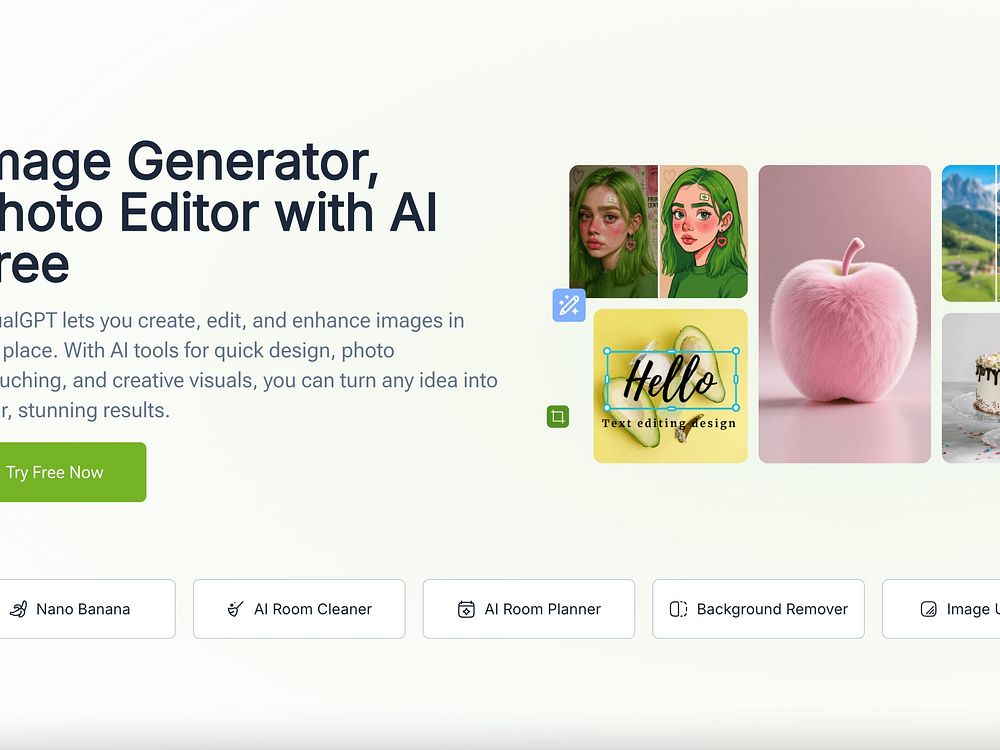
VisualGPT is an all-in-one AI platform to create, edit, and enhance images right in the browser. It combines hundreds of image tools including image generation, background removal, upscaling, retouching, and quick design so you can go from idea to polished visuals fast.
The platform integrates top models like Nano Banana, Flux, Ideogram, and Stable Diffusion to deliver sharp, ready-to-use results. Use purpose-built apps for photo editing, clothes and hairstyle changes, interior and room design, and infographic or flowchart creation with simple prompts or uploads and no learning curve.
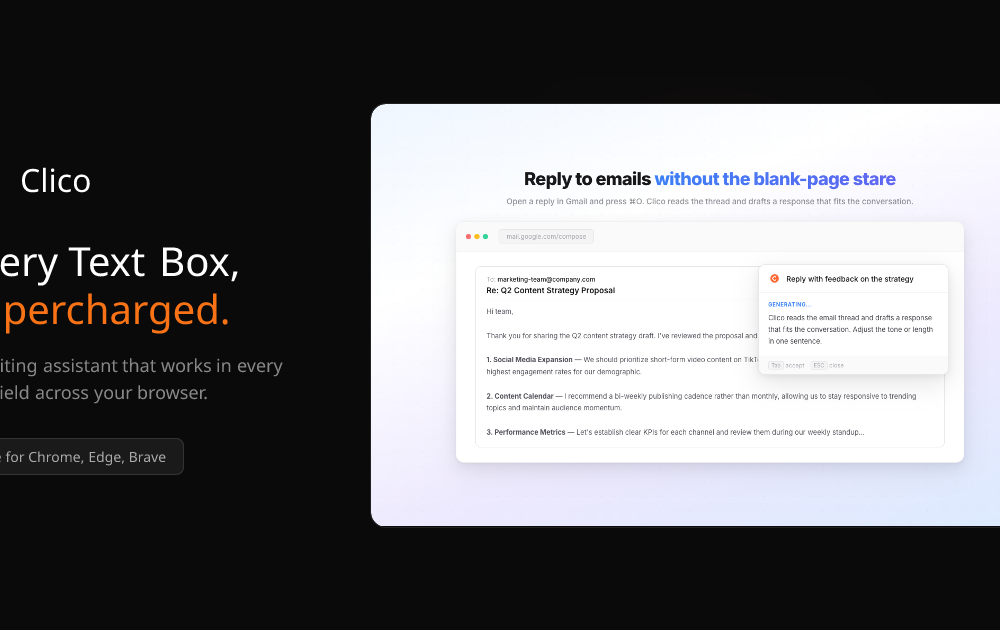
Clico brings AI to every text field in your browser. Use simple shortcuts to draft replies, continue writing in your voice, rewrite selections, summarize long pages, and search highlighted text without switching tabs. It reads on-screen context from emails, posts, and docs to produce accurate, in-place results.
Dictate by holding Command, then edit or insert at your cursor. Clico is free to use, needs no API key, and works across all Chromium browsers.










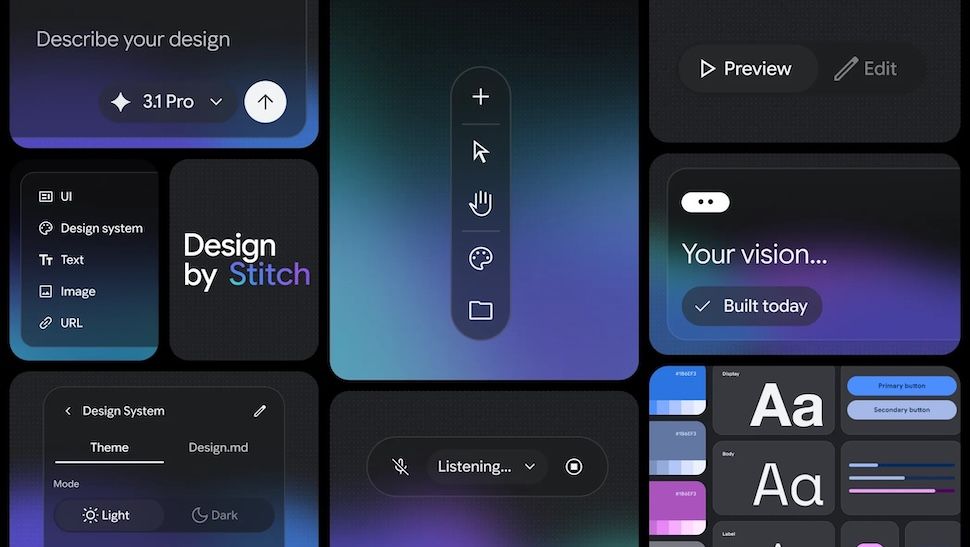
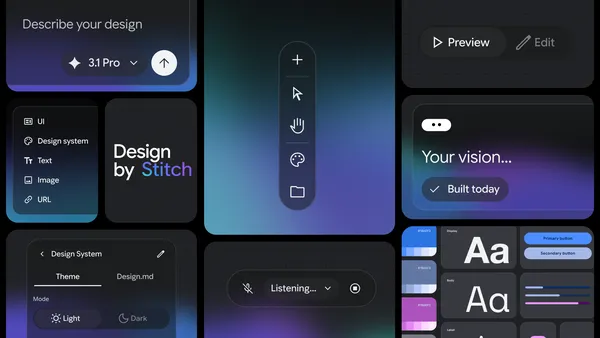 Stitch is evolving into an AI-native platform that allows anyone to create, iterate, and collaborate on high-fidelity UI.

Small publishers are seeing sharp traffic declines from AI search experiences, according to new data from thousands of global sites using Chartbeat analytics.
The details. Publishers with 1,000 to 10,000 daily pageviews lost 60% of search referral traffic over two years, Chartbeat found.
Reality check. AI referrals aren’t replacing lost search traffic.
Yes, but. Traffic is shifting, not disappearing. Total weekly pageviews across publishers fell just 6% from 2024 to 2025, a typical swing tied partly to the news cycle. Search is shrinking as a share of traffic, while direct, internal, and messaging channels are growing.
Why we care. SEO has long been the growth engine for smaller sites. That’s no longer true. If you don’t have a strong brand, direct audience relationships, repeat visitors, or differentiated value, you face the biggest risk as search referrals decline.
The Axios report. Exclusive: Small publishers hit hardest by search traffic declines.

Google is cleaning up outdated requirements in Google Ads, reflecting how legacy ad formats have evolved into newer, more automated products.
What’s happening. As of March 17th, Google discontinued multiple ad format policies, including those related to form ads, image quality, responsive ads, and text ads.
What changed. These requirements are being removed because the original formats have transitioned into newer campaign types and ad experiences, making the old policy frameworks no longer relevant.
Why we care. This update simplifies the policy landscape in Google Ads, reducing confusion around outdated requirements tied to legacy formats.
What advertisers should do. Advertisers are now expected to rely on current Google Ads policies and ad format requirements, which govern newer formats like automated and AI-driven campaigns.
The bottom line. By removing legacy requirements, Google is streamlining policies in Google Ads — signalling a continued move toward fewer, more unified standards for modern ad formats.

















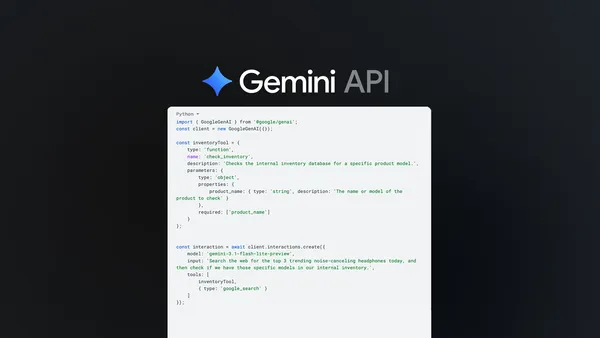 Developers can now combine function calling with built-in tools such as Google Search in a single Gemini API call to build agentic and complex tool-use applications.

Visibility is no longer just about ranking. It depends on whether your content is discovered, evaluated, and selected in AI-driven search experiences.
We’re kicking off our new monthly SMX Now webinar series on April 1 at 1 p.m. ET with iPullRank’s Zach Chahalis, Patrick Schofield, and Garrett Sussman on how you must adapt.
The session introduces iPullRank’s Relevance Engineering (r19g) framework for executing Generative Engine Optimization (GEO) through an omnichannel content strategy. You’ll learn how AI search uses query fan-outs to discover and select sources, and how to structure content so it’s retrieved, surfaced, and cited.
It also emphasizes that GEO success isn’t universal. It requires testing, tailored strategies, and a three-tier measurement model spanning discovery, selection, and citation impact.
Search Engine Land is proud to be a media partner for iPullRank’s upcoming SEO Week event.

Google is expanding how inventory appears in Google Ads Search campaigns, giving automotive advertisers a more visual, product-rich format directly in text ads.
What’s happening. Google Ads now supports vehicle feed integration on Search ads, allowing advertisers to pull inventory from Google Merchant Center and enhance existing text ads with details like make, model, price, and images.
How it works. Vehicle listings appear as clickable assets alongside standard Search ads, either below or beside the main text. Users can click through to a specific vehicle detail page or a broader landing page, depending on the interaction.
Why we care. This update lets automotive advertisers bring real inventory directly into Search ads, making them more engaging and useful for high-intent users. It also means richer visibility without extra campaign setup, while potentially driving more qualified leads by showing key details upfront within Google Search.
Why it’s notable. The update brings Shopping-style visual elements into Search campaigns, helping advertisers showcase real inventory without needing separate campaign types.
For advertisers. Key benefits include a more engaging ad experience, the potential for higher-intent leads, and the ability to use existing Merchant Center feeds without duplicating setup.
Measurement. Performance can be tracked using the “Click type” segment, allowing advertisers to understand how users interact with vehicle listings versus standard ad components.
Matching. Google’s automation determines which vehicles appear based on user intent and query context, continuing the shift toward less manual control and more AI-driven ad assembly.
The bottom line. Vehicle feeds in Search campaigns give automotive advertisers a way to blend inventory with intent-driven queries, turning standard text ads into more dynamic, product-led experiences within Google Search.
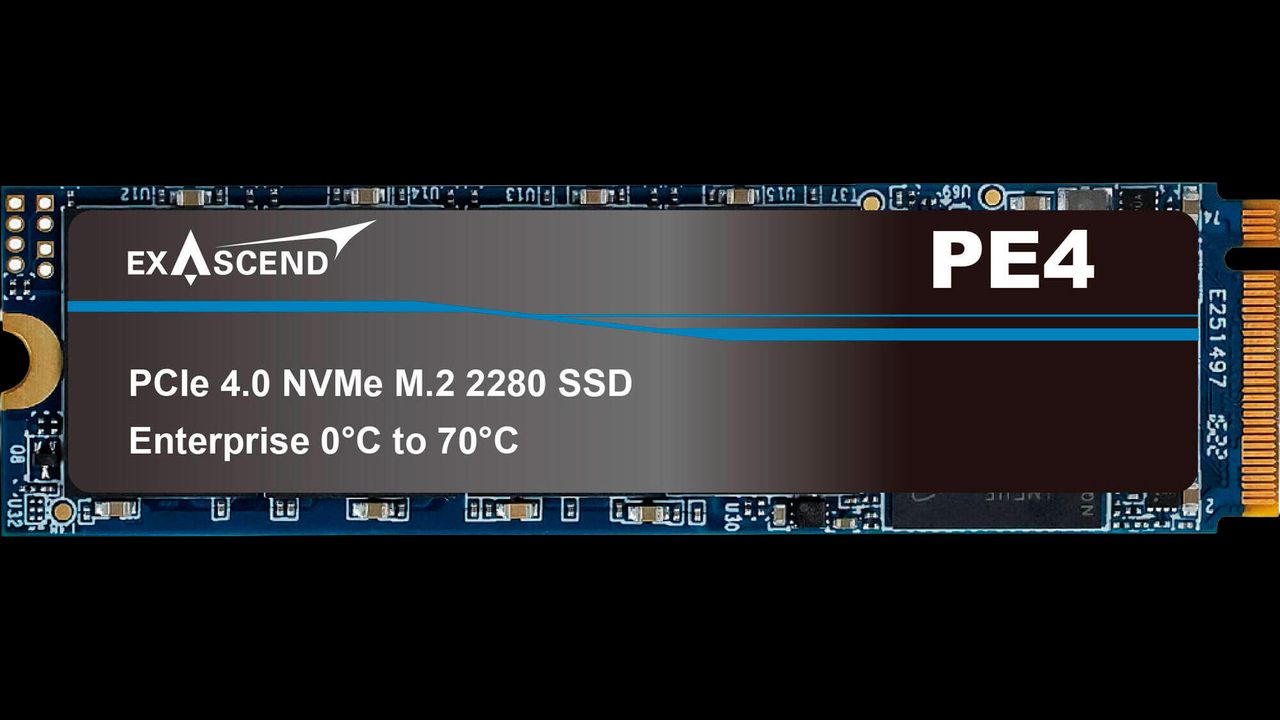
16TB M.2 SSDs are now available to purchase, and their pricing is NUTS If you want to max out your M.2 slots and you have an unlimited budget, you can now buy a 16TB M.2 NVMe SSD for your PC. Fanless Tech has spotted a 16TB PE4 M.2 SSD from Exascend, a drive that costs […]
The post The world’s first 16TB M.2 SSD has appeared on Amazon, and its price is eye-watering appeared first on OC3D.






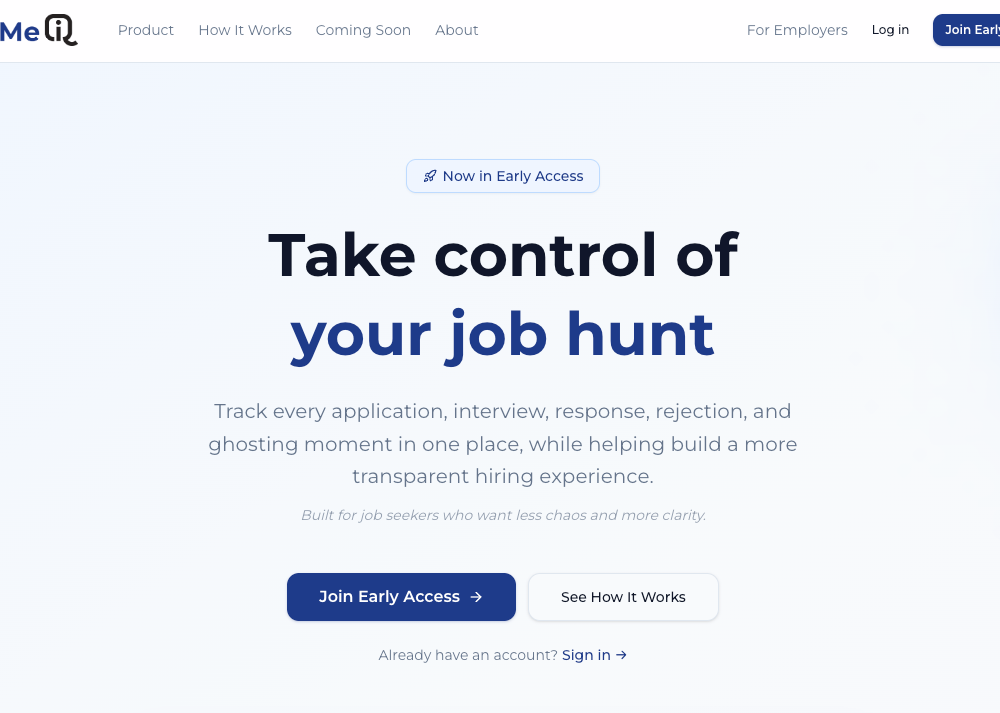
HireMeIQ helps job seekers organize every application, interview, response, rejection, and ghosting in one place. Import roles from links or emails, log each stage, and see at-a-glance insights into volume, response rates, and progress.
HireMeIQ focuses on clarity today and hiring transparency tomorrow, surfacing patterns and timelines across companies as the community grows. Your data stays private, you control what’s tracked, and early users shape what comes next.









 Google is publishing its Recycled Materials Guide, which shares engineering, design, and operations insights.

When technical issues hold your SEO program back, progress stalls. Yet technical SEO remains a top priority for leading SEOs and Google, and a key factor correlated with rankings in Backlinko’s 2026 Google ranking factors report.
One of the biggest hurdles for in-house SEO programs is the lack of resources to implement changes to the website.
When you can’t do everything, focus on the technical SEO tasks that drive the most impact. Here are the priorities to start with.
Most enterprise SEO teams want to fix issues that impact the most pages, revenue, and user journeys. Aira’s report ranks in-house technical SEO changes in this order:
Still, with millions of pages, it’s difficult to know where to focus. Here are some tips:
Starting with a technical SEO audit lets you identify the exact technical issues you need to resolve, hopefully with a prioritized list of tasks.
SEO tools can help identify and prioritize technical fixes. You may also want to check out “SEO prioritization: How to focus on what moves the needle,” which includes prioritization techniques like the Eisenhower Matrix.

If asked for the top foundational technical SEO fixes, I’d point to the following:
A well-organized site creates the foundation for your SEO program to run more smoothly. Site structure impacts key SEO outcomes, including crawling, indexing, and user experience, and getting this piece right really sets the stage for a site primed for search.
Fundamentally, site architecture (what I call “SEO siloing”) helps you organize a site around how people search. The goal is to have your content and navigation hierarchy mirror the keyword themes/queries people use and to couple that with content that answers intent across the customer journey.
For example, this is how a “power tools” section of a large ecommerce site might be siloed/organized:

The internal linking piece of siloing reinforces topical authority and funnels strength toward your primary landing pages. This alignment between search behavior, content themes, and site structure turns your site into a ranking asset.
In AI-powered search, you want your enterprise site to be well-organized, with a clear hierarchy and strong internal linking to send stronger relevance signals.
Here are common site architecture issues to look for:
A full site architecture overhaul is difficult in enterprise environments, so focus on the tasks you can reasonably get done. Consider these three action items to help make an impact with potentially the least resistance:
Internal linking can be deployed without changing the core site architecture/URL structure, so this is usually a faster win. Look to fix:
Instead of reorganizing the entire taxonomy, you can look for things like multiple pages that are targeting the same primary keyword/queries, thin variations of the same topic across different URLs and blog content that may be competing with key pages like products/services.
Here, you can merge overlapping content, choose and reposition one page as the thematic hub and redirect URLs as needed.
When resources are tight or politics get in the way, you can reinforce the site architecture by ensuring that:
At the enterprise level, crawling and indexing issues are almost guaranteed. But which issues deserve immediate attention?
This step may feel obvious, but it’s often overlooked. When search engines aren’t indexing the pages that matter most, this step becomes a No. 1 priority on the “fix” list.
But with so many URLs on an enterprise site, it can be overwhelming to review the Google Search Console Page indexing report. So instead, you can start by filtering the Page Indexing report by your XML sitemap. Compare the URLs listed in the sitemap with what Google has indexed.
Any sitemap URLs that are not indexed should be investigated first. Determine why they’re excluded and fix those issues before expanding your analysis.
During your page reviews, you can do a quick triage by checking:
It’s not uncommon for pages across a large site to send mixed signals to search engines. In enterprise environments, this often happens at the template level where one structural issue can weaken countless URLs.
Look for these problems:
For an enterprise site, crawl budget is a strategic resource. You want to avoid having crawlers spend time on pages that don’t matter. To see if this is happening, check for some common culprits:
If your site is hard to use, it wastes the organic traffic that you’ve worked hard to get. Yelp and Pinterest are two examples of organizations that invested in site performance and experienced revenue and engagement lifts.
What requests should you prioritize?
When the backend is performing poorly, it impacts everything from site speed and crawl efficiency to user experience metrics. Check for problems like:
Some action items that can address these issues include:
Enterprise sites face more navigation issues — especially with filters or JavaScript — and accumulate script bloat. Tag managers, personalization engines, testing platforms, and third-party widgets stack up over time.
Unfortunately, no one wants to remove them because they’re not sure if they’re still needed. When you reduce execution overhead, it can improve interactivity and stability without having to redesign the site.
Here are some problems to look for:
Some high-impact fixes to consider:
Site performance is also about perceived speed and the first meaningful interaction for users. This is another area where Google’s Core Web Vitals become useful as a diagnostic tool.
Common culprits that cause issues in the user experience category include:
When considering what to fix, focus on structural optimizations that change how the browser prioritizes what matters most:
Improving page speed helps improve indexing. The slower and larger pages are, the fewer Google will crawl. That isn’t an issue if your site has 500 pages. It’s an issue getting a million pages indexed.
The Google Search Console Crawl Stats report is an underutilized tool. The report shows how Googlebot is crawling your site, including the total number of crawl requests, total download size and average response time for fetched resources.
About 63% of website traffic is mobile, according to Statista. But the majority of sites aren’t prioritizing their mobile experiences, according to a study by the Baymard Institute.
For example:
A responsive website is the baseline. But mobile experiences go beyond this foundation. The most successful enterprises are thinking about how to create sites that are dialed in for mobile users.
While most would agree that many UX functions fall outside the realm of technical SEO, the ability of your site to retain and convert mobile traffic is a shared goal for SEO and UX teams.
With that in mind, you can analyze your mobile experiences alongside your colleagues by thinking about the following questions:
Technical SEO can feel overwhelming, especially when you don’t control the entire process. Focusing on fundamentals like site structure, crawlability, and user experience sets the stage for everything else in your SEO program.
Prioritize the areas that deliver the biggest impact for the least resistance, and build momentum from there.
AMD responds to the CHUWI CPU scandal Over recent weeks, NotebookCheck has uncovered an AMD CPU scandal involving Chuwi, a Chinese manufacturer. The company has been found selling systems with mislabeled CPUs. The company claimed its notebooks use AMD’s Ryzen 5 7430U CPU, but in reality, they used AMD’s much older Ryzen 5 5500U. This […]
The post AMD releases official statement on the Chuwi Ryzen CPU mislabelling scandal appeared first on OC3D.






JobScroller aggregates tech jobs directly from company career pages and updates them daily, so you see fresh listings from 1,100+ employers without recruiters or stale posts. You can search roles across disciplines and apply via 100% direct links.
It also offers an AI resume checker that reads your resume and each job description to give a Gemini-powered match score, highlight missing hard skills, and suggest targeted edits. You can explore salary intelligence and track opportunities in one place.
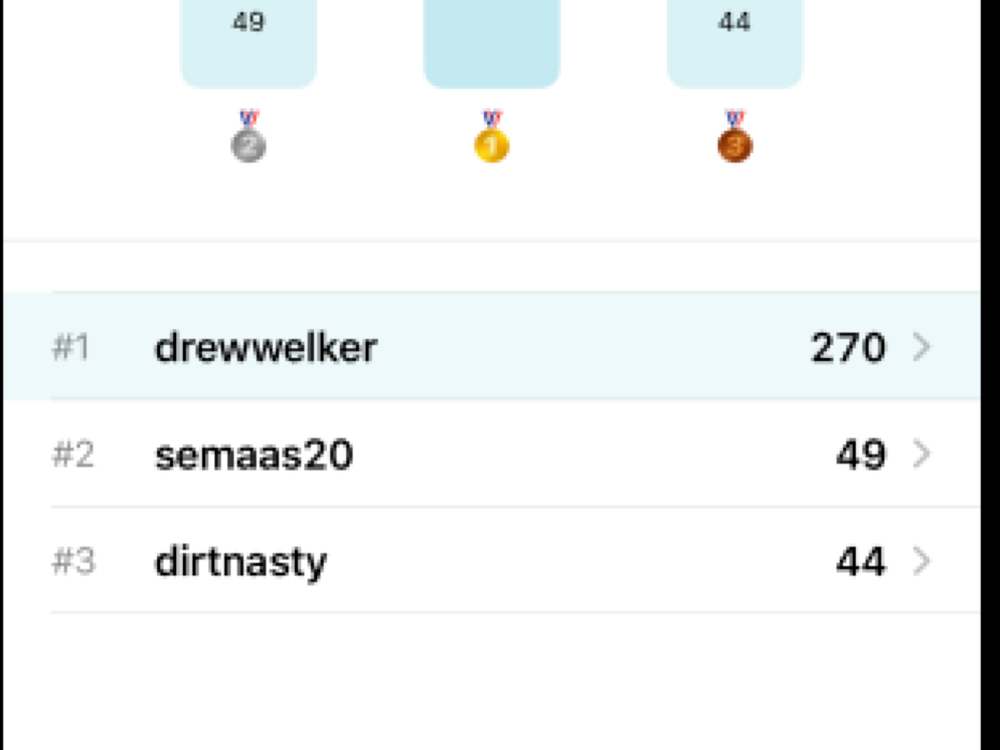
Peak Pursuit is a competition-based health and fitness tracker that turns your workouts and habits into points on a shared leaderboard. Join groups with friends, family, or coworkers to log runs, rides, lifting, and daily habits, and see real-time insights with streaks across Fitness, Health, and Mind to stay accountable and motivated.






 Google is working with the UK’s CMA to ensure new digital market rules promote fairness and choice while protecting user experience.

Local SEO has a visibility problem, but it’s not where most teams think. It’s not about rankings for “near me” or service keywords.
It’s everything that happens before that moment, when customers are trying to figure out what’s wrong, what it means, and whether they need help at all. That gap is why so much high-intent demand slips through the cracks.
Most local service websites are built the same way: a homepage at the top, then service pages, and often location pages underneath. It’s a good, clean structure, and it makes sense because it mirrors how the business thinks.
You offer drain cleaning, furnace repair, and emergency roof replacement, and you want to show up for “drain cleaning Brookline, MA,” or “furnace repair near me.” That structure also aligns with how Google’s local algorithm has historically rewarded local businesses.
The issue is that customers don’t always start with the service name. A lot of the time, they start with the problem in front of them.
“I need drain cleaning” isn’t always the first thing that pops into a homeowner’s mind. Instead, they might be thinking, “My kitchen sink is backed up, it smells, and I don’t want to make this worse.”
A property manager isn’t necessarily thinking of “HVAC maintenance.” They’re thinking, “This unit is blowing cold air again, and tenants are already complaining.”

If your site is built only around service names, you can miss a big part of the search journey, where people are diagnosing, comparing options, and trying to decide if this is a DIY or a “call someone now” situation.
That mismatch is why so many local sites underperform on some of the highest-value searches in their market. They may have strong service pages, but they don’t have pages designed for the way people actually search when the situation is unfolding. Jobs-to-be-done pages are a practical fix for that gap.

A jobs-to-be-done (JTBD) page is built around what the searcher is trying to accomplish in real life, not what the service is called. It’s a “help + hire” page that lets the reader understand what’s happening, what their options are, and what a smart next step looks like, while also making it easy to contact a professional when they’re ready.
At a glance, it can look like a blog post because it’s informational, but its intent is different. A blog post often exists to attract traffic or cover a topic broadly. A JTBD page exists to support a decision and convert the right visitors into calls and estimate requests.
You can usually feel the difference immediately. A JTBD page doesn’t open with a long introduction. It opens by confirming the situation in plain language and offering a quick path forward if the issue is urgent. The goal is to reduce uncertainty fast, because uncertainty is what keeps people bouncing between search results instead of picking up the phone.
The SEO toolkit you know, plus the AI visibility data you need.

Service pages are still quite important, and they’re still the best fit for searches where the customer already knows exactly what they want and is choosing between providers. These pages tend to win for hire-ready searches like:
The gap is that a huge portion of local demand shows up earlier as problem-first searches. People search for symptoms. They search “why,” “how,” “what does it cost,” and “is this dangerous.”
If your site only offers service pages, you’re often invisible during the earlier stage where trust is formed. The business that helps someone understand the problem is often the one they call when they decide it’s time.
JTBD pages help you show up earlier without drifting into generic informational content that doesn’t lead anywhere.
Dig deeper: Local SEO sprints: A 90-day plan for service businesses in 2026
The JTBD pages that perform best tend to follow the same decision sequence customers follow in their heads. They start with symptoms, then move into likely causes, then options, then cost context, and then a clear line for when it’s time to call a pro.

Starting with symptoms helps the reader self-identify quickly. You’re not trying to impress them yet. You’re trying to confirm they landed on the right page. A short symptoms section mirrors their lived experience and makes the content feel immediately relevant.
Right after symptoms is usually the best place for a small conversion nudge that’s practical, not salesy. Something like: “If you need this fixed today, call. If not, keep reading to understand what’s likely going on.”
This is where a lot of local content goes wrong in either direction. Some sites oversimplify and turn every issue into a one-line answer. Others write a technical essay that overwhelms the reader.
A better approach is to list the most likely causes, ordered from common and simple to less common and more serious, and use conditional reasoning to show what would change the diagnosis. For example:
That kind of conditional guidance is useful, and it signals competence.
After identifying the causes, people want to know what they can do right now. You don’t need a full DIY tutorial. The goal is triage.
Provide a few low-risk checks to help someone avoid an unnecessary call, along with clarity on when continuing to “try things” becomes risky or wasteful.
A simple options section often includes:
This is also where conversions happen without pressure. When someone can visualize what a pro will do, the process feels less intimidating.
A lot of local conversions are anxiety conversions. People aren’t just buying the fix, they’re buying relief and certainty.
Dig deeper: Scalable local SEO practices
Pricing content doesn’t need to promise exact numbers. People are going to look it up anyway. If your page helps them understand realistic ranges and what drives cost, you become the safer choice.
A strong cost section usually covers:
The tone matters. You’re not selling a coupon. You’re reducing uncertainty.
This is the conversion center of a JTBD page. Many pages just hint at it. The best ones state it clearly and make the triggers specific and unmissable.
Examples of “call a pro” triggers include:
The reader wants permission to stop guessing. When you give them that permission after guiding them through symptoms, causes, options, and cost context, your CTA feels like the logical next step, not a marketing maneuver.
If you want these pages to feel like service assets rather than “blog content,” placement matters. Don’t bury them in a dated blog feed. Put them in a dedicated section like:
This signals permanence and usefulness and makes internal linking cleaner. A good rule is to include clear conversion moments throughout the page without overdoing it:
An effective version of this page opens with a plain-language title: “Kitchen sink draining slow? Here’s what causes it and what to do next.” The intro stays brief and sets expectations: most slow drains are caused by grease, soap scum, or buildup in the trap or branch line, and this guide covers safe checks, realistic options, and clear signs it’s time to call.
Symptoms come first, helping the reader quickly confirm they’re in the right place: slow draining, gurgling, odor, or backup when the dishwasher runs. From there, the page moves into likely causes, using conditional guidance to help narrow things down.
Next comes options: a few low-risk checks, a short “what not to do,” and a plain explanation of what a plumber typically does on a service call. This leads naturally into pricing context, with realistic ranges and the factors that influence cost.
Finally, “when to call a pro” makes the decision easy. Recurring clogs, multiple drains, leakage, sewage odor, or shared-building situations where DIY mistakes affect others all signal it’s time to bring in help.
The page is informational, but it’s decisional. It helps the reader choose a next step. That’s why it converts.
JTBD pages serve to complement and support existing service pages. A simple model is to keep your main service pages as core conversion targets, then add a “Problems we fix” cluster around your highest-value services.
For internal linking, JTBD pages link to the relevant service page as the “solve this quickly” path, and service pages link back to JTBD pages as the “not sure what’s causing it” path.
This expands your footprint into problem-first searches and funnels visitors into your service pages with more trust and clarity than they would have had if they arrived cold.
Dig deeper: The local SEO gatekeeper: How Google defines your entity
The easiest way to pick JTBD topics is to start with what customers say before they know the service name. Better starting points than a keyword tool include:
Those phrases become your most natural page titles and headings because they’re already written in the customer’s language.
Once you have a starter list, use your favorite keyword tool to expand it and sanity-check demand. You’re looking for problem-first patterns like:
These queries are usually informational in intent and often sit one step before a call, especially when the symptom is urgent or recurring.
A quick way to qualify topics is to ask whether the query has a clear “hire” outcome hiding underneath it. “Furnace blowing cold air” does. “Toilet keeps running” does. “Why does my house have hard water” might, depending on the business. If the query is purely academic or doesn’t naturally lead to a service call, it’s usually better as a blog post, not a JTBD page.
Finally, don’t build these pages randomly. Cluster them around your highest-value services first, and make sure each JTBD page has a straightforward internal link path to the related service page as the “solve this quickly” option. That’s what turns a helpful page into booked work.
Even well-structured JTBD pages can fall short if they miss a few fundamentals.
If the page could belong to any business in any city, it won’t earn trust or conversions. The fix is to include “what to expect” language and provide relevant local context without turning the page into geo-stuffing.
When a page becomes a full tutorial, it attracts the wrong audience and increases the chance of damage or liability. Keep DIY checks low-risk and focused on triage.
If you don’t clearly state when to call a professional, you miss the main conversion opportunity on the page.
JTBD pages also tend to align with the queries that trigger AI answers in the first place. A lot of AI Overviews show up for problem-first searches, especially:
JTBD pages are designed to satisfy that moment, while a standard service page usually assumes the customer has already decided what they need.
The structure helps, too. When a page is organized into symptoms, likely causes, options, cost context, and clear “call a pro” thresholds, it becomes easier for systems to summarize accurately and cite specific passages without guessing.
If you want one simple upgrade, add a short “Quick take” paragraph near the top that summarizes the likely causes and next step in three to four sentences. It helps rushed readers and creates a clean block of text that AI systems can lift without distorting your meaning.
Track, optimize, and win in Google and AI search from one platform.
Local businesses don’t lose jobs because they lack service pages. They lose jobs because they’re invisible or unconvincing during the moment customers are trying to understand what’s happening.
Jobs-to-be-done pages are a practical way to meet customers earlier, answer the problem they’re actually searching for, and guide them toward a safe next step, including a clear path to book service.
When built with the right structure and intent, they become some of the most useful pages on a local website for both search performance and real-world leads.

For many advertisers, a 30-day click attribution is the default conversion window setting in Google Ads. Once that’s set, it’s rarely revisited. But what if your customers convert within a week, or even two days?
One of my clients, a DTC retailer in an intensely competitive industry, has an average conversion window of 2.2 days. Yet we were optimizing campaigns using a 30-day click window, which meant conversions were credited weeks after the initial interaction. This muddied the waters when assessing the true incremental impact of different advertising efforts, especially when trying to capture that impulse-buying behavior.
With that in mind, we transitioned the account from a 30-day click window to a 7-day click window in January. Here’s what changed and what we learned.
This client allocates the majority of its marketing budget to Meta Ads. So, when looking at platform reporting, Meta Ads (unshockingly) accounted for the majority of sales. Since Google Ads operated on a 30-day click window at the time, that platform also accounted for a large percentage of sales.
When your average conversion lag is about two days, allowing 30 days of click credit can inflate perceived contribution in-platform. Because of this, neither platform’s incremental impact was clear, making it difficult for our client to know where to invest the majority of their advertising dollars.
Before making any changes, we analyzed conversion path data to understand how long customers were actually taking to purchase. Over the last three months, users converted in an average of 2.2 days, with the majority of conversions happening in less than a day:

We didn’t just flip the switch. We hypothesized that since the average conversion window was 2.2 days, we shouldn’t see too much volatility. To be safe, we first set up this new conversion action as a secondary conversion.
So it looked like this:
When you change a primary conversion action, smart bidding recalibrates, and learning phases reset. This phased approach allowed us to compare reporting side by side and prepare for any volatility.
Dig deeper: How to tell if Google Ads automation helps or hurts your campaigns
We compared the 30 days post-conversion action change to the previous period, which included peak holiday shopping season.
Results (in-platform)
Initial results looked great, but we wanted to see if there was any measurable impact on the business.
Using Shopify sales data, we saw that total sales increased 20%, and net profit increased 30%.
More importantly, marketing mix modeling (MMM) data showed a shift in incremental contribution:
This was the strongest indication that shortening the attribution window helped clarify channel contribution.
Now, in full transparency, we were also restructuring campaigns, adjusting budgets, and refining bidding during this time. So, we can’t give all the credit to the shorter attribution window. But we can say performance wasn’t negatively affected, and the contribution percentage improved.
With overlapping attribution between Meta and Google, both channels looked over-credited in-platform. By shortening Google’s click window, we limited its ability to claim delayed conversions that were likely influenced by other touchpoints. Tightening this window reduced cross-platform duplication and gave us a clearer view of incremental impact.
Additionally, instead of waiting weeks to understand campaigns’ actual ROAS, we could evaluate performance within days and make adjustments more confidently.
By reducing to a 7-day click window, we:
This change also significantly affected Smart Bidding behavior. Automated bidding strategies, such as target return on ad spend, optimize based on conversion signals. With a 30-day window, those signals are extended, meaning the algorithm reacts more slowly to performance shifts, such as bid adjustments, seasonality shifts, and budget reallocations.
Moving to a 7-day window continuously feeds fresher signals to Smart Bidding strategies. This created tighter alignment between spend and actual buying behavior. Combined with Marketing Mix Modeling data, the picture became even clearer.
\The cleaner attribution structure gave us stronger confidence in making account optimizations and, even better, helped our client make more informed business decisions about where to invest ad dollars.
In short, tightening the conversion window didn’t just change reporting. It improved the quality of the signal driving optimization decisions.
Dig deeper: In Google Ads automation, everything is a signal in 2026
Shortening an attribution window could work for you, but you should consider the trade-offs.
Reported conversion volume will likely drop, at least initially. Removing delayed conversion credit can make performance appear weaker overnight, even if actual sales haven’t changed. That can create internal concern if your client or other stakeholders aren’t prepared.
Smart Bidding will need to recalibrate. Changing a primary conversion action is a significant change to an account. This will trigger a learning phase and short-term volatility, especially in accounts using automated bid strategies such as target ROAS and Max Conversion Value.
Most importantly, this approach only works if it aligns with your sales cycle. For high-consideration or longer purchase journeys, a 7-day window may undercount legitimate conversions, suppress ROAS, and limit optimization data. A shorter attribution window is only better if it reflects how your customers are actually buying.
Adjusting attribution wasn’t the silver bullet here. In this case, other account improvements were happening simultaneously, and this was just one lever.
Ultimately, this change wasn’t about improving platform metrics. It was about improving business insights.
For this client, aligning the attribution window with a 2.2-day conversion cycle improved conversion signal quality, enhanced Smart Bidding, clarified cross-channel impact, and gave leadership stronger confidence in where to invest.
Whether a 7-day click model makes sense depends on how closely your attribution settings reflect your account’s buying cycle.
Two new AMD Ryzen CPUs leak with boosted TDPs and clock speeds A new leak from chi11eddog has unveiled two potential AMD CPUs that could launch this year to refresh AMD’s Ryzen 9000 range. These new CPUs feature higher base/boost clock speeds than their existing counterparts. That means they aim to deliver higher performance for […]
The post New AMD Ryzen CPU leak with boosted speeds appeared first on OC3D.










Pounce streams the best conversations from X and Reddit straight to you. It delivers real-time posts into a focused inbox, seconds after they go live, so you can reply first and build momentum. Set your strategy once, then let AI filter for relevance and draft replies in your voice. Track daily goals and session stats to turn 15 minutes into consistent growth and real connections.

Meridian Realms is an AI-powered platform for immersive storytelling and worldbuilding. Create rich universes across any genre, design characters with long-lasting memory and evolving relationships, and explore narratives through natural dialogue and meaningful choices. Generate artwork in multiple styles, collaborate in shared worlds, and run group adventures with your favorite characters. Choose from the public catalogue, start crafting your own worlds and characters, or use AI to flesh out backstories, settings, and scenes.





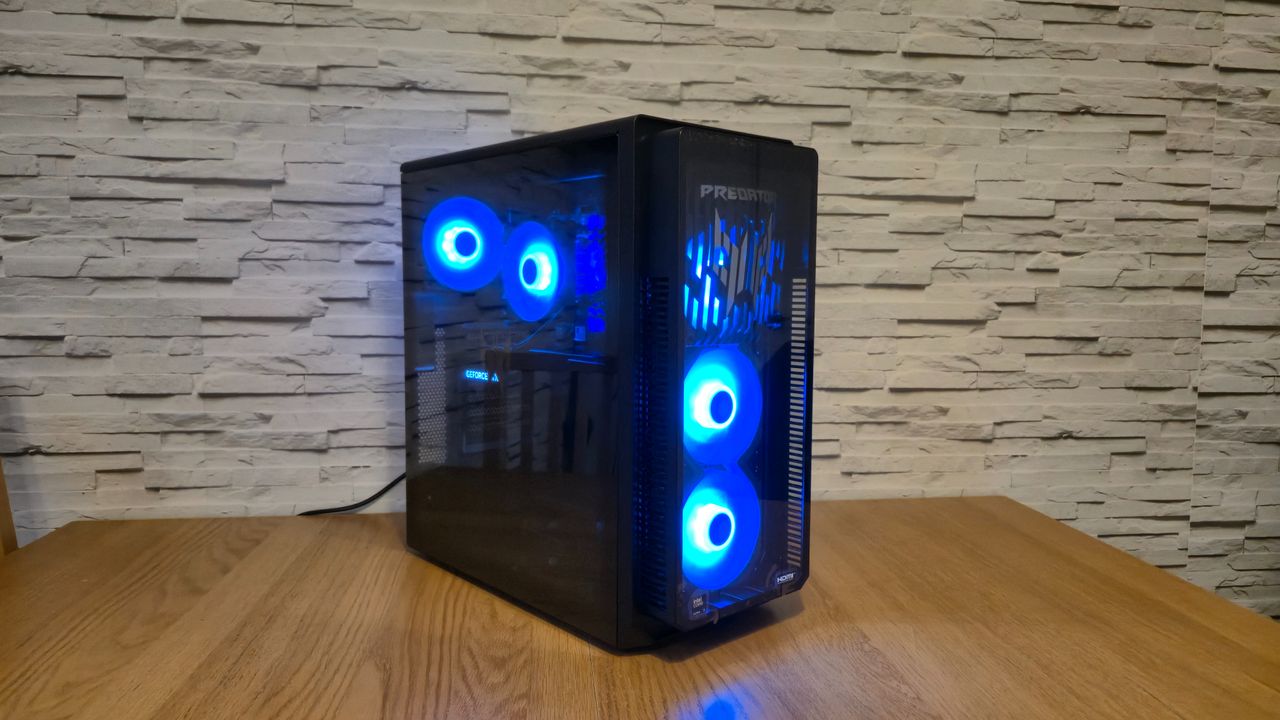

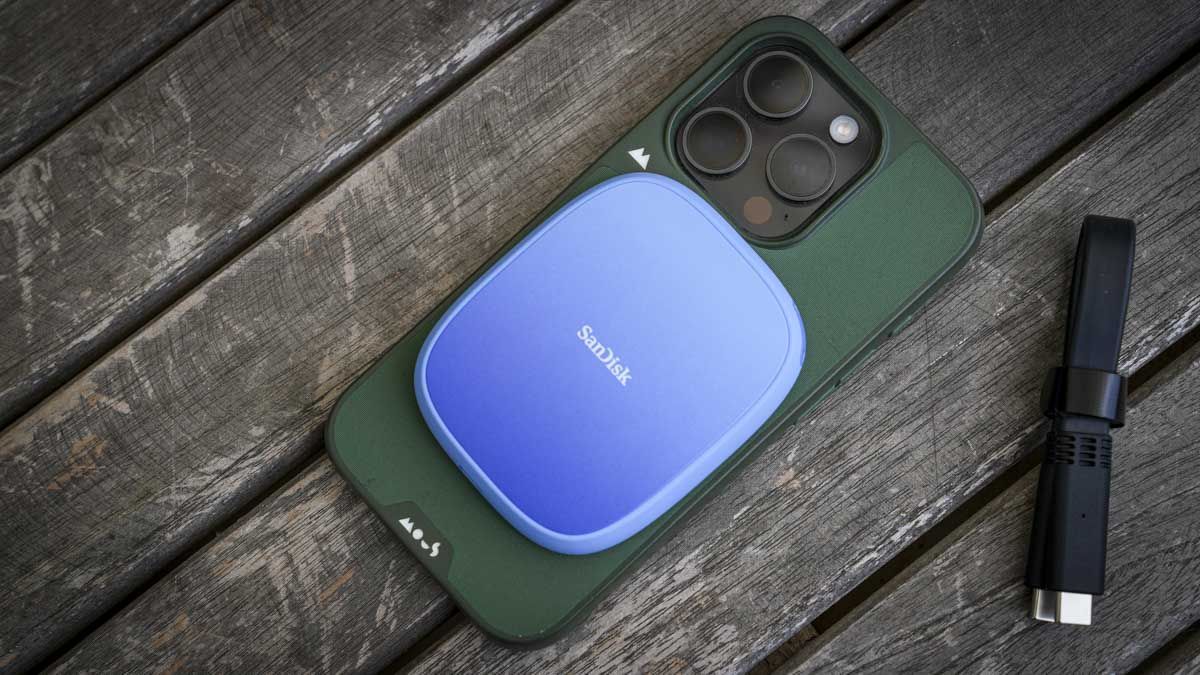






Buyers ask a question. You answer it clearly. That’s the premise behind the “They Ask, You Answer” (TAYA) framework, and it holds up in AI-driven discovery.
In theory, it’s simple. In practice, teams struggle to anchor their approach and get started. The result is predictable: generic questions that produce generic content.
That’s a problem, especially as AI shifts search behavior from short queries to more detailed, contextual questions. The difference comes down to the questions you choose to answer. And that’s where a simple concept makes a big difference: buyer personas.
Odds are, you and many of your competitors have already answered these questions somewhere, or could easily.
The generic question trap happens because when marketing teams brainstorm content ideas, they often start with topics like:
These are reasonable questions. But they’re also questions no real buyer actually asks.
Real buyers ask questions that reflect their situation and their problem. Something more like this:
The difference is subtle but important. The second set of questions includes a person and a problem. That context completely changes the quality of the content.
Instead of typing short keywords, buyers ask detailed, contextual questions:
The AI explains the problem, outlines solutions, and suggests vendors. In other words, the buyer is having a consultation with an AI.
If your content explains why a specific persona experiences a specific problem, you have a much better chance of shaping how that problem is understood in the first place.
This puts you into the conversation and consideration set earlier, making it more likely you’ll stay in as the user refines their thinking.
Consider this scenario. I’ll use myself as an example.
I start by asking a somewhat broad opening question:
Answers then include a bunch of top-level suggestions — bars, food, and activity-type bars. One of these suggestions is for an F1 gaming arcade. I like games, but not so much cars, so this leads my follow-up to dig in a bit more:
I get a bunch of recommendations, one of which is for a pinball arcade in Digbeth (a sub-area of Birmingham).
I then get a set of responses that helps me narrow the list and formulate a perfect day and evening out for a group of old friends.
Being in the early part of the conversation lets you shape the dialogue and increases your chances of being part of the eventual solution.
Personas are the tools that let you think like your customers and figure out the kinds of questions they ask long before they get to what you have to offer.
When you can identify a customer segment, you can dig into that persona, understand their problems and goals, and think like your target customer to generate content ideas that help them decide earlier.
Now, instead of writing content for a generic avatar, write for specific people. For example, instead of “Things to do in Birmingham?” you might write, “The best day out in Birmingham for a group of 50-year-old gamers.”
You’re still addressing the same underlying topic. But now the content speaks directly to a real person experiencing a real problem.
That shift usually leads to much more useful content. This helps you work your way into those conversations, rather than relying on the brutal battleground of commercial queries.
You don’t need a complicated persona framework to make this work. In most cases, a simple three-question exercise will uncover the kinds of problems your buyers are actually trying to solve.
For each persona you serve, ask:
Now the questions start to look very different. Instead of broad category topics like: “What is CRM software?”
You start to see questions like:
Those questions reflect real situations experienced by real people — exactly where the best content opportunities exist.
Now we revisit the big five topic areas from TAYA: cost, problems, comparisons, reviews, and best-of. These topics already give us a powerful structure for content.
But when they’re approached generically, they often lead to content that looks exactly like everyone else’s.
So you can go from the typical, generic kinds of questions:
To questions that are more connected to the needs of our target audience:
The topic hasn’t changed, but the question now reflects the buyer’s reality. This shift produces more useful content and aligns with how people interact with AI assistants.
Those questions include their role, company size, or situation:
If your content already answers these persona-driven questions, you increase the chances that your explanation becomes part of that conversation.
In other words, personas don’t replace They Ask, You Answer. They make it more precise, moving you from answering generic topics to answering the exact questions buyers ask when solving a real problem.
Persona-driven questions improve TAYA content for three simple reasons.
One of the most common mistakes companies make with content marketing is starting with their product.
But buyers rarely start their journey there. They start with a problem.
Personas help keep your content anchored in the buyer’s world rather than your own product — remember, it’s about the customer, not you.
And that simple shift often makes the difference between content that merely exists and content that actually influences decisions.
“They Ask, You Answer” remains one of the most powerful frameworks available to marketers. But the effectiveness of the framework depends entirely on the quality of the questions you answer.
Personas help you turn vague topics into real problems and ask better questions. When your content speaks directly to those problems, buyers and AI systems are far more likely to trust your answers.
Microsoft is now allowing PC games to add 3rd party games and apps to their Xbox App Microsoft has given PC gamers the ability to add any 3rd-party games (or any .exe file) to the Xbox PC App. This is a feature that Valve’s Steam platform has offered for years, allowing PC gamers to centralise […]
The post The Xbox App now supports manually added 3rd party games appeared first on OC3D.






StoreAsk lets Shopify merchants ask questions in plain English and get clear, actionable answers in seconds. It analyzes orders, products, customers, inventory, traffic, and marketing spend to surface trends, explain changes, and recommend next steps.
Connect your Shopify store in one click with read-only access, then get daily briefings, follow-up questions, and exports without dashboards or spreadsheets. Data stays secure with AES-256 encryption, SOC 2 compliance, and 99.9% uptime.
VERDICT.COM is a free AI-powered legal research platform that helps you search court records, explore case law and precedents, understand your rights, draft legal documents, and find qualified lawyers near you. Describe your situation to get targeted case law, verify legal letters, and create forms and agreements with guided assistance. It provides legal information and research support, not legal advice.
AI-native, open-source Datadog alternative
Run OpenClaw locally on your AMD PC





Jensen Huang responds to complaints about Nvidia’s DLSS 5 tech Nvidia unveiled DLSS 5 earlier this week, and to say the least, the tech is controversial. Memes have been flying across the internet, calling the new AI technology little more than an “AI filter”. Gamers are complaining that the tech is changing the look of […]
The post Nvidia CEO claims gamers are “completely wrong” about DLSS 5 appeared first on OC3D.



IntelIntel Precompiled Shaders is custom built and run by Intel. We are also working with Microsoft's on launching Advanced Shader Delivery later this year. Together, both services will provide users of supported Arc GPUs with more game and game store coverage of technologies that reduce waiting times and in-game stutters due to shader compilation.







An SEO experiment shows how easily misinformation ranks in Google Search and spreads to other sites.
The post SEO Test Shows It’s Trivial To Rank Misinformation On Google appeared first on Search Engine Journal.


CarChrono delivers multi-source vehicle intelligence for car buyers. Search millions of listings, decode any VIN or Japanese chassis number, and get transparent reports with specs, title and accident history, market value, recalls, and ownership timelines. It cross-references over nine data sources, flags discrepancies, and helps detect fraud such as odometer rollbacks and title washing. Use it across the US, Canada, Japan, the UK, Germany, and more with real-time coverage.

Google's John Mueller says why migrating a site to HTTPS may cause a site to lose all rankings.
The post Google Explains Why HTTPS Migration May Negatively Impact SEO appeared first on Search Engine Journal.


SteadyFlow tells freelancers exactly how much is safe to spend each week by accounting for tax reserves, unpaid invoices, and irregular income. It was built by a solo founder who got hit with a surprise tax bill.
Track views & payouts for YouTube Shorts creators
AI detecting & preventing SaaS churn
Fast and efficient models optimized for coding and subagents
Track revenue, ads, web vitals, & user insights in one hub
Cursor for your memory. 100% private, open-source & free.
Add folders, search, and sync to Google NotebookLM
Fashion-Grade AI Photos Without the Camera Crew
Everything between your build and the App Store
Fast local dictation that works in every Mac app
Your AI analyst for business performance
Drop-in MCP Security Developers Love and CISOs Trust
Define tools once for agents use them everywhere
Publish Insight, Build Authority
Generate trending subtitles for videos automatically with AI
Perplexity’s Secure AI browser built for enterprise teams
See Claude's 2× usage window live in your macOS menu bar
The email platform your AI agent can operate.
Manage your schedule directly with Claude
Open-source web UI to run and train AI models.
Open source AI-ready documentation platform.
AI-native CRM that builds itself and does work for you
Share git patches with clean, review-ready browser diffs
A simple to-do list with GTD workflows + iCloud sync
Mac + Android, perfectly in sync
See your OpenClaw agents' costs, activity & memory live
Grok's Text to Speech API is now available.
Text Claude from your phone using “Dispatch”

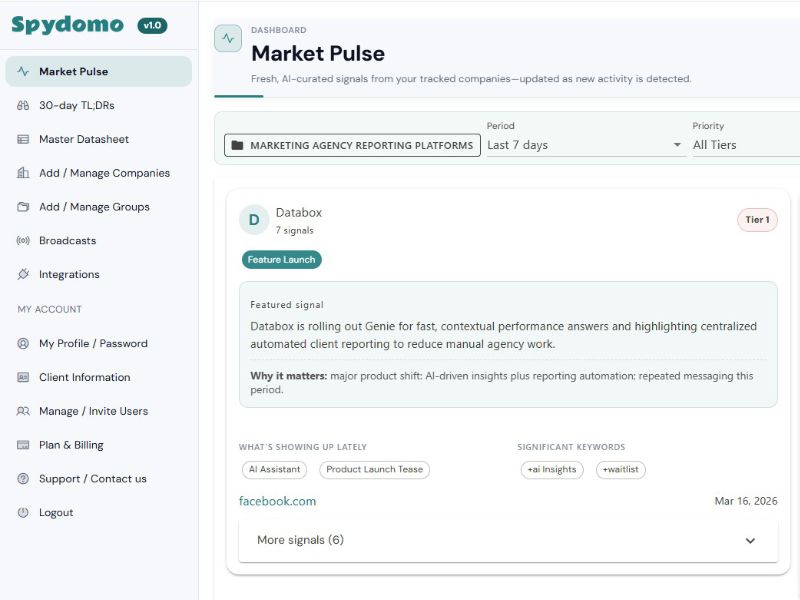
Spydomo monitors competitors across reviews, social media, websites, and news, then delivers concise AI-generated briefs highlighting launches, customer pains, and market trends. It's designed for founders, product teams, agencies, and investors.
It automatically finds sources like G2, Reddit, LinkedIn, and blogs, turning scattered signals into structured insights you can act on. Receive updates daily, weekly, or instantly via email, Slack, or Teams. Pricing starts at $10 per tracked company per month, with a 14-day free trial.
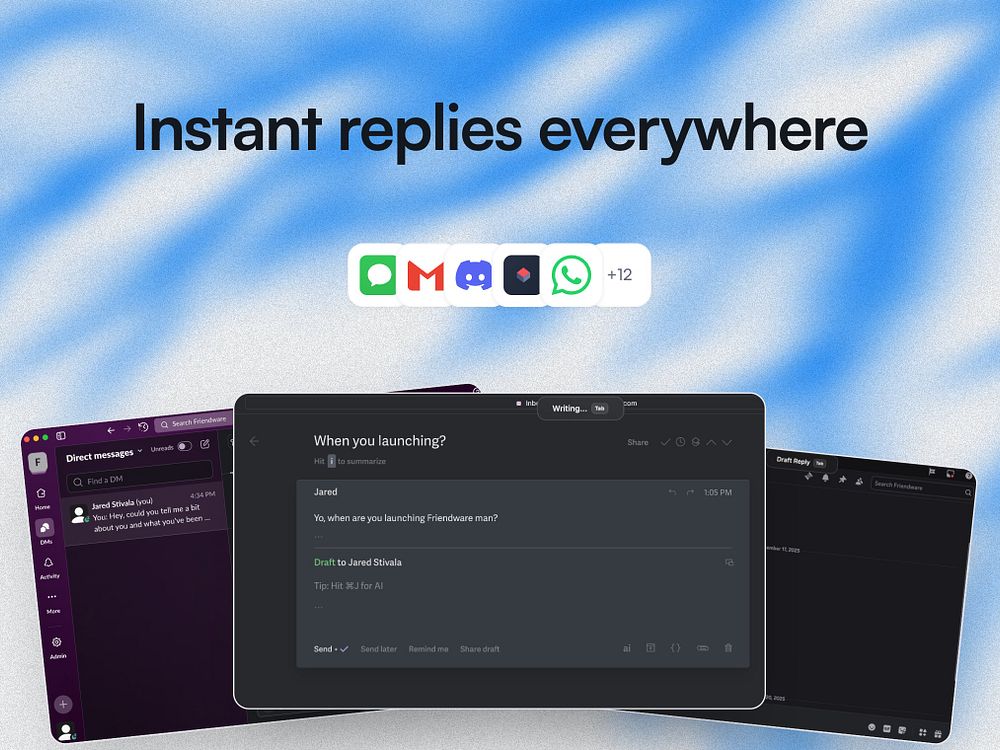
Friendware brings AI autocomplete to macOS so you can write and act faster across every app. It observes your style and drafts instant, context-aware replies for email, Slack, LinkedIn, iMessage, and X. It polishes text and generates prompts as you type; just press Tab.
Use one-click actions to handle multi-step tasks like checking Stripe billing, sending follow-ups, or creating calendar invites. Built with native Mac code, it runs fast, stays lightweight, respects local context, and supports 100+ languages.




Echo is an anonymous 3D voice space where people leave short voice or text messages in a virtual environment. There are no accounts, profiles, or comments, so people can speak more honestly without the pressure of social media.
It offers a quieter way to express feelings, release emotions, and hear real voices from others. Instead of performance and attention, Echo is built for honesty, privacy, and emotional connection.
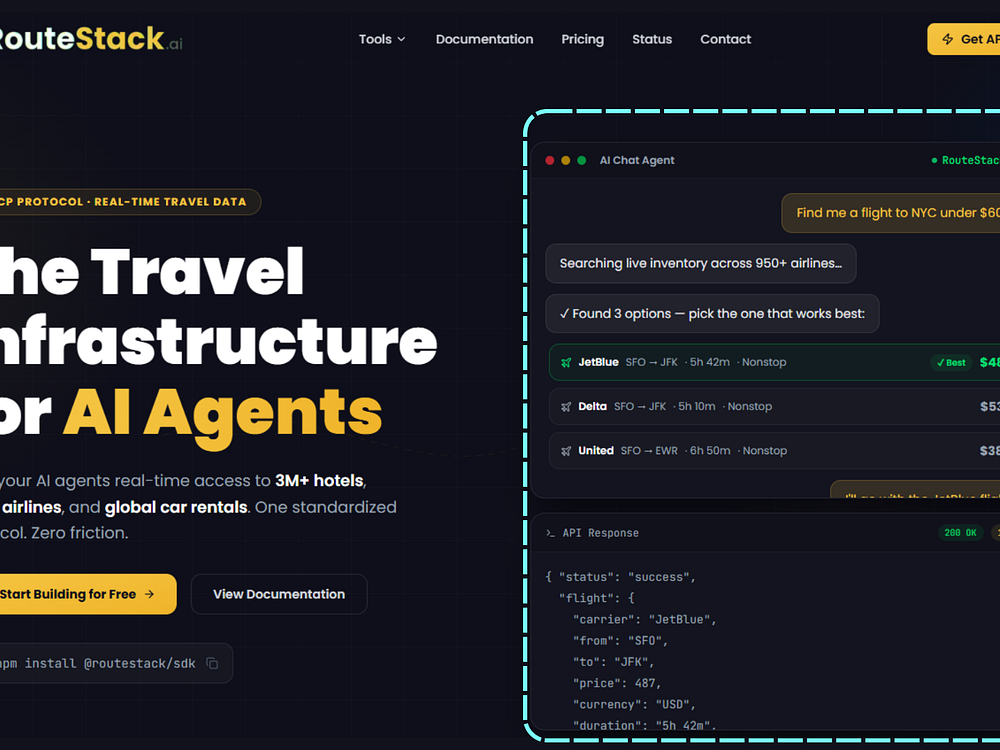
RouteStack gives AI agents access to live travel data including hotels, flights, cars, rentals, and activities in one place. Pricing and availability are pulled in real time from global distribution systems, and every booking link is cryptographically signed for secure checkout.
Developers can connect to RouteStack using Python or Node SDKs, a ready-to-run server, or Docker. It's built to be fast, reliable, and easy to integrate into any AI agent or framework.






Chartbeat data shows search referral traffic fell 60% for small publishers over two years, compared with 22% for large publishers, per an Axios report.
The post Search Referral Traffic Down 60% For Small Publishers, Data Shows appeared first on Search Engine Journal.
SISTRIX analyzed over 100 million German keywords and found AI Overviews reduce the position one click rate from 27% to 11%. Impact varies by industry.
The post Google AI Overviews Cut Germany’s Top Organic CTR By 59% appeared first on Search Engine Journal.
