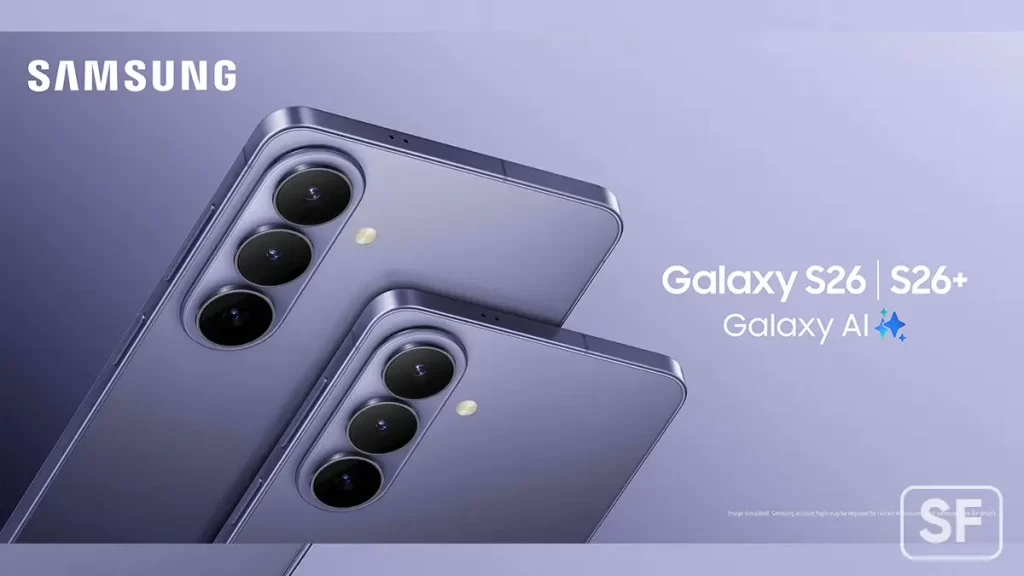
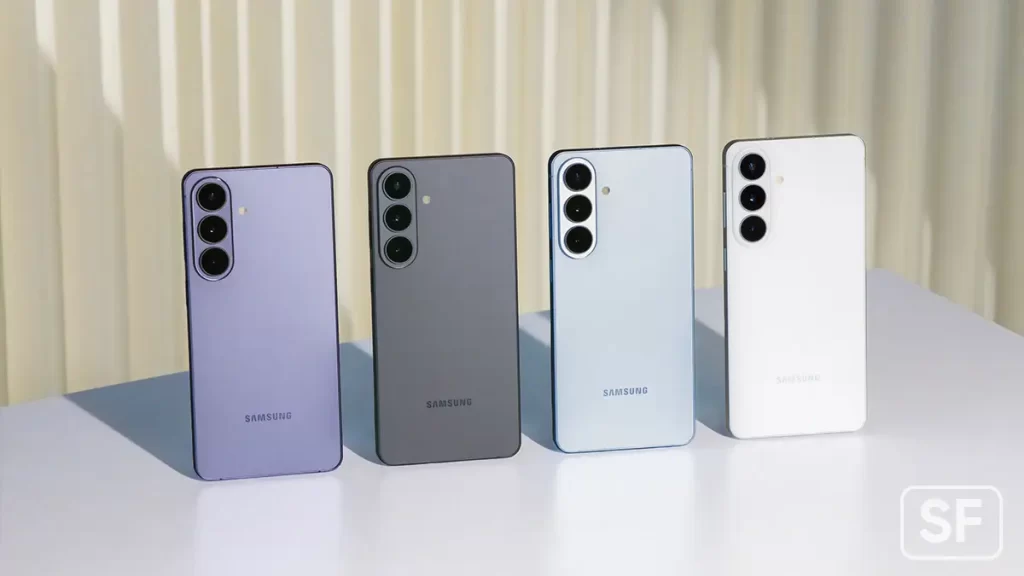
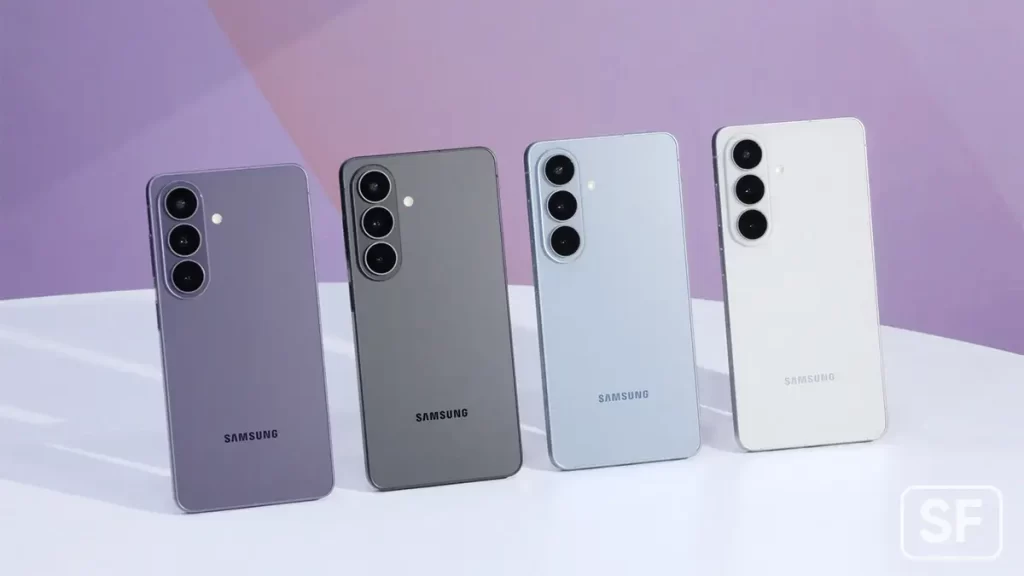
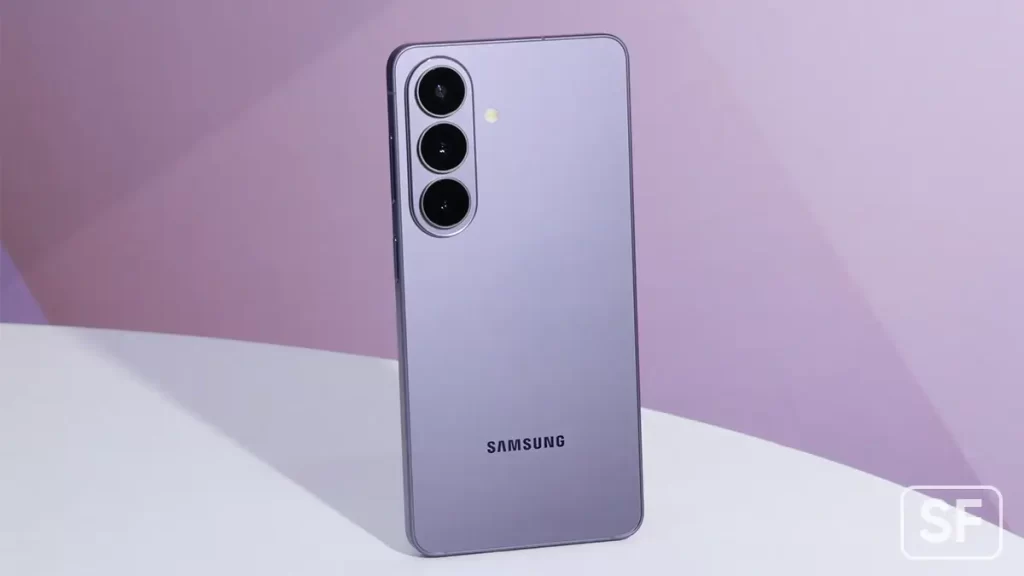
Fresh listings in the EU’s EPREL database suggest the upcoming Galaxy A37 and Galaxy A57 could quietly outperform the Galaxy S26 in one area that matters to everyone: battery life.
The Galaxy A37, model SM-A376B/DS, shows up in the EPREL database with an A rating for battery life. The label claims up to 53 hours on a single charge. The Galaxy A57, SM-A576B/DS, is right behind it at 52 hours, also with an A rating.
The Galaxy A36 carried a Class C energy efficiency rating and managed 41 hours. The Galaxy A56 stepped up to Class B with 44 hours.
For context, the Galaxy S26 is rated at 51 hours. EPREL figures are based on standardized testing conditions. They provide a controlled benchmark, and under that benchmark, the upcoming A-series phones are winning.
The Galaxy S26 remains the performance king, no question. It brings the newest silicon, advanced AI features, and the full flagship package. But when it comes to battery life, the A37 and A57 may edge it out, at least under EU test conditions.
Beyond that, both the Galaxy A37 and A57 phones are listed with 45W charging support. In practice, that likely means 45W PPS, aligning them with higher-end models.
IP68 rating: The Galaxy A37 and A57 are listed with IP68 dust and water resistance. That is a meaningful upgrade over the A36 and A56 from early 2025.
The A57 also scores an A rating for drop resistance, while the A37 comes in at B. Both phones are rated for 1,200 charge cycles before battery replacement is recommended. Repairability sits at C for both, which feels typical for modern sealed designs.
Samsung didn’t talk much about the S Pen of the Galaxy S26 Ultra during the launch conference, fueling rumors of its cancellation. Well, Samsung MX COO confirmed that S Pen is here to stay and a major upgrade is already in the works.
MX Business COO Won Joon Choi says the S Pen remains a “core technology,” and more importantly, he teased a genuine Samsung S Pen Upgrade.
His exact words: “We’re working on a more advanced technology within S-Pen to come up with a new structure of display, so the penalty of having S-Pen is diminished.”
Revamped stylus in the works
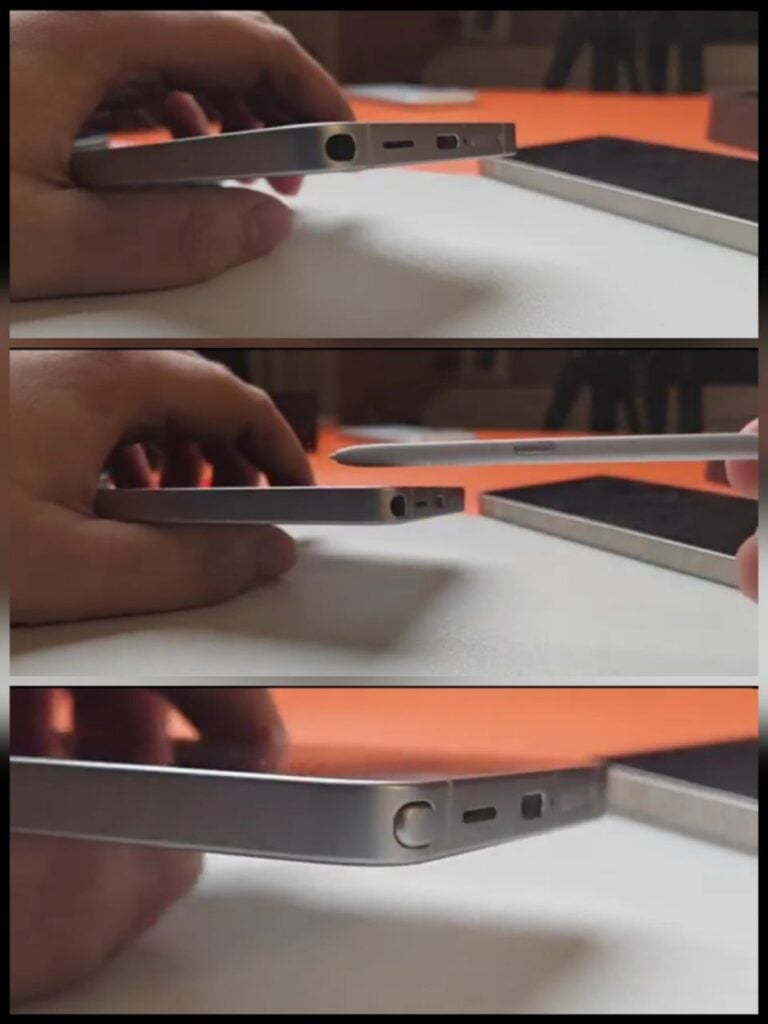
Inside the Galaxy S Ultra chassis, the stylus silo eats into precious internal volume. That space could otherwise house a larger battery, improved cooling, or even more advanced camera hardware.
That phrase, the penalty of having S Pen, is doing a lot of heavy lifting. The “penalty” likely refers to two things: battery capacity and display stack complexity.
On foldables, S Pen support has required a digitizer layer. On slab phones, the internal silo constrains battery growth. If Samsung is talking about a “new structure of display,” it suggests a deeper hardware-level rethink.
One working theory is a more integrated digitizer solution baked directly into the OLED stack, reducing layering overhead. Another possibility is improved resonance technology that needs fewer internal components.
Rumors around the Galaxy Z Fold 8 and the so-called Wide Fold suggest a larger canvas and a different internal layout. If Samsung can reduce the display “penalty,” that opens the door for more seamless S Pen integration.
Samsung did just the opposite of what rumors suggested for months. The Galaxy S26 Ultra doesn’t bring built-in magnets for Qi2 charging; it gave Samsung two paths, and the company picked the less impressive one.
Apple brings strong yet safe magnets inside the iPhone models. Google became the first Android vendor to follow the suite. The Pixel 10 series is a step ahead of the Galaxy S26 series when it comes to native Qi2 charging support.
No magnets means battery gains or thinness
Won-Joon Choi of Samsung confirmed to TheVerge that the Galaxy S26 series doesn’t include MagSafe-style magnets. Like the Galaxy S25 series, users need to purchase specific cases to access enhanced charging features.
When asked why, the official gave an unsatisfactory answer, which is literally hard to defend.
Samsung says about 80 or 90 percent of people are using a case. This internal analysis led Samsung to skip bringing magnets inside the Galaxy S26 phones. If magnetic cases are here, what’s the need for installing magnets inside?
The official added that avoiding magnets saves space inside. This height (space) saving can be used for battery gains and further reduction in thickness. Well, the Galaxy S26 Ultra doesn’t bring either, despite lacking magnets.
Battery inside the Galaxy S26 Ultra remains unchanged, 5000mAh. The thickness barely changed; Galaxy S25 Ultra is 8.2mm, and the Galaxy S26 Ultra is reduced to 7.9mm. It’s just 0.3mm of improvement in a generation.
Well, Samsung is still doing research and development to install magnets inside the body without any sacrifice. Once the solution is achieved, Galaxy phones would embrace Apple’s MagSafe-style magnets and charging features.
Privacy Display is unarguably the most interesting feature of Galaxy S26 Ultra. Samsung Display’s Flex Magic Pixel technology powers the panel. Do you know the Privacy Display was supposed to launch with the Galaxy S25 Ultra?
Samsung launched the Galaxy S25 series last year, with the Ultra model having seen some major changes. It left the Note design legacy behind, adopting rounded corners, Saturn camera rings, and a new ultrawide camera.
The Galaxy S25 Ultra could have already boasted the Privacy Display (via MarkGurman). Samsung took a step back at the last moment and decided to delay. It led the technology to debut with the Galaxy S26 Ultra this year.
“Our goal was to have this, to be honest with you, on the S25 Ultra,” Won-Joon Choi said. “We were almost there. But we had to kind of solve a couple of the last challenges. So we took another year to resolve those. It has been quite a journey.”
Galaxy S25 Ultra features the second-generation Gorilla Armor. Compared to the S24 Ultra, the device improved its strength against glare. However, the Galaxy S26 Ultra seems to be a downgrade in terms of glare resistance.
Samsung yesterday revealed its Flex Magic Pixel passed an independent test. The panel reduces visibility at 45 degrees and dims it further at 60 degrees. It completely restricts visibility from either side, without compromising the front.
Privacy Display is dominating Samsung’s promotional campaign for the Galaxy S26 Ultra. Korean media reported the tech could arrive across the lineup, but the company has kept it limited to the top-tier version this year.
Chinese phone makers are expected to launch their Privacy Display phones later this year. Apple adopted an anti-glare screen with the iPhone 17 lineup. Privacy Display may take some time to land on the iPhone portfolio.
Samsung has officially launched the Galaxy S26 series, and the industry is now looking at the next set of devices. Meanwhile, Samsung’s COO just signalled that the Slim phone project may skip 2026 due to low sales of the S25 Edge.
Won-Joon Choi, COO of MX Business, acknowledged that the sales of the Galaxy S25 Edge were comparatively lower than those of the other Galaxy models.
Market analysis reports already revealed what the executive expressed today. That was the only reason behind the sudden revival of Galaxy S26 Plus in the 2026 flagship lineup.
Is a new Slim phone coming in 2026?
The top executive said that Samsung is “still evaluating” the launch of another super-thin phone. The Galaxy S26 Edge’s development was almost completed, and it was ready to take the place of the S26 Plus in the lineup.
However, the Korean tech giant decided to retain the Galaxy S Plus version. Galaxy S25 Edge sales were not sufficient to make it a real alternative to the Plus. Plus indeed sells lower than the base and Ultra, but more than the Edge.
While Samsung abandoned the Galaxy S26 Edge, the work is still underway on a project named “More Slim.” It’s a device different from the S26 Edge, and Samsung might fix the mistakes of the Galaxy S25 Edge to improve sales.
That said, a Slim phone is uncertain from Samsung this year. Apple is indeed working on the second-generation iPhone Air, but it’s not coming in 2026. The device may launch sometime in 2027, as part of a reshuffled strategy.
Image – The abandoned Galaxy S26 Edge (dummy) | Via – OnLeaks
Price predictions for 2026 range from $400 to $600.
Long term outlook suggests gradual growth potential to approach $1200 by 2030.
Aave (AAVE) is a decentralized finance protocol built on Ethereum that facilitates permissionless lending and borrowing through smart contracts. After witnessing a strong expansion in the previous market cycle, AAVE entered a prolonged correction phase, with price gradually retracing from its earlier highs. Throughout 2025, AAVE remained in a consolidation structure, reflecting a period of market digestion rather than trend continuation. While short-term momentum has cooled, the broader technical structure suggests that AAVE may be transitioning into a new accumulation phase.
As volatility contracts and price holds above long-term demand levels, attention is now shifting toward whether 2026 can trigger the next major price discovery cycle.
AVAX price is currently testing the $9 mark in late February, following resistance faced at $15 in January. A recovery is anticipated in March, with optimistic expectations for the first quarter of 2026 to see a good recovery to reclaim some of its previous levels. Based on the chances of a recovery, experts are targeting $20, with the potential to reach $28. If it surpasses $28, it could climb to $44 by mid-year. However, if $28 proves to be a strong resistance level, consolidation may continue.
Avalanche (Avax) Price Prediction 2026
The price action of AVAX hasn’t been so great since its Q1 2024 high of $65; it has been in decline ever since. Most of 2024 and all of 2025 were in decline.
Even in 2026, this bearish momentum’s shadow didn’t lift; it worsened, with the broader market in turmoil. In January, the AVAX price faced rejection from $15 and slipped to $9 support zone after hitting a low of $7.53 in February. But things can change this time around. Since Q1 still has several days left, a recovery remains an option, as it has been testing a demand area of $9 that ignited the late 2024 rally. Sustained demand here could signal a reversal.
Now, expectations for its recovery, which are gaining momentum in Q1 2026, are significantly higher. Now, it appears AVAX may not have performed in the past two years, but it was all about establishing a base, and it seems it has done so. Now, an impressive rally ahead is a strong possibility.
For Q1, we expect $20 with potential to test the pattern’s upper border at $28. However, if it clears the upper border, we can expect AVAX to hit $44 by the end of the first half. But if $28 repels, then the first half could see consolidation stretching.
Year
Potential Low
Potential Average
Potential High
2026 (conservative)
$25
$33
$50
AVAX On-Chain Analysis
AVAX shows a highly bullish sentiment. Big Whale Orders in both spot and futures indicate strong institutional accumulation. With Taker Buy Dominance at 90 days, aggressive buyers are in control, while the Cooling volume bubble map suggests a healthy consolidation phase. Collectively, major metrics point to a bullish rally ahead.
Avalanche Price Prediction 2026 – 2030
Year
Potential Low ($)
Potential Average ($
Potential High ($)
2026
400
500
600
2027
550
690
820
2028
650
830
980
2029
740
950
1100
2030
820
1000
1200
AAVE Price Forecast 2026
Looking ahead to 2026, AVAX’s potential price is anticipated to rise even further, with a projected low of $20.00 and a high of $80.00. The average price for AVAX in 2026 will likely be $50.00.
AAVE Price Prediction 2027
In 2027, the analysis suggests a continued upward trend in AVAX’s value, with the price potentially ranging between $31.50 and $126.50. Based on the calculated figures, the average price is projected to be approximately $79.00 during this period.
AAVE Prediction 2028
By 2028, AVAX’s price could potentially experience further growth, falling within the range of $50.50 and $202.50. The average price during this period, calculated from the data, is expected to be around $126.50.
AAVE Price Prediction 2029
Moving forward to 2029, AVAX’s price is predicted to ascend between $81.00 and $324.00. The average price during this period is estimated at around $202.50 based on calculated figures.
AAVE Price Prediction 2030
By 2030, AVAX’s price is forecasted to soar between $129.50 and $518.50. Further, the average price during this period, calculated from the data, could stand at $324.00.
Based on the historic market sentiments and trend analysis of the largest cryptocurrency by market capitalization, here are the possible AAVE price targets for the longer time frames.
Year
Potential Low ($)
Potential Average ($)
Potential High ($)
2031
890
1100
1350
2032
920
1200
1500
2033
1100
1350
1780
2040
1600
2200
3000
2050
2600
3300
4500
AAVE Price Prediction: Market Outlook?
Year
2026
2027
2030
Changelly
$500
$750
$1100
DigitalCoinPrice
$480
$680
$1000
WalletInvestor
$520
$650
$1250
Never Miss a Beat in the Crypto World!
Stay ahead with breaking news, expert analysis, and real-time updates on the latest trends in Bitcoin, altcoins, DeFi, NFTs, and more.
FAQs
Is AAVE a good investment for 2026?
AAVE shows long-term growth potential if it breaks key resistance levels. However, price depends on market conditions and DeFi adoption.
What should investors watch before buying AAVE?
Watch support near $135–$150, resistance above $250, overall market trend, and activity within the Aave protocol.
What could drive Avalanche (AVAX) price growth in the coming years?
Key drivers include DeFi expansion, institutional adoption, subnet growth, and overall crypto market recovery cycles.
What is the AVAX price prediction for 2026?
The AVAX price prediction for 2026 suggests a potential range between $400 and $600 if market momentum and network growth remain strong.
What is the AVAX coin price prediction for 2030?
AVAX coin price prediction for 2030 points to a possible range of $820 to $1,200, assuming sustained adoption and favorable market conditions.
What is the Avalanche price prediction for 2040?
Avalanche price prediction for 2040 estimates a broad range between $1,600 and $3,000 if long-term blockchain adoption accelerates globally.
The XRP price isn’t exactly inspiring confidence right now. After a powerful 2025 rally that pushed XRP/USD above the $3 mark, the mood has shifted and not subtly. Price has rolled over hard, now hovering near the $1.44 zone, with momentum indicators tilting south.
On the weekly XRP price chart, that vertical breakout from late 2024 into 2025 looks impressive in hindsight. But markets don’t reward nostalgia. Since topping above $3, XRP price has been printing lower highs, slipping beneath key moving averages, and losing steam.
And the derivatives market? It’s not exactly stepping in to save the day.
Momentum Turns Against XRP Price
Take a look at the oscillators. MACD has crossed lower, histogram bars are bleeding red, and RSI has drifted toward the lower half of its range. That’s not capitulation, not yet, but it’s clear the euphoria phase has passed.
More importantly, the broader XRP price chart shows that the explosive upside move has been fully retraced in sentiment terms. The aggressive buyers that drove the spike have faded.
Which brings us to leverage.
Open Interest Sends a Message
The 90-day change in XRP open interest across major exchanges shows something telling. Large spikes in positioning were followed by sharp contractions. On some platforms, swings reached deeply negative territory before stabilizing.
That kind of volatility in open interest suggests traders piled in aggressively during the rally and then pulled risk just as quickly. In other words, conviction didn’t stick.
When open interest compresses while price trends lower, it often means leverage is being flushed out rather than added. For any XRP price prediction to turn convincingly bullish again, sustained positioning growth would need to return.
Right now, that’s not happening.
XRP/USD at a Crossroads
So where does that leave XRP/USD?
Technically, price is sitting near the $1.40–$1.45 area after rejecting from the $3 zone earlier in the cycle. The structure no longer screams breakout. It looks like digestion maybe even distribution.
Well, here’s the uncomfortable part. Big vertical rallies rarely drift sideways forever. They either re-accelerate with fresh momentum or correct deeper to reset sentiment completely.
Open interest volatility, weakening momentum, and fading upside pressure point toward caution.
That doesn’t guarantee a collapse. But it does mean the easy money phase is over.
For now, the XRP price is stuck proving it can stabilize before anyone seriously talks about new highs again.
Hedera Price prediction highlights HBAR could reach $0.45-$1.05 in 2026.
The Long-term forecasts suggest HBAR could hit $2.20 by 2030, indicating stable growth potential.
Hedera has been making waves in the cryptocurrency space, with a fast and secure blockchain that offers a distinct approach to transaction processing compared to Ethereum and other smart contract chains. It’s permission-only, meaning the blockchain is managed by private companies. Limiting what types of decentralised applications are allowed is what makes Hedera stand out from the rest.
Having entered the top 20 digital assets by market cap in 2024, it is now eyeing a potential leap into the top 10 by the end of 2025. Hedera has also recently ramped up its development activities for its ecosystem. Its ecosystem is strengthening, despite its capped price action. With increasing real-world use cases, institutional interest, and strategic partnerships, many are closely tracking HBAR price chart 2025 to gauge how high the token can rise.
With major companies like Google, IBM, and Chainlink Labs backing the project, and discussions about SEC approved HBAR ETF would flood string liquidity. Many are intrigued that: Will the HBAR Price Reach $1? Let’s discuss this in our Hedera price prediction 2025 article.
HBAR fell below $0.100 by early 2026 and recently tested key dynamic support in February, suggesting potential demand. To maintain a bullish outlook for March, it needs to reclaim the $0.120 level; otherwise, it may pull back to $0.0800. In the long run, holding above $0.0800 is crucial to avoid a drop to $0.0453.
HBAR Price Prediction 2026: What’s Next for Hedera?
Previously, the HBAR price began a prolonged period of consolidation below $0.120, lasting nearly 2 years from 2023 to the third quarter of 2024. Then a rally in Q4 2024 pushed it to $0.4010. But the surprising part is that by the end of 2025, it is back below $0.120, and by the end of January 2026, it has even slipped below $0.100 in February. The question is whether it is an opportunity or something else.
Since the extended decline of 2026 has retested a key support that strongly aligns with the lower border of the pattern, and some reaction from this level confirms the presence of demand at this dynamic support. That makes the current price action an important play that could shape the next big move.
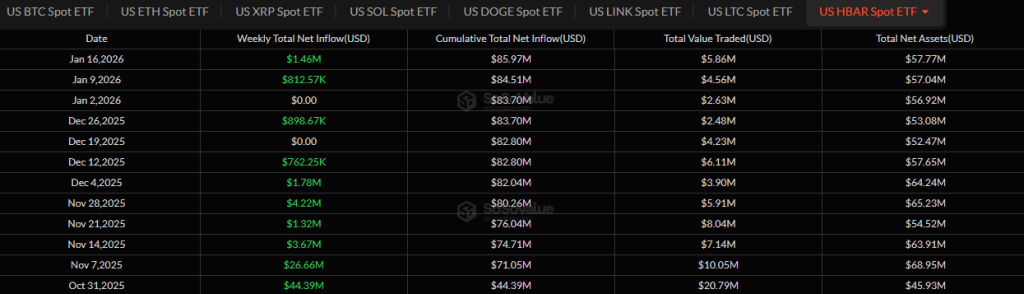
Also, it has an ETF, where odds are suggesting that once a catalyst arrives inflows could resume sooner or later, and the price of HBAR, which is currently experiencing lower demand, that could change. Also, this setup of falling wedge still looks intact with bears ruling for now, and it cannot be confirmed yet whether the recent support taken changes towards the bullish wind. So far, only on the micro level is it bullish, but the long-term chart still doesn’t care about micro momentum because the larger momentum is still dominated by bears, and this needs a big catalyst to break the range.
In the short term, either it will claim its position back above $0.1200 and aim for $0.1836, or it will take a pullback from $0.1200 back to $0.0800.
However, for the majority of this year, holding on to $0.0800 is key; if that’s compromised, it will be very hard to stop HBAR from testing $0.0453 support. Right now in Q1, the initial rally that fruited in late 2024 began from this zone, and if demand manifests, this could be a possible opportunity to accumulate, but caution still comes first.
HBAR On-Chain & ETF analysis
The HBAR ETF is gaining momentum once again, with $1.46 million in inflows this week. The last time we saw such significant inflows was in early December, when it reached $1.78 million. This suggests liquidity is flowing into HBAR, potentially signaling a price rise.
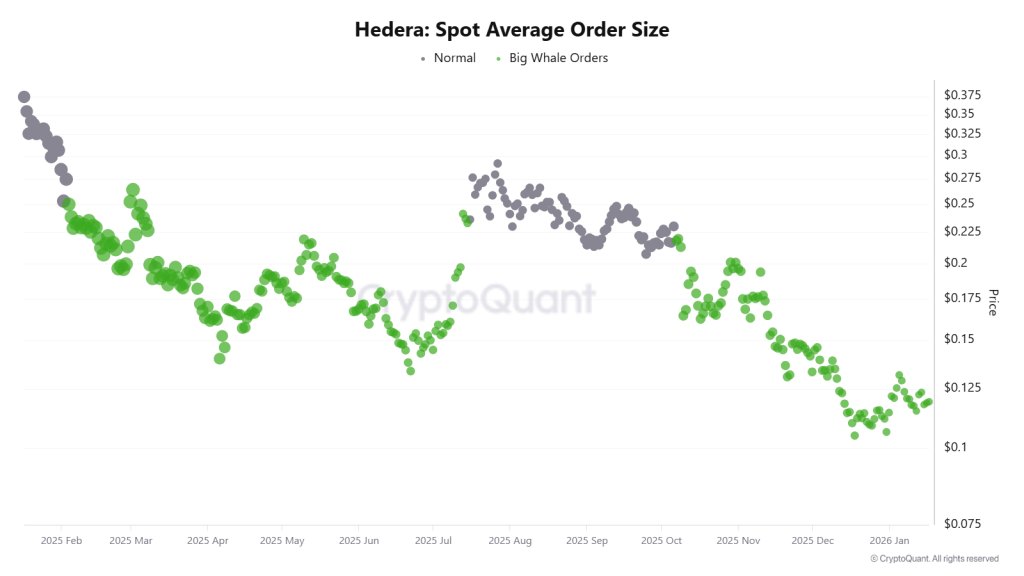
Also, large orders from whales have been increasing since mid-October, suggesting that they are purchasing HBAR on every price decline.
Year
Potential Low
Potential Average
Potential High
2026 (conservative)
$0.15
$0.40
$0.75
HBAR Price Prediction 2026 – 2030
Year
Potential Low
Potential Average
Potential High
2026
$0.45
$0.80
$1.05
2027
$0.60
$0.95
$1.20
2028
$0.65
$1.10
$1.40
2029
$0.70
$1.35
$1.60
2030
$0.95
$1.70
$2.20
HBAR Price Prediction 2026
Moving forward to 2026, forecast prices and technical analysis project that Hedera’s price is expected to reach a minimum of $0.45. The price could escalate to $1.05 on the higher end, with an average trading price hovering around $0.80.
HBAR Price Forecast 2027
Looking ahead to 2027, the optimism around Hedera will lead to steady growth. Hence, the HBAR price is forecasted to reach a low of $0.60, with a potential high touching $1.20 and an average forecast price of $0.95.
Hedera Price Forecast 2028
As we advance to 2028, with moderate gains, the HBAR predictions indicate that the price of a single HBAR could reach a minimum of $0.65, with the ceiling potentially rising to $1.40. Within the range, the average price will be $1.10.
HBAR Price Target 2029
By the time 2029 rolls around, it’s predicted that Hedera’s price will maintain its upward trajectory, reaching a minimum of $0.70, with the maximum price possibly reaching $1.60 and an average of $1.35, reflecting cautious optimism.
Hedera Price Prediction 2030
By the end of this decade, HBAR is predicted to touch its lowest price at $0.95, aiming for a high of $1.70 and an average price of $2.20. Hence, the prediction suggests stable long-term growth for Hedera’s market value.
Market Analysis
Firm
2026
2030
Changelly
$0.370
$1.74
priceprediction.net
$0.40
$1.99
DigitalCoinPrice
$0.50
$1.07
Coinpedia’s Hedera Price Prediction
By the end of 2025, the recovery run in HBAR prices is expected to continue with a gradual rise in momentum. Hence, by the end of 2025, Coinpedia’s HBAR price forecast expects a potential high of $0.80 with a solid support at $0.40, making an average of $0.60.
Year
Potential Low
Potential Average
Potential High
2025
$0.40
$0.60
$0.80
Never Miss a Beat in the Crypto World!
Stay ahead with breaking news, expert analysis, and real-time updates on the latest trends in Bitcoin, altcoins, DeFi, NFTs, and more.
FAQs
What is the HBAR price prediction for 2026?
HBAR price in 2026 is projected to trade between $0.45 and $1.05, with an average near $0.80 under favorable market conditions.
What is the Hedera price prediction for 2030?
By 2030, HBAR price could rise to around $2.20 if network growth, partnerships, and broader crypto adoption continue steadily.
Is Hedera a good long-term investment?
Hedera shows long-term potential due to enterprise adoption, real-world use cases, and strong governance, though price cycles still affect returns.
The live price of the Hyperliquid crypto is $ 28.61306375.
The 2025 HYPE price suggests it could hit $40-$105 in 2026.
Forecasts suggest that HYPE could reach a potential average price by 2030 of around $125, with highs up to $185.
The crypto market is buzzing with excitement over Hyperliquid and its native token, HYPE. As a decentralized, paperless alternative to platforms like Binance and Coinbase, Hyperliquid is quickly gaining traction, prompting investors to look closely at the HYPE price prediction for 2026 and beyond.
With its unique “HyperBFT” consensus mechanism, lightning-fast transactions, and zero KYC hurdles, Hyperliquid is rewriting the rules of perpetual trading. Beyond its consensus mechanism, Hyperliquid also allows users to trade crypto perpetual futures, including major assets like BTC, ETH, SOL, AVAX, and SUI, even without owning the underlying asset.
As the platform gains traction for its streamlined trading experience, many investors are now turning to analyze the HYPE token price outlook. But does its innovative model signal long-term growth for HYPE Token Price?
In this article, we dive deep into market sentiment and Hyperliquid price projections from 2026 to 2030.
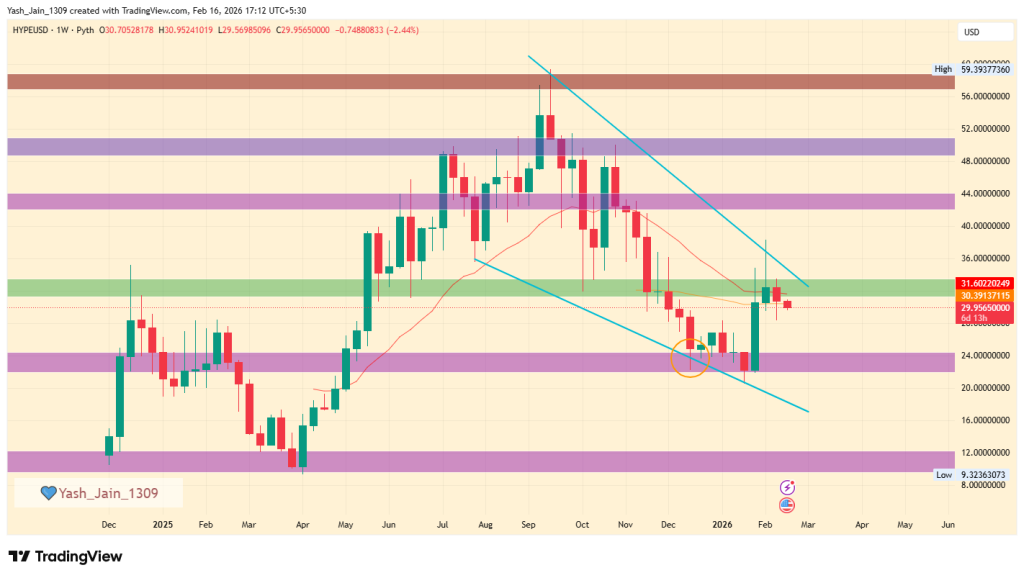
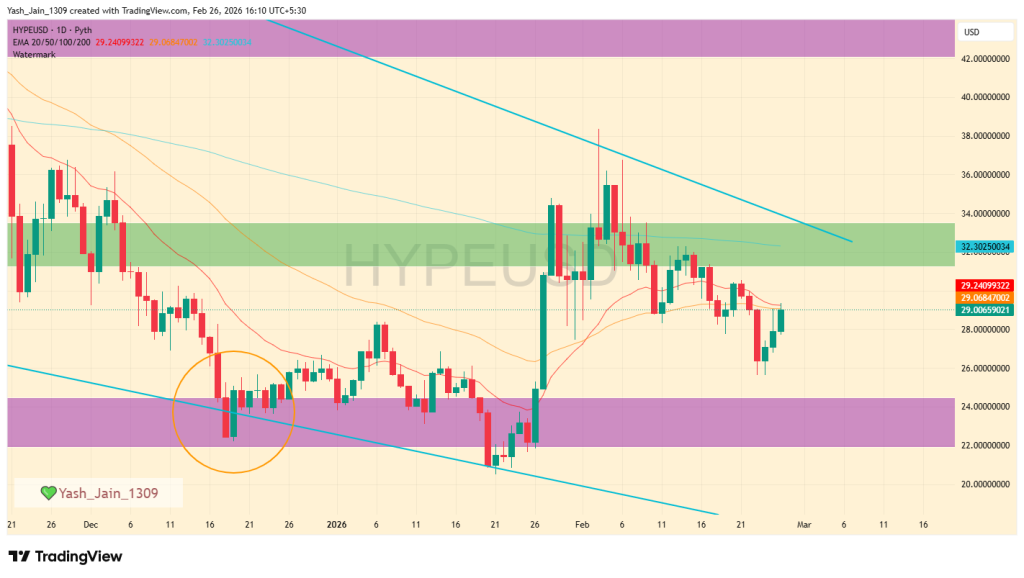
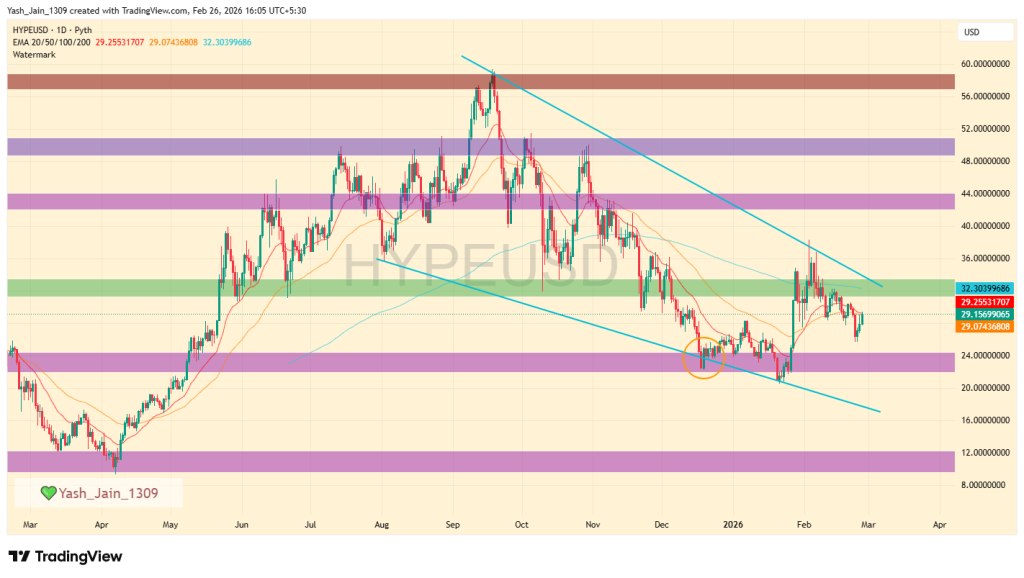
In 2026, HYPE retested support at $21 and rose to $38 but now faces resistance at the upper wedge boundary around $32. If it breaks $32, it could reach $44 or $50; otherwise, it may fall below $21 to $18.
HYPE Price Prediction March 2026
In February, HYPE’s price fell from its $38 peak and is now 30% lower at $26. But late February saw a faint demand again, which pushed the price back up to retest the 20-day and 50-day EMA bands. If it crosses, in March, a retest of $32 could be possible, or even a breach, with targets at $44. But, if $32 repels, then it could hit $21.
Hyperliquid Price Prediction 2026
In 2026, the HYPE price experienced a significant retest of dynamic support at $21, coinciding with the lower boundary of a falling wedge pattern, subsequently rising to $38 by early February. However, the upper boundary of the falling wedge acted as dynamic resistance, preventing further upward movement.
The price is currently consolidating within this narrowing wedge, with the trading range declining each month. At present, the HYPe price is fluctuating around the 20-day and 50-day EMA bands.
In the short term, it may test the upper boundary of the falling wedge once again at approximately $32. If the price successfully breaks through and sustains above this level, it could initiate a rally towards $44 or $50. Conversely, should it face rejection at $32, the price could decline below $21, potentially reaching as low as $18.
Year
Potential Low
Potential Average
Potential High
2026 (conservative)
$15
$35
$80
HYPE On-Chain Outlook
The Dune analytics dashboard provided an quick on-chain overview of the utility metrics of the Hyperliquid token (HYPE), which appears to be improving significantly with each passing month.
HyperEVM total transaction fees have surpassed 235.57K and are at an ATH, and total trading volume has crossed $3.64 trillion and is at an ATH. Even its revenue has reached an ATH, crossing $993 million.
All the major metrics suggest that it is experiencing great adoption among peers, and its on-chain metrics are proof of that, suggesting that if the rally occurs, then 2026 might end on very good numbers.
Hyperliquid Coin Price Targets 2026 – 2030
Year
Potential Low ($)
Potential Average ($)
Potential High ($)
2026
25
50
90
2027
40
75
105
2028
55
95
130
2029
85
110
155
2030
105
125
185
HYPE Price Projection 2026
By 2026, the value of a single Hyperliquid token price could reach a maximum value of $90 with a potential low of $25. With this, the average price could land at around the $50 level.
Hyperliquid Coin Price Prediction 2027
During 2027, the HYPE could reach a maximum value of $105 with a potential low of $40. Considering this, the average price of this altcoin could settle at around $75.
HYPE Crypto Price Action 2028
The Hyperliquid price could achieve the $130 milestone by the year 2028. On the flip side, the altcoin could record a low of $55 and an average price of $95.
Hyperliquid Price Analysis 2029
The HYPE crypto prediction for the year 2029 could range between $85 to $155 and the average price could be around $110.
HYPE Price Prediction 2030
Looking forward to 2030, the Hyperliquid Price may range between $105 and $185, and a potential average value of around $125.
Market Analysis
Firm Name
2025
2026
2030
Binance
$37
$63
$164
DigitalCoinPrice
$76
$54
$97
*The aforementioned targets are the average targets set by the respective firms.
CoinPedia’s HYPE Price Projection
This Layer-1 project has taken the crypto market by storm within a short time frame. With a market cap of over $7 billion, this altcoin has successfully secured a position in the top 25. Moreover, with the mass adoption, this altcoin could claim a spot in the top 10 during the upcoming bull run.
If the bullish sentiment intensifies, the Hyperliquid price will reach a high of $41.39 this year. On the flip side, if the market experiences unfavorable events, this could result in this altcoin settling at a low of $14.65.
Year
Potential Low
Potential Average
Potential High
2025
$14.65
$28.02
$41.39
Never Miss a Beat in the Crypto World!
Stay ahead with breaking news, expert analysis, and real-time updates on the latest trends in Bitcoin, altcoins, DeFi, NFTs, and more.
FAQs
What is Hyperliquid (HYPE) and why is it gaining popularity?
Hyperliquid is a fast, decentralized trading platform with no KYC and low fees, making HYPE popular among traders seeking speed and independence.
What is the Hyperliquid (HYPE) price prediction for 2026?
HYPE price in 2026 is projected to range between $25 and $90, with an average near $60 if adoption and trading volumes keep rising.
What could HYPE be worth by 2030?
Long-term projections suggest HYPE might reach an average of $125 by 2030, with possible highs near $185 if platform usage keeps expanding.
Is Hyperliquid (HYPE) a good long-term investment?
HYPE may appeal to long-term investors due to strong platform growth, but like all crypto, it carries risk and requires careful research.
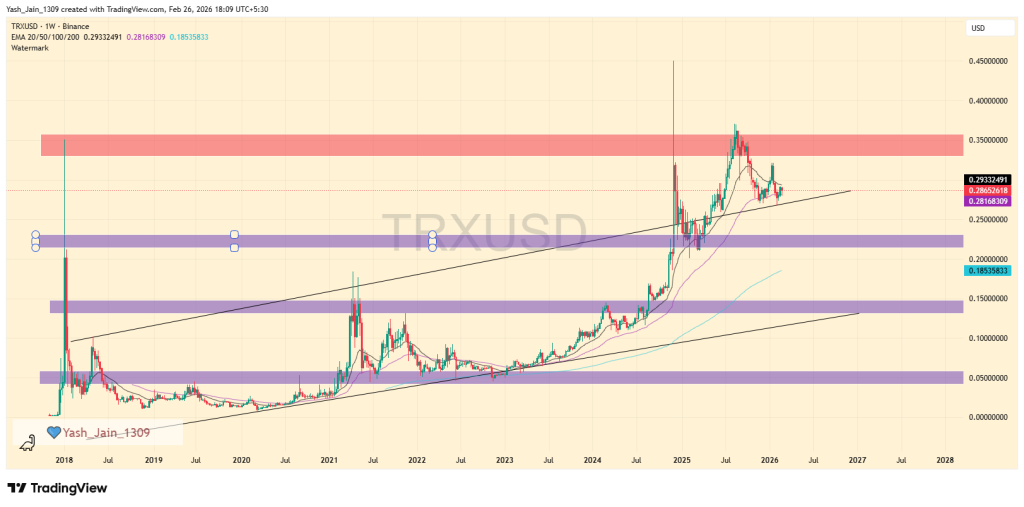
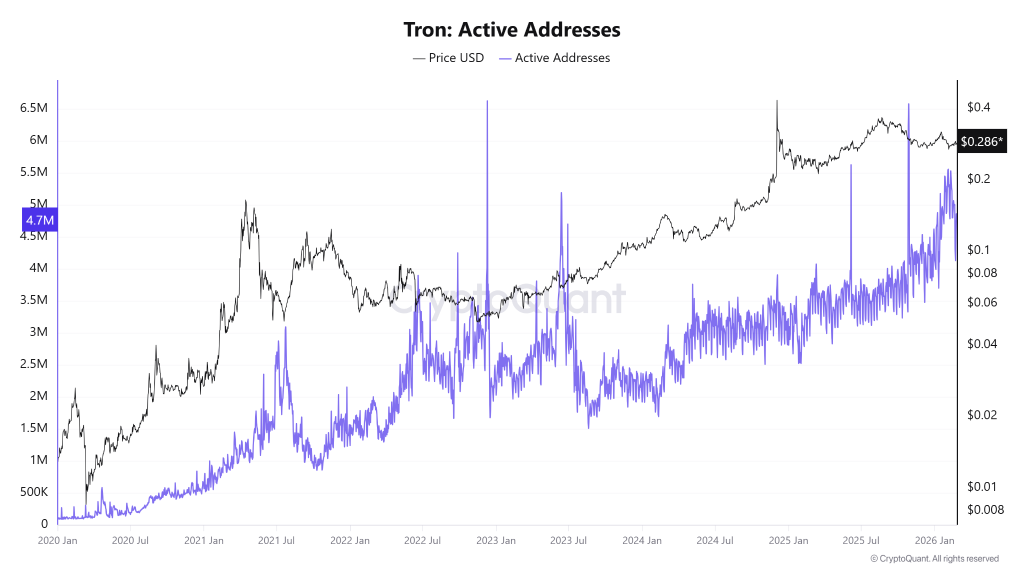
The TRX price topped out at $0.3695 in Q3 2025 and that’s where the music stopped. Since then, momentum hasn’t just cooled, it’s stalled. The $0.3339–$0.3500 range has quietly turned into a major brick wall, turning sellers back into control.
That zone isn’t random noise on the TRX price chart. It’s become the dominant supply area, and rejections spree from it are already unfolding. At current levels near $0.2864, TRX/USD is stuck beneath a ceiling it hasn’t been able to crack.
And when rally pushed back from that pressure its generally a top and that’s rarely a bullish tell.
Long-Term Channel Back in Focus
Now here’s where things get technical. TRX broke out of a long-term ascending channel in 2025 which was a bullish development at the time. But markets have a sense of humor. That former breakout level, the upper border of the channel, is now being tested as support.
If it holds, structure survives. If it breaks, TRX price re-enters the channel.
And that’s where the downside math starts getting uncomfortable. A confirmed slip below that wedge support opens the path toward $0.2215. Lose that, and $0.1354 becomes the logical endpoint of a broader correction phase. From $0.2864, that’s roughly a 50% haircut.
So when traders talk about a bearish TRX price prediction, this is what they’re looking at this structure, not emotion.
Utility Fueled the Rally
But price doesn’t move in a vacuum. The previous rally wasn’t built on hype alone. It was driven by increased USDT activity on the network. More stablecoin transfers meant higher blockchain utility, which meant more active addresses.
In February, active addresses peaked at 5.60 million. They’ve since dipped to 4.74 million. The decline isn’t dramatic or big. In fact, the broader multi-year rising trend in active addresses is still intact. It’s been tested several times and hasn’t broken.
Still, here’s the uncomfortable truth: the more a trendline is tested, the more fragile it becomes.
The 4 Million Line in Sand
Q1 2026 could mark another retest of that rising active address trend. If the metric breaks down decisively, especially below the psychological 4 million level it suggests declining network utility.
And that could have serious consequences. As stablecoin plays a big part, if Lower stablecoin transfer activity is materialized that means reduced liquidity. Reduced liquidity tends to hit price. Hard.
So what’s next? Everything hinges on support both on the TRX price chart and in active addresses. If both crack, a full correction toward $0.2215 and even $0.1354 isn’t far-fetched.
At this point, the TRX price isn’t crashing. But it’s standing on a trapdoor.
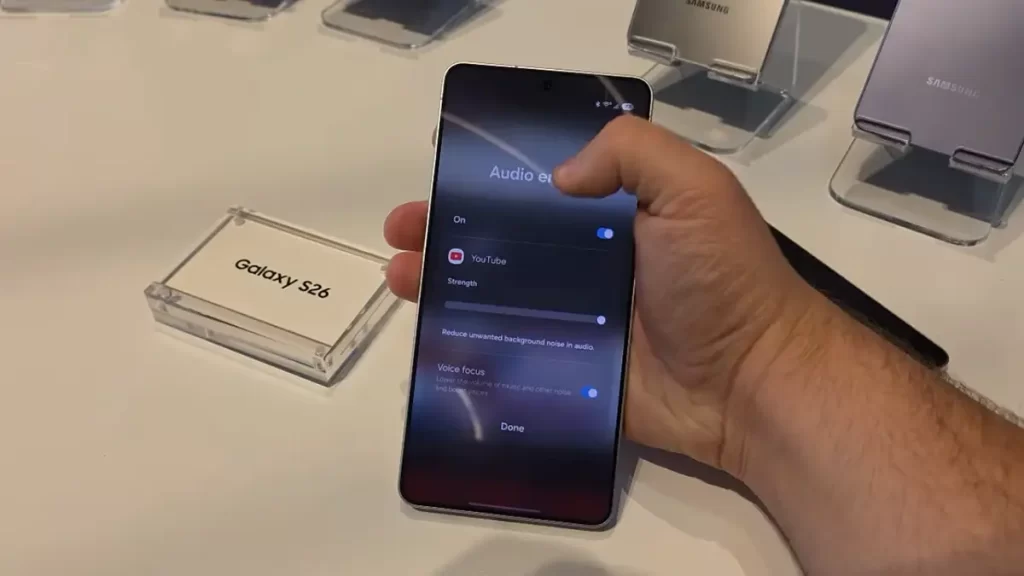
Google’s Pixel phones had a head start with Audio Eraser, but Samsung is finally giving us something better. Instead of cleaning up audio after you record a video, One UI 8.5 lets you fix the sound while you’re watching it. At Unpacked, Samsung confirmed its AI Audio Eraser now works inside YouTube, Instagram, Netflix, TikTok and other apps.
Neither in Samsung Gallery nor in a separate editing screen, it now works inside the actual video stream. With the Galaxy S26 debuting One UI 8.5, real-time Audio Eraser now works directly inside apps like YouTube, Instagram, Netflix, and TikTok.
How it works in One UI 8.5
On the Galaxy S26 running One UI 8.5, Audio Eraser sits in the Quick Panel. Tap it while a video is playing and you get simple, clear controls. There’s a “Voice Focus” toggle and a strength slider for noise removal. You slide it up and the crowd noise from the video fades in real-time.
Real-time Audio Eraser debuts on the Galaxy S26 with One UI 8.5, via 9to5Google. If history repeats itself, we’ll likely see this land on the Galaxy S25, S24, and the latest foldables once One UI 8.5 rolls out more broadly.
Samsung rarely keeps software features locked to one generation for long. The S24 and S25 series already run advanced on-device AI tasks smoothly. Real-time audio filtering is demanding, but it’s not out of reach for those chipsets.
If One UI 8.5 brings this to the wider Galaxy lineup, it won’t just be a spec sheet win for the S26. It’ll be a quality-of-life upgrade for millions of users.
Samsung is developing better camera hardware and considering silicon-carbon battery for future phones. Top executives sat down with media outlets, answering the frequently asked questions by millions of Samsung fans.
At Unpacked 2026, Samsung launched the Galaxy S26 Ultra with Privacy Display. The device also features enhanced camera hardware. Meanwhile, the real upgrades are potentially coming in the years ahead, starting with the S27 Ultra.
Better camera hardware
Post-Unpacked, Samsung revealed (via AndroidAuthority) the ongoing efforts to develop better camera hardware for future phones.
Over the past few years, we haven’t seen substantial camera upgrades. We are talking about innovation, not the usual play with the sensor’s aperture or megapixel counts.
Samsung is investing huge amounts of money in the research and development of better camera hardware. The company seems to have some hardware prototypes ready, but the software part is yet to be evolved for the perfect combo.
“I must say that that has been a frequently asked question so far, and I must tell you that a lot of R&D has been underway on hardware improvement, as well. It’s just a matter of finding the right combination, at the right time… We are always, constantly thinking about what would be the best combination at a given time. So, in the future there would also be new combinations of hardware and software, so I ask for your patience and attention.”
While the official didn’t reveal much, rumors suggest the Galaxy S27 Ultra might revive variable aperture camera technology. Samsung is under pressure after Apple’s efforts to bring this camera solution to the iPhone 18 Pro.
Silicon-carbon battery
Samsung is already planning a significant battery upgrade. There’s no specific timeline for the next battery revolution, but it will come. Samsung appears to be planning silicon-carbon battery tech for future phones.
Samsung insiders, via AndroidHeadlines, revealed that “an unproven technology,” referring to the silicon-carbon battery technology. The evaluation turns out to be underway, but there’s no formal confirmation from Samsung’s end.
Galaxy S26 is the only model to receive a battery capacity upgrade this year. That too jumped to the 4300mAh mark, from 4000mAh in the Galaxy S25. Samsung kept the S26+ and Ultra unchanged at 4900mAh and 5000mAh.
Samsung kicks off One UI 8.5 Beta 6 update rollout with tons of fixes. It’s rolling out to the users of Galaxy S25, S25+, and S25 Ultra in Europe, Korea, and India.
Yesterday, Samsung held a mega Unpacked event, where it introduced the new flagship phones and earbuds. The official One UI 8.5 equipped with Agentic AI upgrades was also a spotlight during the Unpacked keynote.
Now, Samsung pushed the One UI 8.5 Beta 6 (ZZAO) with several fixes. The previous update felt like everything was settled internally. Meanwhile, the expansive content of the Beta 6 release suggests there’s more work remaining.
What’s new in One UI 8.5 Beta 6
The sixth Beta targets Bixby, Gallery, Now Bar, Now Brief, Display settings, Modes, and Routines. Samsung also highlighted improvements for the animations related to notification cards, probably in the Notification Panel.
Bixby Labs users will notice that the wake-up phrase creation feature is now working as intended, and a duplicate “View Previous Image” button that was cluttering the Gallery’s sketch conversion tool has been cleaned up.
Now Bar and Now Brief recommendation cards also got some attention, with text, icons, and Always-On Display visibility all corrected. A crash that occurred when adjusting camera area settings under Display has been resolved.
The lock screen style in Basic mode will no longer unexpectedly change when working with Modes and Routines. Rounding things out, notification card animations have been smoothed out for a more polished feel overall.
Changelog of the sixth One UI 8.5 Beta
Fixed an issue with the Bixby > Labs > Create wake-up phrase feature
Fixed an issue where two “View Previous Image” buttons appeared when using the sketch conversion feature in the Gallery
Fixed issues with the text, icons, and AOD visibility of Now Bar/Now Brief recommendation cards
Fixed a forced close issue when changing the camera area settings in Settings > Display
Fixed an issue where the lock screen style of Basic mode was changed in Modes and Routines
Samsung Galaxy S26 Ultra requires Magnetic cases for Qi2 charging, and using a third-party case might end up troubling the S Pen functionality.
The Korean tech giant is playing it safe with magnets this year. The Galaxy S26 Ultra does not have built-in Qi2 magnets. If you want that snap-on magnetic alignment, you need a specific case.
That decision already raised eyebrows when the phone launched. Now there is another wrinkle: the phone actively warns you about certain magnetic cases.
The discovery comes from known tipster Max Jambor. After attaching a third-party Qi2 magnetic case to the Galaxy S26 Ultra, the device threw up a system notification linked to the S Pen.
The message reads: “Magnets in accessories can interfere with your S Pen’s signal.” The phone then suggests removing the accessory if you experience connection or writing issues.
Samsung chose not to integrate Qi2 magnets directly into the Galaxy S26 hardware. If you want Qi2 wireless charging, you need to separately purchase a specific case from Samsung.
The Galaxy maker sells both magnetic and non-magnetic first-party options. Yet the warning appears when certain third-party Qi2 cases are attached.
Samsung launched Galaxy S26, S26+, and S26 Ultra at the San Francisco Unpacked. The Galaxy S26 now starts at $899, S26 Plus jumps to $1,099, while the S26 Ultra holds at $1,299; here’s your ultimate buying guide in the US.
The base Galaxy S26 is a great phone, but that $100 price hike, going from last year’s starting price up to $899, is hard to ignore. The Galaxy S26 Plus is the sleeper pick, but it brings the spending to nearly the Ultra level.
The Galaxy S26 Ultra is the easiest recommendation if the budget is there. The 200MP camera system, 5,000mAh battery, and 6.9-inch screen with Privacy Display feature represent a premium experience.
Preorder deals close on March 11.
Where to actually buy one
Samsung.com
Samsung is offering the most aggressive straight trade-in values.
Galaxy S26: up to $500 off with trade-in.
Galaxy S26 Plus: up to $700 off with trade-in.
Galaxy S26 Ultra: up to $900 off with trade-in.
Samsung is also bundling free storage upgrades during preorder.
Amazon
Amazon is keeping it simple.
Galaxy S26 512GB for $899 with a free $100 Amazon gift card.
Galaxy S26 Plus 512GB for $1,099 with a free $100 gift card.
Galaxy S26 Ultra 512GB for $1,299 with a free $200 gift card.
You also get a free storage upgrade to 512GB.
This is effectively a soft discount; you pay full price upfront, but the gift card offsets future purchases.
Verizon
Verizon is going heavy on “free.”
Galaxy S26: free with a new line on select unlimited plans.
Galaxy S26 Plus: free with Unlimited Ultimate or Unlimited Plus, or $10 per month on Unlimited Welcome.
Galaxy S26 Ultra: free with trade-in and new Unlimited Ultimate plan.
You are committing to premium unlimited plans. If you were already planning to open a new line on Verizon’s higher-tier unlimited plans, this makes sense.
T-Mobile
T-Mobile is aggressive for both new and existing customers.
Galaxy S26: up to $600 off with a new line on select unlimited plans.
Galaxy S26 Plus: free with trade-in on Experience More, or up to $900 off with a new line.
Galaxy S26 Ultra: free with trade-in on Experience Beyond, or up to $600 off on most unlimited plans.
The carrier is also offering $40 off Galaxy Buds with pre-order.
T-Mobile tends to reward customers on its higher-tier plans. If you are on Experience Beyond or Experience More, these deals can be genuinely strong.
AT&T
AT&T is keeping the formula familiar.
Galaxy S26: free with an eligible trade-in and an unlimited plan.
Galaxy S26 Plus: free with an eligible trade-in in any condition, plus unlimited.
Galaxy S26 Ultra: free with an eligible trade-in and an unlimited plan.
AT&T is often flexible about device condition, which helps if your old phone has seen better days. But again, you are locking into an unlimited plan commitment.
Privacy Display technology is the biggest upgrade on the Samsung Galaxy S26 Ultra. Samsung Display has now revealed that the Flex Magic Pixel technology has passed an independent test with brilliant scores.
Samsung Display’s Flex Magic Pixel technology, used in the Galaxy S26 Ultra, has now received “Privacy Display” verification from UL Solutions.
Privacy Display passes 360-degree test
UL Solutions evaluated Samsung’s Flex Magic Pixel panel under controlled testing. The panel was tilted at 45 and 60 degrees and rotated 360 degrees to measure brightness reduction at off-angles compared to direct front viewing.
At a 45-degree angle, the side-to-front brightness ratio drops to 3.5 percent.
At 60 degrees, brightness falls below 0.9 percent.
For comparison, conventional smartphone OLED panels can retain around 40 percent brightness at similar angles. Additionally, UL confirmed the privacy effect works in all off-axis directions, up, down, left, and right.
The tech is powered by LEAD 2.0 and Black Matrix multi-layer OLED architecture. Together, they create a sharp drop-off in brightness at wider viewing angles without significantly compromising frontal clarity.
Since 2020, Samsung Display has filed approximately 150 patent applications related to key technologies required to implement Flex Magic Pixel, strengthening its technological competitiveness.
Privacy Display is only part of the story; the Galaxy S26 Ultra stacks serious hardware:
Snapdragon 8 Elite Gen 5 for Galaxy under the hood
Samsung’s back on track with software updates right after wrapping up the Galaxy S26 launch event. The February 2026 security update is now rolling out to the Galaxy S23, S23+, S23 Ultra, and S23 FE smartphones.
February 2026 update turns out to be the last One UI 8-based software for the Galaxy S23 series. Samsung introduced the One UI 8.5 yesterday, and the rollout is set to start on March 11, the daythe S26 series goes on sale.
Samsung has initially dropped the February 2026 update in South Korea. In the past couple of days, the security patch has arrived on several recent flagship and foldable phones. It’s now the turn of 2023’s flagship models, via @ya_sking12767/X.
Users can identify the update via the PDA build version ending with EZB2. The firmware weighs 441 megabytes and rolling out in Korea. Samsung would soon expand the update’s availability to Global markets, including the US.
One UI 8.5 Beta is available on the Galaxy S25 series. At the same time, Samsung is internally testing the software for Galaxy S23 series. Existing models will likely start getting new features by the month of April this year.
What’s new and how to install
February patch is necessary as it contains 37 patches from Samsung and Google. Your phone’s user experience will enhance post-installation. The OTA cleans up unnecessary system and cache files to extend storage and improve performance.
To download the update, open Settings on your Galaxy S23 (or Plus or Ultra). Scroll down and hit the Software update tab followed by Download and install.
Image – Samsung Galaxy S23 and S23 FE get February 2026 update
Galaxy S26 series has gone official at Unpacked and is making headlines worldwide. In the meantime, Korean media asked some actual questions to TM Roh, who predicted Galaxy S26 sales and explained the AI OS strategy.
TM Roh predicts Galaxy S26 will beat S25
Samsung could manage to sell more Galaxy S26 smartphones than it did last year with the Galaxy S25 series. Industry is looking forward if the Korean tech giant could hit the 40 million shipments milestone this year.
Meanwhile, TM Roh seems quite confident about the Galaxy S26 series sales. The Mobile Business Head is betting big on the new flagship phones. Based on early response, he believes the new devices will outdo their predecessors.
Here’s what TM Roh said:
“The Galaxy S26 is receiving positive feedback from carriers and partners globally. We are targeting sales that surpass the previous model.”
Source – Samsung
One UI 8.5 is AI OS
Galaxy AI is gradually transitioning to AI OS, starting with the S26 series. The new flagships come with Agentic AI capabilities that go beyond what Galaxy AI offered to Samsung fans.
AI OS is structured so that the entire OS, rather than individual apps, interprets the user’s context and connects functions. The smartphone itself can understand user intent and carry out the necessary tasks.
Galaxy S26 kickstarts the AI OS era and Samsung promised to take it further. The company will work closely with Google on that mission. Expect even more advancements in the future Galaxy devices, including the foldables.
“Starting with the Galaxy S26, we plan to continuously advance AI OS and will work closely with Google to expand its scope.”
Samsung unveiled the Galaxy S26 series today; the chip is faster, AI demos are louder, but the Ultra revisited its metal preference. Samsung’s spec sheet confirms that the Galaxy S26 Ultra drops Titanium and returns to Armor Aluminum.
On paper, Titanium sounds premium, but it is not great at moving heat. Titanium’s thermal conductivity is far lower than Aluminum’s.
Aluminum dissipates heat significantly better. It spreads thermal load across the chassis faster, working in tandem with the enlarged vapor chamber inside the S26 Ultra.
Snapdragon 8 Elite Gen 5 inside the S26 Ultra pushes higher sustained clocks to handle on-device AI, heavier gaming loads, and longer 4K processing. All of that generates heat, and heat is the enemy of performance.
Samsung follows Apple, again
After the Galaxy S24 Ultra chased titanium right after Apple’s iPhone 15 Pro phase, Samsung has now pivoted back to aluminum, just as Apple’s iPhone 17 Pro line does the same.
Samsung moved to titanium with the Galaxy S24 Ultra shortly after Apple made it fashionable with the iPhone 15 Pro. Now, Apple shifts its Pro models back to high-grade aluminum for thermal reasons, and Samsung follows suit.
If you care about sustained frame rates, stable AI processing, and a chassis that actively helps cool a high-performance chip, aluminum makes technical sense.
With the Galaxy S26 series, Samsung debuted its Ambient Design in One UI 8.5. It is not a flashy feature, nor does it introduce bold colors or dramatic animations. It focuses on reclaiming screen real estate and reducing visual clutter.
The South Korean tech giant has spent years trying to make One UI feel lighter without stripping it of personality. With One UI 8.5, Samsung reached the point where the interface stops demanding attention and starts getting out of the way.
Ambient Design – The interface that fades away
In One UI 8.5, the status bar and navigation bar blend directly into the screen. They no longer sit on top as rigid, defined layers. Top app bars and bottom navigation buttons intelligently disappear while scrolling, then return only when needed.
You scroll through a list and suddenly the content feels uninterrupted. The UI chrome dissolves into the background; the display looks wider, cleaner, more immersive. Samsung is essentially treating the interface as ambient infrastructure.
Image – Samsung’s Ambient Design in One UI 8.5
This is not about minimalism for the sake of aesthetics, but UX refinement with intent. The goal is to make the software feel invisible yet smarter, aware of context, responsive to movement, and disciplined about when it occupies space.
Samsung design – From One UI 7.0 to 8.5
One UI 7.0 laid the groundwork with foundational layout changes. Samsung tightened spacing, adjusted typography, and reorganized key interaction zones to better align with larger displays. It was structural work, not glamorous, but necessary.
One UI 8.0 is built on that structure. It refined transitions, polished system apps, and leaned further into a cohesive visual identity. The interface felt more mature, but the core layout philosophy remained recognizable.
Ambient Design hints at where the Galaxy ecosystem is headed. For Galaxy users who care about display quality, this shift makes practical sense. With Ambient Design in One UI 8.5, Samsung may have delivered its cleanest, most distraction-free UI yet.
While the Galaxy S26, S26+, and S26 Ultra ship with One UI 8.5 out of the box, Samsung has confirmed a sequential update rollout for older devices. It is a visual and AI reset built around two pillars: Ambient Design and a Perplexity-powered Bixby.
Samsung confirmed that stable builds will begin rolling out in March 2026. As expected, the newly announced Galaxy S26 flagships are first in line.
For S25 and S24 owners, the wait will be measured in weeks, not quarters. For S22 and older A-series users, patience will be required. That is the trade-off when you run one of the largest Android portfolios in the smartphone industry.
Expected waves for previous phones:
Wave 1, March/April 2026
Galaxy S25, S25+, S25 Ultra
Galaxy Z Fold 7, Z Flip 7
Wave 2, April/May 2026
Galaxy S24 series
Galaxy Z Fold 6, Z Flip 6
Galaxy Tab S11 series
Select Galaxy A series models
Wave 3, May/June 2026
Galaxy S23 series
Galaxy S22 series
Galaxy A56, A36
Galaxy Tab S10 series
Select Galaxy A, M, and F series models
Wave 4, Q2 to Q3 2026
Select Galaxy A, M, and F series models
This tentative roadmap follows Samsung’s familiar anti-fragmentation strategy. Newer models get optimized first, carrier certifications move in parallel, and the long tail of mid-range hardware follows once stability metrics are locked in.
What’s new in One UI 8.5
One UI 8.5 marks Samsung’s most assertive mid-cycle refresh in years. Historically, “.5” updates were incremental, focused on polish. This time, the company is treating it as a platform shift, and it’s bigger than Android 15 to Android 16.
Frosted Glass is the most visible change. Frosted translucency, layered depth, and subtle 3D iconography respond dynamically to wallpapers. System panels, quick settings, widgets, and lock screen elements now carry a sense of depth.
Qualcomm has now officially announced the Snapdragon 8 Elite for Galaxy chipset that powers the Galaxy S26 Ultra worldwide. The chip designer shed light on the product specifications and standout features.
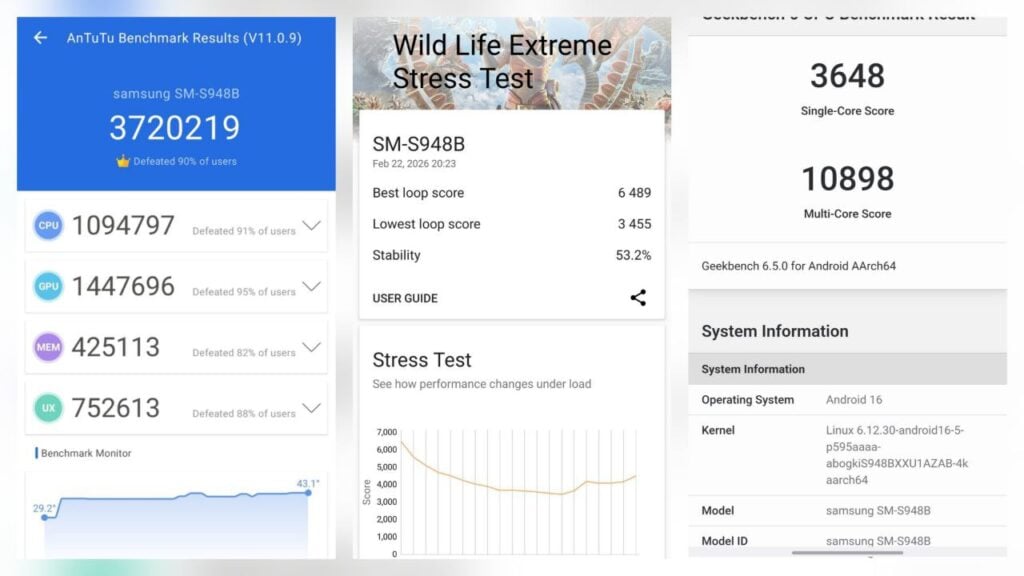
Snapdragon 8 Elite Gen 5 for Galaxy is built around Qualcomm’s 3rd-generation Oryon CPU. Qualcomm claims it is the fastest mobile CPU in the world and early performance scores justify what the company claims.
The upgraded Hexagon NPU handles on-device AI tasks, meaning personalization, image processing, and contextual features happen locally.
Nightography video
Nightography video on the S26 Ultra automatically adapts to complex lighting.
Advanced Professional Video (APV) codec
It allows users to shoot in conditions that previously crushed detail, especially under low light, and retain far more data for editing.
Photo Assist with on-device AI
Photo Assist is powered by the upgraded Hexagon NPU. You can remove background distractions, reframe shots, restore details, or apply stylistic changes in seconds.
Smooth gameplay
The chip introduces Qualcomm Adreno High Performance Memory, feeding the GPU faster and more efficiently.
Integrated Ultra Wideband (UWB)
With integrated UWB in the Snapdragon, the S26 series can enable secure, touchless transit payments and precise device location.
The Galaxy S26 Ultra is not just another annual refresh. With the Snapdragon 8 Elite Gen 5 for Galaxy, Samsung is stacking performance, AI, camera capability, gaming power, and connectivity into one tightly integrated package.
Galaxy S26 series doesn’t bring one chip worldwide as Samsung revived dual chip strategy this year, bringing Exynos and Snapdragon.
Despite being Samsung’s in-house, and technically advanced processor, Exynos 2600 lags behind the Snapdragon 8 Elite Gen 5 for Galaxy. The new Exynos, made using a 2nm process, powers nearly 25 percent of all units.
At Unpacked, Samsung confirmed that the Galaxy S26 and S26+ run the Exynos 2600 processor in several countries. Galaxy S26 Ultra launched with the Snapdragon 8 Elite Gen 5 for Galaxy chipset around the world.
Galaxy S26 and S26+ also come with Snapdragon SoC in select markets, including the US, China, and Japan. Samsung usually launches Snapdragon variants in Canada, so the Galaxy S26 may follow the suite this year.
In the rest of the world, the Galaxy S26 and S26+ will bring the Exynos chip. It includes a larger portion of the world, containing the entire European region and India.
Exynos 2600 appears to be a competitive chip, yet if you can’t settle for it, Galaxy S26 Ultra remains the only option. If you’re OK with Samsung’s chip decision, preorders are open, offering decent benefits to early buyers.
The Ultra tier stays unified on Snapdragon globally. That decision alone suggests Samsung views the Ultra customer as one who demands the most consistent, highest-performing experience regardless of geography.
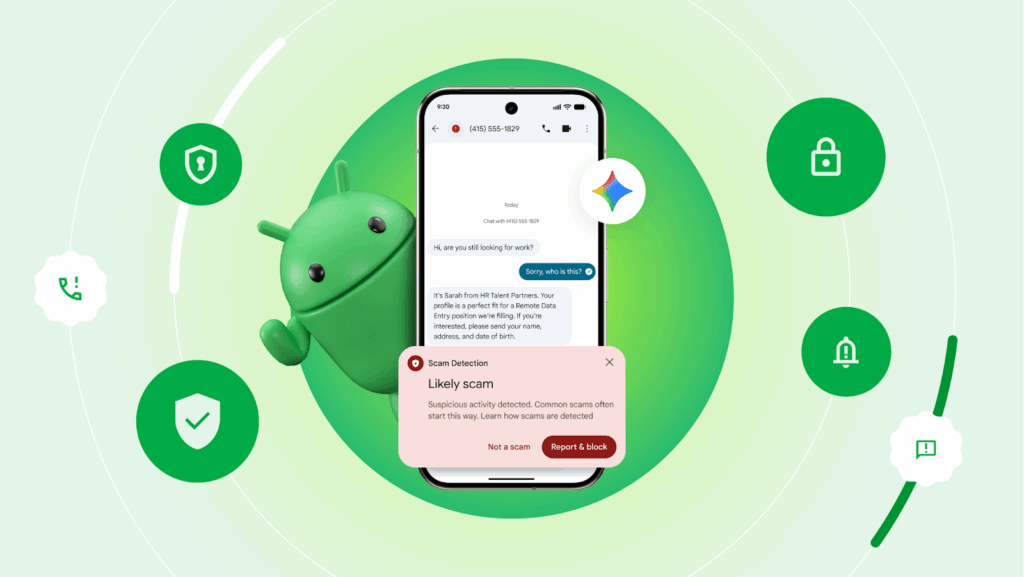
Samsung just closed a gap that mattered. Google’s Gemini-powered Scam Detection, once a Pixel talking point, is now landing on the Galaxy S26 series.
The Gemini model runs locally on the Galaxy S26’s flagship silicon, analyzing calls and messages in real time without shipping your conversations to the cloud.
On the Galaxy S26, Gemini monitors conversational cues during a call or text thread and surfaces a real-time alert if patterns match known scam behaviors. The UI integration is native to Samsung’s dialer and messaging framework.
Scam Detection is already helping millions of users to stay safe from scammers, and we are expanding this feature to more manufacturers, starting with the Samsung Galaxy S26 series in the U.S.
Interestingly, Samsung’s implementation specifically targets so-called “Pig Butchering” schemes. It also flags fraudulent job offer pitches, which have exploded across messaging platforms.
These advanced protections are now rolling out on Google Pixel 10 series and other select devices, and will be available on the Samsung Galaxy S26 series.
Source – Google
For years, Pixel users flexed this feature, but not anymore. The Galaxy S26 now positions itself as the definitive Android choice for users who value security as much as specs.
For Samsung users, this is not a minor software add-on. It is a serious security upgrade baked directly into the phone’s core experience.
Starting with the Galaxy S26 series, Samsung Care Plus is shifting away from its old repair-first mindset for replacements.
Samsung Galaxy S26 series owners in the UK are getting more than just new hardware this year. They are getting something longtime Galaxy users have quietly wanted for years: actual replacements.
If you are picking up a Galaxy S26 device, Samsung now guarantees (via AndroidAuthority) a replacement within 48 hours of you making a claim. The coverage has usually been solid on paper. The problem was always the execution.
Unless your phone was lost or stolen, Samsung would repair it at almost any cost instead of swapping it out. With the Galaxy S26 series in the UK, Samsung Care Plus now promises a replacement device within 48 hours of first contact.
Even better, the coverage travels with you. If you are abroad and something goes wrong, Samsung says it will still arrange a replacement. It turns an insurance plan into something that actually feels premium.
Right now, this improved replacement guarantee appears to be limited to the UK. We have not seen confirmation that markets like the US will get the same 48-hour replacement promise.
Well, Samsung UK has confirmed that existing Care Plus customers will start receiving these upgraded benefits over the coming months.
With mobile phones getting costlier, the importance of longer software support has also increased. Samsung just launched the Galaxy S26, S26+, and S26 Ultra flagship phones, which are secured with 7-year Android/One UI and security updates.
At Unpacked, Samsung announced its new flagships, which will go on sale starting March 11, 2026. The lineup introduces three flagship phones in different sizes. The Ultra packs a quad camera setup and some never-before-seen technologies.
The Galaxy S26 trio debuts One UI 8.5 out of the box. You get the best software from Samsung, built on the Android 16 operating system. Samsung also confirmed the Galaxy S26 family is secured with 7-year Android/One UI and security updates.
Samsung offered up to four years of OS and five years of security updates to the Galaxy S23 series, as well as the Galaxy Z Fold 5 and Z Flip 5. The company has extended the support to 7 years, applicable to the Galaxy S24 and newer flagship models.
Galaxy S25 retained the software support, and Galaxy S26 is no exception. Even if you retire your Galaxy S26 after three to four years of usage, it will stay alive with fresh security patches and regular feature drops for at least three more years.
Galaxy S26 series will join the software chart in March 2026. The flagship models will receive new security updates on a monthly basis. After five or six years, Samsung will transfer the devices to a quarterly schedule before closing its software chapter.
The Galaxy S26 is not just another spec bump; it is Samsung planting a flag for 2030. This is Samsung signaling that its premium flagship line now doubles as a proof point for how serious it is about the circular economy.
The Galaxy S26 is the latest vessel for Samsung’s long-term sustainability roadmap under its Galaxy for the Planet platform, the backbone of the MX business’ environmental push since 2021.
Under Galaxy for the Planet, the company set four major sustainability goals for 2025; all four are now complete. Samsung has now applied 10 types of recycled materials across both exterior and interior components of Galaxy devices.
The 2030 phase of Galaxy for the Planet focuses on three pillars: circularity, water stewardship and biodiversity. Samsung aims to incorporate at least one recycled material in every module of every mobile product.
“The progress we have made through Galaxy for the Planet reflects years of consistent effort across our teams and partners,” said TM Roh, CEO, President and Head of the Device eXperience (DX) Division at Samsung Electronics.
“Sustainability is central to how we operate and innovate. It informs how we design products, manage resources and create value beyond our devices. As we work toward our 2030 goals, we are expanding our commitments beyond products and operations to address broader environmental impact as we work toward our 2030 goals.”
Samsung Galaxy S26+, introduced today, is the classic middle child of the S series. Not as over-the-top as the Ultra, not as compact as the base model, but arguably the one that hits the sweet spot for those who care about balance.
Samsung Galaxy S26 Plus – 2026
Writing Galaxy S26+ specs feels a lot like the Galaxy S25+. The difference is very minor, with Samsung leaning heavily on the new camera island, modern processors, and Galaxy AI advancements powered by One UI 8.5.
Slimmer, sharper, still unmistakably Galaxy
Up front, you are looking at a 6.7-inch Dynamic AMOLED 2X panel with a 3120 x 1440 resolution and a 120Hz refresh rate. The company continues to lean into its display dominance, and on paper, this is peak Galaxy.
Protection comes courtesy of Corning Gorilla Armor 2, which Samsung says improves scratch resistance and glare control. Looking at the glass and frame, the S26+ measures just 7.3mm thick and weighs around 190 grams.
Snapdragon vs Exynos
In the US and China, the Galaxy S26+ runs on the Snapdragon 8 Elite Gen 5. That chip features a custom Oryon V3 Phoenix architecture with 2 performance cores clocked at 4.74GHz and 6 additional cores at 3.62GHz.
For US readers, the Snapdragon branding carries weight.
Europe and India get Samsung’s in-house Exynos 2600, a deca-core setup with one C1-Ultra core at 3.9GHz, three C1-Prox cores at 3.25GHz, and six more at 2.75GHz. On paper, it is a different philosophy: more cores, slightly lower peak clocks.
Whether the gap is noticeable in daily use will come down to thermals and optimization. With 12GB of RAM and storage options of 256GB or 512GB, both variants are well-equipped for multitasking, AI features, and long-term updates.
A refined triple camera setup
The camera system is led by a 50MP main sensor with a 1/1.56-inch size, f/1.8 aperture, dual-pixel PDAF, and OIS. The 10MP telephoto offers 3x optical zoom at 67mm with OIS, while the 12MP ultra-wide brings a 120-degree FOV and Super Steady Video.
The S26+ supports 8K at 24 or 30fps, 4K at up to 60fps, and 10-bit HDR with HDR10+. For creators and influencers who want flagship-grade video without jumping to the Ultra, this setup makes a strong case.
On the front, a 12MP wide camera with dual-pixel autofocus handles selfies and 4K video at 60fps.
Battery and connectivity
The Galaxy S26+ packs a 4,900mAh battery inside that 7.3mm frame. It supports 45W wired charging, along with wireless charging. Samsung is still playing it safe on charging speeds, especially when rivals are pushing beyond 100W.
Connectivity is thoroughly modern: 5G, Wi-Fi 7, Bluetooth 5.4, NFC, USB-C, and a full suite of global positioning systems, including GPS, GLONASS, Galileo, QZSS, and BDS. Dual-SIM support comes via Nano-SIM and eSIM.
Biometrics include an in-display fingerprint sensor and face recognition. Standard sensors like a gyroscope, barometer, accelerometer, and e-compass are all here.
As for the price tag, the Galaxy S26+ starts at $1,099, which firmly plants it in premium territory. Samsung Galaxy S26+ introduced today feels like a device designed for buyers who want flagship power without carrying Ultra.
Samsung launches the Galaxy S26 AI Phone at the Unpacked event. The company did not try to reinvent the Galaxy S26, but tried to perfect it.
This year, Samsung’s strategy with the Galaxy S26 is different. Make it the phone most Android users can buy without second-guessing the decision by tightening the fundamentals, pushing AI, and keeping the price at $899 (512GB costs $1,099).
Display and Design
Samsung Galaxy S26 launches with a 6.3-inch screen, a little larger than the Galaxy S25. It is a Dynamic AMOLED 2X panel with a 120Hz refresh rate and 2600 nits peak brightness. Scrolling feels smooth, and brightness is strong enough for harsh sunlight.
Scratch resistance is improved, but the anti-reflective layer is what stands out. It sounds minor until you use it daily. Samsung first introduced this solution with the S24 Ultra, which was later expanded to the S25 Ultra last year.
Samsung slapped a camera island across all S26 models. It’s inspired by the Galaxy S25 Edge and Z Fold 7. The sensor placement remains the same as the S25 series, but the vertical stack is now surrounded by a prominent bump.
Chipset
For US buyers especially, this one is about power and polish.
In the US, the Galaxy S26 runs on the Snapdragon 8 Elite Gen 5 for Galaxy, and that alone will sell a lot of units. Qualcomm’s latest silicon is clearly built with AI workloads in mind. Benefits of the modern chip include:
Apps open instantly
Games hold frame rates longer
Heat management feels more controlled
Outside the US, Samsung is using the Exynos 2600 processor, built on a 2nm process. On paper, that sounds impressive, but it’s a cautious wait-and-see. If the efficiency gains are real and thermals stay controlled, this could be a turning point.
Camera
The camera hardware looks familiar: 50MP main sensor, 12MP ultra-wide, and a 10MP 3x telephoto and a 12MP selfie snapper. It’s the same camera hardware as the Galaxy S25 series, and Samsung faced huge criticism over it.
The improvements are happening in processing. The Snapdragon chip and Samsung’s AI tuning produce better HDR balance and cleaner night shots. Low-light photos show less noise, skin tones look more natural and zoom shots hold better detail.
RAM and operating system
Samsung finally made 12GB RAM standard across all models. The Galaxy S26 feels stable under pressure, and that matters more than flashy benchmarks.
One UI 8.5, based on Android 16, leans heavily on on-device AI, and that RAM is doing real work behind the scenes. For power users, this is huge when it comes to multitasking and gaming.
Battery and charging
Samsung Galaxy S26 gains a bigger battery than the S25. The flagship phone now boasts a 4,300mAh battery, an additional 300mAh capacity. However, there’s no improvement in the charging speed, which is capped at 25W.
At $799, the Galaxy S26 sits in a sweet spot. It is not ultra-premium pricing, but it is not mid-range either.
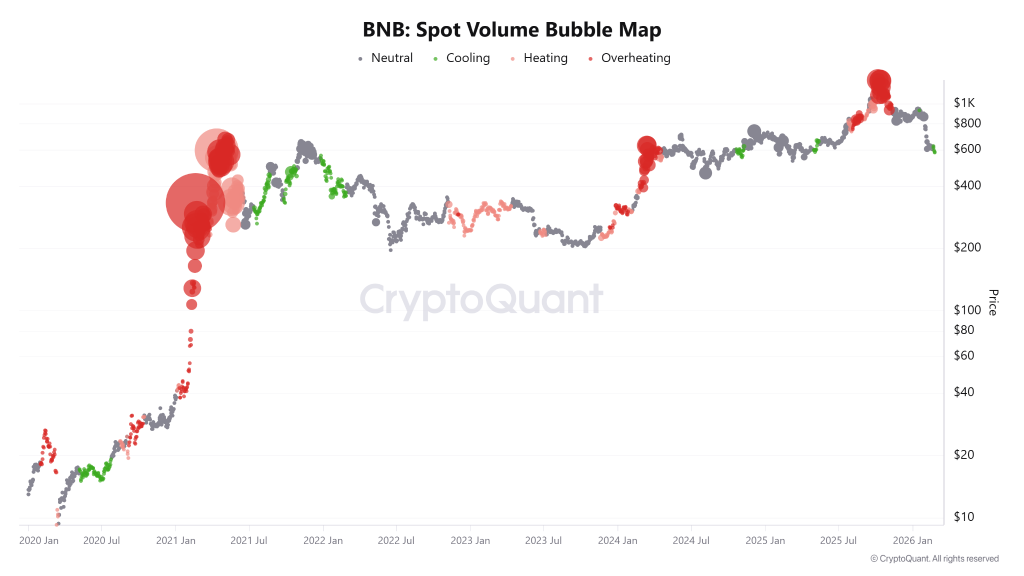
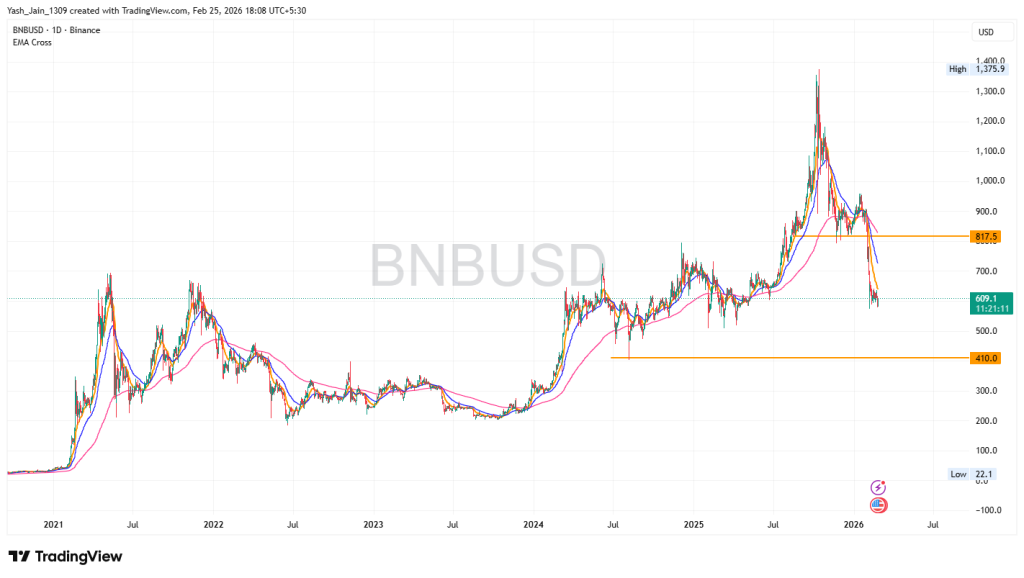
The Binance Coin BNB price is no longer riding the euphoria wave. It’s cooling fast. After what on-chain volume bubble maps clearly mark as overheating phases in both spot and futures markets, the heat has faded. And when volume cools after overheating, it usually doesn’t mean stability. It means pressure.
Right now, sell pressure is dominating the tape. Across both spot and futures volume maps, we’ve shifted from red “overheating” clusters into green cooling zones. That transition historically signals a reset phase. Every major expansion cycle begins with mild heating, accelerates into overcrowded enthusiasm, then exhausts. What follows? A neutral grind lower before quiet accumulation begins again. Similarly, we’re not in the accumulation phase yet.
Binance Coin BNB Price Stuck in Cooling Phase
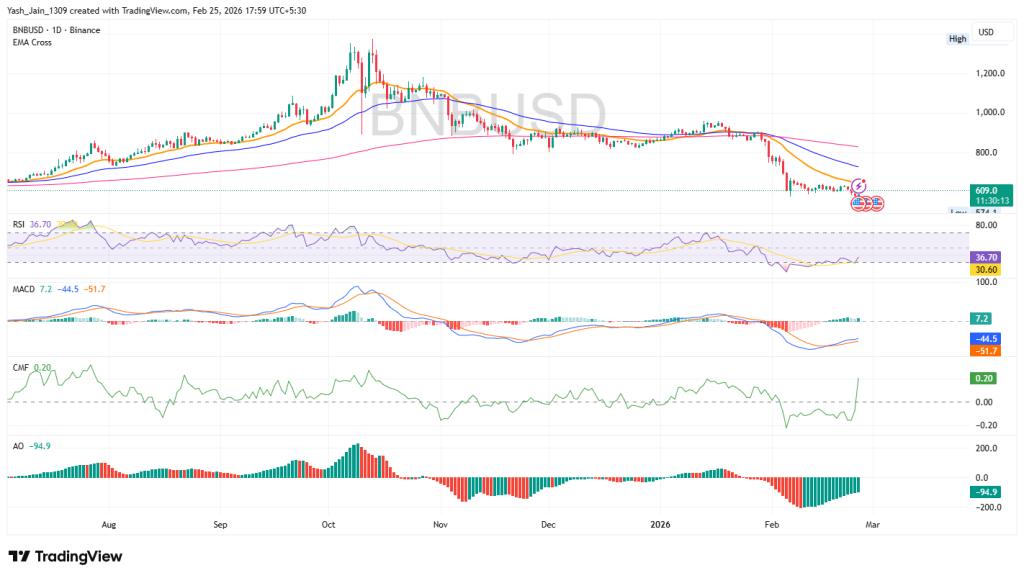
Pull up the BNB price chart and the structure confirms the message. BNB/USD has rolled over from its highs near the $1,000 region and is now trading around $609. Price sits below key moving averages, and momentum has been fading for weeks.
More telling? Volume behavior and derivatives positioning show that aggressive buyers have stepped aside. The futures average order size map reflects reduced large-scale whale aggression compared to prior peaks. Retail bursts showed up near local highs and that rarely ends well. Cooling isn’t bullish. It’s digestion at best, distribution at worst.
CMF Near Historical Reversal Zone
Now here’s the technical twist. The Chaikin Money Flow (CMF) has spiked toward the 0.20 region today a zone that historically sits between 0.20 and 0.30 where BNB has struggled to sustain upside. In previous cycles, whenever CMF pushed into that band, it marked short-term overbought conditions. What followed? Sharp downward repricing.
This doesn’t guarantee another drop. But it’s a familiar setup.
When CMF presses near its upper boundary during a cooling volume phase, it suggests temporary capital inflow against a broader weakening structure. That divergence between momentum spikes and volume exhaustion is worth paying attention to.
BNB Price Prediction: Vulnerable Structure
So, BNB price prediction for shortterm looks in red. If history rhymes, neutralization comes first. That implies more sideways-to-lower grind before a genuine base forms. The spot and futures bubble maps suggest we’re not done digesting the previous excess.
Technically, the next meaningful demand zone sits between $400 and $445. That region aligns with prior consolidation behavior and would represent a deeper reset phase if tested.
Could BNB/USD still hold above $600? Sure, the possibility is slim only if demand increases. However, the market has not yet shown convincing accumulation signals.
And until overheating cycles reset fully and volume flips back into constructive heating rather than cooling, the Binance Coin BNB price remains structurally vulnerable not broken, but certainly not ready to run.
Price prediction for 2026 suggests a potential high of $55.
Long-term forecasts indicate LINK could reach $195 by 2030.
Chainlink has emerged as a game-changing decentralized oracle network, enabling smart contracts to connect seamlessly with real-world data, APIs, and traditional financial systems. As the crypto market evolves, Chainlink’s role continues to expand, especially with its Cross-Chain Interoperability Protocol (CCIP) gaining traction. Its native token, LINK, not only powers the ecosystem but has also caught the attention of investors and analysts. As a result, institutional interest surged, leading to the launch of the LINK ETF by Grayscale in early December 2025.
With LINK price showing signs of a potential breakout and strong on-chain fundamentals backing its rise, the big question remains: Can LINK coin price hit $50 in December 2025? Let’s dive into this detailed Chainlink price prediction 2026–2030 to find out.
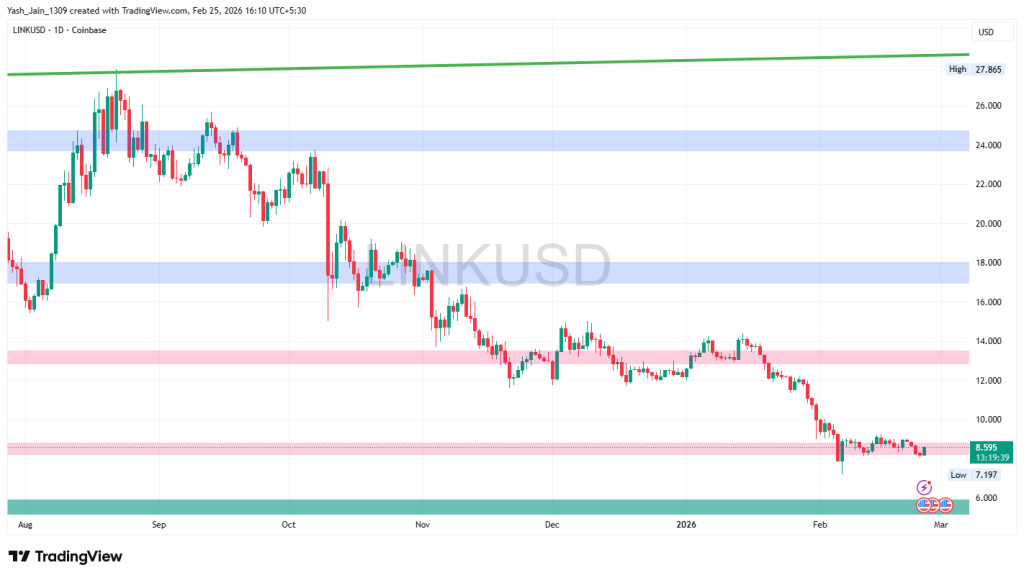
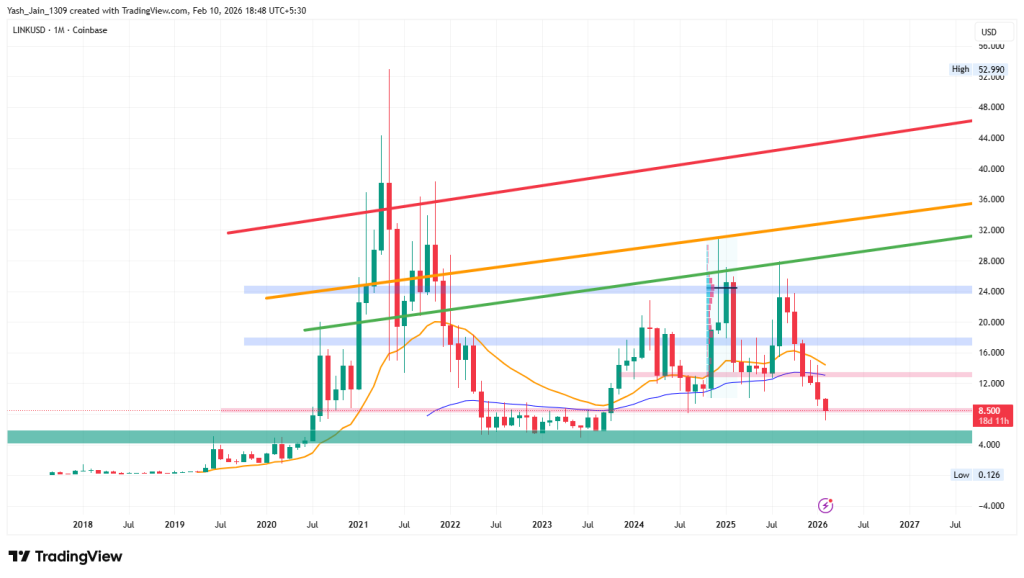
Chainlink (LINK) is currently trading at approximately $8.50. Market indicators suggest that a decline to critical support levels between $4.15 and $6.05 is quite probable should bearish sentiment increase. In the short term, there is potential for bulls to attempt a rally toward the $12 or $15 range. However, sustained bearish pressure could result in a return to the lower price range.
Chainlink Price Targets March 2026
In early January, the LINK price struggled to hold $13, and by mid-January it had dropped to $7, only to rise again by early February. Since then, it has been consolidating around $8.50 as a pivot for the whole of February.
Now, what happens in March depends entirely on the strength of the bulls. If this consolidation is a sign of accumulation and demand, it can establish this level as support; a rise back to $12 or $15 may also be possible. Conversely, if it fails to hold above $8.50, the price could fall to the last line of defense, which is between $4.15 and $6.05.
Chainlink Price Prediction 2026
The weekly chart highlights an important price range for Chainlink (LINK) between $4.15 and $6.05. For many years, this range has provided crucial support, preventing the price from declining further.
In 2023, the price surged from this range, reaching a high of $31 by late 2024. However, bearish market conditions took over, leading to a consistent decline from 2025 onward. Early 2026 continued this downward trend, with the price now struggling around $8.50.
This support level is significant in the short term, as a reversal from this point could lead to a retest of the $12 or $15 levels. Historically, prices do not drop straight down without a challenge from bullish investors. However, if selling pressure remains strong and demand fails to meet expectations, the price may approach the $4.15 to $6.05 demand area again.
Looking ahead, the Chainlink price prediction for 2026 indicates the potential for a significant price surge similar to the explosive rally observed in 2020. Analysts suggest that if momentum and market sentiment align positively, the price could see a reversal, but it would take time to process that kind of price action.
Year
Potential Low ($)
Potential Average ($)
Potential High ($)
2026
35
50
55
Chainlink On-Chain Analysis
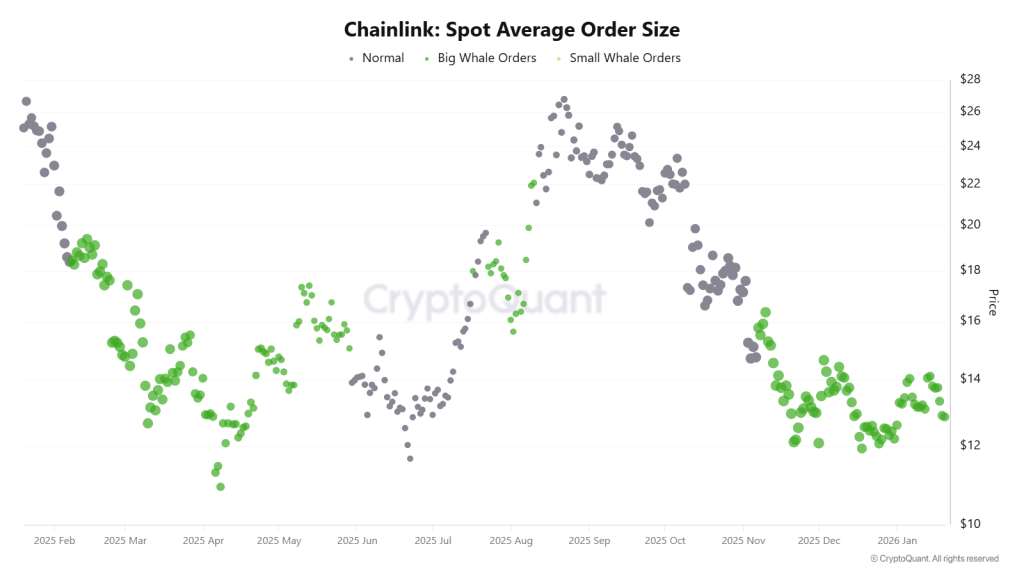
In the LINK on-chain metrics, both spot and futures markets are clearly exhibiting a Taker Buy-Dominant phase. It shows that buyers are actively executing at market prices without waiting for pullback opportunities. This is simply a strong sense of conviction rather than speculative strategies.
Additionally, the Average Order Size in both the spot and futures markets has escalated into the “Big Whale” category. This shift signals the involvement of institutional participants, who significantly influence LINK’s market structure, rather than retail trading flows.
Chainlink Price Targets 2026 – 2030
Year
Potential Low ($)
Potential Average ($)
Potential High ($)
2026
35
50
55
2027
48
64
80
2028
58
85
104
2029
70
108
141
2030
85
147
195
This table, based on historical movements, shows Chainlink price to reach $195 by 2030 based on compounding market cap each year. This table provides a framework for understanding the potential LINK price movements. Yet, the actual price will depend on a combination of market dynamics, investor behavior, and external factors influencing the cryptocurrency landscape.
LINK Crypto Price Forecast 2026
As per Chainlink’s Price forecast for 2026, the high price could be $55, the low may reach $35. This makes the average around $50.
LINK Price Prediction 2027
Moving to 2027, the LINK Price projects that it might hit a high price of $80 potentially. With a $48 low and an average of $64.
Chainlink Price Analysis 2028
Moving to 2028, the Chainlink Price Forecast predicts a high price of $104. On the flip side, the low may fall to $58, and the average is projected to be around $85.
LINK Coin Price Prediction 2029
As per Chainlink Price Forecast 2029, LINK’s high price is predicted to be $141, with a low of $70 and an average of $108.
Chainlink Price Prediction 2030
Finally, as per the Chainlink Price Forecast 2030, LINK’s price can reach a high price of $195. With a low of $85 and an average of $147.
Market Analysis
Firm Name
2026
2030
Changelly
$25.83
$140.70
coincodex
$6.44
$14.79
Binance
$18.43
$22.40
Mitrade
$32.22
$139.2
Investing Haven
$54.10
$80
Flitpay
$62.6
$110
*The aforementioned targets are the average targets set by the respective firms.
Never Miss a Beat in the Crypto World!
Stay ahead with breaking news, expert analysis, and real-time updates on the latest trends in Bitcoin, altcoins, DeFi, NFTs, and more.
FAQs
How much is Chainlink worth?
At the time of writing, the value of one LINK crypto token was $ 9.49016475.
What is the price prediction for Chainlink in 2026?
Chainlink price prediction for 2026 suggests LINK could trade between $35 and $55, with an average price near $50 under bullish conditions.
How much will 1 Chainlink be worth in 2030?
By 2030, 1 Chainlink could be worth between $85 and $195, depending on adoption, market cycles, and long-term crypto growth.
Where will Chainlink be in 5 years?
In five years, Chainlink is expected to be a core Web3 infrastructure, with broader adoption and a potential price range of $80–$140.
Is Chainlink a good long-term investment?
Chainlink is considered strong long term due to its real-world utility, oracle dominance, institutional adoption, and expanding cross-chain ecosystem.
What factors influence Chainlink price predictions?
LINK price is driven by oracle demand, CCIP adoption, staking growth, institutional interest, crypto market cycles, and global liquidity trends.
Analysts predict PEPE could reach $0.0000539 by 2026.
Long-term forecasts suggest potential highs of $0.0002733 by 2030.
Pepe Coin (PEPE), the memecoin inspired by the iconic frog meme, has rapidly become a standout in the crypto world. Ranked just behind Dogecoin and Shiba Inu, PEPE’s explosive rise—boasting gains of over +130325085.96% from its all-time low—has captured investor attention globally.
As it maintains its position among top memecoins, many are now asking: Will PEPE price go parabolic by the end of 2025? In this article, explore CoinPedia’s in-depth PEPE coin price prediction for 2025, and discover long-term forecasts that look ahead to 2030.
The price of PEPE has encountered difficulties due to insufficient liquidity and cautious investor sentiment, a trend that appears to have carried into the first quarter of 2026. A price increase may be feasible in the remaining period of Q1 2026, contingent on the introduction of new capital into the market, particularly in light of the recent narrowing of the PEPE/USD trading range. Conversely, should this capital influx fail to materialize, a decline towards $0.00000120 may be anticipated.
PEPE Price Prediction 2026
PEPE’s price has struggled in Q4 2025 due to low liquidity and cautious investor sentiment. This has continued in January 2026, and February is following that cautious investor, too.
The broader market is in an extreme fear phase, and prices are collapsing. However, if new capital flows in, a price rise is likely in the rest of Q1 2026, as this outlook is supported by a tightening trading range, which indicates a potential breakout more than ever. The PEPE price has faced challenges for several months, falling short of the expectations set by experts and investors alike, primarily due to an overarching risk-off sentiment within the memecoin space.
However, it’s essential to acknowledge that the current low market liquidity and cautious investor behavior have kept new capital on the sidelines amid a series of bearish trends.
Nevertheless, it is also a fact that entering the crypto market through memecoins remains one of the most accessible and easiest methods available. Therefore, should new liquidity begin to flow in, we can undoubtedly anticipate a bigger rise in PEPE’s price. Q1 2026 stands out as an ideal timeframe for this potential resurgence, and the compression of the falling wedge shows compression of the trading range that confirms the effectiveness and reliability of these trendlines that have been containing the price of PEPE since 2025, and the odds of a rally to pop out soon have greatly risen.
But, if it fails and collapses, then a decline toward $0.00000120 is expected, where we saw a rally sprouting back in early 2024.
PEPE On-Chain Outlook
As per the metric “90-day Spot Taker CVD”, the cumulative difference between market buy and market sell volumes has turned positive and is increasing, indicating that high-conviction traders are aggressively market-buying PEPE rather than waiting for passive fills at lower prices.
This aggressive participation is a hallmark of a robust accumulation phase, in which market demand begins to outpace available liquidity, often serving as a precursor to a volatile price expansion.
Given that similar green clusters on the historical chart preceded significant rallies in mid-2024 and mid-2025, the current uptick suggests that “smart money” is positioning for a major move as the asset stabilizes near its current support levels in January 2026.
PEPE Price Prediction 2026 – 2030
Year
Potential Low ($)
Potential Average ($)
Potential High ($)
2026
0.0000179
0.0000359
0.0000539
2027
0.0000269
0.0000539
0.0000809
2028
0.0000404
0.0000809
0.0001214
2029
0.0000607
0.0001214
0.0001822
2030
0.0000910
0.0001822
0.0002733
This table, based on historical movements, shows PEPE price to reach $0.0002733 by 2030 based on compounding market cap each year. This table provides a framework for understanding the potential PEPE price movements. Yet, the actual price will depend on a combination of market dynamics, investor behavior, and external factors influencing the cryptocurrency landscape.
Pepecoin Price Forecast 2026
Our PEPE price prediction suggests that the price of PEPE in 2026 might range between $0.0000179 and $0.0000539, with the average price of the meme coin at $0.0000359.
Pepe Coin Price Prediction 2027
For 2027, we predict that the price of PEPE could range between $0.0000269 and $0.0000809, and the average price of the meme coin is expected to be around $0.000539.
Pepecoin Price Targets 2028
As per our Pepe Coin Price Prediction, in 2028, the price could range between $0.0000404 to $0.0001214, with the average price of the meme coin at $0.0000809.
Pepecoin Price Projection 2029
For 2029, the price of PEPE could range between $0.0000607 and $0.0001822, with the average price of the meme coin expected to be around $0.0001214.
Pepe Coin Price Prediction 2030
Based on our Pepecoin price forecast, the price of PEPE in 2030 might range between $0.0000910 to $0.0002733, with the average price of the meme coin predicted to be around $0.0001822.
PEPE Coin Market Analysis
Firm Name
2026
2030
Changelly
$0.0020
$0.015
CoinCodex
$ 0.000026
$ 0.000047
Binance
$0.000014
$0.000017
Never Miss a Beat in the Crypto World!
Stay ahead with breaking news, expert analysis, and real-time updates on the latest trends in Bitcoin, altcoins, DeFi, NFTs, and more.
FAQs
How much is Pepe coin worth?
The current price of Pepecoin is $ 0.00000416.
What factors could drive PEPE’s price growth in the coming years?
PEPE’s price depends on meme coin market sentiment, liquidity inflows, social media trends, and broader crypto cycles rather than fundamentals alone.
Is PEPE a high-risk investment compared to other cryptocurrencies?
Yes. As a meme coin, PEPE is highly volatile and sentiment-driven, making it riskier than utility-based cryptocurrencies with real-world use cases.
How does PEPE compare with Dogecoin and Shiba Inu?
PEPE competes mainly on community hype and trading momentum, while DOGE and SHIB benefit from longer histories and broader ecosystem support.
What is PEPE price prediction for 2026?
PEPE could trade between $0.0000179 and $0.0000539 in 2026, depending on meme coin demand, liquidity inflows, and overall crypto market momentum.
What is PEPE price prediction for 2027?
In 2027, PEPE may range from $0.0000269 to $0.0000809 if bullish sentiment and retail participation remain strong across meme coins.
What is PEPE price prediction for 2028?
PEPE’s price in 2028 could move between $0.0000404 and $0.0001214, driven by broader market cycles rather than project fundamentals.
What is PEPE price prediction for 2030?
By 2030, PEPE could reach up to $0.0002733 in optimistic scenarios, though prices will remain highly sensitive to market sentiment and risk appetite.
Analysts project Dogecoin could reach $0.75 to $1.25 by the end of 2026.
Long term projection highlights that by 2030 it could even reach the $3 mark.
Dogecoin, the original meme coin, has cemented its status as a crypto legend. Known for its viral appeal and a fiercely loyal community, it continues to capture headlines and investor interest. Following Donald Trump’s election win, speculation around a potential Dogecoin ETF fueled a surge in optimism.
Now, that speculation has become a reality. With the September 18 launch of the REX-Osprey DOGE ETF, trading under the ticker DOJE and carrying a 1.5% fee, the path has been cleared for institutional access. This groundbreaking debut makes it the first U.S.-listed spot ETF for Dogecoin and significantly raises the odds for similar approvals from major players like Bitwise and Grayscale before year-ends.As growing optimism and increasing adoption reshape the market, traders are asking: “Will Dogecoin go back up?” and “Can DOGE hit $1?” In this article, we dive into a detailed technical analysis and a long-term Dogecoin price prediction 2025 to 2030.
The DOGE price continued its decline in January and In February, it retested the downward trendline after breaking below $0.10, but from mid-February onward, it experienced a brief bounce.
For a trend reversal to occur, it must surpass the key resistance level of $0.1380. If it falls below $0.0810, it could drop to the range of $0.055 to $0.060.
Dogecoin Price Prediction 2026
In January, the price consistently declined on the weekly chart, continuing where 2025 left off. Now, in February, it has retested the downward trendline after breaching the $0.10 support area. However, the dynamic support trendline has acted as a sturdy support that gave it a brief bounce to $0.1170 but still trades under $0.10 when short-term bullish momentum faded.
Since bullish demand is reacting at this level, the odds suggest that this long-term monthly decline could be flipped only if a certain level is knocked down to signal a change in trend, like $0.1380.
If it regains its footing above this area, then by the rest of Q1’s remaining days, a retest of $0.2000-0.2200 range could be possible.
But, at this point, if DOGE loses the 0.0810 point of contact of its support taken in February, which is knocked down, then it will end up retracing towards the support area of $0.055-$0.060, a range that previously contributed to a substantial rise in late 2023.
Year
Potential Low ($)
Potential Average ($)
Potential High ($)
2026 (conservative)
0.10
0.39
1.00
DOGE On-Chain Outlook
Despite the price facing challenges after peaking at $0.46 in late 2024 and then falling, 2025 is a very tough year for its investors. But the total number of holders has surged to an impressive 8.17 million, indicating strong investor accumulation.
Similarly, large holders are showing strategic accumulation patterns that suggest bullish sentiment. While the number of retail holders holding between 10 and 10,000 coins has been declining, those holding between 100 million and 1 billion coins continue to increase, reinforcing a positive outlook for the asset.
Dogecoin Price Prediction 2026 – 2030
Year
Potential Low ($)
Potential Average ($)
Potential High ($)
2026
0.75
1.00
1.25
2027
1.15
1.35
1.50
2028
1.25
1.75
2.00
2029
1.50
2.15
2.65
2030
2.50
2.75
3.00
This table, based on historical movements, shows DOGE price to reach $3 by 2030 based on compounding market cap each year. This table provides a framework for understanding the potential DOGE price movements. Yet, the actual price will depend on a combination of market dynamics, investor behavior, and external factors influencing the cryptocurrency landscape.
The Ethereum price is bleeding, and now the on-chain data is flashing something interesting, maybe ominous. Unique ETH deposit addresses on Binance have surged from around 360K to over 450K, the highest level since August 2025. That’s not subtle. And it’s happening while ETH/USD is clinging to the $1,900 zone after a brutal drop from October’s $4,900 peak.
Ethereum Price Chart Looks Heavy
Pull up the Ethereum price chart and it’s not exactly screaming recovery. Price is trading below the 50, 100, and 200-day dynamic EMA bands. Lower highs, lower lows. RSI hovering near oversold but without a convincing bullish divergence. MACD and AO still stuck in bearish territory.
Simply put, the trend is down. The recent breakdown below $2,000 was a psychological line in the sand and its break is what accelerated the slide. Structurally, this remains a confirmed downtrend. Conditions are stretched, sure. But oversold doesn’t mean reversal. It just means pressure has been relentless.
So when the Ethereum price is falling and exchange deposit addresses explode higher, that’s not background noise.
Panic Mode or Margin Defense?
Here’s where it gets interesting. A surge in unique deposit addresses usually signals one thing: people are moving coins to an exchange to sell. Retail capitulation is the obvious narrative. Investors who held through the first leg down may finally be throwing in the towel, locking in losses, and exiting spot positions.
But let’s be real, it’s not always that simple. Given the steep drop below $2,000, a chunk of those deposits could be margin top-ups. Derivatives traders defending long positions, scrambling to avoid liquidation. When ETH/USD falls fast, collateral flows spike. It’s mechanical. Brutal. But most importantly Necessary to save positions. Either way, supply on Binance increases. And that tends to mean volatility.
In the short term, elevated deposits translate to potential selling pressure. That doesn’t disappear overnight. If deposit activity stays high and price continues making lower lows, we’re likely looking at another capitulation leg.
But, historically, extreme spikes in exchange deposit activity often cluster near exhaustion phases. When everyone who wants out has moved their coins, there’s simply less forced selling left.
Now, the best preservation of capital is to not enter any unsafe trades, so it’s best to look for changes in a few metrics which can hint for a reversal like declining deposit activity, exchange outflows rising, RSI divergence, and a reclaim of the 50-day EMA with real volume. Until then, the Ethereum price remains in a late-stage downtrend stretched, volatile, and sitting in what looks like an inflection zone.
FAQs
Why is the Ethereum price dropping so much?
Ethereum’s price is falling due to a confirmed downtrend, trading below key moving averages, and surging exchange deposits which typically signal increased selling pressure.
Is it safe to buy Ethereum when the RSI is oversold?
An oversold RSI suggests heavy pressure but doesn’t guarantee a reversal. Smart investors wait for confirmation like bullish divergence or a reclaim of key EMAs before buying.
Will Ethereum bounce back from the $1,900 support level?
A bounce is possible, but the current structure shows lower highs and lows. A sustained recovery requires decreasing exchange inflows and a breakout above the 200-day EMA.
Samsung will reveal the Galaxy S26 series today, and a last-minute leak has just brought big news. Samsung’s Galaxy S26 series supports iPhone AirDrop sharing through Quick Share, a feature previously limited to Pixel phones.
Google introduced an upgraded Quick Share that lets Pixel 10 users share files with iPhones. After a brief exclusivity, the feature was expanded to the Pixel 9 series.
A screenshot, featuring Samsung aesthetics, spotlights the AirDrop-Quick Share compatibility. It clearly shows that Quick Share on Galaxy S26 now allows users to share with iPhones, iPads, Macs, and other devices that support AirDrop. Credit – @chunvn8888
The interface also contains a quick tutorial that assists users in sending and receiving files.
Send to an Apple device
Make sure the recipient has AirDrop set to Everyone. This makes their device visible so you can send files to it.
Receive from an Apple device
Tap Quick Share in the quick panel. This makes your phone visible so Apple devices can send files to it.
While Share with Apple devices is turned on, your phone may temporarily disconnect from Wi-Fi networks while searching for or sharing with Apple devices.
Source – @chunvn8888/X
Apple, so far, remained silent on this strike on its AirDrop platform. The company might patch the loophole that led Google to realize this support. Well, Galaxy S26 users will be able to share files across Android and iOS devices.
It was widely anticipated that Samsung would also introduce the upgraded Quick Share at the Unpacked event. As expected, the Galaxy S26 series brings support for iPhone AirDrop via Quick Share, and it’s a game-changer.
Apple has made it pretty complicated to share files across operating systems. Google found a trick that bridged the gap and unlocked sharing. The feature is now expanding to Galaxy phones after being exclusive to Pixel.
Samsung takes another shot at Apple iPhone in a new Galaxy S26 Nightography teaser. This follows the clip, in which Samsung roasted Apple iPhone’s editing limits. The latest jibe is now at the nighttime camera capabilities.
In a clip posted by SamsungMobileUS on X, Samsung shows a lady capturing the moment when a man presents a ring to his partner. The clip shows they are posing again and again because the iPhone isn’t taking a good picture.
“Feeling left in the dark?”
The 15-second clip shows two back-to-back shots, with the couple and the other lady are seen uncomfortable as the moment is pretty precious, and it’s getting ruined because of the limited night camera capabilities of iPhone.
“Get ready for next level of Nightography”
The latter part teases “next level of Nightography.” With this term, Samsung confirmred low light camera improvements of the Galaxy S26 series. The enhancements are made by new algorithms, software, and artificial intelligence.
Source – SamsungMobileUS/X
Like before, Samsung has used an older version of the iPhone, which boasts a squarish camera module on the back with three sensors. It’s a Pro or Pro Max model, and strategic as well as iPhone 17 Pro has improved the camera game.
Galaxy S26 Ultra leaks are about to reach the “disaster” level, and it seems Samsung has launched an internal investigation. Samsung partners have broken the NDA terms by opening an early sale of the unreleased flagships.
It started with a Dubai-based retailer, which started selling the Galaxy S26 Ultra African units earlier this week. It led the device to be completely exposed in hands-on, unboxing, and first impression videos on the web.
Over the past days, we’ve seen the real Galaxy S26 Ultra leaks, with videos exposing its design, camera, charging, and benchmarks, Privacy Display, build and literally everything.
Samsung has already started sending DMCA to creators publishing Galaxy S26 Ultra videos before its official launch. An internal investigation has also launched, via IceUniverse, with TM Roh worried about the Galaxy S26 Ultra leaks.
Well, it’s too late, and the damage has been done. Samsung has nothing left to secure now, and the Unpacked is going to be a formal presentation. Real looks at the most anticipated device are already available on X and YouTube.
Samsung has no control over its software and hardware departments when it comes to securing them from early exposure. Power users are already using One UI 9, even when the entire fanbase is waiting for One UI 8.5.
Galaxy S26 Ultra joined a similar stream because of some sellers. It has reached the hands of creators and influencers. It’s not about blaming creators who exposed the device, but Samsung and its sellers are to blame.
It’s your last chance to reserve the Galaxy S26 series to secure the reservation bonus. Unpacked is almost here, and the reservation link expires soon. If you haven’t completed the registration, do it now as it’s completely free.
Reserving the next Galaxy doesn’t require any payment in the US. You just need to fill out a basic form for registration. It’s a “reserve now, think later” offer that doesn’t mandate a purchase if you’ve reserved the next Galaxy.
Galaxy S26 reservation bonus includes four key benefits. It includes a flat $30 free credit as well as a higher trade-in value, $150 without trade-in, and entry into a hefty giveaway. Here are the key benefits of reservation:
$30 Samsung Credit
$150 in savings
Up to $900 trade-in benefits
$5,000 giveaway
Beyond that, the “reserve” promo also ensures buyers have early access to the devices by priority delivery, an opportunity to purchase exclusive colors available on samsung.com, and enhance trade-in value upon their devices.
Samsung is launching the Galaxy S26 series, Buds 4, and Book 6 series. Filling out one reservation form secures benefits across products. The company has already revealed the price and availability of its latest Galaxy Book laptops.
Details of the Galaxy S26 and Buds 4 series will be shared at the event. The new Galaxy gadgets are set to go on sale on March 11.
Nearly 14 hours left in Unpacked and the reservation campaign as well. Samsung is setting up the Palace of Fine Arts to unveil the new products. It’s an in-person event, but you can also join the official livestream on YouTube.
Samsung picked the same venue as the Galaxy S20 series for the Galaxy S26 series launch at an Unpacked event in San Francisco.
Reports emerging from South Korea, via Chosun, reveal that Samsung is launching the Galaxy S26 series at the Palace of Fine Arts in San Francisco, California.
Built for the 1915 Panama-Pacific International Exposition, the Palace of Fine Arts is one of San Francisco’s iconic cultural landmarks. Now, the historic building serves as a multi-purpose arts venue hosting a variety of events.
The event venue has received an Unpacked makeover. Access is currently prohibited by security personnel, who are stationed around the venue to control access.
A simple sign reading that reads “Galaxy Unpacked 2026” has been installed on the building’s outer wall. Samsung will kick off the Unpacked event nearly 15 hours later.
Nearly six years ago, Samsung launched the Galaxy S20 series and its first Flip phone. The Unpacked event was held in San Francisco, and the venue was the Palace of Fine Arts, a historic landmark.
Experience zone
Samsung has also set up an experience zone inside the venue. It will offer visitors a hands-on experience of the newly unveiled products. Galaxy S26’s upgraded camera and Galaxy AI capabilities are in the spotlight.
Samsung will announce the Galaxy S26 series and Buds 4 series. With the Palace of Fine Arts as the venue, fans around the world can join the event livestream. The products will be available for purchase starting March 11.
Samsung has an updated LockStar version for One UI 8.5 devices, which carries a new unlock animation and functional enhancements.
With its One UI 8.5 refresh, Samsung LockStar gained some serious upgrades for the unlock animation segment. Now, the company is expanding the directory with a new addition called “Swirl,” and it’s ready to refresh your lockscreen.
Samsung enthusiast TarunVats showcased the new Swirl unlock animation in action. Unlocking the device using biometrics or PIN launches the transition that takes you to the home screen through a quick swirl animation effect.
Source – TarunVats/X
Additionally, the LockStar update improves manual brightness range for Full screen AOD. It’s a major feature of the Galaxy S25 series, which is gaining functional-level improvements to elevate the user experience.
Samsung specifically noted the enhancements provided to the status bar visibility. Galaxy users can expect even clearer status bar visibility while editing the unlock animation. Here’s the changelog of the LockStar update:
Adjusted manual brightness range for Full screen AOD
Added “Swirl” type to Unlock animation
Improved status bar visibility in Unlock animation edit screen
The updated LockStar is available on Galaxy Store.
One UI 8.5 is currently available on the Galaxy S25 series, that too on the Beta channel. The software is set to be officially revealed tomorrow. Samsung is expected to open the Stable One UI 8.5 rollout following the S26 series sale.
EU energy labels for the Galaxy S26 series have surfaced less than 36 hours before launch, and they reveal something few expected: better efficiency, but potentially weaker long-term battery health than the Galaxy S25.
The labels, obtained by Ytechb, cover the full lineup: the Galaxy S26, S26+, and S26 Ultra. They outline energy efficiency, endurance per cycle, repairability, durability ratings, and battery lifespan under the EU’s standardized testing framework.
Moving from 2000 cycles to 1200 cycles represents a reduction in long-term battery longevity. For users who keep their phones for four or five years, cycle count matters as it impacts how quickly battery capacity degrades over time.
The labels list battery endurance at 1200 charge cycles before dropping to 80 percent health. The Galaxy S25 series and several other recent Samsung devices were rated for 2000 charge cycles to reach that same 80 percent threshold.
More from EU label
On paper, the efficiency story looks strong. All three models carry an A-class energy efficiency rating. That puts them among the most power-efficient phones under the EU system. The standardized battery endurance test shows:
Galaxy S26: 51 hours, 4,175mAh battery
Galaxy S26 Plus: 55 hours, 4,755mAh battery
Galaxy S26 Ultra: 55 hours, 4,855mAh battery
Those are solid numbers, especially considering the battery sizes are not dramatically larger than previous models. If the labels are accurate, Samsung has squeezed more usable time out of similar capacity cells.
All three devices are rated A for repeated free-fall reliability. The lineup carries an IP68 certification, meaning they are fully dust-tight and can survive submersion in up to 3 meters of fresh water for at least 30 minutes.
The Galaxy S26 series reportedly earns a C grade for repairability, suggesting moderate difficulty for component replacement. With launch day just hours away, official confirmation is close.
Samsung just posted a 15-second clip that might go down as one of the sharpest pre-Unpacked jabs in recent memory. With the fresh Galaxy S26 teaser, Samsung roasts Apple and the photo editing limits of its iPhone and iOS.
The ad opens on a woman, carrying an iPhone, complete with the aged notch design and squarish camera setup on the back. The irony is that Samsung refrained from using the recent iPhones, which fully adopted Dynamic Island.
She is trying to erase her ex from a photo. Tap, smudge, and try again. The results look half-baked; ghosting artifacts everywhere. The message is clear: Apple’s so-called Object Removal is still playing catch-up.
The phrase Can your phone do that is clever because it avoids naming Apple. In the context of the iPhone 17 cycle and the broader iOS 26 AI push, it reads like a challenge.
Samsung is framing Apple as safe, controlled, and limited. Meanwhile, Galaxy AI is being positioned as creative, expressive, and even a little chaotic in the best way.
The Galaxy maker has done this before, but this time it feels more surgical. Using an actual iPhone as the prop is not accidental, but a direct shot at Apple’s ecosystem lock-in strategy.
AI Object Eraser
Object removal is not new. Samsung has had Object Eraser in the Gallery for years. What this teaser signals is a serious upgrade.
Apple’s Clean Up tool in recent iOS builds handles basic object removal. It runs largely on devices and struggles with complex backgrounds.
Samsung owned the 2025 market in Europe, and the Galaxy was the region’s top-selling phone. Apple gained an upper hand in the fourth quarter, given the iPhone 17’s release, but the thunder didn’t help much against Samsung.
According to Omdia, the European smartphone market declined by 1% in 2025 to 134.2 million units. Samsung led Europe mobile phone market in 2025, and Galaxy A56 was the region’s top-selling smartphone.
Samsung remained Europe’s largest smartphone vendor in 2025, with shipments marginally growing to 46.6 million units. Apple grew 6% to 36.9 million this year, reaching a record-high 27% market share in Europe.
Europe’s bestseller belonged to Samsung, but the situation was entirely different in the US. Apple iPhones remain the top-selling phone stateside. Samsung manages to get its Galaxy A1x model ranked in the top 10 chart.
Xiaomi ranked third with 16% market share as it declined 1% to 21.8 million units. Motorola remained fourth despite declining 5% to 7.7 million units. HONOR climbed into Europe’s top five as it grew 4% to 3.8 million units.
Europe’s five largest smartphone vendors continued to gain combined share, reflecting the importance of scale for long-term success in the region.
According to Runar Bjorhovde, Senior Analyst at Omdia:
In 2026, concerns around memory pricing have created a challenging outlook. In Europe, which made up just 10.8% of all smartphones shipped worldwide in 2025, the biggest question is which vendors are most likely to prioritize the region if hit by price increases or supply shortages.
The Galaxy S25 series was a hit in 2025, and Samsung is on the verge of releasing its successor lineup. This article tracks the complete specifications of the Samsung Galaxy S26 Ultra smartphone, based on leaks and reliable inputs.
Samsung is set to launch the Galaxy S26 Ultra on February 25, 2026, but the specifications mentioned in this article may change. For now, do not take this information as a confirmed spec or feature of the upcoming device.
Quick Look: What the rumors say
Launch date: February 25 in San Francisco
Availability: Starting March 11
Processor: Snapdragon 8 Elite Gen 5 for Galaxy (TSMC 3nm)
RAM: LPDDR5X RAM (Faster 10.7Gbps)
Display: 120Hz refresh rate, 2600 nits brightness, and a new Privacy Display feature (Flex Magic Pixel technology)
Camera: 200MP main, 50MP ultrawide, 50MP 5x periscope and a 10MP 3x telephoto
New Feature: The most exciting feature is the “Privacy Display” technology based on “Flex Magic Pixel.”
Performance
Galaxy S26 Ultra uses Snapdragon 8 Elite Gen 5 for Galaxy, a chipset tailored for Samsung flagships. The chip will be manufactured using TSMC’s 3nm process technology, offering significant gains in CPU, GPU, and especially NPU.
A key rumor indicates the S26 Ultra will be one of the first phones to use new LPDDR5X RAM clocked at 10.7Gbps. This is a substantial speed bump from the 8.5Gbps RAM in the S25 Ultra, offering various improvements.
Images: Samsung Galaxy S26 Ultra AnTuTu, 3D Mark and Geekbench test results
Camera
Samsung’s Galaxy S26 Ultra is expected to be paired with:
A 200MP Wide (primary) sensor with f/1.4 aperture.
A 50MP Ultrawide lens (1/2.52-inch sensor size).
A dual-telephoto system.
The device may use a new telephoto camera with 10MP resolution, trimmed down from a 12MP lens, featuring 3x optical zoom at a 1/3.94-inch sensor size, smaller than the Galaxy S25 Ultra’s 1/3.52-inch image sensor.
Additionally, the Galaxy S26 Ultra will have a 50MP periscope with a 1/2.52-inch sensor size. This camera will offer 5x optical zoom capabilities and enhanced light intake as compared to its predecessor, the S25 Ultra.
The bigger punch-hole:
Recent rumors suggest it will stick with a 12MP punch-hole but will make the cutout larger. This is allegedly to house a new lens with a wider 85-degree field-of-view (up from 80), allowing for better group selfies.
Battery and charging
This is the upgrade users have been requesting for years. Samsung isn’t bringing a capacity upgrade to the Galaxy S26 Ultra. The battery will remain 5,000mAh, but the wired and wireless charging will upgrade to 60W and 25W, respectively.
Disclaimer: This is an Article Based on Leaks and Rumors
The information presented in this article is based on early leaks, supply chain rumors, and industry analyst speculation circulating as of February 23, 2026.
Samsung officially announced Galaxy Book6 prices and release date in the US. The company also revealed that its latest laptops will join the unveiling of the Galaxy S26 and Buds 4 series at the February 25 Unpacked event.
The Galaxy Book6 lineup introduces three models: Galaxy Book6, Book6 Pro, and Book6. The laptops feature Galaxy AI, incredible performance, and a symmetric and sleek design.
The latest laptops are crafted to be slim while retaining a premium feel. Both Galaxy Book6 Pro and Galaxy Book6 Ultra boast a notably slimmer profile, measuring just 11.9mm and 15.4mm, respectively.
Galaxy Book6 US prices and release date revealed
Samsung confirmed that beginning March 11, the Galaxy Book6 series will be available throughout the US. Galaxy Book6 Ultra starts at $2,449.99, Galaxy Book6 Pro starts at $1,599.99, and Galaxy Book6 starts at $1,049.99.
Interested buyers can reserve the Galaxy Book6 series in Grey color. Consumers who reserve the latest devices receive a $30 credit upon pre-order and auto-enroll for a chance to win a $5,000 gift card to use on Samsung.com.
Additionally, Samsung says it will offer up to $900 trade-in credits. Even if you don’t trade your existing device, you will receive a $150 credit. These offers are applicable when you reserve and preorder through Samsung.com.
Samsung Galaxy S26 Ultra is a spec monster, yet it reportedly lacks a power-off tracking feature.
Despite Google rebranding and expanding its Find My Device network into Find Hub, Samsung’s Galaxy S26 lineup appears to miss one of its most practical recovery features: powered-off tracking.
Friends over at AndroidAuthority spotted a revealing entry on Google’s Issue Tracker. A Google employee shared logs from a Galaxy S26 Ultra while investigating a font-related issue. Buried inside was this line:
[ro.bluetooth.finder.supported]: [false]
It indicates that the Galaxy S26 Ultra does not support Bluetooth-based device finding after the phone is powered off. Google introduced this capability with the Pixel 8 series and continues it with the Pixel 9 lineup.
Google’s Find Hub powered-off tracking allows a device to be located for several hours after it has been turned off. Nearby Android phones act as anonymous relays through Find Hub, helping pinpoint a lost device.
This is not a minor convenience, but a real-world safety net, and Samsung still is not using it. Samsung fans often point to SmartThings Find and say, “We already have offline tracking.”
Samsung’s system relies on nearby Galaxy devices acting as “Find Nodes.” However, once the device is fully shut down, SmartThings Find stops working.
Google’s powered-off tracking is different. It leverages low-level Bluetooth functionality that survives shutdown for a limited window; that’s the key distinction.
What do you think, SammyFans? Is the lack of powered-off tracking on the Galaxy S26 Ultra a serious miss, or is Samsung’s SmartThings Find system sufficient for your needs?
Just a few hours more, and the world will witness 2026’s first mega reveal. Samsung is unveiling the Galaxy S26 series on February 25 at an in-person Unpacked, and the event will livestream on YouTube as well.
At the Unpacked event, Samsung will uncover the Galaxy S26 series, Buds 4 series, upgrades to Galaxy AI, and the new One UI 8.5. Galaxy S26 Ultra is the star of the show, but millions of fans are excited for the software update.
Galaxy S26 series
AI will dominate the Unpacked event, similar to the past few years. Samsung doesn’t have much to showcase other than software advancements. The Privacy Display feature will be the main highlight of the Galaxy S26 Ultra.
Samsung has also cut Snapdragon utilization from 100 percent to around 75 percent this year. In place of Qualcomm chip, the company is utilizing Exynos 2600, its in-house SoC made using 2nm process, in the Galaxy S26 series.
Exynos 2600 may also see some limelight at the Galaxy S26 launch. It brings significant upgrades in terms of CPU, GPU, and NPU. Leaked S26 Ultra promos already confirmed enhancements of the Snapdragon versions.
Galaxy Buds 4 series
Samsung confirmed new earbuds will also be unveiled at the Unpacked event. The Galaxy Buds 4 series includes a standard and a Pro variant. These models bring major design refinements and a tweaked charging case.
The company has altered how owners will place the earbuds in the case. The blade light has been removed in line with improving the battery life. Various AI features have been added to improve the listening experience.
One UI 8.5
Samsung has been running One UI 8.5 Beta Program on the Galaxy S25 series. The new software will officially be unveiled at the Unpacked event.
The Galaxy S26 series will go on sale on March 11, 2026, marking the rollout of the official One UI 8.5 software. Samsung confirmed existing devices will receive the new features and updates sequentially.
Samsung’s Galaxy Enhance-X app is getting a major design overhaul in One UI 8.5, along with Good Lock vibes. With the latest update to the AI-powered application, editing on a Galaxy phone just got a lot more serious.
Enthusiast GalaxyTechie revealed the One UI 8.5-based Galaxy Enhance-X app with Good Lock vibes. The app’s version 16.3.00.31 brings a major change to the user interface and adds support for installable plugins.
Samsung has quietly rebuilt the app around a cleaner, more deliberate layout that mirrors One UI 8.5 aesthetics. Open the updated app and you are greeted with a new three tab structure: Plugins, Home, and History.
Rounded elements, refined spacing, and subtle animations give it that One UI 8.5 flavor.
Credit – Galaxy Techie
The real headline feature is the new Plugin system. Samsung is introducing downloadable plugins that expand editing functions. Right now, the spotlight is on nine Film Style Filters; each preset leans into a distinct film inspired mood.
Cinematic Glow stands out as it adds a soft, dreamy bloom to highlights. There is also a Focus Shift tool that intelligently isolates a subject and blurs the background.
Credit – Galaxy Techie
Beyond editing, version 16.3.00.31 introduces stronger document tools: annotation, translation, PDF to JPEG conversion, and even bulk editing. This turns the app into a lightweight productivity companion for scans, notes, and markups.
Samsung is clearly positioning Enhance-X as more than a filter app. With this update, it feels integrated, purposeful, and aligned with the broader Galaxy AI direction.
Samsung pushes new software updates with tighter security and smoother performance. Meanwhile, the latest update on the Galaxy S22 series has caused a severe issue: endless restarts.
Reports from Reddit, via Piunikaweb, confirm the Galaxy S22 series endless reboots. Shortly after installing the update, some users say their phones began restarting over and over again. Some describe devices overheating or freezing to the point of being unusable.
This is not limited to a single model; both the base S22 and the Ultra are mentioned repeatedly in user threads. A few owners say their devices became so unstable that they were effectively unusable.
Some users tried a factory reset as well, but it didn’t make any impact. Several users attempted recovery mode wipes, only to find the boot loop returning. Others went deeper, clearing cache partitions or even reflashing firmware through PC tools.
These methods are not for casual users.
There is one workaround that appears to help in some cases. Updating the One UI Home app seems to stabilize certain affected devices.
To be clear, this does not appear to be affecting every Galaxy S22 owner. Some users responding to the same threads say their devices updated without issue.
Security patches are supposed to protect devices, not send them into an endless restart. The silence from Samsung so far only adds to the anxiety; there is no detailed public statement so far.
If you own a Galaxy S22 device and it’s functioning accurately, don’t update its software as for now.
In a shocking twist, a Dubai-based retailer has already put the Galaxy S26 Ultra on sale at a significantly higher price. The seller is selling African units of the Galaxy S26 Ultra, now in 512GB as well, and the price dropped significantly.
YouTuber Sahil Karoul announced the pre-launch purchase of the Galaxy S26 Ultra for 12,000 AED in Dubai. It’s almost double the price of the flagship phone when it goes on sale around March 11, 2026.
After tons of leaks, the YouTuber revealed that the device is now 4,000 AED cheaper than the first purchase. It brings the pre-launch mode’s price to around 8,000 AED in Dubai, which is still 1.5x more expensive than the real cost.
What’s more, the 512GB version is also selling in the market. Anyone willing to pay such huge money for an early treat can visit the store and make the purchase.
It has just made Unpacked boring and raises questions about Samsung’s product control strategy. While we were awaiting a slew of promotional material, the internet was flooded with in-hand shots and videos, that too without control.
Galaxy Unpacked is officially scheduled for this Wednesday. The wait is almost over, and yet, in a shocking twist, the Galaxy S26 Ultra unboxing has already happened.
Hours before Samsung takes the stage in San Francisco, a retail unit of the Dubai and African variant surfaced online via Sahil Karoul. The pre-launch unboxing of Galaxy S26 Ultra stole the thunder from Samsung Unpacked.
Galaxy S26 Ultra in its White colorway is shown in the video. It gives us the cleanest look at the retail box, what it contains inside, and how the phone looks. The Dubai-based YouTuber also tested the device on various segments.
Samsung has removed the individual camera rings this time. The rear now looks flatter, more unified, with a circular periscope module that stands out subtly against the White finish. Rounded edges are back, prioritizing in-hand comfort.
Coming to the front, the Galaxy S26 Ultra has more rounded corners. The difference is clearly visible from the screen size, more than the back view. Key specs like refresh rate and resolution remain unchanged.
Privacy Display is the biggest highlight of the Galaxy S26 Ultra. The YouTuber tested out the phone’s signature feature outdoors. It practically saves on-screen content from peeping eyes, as shown in the unboxing video itself.
Gaming performance has been tested across different titles. The device runs effectively faster and cooler than its predecessor. The new Snapdragon 8 Elite Gen 5 for Galaxy chip is paying off the technological upgrades here.
The Unboxing video will follow camera review soon, as promised by Sahil. The first impressions video alone features some initial daytime and low-light shots. The software looks stable, with more improvements likely ahead.
You can watch the full video here. Credits – Sahil Karoul
Samsung starts February 2026 update rollout to the Galaxy S25, S25+, S25 Ultra, S25 Edge and S25 FE. The firmware has just dropped in South Korea, and users around the world are lining up to grab the latest patch.
Galaxy S25 (Edge too) users in Korea can identify the February 2026 update via PDA build version ending with BZB2. If you own a Galaxy S25 FE, the firmware ends with AZB2, as the device has an edge over the main models.
Earlier this month, Samsung revealed its February patch brings fixes for 37 vulnerabilities. The package is dominated by patches provided by Samsung. Google’s participation is here, but the contribution is minimal.
February patch is necessary before the major One UI 8.5 upgrade. It sets the foundation for the next big release, slated after the Galaxy S26 release. If Samsung holds the rollout in March, we may see the OTA dropping in April.
How to update
Updating software on Samsung phones doesn’t require manual flashing. You just need to enter System Settings and initiate the Software update.
Before you begin, make sure your phone is charged above 50 percent. While not necessary, creating a backup of your device’s settings and data is always a good precaution.
After Qualcomm, Samsung has now formally confirmed the big Galaxy S26 reveal with Snapdragon. The next Unpacked is just days away, and the lineup is bringing the world’s fastest and most advanced mobile processors this year.
Samsung is seemingly treating Exynos 2600 as a side project, as no promo material or social handle posts promoting the in-house chip. In a recent development, Samsung has now teased a big reveal, the Galaxy S26 series, with Snapdragon.
Snapdragon 8 Elite Gen 5 for Galaxy is tuned specifically for Samsung flagships. It has an overclocked central processing unit (CPU) over the standard version, bringing two prime cores clocked at 4.74 GHz.
A leaked Galaxy S26 Ultra promo revealed that the chip delivers 39 percent better NPU, 24 percent more capable GPU and 19 percent faster CPU than the Snapdragon 8 Elite.
Exynos is making a comeback to Samsung flagships in 2026. The company has succeeded in approving Exynos 2600 for the Galaxy S26 series. It’s the world’s most advanced processor manufactured on a 2nm process.
A larger portion of the Galaxy S26 series will still feature the Snapdragon 8 Elite Gen 5 for Galaxy processor. Specifically, all the S26, S26+ and S26 Ultra variants in the US, Canada and China will use Qualcomm-made processors.
Samsung has reportedly finalized the Galaxy S26 Ultra prices, and South Korean consumers may be paying up to 20 percent extra. The smartphone’s top-tier variant might be getting a steep price hike of roughly $300 in Korea.
According to Chosun, Samsung Galaxy S26 Ultra prices have been decided. The company is raising prices across the memory variants. If you’re considering getting the 1TB model, you might have to take a step back.
The report says that the S26 Ultra is set to launch at 1,797,000 won (~ $1,250) for 256GB, 2,050,900 won (~ $1,425) for 512GB and 2,545,400 won (~ $1,765) for 1TB. By storage capacity, the price hike grows steeper with larger storage.
Galaxy S26 Ultra price
12GB + 512GB – 1,797,000 won (~ $1,250)
12GB + 512GB – 2,050,900 won (~ $1,425)
16GB + 1TB – 2,545,400 won (~ $1,765)
The price figures are for South Korea; USD converted at the exchange rate as of February 23.
Comparison with the S25 Ultra
The 1TB model has been finalized at 2,545,400 won (~ $1765). This is 418,000 won (~ $290) more than the previous Galaxy S25 Ultra 1TB (2,127,400 won/~ $1475), representing an increase of approximately 20%.
The Galaxy S26 Ultra 512GB model is priced at 2,050,900 won, up 11.3% from the previous model (1,841,900 won). The 256GB model is set at 1,797,000 won, a 5.8% increase from its predecessor (1,698,400 won).
The spike in prices is fueled by rising costs of components. Over the past couple of months, the costs of DRAM and NAND flash memory chips have skyrocketed. It remains to be seen if the impact is seen in the United States.
An industry insider noted,
“The Ultra lineup has a high proportion of large-capacity storage adoption, and as memory prices have surged recently, the cost burden for higher-capacity options like 1TB has been more significantly reflected in pricing.”
Samsung last year dumped Bluetooth features from the S Pen on the Galaxy S25 Ultra, and the new Galaxy S26 Ultra repeats that lack.
A video leaked of a pre-launch retail unit confirms that the Galaxy S26 Ultra doens’t feature Bluetooth-powered S Pen features. It’s not a sudden shift, but retained from the previous year’s flagship model.
YouTuber Sahil Karoul, who is the world’s first person to own the S26 Ultra, tested the S Pen on the device. The demo video showcases that the device repeats the lack of Bluetooth, erasing hopes for an upgraded S Pen.
When Samsung removed Bluetooth support, Galaxy S25 Ultra buyers criticized the move and asked if it’s a start of the complete removal of the S Pen in the following year(s).
S Pen faced two massive shifts in 2025, and 2026 looks no different. The Galaxy S26 Ultra still lacks S Pen features seen in the S24 Ultra and previous models. Air Actions are the first victim of the lack of Bluetooth in the stylus.
Galaxy S26 Ultra has increased the curvature of its corners. Samsung also pushed the S Pen silo to the edge, making the upper button rounded on one side. It makes the S Pen vulnerable if it’s inserted incorrectly or by accident.
Alongside the upcoming Galaxy S26 series, Samsung is rolling out an upgraded “New Galaxy AI Subscription Club.” It looks like a richer bundle, but it’s a more complex bet on how long you plan to hold onto your phone.
Galaxy S26 introduces enhanced AI Subscription Club
Samsung launched enhanced Galaxy AI Subscription Club ahead of the Galaxy S26 series debut. Now the headline change: a new 3-year tier priced at KRW 8,900 per month ($6.18). The existing 1-year and 2-year plans remain at KRW 6,900 per month ($4.79).
What you get for that higher monthly fee is Samsung Care+ Smartphone Loss & Damage coverage for 36 months, along with a 25 percent residual value guarantee if you return the device at the end, with loss coverage that is new at this tier.
The plan allows one loss claim per year with a 25 percent deductible. Damage claims are unlimited, with a 25 percent deductible. It also includes battery replacement, free repairs, and in-home service.
The new 3-year plan trades higher short-term value retention for longer protection against the worst-case scenario: losing the device entirely.
To qualify for the residual value payout, you must return the device within two months, including the final subscription month.
Subscribers get up to KRW 3,000,000 ($2,083.33) in compensation for cyber financial crimes such as phishing or smishing, with no deductible.
There is also up to KRW 500,000 ($347.22) in coverage for online direct transactions or shopping fraud, though here the deductible is 20 percent of the loss or KRW 100,000 ($69.44), whichever is greater.
Customers who enrolled in the 1-year plan with a Galaxy S25 and re-enroll after buying a new Galaxy device will receive three months of free subscription fees, plus one year of Samsung Fire & Marine 365 Travel Insurance.
Samsung Electronics Korea VP Jung Ho-jin commented:
“The renewed New Galaxy AI Subscription Club has been designed to offer customers broader choices and wider coverage. We will continue to evolve our subscription services to meet changing smartphone usage patterns and customer needs.”
The original program, introduced last year, bundled a residual value guarantee of up to 50 percent, Samsung Care+ damage coverage, and accessory discounts. Samsung says 1 in 5 customers who bought flagship unlocked models signed up.
A fresh theory surrounding the next Galaxy S Ultra phone is gaining traction, and this one is rooted in optics rather than wishful thinking. Samsung may have equipped the Galaxy S26 Ultra periscope camera with ALoP technology.
According to analysis shared by @MyDaebakCafe on X, Samsung looks to have applied All Lenses on Prism (ALoP) technology to the Galaxy S26 Ultra periscope camera. If this holds true, it would mark a meaningful shift.
The claim is not coming out of thin air. It is based on macro-level visual inspection of the camera module. Specifically, how light appears to interact with the periscope structure beneath the cover glass.
Shape or tetraprism systems
In conventional folded zoom designs, light enters the module and hits the prism first. The prism then redirects the light sideways into a horizontal optical stack. The side effect is a visible “deep well” when you peer into the camera.
The visual evidence suggests the S26 Ultra module shows circular lens elements sitting flush against the cover glass rather than buried in a rectangular cavity.
Image courtesy – @KaroulSahil/X
By stacking lenses above the prism, Samsung can shorten the overall module length. It also allows for larger apertures; a wider aperture means more light gathering and more light means brighter shots and cleaner zoom.
If the Galaxy S26 Ultra is indeed the first mainstream device to adopt it, Samsung seems to be pivoting toward a more refined periscope strategy after iterating through multiple zoom configurations.
Privacy Display turns out to be the most intelligent feature crafted in recent years. Samsung is aggressively marketing the Privacy Display as a critical feature of the Galaxy S26 Ultra, and a new leak just exposed its strongest mode.
A Dubai-based YouTuber has already bought the Galaxy S26 Ultra by paying almost double the retail cost. Samsung is set to reveal the new phones on February 25, but this pre-launch purchase has flooded the internet with early leaks.
Display settings in Galaxy S26 Ultra feature a Privacy display toggle. Next to it is a secondary mode entitled “Maximum privacy protection.” Switching it on launches the maximum on-screen content security on the device.
Privacy display toggles do the same work on the Galaxy S26 Ultra, but if you want the strongest anti-peeping, you need to switch on “Maximum privacy protection,” via IceUniverse.
In a recent leak, we’ve seen the user interface and customizable options of the Privacy screen feature. The menu allows you to set up the feature to work when and how to function, along with specific app preferences.
Samsung is reportedly utilizing Flex Magic Pixel in the Galaxy S26 Ultra. The Privacy Display feature is backed by this technology alone. Its combination with software and artificial intelligence makes it a truly useful solution.
Galaxy S26 series reveal is scheduled for February 25 at a mega Unpacked event. Samsung is offering up to $900 savings upon trade-in. Reservation is free and enters you into a $5,000 giveaway in the United States.
Samsung Galaxy S26 Ultra’s first real-world AnTuTu, 3DMark, and Geekbench test results are already out, even before the official debut. The device is powered by an overclocked Snapdragon 8 Elite Gen 5 for Galaxy chipset.
AnTuTu, 3DMark and Geekbench scores out
Samsung’s Galaxy S26 Ultra scored 3.72 million on AnTuTu, alongside 3,648 in Geekbench 6 single-core and 10,898 in multi-core testing. Source – Sahil Karoul
In 3DMark Wild Life Extreme stress testing, the S26 Ultra posted 53.2 percent stability. Peak temperature on the S26 Ultra reportedly reached 44 degrees Celsius during testing.
For context, the S25 Ultra balanced closer to 70 percent under similar conditions.
Images: Samsung Galaxy S26 Ultra AnTuTu, 3D Mark and Geekbench test results
he data suggests a meaningful jump over the Galaxy S25 Ultra, especially in multi-core throughput. CPU gains look healthy, and GPU performance also appears strong.
A 3.72 million AnTuTu score is no small feat. The 53 percent stability figure looks less like a hardware limitation and more like unfinished optimization work. 3,648 points in single-core and 10,898 points in multi-core on Geekbench will even improve.
It is worth noting that this is a pre-launch device running non-final firmware.
Early Galaxy S24 and S25 units also showed uneven stability prior to release, only to improve noticeably with launch firmware and subsequent updates. With the official release expected on March 11, Samsung still has time to refine the software.
If Samsung tightens things up before release, the retail S26 Ultra could deliver not just record breaking peak numbers, but also the sustained performance fans actually care about.
Samsung has increased the Galaxy S26 Ultra corner curvature, which ends up making S Pen insertion trickier than the S25 Ultra.
Days before Samsung’s February 25 Unpacked event in San Francisco, YouTuber Sahil Karoul posted hands-on footage of what he claims is a Galaxy S26 Ultra, which shows S Pen insertion has become a bit tricky.
The video shows Karoul correcting an earlier mistake: the stylus must be inserted tip-down, with precision. The dramatically rounded bottom corners reject anything less, a cost of the design overhaul.
On the Galaxy S25 Ultra, the slot was forgiving. Users could slide the S Pen in from either orientation without thinking. Muscle memory handled the rest, with the S26 Ultra appearing far less tolerant.
Source – Sahil Karoul (X)
A stylus that demands careful alignment risks becoming an ergonomic headache. Notably, the design shift came before rumors that the S27 Ultra could ditch a stylus compartment.
It seems the design change in S26 Ultra is aimed at turning the S Pen into a headache, leading buyers to wish for its departure from the following year’s flagship smartphone.
The same source also exposed the Privacy Display feature in action. The screen turns completely dim from the side angle, restricting exposure to others in crowded places.
Samsung is set to reveal the Galaxy S26 series on February 25. Reservations are already live, securing you a $30 free credit, up to $900 trade-in savings and entry into a $5,000 giveaway.
A week before Samsung is scheduled to take the stage on February 25, a Galaxy S26 Ultra has surfaced in the most unlikely way possible: real-live hands-on leak.
The device shown on camera appears fully retail-ready. More importantly, it offers a clear look at how Samsung’s latest design looks against the S25 Ultra, Vivo X300, Oppo Find X9 Pro, and iPhone 17 Pro Max. Credit – KaroulSahil
Placed side by side, the S26 Ultra appears as an evolution rather than a redesign. Compared to the S25 Ultra, the new S26 Ultra introduces a little more rounded corners, a bigger selfie snapper cutout, and a prominent camera island.
Galaxy S26 Ultra leak against its Apple, Oppo and Vivo alternatives
The Vivo X300, positioned to the left in the image, embraces a large circular camera module. Next to it, the Oppo Find X9 Pro uses a rectangular island with rounded edges. Then there is the Apple iPhone 17 Pro Max.
Apple continues with its square camera plateau, housing three large lenses in a triangular arrangement. Vivo adopts a large circular camera module, which dominates the upper third of the phone. Oppo flagship features a rectangular island with rounded edges, with sensors grouped into a unified plate.
The Galaxy S26 Ultra, in contrast, avoids a camera island altogether. The individual lens rings preserve a flatter back surface outside the lens area.
Image courtesy – @KaroulSahil/X
Viewed edge-on, the S26 Ultra appears marginally slimmer than the Vivo X300 and roughly comparable to the Oppo Find X9 Pro. iPhone 17 Pro Max remains the most squared off of the group; its rails are thick and rigid.
With Unpacked just days away, this early hands-on gives us a rare pre-launch comparison.
Privacy Display is the signature feature of Galaxy S26 Ultra, which has just revealed in real life. A retail store in Dubai is already selling the latest flagships, opening a door to massive leaks days before the official unveiling.
This is not a concept demo, nor a press render.
It is a retail unit, running production software, with the privacy feature toggled on and off in real time. The video (via KaroulSahil) shows the holder seeing a clear UI, while the side angle looks almost completely blank.
The effect appears to be digitally toggled, not permanently baked in like traditional privacy protectors. It gives Samsung a wide edge over Apple as it has not integrated hardware-level privacy filtering into its iPhones.
Based on early teasers and what we are seeing in the leak, Samsung is layering intelligence on top of the panel:
Auto Privacy
Selective masking
App-specific triggers
Source – @KaroulSahil/X
Samsung began the Galaxy S26 Ultra teasers with Privacy Display alone. Later teaser doubled down on this technology. The feature is backed by Flex Magic Pixel, and the company internally calls it Zero-Peeking Privacy.
The South Korean tech giant has integrated a switchable optical layer directly into the panel stack. It’s said that when the privacy mode is off, you get full color accuracy and the panel’s full brightness.
Long-term durability, impact on power consumption, and real-world edge cases remain unknown. However, the implementation looks far more refined than any stick-on solution fans have tested over the past decade.
February 25 is when Samsung will put the Galaxy S26 Ultra on stage and explain this on its own terms.
Samsung Galaxy S26 Ultra brings no change in battery compared to the Galaxy S25 Ultra, and newly leaked promo material signals no significant development in the charging aspect, despite the rumored 60W upgrade.
Fresh promo material leaked by @ya_sking12767 gives us an early look at the Galaxy S26 Ultra ahead of its expected February 25 launch. The headline feature everyone wanted to see? Faster charging. Maybe even a bigger battery.
Battery
If you were hoping for a massive upgrade, you might want to lower your expectations. Yes, there is talk of 60W charging. No, the battery is not bigger, and the leaked 30-minute charging figure tells a story that users will recognize.
The Galaxy S25 Ultra launched with a 5,000mAh battery. The Galaxy S26 Ultra, based on leaked materials, keeps the exact same capacity. From a hardware perspective, 5,000mAh is mature and safe, but it’s unexciting.
Charging
Rumors have pointed to a jump from 45W to 60W wired charging on the S26 Ultra. But the leaked promo slide says 75 percent in 30 minutes, which is exactly what Samsung advertised for the S25 Ultra with 45W charging.
If those numbers are accurate, then in real-world use, we are looking at the same charging curve. Peak wattage does not equal sustained wattage, as mobile devices rarely pull max power for the entire session.
Unless the South Korean tech giant has improved efficiency in the final 0 to 100 stretch or optimized thermal management to maintain higher speeds longer, the practical battery charging gain could be negligible.
You are quite familiar with the OK Google and Hey Google hotwords to trigger Google Assistant and Gemini. It started with Google Assistant and was retained in Gemini, despite a major technological shift. Now, Samsung devices are set to get a second hotword called Hey Plex, and it will summon Bixby-powered Perplexity.
Samsung today announced Perplexity as a second AI agent on Galaxy devices, starting with the Galaxy S26 series. The upcoming flagships will bring an upgraded Bixby that relies on Perplexity for real-time web search.
Galaxy phones offer two easy ways to launch a virtual assistant. Either you press and hold the side key or call the Hey Plex hotword. Both actions result in the same outcome; the preferred assistant will come into effect on the fly.
Users will be able to access Perplexity through a dedicated voice wake phrase, “Hey Plex,” or via quick-access controls such as pressing and holding the side button, making contextual assistance easy to reach when needed.
The new voice wake phrase is inspired by the name of the AI assistant and is easy to remember and pronounce. Calling Hey Plex will summon Bixby, and it will be ready for a web search to gather results from the internet.
Samsung says the new Bixby is deeply embedded across select apps, including Samsung Notes, Clock, Gallery, Reminder, and Calendar, as well as select third-party apps. Perplexity’s AI agent enables smoother, multi-step workflows.
Pay attention, Samsung recently rolled out the new Bixby with Perplexity AI to Galaxy S25 series. Users who are running the One UI 8.5 Beta can access the new assistant. Hey Plex is expected to be provided as well through app updates.
Hey Google will remain available on Samsung phones.

 Login
Login
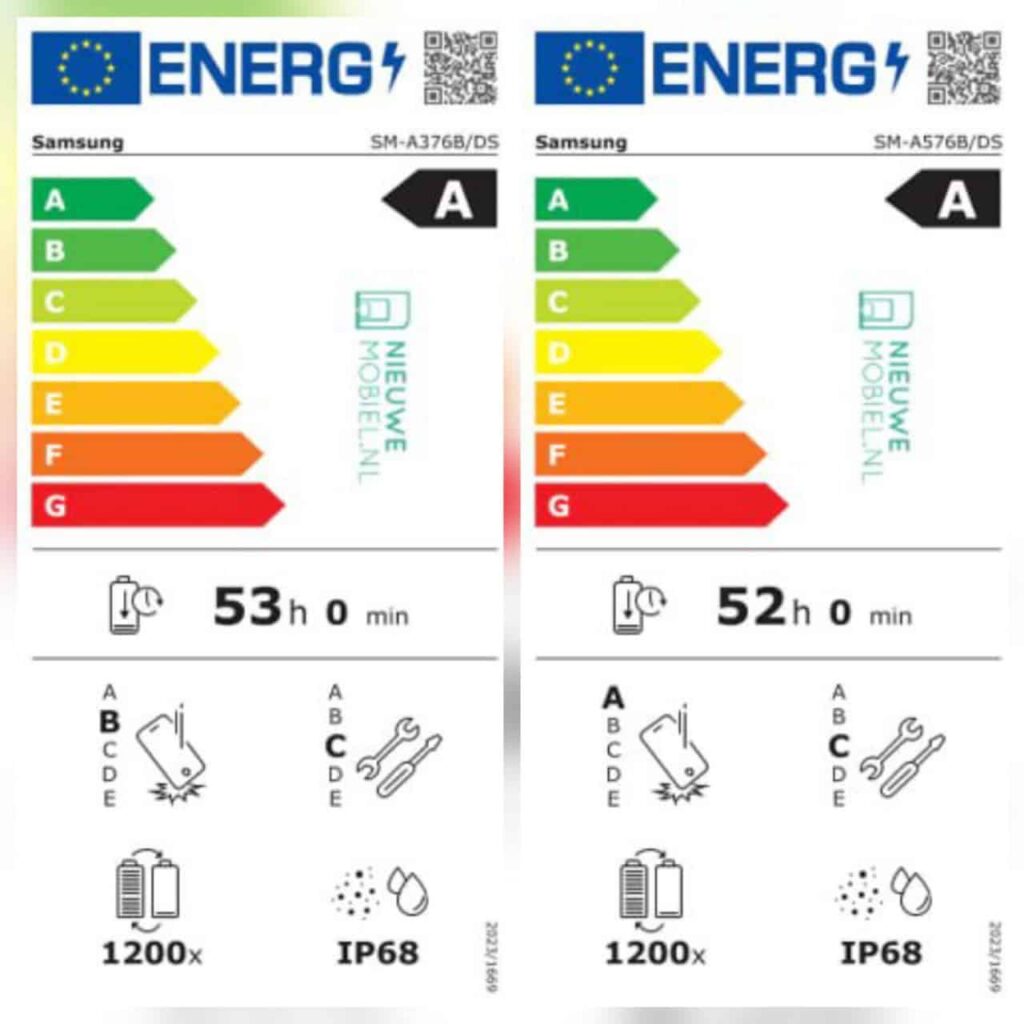


 -0.40%
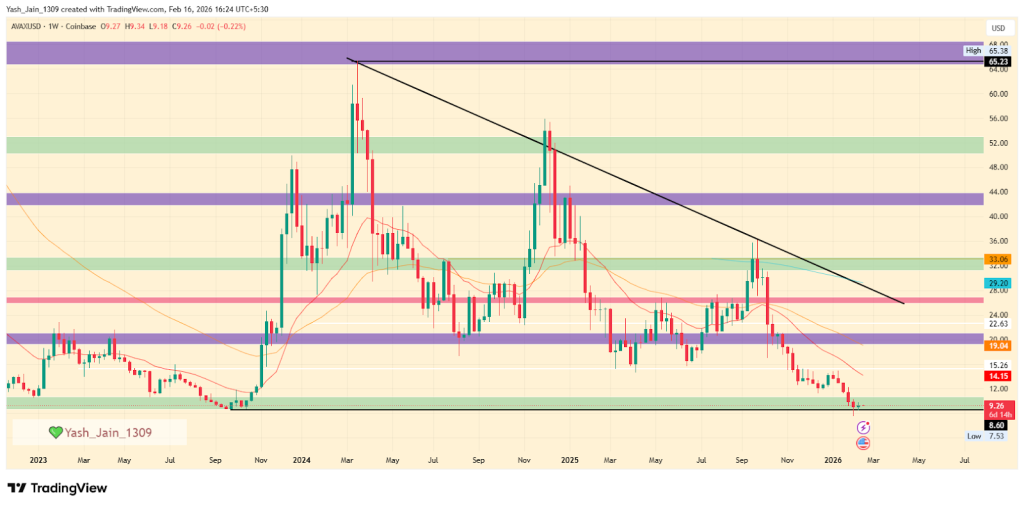
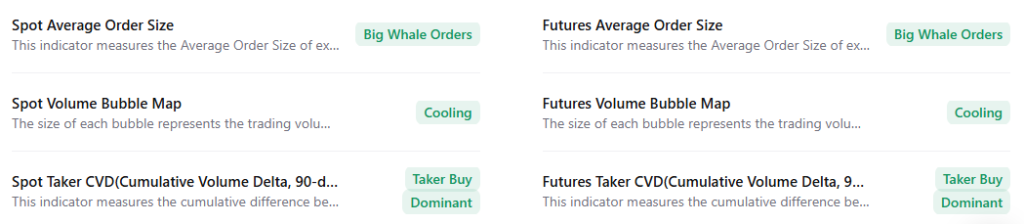
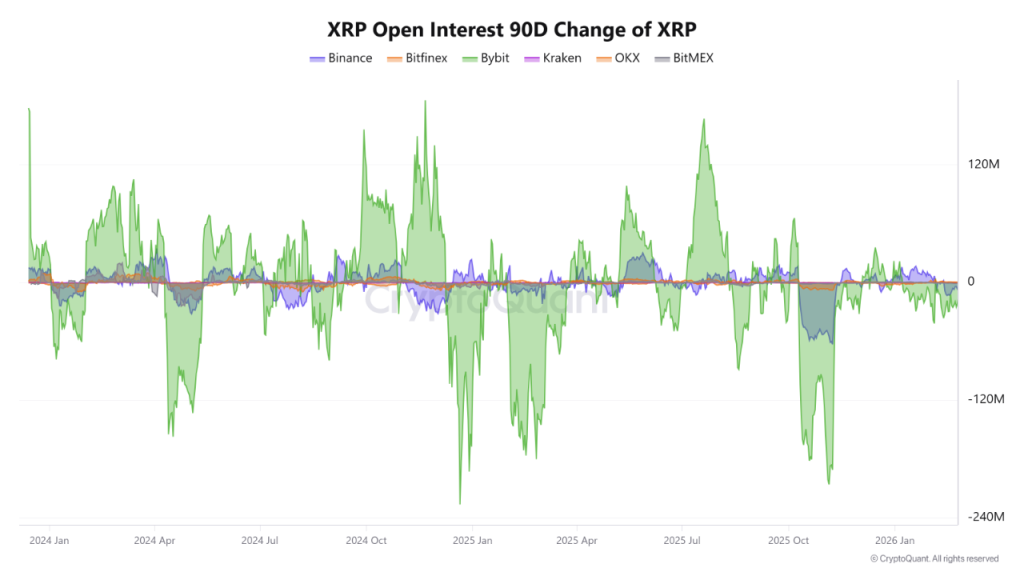
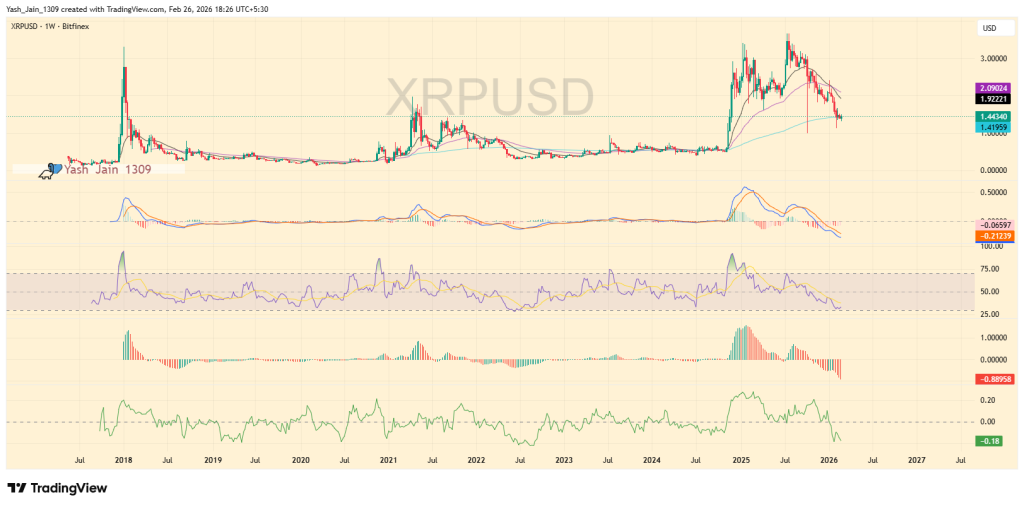
 1.10%
1.10%