Users running the Galaxy S26 Ultra are discovering a problem with the Close Focus Enhancement feature: it doesn’t do what it says. This is a frustrating camera problem on its latest flagship device that Samsung can’t hide anymore.
What you see in the viewfinder is not what you get in the final shot. The captured image shifts left, chopping off the right side of the frame. For a top-tier Samsung flagship that costs much over $1,000, that’s embarrassing.
The core issue is a lens mismatch between the preview and the capture. When Close Focus Enhancement kicks in during a tight shooting situation, the phone appears to switch lenses mid-process, but the preview doesn’t follow.
So you frame your shot, hit the shutter, and the camera quietly delivers something different than what you composed. Well, Samsung acknowledged it; a Korean community moderator has confirmed the bug is real.
According to the moderator, the problem surfaces specifically when the phone switches lenses during close-range shooting after Close Focus Enhancement is enabled. A software fix is coming, but no timeline is given.
If you’re shooting close-up subjects and you care about getting the frame you actually composed, disable Close Focus Enhancement until Samsung patches this.
It strips away some of the assisted focus behavior, but you’ll at least stop losing the right edge of your shots to a rogue lens switch.
Privacy coins are back and not quietly either. Since April 4, the privacy coins surge has been hard to ignore, with tokens like DASH, ZEC, DCR, and XMR snapping out of their long consolidation phases and ripping higher. The timing? Not random. The spark came from a geopolitical twist, the April 8 U.S.- Iran ceasefire news acted as major trigger which flipped the market into full-blown risk-on mode.
And when that switch flips, capital doesn’t tiptoe infact it rotates fast. This time, it ran straight into high-beta altcoins, with privacy assets leading the charge.
Privacy Coins Surge Fueled By Risk-On Rotation
Here’s the thing: markets love narratives, and this one had everything it showed hopes of macro relief, fresh liquidity, and a sector that had been sleeping for months.
DASH led the charge, jumping over 33% in just 24 hours to hit $42.84. That kind of move doesn’t happen in a vacuum. Volume surged to nearly 45% of its market cap, hinting at a mix of short squeeze chaos and genuine accumulation. ZEC wasn’t far behind, pushing toward $382.24.
Now zoom out a bit. This wasn’t a one-coin wonder. DCR clawed its way back to $22.96 after a prolonged downtrend, showing signs of life as broader sentiment improved. And then there’s XMR the so-called gold standard. It surged to $344.99, brushing off exchange delisting pressures like they’re background noise. Even more telling? Peer-to-peer volumes are hitting yearly highs. That’s not speculation that’s usage.
So yeah, technically speaking, the charts are aligned. Breakouts, volume, momentum, basically it’s all there.
Privacy Demand Grows Beyond Just Niche Use
But let’s be real, this isn’t just only about charts. Privacy is slowly shedding its “niche” label. On public blockchains, everything is visible forever for instance transactions, balances, the whole deal. That’s great for transparency, terrible for businesses trying to stay competitive.
And that’s where the shift is happening. It’s no longer just about anonymity. It’s about operational confidentiality like payroll, suppliers, treasury flows. Stuff that companies simply can’t afford to expose.
Of course, there’s always a catch. Stronger privacy usually means weaker distribution. Delistings, compliance headaches, restricted access and it’s all part of the package. But here’s the twist: the narrative is starting to split.
Some regions are tightening the screws. Others? They’re beginning to see privacy as a feature, not a bug. So, what’s next? Well, if the current risk-on environment holds, this privacy coins surge might not just be a reaction but it could be the start of a broader repositioning.
Everything EV has pulled off nice ascent in past 30 days and it briefly outpaced even Bitcoin in 24-hour visits on CoinMarketCap. Yeah, that got attention. And naturally, when a relatively under-the-radar token suddenly tops traffic charts, it’s either the start of something… or the middle of something messy. Let’s unpack what’s actually going on.
Everything EV Token Demand Spikes With Staking Boom
At first glance, the surge looks like a classic retail rush. Dig a little deeper, though, and there’s a more structured narrative forming. Investors aren’t just browsing but they’re staking.
Its staking activity has picked up, signaling a rise in perceived trust and liquidity around Everything EV. And honestly, nothing attracts capital faster than yield. The project’s own numbers back that up. The EV/USDTO pair has climbed to roughly $379,995, while WETH/USDTO sits at $105,739.
Why the gap? Simple its the APR rates difference. The EV/USDTO pool is offering a massive 293.55%, while WETH/USDTO trails at 152.07%. High yields, high attention. No surprises there.
But let’s be real but those kinds of returns don’t just attract believers. They attract opportunists.
High APR Incentives Driving Short-Term Capital Flows
On its official X, its team itself confirmed that incentive programs have kicked off, with “crazy good APR” being unlocked. That explains the sudden spike in participation.
Meanwhile, their broader DeFi strategy is also gaining traction. The “DeltaUSD HyperLiquid USDN Funding Arb” vault, for example, targets a 15–20% yearly yield by arbitraging between SMARDEX perpetuals and Hyperliquid funding rates. And based on recent data, it’s actually delivering a steady upward trajectory.
So yeah, there’s some real infrastructure here not just all hype.
Its website claims that the project is built in Montreux, Switzerland, backed by a team with over 15 years of trading experience, 30+ in-house engineers, and over $25 million in self-funded capital. Sounds solid on paper. But markets don’t reward resumes they reward flows.
TVL Decline Raises Questions On Sustainability
And this is where things get… less exciting. Despite the buzz, Everything EV isn’t widely available. It’s currently limited to Uniswap and SMARDEX hardly the deep-liquidity venues that sustain long-term growth.
Now look at the numbers. TVL spiked to $1.3 million in late March. Great. But by April? It dropped to around $862.7K. That’s not a rounding error but that’s a meaningful pullback.
So while staking demand and APR-driven flows pushed attention higher, overall locked value suggests capital isn’t sticking around as strongly as the narrative implies.
So, What’s Actually Going On Here?
Well, it looks like a classic case of high-yield magnetism meeting fragile liquidity. Everything EV is trending, no doubt. It’s attracting users, generating buzz, and showcasing some clever DeFi mechanics.
But underneath all that? The TVL dip hints that not all that capital is committed. And in crypto, attention is easy. Retention is everything. So, its price shows caution clearly.
The live price of the Hyperliquid crypto is $ 42.16944503.
The 2025 HYPE price suggests it could hit $40-$105 in 2026.
Forecasts suggest that HYPE could reach a potential average price by 2030 of around $125, with highs up to $185.
Hyperliquid (HYPE) is gaining attention as a decentralized trading platform focused on perpetual futures. The protocol operates without traditional onboarding barriers and offers access to assets such as BTC, ETH, SOL, AVAX, and SUI without requiring ownership of the underlying tokens.
Its infrastructure includes the HyperBFT consensus mechanism, designed to support high-speed transactions. As platform activity grows, market participants are assessing the HYPE Price outlook for 2026 and beyond.
Following the conclusion of Q1 2026, Hyperliquid (HYPE) has demonstrated significant market strength by maintaining a bullish trajectory, recently in Q2’s starting month April it is rebounding from the $32.00 support zone to trade near $41.00. This recovery was bolstered by the launch of the Bitwise Hyperliquid Staking ETP and a volume surge largely driven by the platform’s expanding TradFi perpetuals market.
The current price action shows HYPE is approaching the resistance zone at $44 after having successfully broken out of the descending wedge pattern in March and seems like it could continue in April.
Technically, the structure remains robust as the price holds firmly above the 50-day EMA ($35.82) and the 200-day EMA ($33.81), which now serve as a formidable support floor. A decisive daily close above $44 would likely clear the path for a retest of $48.00, with the potential to extend toward the psychological $50.00 mark. However, traders should monitor the recent swing built around $35 because if $44 rejects it might revisit $35 and failure to maintain this level could signal a short-term retracement back into the $32.00 demand zone, potentially slowing the momentum as the market digests the explosive growth of the past month.
Recent News/ Opinions
Bitwise officially expanded its European suite on April 9th with the launch of the Bitwise Hyperliquid Staking ETP (BHYP), now trading on the Deutsche Börse Xetra. This seventh staking product highlights Hyperliquid’s emergence as a top-tier on-chain derivatives venue, offering institutional investors regulated exposure to its innovative, fully on-chain order book and execution model.
Hyperliquid Price Prediction 2026
The weekly structure of HYPE shows that after topping near $60, the asset entered a prolonged downtrend that formed a clear falling wedge pattern, eventually bottoming in the $21–$24 demand zone. This region proved to be structurally significant, with strong buyer interest stepping in. The eventual breakout from this wedge triggered a sharp expansion move, pushing price toward $38 and then into the $44–$48 resistance band. However, this rally stalled at a major higher-timeframe supply zone, meaning the broader market structure is still in transition rather than fully bullish.
From an investor standpoint, the current phase calls for a measured and strategic approach rather than aggressive positioning. Accumulation is most favorable near support zones, particularly between $32 and $34, with additional opportunities closer to $28 or $24 if volatility increases.
However, aggressive buying is best reserved for confirmation, which in this case would be a decisive weekly breakout and hold above $44. Until that level is flipped into support, the market remains susceptible to rejection, and a range-bound environment between $32 and $44 is a realistic base case. In such a scenario, investors can consider a range-trading strategy as accumulating near support and trimming exposure near resistance.
Looking ahead to the remainder of H1 2026, the most constructive outcome would involve HYPE holding above $32 and building enough strength to reclaim $44. If this occurs, the price is likely to trend toward $52 and potentially test the $60 level, which represents the gateway to price discovery.
Conversely, if $32 fails, H1 could be dominated by consolidation or downside pressure, delaying any meaningful trend expansion and keeping the asset confined within a broader corrective phase.
For H2 2026, the outlook becomes significantly more directional depending on how price reacts at key levels. A confirmed breakout above $44, followed by sustained strength, would signal a true macro trend reversal, opening the door for a move beyond $60 and into the $70–$80 range, with the potential for further upside in a strong market environment.
If, however, HYPE price continues to reject from resistance and remains stuck between $30 and $45, the second half of the year may evolve into a prolonged accumulation phase before any major breakout. In a bearish scenario where $24 is lost, the bullish structure would be invalidated, and the asset could enter an extended period of re-accumulation, significantly delaying upside expectations.
HYPE On-Chain Outlook
The Dune analytics dashboard provided a quick on-chain overview of the utility metrics of the Hyperliquid token (HYPE), which appears to be improving significantly with each passing month.
HyperEVM total transaction fees have surpassed 235.57K and are at an ATH, and total trading volume has crossed $3.64 trillion and is at an ATH. Even its revenue has reached an ATH, crossing $993 million.
All the major metrics suggest that it is experiencing great adoption among peers, and its on-chain metrics are proof of that, suggesting that if the rally occurs, then 2026 might end on very good numbers.
Hyperliquid Coin Price Targets 2026 – 2030
Year
Potential Low ($)
Potential Average ($)
Potential High ($)
2026
25
50
90
2027
40
75
105
2028
55
95
130
2029
85
110
155
2030
105
125
185
Hyperliquid Coin Price Prediction 2027
During 2027, the HYPE could reach a maximum value of $105 with a potential low of $40. Considering this, the average price of this altcoin could settle at around $75.
HYPE Crypto Price Action 2028
The Hyperliquid price could achieve the $130 milestone by the year 2028. On the flip side, the altcoin could record a low of $55 and an average price of $95.
Hyperliquid Price Analysis 2029
The HYPE crypto prediction for the year 2029 could range between $85 to $155 and the average price could be around $110.
HYPE Price Prediction 2030
Looking forward to 2030, the Hyperliquid Price may range between $105 and $185, and a potential average value of around $125.
Market Analysis
Firm Name
2025
2026
2030
Binance
$37
$63
$164
DigitalCoinPrice
$76
$54
$97
*The aforementioned targets are the average targets set by the respective firms.
CoinPedia’s HYPE Price Projection
This Layer-1 project has taken the crypto market by storm within a short time frame. With a market cap of over $7 billion, this altcoin has successfully secured a position in the top 25. Moreover, with the mass adoption, this altcoin could claim a spot in the top 10 during the upcoming bull run.
If the bullish sentiment intensifies, the Hyperliquid price will reach a high of $41.39 this year. On the flip side, if the market experiences unfavorable events, this could result in this altcoin settling at a low of $14.65.
Year
Potential Low
Potential Average
Potential High
2025
$14.65
$28.02
$41.39
Never Miss a Beat in the Crypto World!
Stay ahead with breaking news, expert analysis, and real-time updates on the latest trends in Bitcoin, altcoins, DeFi, NFTs, and more.
FAQs
What is Hyperliquid (HYPE) and why is it gaining popularity?
Hyperliquid is a fast, decentralized trading platform with no KYC and low fees, making HYPE popular among traders seeking speed and independence.
What is the Hyperliquid (HYPE) price prediction for 2026?
HYPE price in 2026 is projected to range between $25 and $90, with an average near $60 if adoption and trading volumes keep rising.
What could HYPE be worth by 2030?
Long-term projections suggest HYPE might reach an average of $125 by 2030, with possible highs near $185 if platform usage keeps expanding.
Is Hyperliquid (HYPE) a good long-term investment?
HYPE may appeal to long-term investors due to strong platform growth, but like all crypto, it carries risk and requires careful research.
CAD renders of the Galaxy Z Flip 8 surfaced today through Onleaks and MyMobiles, giving us the clearest early look yet at Samsung’s 2026 flip phone. It looks almost exactly like the foldable phone it’s replacing.
The Galaxy Z Flip 8 measures 166.8 x 75.4 x 6.6 mm, which is identical to the Flip 7. The footprint won’t feel different in your hand, won’t photograph differently on a desk, and won’t inspire anyone to write a headline about bold new design choices.
The outer cover screen stays at 4.1 inches, the main display holds at 6.9 inches, and the rear camera layout appears to be copied and pasted from the previous generation.
At 13.2 mm folded, the Flip 8 trims about half a millimeter from the Flip 7’s 13.7 mm profile; half a millimeter is something you’ll actually feel over time. Here’s the thing about CAD leaks: they’re reliable for dimensions and proportions.
Bezels, material choices, color options, finish quality, none of that shows up cleanly in renders. So while the bones of the Flip 8 appear to be straight from the Flip 7’s skeleton, there’s still room for Samsung to differentiate on surfaces and finishes.
Samsung does this with its foldables, choosing to consolidate a design for a generation rather than tear it apart. The Flip 6 to Flip 7 shift was more substantial visually. This time, the company seems comfortable with the shape.
The South Korean tech giant pioneered the modern flip foldable, and right now it’s coasting on that legacy while competitors sharpen their angles.
Samsung is expected to unveil the Galaxy Z Flip 8 alongside the Wide Fold and Fold 8 on July 22, 2026, in London.
Price predictions for 2026 range from up to $4.18.
Long-term forecasts suggest potential highs of $35.60 by 2030.
Worldcoin (WLD) has seen a steep decline after reaching its peak in 2024. The token dropped from nearly $12 to below $1 by the end of 2025 and now trades close to historical support levels. The project continues to develop its decentralized identity infrastructure while maintaining links to the AI sector. These developments shape the WLD Price Forecast for 2026 and beyond.
Worldcoin price (WLD) has faced a relentless bearish trend since its last significant spike in Q4 2025. This downward pressure persisted throughout the first quarter of 2026, leaving the price in a weakened state as Q2 begins.
Currently, WLD/USD is hovering just above a critical support floor at $0.2424. While this level offers a temporary safety net, the overall market momentum remains fragile, heavily weighed down by ongoing geopolitical uncertainties that are suppressing broader risk appetite in the crypto sector.
Looking ahead through April, the most likely scenario appears to be continued consolidation. For a true bullish revival, WLD must first reclaim and flip the $0.40 level into support. Success here could clear a path toward the $0.60 resistance (aligned with the 200-day EMA) and potentially $0.80–$0.95.
However, given the current “cautious” sentiment, any breach below the $0.24 threshold would likely invalidate recovery hopes and trigger further declines as the dominant bearish trend resumes.
Worldcoin Price Prediction 2026
The technical outlook for Worldcoin price (WLD) remains heavily influenced by the aftermath of the failed WLD, which peaked at $2.12 in September 2025 before facing strong rejection, triggering a prolonged downtrend through Q1 2026. By the end of March, the price had fallen to the $0.24 support level, with liquidity drying up as traders stepped back, waiting for signs of stabilization.
At this stage, $0.24 is a critical level. A breakdown below it would likely open the door to further downside, while holding it could mark the beginning of a base formation. Sentiment remains muted, especially in the futures market, where positioning suggests hesitation rather than conviction.
For any meaningful recovery, WLD needs to first stabilize at current levels. A bounce from this zone could lead to a relief rally toward the 200-day EMA around $0.60. Reclaiming and holding that level would be an early signal of a potential trend reversal.
If broader market conditions improve, a move back toward $1.00–$1.50 becomes possible. In a stronger recovery scenario, WLD could attempt to revisit the $2.00 level by year-end, though that would depend heavily on sustained momentum and renewed market participation.
WLD On-Chain Analysis
The WLD Spot Average Order Size chart reveals persistent green clusters into January 2026, indicating sustained “Big Whale” participation. This heavy institutional accumulation suggests that smart money is aggressively building positions, viewing the current price range as a high-conviction entry point.
Similarly, development activity on Worldcoin is surging to new local highs in January 2026, showcasing intense builder commitment. This spike in innovation, combined with whale interest, creates a powerful fundamental divergence that historically precedes a massive price reversal.
WLD Price Forecast 2026 – 2030
Year
Potential Low ($)
Average Price ($)
Potential High ($)
WLD Price Prediction 2027
2.50
9.25
15.70
Worldcoin Price Forecast 2028
10.75
15.95
21.15
WLD AI Token Price Forecast 2029
15.65
21.60
27.50
Worldcoin AI Token Price Prediction 2030
19.75
27.75
35.60
This table, based on historical movements, shows Worldcoin price to reach $35.60 by 2030 based on compounding market cap each year. This table provides a framework for understanding the potential Worldcoin price movements. Yet, the actual price will depend on a combination of market dynamics, investor behavior, and external factors influencing the cryptocurrency landscape.
WLD Price Prediction 2027
Worldcoin’s price for 2027 is expected to fluctuate between $2.50 and $15.70, with an average price of around $9.25.
Worldcoin Price Forecast 2028
Worldcoin’s price for 2028 is anticipated to be between $10.75 and $21.15, with an average price of about $15.95.
WLD Token Ai Price Forecast 2029
Worldcoin’s price for 2029 is projected to vary from $15.60 to $27.50, with an average price of roughly $21.60.
Worldcoin AI Token Price Prediction 2030
Worldcoin’s price for 2030 is expected to fluctuate between $19.75 to $35.60, with an average price of approximately $27.75.
Market Analysis
Firm Name
2026
2030
Swapspace
$1.30
$2.07
coincodex
$2.40
$4.30
DigitalCoinPrice
$3.02
$4.06
*The targets mentioned above are the average targets set by the respective firms.
Never Miss a Beat in the Crypto World!
Stay ahead with breaking news, expert analysis, and real-time updates on the latest trends in Bitcoin, altcoins, DeFi, NFTs, and more.
FAQs
What is Worldcoin?
Worldcoin is a cryptocurrency project aiming to distribute digital assets to a global audience through a unique identity-verification system.
What is the Worldcoin (WLD) price prediction for 2026?
WLD is expected to trade between $0.30 and $4.18 in 2026, depending on market sentiment, adoption growth, and its ability to break key resistance levels.
How much will Worldcoin be worth in 2030?
Worldcoin is projected to reach between $19.75 and $35.60 by 2030, driven by adoption, market trends, and growth in AI-based applications.
What is the Worldcoin prediction for 2040?
By 2040, Worldcoin could trade well above $50 if global adoption of digital identity and AI expands, though long-term forecasts remain speculative.
Is Worldcoin a good long-term investment?
Worldcoin offers long-term potential due to its focus on decentralized identity and AI, but it remains volatile and requires risk awareness.
What factors influence WLD price the most?
WLD price is driven by AI narrative strength, user adoption, token supply dynamics, market sentiment, and overall crypto market trends.
Samsung is giving one last shot at the $2,900 Galaxy Z TriFold phone in the US. The first triple foldable Galaxy device is getting a final restock today at 10 AM ET on Samsung’s website.
There’s a countdown timer on the product page right now, which means you’ve got a narrow window to get your affairs in order before this thing vanishes from retail forever.
Every single time Samsung has listed the TriFold online, it has sold out within minutes. Whether that speed reflects genuine, overwhelming demand or just genuinely thin stock is a question that no longer matters.
Samsung has officially pulled it from its lineup, which means whatever units are sitting in that warehouse today are the last ones that will ever carry the original TriFold name.
Before the restock goes live, pull up Samsung’s website and walk through the checkout flow on any in-stock device. Sign into your Samsung account. Make sure your payment method and shipping address are already saved and populated.
The direct product page and the dedicated waiting page are both viable entry points. Either one should surface the “Add to Cart” button at 10AM. Keep both tabs open.
The last TriFold units ever sold at retail go on sale at 10 AM ET. After that, the only place left to buy one is exactly where Samsung wanted you not to go.
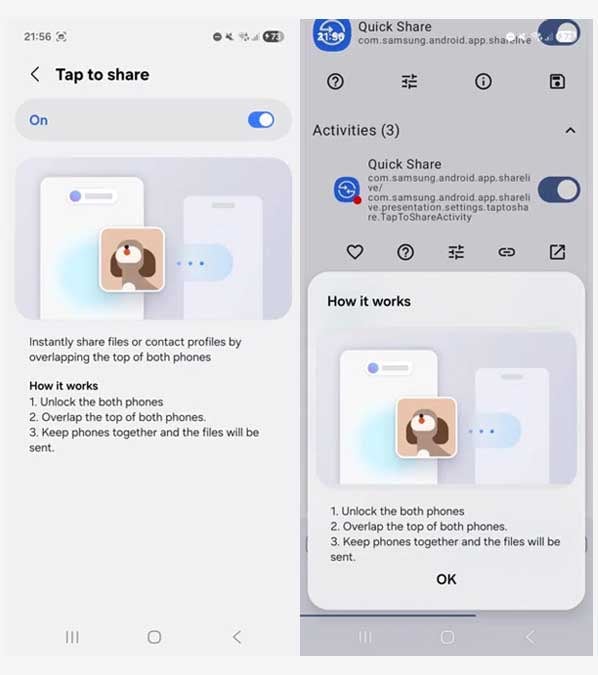
Samsung has confirmed that One UI 8.5 Beta brings AirDrop support through Quick Share on select Galaxy devices. Not a workaround, nor a third-party app; actual Apple-like AirDrop compatibility baked into the operating system.
Apple users have smugly shared files among themselves for years. You would watch them tap two phones together to share files in seconds. Meanwhile, Android users stood there fumbling through Bluetooth menus and email attachments.
That era is ending.
Samsung and Google have been tightening their collaborative grip on cross-platform sharing for a while now. Quick Share itself was the product of that partnership, a rebranding effort that merged Samsung’s Quick Share with Android’s Nearby Share.
AirDrop integration is the next logical step in that ongoing relationship.
Quick Share with AirDrop support changes the interaction entirely. Galaxy users can receive files directly from nearby iPhones.
What devices actually get it
The list includes the Galaxy S25 series, Galaxy S24 series, Galaxy Z Fold 7, Galaxy Z Flip 7, Galaxy Z Fold 6, and Galaxy Z Flip 6. If you’re on a Galaxy S24 or S25 and want to test it, joining the One UI 8.5 Beta program gets you access.
If you’re running anything older than that, you’re out.
Samsung isn’t in the business of leaving money on the table with software updates, which means the Galaxy S23 users get to watch from the sidelines.
Worth being clear: this is a beta feature.
One UI 8.5 beta is not the finished product, and betas have a long tradition of surfacing features that get quietly killed before public release. Samsung hasn’t committed to a full rollout date.
Samsung confirmed that eight Galaxy devices will support SoftBank Starlink Direct in Japan. It is a satellite-to-smartphone service launching April 10, 2026.
Without installing any additional apps or paying a fee, eight Samsung phones gained support for SoftBank Starlink Direct in Japan, with satellite connectivity baked into plans that SoftBank and Y!mobile customers already pay for.
The eligible devices are the Galaxy S26, S26+, S26 Ultra, S25, S25 Ultra, Z Fold 7, Z Flip 7, and A25 5G. The last one is worth pausing on; it sits at the budget end of Samsung’s lineup, and it’s sitting in the same satellite support list as the S26 Ultra.
You need to be running a SoftBank SIM, a Y!mobile SIM, or LINEMO.
What can you do with it?
Text messages
Certain emergency alerts, including earthquake warnings
Data on supported apps
Voice calls aren’t supported. Emergency calls aren’t either, which feels like the one gap that actually matters. The service only activates outside SoftBank’s ground-based coverage zones. Also, it requires a clear line of sight to the satellite above.
Japan has a specific problem that makes satellite direct-to-device genuinely urgent. Earthquakes don’t just kill people; they destroy towers, cut fiber, and leave entire regions without any communication infrastructure for days.
SoftBank has been aggressive about Starlink integration. Pairing that with Samsung’s installed base is the right move. Samsung dominates premium Android smartphone sales in Japan in a way it doesn’t in every market.
Samsung confirmed it plans to bring satellite support to more devices over time.
Samsung just quietly bumped the pricing of the 1TB Galaxy Z Fold 7 in the US. The phone that already costs $2,000 at its base now costs more in its top storage configuration.
The Galaxy Z Fold 7, which launched at $2,419, has jumped to $2,499. Samsung is charging more for the exact same phone it was selling weeks ago.
The online store was showing original prices as recently as March. Samsung just updated the numbers and hoped nobody would notice, some people didn’t, but the ones who did are rightfully annoyed.
The 512GB model appears to have taken the same $80 hit, landing at a new price of $2,199, though Samsung is currently running a sale that brings it down to $2,079.
DDR5 and other RAM components are getting expensive. AI datacenter demand for high-bandwidth memory is absolutely ferocious right now, and smartphone components are competing for the same supply chain.
Manufacturers absorb those costs until they can’t, and then they pass them along.
Sometimes they do it loudly, with a press release and a prepared talking point about “global supply chain pressures.” Sometimes they do it like this: silently, mid-cycle, hoping the revised number just becomes the new normal before anyone does the math.
The Galaxy Z Fold 7 won’t be the last device hit with a mid-cycle adjustment. If memory costs stay elevated and AI infrastructure demand doesn’t ease, more devices across more brands will get the same treatment.
Samsung has a mess on its hands that doesn’t look good for a company trying to convince people its software support promises actually mean something. We are talking about the factory reset lockout issue that the users of Galaxy S22 Ultra are facing.
Some Galaxy S22 Ultra owners are discovering that after a factory reset, their phones are behaving like company-issued enterprise devices, locked behind organizational management controls that prevent them from logging into their own accounts.
This isn’t a minor annoyance like a stuttering animation or a bloated update file. Your phone decides you’re not authorized to use it after a reset. The device becomes an expensive paperweight, and the user has done nothing wrong to deserve it.
What makes this particularly strange is the enterprise angle.
People reporting this issue are saying they bought these phones straight from retailers like Best Buy, brand new, years ago. No corporate IT department, no company policy; just a regular person trying to reset their personal phone.
The first reports of the Galaxy S22 Ultra reset lockout issue surfaced nine months ago. That is a problem that has been sitting in the open, quietly collecting victims, while the company apparently treated it as something less than urgent.
The issue doesn’t seem widespread based on current Reddit threads. What’s the point of four years of updates if a factory reset can strand you outside your own phone?
Samsung hasn’t said a word publicly.
Samsung needs to do two things quickly.
First, acknowledge the problem publicly.
Second, provide a clear workaround or fix.
If you’re dealing with this right now, reaching out directly to Samsung support is your best shot. There’s no known self-service fix, and attempting more resets won’t help.
Turns out that Samsung will have a global rollout of the Galaxy S26’s AI-powered Scam Detection feature.
Code buried inside a recent Beta build of the Phone by Google app has surfaced model numbers tied to three upcoming Samsung foldables: the Galaxy Z Fold 8, the Galaxy Z Flip 8, and a new Wide Fold variant.
The strings point directly at SM-F976, SM-F971, and SM-F776, not just concept units, as discovered by Android Authority. What makes this genuinely interesting isn’t that the feature is coming to new foldable phones.
The regional variant spread in that code is wide. You’ve got B for global, U and U1 for US carrier-locked and unlocked variants, W for Canada, and C, Z, and Q covering additional markets.
Samsung appears to be setting up Gemini-powered Scam Detection for a genuine international push, which would mark a significant departure from how the Galaxy S26 launch played out earlier this year.
Scam Detection on the S26 series works only for English-speaking users in the US. For a feature Samsung co-developed with Google and built into its Phone app, the reach was basically a pilot program wearing a flagship price tag.
Samsung is expected to pull the curtain on its next foldables at Galaxy Unpacked in July 2026. Galaxy S26 owners outside the US might finally get access to Scam Detection around that same window, either alongside the foldable launch or ahead of it.
Galaxy S23 FE and Galaxy A35 5G are gearing up to receive One UI 8.5 Beta as Samsung officially confirmed the expansion to the two popular smartphones.
On April 9, Samsung announced One UI 8.5 Beta will be available for the Galaxy S23 FE, along with the Z Fold 5 and Z Flip 5. Before practical things happen, the first Beta has been spotted on the server, signaling imminent rollout.
There’s a new software listed on the server: S711NKSUEZZD5. It’s a Beta build that will be available to users upon joining the Beta Program. The availability is now confirmed for Korea (via TarunVats), with India, UK and the US may be listed too.
In addition, Samsung has published Beta Program forums on its community sites, covering the Galaxy S23 FE and Galaxy A35.
Samsung recently expanded the Beta Program to the S23 series and A36. There was a wider wave of One UI 8.5 rollout for existing models. Galaxy S25 series, in particular, received the 9th Beta, which installed AirDrop feature as well.
After Samsung’s confirmation, users of S23 FE, Fold 5, and Flip 5 are eagerly waiting for the Beta Program. It should be available within a week or two, while the company, in the press release, said it’s coming later this month.
You won’t directly get One UI 8.5 Beta on your Galaxy S23 FE. It requires manual enrollment through the Samsung Members app. Check for the Beta banner once the program goes live, and finish the signup after consenting to the T&C.
Galaxy S23 FE: First One UI 8.5 beta build spotted on Korea test server
Samsung is dropping $4 billion into northern Vietnam, and the focus is on AI. The investment rolls out in phases, with the first portion landing at $2 billion.
The South Korean giant plans to build a chip packaging facility in Thai Nguyen province, the same region where it already runs one of its largest phone manufacturing operations.
Vietnam’s finance ministry confirmed it’s working through a memorandum of understanding with Samsung on the semiconductor project. Vietnam has become the preferred escape valve for companies untangling themselves from China.
Samsung already committed $1.2 billion earlier this year for high-end circuit board production in Thai Nguyen. This new chip packaging plant stacks directly on top of that.
The company is not diversifying in Vietnam; it’s concentrating. That’s a different thing entirely, and it tells you exactly where Samsung thinks the next decade of chip demand is actually coming from.
Samsung arrived in Vietnam in 2008, planting its first factory in Bac Ninh. Since then it has poured more than $23 billion into Vietnam, created 90,000 jobs, and quietly turned the country into its single largest smartphone manufacturing hub.
Reports have surfaced of YouTube 90-second ads landing on Samsung smart TVs and other connected televisions, unskippable for the full duration, and viewers are furious.
This isn’t the 30-second bumper YouTube quietly made official last month. That was bad enough, but this is three times that, locked to your screen, no exit button in sight.
One viewer caught the ads in a 40-minute video. Another saw them on something under 20 minutes. The ad block itself reportedly runs longer than 90 seconds total, with skipping only unlocking after that initial window.
Virtually every reply across both threads was hostile. People are recommending third-party YouTube clients, hunting for ad blockers that still work on TV platforms, or just venting about what the platform used to be.
Google’s logic here isn’t mysterious. The company wants traditional TV advertisers on YouTube, the kind accustomed to buying 60 and 90-second cable spots. Samsung TV owners are collateral damage in that negotiation.
YouTube Premium Lite launched in the US less than two months ago at $8 a month, offering ad-free playback on most content. Google seems to be making the free tier painful enough that paying feels like relief.
Samsung today expanded One UI 8.5 Beta to several devices, and the company also announced April Wave 2 expansion. This time, we know which devices are getting the Beta Program invite, and it’s scheduled for later this month.
One UI 8.5 Beta Wave 2 will happen in April 2026. Samsung confirmed the next set of devices, which are the Galaxy Z Fold 5, Galaxy Z Flip 5, and Galaxy S23 FE.
It’s worth noting that the One UI 8.5 Beta for the Z Fold 5 and Z Flip 5 will only be available in South Korea and the US. The Galaxy S23 FE may get the update in India, South Korea, the United Kingdom and the United States.
Devices that received the One UI 8.5 Beta today are the Galaxy S23 series and the Galaxy A36. Besides, we’ve reported new Beta update rollouts for phones that were already running One UI 8.5 Beta firmware.
The story may not just stay limited to what Samsung disclosed. Various Galaxy devices are internally testing One UI 8.5 Beta builds. The company may end up opening early access to devices as much as possible.
The bad news
Galaxy S21 FE is the only model from 2021 that received Android 16-based One UI 8.0 update. It was widely anticipated to receive the One UI 8.5 update as well.
Meanwhile, Samsung has no plans to provide the mid-cycle update to the 2nd-gen Fan Edition phone. There’s no internal Alpha/Beta firmware under development, indicating that the device will spend its remaining life on One UI 8.
There’s no denying the wonder from Samsung. We did see it happening with the Galaxy Watch 4, and providing One UI 8.5 update to the Galaxy S21 FE isn’t impossible either.
The Solana price analysis right now feels like a standoff because institutions are quietly loading up, indicators are hinting at a shift, and yet price… just sits there. Hovering around a critical zone, refusing to make the call everyone’s waiting for. So, it’s one of those moments. Calm on the surface, tension underneath.
Institutional Demand For SOL Is Rapidly Rising
A year ago, ETFs held just 2.15% of SOL, and DATs didn’t even exist. Fast forward to today, and suddenly ETFs control 4.17% while DATs sit at 2.79%. Combined? That’s 6.96% of the circulating supply.
That’s nearly 7%, locked inside structured vehicles. That’s not retail noise. That’s institutional-style exposure scaling fast. And it’s happening while SOL price is still struggling to find a clear direction, which, honestly, makes it even more interesting. Because accumulation rarely looks exciting in real time.
Solana Price Analysis Signals Critical Decision Zone
Now flip over to the weekly chart, and things get… messy. SOL is consolidating right around the $80 region which is a level that previously acted as a strong base back in January 2024. If history decides to rhyme here, this could be the launchpad for a move back toward $200.
But let’s not get carried away. There’s also a descending channel in play, quietly pressing price lower over time. The lower boundary was tested around $67.50 in February 2026. If that structure holds, another visit this time potentially dipping closer to $60 can’t be ruled out.
So, it’s a fork in the road: hold $80 and build, or lose it and flush lower.
Indicators Hint At Momentum Slowly Shifting
Here’s where it gets a bit contradictory but in a good way. Like, MACD is on the verge of a bullish crossover. The AO histogram is already flashing early signs of weekly bullish momentum building up. Even CMF, sitting at -0.20, is starting to curve upward, hinting that money might slowly be flowing back in.
And RSI? Sitting at 32.55. That’s not overheated that’s borderline exhausted.
In other words, momentum indicators are leaning toward a recovery… even if price hasn’t caught up yet.
$80 Or $60 Bottom Debate Intensifies
So, what’s next? Well, it might not even be about Solana itself. Fundamentals aren’t the problem here. Institutional demand is rising, indicators are stabilizing, and the network isn’t exactly lacking momentum.
The real variable? Broader sentiment. Geopolitics. Market mood. If conditions stabilize and $80 holds firm, the path toward $200 starts to look realistic again. But if fear creeps back in and that descending channel stays in control, a sweep toward $60 could be the final shakeout before any meaningful reversal.
Either way, this Solana price analysis isn’t about chasing hype, it’s about watching which level breaks first.
The XRP price analysis right now feels like a classic case of hype meeting reality and losing. After briefly flirting with $1.38 on April 8, XRP got slapped right back down to $1.33, as if the market collectively decided the so-called “ceasefire rally” wasn’t worth the follow-through. Turns out, a headline-driven pump without real volume is just that a temporary illusion.
Ceasefire Rally Fizzles Without Real Volume
Well, the rejection at $1.38 didn’t just stall momentum, it exposed it. That move lacked the kind of sustained buying pressure needed to flip the broader bearish structure. So instead of continuation, XRP drifted… slowly, awkwardly… right back into its comfort zone.
The $1.30–$1.35 range? That’s home base again. But let’s be real as this activity tht we saw suggests the geopolitical de-escalation between the U.S. and Iran was already priced in. Traders aren’t chasing narratives anymore; they’re waiting for something concrete. And until that shows up, XRP looks stuck in a loop.
XRP Price Analysis Shows Heavy Resistance Ahead
Now zoom into the chart, and things get even less exciting. XRP is currently squeezed between descending moving averages and a stubborn resistance cluster. The $1.38–$1.41 zone lined up with the 50-day EMA which is acting like a ceiling that just won’t budge.
Until there’s a clean daily close above $1.4171, this structure doesn’t magically turn bullish. At best, it’s neutral. At worst, still leaning bearish.
And then there’s the 200-day moving average sitting way up at $1.83. That’s not just resistance. A reminder that institutional-level conviction isn’t exactly rushing in at current prices.
Support Holds Firm But Risk Still Lingers
On the downside, bulls are doing just enough to keep things from falling apart. The $1.28–$1.30 zone is holding atleast for now. It’s psychological, it’s technical, and frankly, it’s fragile.
We’ve seen those long wicks near $1.10 before. That’s where liquidity hides. If $1.30 cracks, don’t be surprised if XRP price takes a quick trip down to $1.15 to test real demand again. So yeah, support exists but it’s not invincible.
Regulation And Whales Driving Quiet Undercurrents
So, what’s next? That’s where things get interesting. The market is clearly in “wait-and-see” mode ahead of the CLARITY Act markup expected later this month. Even though XRP’s classification as a digital commodity got a boost from joint SEC-CFTC guidance in March, traders aren’t jumping in just yet.
TODAY: The U.S. Senate Banking Committee meets on the CLARITY Act
Regulatory clarity is getting closer by the day…
Once the rules are set, the real move begins — and assets like XRP could be among the biggest winners.
But beneath the surface? Different story. Whale accumulation is quietly picking up pace. No fireworks, no headlines just steady positioning. If the regulatory picture clears up positively, the path toward $1.50–$1.60 opens up pretty quickly.
Until then, expect more sideways chop. Not exciting, not dramatic just XRP price doing what it does best lately: waiting. And yes, that’s exactly what this XRP price analysis is telling you.
Samsung held a media briefing in Seoul last week and the session covered how the Galaxy S26 smartphones and Galaxy Buds 4 earbuds were designed.
During the session, Samsung dropped something no one had expected: real numbers behind the design decisions of Galaxy S26 and Buds 4 series. However, the framing Samsung kept returning to was “human-centered design.”
Galaxy Buds 4 earbuds
One hundred million ear shapes: that’s what Samsung’s team analyzed when reworking the Buds 4 fit. On top of that, Samsung engineers ran more than 10,000 wear simulations.
Song Jun-yong, Head of the Design Group at Samsung’s MX Division, was clear about the stakes. “Fit is not just about comfort, but also performance.”
Samsung also tracked how users actually pull out, wear, and store their earbuds, then redesigned around those behaviors.
Galaxy S26 smartphones
On the phone side, the Galaxy S26 Ultra has finally dropped its angular identity. Previous Ultra models were noticeably sharper than the standard and Plus variants.
Now all three models share the same outer silhouette. The specific geometry Samsung landed on is called 7R. Corners follow a circular arc with a 7mm radius.
Executive Vice President Lee Ji-young explained that the number came from balancing three factors: the signature Galaxy aesthetic, grip comfort, and overall proportional harmony.
The S Pen tip on the S26 Ultra was given an asymmetrical curvature to complete the 7R language. The camera module got quieter too; with Samsung applying Ambient Island on the back.
The live price of the UniSwap crypto token is $ 3.08273592.
Price predictions for 2026 range from $5.00 to $10.00.
Long term forecasts suggest UNI price may hit $30.00 by the end of 2030.
Founded in 2018 by Hayden Adams, Uniswap has transcended its origins as a simple Ethereum-based Automated Market Maker (AMM) to become the undisputed backbone of the decentralized finance (DeFi) economy. By mid-2026, the protocol has achieved a staggering $4.0 trillion in all-time volume, supported by 119 million swappers and $2.6 billion in Total Value Locked (TVL).
Uniswap Labs continues to dominate the landscape by offering a seamless, no-fee trading experience backed by deep, on-chain liquidity. Beyond simple swaps, its sophisticated Liquidity Pools allow users to earn yield by powering the very markets they trade in. As Uniswap integrates deeply with the on-chain economy into a single platform, the central question for investors remains:
Will UNI reach $70? How high can UNI go in five years? Let’s take a look at Uniswap price prediction 2026 -2032 to provide answers to these queries.
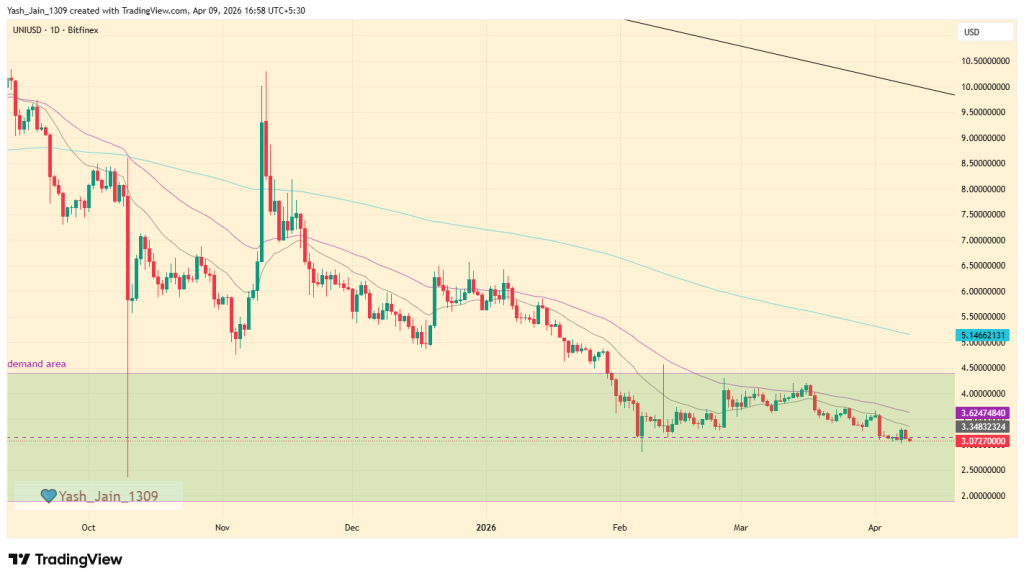
In the daily timeframe, Uniswap’s (UNI) price experienced a significant decline in the first quarter of 2026. A drop below the crucial $5.00 support level in January resulted in a decrease to approximately $3.00 by early February.
Nevertheless, February brought promising signs of recovery, characterized by heightened buying activity within a historical demand zone, signaling a transition from distribution to accumulation. By mid-March, this optimistic momentum continued to push UNI’s price upward, although it faced some pullback subsequently.
As we concluded Q1, UNI has successfully maintained its position above the $3.00 support level. If bullish demand returns in Q2 starting in April, we can anticipate targets of $4.50 and $5.45. However, should selling pressure intensify and the $3.00 support falter, we might observe a decline toward the $2.00 level for deeper liquidity.
Recent News / Opinions
On March 3, 2026, Judge Failla of the Southern District of New York dismissed the Risley class action against Uniswap Labs and Hayden Adams with prejudice. This ruling effectively clears the protocol of all federal and state claims, providing a massive regulatory green light for the DEX’s operations.
Uniswap recently announced a strategic collaboration with Securitize to integrate BlackRock’s USD Institutional Digital Liquidity Fund (BUIDL) into the UniswapX ecosystem. Launched on February 11, this integration allows institutional-grade assets to be traded directly on-chain, bridging the gap between TradFi and decentralized liquidity.
UNI Price Prediction 2026
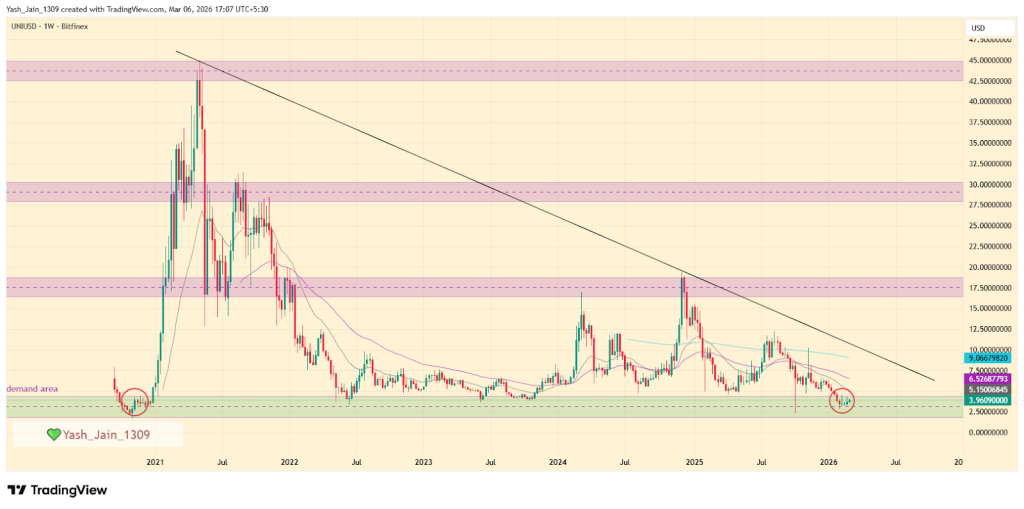
As of Q1 2026, Uniswap (UNI) is currently consolidating within a highly-crucial demand zone ranging from $1.80 to $4.50. This specific price floor carries immense historical weight, as it served as the original launchpad for the 2021 bull run that saw UNI skyrocket to its $44.50 all-time high.
For the first time in five years, the price has returned to this foundational level, effectively completing a full market cycle. This re-entry into the “genesis demand zone” suggests a significant long-term accumulation phase is underway, as long-term holders seek to front-run a potential structural shift in DeFi liquidity.
While the market awaits a catalyst as explosive as the 2021 rally, the current price action is also defined by a massive descending triangle pattern. This structure indicates that while selling pressure is exhausting at the multi-year floor, the price remains capped by a descending resistance line.
Throughout 2026, a steady recovery setup appears more likely than a vertical spike. Technical targets for the year point toward a possible retest of the $10.00 level, which aligns perfectly with the pattern’s upper border. A confirmed weekly breakout above this resistance could signal the end of the long-term bear cycle and the beginning of a sustained move toward mid-range targets.
Uniswap On-Chain Analysis
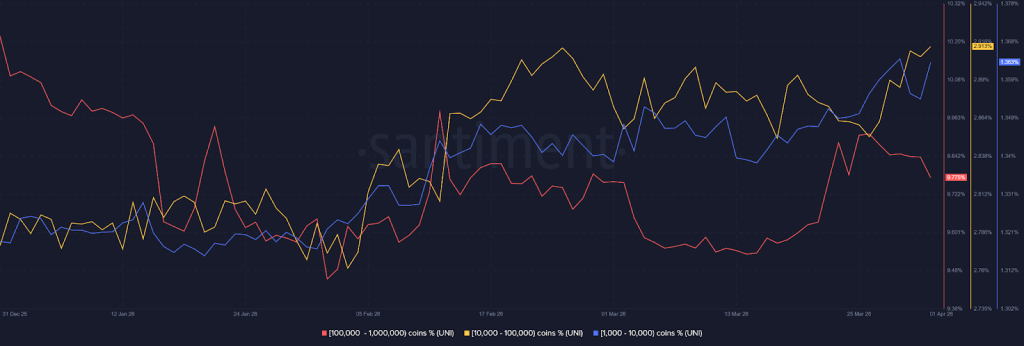
On-chain metrics for Uniswap (UNI) reveal a notable tug-of-war between investor classes. Over the past week, large-scale holders (100k–1M UNI) have significantly reduced their positions. This “whale” selling pressure has been largely absorbed by medium-sized investors (1k–100k UNI), whose steady accumulation has prevented a total collapse but effectively capped price upside.
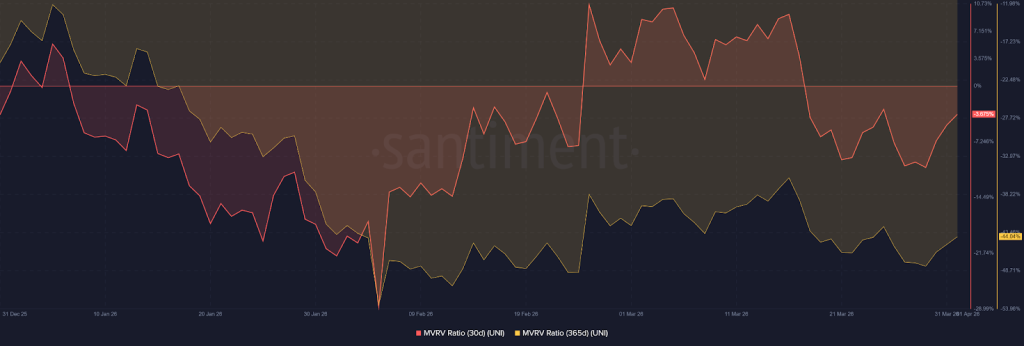
From a valuation perspective, the 30-day MVRV Ratio has recovered from its February lows but remains in negative territory, indicating that recent buyers are still underwater. More starkly, the 365-day MVRV sits at -44%, signaling that long-term holders are facing substantial unrealized losses.
Historically, such deep “undervaluation” levels suggest that the current price stagnation is unsustainable; while the big players are dumping, the severe long-term losses often precede a market capitulation or a major trend reversal as the supply stabilizes.
UNI Crypto Price Prediction 2026 – 2030
Year
Potential Low ($)
Potential Average ($)
Potential High ($)
2027
7.00
10.00
13.50
2028
8.50
11.50
18.00
2029
10.00
15.50
22.00
2030
12.00
19.00
32.00
Uniswap Price Prediction 2027
The UNI price range can be between $7.00 to $13.50 during the year 2027.
Uniswap Price Forecast 2028
The UNI Network price for 2028 is anticipated to lie within the range of $8.50 to $18.00.
Uniswap Coin Price Prediction 2029
In 2030, the price of UNI is expected to systain trend and remain positive. It may trade between $10.00 and $22.00.
Uniswap (UNI) Price Prediction 2030
Finally, in 2030, the price of UNI is predicted to maintain a steady and positive. It may trade between $12.00 and $32.00.
UNI Price Prediction 2031, 2032, 2033, 2040, 2050
Based on the historic market sentiments and trend analysis of the largest cryptocurrency by market capitalization, here are the possible UNI price targets for the longer time frames.
Year
Potential Low ($)
Potential Average ($)
Potential High ($)
2031
19.00
29.00
39.00
2032
26.50
35.00
41.00
2033
35.00
37.00
44.00
2040
42.00
52.00
57.00
2050
55.00
62.00
70.00
UNI Price Prediction: Market Analysis?
Year
2026
2027
2030
Changelly
$13.25
$15.80
$20.10
CoinCodex
$10.90
$14.85
$19.45
Binance
$12.40
$15.10
$20.85
CoinPedia’s UNI Price Prediction
Uniswap (UNI) is currently consolidating within a key demand zone that ranges from $1.80 to $4.50. This area represents a return to its foundational level from the 2021 bull run. A descending triangle pattern indicates the potential for a gradual recovery throughout 2026, with targets set around $10.00. A breakout above this resistance level could signal the end of the bear market.
Never Miss a Beat in the Crypto World!
Stay ahead with breaking news, expert analysis, and real-time updates on the latest trends in Bitcoin, altcoins, DeFi, NFTs, and more.
FAQs
What is Uniswap (UNI) and how does it work?
Uniswap is a leading decentralized exchange protocol, allowing users to trade tokens directly on Ethereum and Layer-2 networks without intermediaries.
What is Uniswap’s price prediction for 2026?
UNI could trade between $5.00 and $10.00 in 2026 if demand for DeFi grows and the token breaks key resistance levels.
What is the price prediction for Uniswap in 2027
Analysts estimate UNI could trade between $7.00 and $13.50 in 2027 if DeFi activity expands and the broader crypto market remains bullish.
How much will $1 UNI be worth in 2030?
Forecasts suggest UNI could reach $12.00 to $32.00 by 2030 if adoption increases and Uniswap continues leading decentralized exchange trading.
Can Uniswap (UNI) be a long-term investment?
UNI offers long-term potential as a key DeFi token, supported by Layer-2 adoption, stable protocol activity, and growing Ethereum ecosystem usage.
ORDI price is consolidating in the $1–$5 demand zone after a 95% drop from $95. A breakout above $5 could trigger a rally toward $10 and possibly $30 if market sentiment turns bullish.
Ordinals (ORDI) may be forming a bottom in 2026. If bulls reclaim $5 resistance, the token could target $8–$10 short term, with long-term forecasts reaching $60+ by 2030.
Ordinals allow users to engrave data onto Satoshis. These inscriptions act like NFTs, but without smart contracts. It’s working to be more precise; the ORDI tokens are the wallet’s native BRC-20 token inscribed onto satoshis, which users can securely store, transfer, or trade in the wallet’s built-in marketplace. Using this method offers a new form of digital value on Bitcoin.
ORDI isn’t just a token; it’s a milestone. The Ordinals protocol’s structure keeps it close to Bitcoin’s core while opening new use cases. All this happens on a non-custodial Ordinals wallet. As a result, it had a strong response in Q1 2024, spiking to around $95, but in Q1 2026, it’s over 95% down in a two-year span, showing complete consumption of its gains.
What’s coming next for the token? How high will ORDI price go? Can ORDI surge 100x? What will the price of ORDI be in 2030? Let’s explore the ORDI price prediction from 2026 to 2032.
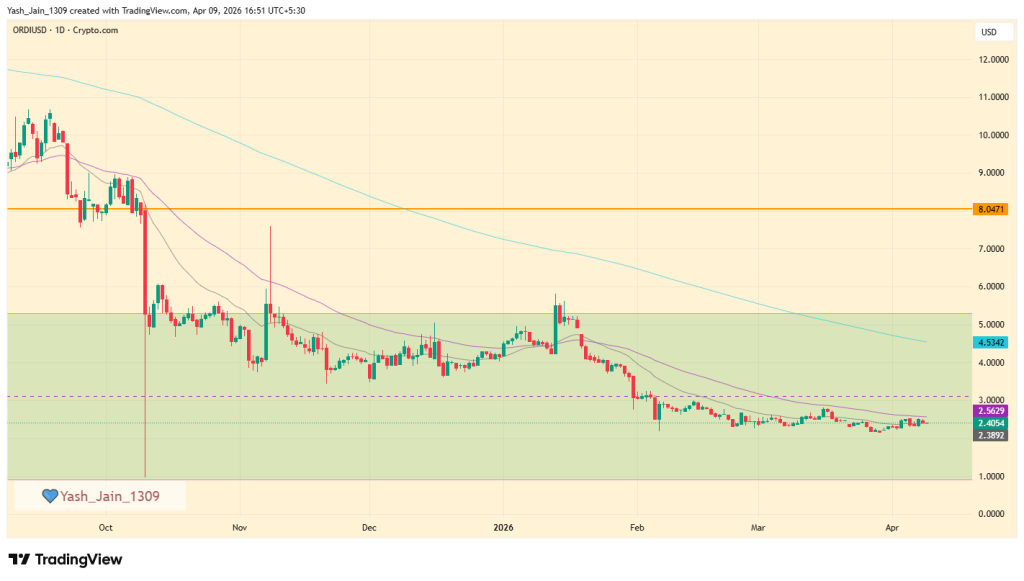
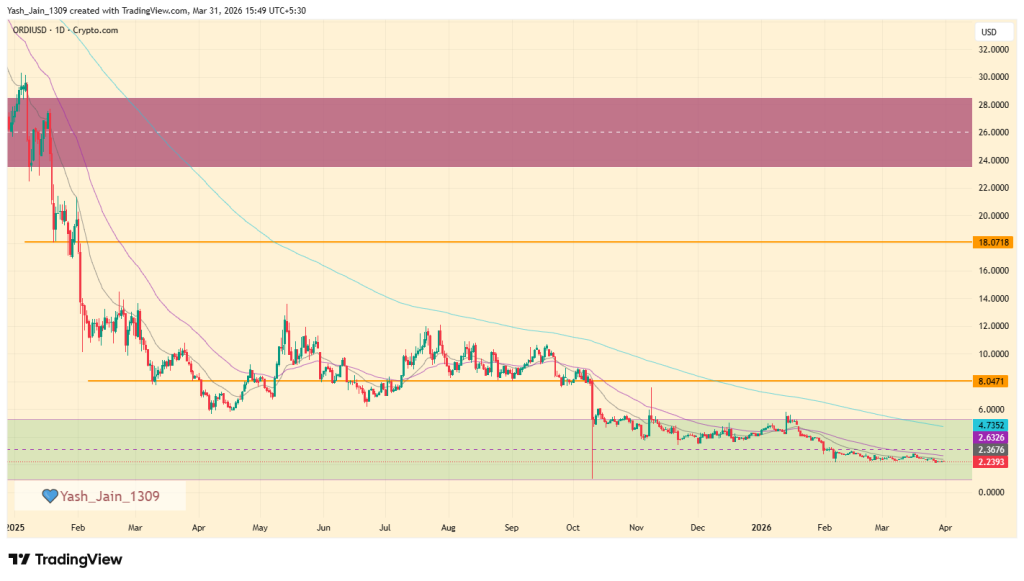
The daily chart of ORDI’s price shows a notable decline in buyer interest, characterized by a significant downward trend that intensified in early 2025 following a substantial sell-off. This situation has created a robust supply zone between $24.00 and $28.00.
Throughout late 2025, the technical landscape remained weak, as both the $18.00 and $8.00 support levels proved ineffective. The critical breach of $8.00 in October led to continued selling pressure, with prices struggling to overcome the resistance indicated by the 20-day and 50-day exponential moving averages.
As Q1 2026 closed with dull momentum, prompting caution among investors. Should the current support at $2.00 fail to hold, we may see a decline to $1.00.
Conversely, a potential relief rally in April could offer bullish traders a valuable opportunity to retest the $5.00 resistance level, an essential step toward reversing the trend of lower highs and revitalizing market sentiment.
Ordinals (ORDI) Price Prediction 2026
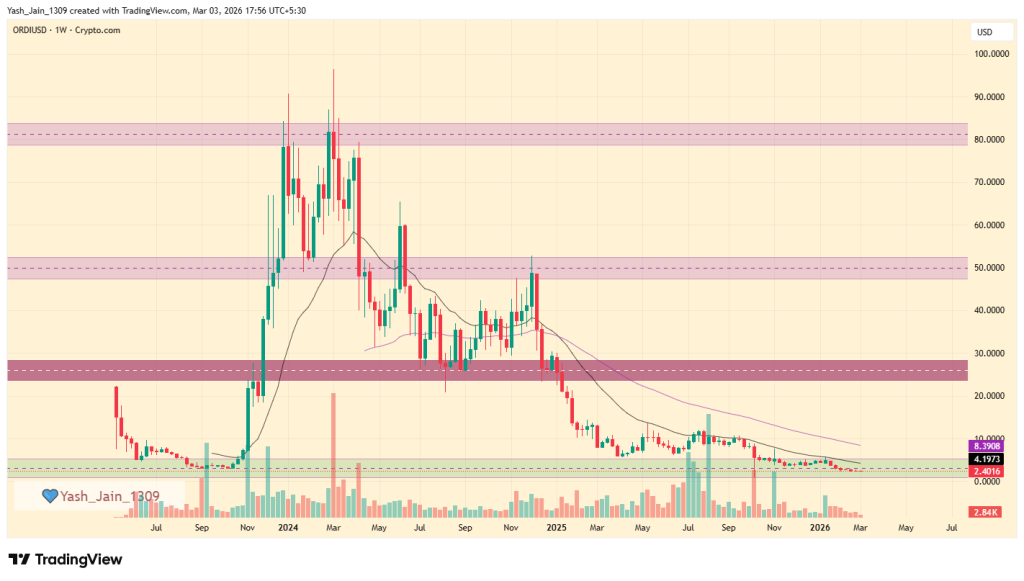
The weekly chart for Ordinals (ORDI) highlights a critical technical juncture as we move through the first quarter of 2026. After a prolonged period of bearish dominance, the price has returned to the very foundation of its historical market structure.
The 2026 Bottoming Pattern? ORDI is currently undergoing a significant consolidation phase within the $1.00 to $5.00 demand zone. This accumulation range is of paramount importance; it is the exact same launchpad that ignited the legendary late-2023 rally, where the asset surged from a low of $2.75 to a staggering peak of $95.00, delivering gains exceeding 3,300%.
Following that historic high, the past two years have seen a consistent downtrend. However, the Q1 2026 return to this primary demand area suggests that the “selling exhaustion” phase may be nearing completion.
Moreover, the immediate focus for bulls is a decisive breakout above the $5.00 level from resistance to support, which is the primary requirement for a short-term trend reversal.
Once $5.00 is reclaimed, the path clears for a swift move toward the $8.00 to $10.00 liquidity pocket.
Macro Target: Should broader market sentiment shift to “risk-on,” the explosive nature of the Ordinals protocol could drive the 2026 recovery target to $30.00, representing substantial odds of recovery from current accumulation levels. But if it doesn’t happen, then consolidation in this demand area may stretch.
Ordinals (ORDI) price prediction 2027-2032
Year
Minimum Price ($)
Maximum Price ($)
Average Price ($)
2027
6.40
27.60
16.50
2028
19.10
40.90
29.50
2029
23.00
55.75
33.50
2030
38.50
62.50
49.00
2031
47.00
72.00
57.90
2032
57.50
85.90
68.50
Ordinals (ORDI) Price Prediction 2027
The outlook for 2027 suggests a substantial expansion in market valuation. ORDI is expected to trade within a wide range of $6.40 to $27.60, maintaining a healthy average price of $16.50 as it consolidates its position in the Bitcoin ecosystem.
Ordinals Crypto Price Prediction 2028
Building on the momentum of the previous year, 2028 could see ORDI breaking into new territory. Projections indicate a minimum price of $19.10 and a potential peak of $40.90, with an anticipated average trading cost of $29.50.
ORDI Price Prediction 2029
By 2029, the maturation of BRC-20 utility is expected to drive prices further. The token is projected to range between $23.00 and $55.75, resulting in a yearly average of approximately $33.50.
Ordinals Price Prediction 2030
Entering the new decade, Ordinals is forecast to show significant strength. Analysis suggests a price floor of $38.50 and a maximum surge toward $62.50, with investors looking at an average price of $49.00.
ORDI Coin Price Prediction 2031
The upward trajectory is expected to intensify in 2031. The highest projected price for the year reaches $72.00, while the minimum is expected to hold firm at $47.00, averaging out to $57.90.
Ordinals (ORDI) Price Prediction 2032
Looking toward 2032, the Ordinals protocol estimates a continued bullish trend. ORDI is expected to fluctuate between $57.50 and $85.90, with an average market price of $68.50.
Never Miss a Beat in the Crypto World!
Stay ahead with breaking news, expert analysis, and real-time updates on the latest trends in Bitcoin, altcoins, DeFi, NFTs, and more.
FAQs
What is Ordinals (ORDI) in crypto?
Ordinals (ORDI) is the first BRC-20 token built on Bitcoin using the Ordinals protocol, allowing data to be inscribed on satoshis and traded like digital assets.
What is the ORDI price prediction for 2026?
ORDI could trade between $1 and $30 in 2026. A breakout above the key $5 resistance may trigger recovery momentum toward the $8–$10 range.
How much will ORDI coin be worth in 2030?
By 2030, ORDI could trade between $38 and $62, with an estimated average near $49, if adoption of Bitcoin Ordinals and BRC-20 tokens continues to grow.
What factors could drive ORDI price growth?
ORDI growth may depend on Bitcoin ecosystem adoption, BRC-20 token usage, NFT demand on Bitcoin, and overall crypto market sentiment.
Can ORDI reach $100 again?
Reaching $100 would require strong adoption of Bitcoin Ordinals and a major market cycle. While possible long-term, it depends on demand and ecosystem growth.
SHIB enters a key demand zone in 2026, with potential for breakout or gradual recovery if bulls hold support and market momentum strengthens.
Long-term outlook remains positive, with SHIB potentially reaching up to $0.000130 by 2030 as adoption, demand, and ecosystem growth improve.
Shiba Inu (SHIB) is a decentralized cryptocurrency operating within the Ethereum ecosystem and remains one of the most actively traded meme-based digital assets in the market. After experiencing extended price corrections over the past cycle, SHIB entered 2025 under sustained consolidation, with volatility gradually compressing near long-term support levels.
While recent price action has remained range-bound, technical structure suggests that SHIB may be approaching a multi-year inflection point. As compression continues and market participation rebuilds, attention now shifts to whether 2026 can initiate a new macro expansion phase for SHIB.
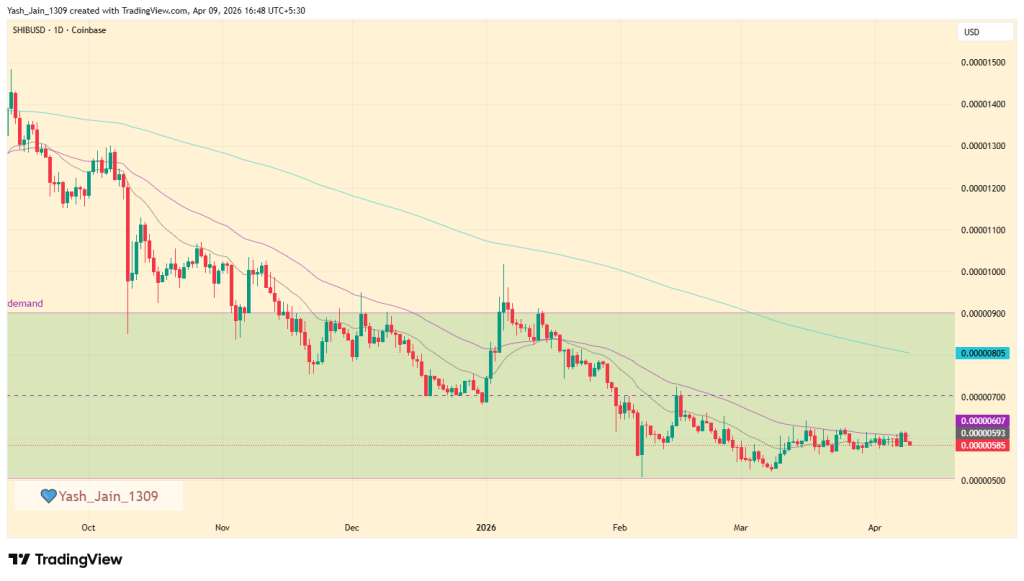
On the daily chart, the SHIB price is currently situated within a consolidation box, nestled inside a long-term accumulation range that has developed over several years. Notably, during the first quarter, the price dipped to the lower boundary of this range at $0.00000500.
However, since mid-March, we have observed a significant surge in bullish demand, indicating a likely retest of the mid-range level at $0.0000070 in April. Should this positive momentum wane, we might see a return to the support level of $0.0000050 within this framework.
SHIB News / Opinions
Biconomy has announced a significant update for Shiba Inu enthusiasts, offering up to 380% APR in rewards through their $SHIB Earn Products. This promotion, launched on February 10, invites users to subscribe and maximize their holdings via these high-yield decentralized finance incentives.
Shiba Inu Price Prediction 2026
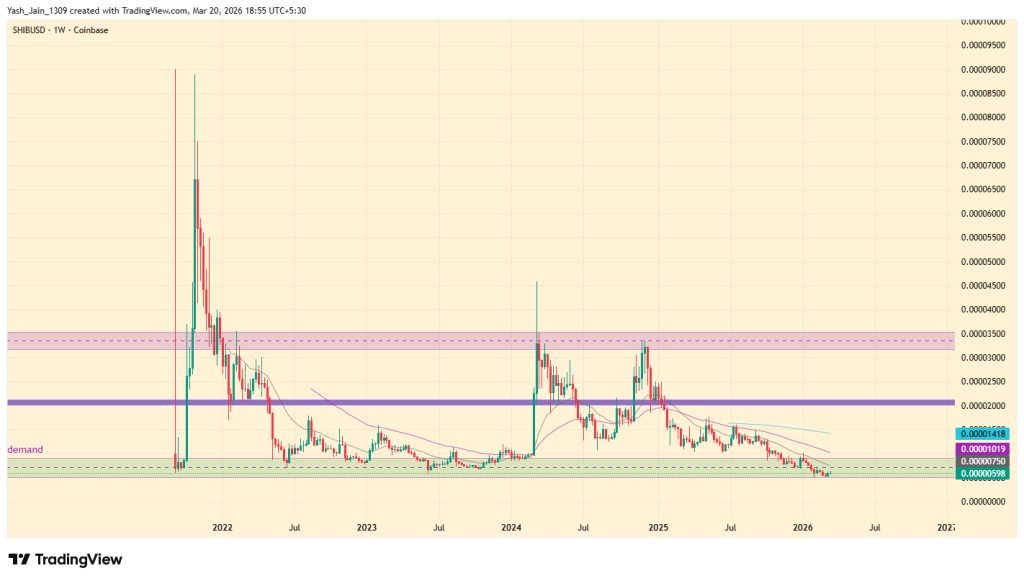
The weekly chart for Shiba Inu (SHIB/USD) shows the price descending into a historically significant and “spectacular” demand zone as of Q1 2026. This green-shaded accumulation area has acted as a powerful springboard in the past, most notably fueling the parabolic rallies of late 2021 and the aggressive surge in early 2024. The current price action suggests that SHIB is once again entering a phase of high-interest absorption, where long-term holders typically begin positioning for the next major market cycle.
While the symptoms of a potential 2026 breakout are building, history indicates two possible paths forward. A high-volatility spike could see SHIB rapidly reclaim higher resistance levels, mirroring its previous explosive moves. However, if a massive breakout does not materialize immediately, the asset is likely to follow a more measured, “gradual” recovery path. In this conservative scenario, the initial recovery targets would focus on reclaiming the 200-day EMA and establishing a foothold in the $0.00001600 to $0.00001800 range.
Regardless of the speed of the move, the primary narrative remains the defense of this multi-year demand floor. The ability of the bulls to hold this level throughout the first half of 2026 will be the deciding factor in whether SHIB undergoes a rapid repricing or a steady, trend-following climb toward its mid-term resistance clusters.
SHIB Crypto Price Prediction 2026 – 2030
Year
Estimated Low Price
Estimated High Price
Estimated Average Price
2027
$0.0000200
$0.0000300
$0.0000150
2028
$0.0000250
$0.0000500
$0.0000350
2029
$0.0000340
$0.0000790
$0.0000650
2030
$0.0000580
$0.0001300
$0.0000950
Shiba Inu Coin Price Price Prediction 2027
Shiba Inu (SHIB) price range can be between $0.0000200 to $0.0000300 during the year 2027.
Shiba Inu Memecoin Price Forecast 2028
In 2028, Shiba Inu is forecasted to potentially reach a low price of $0.0000250, and a high price of $0.0000500.
SHIB Coin Price Targets 2029
Thereafter, the SHIB price for the year 2029 could range between $0.0000340 and $0.0000790.
SHIB Coin Price Prediction 2030
Finally, in 2030, the price of SHIB is predicted to maintain a steady and positive. It may trade between $0.0000580 and $0.0001300.
Based on the historic market sentiments and trend analysis of the largest cryptocurrency by market capitalization, here are the possible SHIB price targets for the longer time frames.
Year
Potential Low ($)
Potential Average ($)
Potential High ($)
2031
0.000220
0.000340
0.000480
2032
0.000260
0.000400
0.000580
2033
0.000310
0.000500
0.000700
2040
0.000550
0.000850
0.001300
2050
0.000900
0.001500
0.002300
SHIB Price Prediction: Market Analysis?
Year
2026
2027
2030
Changelly
$0.000085
$0.000140
$0.000320
DigitalCoinPrice
$0.0000920
$0.000150
$0.000350
WalletInvestor
$0.0000340
$0.0000520
$0.0000980
Never Miss a Beat in the Crypto World!
Stay ahead with breaking news, expert analysis, and real-time updates on the latest trends in Bitcoin, altcoins, DeFi, NFTs, and more.
FAQs
What is the Shiba Inu (SHIB) price prediction for 2026?
SHIB price predictions for 2026 range between $0.0000200 and $0.000099, depending on whether the token confirms a long-term breakout.
What could drive SHIB price growth by 2030?
Growth could come from adoption, token burns, DeFi expansion, and a stronger crypto market pushing demand higher over time.
Will Shiba Inu reach $1 dollar by 2040?
Reaching $1 is highly unlikely due to SHIB’s large supply, requiring massive market cap growth far beyond realistic projections.
What will Shiba Inu be worth in 2050?
By 2050, SHIB could reach between $0.000900 and $0.002300 depending on long-term adoption, burns, and crypto market expansion.
What are the main factors influencing SHIB price growth?
SHIB’s price is driven by market sentiment, token burns, ecosystem development, overall crypto cycles, and broader risk appetite.
Is Shiba Inu a good investment for the long term?
SHIB may have long-term potential with ecosystem growth, but it remains volatile, so investors should carefully manage risk.
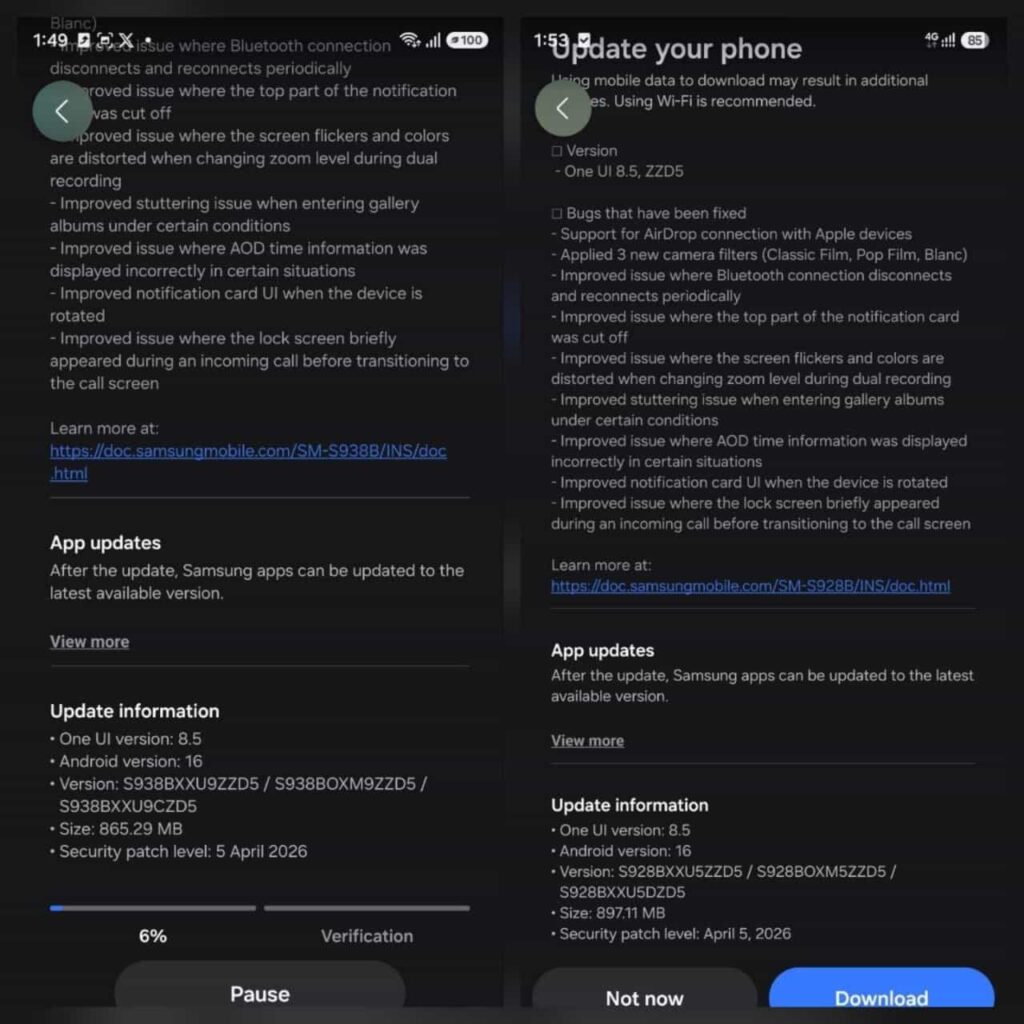
With new One UI 8.5 Beta updates, Samsung has fresh perks for the users of Galaxy S25 and S24 series: AirDrop sharing and three new camera filters.
Samsung just dropped One UI 8.5 Beta 9 and Beta 2 updates for the S25 and S24 series, respectively. Changelog of both updates carry exact the same content, even the ending of the PDA version is also the same.
What’s impressive is the addition of AirDrop support and new camera filters.
AirDrop sharing update
Users of the S25 and S24 phones can now share files with iPhone users. Quick Share has been upgraded with AirDrop support.
The upgraded Quick Share allows you to transfer photos, videos, and other supported files across Android and iOS. The best part: neither party needs to install any other app; just the preinstalled apps work.
Samsung first brought AirDrop support to the Galaxy S26 series. We heard in the past that an expansion is being planned for various devices. With the latest Beta builds, AirDrop is no longer exclusive to the Galaxy S26 series.
Camera filters
Samsung’s release notes also mention the addition of three new camera filters, namely Classic Film, Pop Film, and Blanc. Thanks to the new filters, Galaxy Camera now has an even wider set of presets to assist in photography.
Apart from this, the updates bring various improvements and bug fixes. The aim is to optimize the system stability and reliability. Rumors say Beta 10 would also arrive, which could drop sometime around April 20.
Samsung will reportedly supply its best M16 OLED display to Apple and Google for iPhone 18 Pro and Pixel 11 smartphones. The industry report has no mention of the Galaxy S27 series, sparking uncertainty about key hardware.
Apple and Google get first access to M16
According to ETNews, Samsung Display will supply OLED panels using the M16 organic material set for the Google Pixel 11 series, Apple’s iPhone 18 Pro and Pro Max, as well as a foldable iPhone set to launch later this year.
Samsung develops its highest-performance OLED panels for flagship phones using its latest material sets, known as the “M” series. The M16 set is said to deliver top-level performance in brightness, color, lifespan, and power efficiency.
Samsung’s own flagship lineup?
Samsung Display is standardizing its second-half flagship OLED shipments around M16. This is the successor to M14, the same material set that powered the iPhone 16 Pro and later expanded into the iPhone 17 lineup.
Google is also stepping up. The Pixel 11 series joins the list, meaning two of Samsung’s biggest external customers are getting its best display tech at the same time.
Meanwhile, there is no clear confirmation that the Galaxy S27 series will launch with M16. If history is any guide, Samsung tends to lag one generation behind in adopting the newest material set.
Samsung Display is moving fast, and its external clients are benefiting first. As a result, you could soon have an iPhone 18 Pro or Pixel 11 with a more advanced OLED stack than the Galaxy S27.
Samsung officially launched One UI 8.5 Beta Program for the Galaxy A36. This activity allows Samsung users to enjoy the latest software before its public release.
To get the Beta software, you need to complete a simple sign-up process. Once done, your device will receive the Beta firmware over the air, opening up a whole new experience.
Galaxy A36 5G’s One UI 8.5 Beta is available in India. Users interested in joining the test can register through the Samsung Members app. Make sure your phone has a SIM card inserted and Samsung Account logged in.
Open Samsung Members > tap Beta Program banner > hit Enroll. You will need to give your consent to the terms and conditions of the Beta Programme. Once done, wait for a few minutes so your participation is verified.
Now, head toward your phone’s Settings, followed by Software update page. Here, hit the Download and install button so your device fetch the latest firmware. Once completed, hit Install/Restart now to finish the installation process.
One UI 8.5 Beta has reached a decent level of stability. It can also be installed on your primary device if you are eager to test out advancements. Make sure to create a backup before initiating the Beta participation process.
Samsung has rolled out the One UI 8.5 Beta 2 update for the Galaxy S25 FE. This release follows the recent Beta rollouts to the Galaxy S25 and S24 lineups. Samsung will soon push the second Beta update to the Galaxy S24 FE.
However, unlike recent updates for the Galaxy S25 and Galaxy S24 series, the second One UI 8.5 Beta still misses the new AirDrop-style sharing feature, which is also expected to be absent on the Galaxy S24 FE for now.
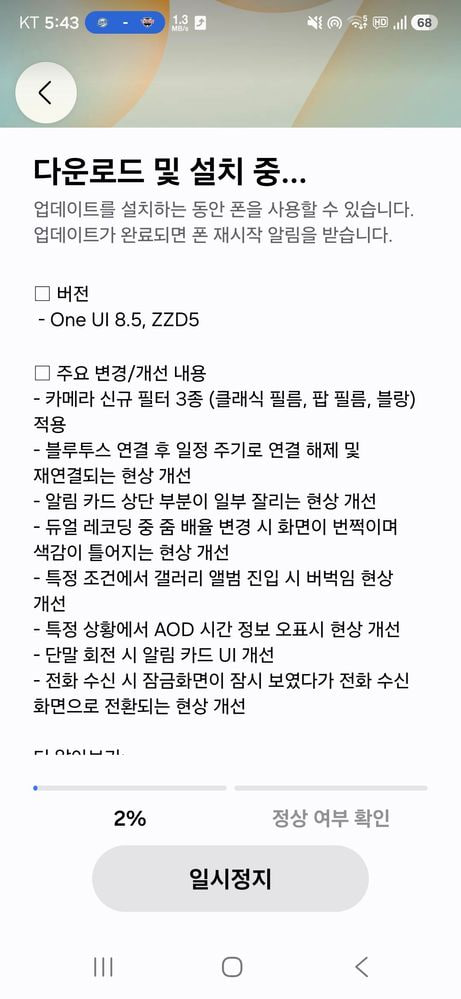
One UI 8.5 Beta 2 for Galaxy S25 FE focuses mainly on polishing the experience rather than adding major features. The update brings three new camera filters and improves overall system stability to improve the user experience.
Annoying bugs have been addressed, including Bluetooth connection drops, notification card clipping, and flickering during dual recording. Samsung also reduced Gallery lags and fixed incorrect AOD time display in certain situations.
There are also small but noticeable UI refinements, like smoother notification behavior during screen rotation and a fix for the lock screen briefly appearing before incoming calls. Overall, it’s a cleanup update aimed at improving day-to-day usability.
Samsung just released the latest Beta updates for Galaxy flagships. The Galaxy S25 series is getting the One UI 8.5 Beta 9 and the Galaxy S24 series is getting One UI 8.5 Beta 2.
The latest ZZD5 build is available in India, and the expansion will cover more countries, including Germany, Poland, South Korea, the UK, and the US.
One UI 8.5 Beta 9 for Galaxy S25 and Beta 2 for Galaxy S24 bring a mix of useful features and small fixes. The biggest highlight is support for AirDrop connection with Apple devices, making file sharing easier.
The camera gets three new filters called Classic Film, Pop Film, and Blanc, giving users more creative options. The filters derived from the latest flagships as part of offering more ways to capture your moments.
Samsung has also fixed issues like Bluetooth randomly disconnecting and notification cards appearing cut off at the top. Several visual and performance problems have been improved across the system.
These include screen flickering during dual recording zoom, stuttering when opening gallery albums, and incorrect AOD time display in certain situations.
Samsung also refined the overall interface for better usability. Notification cards now behave properly when rotating the device, and the lock screen no longer flashes briefly during incoming calls before switching to the call screen.
Samsung is now rolling out the April 2026 update to the Galaxy S25 series in Europe and India. After an initial drop in South Korea, it’s the first expansion, covering prominent markets before reaching the United States.
Galaxy S25, S25+ and S25 Ultra are receiving April 2026 security update in Europe and India. Users can identify the update via PDA number ending with BZCH. The firmware weighs roughly 530 megabytes, as per TarunVats.
Samsung’s April patch contains 47 improvements for Galaxy devices. The complete SMR carries fixes from Google and Samsung for Android and One UI. If your device has Exynos chip, there are four specific fixes included.
One UI 8.5 Beta is also available in Europe, India and the US. April patch has only arrived for those avoiding the Beta testing. To check for updates, navigate through Settings > Software update > Download and install.
Samsung is close to releasing the 9th Beta update. It would also include the April 2026 security patch. The Beta rollout is anticipated this week, and we may see a surprise drop even today as well.
April patch has also arrived for Galaxy A55 and Galaxy A56 in South Korea. Both phones will likely be joining the One UI 8.5 Beta activity later this month.
Galaxy S26 Ultra is selling beyond expectations, with Samsung reportedly increasing April 2026 production. The news comes out from a Korean outlet, which also indicates that the May forecast has been reduced.
According to ZDNet, Samsung is ramping up the production of Galaxy S26, S26+ and S26 Ultra to keep selling at scale in April 2026.
Information pulled from supply chain sources suggests that the South Korean tech giant is aiming for an output of 3 million units this month. The revised production plan is up by 600,000 units, as compared to the initial target.
April 2026 expected output:
Galaxy S26 – 1.3 million (+500,000)
Galaxy S26+ – 200,000 (-100,000)
Galaxy S26 Ultra – 1.5 million (+200,000)
All focus is on the Galaxy S26 Ultra, which is set alone for a total production of the base and Plus versions. Galaxy S26 Plus, in comparison, has a very small target of just 200,000 units, which isn’t new if you’re a seasoned Samsung reader.
Last but not least, the report mentions that the company may have reduced its production target for May 2026. Samsung decides output based on demand from analysis and future scope, and May could see a cut in production.
What’s notable this year is that the Ultra model accounts for over 60–70 percent of total S26 sales. Even in the past, the Galaxy S Ultra made up about half of S-series sales, but this year its share is especially high.
Privacy Display is the biggest feature pushing the sales of the Galaxy S26 Ultra. The chip choice, Snapdragon-exclusivity, is another reason encouraging buyers to consider the Ultra flagship in countries where Exynos exists.
Samsung is preparing something bigger than a routine launch. Word from the Korean supply chain suggests Samsung plans to launch the Galaxy Z Fold 8, Z Wide Fold, and Flip 8 on July 22, 2026, in London, UK.
If accurate, it will be the first time Samsung unpacks its strategic devices in the city of London. This is not just about a new venue; it is positioning, via WowTV Korea.
Europe is where the premium market is tightening, and where Apple is quietly gaining ground. Samsung still leads with roughly 35 percent share, but Apple sits close behind at 27 percent.
The spotlight will fall on three devices: Galaxy Z Fold 8, Galaxy Z Flip 8, and a new entrant insiders are calling the “Wide Fold.” Samsung is said to be moving toward a 4:3 aspect ratio, a noticeable shift from the taller, narrower foldables.
It closely mirrors what’s expected from Apple’s foldable iPhone. The device is tipped to come in about 0.5mm thinner than Apple’s rumored foldable. If these confirmation points hold steady, Samsung is not waiting to react; it is preempting.
S Pen is making a return
Samsung had quietly stepped back from stylus support in the Galaxy Z Fold 7 due to thickness and weight constraints. The report indicates that Samsung might reintroduce stylus support on the foldable phone, probably the Wide Fold.
Bringing back S Pen support on a thinner chassis tells you a lot about how far the engineering has come. It also reopens a key differentiation point that Apple still does not match in the foldable space.
If this Unpacked plays out as expected, July 22 could set the tone for the next phase of the foldable race.
Samsung’s Galaxy A37 and Galaxy A57 are now available for purchase in the US. Launched back in March 2026, the two mid-range phones went on sale stateside, with Samsung offering up to a $210 discount to early buyers.
Galaxy A37 5G
Galaxy A37 comes in 128GB and 256GB memory variants, pairing 8GB of RAM. The device starts at $450 for the base version, and goes up to $539 for the higher memory variant.
Colors:
Awesome Lavender
Awesome Charcoal
Galaxy A57 5G
Galaxy A57 comes in two memory configurations, both featuring 8GB of RAM. This smartphone comes with a price tag of $550, and spending an additional $60 doubles the storage to 256GB.
Colors:
Awesome Navy
Samsung lets you save up to $210 toward the purchase of the Galaxy A37 and Galaxy A57. It includes a trade-in credit of up to $180 and a $30 instant Samsung Credit.
Besides, you get up to 30 percent off select buds and cases with your purchase.
Notably, Samsung announced 12GB RAM variants for the Global market. However, the official website doesn’t list that version in the US. The move seems driven to present the A57 behind the S25 FE due to pricing decisions.
Galaxy S25 FE is a better option even without stretching your budget. The 256GB model, which originally cost $750, is currently $600. Opting for the base, 128GB model, saves another $100, without compromising on experiences.
Galaxy S26 series debuted enhanced Photo Assist and Log Video feature upgrades, which Samsung reportedly plans to offer on older phones and tablets.
Tipster Alfaturk revealed on X possible lists of Samsung phones and tablets, which could receive the enhanced Photo Assist and Log Video feature upgrades from Galaxy S26 series.
Powered by Galaxy AI, Photo Assist is Samsung’s native photo editing solution. With the Galaxy S26 series, it has gained some useful perks such as editing across versions. It also added a text input option for precise outputs.
Enhanced Photo Assist
Samsung may expand the new Photo Assist to these Galaxy phones, foldables and tablets:
Galaxy Z TriFold
Galaxy Z Fold 7 and Z Flip 7
Galaxy Z Flip 7 FE
Galaxy S25, S25+, S25 Edge and S25 Ultra
Galaxy S25 FE
Galaxy Z Fold 6, Fold SE and Z Flip 6
Galaxy S24, S24+ and S24 Ultra
Galaxy S24 FE
Galaxy Tab S10 series
Galaxy Tab S11 series
Log Video is another impressive feature, available on select Samsung devices. The Galaxy S26 flagships allow users to add colors to the Log Video footage on the fly. This added convenience is getting ready for many more devices.
Log Video colors
Samsung may offer the ability to add colors to videos recorded in Log mode on various phones, foldables and tablets, including:
Galaxy Z TriFold
Galaxy Z Fold 7 and Z Flip 7
Galaxy Z Flip 7 FE
Galaxy S25, S25+, S25 Edge and S25 Ultra
Galaxy S24, S24+ and S24 Ultra
Galaxy Z Fold 6, Fold SE and Z Flip 6
Note that the list is based on inputs from the community forum and moderators. Samsung usually distributes software-driven perks to existing devices. The rollout is expected to happen as part of the Stable One UI 8.5 update.
WhatsApp is rolling out username support to users right now, letting people ditch the phone number requirement. It’s a phased rollout, limited for now, but it’s real and it’s moving.
WABetaInfo spotted the WhatsApp username feature surfacing in the latest Beta builds on both Android and iOS platforms. You won’t see it unless the rollout has hit your account specifically, which is the annoying part.
Want to check? Open WhatsApp, go to Settings, then Profile.
Right now, sharing WhatsApp access means handing over your phone number. A username system changes that: someone can reach you without ever knowing your phone number digits.
WhatsApp still requires a phone number to create and run an account.
Usernames sit between 3 and 35 characters, can only use lowercase letters, numbers, periods, and underscores, and must contain at least one letter.
WhatsApp is introducing something called a username key alongside this rollout. It’s a 4-digit code that someone needs to send you a message via username.
A username system shifts how people share contact information. It could quietly reduce how often Samsung users feel compelled to use other apps for privacy reasons.
Signal, Telegram, and others built identity around usernames years ago. WhatsApp is late to this.
The world’s top 10 best-selling smartphones have been revealed and five of them were Android, including the Galaxy S25 flagship.
Apple owned the fourth quarter of 2025, five spots in the global top 10. Samsung managed four, and the one Android that outsold everything else was not the Galaxy S25 Ultra; it wasn’t even a top-tier flagship.
iPhone 17 Pro Max led the entire Counterpoint list, with the iPhone 17 and Pro stacking up right behind it. The standard iPhone 17 punched harder than its predecessor this cycle, because Apple finally stopped embarrassing itself on specs.
The Galaxy A56 was the best-selling Android smartphone globally for the quarter, trailed closely by the A36 and the budget-tier A07. Three of Samsung’s four top-10 spots went to mid-range and entry-level devices.
So where did the Galaxy S25 Ultra land?
Well, Samsung’s Galaxy S25 Ultra didn’t make the list at all. The base S25 scraped into tenth place, helped along by second-half promotions. Samsung’s flagship device couldn’t crack the top nine without a sale pushing it there.
That said, the S25 Ultra is a genuinely impressive device that most of the world has no intention of buying.
Xiaomi’s Redmi A5 took ninth, driven by demand across Latin America and the MEA region. Samsung keeps betting big on flagships and AI capabilities.
The market keeps buying A-series phones and Redmi handsets. That gap between Samsung’s strategy and Samsung’s actual sales mix has been widening for years.
With the debut of the APV (Advanced Professional Video) codec on the Galaxy S26 Ultra, Samsung is not just improving mobile video; it is laying the groundwork for smartphones to step into real production workflows.
Regarding the APV codec, Samsung developers are hinting at something bigger, a future where a Galaxy Ultra device is not just capable of shooting cinematic content, but is trusted in actual film production environments.
When asked, “As a developer from the Visual Solution Team, what are your plans going forward?”
Samsung’s Sunmi Yoo responded:
We plan to continue advancing the codec so that both users and creators can find even greater value in Galaxy-based video editing. Through APV, we look forward to the day when Galaxy S26 Ultra is even used in film production environments.
Samsung didn’t exactly reveal its plans for the APV codec. However, the functionality will continue to be improved with each major generation of Galaxy. The next wonder, we may see happening sometime in July this year.
Developed in collaboration with Samsung Research and standardized through the Internet Engineering Task Force, the codec is built with editing in mind. It preserves more visual data while still maintaining efficient compression.
Samsung claims an over 10 percent reduction in file size at the same quality level compared to similar codecs. Smaller files mean faster transfers, less strain on storage, and smoother timeline performance.
More importantly, APV supports YUV 4:2:2 color sampling. Compared to the 4:2:0, 4:2:2 retains significantly more color information, impacting color grading. Samsung is essentially bringing semi-professional color fidelity.
Samsung is expected to outclass NVIDIA in profits next year despite a smaller market cap. The company just posted earnings guidance for Q1 2026, estimating operating profit of nearly $42 billion in a single quarter. That’s a 755% jump over the same period last year.
We just reported that Samsung made more money in one quarter of 2026 than it did in the entire year of 2025. The memory chip market has been building toward something like this for a while; HBM demand exploded and AI infrastructure build-outs accelerated.
Every hyperscaler on the planet needed more memory, faster, and Samsung is the company that makes the stuff the entire industry runs on. KB Securities (via Jukan) projects Samsung’s full-year operating profit at $221 billion in 2026, and the 2027 projection sits at $330 billion.
KB Securities’ 2027 forecast for NVIDIA falls below $330 billion. If Samsung hits that target, it becomes the most profitable company on the planet by operating income, and it would do it while carrying a market capitalization that’s roughly 19% of NVIDIA’s.
Analysts tracking the memory cycle believe it hasn’t peaked. We’re sitting at the midpoint, with prices still having room to climb. Samsung’s own guidance suggests the company knows it.
The most profitable company in the world might not be the one building the AI future. It might be the one quietly selling the memory it runs on, and that should make Big Tech a little uncomfortable.
Bookmark this. KB Securities expects Samsung to make more money than Nvidia next year. pic.twitter.com/KNlDOG3gEd
Coinbase stock price teased a bullish spike but then hesitated at the worst possible moment. The recent move up toward $189 looked promising, especially coming off that February support zone around $140–$160. That area isn’t random either as it lines up with a two-year-old demand zone. So naturally, buyers showed up.
But let’s not get carried away. The top crypto exchange company’s stock is still restricted by the 50-day EMA as it is still acting like a ceiling, and until that flips, this isn’t a breakout as it’s just another test, because in today’s attempt it didn’t break through. Also, Multiple attempts have already been rejected at this dynamic level, which tells that there’s still supply sitting overhead.
Still, the structure isn’t completely bearish in the short term. Price has been grinding higher with small resets, which usually signals some level of accumulation. The question is whether that’s enough.
Death Cross Still Dominates The Bigger Trend
Now for the uncomfortable part. Back in mid-December 2025, Coinbase stock printed a death cross and it hasn’t exactly invalidated it since. The gap between the moving averages remains wide, which basically screams that bearish momentum hasn’t gone anywhere.
So even though the recent bounce looks nice on the surface, zoom out and the trend still leans heavy to the downside.
Indicators aren’t doing bulls any favors either. OBV is sitting at -45.58 million, well below the zero line. CMF? Negative 0.19. That’s not exactly a flood of capital rushing in but it’s more like cautious dipping of toes.
Accumulation Zone Builds Quietly Below Resistance Levels
But interesting part is that $140–$160 range isn’t just support but it’s turning into an accumulation zone. Price keeps revisiting it, bouncing, and then pushing higher. That kind of behavior usually means someone’s buying… just not loudly.
If COIN price can finally flip the 50-day EMA, there’s a clear path toward $240. That’s roughly a 30% move from the current ~$182 range. Not guaranteed, obviously, but technically clean.
Until then? It’s a waiting game.
Coinbase Expands Globally With New License Approval
Meanwhile, on the fundamentals side, Coinbase isn’t exactly sitting still. The exchange just secured an Australian Financial Services Licence with retail derivatives authorization. Translation: it can now roll out crypto and equity perpetuals in Australia, with options expected later.
That’s a big step toward its “Everything Exchange” ambition. And let’s not forget that Coinbase still holds 15,876 BTC, making it one of the largest corporate holders out there. So yeah, it’s not just a trading platform. It’s deeply tied into the broader crypto ecosystem.
So, if Coinbase stock can reclaim that EMA level, momentum could flip fast. But if it keeps getting rejected, that accumulation zone might get tested again and harder.
Why Coinbase’s Recovery Matters for Ethereum
Investors often look for a “Coinbase token,” but the exchange remains uniquely tied to the Ethereum ecosystem. While Coinbase’s Layer 2 network, Base, is a massive growth driver, it does not have a native token; instead, it utilizes ETH for all gas fees.
Technically, this creates a symbiotic relationship: if the Coinbase stock breaks its 50-day EMA resistance due to increased on-chain activity, it likely signals a surge in Base network usage. Because Base settles on Ethereum, a bullish breakout for COIN often serves as a fundamental tailwind for ETH, driving utility and demand for the asset as the underlying “gas” of Coinbase’s global expansion.
Samsung is upgrading the Galaxy S25 Ultra camera experience, bringing a new tool called Ocean Mode. This is the same feature Samsung built a couple of years ago to help map coral reefs and monitor underwater ecosystems.
An Expert RAW update pushed to the S25 Ultra running One UI 8.5 Beta, specifically version 5.0.08.2, appears to have brought Ocean Mode. It was never meant for your average consumer, but the Galaxy S26 Ultra got it first.
Earlier this year, the company signaled Ocean Mode would go public, and now here it is, landing on the Galaxy S25 Ultra through a Beta firmware update.
Ocean Mode uses algorithms to correct the color distortion and visual warping that happens the moment you point a camera at anything underwater.
Samsung’s Galaxy phones carry IP ratings for fresh water. Ocean Mode is a camera algorithm. It corrects what your lens captures underwater. It does absolutely nothing to the physical integrity of your device.
Use a proper waterproof housing for anything serious. Don’t let a software feature create a false sense of security about hardware limitations that haven’t changed.
Whether this stays locked to the S25 Ultra or spreads to the S24 Ultra in the coming weeks is the question worth watching.
Galaxy S26 Ultra is the first phone that features built-in Privacy Display technology. We’ve already heard that this technology will be adopted by Chinese phone makers later this year.
Market research firm Sigmaintell (via TheElec) projects global smartphone shipments featuring privacy display technology will climb from 1 million units in 2025 to 21 million in 2026.
It’s going to be a 20-fold jump in twelve months; then 29 million in 2027, a roughly 40 percent year-over-year increase. Numbers like that don’t happen by accident; Galaxy S26 Ultra opened the door for this segment.
Huawei and Xiaomi are reportedly weighing their own versions. Oppo and Vivo are said to be deep in development. When Samsung moves on something premium, the rest of the Android field doesn’t wait around to see how it plays out.
Sigmaintell thinks this technology moves into foldables next. However, this technology currently carries penalties in resolution and brightness. Well, nobody should expect this in next year’s Z Fold without serious groundwork being laid first.
The forecast says 29 million units by 2027. Samsung got here first. The question now isn’t whether privacy displays become standard in premium Android. It’s whether anyone catches up before Samsung makes the gap embarrassing.
We are in the second week of April, the likely timeline when Samsung could rollout new One UI 8.5 Beta updates for Galaxy S25, S24 and S23 series.
One UI 8.5 Beta Program is already open for Galaxy S25 and S24 series, whereas the Galaxy S23 lineup may mark its entry this April. Newly discovered builds are the same across all lineups, signaling a good pace of testing.
Users of the Galaxy S25 series will get the 9th Beta, while the Galaxy S24 series users will get the 2nd Beta. Users of the Galaxy S23 series will join the Beta Program, with signups bringing them the 1st build over the air.
Next One UI 8.5 Beta builds could be as follows:
Galaxy S25 Series → ZZD5
Galaxy S24 Series → ZZD5
Galaxy S23 Series → ZZD5
Galaxy S25 series may also receive the 10th Beta update. The rollout is expected to take place on 20th of April. We also heard that the public release could begin at the end of this month, while Global expansion may happen on May 4.
Samsung has officially released the One UI 8.5 on March 11. Galaxy S26 series comes preinstalled with the latest version of the software. Older devices will likely begin grabbing the official update sometime in May this year.
New One UI 8.5 beta builds spotted
• Galaxy S25 Series → ZZD5 • Galaxy S24 Series →ZZD5 • Galaxy S23 Series → ZZD5
It seems the development and testing of Samsung’s Exynos 2700 chipset is progressing well as its CPU hit Geekbench for the first time.
In its first appearance, Samsung’s Exynos 2700 posted a 2,603 single-core score and 10,350 multi-core on Geekbench CPU, via AbhishekYadav. The chip runs a deca-core configuration, which is already interesting.
One prime core sits at 2.78GHz, four performance cores at 2.88GHz, then a middle cluster of four at 2.40GHz, plus a single low-power core at 2.30GHz. Paired with the Xclipse 970 GPU, the tested unit pulled an OpenCL score of 15,618.
The prototype device ran Android 16 with 12GB of RAM onboard. And yes, that means Samsung is already deep into the OS development for the S27 lineup.
Samsung has been fighting to reclaim Exynos credibility since the 2200 generation embarrassed them globally. Every benchmark entry between now and launch will be scrutinized harder than any Qualcomm chip ever faces.
The company is rumored to use an enhanced 2nm process in manufacturing the Exynos 2700. It would be used in the Galaxy S27 and S27 Plus, and the utilization rate will increase as compared to the Galaxy S26 series.
Exynos 2600, used in the S26 and S26+, turned out to be a huge success. It still lags behind its Snapdragon counterpart, but it has significantly solidified Samsung’s credibility in the mobile processor and Foundry market.
It’s said that the S27 lineup may add a Pro version, while keeping the three unchanged. That said, the range would bring S27, S27+, S27 Pro, and S27 Ultra. These are just early rumors, and the product plan may change as well.
Samsung just shipped the April 2026 security update to the Galaxy S24 and S23 series, including FE models. The rollout follows the recent opening for the Galaxy S25 series, which followed the wider availability of the Galaxy S26 series.
The April 2026 update is now available for download on the Galaxy S24, S24 FE, S24+, S24 Ultra, S23, S23 FE, S23+, and S23 Ultra devices. The rollout has only started in SouthKorea, with wider availability following in the next few days.
Samsung yesterday revealed the details of its April 2026 security patch. The OTA carries forty-seven improvements for Galaxy users. If your device runs a Snapdragon chip, expect four fewer patches than Exynos devices.
Software update notifications may be delayed. You can speed up the process by manually fetching the latest firmware. To do so, open Settings, followed by Software update page and hit the Download and install.
One UI 8.5 Beta is available on the Galaxy S24 series. Samsung is preparing to kickstart the Beta testing for the S23 series. The Beta Program expansion will likely take place this month, while the exact timeline is unknown.
April patch sets the foundation for the Beta Program opening. If you’re a Galaxy S24 smartphone user and enrolled in Beta, it’s not the one for you. The security patch is based on One UI 8.0, which is based on Android 16.
Apple is locking in its foldable future and it’s doing it the Samsung way. The first foldable iPhone, tentatively named iPhone Ultra, will solely rely on Samsung Display and Apple might have already banned the entry of any other firm for three years.
Multiple industry sources confirm that Apple has agreed to source iPhone Ultra phone’s foldable OLED panels exclusively from Samsung Display for the next three years.
Samsung Display reportedly pushed for the deal first. Supplying a critical component to a direct rival like Apple always needs justification, especially when Samsung’s MX Division is competing head-on in premium phones.
BOE has made progress in foldables, shipping panels to Chinese OEMs; however, yields and durability remain sticking points at Apple’s quality thresholds. LG Display is even further behind with no commercial track record in foldable panels.
Production is expected to begin in Q2, with initial shipments pegged at around 3 million units this year. Even with Apple entering the segment, scaling too fast carries risk.
The foldable OLED panels will use CoE (Color filter on Encapsulation). It removes the polarizer, reducing thickness and minimizing stress in the folding area. Apple is also sticking with the M14 OLED material set, the same as iPhone 17 Pro.
Just like March, April is not a good month if you were planning to pick up a budget Samsung phone in India. We’re seeing a fresh round of price revisions across the Galaxy A, M and F lineup. No slow rollout, no silent tweaks; retail channels have already started updating tags.
Tipster AbhishekYadavflagged the changes, and from what we’re hearing on the ground, this aligns with what distributors were briefed earlier this week.
It’s a full sweep across the entry and lower mid-range portfolio. The kind of move Samsung usually avoids mid-cycle unless something breaks badly in the supply chain.
We’ve been tracking component pricing for months now, and the pressure has been building. DRAM and NAND prices have surged sharply this quarter, in some cases touching a 30 percent jump.
Samsung is both a supplier and a buyer in this game. It makes memory, but its smartphone division still operates on tight internal pricing. That matters a lot in India, where the Galaxy M and F series run on razor-thin margins.
Samsung Electro-Mechanics has been supplying glass substrate samples to Apple since last year and the AI chip industry is paying attention.
TheElec sources confirmed this week that Samsung’s advanced packaging division has been feeding Apple experimental substrate materials, the kind that replace the organic core inside traditional flip chip-ball grid array packaging with glass.
Apple’s AI server chip is being developed with Broadcom and is expected to be manufactured at TSMC. Samsung Electro-Mechanics is running a pilot glass substrate line, while mass production isn’t targeted until after 2027.
Samsung Electro-Mechanics has been running glass substrate trials with Broadcom since last year too. Broadcom sits at the center of the custom AI chip market, co-designing silicon with Google, Meta, OpenAI, and now Apple.
If Samsung locks in Broadcom as a customer, those substrates could end up inside chips built for half of Silicon Valley. But Apple coming directly to Samsung changes the texture of this story.
Apple has a documented habit of bringing things in-house. That said, the Cupertino giant doesn’t rely on a partner, study the space intensely, then quietly build the capability internally and cut the partner out.
Samsung has a totally killer plan for Bixby, and ultimately, you won’t be required to use apps on Galaxy devices. Bixby has been upgraded with LLM and the integration of Perplexity’s AI capabilities is a solid move.
On March 31, Samsung relaunched Bixby not as a smarter voice assistant but as what it calls a “device agent.” A voice assistant waits for commands, while an agent understands what you actually want and figures out how to get there
Jisun Park, Corporate Executive Vice President and Head of Language AI at Samsung’s Mobile eXperience division, laid out what that looks like in practice.
The new architecture puts an LLM at the core, which means Bixby now interprets intent rather than matching commands. Samsung rebuilt individual device functions as callable agents, each defined in a way the LLM can invoke on the fly.
Ask the new Samsung Bixby service to make your screen visible only to you and it activates Privacy Display. Tell it your eyes are tired and it recommends and switches on Eye Comfort Shield, right there in the conversation.
Bixby supports multiple languages, but Korean is structurally brutal for language models. Park said they surpassed their original Korean performance targets by a significant margin.
Samsung’s Bixby is already available across Samsung’s broader device lineup. You can tell your robot vacuum to start cleaning while you’re across town. You can flip on the air conditioning before you get home.
The phone becomes a control surface for the entire household. That’s the actual play here: a single conversational layer across every Samsung device you own.
Samsung and Apple flop the EU repairability report once again. Two of the most powerful phone manufacturers on the planet just got schooled by Motorola.
The “Failing the Fix 2026” report from the US PIRG Education Fund (via WIRED) dropped this week, and it’s not kind to the industry’s biggest names.
Apple pulled a D minus, the lowest grade among major brands surveyed.
Samsung wasn’t far behind with a D.
Motorola walked away with a B plus.
This isn’t the old French repairability index system. The report has shifted to the EU’s EPREL database, a framework designed to capture how repairs actually work in the real world, not just how manufacturers say they work on paper.
The scoring pulls from disassembly ease, spare parts availability, repair documentation access, standard tool compatibility, and declared software support duration.
Inside the EPREL system, Samsung lists only the regulatory minimum: five years of software support. Samsung scores the worst possible marks in the software category despite offering better coverage than most of its rivals.
Ease of disassembly now carries more weight than any other factor in the scoring. That shift hit Samsung and Apple harder than most.
Samsung’s scores were calculated from just five models because its EPREL listings are incomplete. The company had the opportunity to update its official regulatory disclosures, which may have improved its repairability scores.
A new experiment from Marques Brownlee (MKBHD) offers a rare, side-by-side look at how Samsung’s smartphone selfies from the original Galaxy S1 to the latest Galaxy S26 have evolved over more than 15 years.
The YouTuber recreated the same self-portrait across every major Galaxy S generation, starting from the original Galaxy S1 and moving all the way to the Galaxy S26.
The intent was simple: hold framing constant and expose the shifts in HDR handling, color tuning, and computational photography.
Early Galaxy S models lean heavily on basic sensor output, with limited dynamic range and inconsistent exposure control. The transition phase begins around the mid-2010s.
Devices like the S6 and S7 introduce more reliable HDR stacking, though results often skew toward artificial contrast. By the time Samsung enters the S10 and S20 era, the company is clearly pushing computational photography harder.
Recent models show a different philosophy. The S23 and S24 outputs appear more controlled. Skin tones are steadier and highlights retain detail without aggressive flattening.
One result breaks the progression; the Galaxy S20 stands out for the wrong reasons. The 2020’s flagship struggles with both dynamic range and clarity. Bright areas wash out, while facial details lack definition.
The S23 and S24 represent a stable baseline, where HDR, detail retention, and tonal accuracy are largely in sync. The improvements on the recent models, including the Galaxy S25 and S26, are now incremental, not dramatic.
It's Samsung's turn: I took the same photo with every gen Samsung Galaxy S from 26 to 1. Holy HDR pic.twitter.com/AoLsKBwEFf
Samsung has now started the first sale of the Galaxy A37 and A57 with some incredible discounts. Shoppers can purchase the smartphones in India, starting today, and the company has a decent discount offer for all.
Galaxy A37 and Galaxy A57 come with an instant discount of INR 3,000 in India. You can score this instant discount by making a payment through one of the eligible banks’ credit cards, including HDFC, ICICI, SBI, and Axis Bank.
The discount of INR 3,000 is available across both models and all configurations. You can also get the smartphone on early EMI, which removes the cost burden. Samsung also lets you unlock 6 percent extra corporate benefit for special pricing.
Galaxy A37 and A57 come with a striking new design. The camera bump looks familiar to the Galaxy S26 series flagships. Samsung has also made them thinner than their predecessors to improve the in-hand feeling.
The costs of these smartphones have spiked significantly due to memory prices. Other components, such as application processor and camera sensors, are also playing a major role in increasing the cost of bill of materials.
Samsung dropped a firmware update for Galaxy XR today, and it’s not a minor patch. Android Enterprise support has landed, paired with a five-year software commitment. For a platform that launched in October 2025, that’s a bold statement.
Android Enterpriseextends the management framework that IT departments have trusted across millions of Android phones into spatial computing.
The Galaxy XR can now be deployed at scale in manufacturing floors, hospitals, retail environments, and training facilities without giving corporate security teams a collective heart attack.
Organizations get fully managed and dedicated device support, zero-touch enrollment, QR code provisioning, and DPC identifier setup.
Managed Google Play handles app distribution. Admins can push password policies, configure networks, and remotely lock or wipe devices.
“Our vision for XR extends beyond hardware — it’s about building a secure, scalable ecosystem informed by our users,” said James Choi, EVP and Head of XR R&D Team, Mobile eXperience (MX) Business at Samsung Electronics. “With Android Enterprise support and ongoing platform upgrades, Galaxy XR demonstrates how real-world use cases across work, discovery, and play influence our direction.”
Virtual keyboard positioning now saves your preferred depth and height. Desktop session restore brings back up to three apps in their original layout after a reboot.
Accessibility improvements include single eye tracking and pointer customization. Wall panel alignment helps users line up content against physical surfaces without the usual guesswork.
Auto Spatialization is the flashiest addition, converting 2D content in Chrome and YouTube into 3D photos and video. Five years of updates on a first-gen XR headset is a commitment Samsung’s phone line had to earn over time.
A leak just surfaced that’s either the best Samsung news in years or a very well-timed fantasy. A new leak suggests that Samsung could keep the Galaxy Z Fold 8 price the same as Fold 7.
Samsung is planning three configurations for the Galaxy Z Fold 8, all targeted at a July 2026 launch. The variants are expected to be 12GB RAM with 256GB storage, 12GB with 512GB, and a top-shelf 16GB with 1TB.
According to the leak, Samsung intends to hold the line at $1,999, $2,199, and $2,499. Word-for-word, the same structure as the Fold 7. If that actually happens, it will be the most deliberate pricing decision Samsung has made in years.
Foldables are no longer curiosities; they are inching toward mainstream adoption, and the biggest obstacle has always been price. Keeping the Fold 8 at $1,999 removes the objection for a lot of buyers who are willing to join the Fold Army.
The Galaxy Z Wide Fold is rumored to arrive around the same time, a device clearly designed to cut off Apple’s anticipated foldable iPhone. A surprise price hike on the Fold 8 would muddy that narrative badly.
Currency swings, supply disruptions, last-minute spec changes, any of those can move final retail pricing. @TheGalox_ has a solid track record, but even reliable sources work from information that can become stale between now and launch.
Samsung is equipping the Galaxy Watch Ultra 2 with 5G network support, but it might be limited to the US, as a new leak signals 4G version exclusivity in Europe.
The European version of the Galaxy Watch Ultra 2 carries model number SM-L715F, and early test firmware for that moniker has already been spotted, via GalaxyClub.
Standalone 5G on a smartwatch isn’t the same transformative leap it is on a phone. However, it matters for latency on calls, responsiveness when the watch is untethered from your phone, and future-proofing for health and emergency services.
Samsung’s 5G watch ambitions were supposed to be a big deal. It was reported weeks ago that the Galaxy Watch Ultra 2 would become the company’s first smartwatch with a 5G modem.
If accurate, European consumers paying premium prices for a product called “Ultra” deserve the same hardware as American customers. The word “Ultra” implies no compromises; a 4G-only modem in 2026 is a compromise.
Could Samsung announce a 5G variant for Europe later?
Samsung may take some time to bring a 5G-compatible variant. But right now, development resources on are clearly pointed at the 4G version, and there’s been no indication that a 5G European variant is even in the pipeline.
The development of Watch 9 and Watch Ultra 2 is underway. Samsung may introduce these new smartwatches alongside the next-gen foldables. All the devices are expected to go official at an Unpacked event around July 2026.
Samsung’s next big software push is bleeding out in pieces, and the latest One UI 9 builds have let slip two features worth paying attention to: Tap to Share and Now Brief design tweaks.
One UI 9 will launch with the next-gen foldable phones around July this year. Samsung is internally testing this software, which could launch first as the Beta Program on the Galaxy S26 series.
Tap to Share
One UI 9 is bringing Tap to Share to Quick Share, and yes, it works exactly like AirDrop. You unlock both Android phones, overlap the tops, hold them there, and the files move. It also adopted Apple’s NameDrop sharing functionality.
The settings page of Tap to Share feature has descriptive text explaining the workflow (via SammyGuru). There’s also a header image, though it’s currently a placeholder borrowed from the “Share with Apple devices” screen.
The placeholder assets at this stage are normal, and the underlying mechanics are clearly in motion. A full dialog box surfaces on first use, walking you through the steps. For a feature that’s still non-functional, the UI scaffolding is surprisingly complete.
Now Brief gets colorful
Inside the Personal Data Intelligence app, the Now Brief widget finally has some color. We’re talking a blue-to-orange gradient that kicks in during evening hours.
Open the widget and it gets even more dramatic, with bright gradient shifts that apparently vary across different times of day. Such small things matter in software that people stare at every day.
The Galaxy S26 Ultra filmed a live Street League Skateboarding competition on April 4. Not as a stunt, not as a side experiment, but as part of the actual broadcast.
Samsung confirmed that the S26 Ultra captured the SLS DTLA Takeover in Los Angeles, with devices physically embedded into the course itself: rails, ledges, gaps.
The footage fed directly into live production, enabling near-instant replay in a sport where the difference between a landed trick and a bail happens in under a second.
The S26 Ultra brings enhanced stabilization, Super Steady with horizontal lock, and Instant Slow-Mo to a context where all three matter simultaneously. High-speed motion, cramped physical spaces, low-light pockets under course obstacles.
It’s a genuinely hostile shooting environment, and Samsung claims the device held up alongside conventional broadcast cameras without a drop in clarity.
Brett Clarke, Chief Revenue Officer at Thrill Sports, the parent company of SLS, called it an evolution in how the sport reaches fans.
Joshua Cho, Samsung’s EVP heading the Visual Solution Team within the MX Business, framed it as extending what the company proved at Milano Cortina into a rawer, less predictable setting.
With Los Angeles 2028 on the horizon, the company’s direction is obvious: position Galaxy hardware as a legitimate broadcast tool before the world’s biggest sporting event lands in its backyard.
Galaxy S25 users are mentally prepared to receive the Stable One UI 8.5 update after two more Beta builds. Now, we’re hearing the potential release dates from a credible source who has a solid track record of Samsung leaks.
According to TarunVats, Samsung may start Stable One UI 8.5 release on April 30. It is said to be the date for initial rollout that will happen in South Korea. If this date is accurate, Global users may begin getting the update on May 4.
On March 11, Samsung began the official rollout of One UI 8.5. It was the same day that the Galaxy S26 series started shipping to users. Now, the next wave is set to take place on April 10 when the new A phones go on sale.
One UI 8.5 Beta is running for more than three months. Back in December, Samsung launched it for the Galaxy S25 series. After receiving eight Beta updates, Galaxy S25 users were waiting for the Stable One UI 8.5 update.
Meanwhile, Samsung plans to push at least two more Beta updates. The 9th Beta could be available this week, while the Beta 10 could arrive sometime around April 20.
Samsung just confirmed the rollout of several Galaxy S26 features to the Galaxy S25 series. The company pushed a notice through Samsung Members app. Call Screening is the main highlight, along with other enhancements.
That said, if you are on One UI 8, the end of April and beginning of May are a crucial period, especially for Galaxy S25 users. The expected dates align with our own estimations, but they are not officially confirmed yet.
Samsung’s April 2026 update is covering another important smartphone, the Galaxy S25 FE. Samsung started the latest SMR rollout for the Galaxy S26 series, which later expanded to the S25 series and several foldables.
Now, Galaxy S25 FE users can download the April 2026 update. The OTA is readily available for installs in South Korea. Owners of the phone can identify the software update through the PDA build version S731NKSS6AZCH.
Samsung revealed the details of April patch, confirming 47 patches for Galaxy devices. Since the S25 FE comes with Exynos chipset, it gets the complete package. The SMR contains critical, high and moderate levels of fixes.
The Korean tech giant is also running One UI 8.5 Beta Program. It’s available in South Korea and a few more countries. If you are on Beta firmware, wait for the second build, which should carry the April security improvements.
One UI 8-based April patch has arrived for those avoiding Beta testing. The smartphone is eligible for new security updates every month. Samsung guarantees seven years of software support, including major OS and patches.
Check for updates through Settings, followed by Software update and Download and install. Once fetched, the firmware will be downloaded. Once it gets done, hit Install/Restart now to initiate the installation process.
Google will be rolling out its April 2026 Google Play system updates. While nothing here screams “major feature drop,” the changes quietly touch almost every Android and Samsung Galaxy device you might be using right now.
It is the kind of update that works in the background, but still shapes how smooth, secure, and connected your experience feels. For Samsung users running One UI, these updates matter more than they look on paper.
Here’s a quick breakdown of what Google is pushing with Play services v26.13 and Play Store v50.9:
Smarter sign-in on Android Automotive
Shows the requesting device name during QR login, improving clarity and reducing chances of accidental sign-ins.
Device Connectivity upgrades (Phone)
Adds new developer tools to improve how apps manage connections across devices like phones, watches, and accessories.
Location Sharing gets refined (Phone)
Improves location APIs, enabling apps to deliver more accurate, reliable, and controlled real-time location sharing experiences.
More frequent Location History processing (Phone)
Processes on-device location history more often, making store visit tracking and timeline data more precise and timely.
System Management improvements (All devices)
Enhances core system services with better security patches and stability fixes across phones, wearables, TVs, and cars.
Google Wallet bug fixes (Phone)
Resolves minor issues to improve payment reliability and ensure smoother contactless transactions on supported devices.
Play Store now shows download numbers in ads (Phone)
Displays app download counts in ads, helping users quickly judge popularity and make more informed install decisions.
Play Games Leagues from the You tab (Phone)
Lets users join and compete in gaming leagues directly from the Play Store, simplifying competitive gameplay access.
Samsung’s One UI already layers a lot on top of Android. That sometimes makes these Play system updates feel invisible, but they are not. In the April 2026 release, security and stability improvements are listed as a single line.
On Samsung Galaxy devices, where One UI, Knox security, and Google Mobile Services all stack together, these under-the-hood updates reduce crashes, tighten data protection, and keep everything running smoothly.
Samsung’s software plan page added Galaxy A37 and A57 phones, which were introduced in late March 2026. The company also tweaked the identity of a category, impacting Galaxy A56, but users face no impact from this change.
One budget phone from the Galaxy M series has been retired, while one popular Galaxy A phone has been shifted to Quarterly updates.
Breakdown of all changes from March to April:
Newly Added
Galaxy A57 5G – added to Monthly > Enterprise Models (brand new entry)
Galaxy A37 5G – added to Quarterly > Galaxy A Series
Removed / Dropped
Galaxy M23 5G – present in Quarterly > Galaxy M Series in March; completely absent in April (not moved anywhere)
Shifted: Monthly → Quarterly
Galaxy A53 5G – moved from Monthly > Enterprise Models to Quarterly > Enterprise Models
Reclassified (within Monthly, section change)
Galaxy A56 5G – in March it was listed under its own standalone “Galaxy A Series” section in Monthly; in April it was folded into Monthly > Enterprise Models
The first Apple foldable iPhone appears to be delayed again: details surfacing from the supply chain suggest serious engineering problems during the test phase.
We’re talking core design validation failures, the kind that force teams to tear back to fundamentals before the device moves toward mass production. Apple had lined up an initial production target somewhere between 7 and 8 million units.
Worth remembering that the number exists because Apple believed demand would be there. It probably still is, but demand doesn’t matter if the hardware isn’t ready to ship, as per the NikkeiAsia report (via Jukan).
Here’s the thing about building a foldable: the problems are always the same.
Hinge durability
Crease visibility
Internal display reliability over thousands of cycles
Structural integrity after real-world abuse
Samsung knows this intimately because the company bled for it publicly. The company spent years perfecting foldables with each generation. The current foldable lineup operates on a foundation that took years to stabilize.
The first foldable iPhone has to be close to perfect. Apple’s entire market identity depends on it. A stumbling debut isn’t just bad PR; it’s a category-defining mistake that competitors will reference for a decade.
A late entry into a mature category requires something more than polish. It requires a genuinely different product, and right now Apple is still figuring out if its product can even survive testing.
Samsung’s April 2026 security update is rolling out now to the Galaxy Z Fold 7, Flip 7, TriFold, Fold 6, Fold SE and Flip 6. The initial rollout has started in South Korea, with Global expansion taking place in a couple of days.
Recently, Samsung revealed the details of its April 2026 patch. The company provides up to forty-seven fixes to Galaxy devices. The update has already landed on the Galaxy S26 series (widely) and the Galaxy S25 series (Korea).
Foldables are the latest to join the expansive list of devices. Samsung’s latest April 2026 update expansion covers the Galaxy Z Fold 7, Z Flip 7 and Z Flip 7 FE, the Galaxy Z Fold 6, Fold SE and Flip 6, as well as the Z TriFold.
Software build versions
AZCS – Galaxy Z TriFold
AZCS – Galaxy Z Fold 7, Flip 7, and Flip 7 FE
CZCS – Galaxy Z Fold 6, Fold SE, and Flip 6
If you own one of the eligible models, check now for the latest updates.
You may receive a system notification for the same. However, the process can also be fast-paced by triggering it through Settings > Software update > Download and install.
One UI 8.5 Beta Program is also underway for several devices. That said, if you’re running a Beta firmware, the April patch will arrive with the next Beta. It’s currently available for those sticking to the Stable One UI 8.0 version.
Samsung plans to open the Stable One UI 8.5 rollout in May 2026. Galaxy S25 series may surprise by receiving the update a little earlier. However, users may have to go through two more Beta releases, as per the rumors suggest.
On March 6, Samsung shared its April 2026 software rollout roadmap. It’s important information for every Galaxy device user. The company has made some notable changes in this month’s roadmap, compared to March 2026.
Current Models for Monthly Security Updates
Samsung offers new security updates to premium Galaxy phones and foldables on a monthly basis. This is the company’s most superior software update offering, which also includes Enterprise Edition models and select non-premium devices.
Galaxy Foldable Series
Galaxy Z TriFold
Galaxy Z Fold4, Galaxy Z Fold5, Galaxy Z Fold6, Galaxy Z Fold7, Galaxy Z Fold Special Edition
Galaxy Z Flip4, Galaxy Z Flip5, Galaxy Z Flip6, Galaxy Z Flip7, Galaxy Z Flip7 FE
Galaxy XCover6 Pro, Galaxy XCover7, Galaxy XCover7 Pro
Galaxy A57 5G – added to Monthly > Enterprise Models (brand new entry)
Galaxy A56 5G – shifted from Galaxy A series to Enterprise Models
Current Models for Quarterly Security Updates
Samsung’s Galaxy A, Galaxy M, Galaxy F and Galaxy Tab devices support quarterly software updates. Devices enter this category after their launch, and that’s not the only case with this second-class update category.
Premium Galaxies that receive monthly updates get shifted to the quarterly plan after hitting their first-class support. Samsung usually transfers devices from monthly to quarterly around a year before complete stoppage of updates.
Samsung today shared the details of its April 2026 security patch. The full update includes 47 improvements for Galaxy devices. If you own a Snapdragon or MediaTek chip device, expect 4 fewer security improvements.
If you’re on a recent Galaxy flagship, this update closes off some genuinely uncomfortable attack paths, especially the kind that rely on brief physical access. Fourteen critical vulnerabilities from Google sit at the core of this SMR.
Several of them target core Android layers where privilege escalation and remote code execution can quietly expand the vulnerability surface.
April 2026 patch from Samsung includes fixes from the Android Security Bulletin alongside its own SVE stack and Samsung Semiconductor patches. Google handles the platform-level cracks, Samsung tightens the device-specific seams.
Android Security Bulletin
Google Patches for the following CVEs from Android Security Bulletin are applied in this Security Maintenance Release – April 2026 Package.
Samsung also patched four high-severity vulnerabilities tied to its semiconductor stack. Anything touching firmware or low-level hardware abstraction layers can undermine the entire security baseline if left exposed.
Samsung Semiconductor patch is also included in this Security Maintenance Release for the following CVEs:
Samsung projected an operating profit of 57.2 trillion won ($37.92 billion) for Q1 2026. Revenue is expected to reach 133 trillion won for the quarter, a 68 percent jump year over year.
That’s more than the South Korean chipmaker earned across all of 2025, and it’s nearly triple the previous record quarterly profit of 20 trillion won, set just three months ago.
While analysts expected 40.6 trillion won, Samsung blew past that by a margin that should embarrass forecasters.
Samsung’s chip division did the heavy lifting, generating an estimated 54 trillion won in operating profit, which is 95 percent of the company’s total target; everything else is basically noise.
Data center buildouts have been draining the world’s memory supply for months now, pulling chips away from phones and PCs and game consoles, and tightening supply enough that contract DRAM prices shot up roughly 50% in Q1 alone.
The company’s Mobile Business posted a 4 trillion won profit despite pressure on component costs. Meanwhile, rising memory and materials costs, compounded by Middle East supply chain friction, will squeeze margins in Q2.
“As customers anticipated further increases, actual contract prices came in higher, leading to the beat,” said Kim Sunwoo, senior analyst at Meritz Securities. Straightforward.
Samsung went from a 6.69 trillion won operating profit one year ago to 57.2 trillion won today. The AI gold rush isn’t coming, but it already ran through Samsung’s books.
Users of the Galaxy S25, S25+, and S25 Ultra are getting the April 2026 security update. This development comes a little after the company expanded the Galaxy S26 lineup’s April update to Europe, India, and the US.
Samsung’s April 2026 security update is available for the Galaxy S25 series in South Korea. The patch details are yet to be released by Samsung. Expansion outside Korea would take some time, just like the Galaxy S26 series.
Users can identify the update through the PDA build version BZCH. The update weighs around 550 megabytes and the content seems familiar. The changelog has nothing specific about the fixes apart from a newer security patch.
Update – Galaxy S25 Edge
Samsung’s Galaxy S25 Edge has also started grabbing the April 2026 security update. Initially available in South Korea, the BZCH would soon be available in the Global markets.
Just recently, Samsung confirmed the rollout of Galaxy S26’s features to the Galaxy S25 series. The updates would come as part of One UI 8.5. However, the company hasn’t disclosed when the public rollout will begin.
AI-powered Call Screening is the most important Galaxy S26 feature confirmed to arrive on the Galaxy S25 series. Samsung also confirmed “useful enhancements” for last year’s flagships as part of the One UI 8.5 upgrade.
One UI 8.5 Beta is also underway in six countries. If you’re on Beta, it’s not the firmware update for your device; you will get the 9th Beta. It appears only when your Galaxy phone is running the Android 16-based One UI 8.
If you are not a Beta Program participant, you will get the BZCH build. Check for updates manually through Settings > Software update > Download and install.
Buried inside One UI 9 firmware files for a device carrying the model number SM-F971B, what appears to be the Galaxy Z Wide Fold has revealed its most critical spec: a 4:3 aspect ratio inner display.
The Galaxy Z Fold 7 carries an inner display with roughly a 1.11:1 aspect ratio. It’s always been the defining quirk of Samsung’s book-style foldables, a shape that feels neither like a phone nor fully like a tablet.
Update – One UI animation
A new leak shows off One UI animations from the possible software of the Galaxy Z Wide Fold phone, via Android Authority.
— Samsung Software Update – One UI 9 #OneUI9 (@SamsungSWUpdate) April 7, 2026
Original story as follows
The Wide Fold blows past that geometry entirely, via SamMobile. Anyone who’s watched a video on an iPad knows exactly what that feels like in the hand, and Samsung appears to be chasing that sensation in folding form.
The name of the Samsung Galaxy Z Wide Fold makes considerably more sense than it did six months ago. The Wide Fold’s 4:3 ratio also aligns it more closely with the Galaxy Z TriFold, Samsung’s three-panel device.
That’s either a deliberate design language choice across the premium foldable lineup, or it’s a signal that Samsung is trying to unify the visual experience when unfolded, regardless of how many hinges are involved.
Samsung has dominated the book-fold market by default. But the rumored Apple foldable iPhone, expected later this year, is also reported to land somewhere around that same 4:3 display territory when open.
If that’s accurate, Samsung and Apple will be shipping nearly identical inner-screen geometries in the same calendar year.

 Login
Login
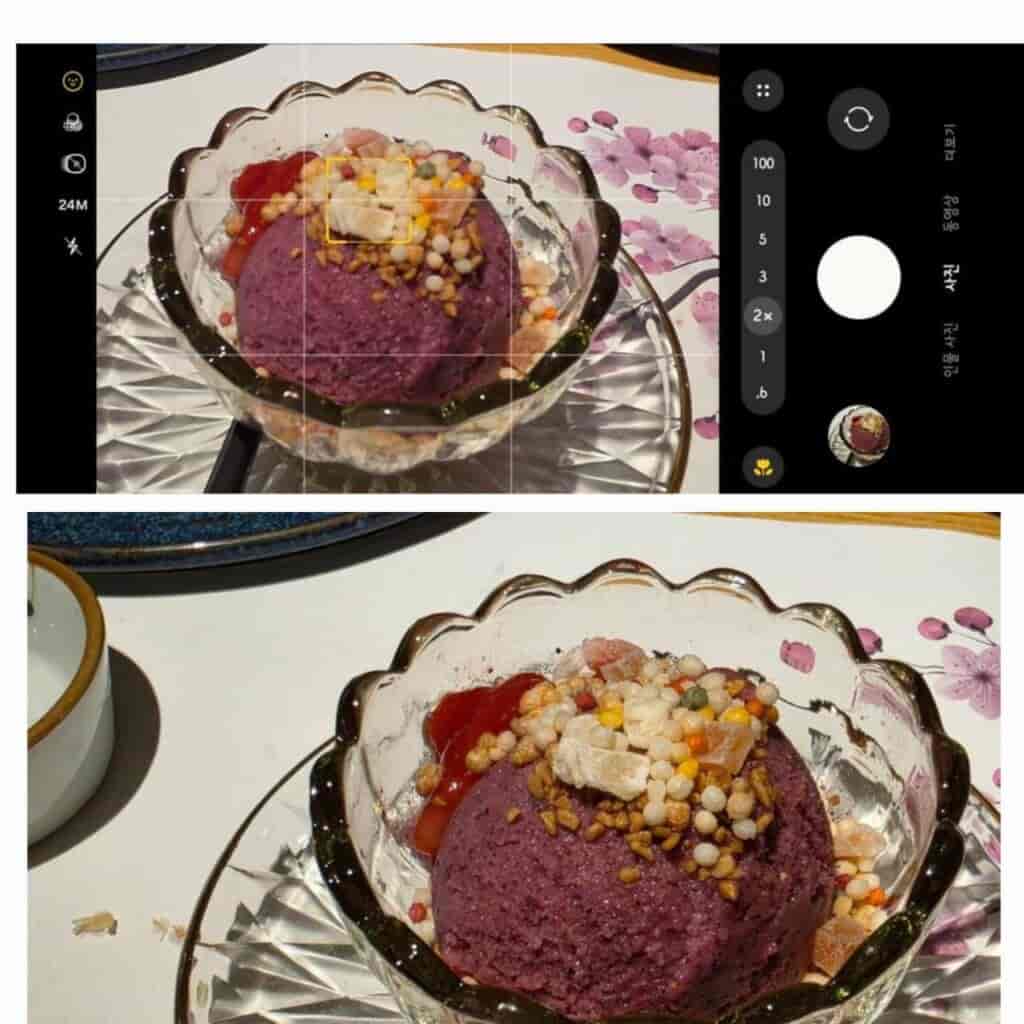
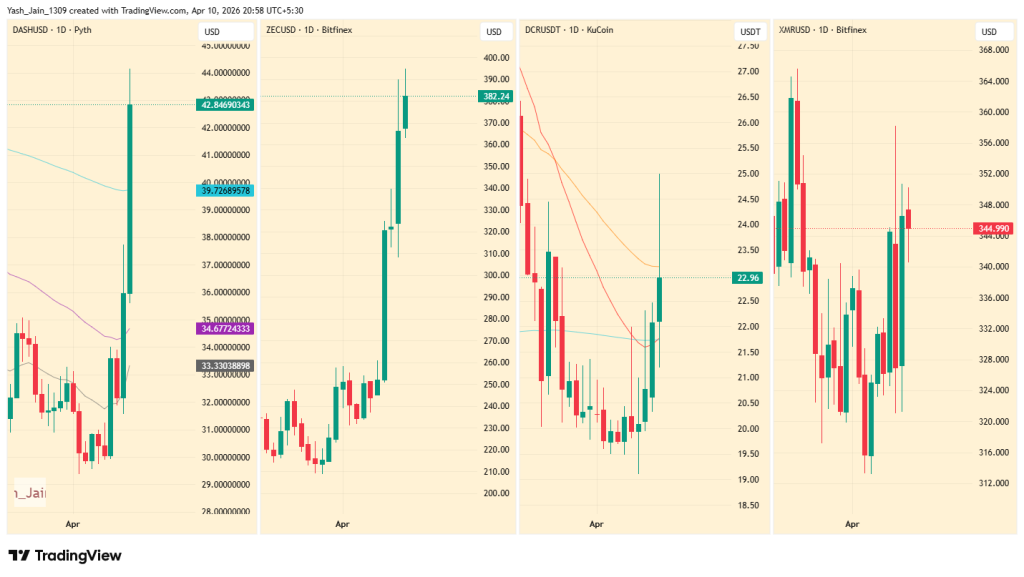

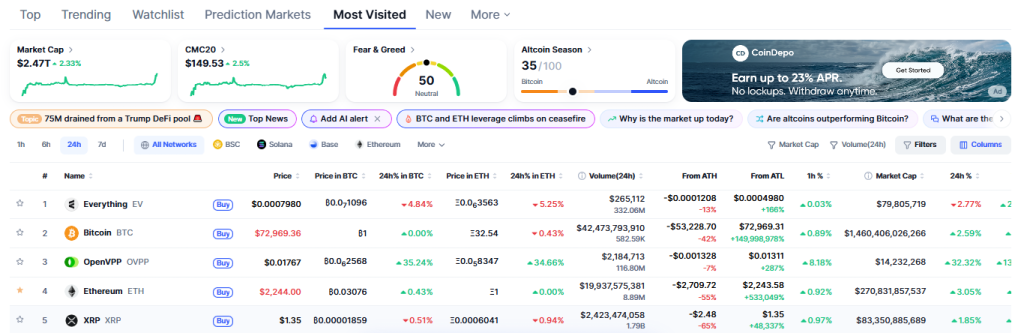
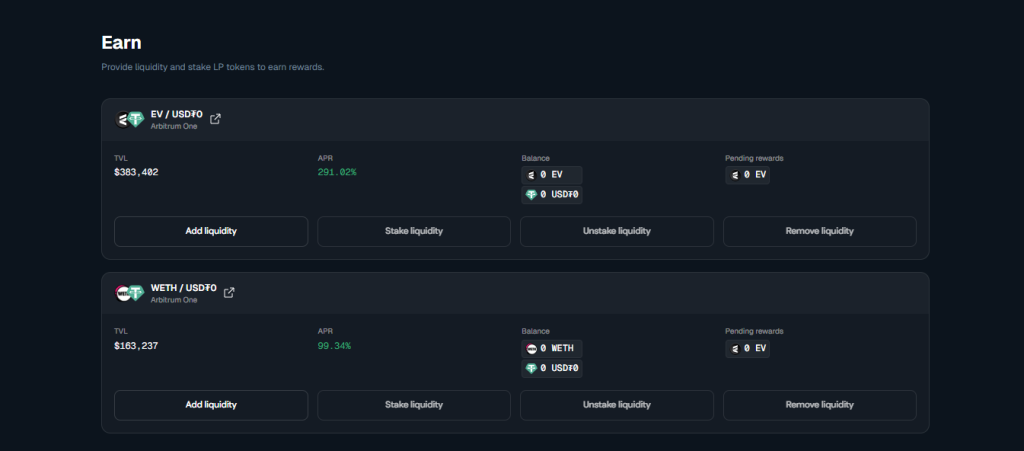
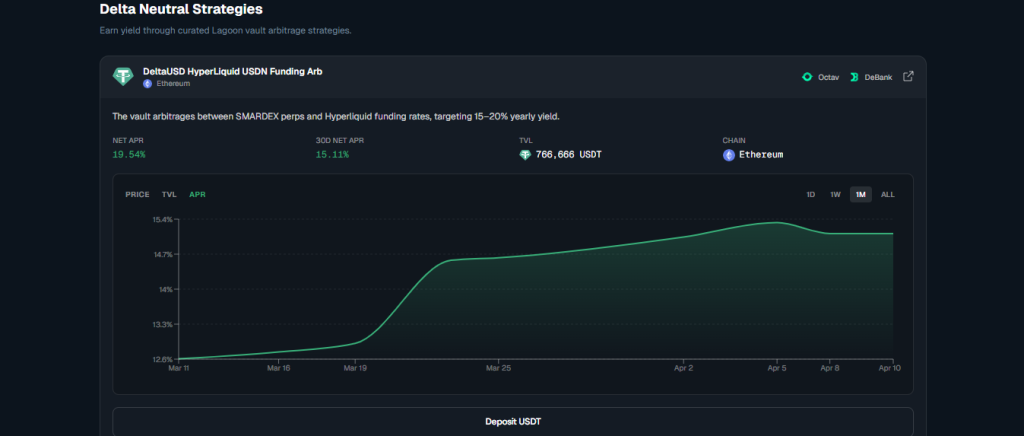
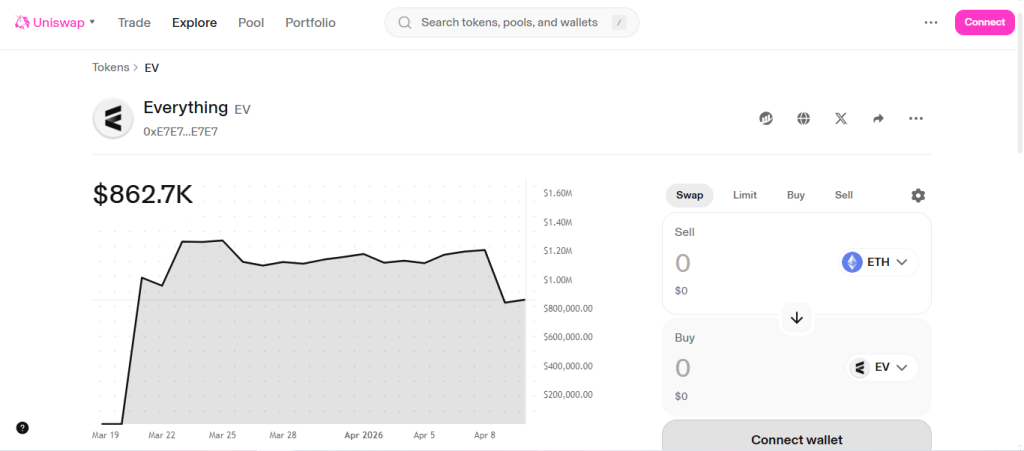
 7.36%
7.36%
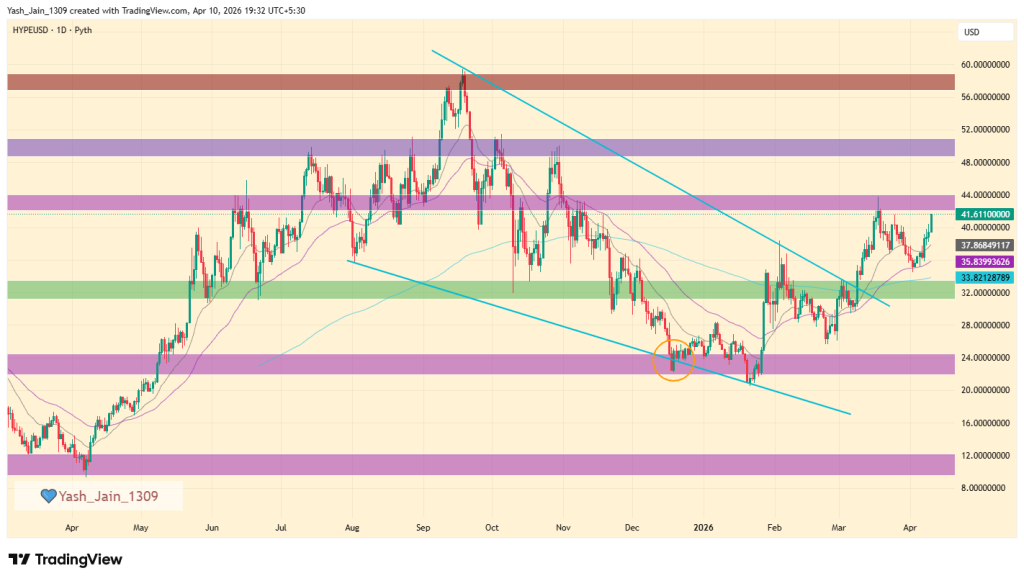
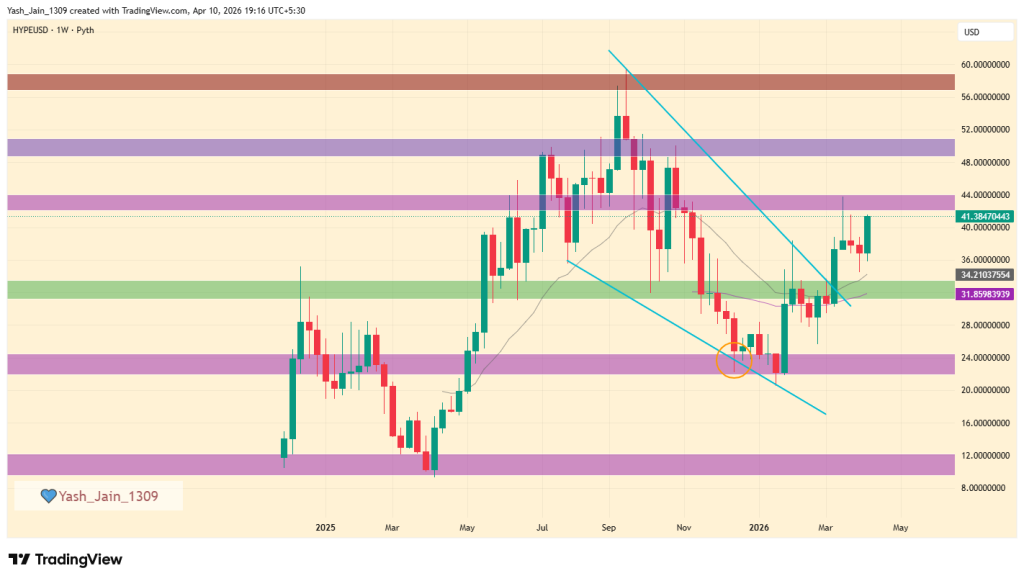

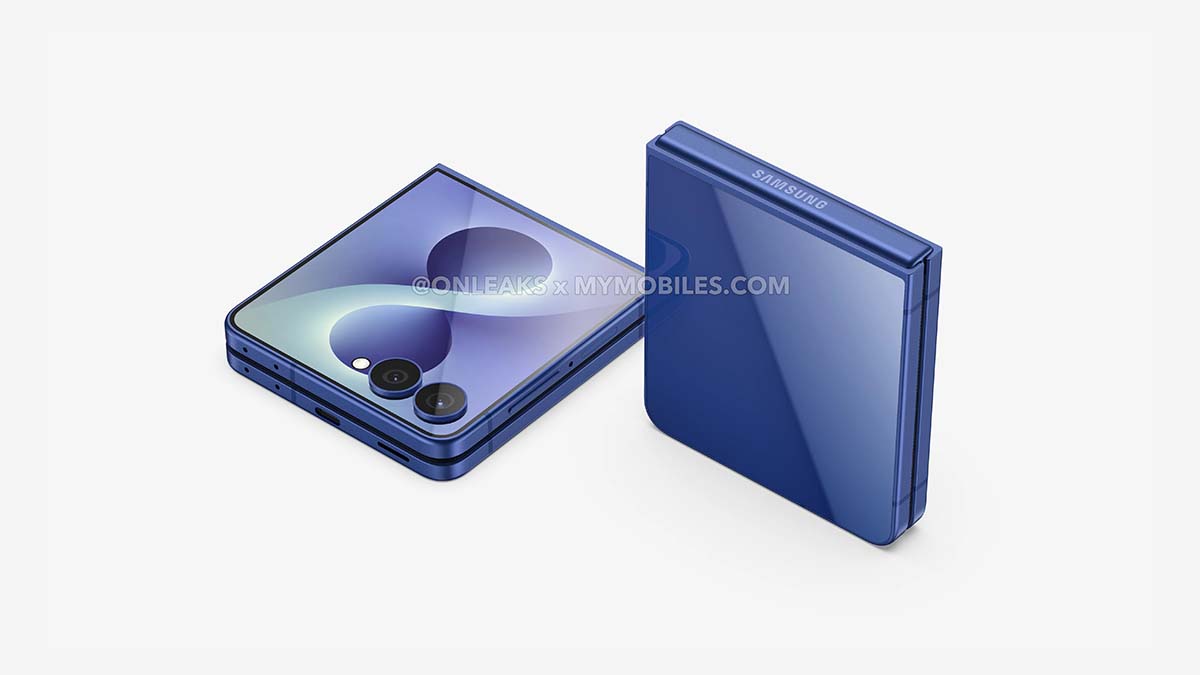
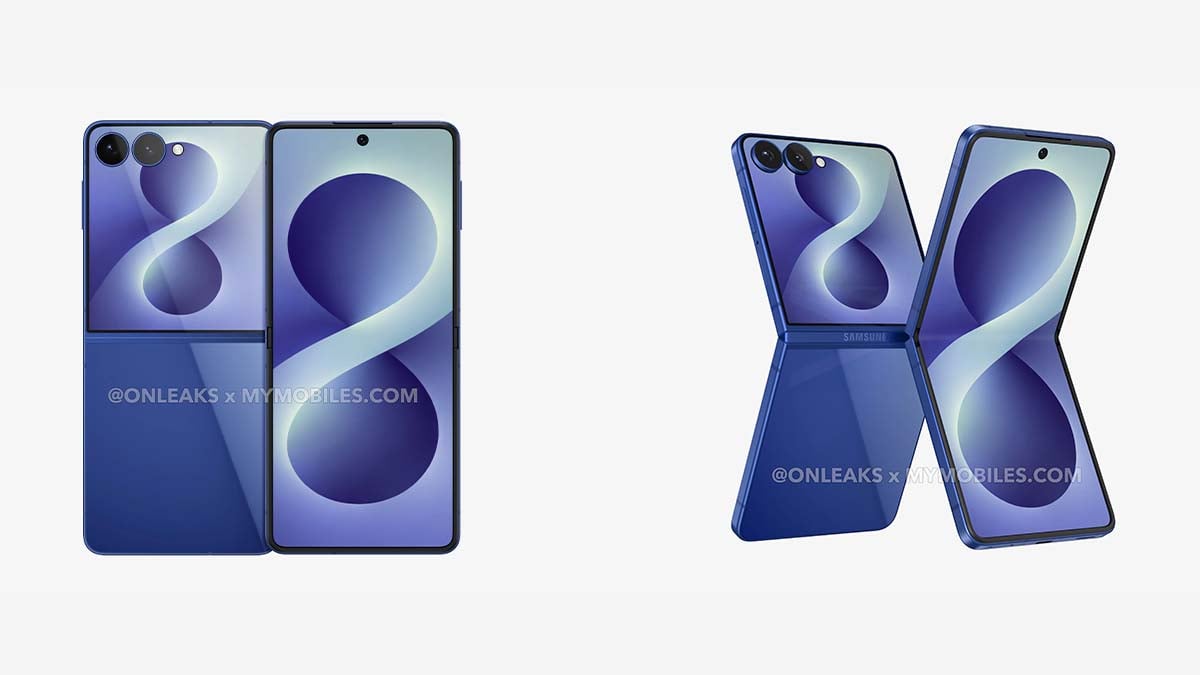
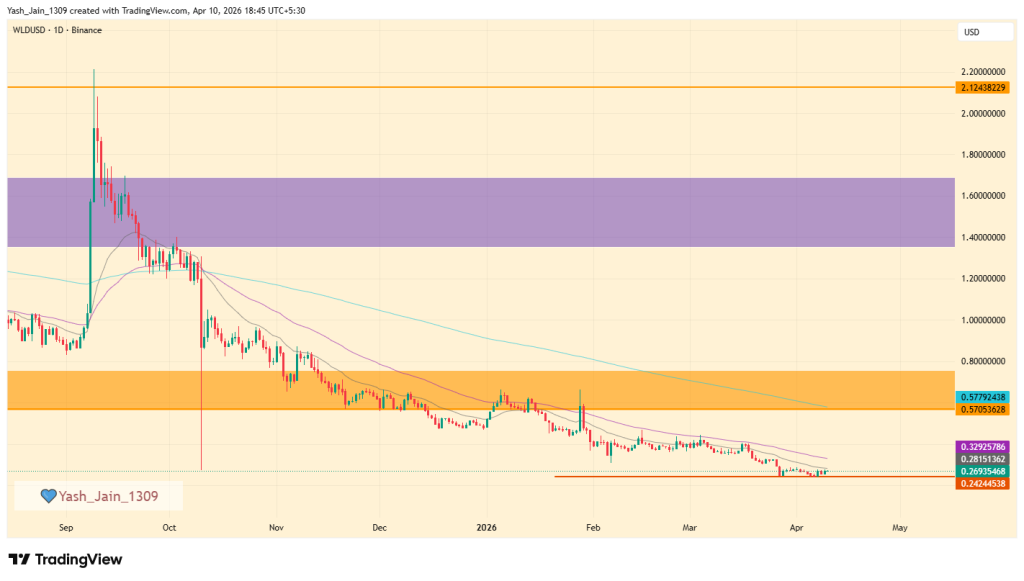
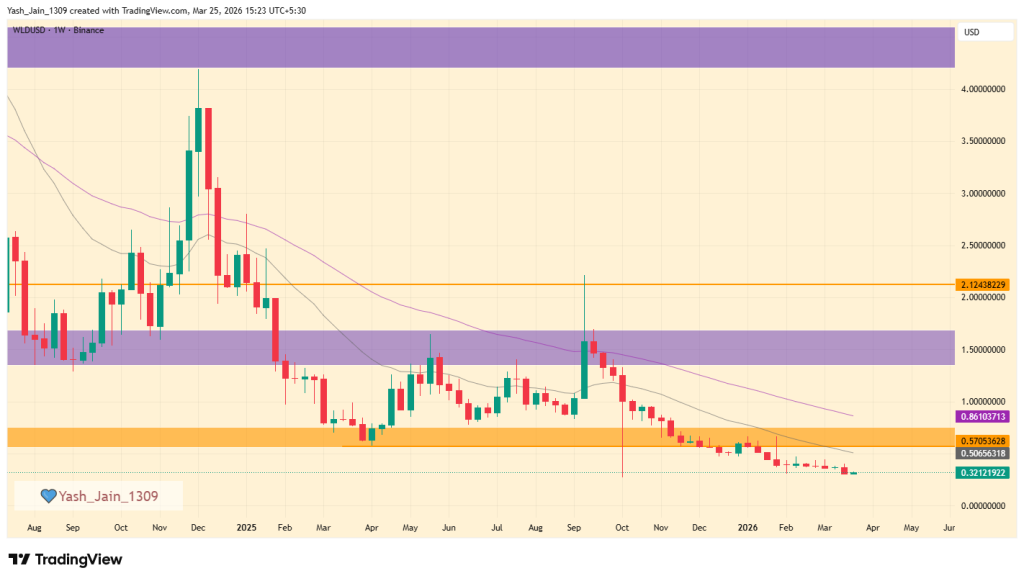
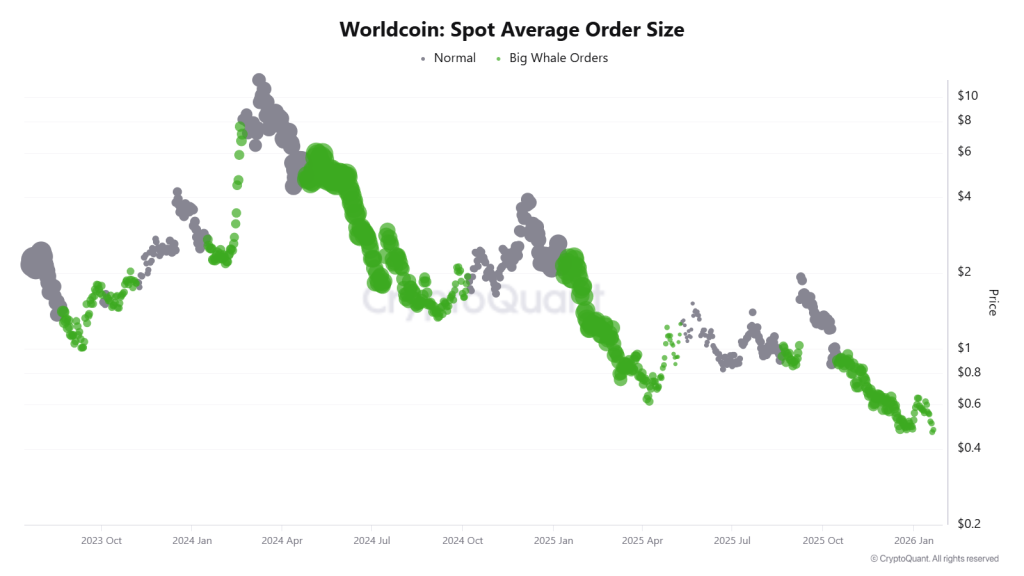
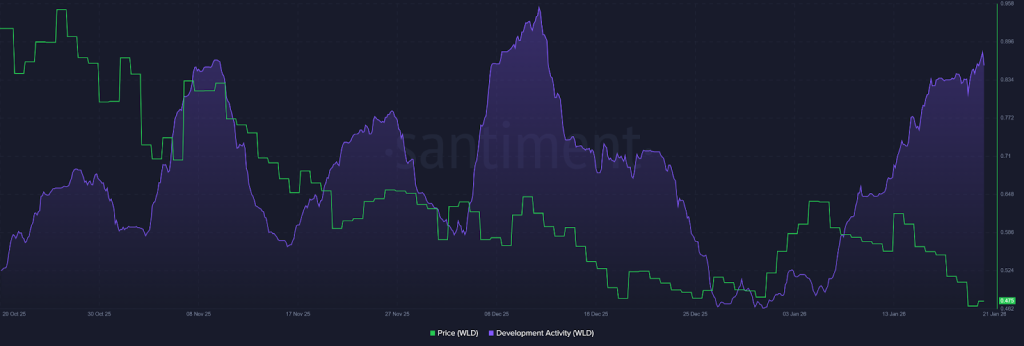

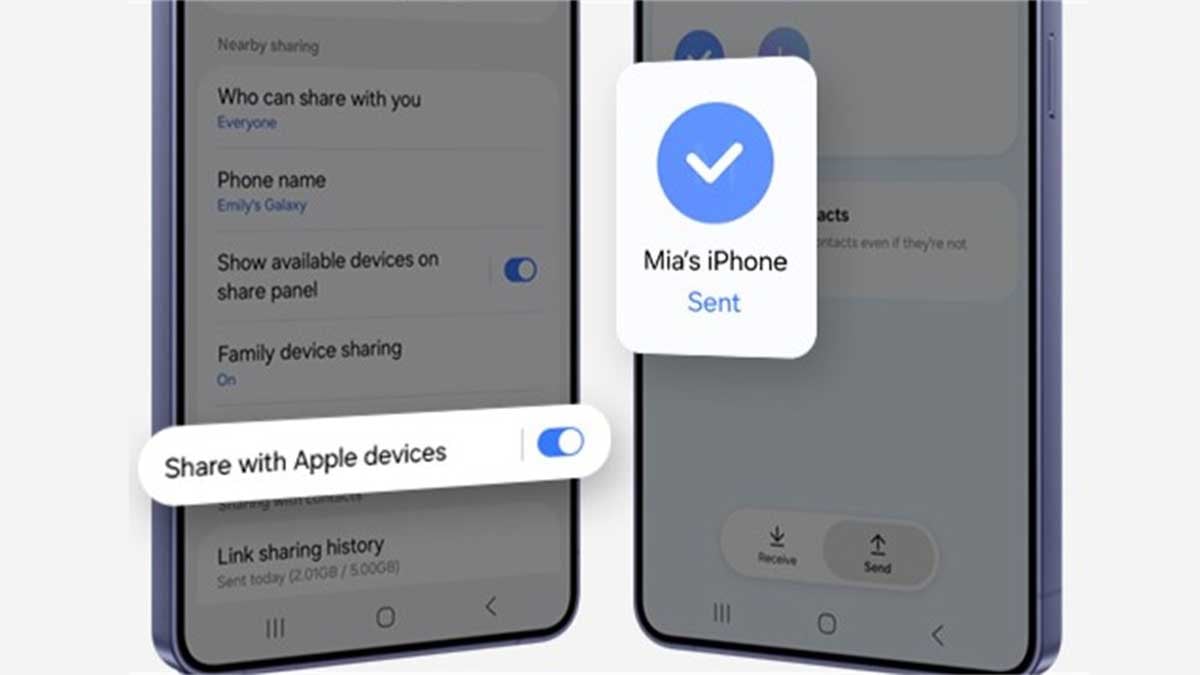
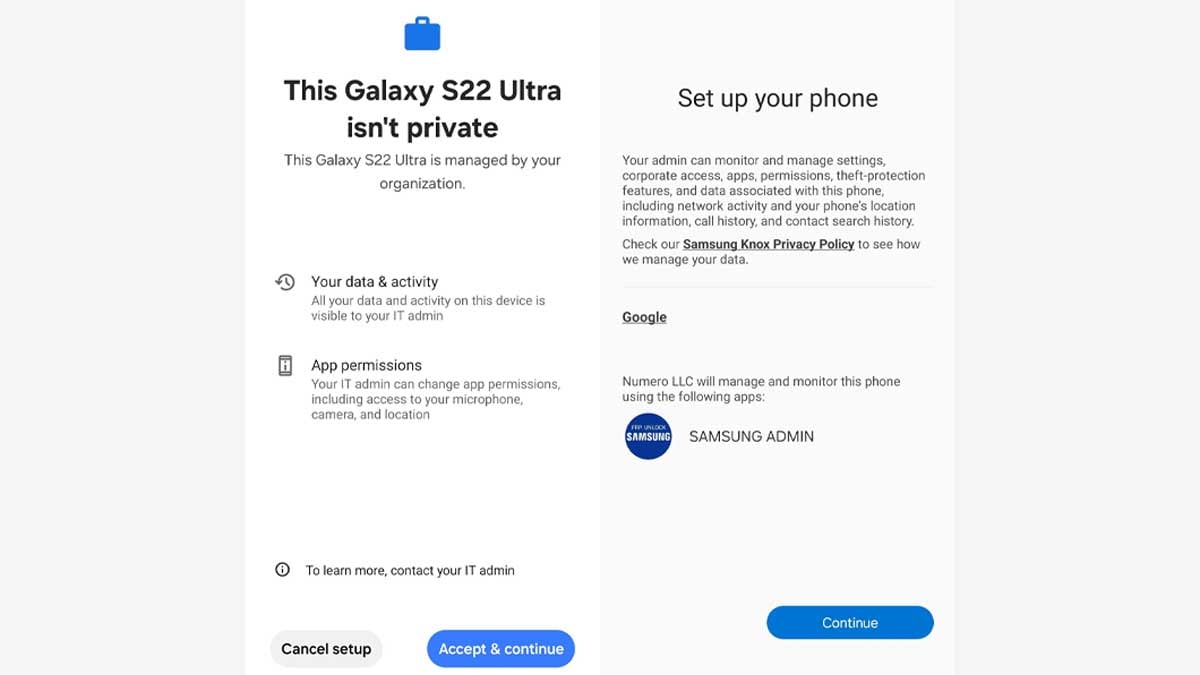
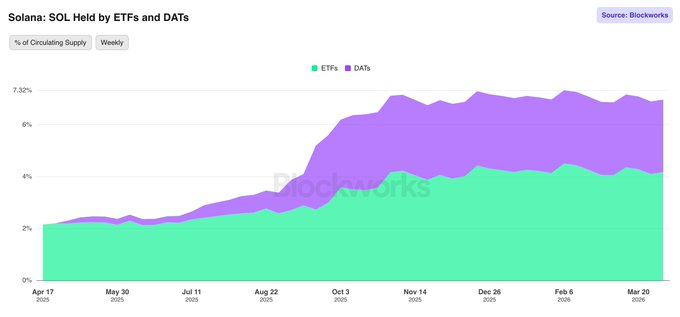
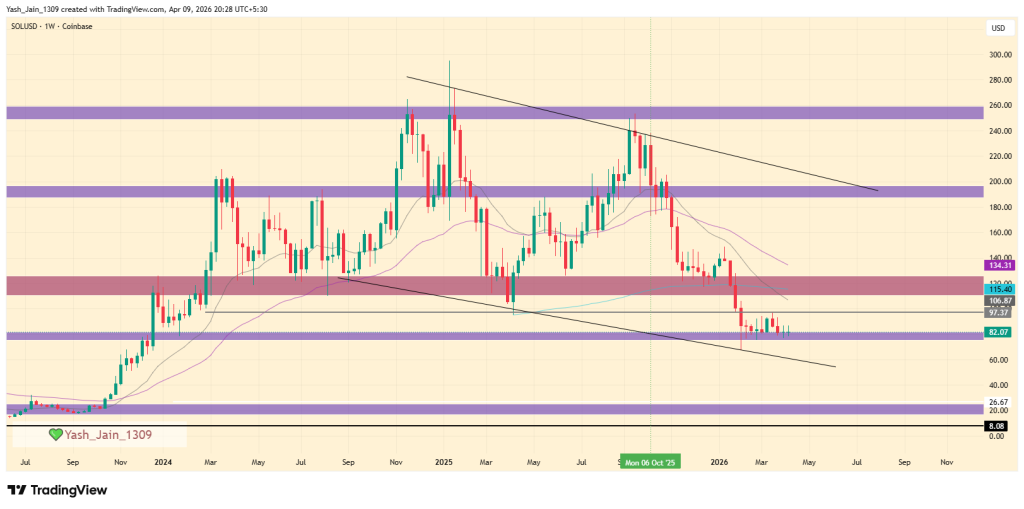
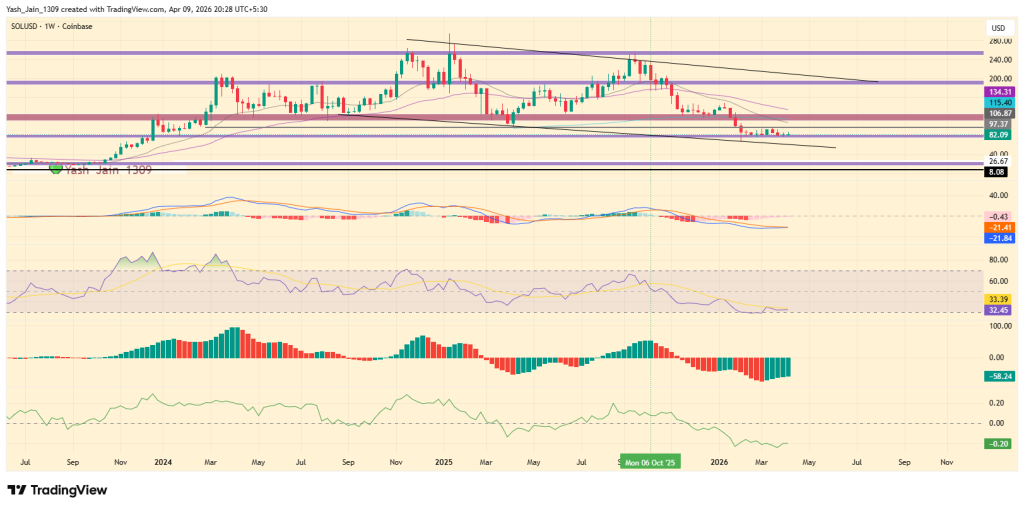
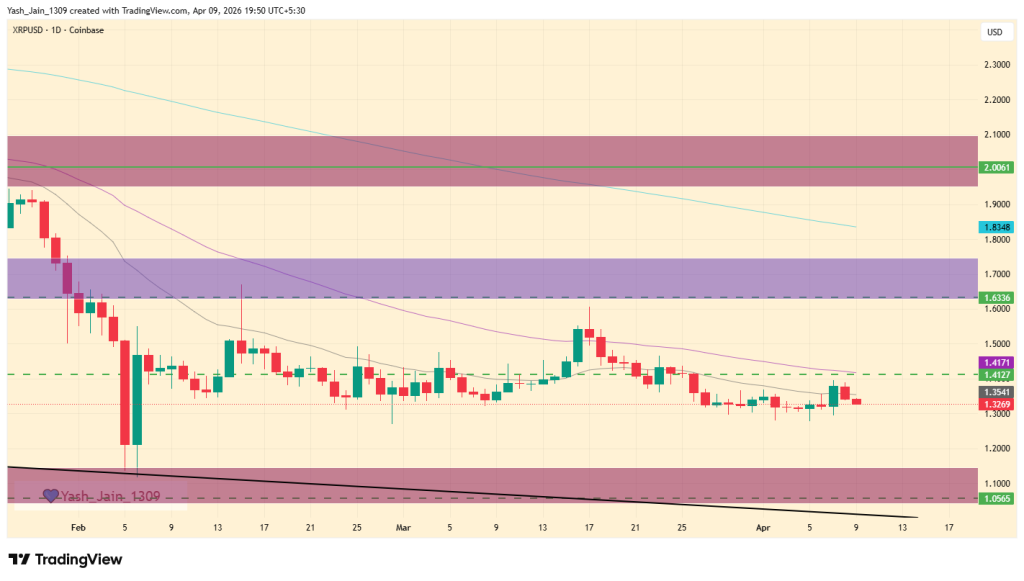
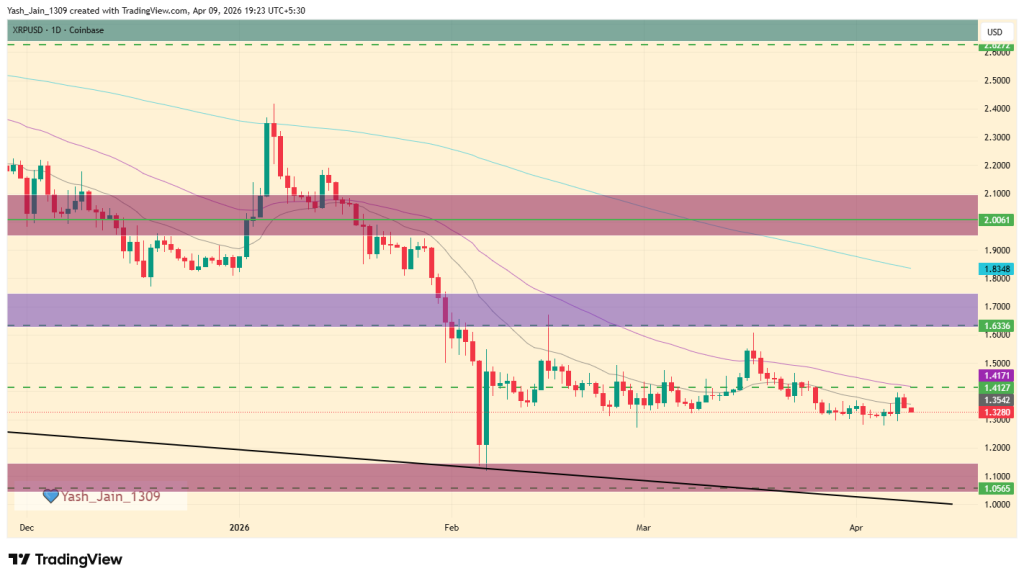
 TODAY: The U.S. Senate Banking Committee meets on the CLARITY Act
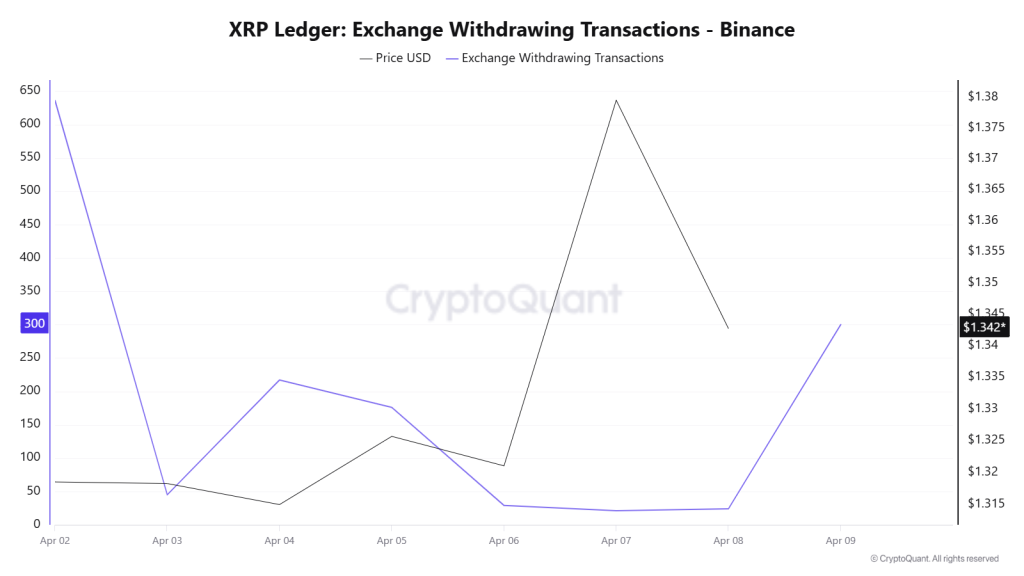


 -4.46%