Google said it has “resolved” an issue with logging data within Google Search Console reporting. The logging issue happened between May 13, 2025 through April 27, 2026, about 50 weeks. The resolution did not fix the past data, but it did fix the issue going forward.
“A logging error prevented Search Console from accurately reporting impressions from May 13, 2025 until April 27, 2026. This issue has been resolved. As a result, you may notice a decrease in impressions in the Search Console Performance report. Only impressions and related metrics – CTR and average position – were affected; clicks were not affected by the error, and this issue affected data logging only.”
What was fixed. Just to be clear, Google has not fixed the data from May 13, 2025 through April 27, 2026 but just fixed the data going forward. So keep this in mind when reviewing the data in that date range.
John Mueller from Google confirmed on Bluesky that this is only fixed going forward and the old data will not be fixed.
Why we care. When reviewing your Search Console data, please note that for about 50 weeks, almost a year, the reports may be off and you may see a decrease in impressions, and thus click-through rate and average position data are also impacted.
This week, the shadows moved faster than the patches.
While most teams were still triaging last month’s alerts, attackers had already turned control panels into kill switches, kernels into open doors, and open-source pipelines into silent delivery systems.
The game has shifted from breach to occupation. They’re living inside SaaS sessions, pushing code with trusted commits, and scaling
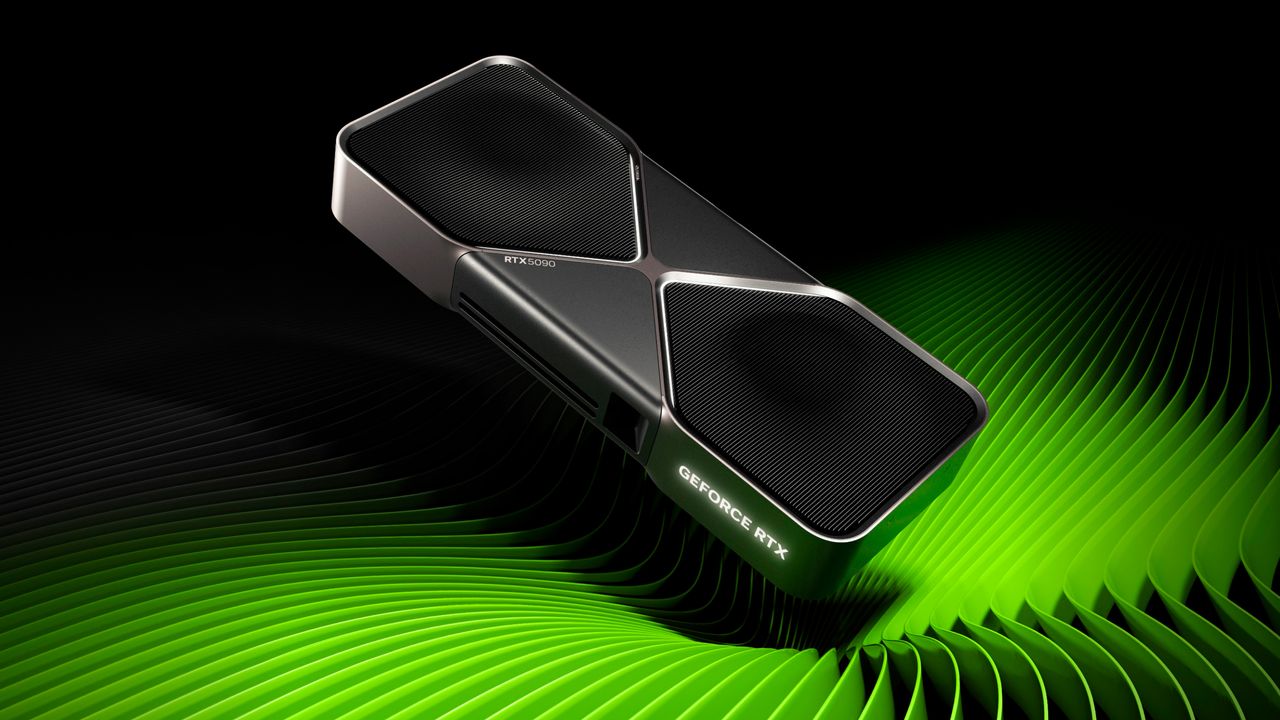
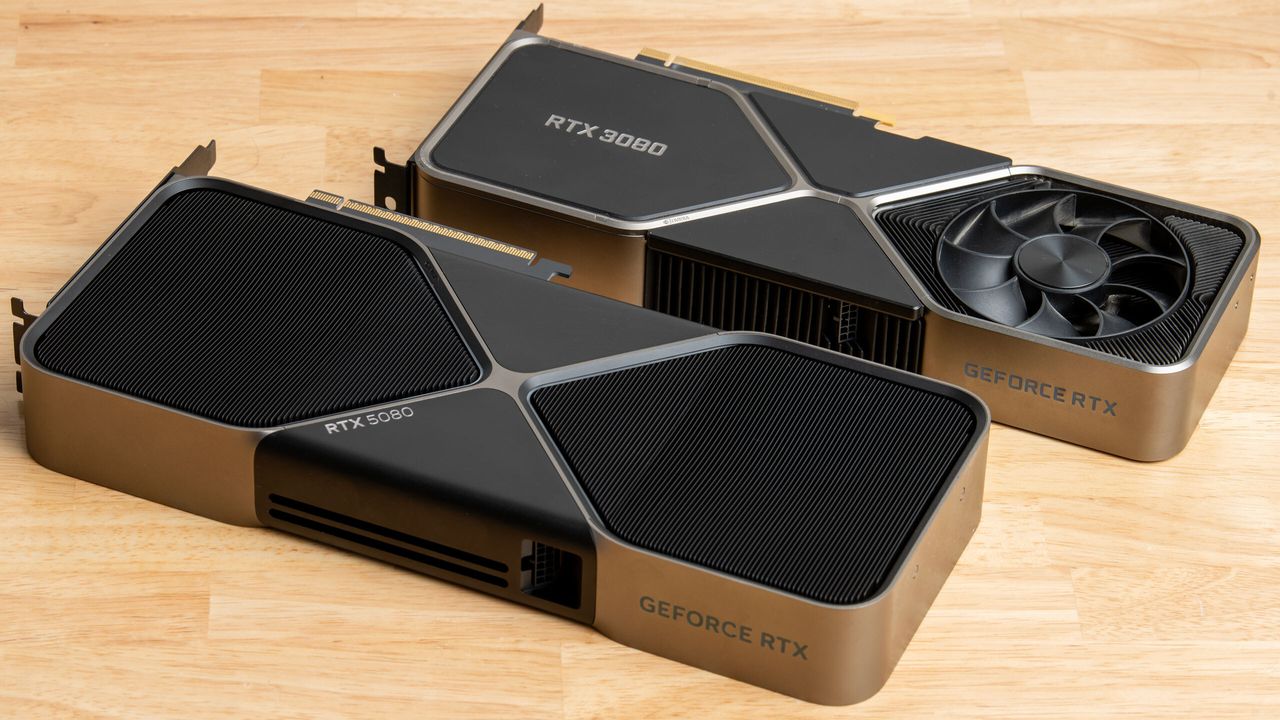
ASUS is reportedly limiting the supply of its RTX 5070 Ti models to prioritise its higher-profit RTX 5080 models According to a report on Channel Gate, via WCCFTECH, ASUS are reportedly changing its GPU supply strategy. ASUS will reportedly continue to reduce its supply of its RTX 5070 Ti series GPUs to “primarily focus” on […]
Our time with IO Interactive’s take on James Bond was filled with smart multi-approach spy action, intense shoot-outs, and one of the most unique vehicle chase sequences in the franchise.
Intel Corporation today announced two key leadership appointments to strengthen its core product business and advance the company's innovation agenda.
Alex Katouzian Appointed to Lead Client Computing & Physical AI Group
Alex Katouzian will join Intel as executive vice president and general manager of the Client Computing and Physical AI Group. In this role, Katouzian will align Intel's client computing business with emerging physical AI systems that span robotics, autonomous machines, and other AI devices.
JEDEC's latest announcement provides an updated timeline for the future of MRDIMM, a relatively new memory standard introduced a few years ago to support bandwidth-intensive data workloads. Multiplexed Rank DIMM technology uses a multiplexing register and buffers to allow two memory ranks to operate simultaneously on a single DIMM, effectively...
The Academy clarified rules for two categories related to AI, writes Vanity Fair. The first states that the only acting roles eligible for Oscar nominations are those "demonstrably performed by humans with their consent." Screenplays, meanwhile, must be human-authored to be eligible.
The mobile DRAM market is showing no sign of retrenchment as the wider industry stares at a ~100 percent quarter-over-quarter (QoQ) price increase in Q2 2026, building upon the 58 percent - 63 percent QoQ price growth for LPDDR5X in Q1. The mobile DRAM market shows no sign of cooling off, as Long-Term Agreements (LTAs) entrench price hikes SemiAnalysis reported just a few days back that LPDDR5 contract prices were recently hovering at around $10/GB after undergoing a 3x increase since Q1 2025. What's more, the firm expected this trend of price hikes to continue well into 2027. While DRAM […]
GTA 6 is poised to set the market on fire when it launches this November. While its price hasn't been determined, there's no doubt the sixth entry in the series by Rockstar Games will be a smashing success, but Bank of America believes the game should be priced at $80. A high price point that would not only be in Take-Two's self-interest, but that could also save the entire gaming industry, which is perceived as struggling. In an investor note penned by Omar Dessouky, as reported by Seeking Alpha, after attending the iicon Video Game Conference where Take-Two CEO Strauss Zelnick heavily suggested the […]
Intel has made two big changes: the appointment of Alex Katouzian from Qualcomm in the Client Computing & AI segment, along with Purskar Randae as CTO. Alex Katouzian Appointed to Lead Intel's Client Computing & Physical AI Group Press Release: Intel Corporation today announced two key leadership appointments to strengthen its core product business and advance the company’s innovation agenda. Alex Katouzian will join Intel as executive vice president and general manager of the Client Computing and Physical AI Group. In this role, Katouzian will align Intel’s client computing business with emerging physical AI systems that span robotics, autonomous machines, […]
Veteran game developer and Fallout co-creator Tim Cain has only just recently returned to game development full-time, but he's also kept up his personal YouTube channel, as he promised he would when he re-joined Obsidian Entertainment in December 2025. That's where his latest comments on the state of the industry that are catching several eyes come from, as he shares how the rise of social media influencers and "how the internet changed game design." Cain discusses how he's seen the video games industry, and specifically how the industry portrays video games to its audience. Anyone who follows games knows how […]
AMD's immense success for its CPUs and GPUs in the AI segments will be a key driver for the company in the current year & the years ahead. AMD Is Expected To Ship Nearly 1.9 Million AI GPUs By 2027, While It's Share In China Will Be Larger Than NVIDIA's Intel, gaining momentum this quarter, thanks to Agentic AI's reliance on CPUs, has given us a teaser of what to expect from AMD's upcoming earnings. As per UBS, AMD isn't as constrained as Intel in the CPU segment and is anticipated to grow its Server CPU revenue by 80% this […]
CISA warns of the actively exploited “Copy Fail” Linux flaw (CVE-2026-31431), enabling root access, with a public exploit released before patches were ready.
In a new review for the Arc Pro B70, the workstation GPU performs rather well across five games tested at 1440p resolution. On average, it loses to the RTX 5060 Ti 16GB in traditional raster but beats it in ray tracing. Overall, the B70 was only 2.9% behind the 5060 Ti in all games when you average out both RT and raster.
Emotions change day to day, and that's okay. Sometimes it's difficult, but it always gets better—you just need to be present and watch it shift. Uplume is a digital safe space designed to provide hope and acceptance through an aesthetic daily diary. Instead of tracking productivity, users check in with up to three feelings a day, blending them into beautiful, fluid 2D auras. You can discover emotional patterns, mix feelings, and build a quiet digital universe with your closest friends. It is a gentle reminder that every day has its colors, and your sky is always growing.
PartyInvitation.ai is a free AI-powered party invitation and online RSVP platform. Describe your party theme, and AI generates a unique invitation card with a built-in QR code in under a minute. Guests scan to RSVP instantly with no app or signup needed. It supports over 38 event types from birthdays to holiday parties, with optional gift registry and potluck sign-up. You can print or share invitations digitally, free to start.
Virginia and Washington D.C. paused the data collection and sharing, after Bloomberg's investigation found their health insurance marketplaces were sharing users' information with advertisers.
The BOGO offer is live. For a limited time, buy one pass to TechCrunch Disrupt 2026 and get 50% off a second of the same ticket type. Offer ends this Friday, May 8. Save here.
There’s a fundamental battle happening in search right now.
On one side is topical authority — the darling phrase of every SEO consultant who needs to sell more content.
On the other is brand authority — something marketers have talked about for decades, while much of search treated it as optional, vague, or something the brand team could handle after the sitemap was fixed.
Now AI has walked into the room, kicked over the furniture, eaten half the traffic, and exposed the real problem.
Search still matters. The global economy runs on people looking, comparing, buying, and solving problems through it. But the industry has a marketing problem.
And it shows. Too many SEOs have lost the plot on why people choose, remember, trust, search for, recommend, and buy from brands. AI search is making that ignorance harder to hide. That’s why brand authority wins — but not in the way most SEO dashboards suggest.
Topical authority was never supposed to mean content landfill
Before we get to AI, we need to define what topical authority was meant to be. At its best, it’s simple.
You publish useful work, create evidence, and share expertise. Others cite you, journalists mention you, communities discuss you, and customers search for you. Over time, your brand becomes associated with the topic. That’s authority. It’s also brand building.
The problem is that much of the SEO industry hasn’t sold it that way. In practice, topical authority became a convenient commercial wrapper for content production.
SEO retainers were built around three pillars: technical, content, and links. Technical SEO became more specialized. Links were outsourced, packaged, renamed, earned through digital PR, or bought in one way or another.
Content, meanwhile, remained the dependable agency engine — easy to sell, scope, and report. Think 4-8 blog posts a month, a topical map, a content hub, a cluster, a pillar page, and another 2,000 words on something nobody asked to read.
This wasn’t always wrong. In the pre-AI search world, content had real labor behind it. A decent article required research, writing, editing, optimization, internal linking, and promotion. That work had value. Good content could rank, attract links, build email lists, support commercial pages, and create some advertising effect through exposure.
Back in the day, we built what were often called power pages — strategic assets designed to earn links, rank, get shared, and pass equity to commercial pages. They had a purpose. They weren’t created just because the spreadsheet had another empty cell.
Topical authority changed that logic. It turned “let’s create something worth citing” into “let’s cover every possible keyword in the topic map and hope Google mistakes volume for expertise.” That was the original sin.
Authority isn’t created by what you publish on your own site. It’s created when you become a recognized source.
Former Google engineer Jun Wu described this in terms of “mention information” — how search engines analyze natural language, identify topic phrases and sources, cluster related terms, and map associations between sources and topics.
In plain English, they can recognize when certain brands, people, domains, and entities are repeatedly mentioned in relation to specific topics.
Today, SEOs call that brand co-occurrence. The idea isn’t new. When authoritative sites, journalists, communities, reviewers, experts, and customers consistently mention your brand in relation to a topic, you become associated with it — not because you published hundreds of near-identical articles, but because the wider web treats you as relevant.
Topical coverage is what you say about yourself. Authority is what the market says about you. AI search makes that difference hard to ignore.
The smash burger test
Suppose you want to become an authority in the smash burger industry. You probably don’t, but some topical authority consultant calling themselves a “semantic SEO” is likely pitching it to a fast food brand right now.
An SEO version of topical authority would probably begin with a map:
What is a smash burger?
Best meat for smash burgers.
History of smash burgers.
Smash burger recipes.
Smash burger toppings.
Smash burger glossary.
Best smash burger restaurants.
How to make a smash burger at home.
There’s nothing inherently wrong with that. If you run a serious smash burger publication, restaurant group, food brand, or equipment business, some of it might be useful. But authority doesn’t come from publishing those pages.
Real authority looks different. You create original data on the fastest-growing smash burger chains. You publish an index of the best-rated smash burger restaurants in the U.S. and U.K. You interview chefs, test meat blends, and produce videos people actually watch.
You become a source journalists use when covering the category. Food creators reference your data. Restaurant owners subscribe to your newsletter. People search for your brand plus “smash burger report.”
That’s topical authority. It’s also brand authority.
The thin SEO version is publishing thousands of keyword pages and internally linking them until your CMS starts begging for death. The real version is becoming known.
AI has broken the old content economics
The old commercial defense of topical authority was traffic.
Brands didn’t hire search marketers because they had a deep spiritual yearning to become encyclopedias. They hired them for organic revenue growth — to appear when customers searched, and to drive clicks, leads, and sales.
Informational content was sold, in part, as advertising. Someone searches a question, lands on your article, and sees your brand. Maybe they join your email list, return later, or buy.
That model was always more fragile than the industry admitted. Most users don’t sit around thinking about your B2B SaaS platform, your dog food brand, or your running shoe category page.
Ask someone to name 10 toothpaste brands, and they’ll struggle, despite a lifetime of exposure. Ask them to recall the last ten TikToks they watched, and watch their face collapse.
Advertising works through memory structures, distinctive assets, repeated exposure, and relevance. A single accidental visit to a generic “what is” article was never the brand-building miracle some content marketers claimed.
Now AI has made the economics worse. For many informational searches, answers are increasingly synthesized before the click. From the user’s point of view, that’s often a better experience.
My dad is in his 70s. He loves AI Overviews. He doesn’t want to click through three ad-infested recipe pages, dodge newsletter popups, reject cookies, scroll past a life story, and finally find how long to boil an egg. He wants the answer.
Users aren’t mourning your lost organic session. They’re getting on with their lives. That’s the uncomfortable truth.
If the click disappears, much of the supposed advertising effect of informational content disappears with it — no logo exposure, no distinctive assets, no remarketing pixel, no email capture, and no carefully designed journey. Just your content absorbed into a synthesized answer, and maybe a small source link on the side.
This brings us to another emerging industry obsession: AI citations.
The small source boxes in ChatGPT, Gemini, Perplexity, AI Overviews, and other AI search experiences are being treated as the new holy metric. Agencies, tools, and consultants are already building around it.
The SEO industry loves a single metric — domain authority, traffic, keyword positions, share of voice, and now AI visibility. The problem is that an AI citation isn’t the same as a human citation.
An AI citation is often a helpful link — a reference, a retrieval artifact. It’s directionally useful. It can show what sources a system uses to support an answer, and whether your content is accessible, relevant, and being surfaced in certain contexts.
But it’s not the same as:
A journalist choosing to cite your research.
A customer recommending you in a forum.
A creator reviewing your product.
A trade publication naming your brand as an expert source.
Human citations are evidence of market recognition. AI citations are evidence of machine retrieval. Don’t confuse the two.
The goal isn’t to be scraped. It’s to be recommended.
Brand search is the cleaner signal
If you want a better proxy for whether your authority is growing, look at brand search.
People search for brands they know, are considering, have bought from, or were recommended. Brand search isn’t perfect, but it’s much closer to commercial reality than counting how often a chatbot footnotes your blog post.
That’s why share of search matters. It gives you a directional view of market demand and mental availability. If more people are searching for your brand relative to competitors, something is happening. Your advertising, PR, product, reviews, word of mouth, content, partnerships, social presence, and customer experience are creating demand.
This is where the “but this is just SEO” crowd starts clearing its throat.
It’s not “just SEO.” Or rather, it’s only SEO if you define it so broadly that it includes every activity that might influence a search result. That’s strategic ambiguity. It lets everyone claim they were doing the future all along.
Most SEO retainers weren’t building brand fame. They were producing content, fixing technical issues, buying or earning links, and reporting rankings. Sometimes it worked — sometimes very well. But the average topical authority strategy wasn’t a sophisticated brand visibility program.
Traditional SEO still matters
None of this means you abandon traditional SEO. Buyer-intent rankings, category pages, product pages, local pages, technical SEO, internal linking, structured data, reviews, and crawlability matter.
Search still works as a shelf. Many brands are discovered for the first time in supermarkets. The same is true in Google. If someone searches “emergency locksmith near me,” “best trail running shoes,” or “meeting intelligence software,” you want to appear.
Being found still matters, but it’s not the same as being recommended. Traditional SEO helps you get found, while brand authority drives recommendation.
AI search shifts the balance toward the latter, synthesizing options, reducing uncertainty, and often naming brands, products, and solutions directly.
The new job is meaningful visibility
Semrush accidentally said the quiet part out loud with its April Fools’ “Brand Visibility Expert” stunt, where employees changed their titles on LinkedIn. It was a joke, but not entirely.
The company later described AI visibility tools that track brand visibility, mentions, prompts, perception, and competitor presence in AI search. That’s where the market is going.
The future of search marketing isn’t just search engine optimization. It’s brand visibility across the network.
That means increasing meaningful visibility in the places where humans and AI systems encounter information:
Search engines.
AI answers.
Review sites.
Communities.
YouTube.
Reddit.
Trade media.
News sites.
Podcasts.
Influencers.
Comparison pages.
Customer reviews.
Social platforms.
Partner ecosystems.
Your own site.
The web is now the surface, and your website is just one part of it. This is the shift many SEOs don’t want to face. Many are used to optimizing owned pages for search engines.
The next era is about optimizing a brand’s presence across the web. That requires different work.
Start with positioning
If you want to build brand authority in AI, start with positioning.
Who are you for?
What problem do you solve?
How do you solve it better?
What should the market associate with you?
What proof supports that claim?
These aren’t fluffy brand questions. They’re search questions now.
A locksmith isn’t only an emergency locksmith. They may install commercial locks, repair window locks, replace garage locks, secure doors, and provide security advice.
A running shoe retailer may want to be known for trail running expertise, fast delivery, wide range, gait analysis, competitive pricing, or specialist advice.
A SaaS platform may want to be known for extracting meeting intelligence that helps sales teams improve conversion.
These are performance attributes — the reasons people choose you. Your search strategy should reinforce them.
If your pet food brand specializes in sensitive stomachs, you need to be visible around dog dietary problems — not just on your blog, but in vet commentary, buyer guides, reviews, creator content, journalist coverage, customer stories, comparison pages, and data studies.
These are the places where humans and AI systems learn what’s credible. That’s brand authority.
Create things worth being cited by humans
The rule for AI-era content is simple. Every piece of content should have real-world marketing value at publish.
If one person encounters it, they should understand your brand better, feel more positively about it, remember something useful, or be more likely to trust you.
If content only makes sense as an SEO asset after it ranks, it’s probably weak.
This means you stop creating “dead” content. Instead:
Create original research.
Publish category data.
Build useful tools.
Share expert commentary.
Produce strong product comparisons.
Release reports journalists can cite.
Create opinionated guides.
Review products properly.
Explain problems better than competitors.
Make videos people want to watch.
Turn internal data into public insight.
Build assets that earn links and mentions.
Do fewer things. Make them better. Promote them harder.
Brands have limited budgets — smaller ones have even less room for waste. Spending thousands on a content library that repeats known information may be less effective than using the same budget to create one excellent data study, seed it with journalists, get creators talking, earn reviews, improve product pages, and run ads that make people search for your brand.
Ask yourself, “What use of this budget is most likely to increase brand search, links, mentions, reviews, and recommendations?”
Fitness times visibility equals success
A useful idea from network science applies here: success is driven by fitness multiplied by visibility.
Fitness is your ability to outperform alternatives — product, service, price, expertise, speed, range, design, convenience, proof, reviews, and customer experience.
Visibility is how often and how meaningfully the market encounters those signals.
Fitness without visibility is a brilliant brand nobody knows. Visibility without fitness is hype — and it usually collapses.
That’s how preferential attachment starts. Brands that are talked about get talked about more. Brands that are searched get searched more. Brands that earn links earn more links. Brands that become default sources are cited more often. Brands that sell more get more reviews, more mentions, more data, and more presence.
AI accelerates this dynamic, consuming the web faster than humans and reinforcing those signals at scale. If your brand has dense, consistent, and credible associations with the problems you solve, you reduce uncertainty that you’re a good recommendation.
Brand authority wins in AI — because real topical authority was always brand authority.
The version of topical authority that deserves to survive is the one where a brand becomes a genuine source in its category — creating useful information, earning mentions, building demand, getting searched, getting cited, and becoming associated with the problems it solves.
The version that deserves to die is the one where a brand publishes endless keyword-targeted sludge and calls the result authority.
AI hasn’t killed SEO. It’s killed the illusion that mediocrity deserves traffic.
The search marketers who win next won’t be the ones who publish the most. They’ll be the ones who make brands more meaningfully visible across the internet. They’ll understand positioning, PR, content, technical SEO, reviews, creators, category demand, links, mentions, and brand search as one connected system.
The goal isn’t to optimize for search engines, but for the network they use to understand the world.
Build the brand. Make it visible. Make it worth recommending. Everything else is just content with delusions of grandeur.
The other day, I was putting together my version of a Lumascape of answer engine optimization (AEO) tools — I’m kidding, my computer doesn’t have that kind of bandwidth.
Instead of mapping every tool — which would be outdated in minutes — I’m focusing on the ones I actually use to grow clients’ AI search presence.
This is a deliberately short list: four tools I rely on, plus three I’m testing before adding them to my team’s stack.
1. AI assistants (ChatGPT, Claude, Perplexity)
Used thoughtfully, large language model (LLM) assistants are research and analysis tools in their own right. For AEO work specifically, they serve several distinct purposes:
Competitive landscape research.
Content gap analysis.
Prompt testing.
Entity and topical coverage audits.
Structured content drafting.
The key distinction from passive use is intentionality — using these tools with a defined AEO research methodology rather than ad hoc.
Why they’re essential
AEO requires a fundamental understanding of how AI systems process and represent information. The most direct way to develop that understanding is to work regularly and analytically within those systems.
Querying AI assistants with the same prompts your target audience uses — and carefully analyzing what they return, what sources they cite, what entities they associate, and how they structure answers — gives you peerless ground-level intelligence.
Competitive strengths
Each platform has its own strengths worth noting:
ChatGPT is widely used and offers broad general knowledge synthesis, making it useful for understanding how mainstream AI handles queries in your category.
Claude tends toward more nuanced, caveated responses and is strong for analytical tasks.
Perplexity is citation-heavy by design and particularly valuable for AEO research precisely because it surfaces its sources explicitly. You can see in real time which domains are being pulled and why.
What you can’t do without them
Firsthand research on your brand’s current AEO status, which includes:
Manual prompt testing: See how your brand and content are being represented.
Competitive research: Query AI systems with category-level questions to see which competitors appear and how they are framed.
Topical gap analysis: Identify questions AI systems answer where your brand is absent.
Structural content analysis: Understanding the answer formats (lists, definitions, comparisons, how-tos) that AI systems prefer for your query types.
Caveats
AI assistant outputs are non-deterministic and vary by platform, model version, session context, and even time of day. Manual prompt testing is qualitative and difficult to scale. These tools are best used to build intuition and generate hypotheses, which should then be validated with quantitative data from platforms like Profound.
Also worth noting: querying AI systems for competitive research can quickly become a rabbit hole, so before you truly dig in, build a structured testing framework and stick to it.
Profound is purpose-built AEO intelligence that monitors how AI platforms (ChatGPT, Perplexity, Google AI Overviews, Claude, etc.) discover, surface, and cite your brand and content.
It also tracks brand mention frequency and sentiment, competitors’ share of voice, and the specific prompts or query types that trigger your content to appear in AI-generated answers.
Why it’s essential
If you want to understand where your brand stands in the AI answer ecosystem, it’s currently the most direct way to get that data. It shifts the question from “where do we rank?” to “when AI answers a question in our category, are we in the answer?”
Competitive strengths
The cross-platform coverage is the tool’s most distinctive feature. Rather than measuring a single AI engine in isolation, it provides a comparative view across the major platforms simultaneously. The competitive benchmarking functionality is particularly useful: you can see both your own AI citation share and how it stacks up against named competitors. It’s the kind of context that transforms data into strategy.
What you can’t do without it
Some fundamental capabilities, like:
Quantifying your brand’s presence in AI-generated answers at scale.
Tracking citation share over time and across platforms.
Identifying which content types and topics drive AI mentions — and which competitors are winning the queries you’re losing.
It’s a pretty expensive tool. If you want to justify the expense to your C-suite, tell them, “This will show us exactly where we’re losing to {most hated competitor}.”
Caveats
The tool is evolving quickly, which it needs to do as the AEO landscape morphs in real time. The data it surfaces reflects AI outputs at the time the query is made. Outputs are inherently variable because AI systems don’t return the same answer to the same prompt every time.
Treat metrics as directional signals and trend data rather than precise, static rankings. It also won’t tell you why you’re being cited or not. That’s on you and your team to analyze.
3. Google Trends and Google Keyword Planner
Google Trends tracks the relative search interest for queries over time, across geographies, and in comparison to related terms. Google Keyword Planner provides search volume estimates and demand forecasting, originally designed for paid search planning but equally useful for organic and AEO strategy.
Why they’re essential
AEO strategy lives and dies by understanding demand signals. Before optimizing content to appear in AI answers, you need to know what questions people are actually asking, how that demand is trending, and whether the topic has enough volume to warrant investment.
Google’s tools remain the most reliable source of this data at scale — and crucially, they reflect the same underlying search behavior that feeds into AI engine training data and query patterns.
Competitive strengths
Google Trends is uniquely powerful for directional trend analysis. It doesn’t give you absolute volume, but it gives you relative momentum — which is often more strategically valuable when you’re trying to anticipate where audience interest is heading rather than just where it has been.
For AEO specifically, rising query trends can signal emerging answer opportunities for you to address before your competitors do.
In my experience, Keyword Planner’s forecasting features are underused. They can help you prioritize content investment based on projected demand rather than historical data alone.
What you can’t do without them
Build a truly dynamic AEO strategy in which you:
Understand whether demand for a topic is growing, stable, or declining before building content around it.
Identify seasonal patterns that should shape content publishing calendars.
Surface related queries and rising breakout terms that expand your AEO content coverage.
Validate whether a topic has enough search demand to justify the content investment.
Caveats
As you probably noticed when I recommended those tools, neither reflects AI-native query behavior directly. They measure traditional search, not prompts submitted to ChatGPT or Perplexity.
As information-seeking behavior shifts toward AI interfaces, these tools will increasingly undercount true demand. Use them as a strong proxy and directional guide, not as a complete picture.
Worth noting: Keyword Planner also requires an active Google Ads account, and volume estimates in low-competition or niche categories can be imprecise.
Google Search Console (GSC) provides direct data on how your site performs in Google Search: which queries trigger impressions, click-through rates, average positions, and indexing status.
Google Analytics 4 (GA4) tracks on-site behavior — how users arrive, what they do, how long they stay, and where they exit — including referral traffic sources that reveal whether visitors are arriving from AI-adjacent platforms.
Why they’re essential
For AEO practitioners, these tools serve critical diagnostic functions.
GSC tells you whether the content you’re optimizing for AI citation is also performing in traditional search, which matters because Google AI Overviews and traditional organic results draw from overlapping content pools.
GA4’s referral traffic data is increasingly important for detecting direct traffic from AI platforms: as users click through citations in tools like Perplexity or ChatGPT’s browsing mode, that activity shows up as referral or direct traffic. That’s worth segmenting and monitoring, even if, given the scorching rise of zero-click activity, it paints a very incomplete picture of your AEO impact.
Competitive strengths
GSC’s query data is irreplaceable. No third-party tool has access to the same level of Google-sourced search performance data. The ability to see exactly which queries are driving impressions (even without clicks) is foundational for identifying content that has topical authority but may not be converting visibility into AI citations.
GA4’s cross-channel attribution and audience analysis capabilities help you understand where AEO-driven traffic comes from and what that traffic does when it arrives — which is the commercial case for the discipline.
What you can’t do without them
Develop a true understanding of AEO business impact — and AEO blockers — by:
Measuring whether your AEO content investments translate into actual traffic and engagement.
Identifying content with high impression share but low CTR — a common signal of AI Overview cannibalization.
Monitoring referral traffic from AI platforms as that ecosystem matures.
Diagnosing indexing or crawlability issues that prevent AI systems from accessing your content.
Caveats
GSC data has well-documented limitations: it samples at scale, attribution can be murky, and data is typically available with a 48-72 hour lag. Critically, it only reflects Google. It tells you nothing about how you perform in Bing-powered AI search or standalone AI platforms.
GA4 still has UX rough edges, so you’ll need to confirm that your event tracking and conversion configuration is solid before drawing strategic conclusions from the data.
Rapid-fire roundup
That shortlist leaves, oh, thousands of tools left to consider. I recommend putting these on your radar and testing them to gauge their value as the AEO ecosystem develops.
5. AI Trust Signals
AI Trust Signals focuses on the credibility and trustworthiness signals that influence whether AI systems choose to cite a source.
This is an emerging and underexplored dimension of AEO: it goes upstream from content relevance and helps brands understand whether an AI system “trusts” a domain enough to surface it as an authoritative reference. It’s worth monitoring as the understanding of AI citation mechanics matures.
6. Ahrefs
Ahrefs is a mature SEO platform with deep backlink analysis, content gap tooling, site auditing, and keyword research capabilities.
Its relevance to AEO is primarily indirect, but it’s significant: authority signals, including referring domain quality and topical authority depth, are widely believed to influence AI citation likelihood. Ahrefs is a benchmark tool for understanding and building that authority infrastructure.
Its Content Explorer is also a practical tool for identifying high-performing content in your category that AI systems are likely to draw from.
7. Roadway AI
Roadway AI positions itself as an AI-native platform with a focus on scaling growth marketing activities. Where it helps is building agents that can help attribute AEO signals into revenue, so you can better understand impact.
As a newer entrant, it’s worth evaluating as part of a toolkit audit, especially if you’re looking for tooling built specifically for AEO use cases. The category is moving fast, and platforms like Roadway AI may gain significant mindshare within 12 months, which also means more competitors are coming soon.
The reality of AEO tools: Fast-moving and imperfect
AEO tooling is still catching up to AEO as a discipline, which will likely be the dynamic for the next few years, at least.
Everything is changing so fast, and AI-driven discovery is evolving as users adopt new behaviors that vary by vertical. What matters is consistently applied measurement, strong analysis, and testing that lead to actionable insights.
You won’t get your setup perfect. Like much of marketing, solidly directional is probably as good as you’re going to get. With any tool, if you can explain and measure how it improves your AEO efforts, that’s a great start.
Before you sign any contracts, see if you can find an industry colleague with real-life experience using the tool, and ask them for their take. Unless they’re staunch advocates, chances are you can either find an alternative that does the same thing better or cheaper, or you can wait another month for one to emerge.
A YouTuber spent 15 months testing 200 games on the Surface Pro 11, showing how much Windows on Arm gaming has improved and where Snapdragon X still needs work.
On May 6, Utah's Online Age Verification Amendments, formally Senate Bill 73, takes effect. The law states that a user is considered to be accessing a website from the state if they are physically located there, regardless of whether they use a VPN, proxy server, or other means to disguise...
Back in March, a jury already found the company violated the state's consumer protection law by lying about platform safety and hit Meta with $375 million in damages.
We see a lot of stories about US tech giants laying off employees because AI systems are replacing them. As was the case with Meta, Amazon, and Block, these cuts are usually framed as ways to streamline businesses and embrace new technologies – even when they're not – which tends...
DDR6 memory development is in full swing with major DRAM makers including Samsung, SK Hynix & Micron all racing towards completion to meet growing AI demands. The Next Chapter of DRAM Just Kicked off With Samsung, SK Hynix & Micron All In The Race To Complete DDR6 Development & Deployment By 2028-2029 As AI continues to demand speedier and higher-capacity memory, DRAM makers are now initiating the development plan for next-gen standards. Last year, JEDEC announced the LPDDR6 standard, bringing improved performance and efficiency versus LPDDR5. LPDDR memory has already become the favorite of the AI industry, offering faster speeds, […]
Samsung continues to improve its 2nm GAA process with its second iteration, which will be utilized for the Exynos 2700, enabling the company to introduce the direct successor to the Exynos 2600. While the upcoming chipset’s release will serve to reduce the Korean giant’s dependency on Qualcomm and lower its expenditure on outsourced silicon, it can also help restore its non-memory and semiconductor businesses, which are currently facing a 1 trillion won deficit ($679.21 million). Analysts predict that, depending on the Exynos 2700’s capabilities, Samsung should be able to reduce its deficit to around $543.47 million During the first quarter […]
Newegg deal actually delivers. Score the ABS Kaze II Aqua with i9-14900KF and RTX 5070 Ti for $2,175 with code—over $1,100 off a powerful, ready-to-game prebuilt.
Startup Factory is an autonomous venture studio that helps founders generate ideas, validate demand, build products, and run go-to-market to first revenue. You set strategy and choose bets; the system handles research, coding, infrastructure, deployment, and launch. It scans markets for high-potential gaps, creates landing pages and brand assets, and executes targeted outreach and content to acquire early customers. Operate a portfolio of experiments, kill weak ideas fast, and reach paying users in days.
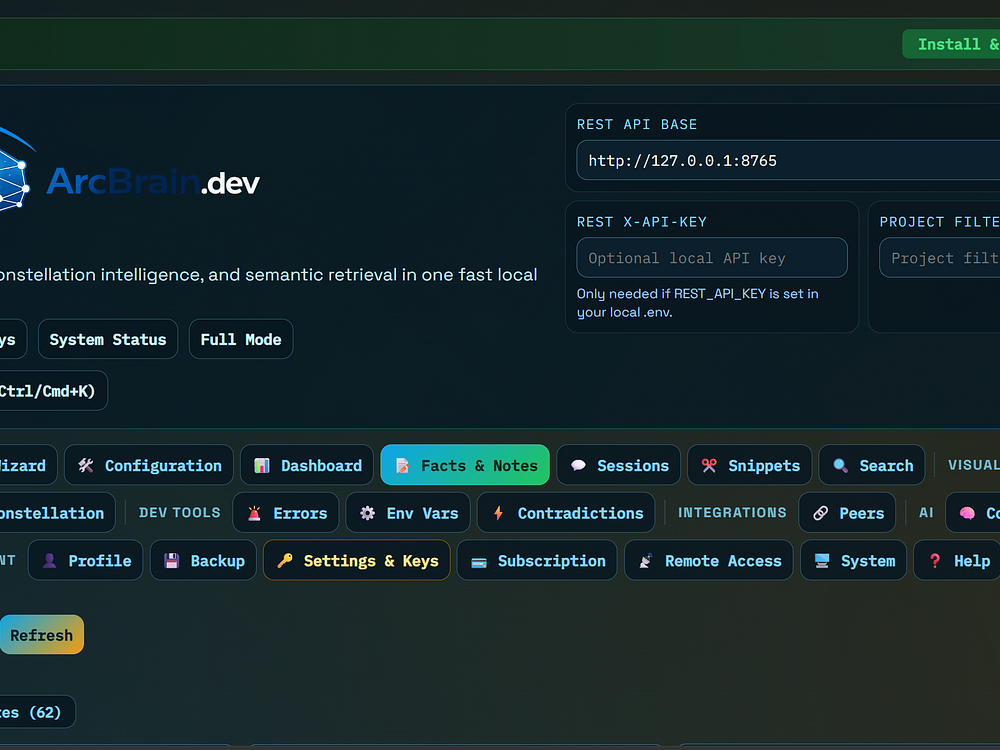
Every time you start a new AI chat, it has no idea what you're building. You have to re-explain everything — the project, the decisions, what didn't work last week. Every session is the same.
ArcBrain fixes that. It runs in the background, watches your sessions across Cursor, VS Code Copilot, Claude, and Windsurf, and builds a persistent memory of your project. Every new chat loads what you've already figured out. Everything stays on your machine — no cloud, no data leaves your system. Switch between programs like VS Code and Claude desktop, and Claude knows what you were just doing.
Crypto signal providers can delete losing trades and fake their stats, manipulating their track record. Gloriam Insights tracks trading signals in real time and verifies every prediction against live exchange data, providing real statistics for each individual signal and trader. Compare signal providers by profit factor, expectancy, win rate, target-level success, streaks, and intraday efficiency so you can follow traders with verifiable results.
DoorDash on Monday added new AI-powered tools that let merchants speed up onboarding, edit photos to make dishes look better, and create new websites from existing content.
The conversation has shifted. We’re spending less time optimizing for clicks and more time trying to fix the AI ROI story. AI now sits at the center of discovery, shaping what gets seen, summarized, and cited.
Here’s what’s working right now, what your peers are doing, and why SMX Advanced will feel different this year.
The SparkToro wake-up call: Influence happens everywhere
The foundation of any serious 2026 content strategy has to start with Rand Fishkin’s landmark March 2026 study, “Influence Happens Everywhere,” an analysis of the 5,000 most-visited sites on both mobile and desktop.
The finding that rattled the industry: while Google still commands 73% of search traffic, search itself is merely a response to influence created elsewhere.
People don’t wake up and search for a brand in a vacuum. They read, watch, and listen across a fragmented web of news, social media, and niche communities before they ever hit a search bar.
AI tools, despite their rapid growth, still account for a fraction of total web visits compared to the “big incumbents.” But the trajectory is unmistakable.
The fundamental problem with attribution in 2026 is that search gets over-credited because it captures demand at the finish line, while the fragmented channels — email, news, specialized content — get under-credited for creating that demand in the first place.
When creating content, your job is to win the influence phase so thoroughly that when a user eventually turns to an AI assistant or a search bar, your brand is the only logical answer.
That framing is the strategic backbone behind sessions at the upcoming SMX Advanced in Boston, June 3-5, and the lens through which your entire editorial calendar should be rewritten.
What your Search Engine Land colleagues are already doing
Before we discuss tactics, it’s worth pausing to note that this publication’s own contributor base has been sounding the alarm in complementary ways. Read them together and a clear picture emerges.
Drawing on Siege Media’s two-year content performance study covering more than 7.2 million sessions, Grow and Convert’s conversion research, and Seer Interactive’s AI Overview findings, Davies made the case that the metrics we’ve lived by — impressions, sessions, CTR — “no longer tell the full story.”
Mentions, citations, and structured visibility signals, he argued, are becoming the new levers of trust and the path to revenue.
Carolyn Shelby, who appeared in a recent SMX Munich 2026 recap for her session “Inside Google’s Head,” crystallized what many of us have only half-articulated: AI doesn’t discover new brands — it selects from known entities.
The implications are stark. If you haven’t built entity recognition across the web’s key reference points — Wikipedia, Reddit, LinkedIn, authoritative press coverage — you don’t get selected.
My own October 2025 piece for this publication compared how ChatGPT, Perplexity, Gemini, Claude, and DeepSeek differ in their data sources, live web use, and citation rules. The conclusion I reached then is truer today: a single-platform AI strategy isn’t a strategy. Each model has different retrieval logic, different trust signals, and different recency weighting.
Jordan Koene made the same point in January 2026, noting that different LLMs win different jobs. This heterogeneity is the fundamental reason why “write good content” is both correct and insufficient as advice.
What ‘full-stack content’ actually means
In 2024, we were impressed if an AI tool could write a decent 500-word blog post. Today, writing is the least interesting thing AI does.
Jasper’s 2026 Enterprise Suite is a useful illustration. It doesn’t just draft text, it:
Pulls real-time performance data from Google Search Console.
Identifies content gaps where competitors are gaining ground.
Generates a multimodal package: a 1,500-word deep dive, three vertical videos for YouTube Shorts, and custom infographics, all calibrated to a brand-voice model trained on your last five years of successful campaigns.
We have moved from “Help me write this” to “Help me dominate this topic.”
But tools don’t solve strategy problems. The harder question is “what should the content actually say?” AI can’t produce the original research, the proprietary case study, or the hard-won perspective that makes an LLM choose you over a dozen lookalike alternatives.
Her argument — that AI investment must generate measurable business outcomes “at the P&L level,” not just activity, efficiency, or content volume — is a direct challenge to teams that have been celebrating output metrics while their revenue dashboards flatline.
Google Vids and the democratization of video: A genuine inflection point
Perhaps the most significant platform shift for content creators in 2026 was Google moving Google Vids out of its Workspace-only silo. You can now create, edit, and share videos at no cost directly within the Google ecosystem, powered by the Veo 3 generative model.
For years, video production was protected by a high barrier to entry: expensive tools, specialist skills, and days of editing time. Google Vids collapses that barrier. Drop a Google Doc or a URL into the “Help me create” prompt, and you get a full-motion storyboard with AI-generated voiceovers, licensed music, and transitions in minutes.
The practical consequences are arriving fast:
Small agencies are now producing video-first content calendars that previously required five-figure budgets. The “if only we had video” excuse has expired.
Hyper-localization is becoming a baseline expectation. Using Vids’ automated dubbing and visual swapping, a single “hero” video can be localized for 20 different markets in an afternoon.
AI-generated summaries are already threatening video metadata. YouTube recently tested swapping video titles for AI-generated summaries. Brands that have not invested in clear entity signals and structured descriptions may soon find their video content renamed by an algorithm — not a person.
The strategic implication is the same as it was for text: AI tools lower the floor but raise the bar. Every competitor now has access to cheap video. But who has something worth saying in that video?
GEO, AEO, and the language problem
Depending on which Search Engine Land article you read in the past few weeks, the dominant framework for surviving this shift is either generative engine optimization (GEO) or answer engine optimization (AEO).
A growing number of contributors argue these terms are marketing noise for what is, at bottom, just good search everywhere optimization plus structured data plus earned media.
That debate is genuinely worth having, and it will be had at SMX Advanced. But for the practitioner who needs to make decisions next week, here’s what the evidence actually supports:
eMarketer’s Nate Elliott put it plainly in a recent FAQ: “Almost every GEO response is different from every other GEO response.” Between 40% and 60% of cited sources change month-to-month across Google AI Mode and ChatGPT, making AI visibility far less stable than organic search rankings. That volatility is the real risk, not the terminology debate.
Similarweb’s 2026 GenAI Brand Visibility Index, reported by Digiday, found that major publishers like Reuters and The Guardian receive less than 1% of referral traffic from AI platforms despite being frequently cited. Yet, The Washington Post found that visitors arriving from AI platforms convert to subscriptions at four to five times the rate of traditional search visitors. The volume-versus-value tension has never been more acute.
The practical translation of all of this:
In 2006, we optimized press releases for keyword density: In 2026, optimize for entity association: linking your brand to specific solutions in the AI’s knowledge graph.
Long-form blogs become modular content: Snippets, FAQs, and data tables designed for “chunk-level” ingestion by fetcher bots.
Gated white papers become open data: Making unique research crawlable so AI credits you as the source in an overview, not a competitor who summarized your findings.
Your robots.txt file now has strategic consequences: Allowing OAI-SearchBot but blocking GPTBot is a choice — one that determines whether you show up in real-time AI search citations versus model training data.
As AI-generated content reaches its peak volume, the value of the human voice has skyrocketed — but not for the reasons most think-piece writers suggest.
The standard argument runs like this:
Audiences can smell AI slop.
Authentic human writing wins.
That’s partially true, but it understates the mechanism. The deeper reason human-authored content is winning in AI-mediated search is structural.
Human authors who’ve built genuine reputations across years of bylined, cited, and cross-referenced work have, in effect, built entity graphs that AI systems can navigate. That isn’t something a prompt can replicate.
The classic example: an AI-generated 2026 review of a new electric vehicle might be factually flawless, listing every spec and battery range. But it loses to a human-authored piece that says, “I drove this through a New England blizzard and the door handle froze shut.”
AI can’t freeze. It can’t feel frustration. It can’t have a bad morning. Those human frictions are now genuinely valuable SEO assets — not because they’re charming, but because no language model can fabricate them with any credibility.
Readers, trained by years of exposure to AI content, have developed a reliable instinct for the difference.
The Siege Media data Davies cited adds a quantitative dimension: across 7.2 million sessions, the content that earned sustained citations and conversions shared a consistent profile — original data, expert voice, and clear structure that an AI system could extract and attribute. Volume without those properties is, as the headline puts it, just noise.
What to watch at SMX Advanced 2026 — and what it tells us about where this is going
The SMX Advanced agenda is the clearest available signal of where the practitioner community thinks the critical problems are right now. A few sessions deserve particular attention from anyone focused on content creation.
Virji’s keynote, “Your AI ROI story is broken: How to fix it before budgets get cut,” opens Day 2. Virji isn’t arguing that AI investment is wrong. She’s arguing that almost every organization is measuring it incorrectly — and that the correction required is organizational, not tactical.
Davies’ session, “Predicting and influencing AI citations with retrieval signals,” on June 4, is the direct technical counterpart to the strategic framing above. If Virji is asking “what does success mean,” Davies is asking “how do you engineer it.”
SMX Master Classes ran in April, and SMX Next follows in November. If there’s a throughline across the entire 2026 SMX calendar, it’s this: the search marketing community has collectively decided that the era of isolated channel optimization is over. Content, paid, technical, and brand are now one discipline, or they are failing disciplines.
What you need to actually do in the second half of 2026
Broad strategic advice is easy to nod at and ignore. Here is the specific and uncomfortable version:
Audit your AI visibility before you touch your content: Query ChatGPT, Claude, Copilot, Gemini, and Perplexity with the prompts your customers actually use. Note which brands appear. Note which sources get cited. If you’re not among them, adding more content isn’t the first fix — fixing your entity signals is.
Stop treating your unique research as a lead-generation gate: Crawlable, citable original data earns AI attribution. A PDF behind a form wall earns nothing except a diminishing number of direct downloads as discovery migrates to AI interfaces.
Invest in community platforms as a first-party strategy, not an afterthought: LLMs pull heavily from Reddit, YouTube, and Wikipedia. eMarketer’s Max Willens has noted that Reddit alone has 100 million daily active users generating brand conversations. Your brand’s absence from those conversations isn’t neutral. It creates a vacuum that your competitors or your critics will fill.
Optimize for citatability, not just rankability: The new KPI isn’t the visit — it’s the attribution. If an AI Overview uses your data but doesn’t name your brand, you’ve been mined, not cited. Use clear entity markup, structured FAQ sections, and “quotable” conclusions that make it easy for an LLM to attribute rather than anonymize.
Diversify your robots.txt strategy intentionally: Different bots serve different purposes. Allowing OAI-SearchBot (real-time citation) while blocking GPTBot (model training) is a legitimate strategic choice. Most organizations have not made it deliberately. Make it deliberately.
Measure differently: The eMarketer-recommended framework allocates 40% of your optimization budget to core SEO fundamentals, 25% to digital PR, 20% to data and reporting, 10% to training, and 5% to experimentation. If your current allocation looks nothing like that, the gap explains more about your AI visibility struggles than any content audit will. So, combining SEO and PR is even more important today than it was back in the old days when I started speaking and writing about search.
The age of the proxy is over. You can no longer hide behind a ghostwriter or a simple prompt and expect to build a brand. But the deeper truth — the one that doesn’t make it into most AI content trend pieces — is that this transformation benefits people who’ve been doing the hard work all along.
If you’ve been building genuine expertise, publishing original data, earning bylines in authoritative publications, and cultivating real presence in the communities where your customers actually talk — then you already have most of what you need. The AI infrastructure of 2026 is, in many ways, a system that rewards exactly the things good content has always required.
The difference is that the competition is now generating plausible-sounding content on a scale that would have been impossible to imagine four years ago. Being good isn’t enough to stand out.
You have to be citable, structured, and present in all the right places at precisely the right time — which is a harder, more interesting, and ultimately more durable strategic problem than keyword density ever was.
On December 4, 2025, a 17-year-old was arrested in Osaka under Japan’s Unauthorized Access Prohibition Act. The young man had run malicious code to extract the personal data of over 7 million users of Kaikatsu Club, Japan's largest internet cafe chain. When asked, the young man shared his motivation for the hack: he wanted to buy Pokémon cards.
In a sense, this is a fairly conventional story.
The China-based cybercrime group known as Silver Fox has been linked to a new campaign targeting organizations in Russia and India with a new malware called ABCDoor.
The activity involved using phishing emails that mimic correspondence from the Income Tax Department of India in December 2025, followed by a similar campaign aimed at Russian entities.
"Both waves followed a nearly identical
As a fitness tech editor, I can personally attest that all the fitness gadgets in the world can't replace a spreadsheet when it comes to logging weight training.
Pentagon personnel rapidly adopt vibe-coding tools as more than 100,000 AI agents are created to automate routine work and eliminate manual data entry across unclassified networks.
MSI has built a Limited Edition GPU for The Mandalorian and Grogu MSI Germany has started to tease a new Limited Edition RTX 5080 graphics card. This new GPU will be themed around The Mandalorian and Grogu, the newest Star Wars movie. The film will be coming to cinemas on May 22nd, with Jon Favreau […]
Intel today released its latest Arc GPU graphics drivers with the version 101.8737 Beta brining new game-ready support for two new releases, including an RPG game Heros of Might & Magic Olden Era, as well as Neverness to Everness open world title. What is perhaps the most interesting thing with this beta driver release is the series of fixed issues in the Pragmata game with DirectX 12 API, which resulted in application crashes when loading into game menu on Intel Arc GPUs. This used to occur on everything from "Panther Lake," "Lunar Lake," and "Meteor Lake" integrated graphics, all the way to discrete Arc "Alchemist" and "Battlemage" solutions. Now the problem is resolved, but some issues remain. For example, Fortnite might crash on "Wildcat Lake" systems during launch, and discrete GPUs might experience some graphics corruption in games like Call of Duty Black Ops 6 and Dune: Awakening. For a full list of known issues, check out the changelog below.
The Windows 11 install base seems to be expanding, contradicting the overall sentiment surrounding Microsoft's highly controversial operating system. According to the latest Steam Hardware and Software Survey results from April, Windows 11 now accounts for 67.74% of the Steam gamer base, marking an increase of 0.89% from March. This growth comes at the expense of the remaining two operating systems noted in the Steam survey, primarily Linux and macOS. Interestingly, the April data suggests that Linux-based operating systems now stand at 4.52%, a significant 0.81% decrease from March. Most Linux distributions saw a decline in user share, with only Debian Linux, Ubuntu 24.04 LTS, and Fedora Linux 43 recording a meaningful uptick. The rest experienced a decline in April, indicating some market-wide corrections among gamers worldwide.
For Windows, both Windows 11 and Windows 10, which reached end of life back in October 2025, recorded increases, and the overall share of Windows-based gaming PCs grew by 1.14% in April. Now, Windows accounts for 93.47% of all gaming PCs, meaning that Linux and macOS remain relatively small compared to the dominance of Microsoft's OS. Especially among gamers, switching to a different OS seems problematic, despite recent growth rates. Even as Windows 11 has its own issues, the majority of gamers remain on the platform because it offers the best game compatibility and the lowest learning curve of all the mentioned platforms.
A research team at Chiba University in Japan is taking a different approach, focusing on solid carbon materials that can do the same job with far less heat. Their work centers on a new class of materials called viciazites, designed to control how nitrogen atoms are arranged within a carbon...
There was little movement at the top of the GPU chart as the RTX 3060 remained the most popular option among survey participants. Its place at the top could be cemented if reports that Nvidia is re-releasing the 2021 card in July – a response to the memory crisis – prove accurate.
ASUS is planning to limit the production of its RTX 5070 Ti GPUs and prioritize the higher-end RTX 5080 models in its place. ASUS Prioritizes Higher-End RTX 5080 GPUs By Limiting Other 16 GB Models, Such As The RTX 5070 Ti While NVIDIA has confirmed that production across all RTX 50 GPUs remains stable, AIBs are doing things differently on their end. As per industry sources quoted by Channel Gate, it looks like ASUS is making some significant changes to its GPU allocation, where it will prioritize higher-end 16 GB graphics cards while limiting the supply of RTX 5070 Ti […]
Long-time gamers know all too well that Nintendo has a rather unique policy when it comes to discounts for its exclusive games: they rarely, if ever, exist. Most of the time, you'll see Nintendo titles keeping their full price even years after their release, whereas every other platform, be it other consoles from Sony and Microsoft or PC itself, applies regular discounts for even the biggest games some time after their original launch. Former Nintendo of America president and CEO Reggie Fils-Aimé provided his own explanation for why that's the case. In a recent talk with games analyst Joost Van […]
AMD's upcoming Ryzen AI 5 435G Desktop APU has leaked out, showcasing benchmark performance similar to Ryzen 8000G APUs. AMD Ryzen AI 400 Desktop APUs Bring The Latest Architectures To AM5 Platforms, Ryzen AI 5 435G Shows Similar Performance As 8600G The AMD Ryzen AI 400 Desktop APUs will be launching soon, bringing up to 8 "Zen 5" CPU cores, up to 8 "RDNA 3.5" GPU cores, and a 50 TOPS NPU. They don't feature the higher-end Strix/Gorgon specifications such as up to 12 "Zen 5" CPU cores, and 16 RDNA 3.5 GPU cores, but they do feature a modern […]
Resident Evil Requiem running with NVIDIA DLSS 5 was among the most controversial showcases of the upcoming technology, if not the most controversial, as it seemed to alter Grace's character design significantly. Speaking with Eurogamer, Producer Masato Kumazawa refused to comment directly on the team's involvement in the controversial showcase, but what has been said suggests how the developer will place any tech that could alter artistic intent under heavier scrutiny in the future. "The fact a lot of players commented they really liked the original design of Grace and didn't want to see it changed was a positive," Kumazawa-san […]
The Ryzen AI Max+ PRO 495 appears to retain the same core configuration as its predecessor while adding more unified memory and slightly better performance.
Demand for storage devices is so high that large customers are willing to sign up to five-year long-term supply agreements, according to Sandisk, Seagate, and Western Digital.
A new Ryzen PRO series processor has appeared on PassMark with just three samples, but a very promising spec sheet. The Ryzen 9 PRO 9965X3D is a 16-core Zen 5 chip with 3D V-Cache, making it the first of its kind. It performs quite closely to the standard 9950X3D it's based on, but likely has a lower TDP.
A previously unknown threat actor has been observed targeting government and military entities in Southeast Asia, alongside a smaller cluster of managed service providers (MSPs) and hosting providers in the Philippines, Laos, Canada, South Africa, and the U.S., by exploiting the recently disclosed vulnerability in cPanel.
The activity, detected by Ctrl-Alt-Intel on May 2, 2026, involves the
The Logitech G512 X is a curious product that makes for a good mechanical keyboard and a decent rapid trigger one, although it sometimes feels like its versatility is the very thing that lets it down.
DLSS 4.5 Dynamic Frame Generation has arrived in Crimson Desert With Crimson Desert update 1.05, the game now supports DLSS Dynamic Frame Generation on PC. This appears to be a first for PC games, as until now, DLSS Dynamic Frame Generation has only been available in games through Nvidia App game overrides. DLSS Dynamic Frame […]
Asustor Inc. today is announcing that it will unveil a range of new products at Computex 2026 in Taipei, to showcase its superior network storage prowress with numerous models in addition to its award winning lineup of network storage solutions.
Flashstor Gen3 Series - Flagship Flash NAS for Creators with Optional AI
The all-flash NAS, highly praised by professional photographers and video creators, is receiving a significant upgrade. The new Flashstor Gen3 series is equipped with an AMD Ryzen 5 Pro 8640U Six-Core processor, providing 16 TOPs of AI computing power.
The launch of the PlayStation 5 Pro marked the debut of AI-powered upscaling in the console space with PSSR. While the upscaler's latest version significantly improves image quality over its launch iteration, there's a very strong chance that, on PlayStation 6, the upscaler will also deliver AI-powered frame generation, judging from the LinkedIn profile of a Senior Research Scientist at Sony Interactive Entertainment. As spotted by MP1st, Ayan Kumar Bhunia has been working on Machine Learning and Computer Vision for SIE since December 2023. One of the highlights of their experience at the company is having "spearheaded core research behind […]
It looks like Take-Two and Rockstar Games are both pushing to avoid a third GTA 6 delay. Just last week, Take-Two CEO Strauss Zelnick shrugged off delay rumors, pointing out that many people will likely take a sick day on November 19, the current release date for Grand Theft Auto 6. The toll of this final push, however, may weigh heavily on employees. On Glassdoor, a website that allows verified employees to anonymously publish reviews of their own companies, two reviews were posted last week noting this very issue. The first one went live on April 30. A former game […]
RealtyKit bundles AI prompts, templates, and scripts that help real estate agents create listing descriptions, stage photos, nurture leads, and film social videos faster. Paste property details to get MLS-ready copy, use over 200 Midjourney and ChatGPT staging prompts, and add 52-week email sequences to your CRM. The vault delivers viral TikTok/Reel scripts plus FSBO and expired listing scripts, with instant digital access and lifetime updates. It works with ChatGPT, Midjourney, and other models, turning hours of work into seconds.
AgentSolar is a data-driven AI platform that helps homeowners find the right solar solution at the right price. Trained on millions of solar quotes, it sets fair prices, analyzes quotes, benchmarks them against real market data, and can negotiate better deals so you don’t overpay.
AMD's upcoming APU refresh with the Ryzen AI Max 400 series is divided into "Gorgon Point" and "Gorgon Halo." Today, we see one of the first "Gorgon Halo" APUs appearing in online benchmark databases. The AMD Ryzen AI Max+ PRO 495 "Gorgon Halo" APU, featuring 16 cores and 32 threads based on the current "Zen 5" CPU architecture, has landed in the PassMark testing database. These cores can reach a boost frequency of up to 5.2 GHz, which is about a 100 MHz improvement over the current "Strix Halo" APU generation. Complementing the CPU setup is the RDNA 3.5 GPU architecture, now in the form of a Radeon 8065S, which appears to be an overclocked version of the current Radeon 8060S. This new Radeon 8065S iGPU runs at 3.0 GHz, while the current Radeon 8060S runs at about 2.9 GHz. No increase in cores is expected here, and the "Gorgon Halo's" integrated graphics should continue with the 40 RDNA 3.5 CUs.
In terms of performance, AMD has managed to achieve better efficiency thanks to the higher boost frequency. PassMark's comparisons now list the new Ryzen AI Max+ PRO 495 "Gorgon Halo" APU as about 4% ahead in multicore and about 3% in single-core benchmarks compared to the AMD Ryzen AI Max+ PRO 395 "Strix Halo" APU. Another significant aspect is the integrated memory configuration. With the previous "Strix Halo," the maximum memory configuration was 128 GB, while the latest "Gorgon Point" shows 192 GB of LPDDR5X memory, suggesting that AMD has updated its integrated memory controller to increase the maximum memory capacity.
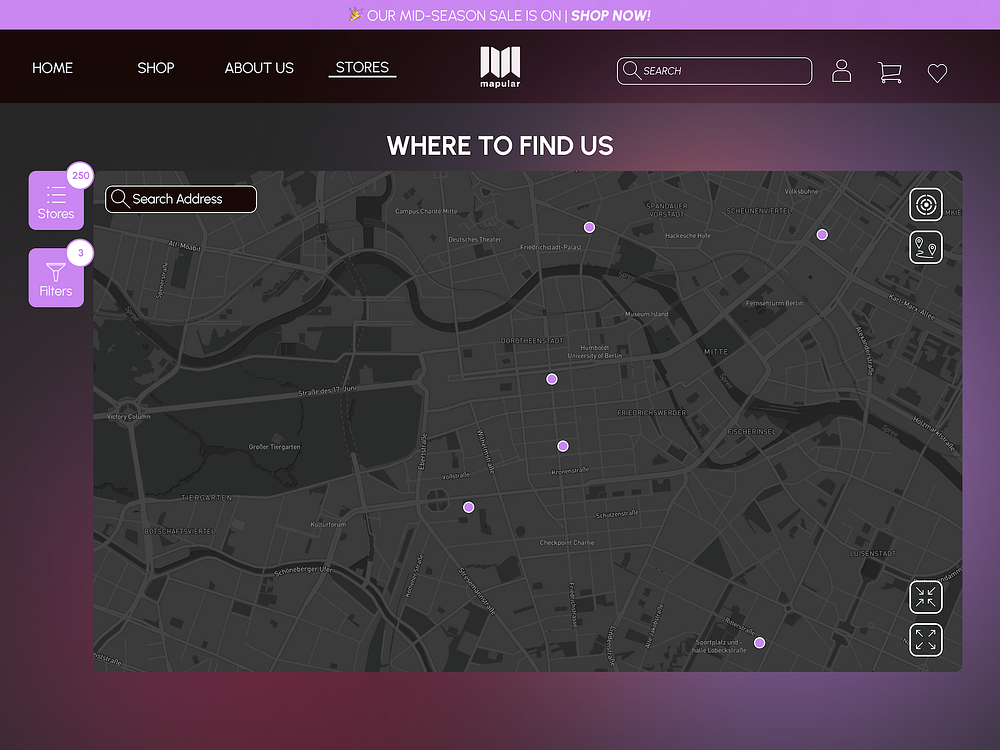
An embeddable store locator for brands selling through retail partners. It works on any website via a single script tag. Every customer search is captured automatically—city, product, and retailer—and shown in an analytics dashboard that maps demand and identifies where retail coverage is thin. Features include full brand customization, product availability filtering, retailer chain filtering with logos, pre-filtered campaign URLs, a Store Data API, and automatic Google Analytics tracking. It can be live in days.
A coordinated international operation involving U.S. and Chinese authorities has arrested at least 276 suspects and shut down nine scam centers used for cryptocurrency investment fraud schemes targeting Americans, resulting in millions of dollars in losses.
The crackdown was led by the Dubai Police, under the United Arab Emirates (UAE) Ministry of Interior, in partnership with the U.S. Federal
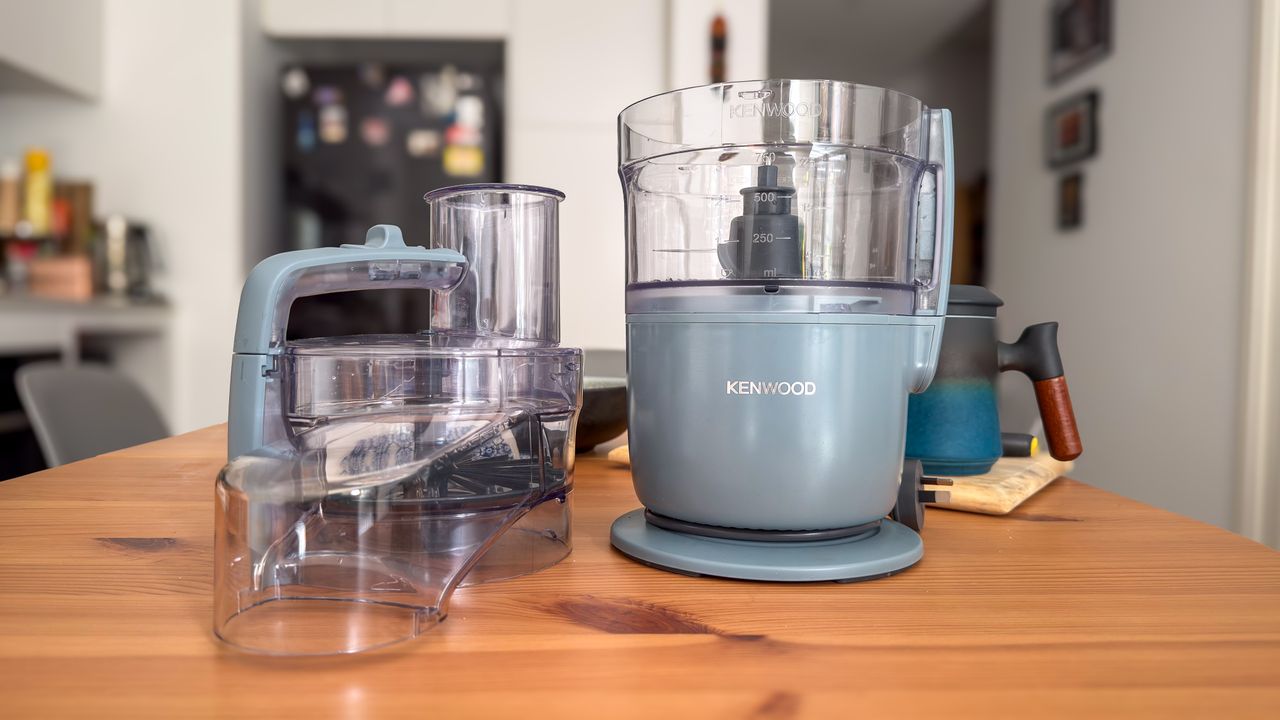
The Kenwood MultiPro Go food processor fits into a deep kitchen drawer easily for storing and still powerful enough to slice, grate, knead and chop with ease.
Amnezia VPN just rolled out its 4.8.15 update. Here is everything you need to know about the new features, bug fixes, and critical security patches keeping your devices safe.
When market distortions become so extreme that the underlying economics stop making sense, retreat is the only recourse. And, this is exactly what Morgan Stanley is now betting on in relation to Apple's ongoing bid for uncontested market share supremacy via a combination of price freezes and strategic hoarding of memory resources. Morgan Stanley believes Apple will not be able to sell the upcoming iPhone 18 variants at the same prices as those of their equivalent iPhone 17 counterparts Apple's emergent strategy to freeze the prices of its products amid the ongoing memory-driven turmoil first became evident when it refused […]
Foodbe is the first AI platform that answers food questions with the depth of a nutritionist, the knowledge of a food historian, and the instincts of a Michelin-level chef. Ask anything—why does garlic turn bitter, what does salmon do for inflammation, how do you get a perfect sear—and get answers from Neuro (food science), Oracle (food history and culture), and Chefy (cooking technique). Every answer is sourced and verified. Not a ChatGPT wrapper. Built from scratch on 3,000+ hand-curated seeds over 14 months. A B2B API is available for food apps, grocery platforms, and health companies at api.foodbe.ai.
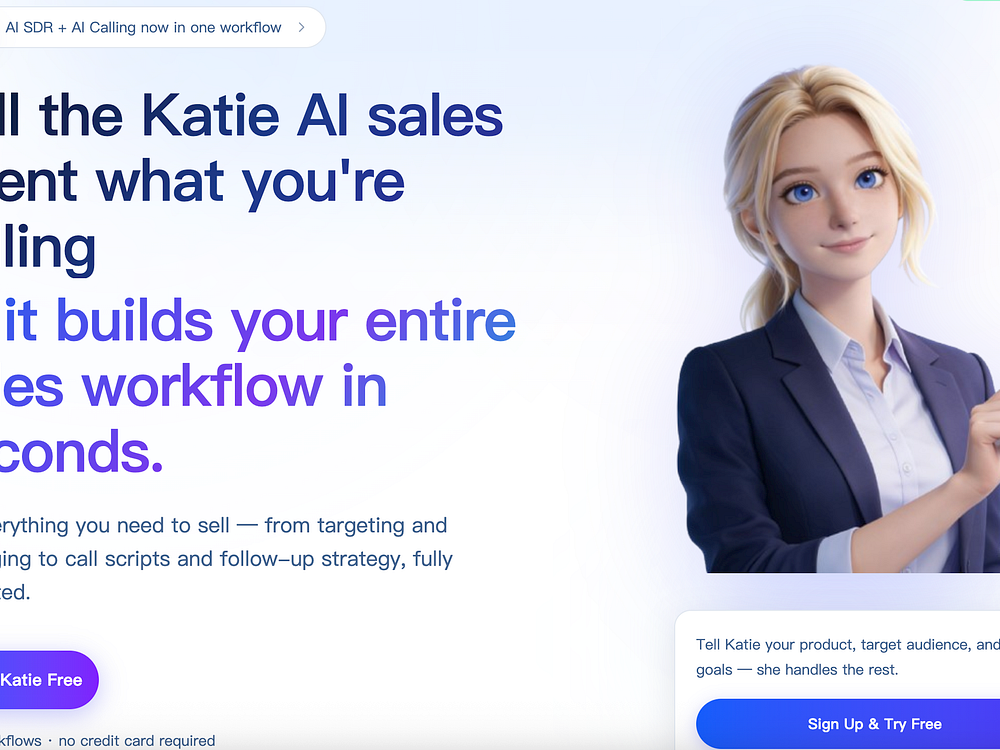
Katie AI is an AI sales agent that builds your entire outbound workflow in minutes. Describe your product and target market, and it generates ICPs, messaging, cold emails, call scripts, follow-up cadences, and next-best actions with lead scoring. Specialized agents like Market Analyst, ICP Finder, Email Writer, Call Script, and Closer guide each step so you know who to target, what to say, and when to act. Start free to turn cold leads into qualified opportunities fast.
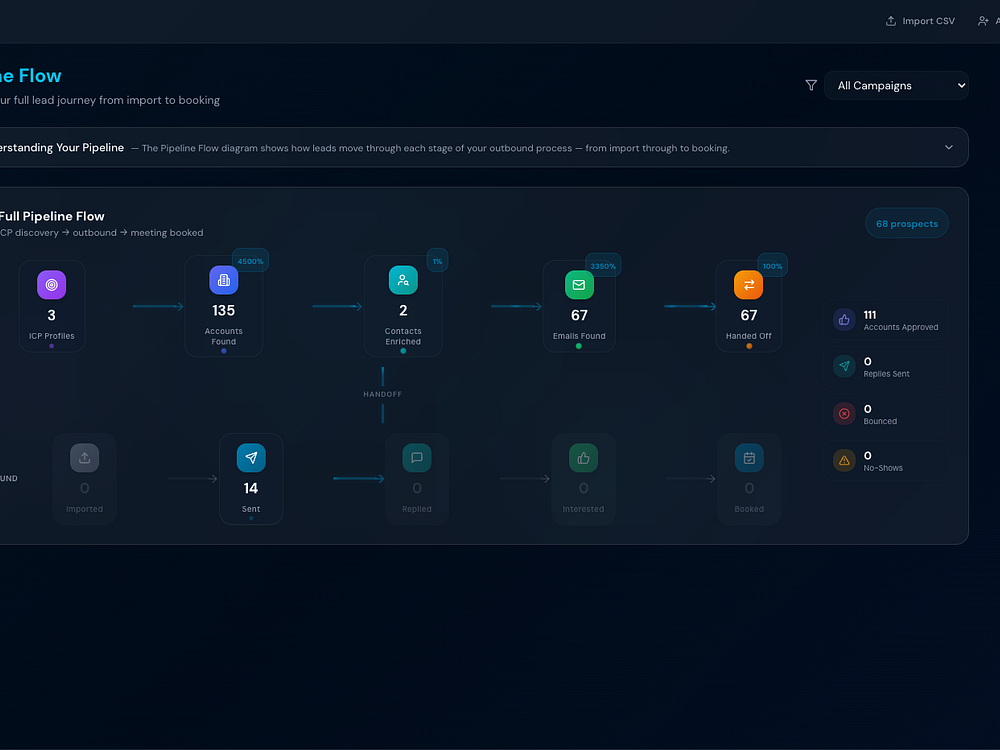
AI Prospect Scout is an AI SDR platform for founders and lean teams to turn ICPs into booked meetings. It generates your ideal customer profile from your website, discovers accounts with 20+ signals, enriches contacts, and drafts tone-matched outreach using your brand voice. Run multi-step campaigns with approvals, quality scoring, and compliance built in. Handle replies with Maria Replies AI Agent, prioritize hot leads, and schedule meetings, while Marc Prospecting AI Agent keeps your pipeline full. Track sends, replies, bookings, and funnel performance in one dashboard and connect your own email and enrichment providers for transparent costs.
MusicWave is an AI music generator that turns text prompts into full, radio-ready songs in minutes. Describe your idea, pick a genre, and get a complete track with vocals, instruments, and mixing, all AI-generated. Features include AI cover song generation, stem splitting, BPM and key detection, lyrics generation, audio mastering, AI remix, vocal removal, and image-to-song creation, offering nine professional tools in one platform.
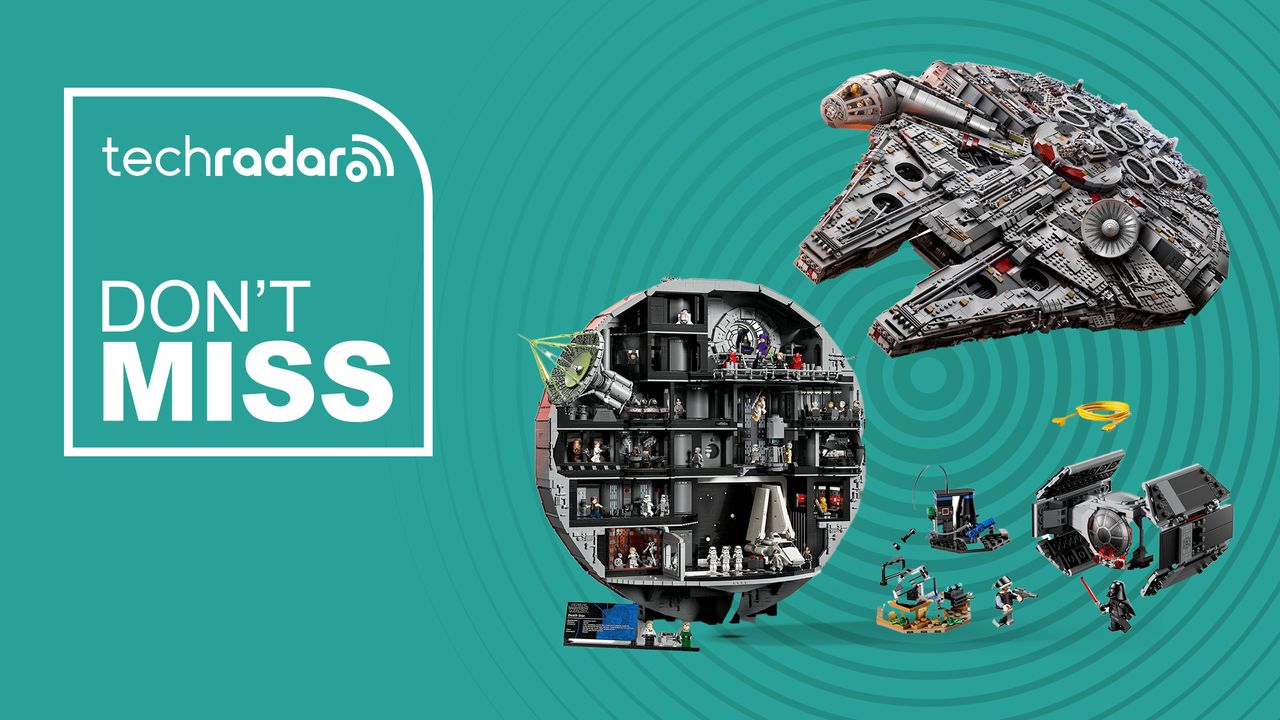
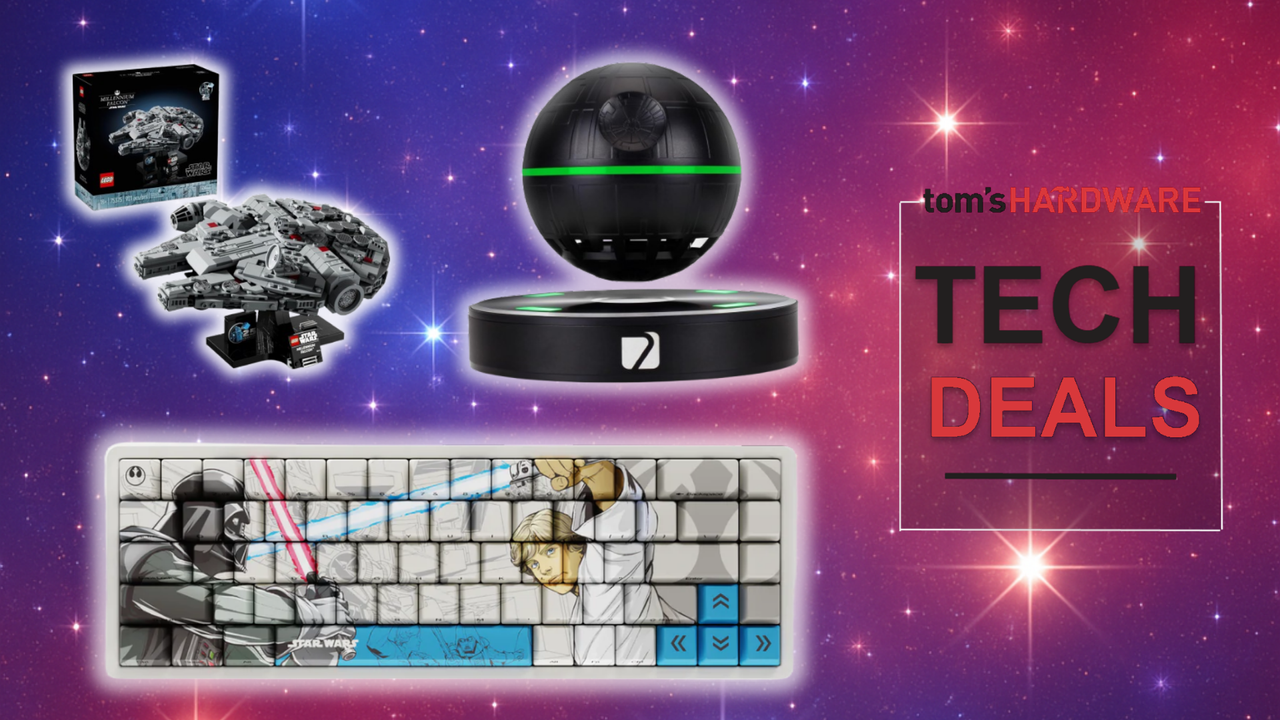
If you’re a Star Wars fan and keen to celebrate May the Fourth, Amazon has great deals on some Lego sets, ranging from big-ticket builds to more affordable ones starting at just AU$39.
Within hours he'd thrown up a website — a janky, one-hour job, by his own admission — and by Sunday, 36,000 "founding patrons" had pledged nearly $23 million, crashing his servers in the process.
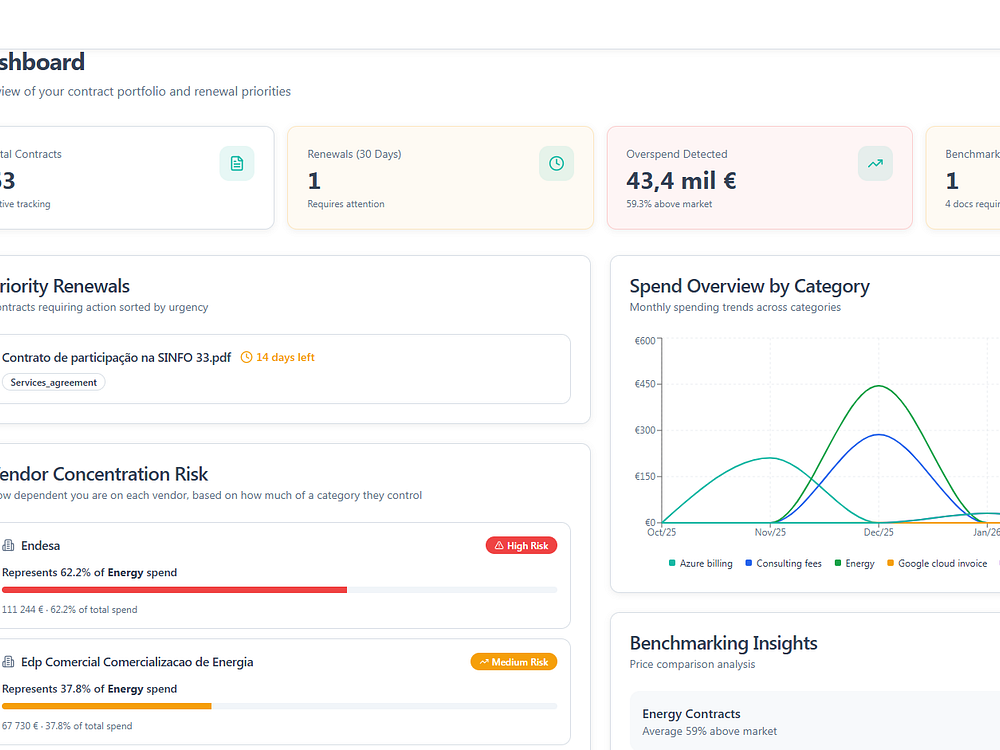
bizSupply tracks procurement contracts, monitors vendor spend, and alerts you before renewals so you can negotiate and avoid waste. It benchmarks prices, detects unused subscriptions, and shows savings opportunities in a unified dashboard with bank-grade security.
Connect your email and accounting system to auto-import contracts, then get 90/60/30-day renewal alerts and recommendations. A Chrome extension brings insights to your inbox, helping teams stay on top of every vendor relationship.
Brivvy gives teams one place to define tone, rules, audience, templates, and a glossary, then delivers that voice directly into AI clients through MCP. Write in ChatGPT, Claude, Cursor, and more while Brivvy enforces brand style and terminology automatically.
Use a unified workspace to create voices, structure content with templates, and manage preferred terms and phrases. Brivvy applies your rules at generation time so every message stays consistent and on-brand across channels.
Signed helps angels and startup employees manage their startup investments from one place. You can track portfolio value, IRR, and TVPI, run AI diligence, parse investor updates from email, triage pitches, and manage contacts. Generate tax-ready reports with cost basis, K-1 support, and year-end summaries, and track multiple entities. Build and search your investor network to bring the right people into every deal.
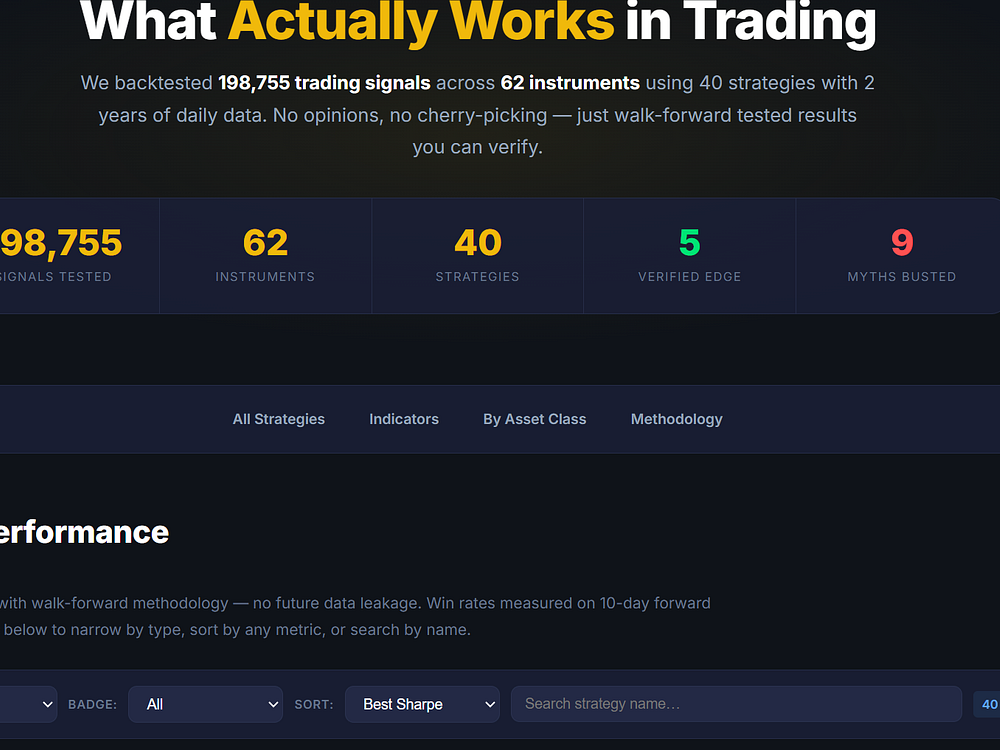
Stocks365 delivers AI-powered market intelligence for stocks, forex, crypto, and commodities. It scans 200+ instruments to generate model-driven signals with trust scores, real-time TP/SL tracking, and walk-forward tested performance statistics. The platform combines a live signals dashboard, verified track records, a geopolitical risk tracker, and market news, plus calculators, education, and research to help you act with data-backed confidence.
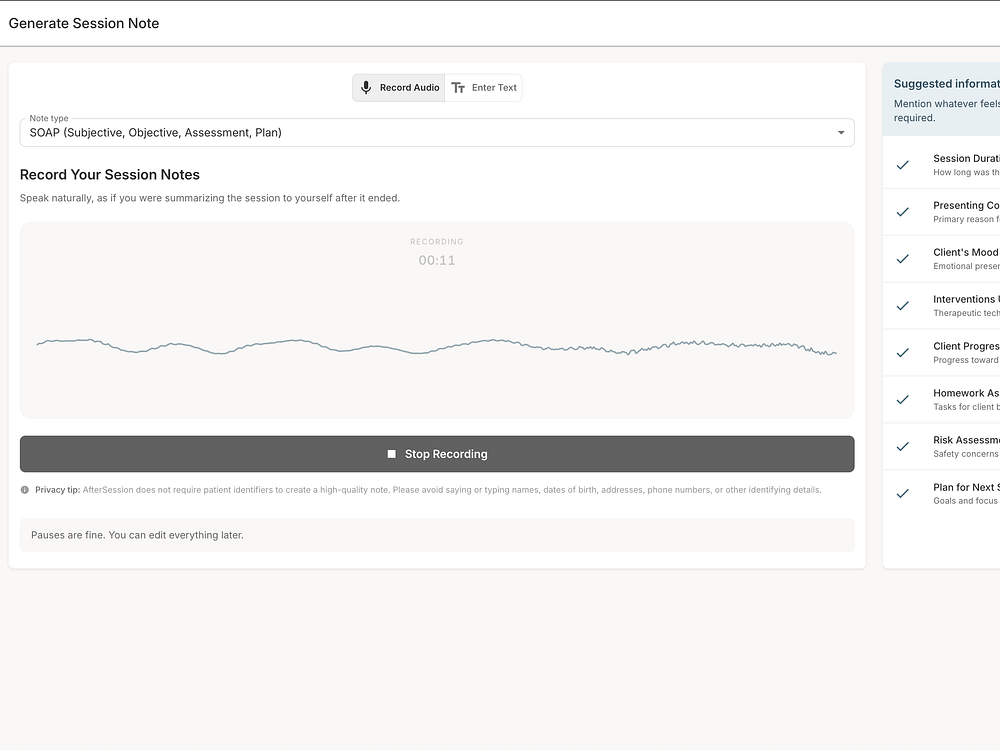
AfterSession helps therapists write session notes faster. Instead of starting from a blank page, you enter a quick summary of the session and get a structured note in seconds. It supports common formats like SOAP, DAP, and BIRP, so the output fits what clinicians already use. You can review and edit everything before saving to stay in control of the final note. It doesn’t record sessions or change how you work. It’s designed to fit into your existing workflow and reduce the time spent on documentation, especially at the end of a long day.
It’s the latest move in a race to add artificial intelligence to consumer-facing home technology, with xAI and Amazon also competing for future category dominance.
The platform will allow creators to replace copyrighted songs with royalty-free instrumental clips, while also using conversation context to filter video comments.
Anthropic, the creators of Claude AI, are reportedly in early talks with a UK startup whose SRAM tech can boost AI inference by 100x & reduce costs by 10x. Anthropic Reportedly In Early Talks With Fractile, A UK-based Startup Working on the fusion architecture as an AI Inference Booster Currently, Anthropic sources its chips from various companies, including NVIDIA, Google, and Amazon. This trio allows the company to keep running its AI infrastructure without major concerns that are often associated with relying on a single chipmaker. But as compute demand intensifies in the AI space, many AI firms are now […]
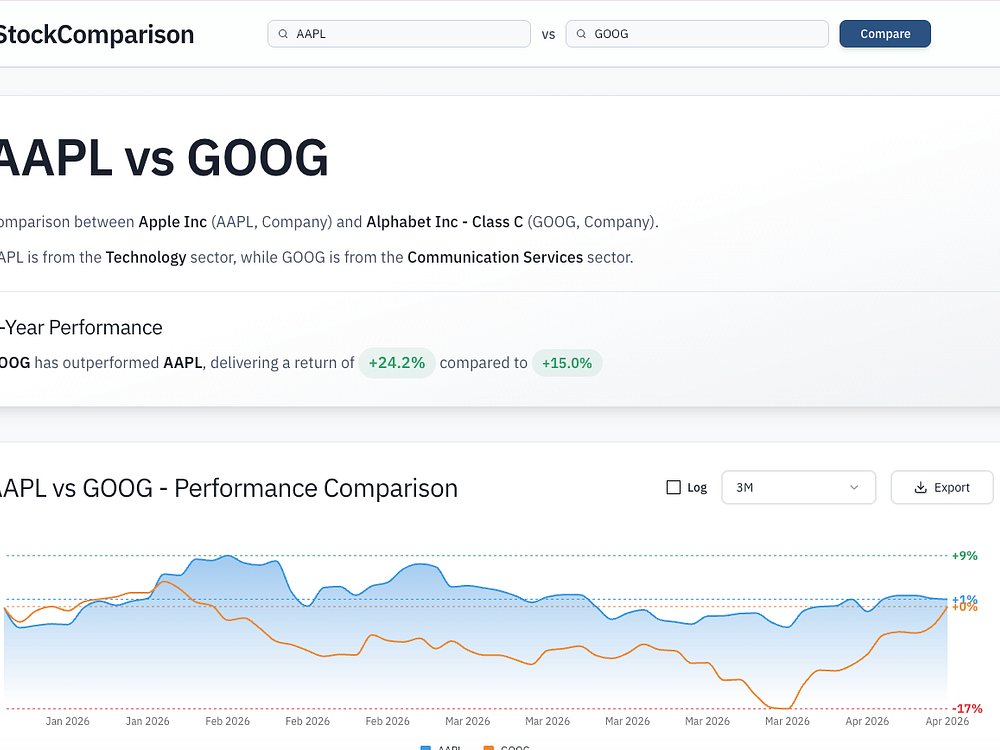
StockComparison lets you analyze two stocks or ETFs side by side using clear metrics, valuation ratios, and performance charts. It highlights the winner for each metric and visualizes returns across multiple time frames to help speed your decision-making. Powered by reliable, up-to-date market data, it tracks 5-year growth trends like EPS CAGR, dividend growth, and revenue. Search any symbol, pick two assets, and get instant comparisons without spreadsheets.
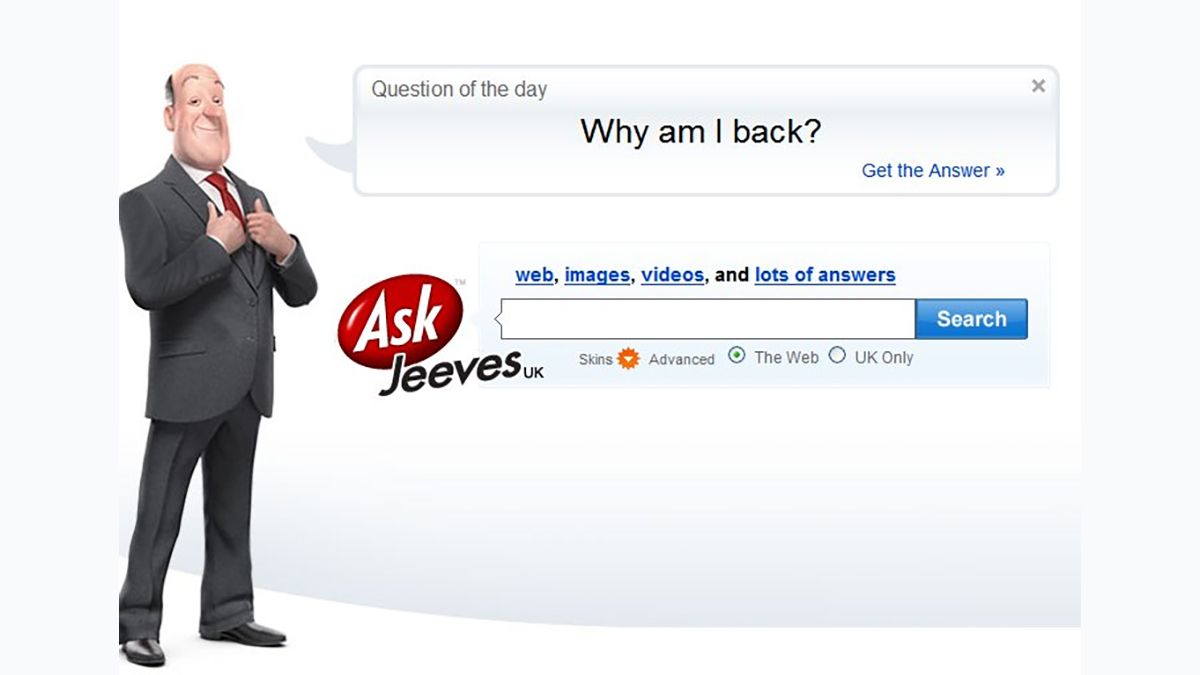
Ask.com, formerly Ask Jeeves, which launched 29 years ago on June 3, 1996, before Google launched, shut down on May 1, 2026.
Ask.com now has a turn down page that reads:
Every great search must come to an end. As IAC continues to sharpen its focus, we have made the decision to discontinue our search business, which includes Ask.com. After 25 years of answering the world’s questions, Ask.com officially closed on May 1, 2026.
“To the millions who asked…” We are deeply grateful to the brilliant engineers, designers, and teams who built and supported Ask over the decades. And to you—the millions of users who turned to us for answers in a rapidly changing world—thank you for your endless curiosity, your loyalty, and your trust.
Jeeves’ spirit endures.
Ask.com has been known as an answer engine, the Jeeves butler was who you spoke to in the early days. With AI and all these new answer engines, Ask.com could have deployed its own unique taste for its answer engine. But I guess with all the competition and the market being harder, IAC, Ask.com’s parent company, decided to turn it down.
Ask.com will always have a place in the search marketing industry and Ask, including Jeeves, will be missed.
NVIDIA's Feynman GPUs will be the first to feature Co-Packaged Optics, but this wasn't always the case until the AI giant decided to switch gears. Co-Packaged Optics Were Many Years Away, But NVIDIA Decided To Move Ahead With Its Feynman GPUs CPO or Co-Packaged Optics (Silicon Photonics) is the next-generation solution that reduces reliance on copper and harnesses light to transfer signals. These CPOs are packaged alongside hardware accelerators such as GPUs and will be a key solution for next-gen AI factories, offering improved interconnect latency and creating high-bandwidth connections between CPU and GPU. If we go by the original plans, […]
After a long time, the entry-level RTX 50 series GPU made its debut on the Steam Hardware Survey charts. All NVIDIA RTX 50 GPUs Appear on Steam Hardware Survey With RTX 5050 As the Latest Entry; 16 GB VRAM GPUs Now Closer in Popularity to 8 GB GPUs The previous Steam Hardware Surveys recorded almost all NVIDIA GeForce RTX 50 series GPUs, but the RTX 5050 always remained missing. Despite launching mid-2025, there was no sign of the GeForce RTX 5050 until now, when the card suddenly appeared on the Steam database. Both laptop and desktop variants are now available […]
APOLLO Data Auditor scans files, databases, cloud storage, and Active Directory to detect personal data, quantify regulatory exposure in euros and dollars, simulate breach scenarios, and measure AI readiness. It can be deployed in 48 hours without dedicated staff.
Enterprise data audit tools cost €50-300K per year and cover 1-2 axes. APOLLO covers all four: Risk, Compliance, Data Protection, and AI Readiness, at under €5K per year. It is designed for SMBs and is based on real scanned data, not declarations.
Zerentry automates invoice and receipt data entry with an LLM-based engine that reads documents like a human and captures vendors, dates, VAT, totals, and line items with high accuracy. You can review low-confidence fields inline and sync results to Xero, QuickBooks, or Zoho Books in one click. It learns from your corrections, detects duplicates and anomalies, supports bulk uploads and email forwarding, and offers optional human verification. SOC 2 Type II security and audit logs help you close your books faster.
A new study examines how large language models perform in a variety of medical contexts, including real emergency room cases — where at least one model seemed to be more accurate than human doctors.
The underlying concept is not new. Acoustic fire suppression has been studied for years as a means of disrupting combustion by pushing oxygen away from the fuel surface.
AMD's next-generation Halo flagship, the Ryzen AI MAX+ 495, has leaked out, featuring a 10% bump in performance & a new Radeon 8065 iGPU. AMD Ryzen AI MAX+ 495 Is The Flagship Gorgon Halo APU, Rocks 16 "Zen 5" Cores & Radeon 8065S GPU Earlier this year, we reported that AMD was working on a new Halo family called Ryzen AI MAX 400, and codenamed Gorgon Halo. Just like Strix Point to Strix Halo, Gorgon Halo will offer similar architectures as Gorgon Point "Ryzen AI 400" SoCs, but elevate the configurations with more cores, beefier GPU, and lots of memory […]
In an era of unprecedented memory-led chaos in the global smartphone sphere, Apple lobbed nothing short of a bombshell during its earnings call this week, declaring that TSMC's advanced node capacity - not memory - was the main bottleneck for its products. Think about this. As per conservative estimates, Apple's iPhones are all set to consume 2.4 exabytes of memory this year! And yet, the Cupertino tech giant declares it is not memory-constrained, while seemingly capping the prices of its products. This declaration is nothing short of a gauntlet for Chinese OEMs: Apple is coming after your market share! Apple's […]
omnirun runs on your computer and builds real projects using your actual files. Describe what you want by text or voice — it plans, creates, previews, and deploys to Vercel, Netlify, and more. Works with Claude, OpenAI, Gemini, Groq, DeepSeek, and Ollama. Bring your own keys, no markup. Everything stored locally in SQLite — your code never leaves your machine.
Built-in AI assistant connects to Gmail, Google Calendar, GitHub, Slack, and Notion. It reads emails, drafts replies, and has watching agents that notify you when things happen. Project memory lets you return months later and resume instantly. Auto model routing cuts token costs 60-80%. Unlimited version history with instant rollback.
Mallary unifies social media scheduling, posting, and engagement through a single API and dashboard. Developers can schedule cross-platform posts, attach first comments, and enable AI auto-replies that keep audiences engaged.
The platform manages authentication, rate limits, retries, and platform approvals, with CLI and MCP support for agents and automation. Track views, likes, and comments, run bulk uploads, and rely on durable queues and preflight checks to keep workflows running across Instagram, YouTube, TikTok, LinkedIn, X, Pinterest, Reddit, Threads, and more.
LEGO Batman: Legacy of the Dark Knight’s PC system requirements are a disgrace The PC system requirements of LEGO Batman: Legacy of the Dark Knight have arrived, and whoever crafted them should be ashamed of themselves. The game is due to launch on PC on May 22nd, and the only word we can use to […]
One of the more distinctive entries in that category comes from Wokyis: a retro-styled dock that adds NVMe storage, extra ports, and a small secondary display, all within a chassis designed to sit directly under the Mac mini.
Japan's defense ministry recently sat down with Air Kamuy, a drone manufacturer whose signature design relies on corrugated cardboard construction. The meeting signals Tokyo's broader ambition to carve out a leadership role in low-cost drone production as mass-market models reshape the calculus of modern warfare.
Apple observes stringent quality control measures so that its premium products not only stand the test of time regarding durability but also minimize hardware failures caused by manufacturing defects. Unfortunately, when you’re dealing with millions of units being shipped in a calendar year, there’s always a chance that an owner ends up with an ‘odd one out’ and, sadly, an M5 MacBook Pro that was only two days old was completely dead when a spark formed due to the machine’s hinge movement. The M5 MacBook Pro’s failure will definitely be an interesting case for Apple’s engineering team, but a YouTuber has […]
Intel's Z-Angle Memory (ZAM) is approaching completion as it races towards taking a bite at the AI boom while challenging HBM as a viable alternative. Intel's ZAM Challenges HBM As A Big Memory Innovation In the High-Bandwidth, High-Capacity Segment Offering 2x The Speed of HBM4 Z-Angle Memory or ZAM has been stirring up a lot of talk in the memory segment. The upcoming memory standard is being developed by Intel and SoftBank & aims to offer a low-power, high-density replacement to HBM. Now, new details have been shared that provide more insight into ZAM memory. For starters, the new memory […]
Nvidia is apparently discontinuing some older embedded platforms earlier than anticipated, but this is mostly about market reality finally catching up, not abrupt discontinuation.
This Newegg bundle offers cutting-edge performance with practical value, combining AMD’s latest flagship CPU with high-end supporting components at a discounted price.
The GameSir G8 Galileo is a wired USB-C mobile controller with full-size grips, Hall effect joysticks and triggers, and a pair of programmable back buttons.
Intel's recently released Arc Pro B70 32 GB GPU has been tested in games, outperforming the Arc B580, and trading blows with the RTX 5060 Ti. Intel Arc Pro B70 GPU Gaming Benchmarks Give Us A Hint of What The Arc B770 "Big Battlemage" GPU Could've Offered To Gamers Back in March, Intel launched its Arc Pro B70 graphics card based on the Battlemage BMG-G31 GPU, which we all know as Big Battlemage. This bigger Battlemage chip was long-awaited in the gaming segment, but Intel decided to focus its efforts towards the AI market, equipping the card with a large […]
Reports of YouTube freezing browsers and consuming massive amounts of RAM are spreading online, with developers tracing the issue to a suspected UI bug that may trigger endless layout recalculations and severe system lag.
AMD promotes open platforms for space AI, arguing modular systems reduce vendor lock-in risks while improving flexibility across complex multi-supplier mission environments.
The set launches June 1, priced at $39.99, and comprises 479 pieces. The finished model measures roughly 4.5 inches long and six inches wide, a compact footprint that still leaves room for the details that made the original console recognizable.
xAI is reportedly able to utilize just over 10% of its entire NVIDIA GPU fleet, as report suggests lackluster AI software stack optimizations. AI Software Stack Bottlenecks Are An Industry-Wide Problem, As xAI Is Only Able To Utilize 11% of Its Entire NVIDIA GPU Installation. The Information has reported that Elon Musk's xAI, the software firm behind Gorq and other key AI-based components, is only able to utilize a small chunk of its total installed GPU capacity. Currently, xAI runs around 550,000 NVIDIA GPUs, which are a combination of H100s and H200s. These are deployed within xAI's Memphis and Colussus […]
The ROG Equalizer doesn't work as advertised as discovered by Der8auer in his latest demonstration. ROG Equalizer 12V-2x6 Cable Shows Large Current Imbalance On WireView Pro II While Removing the Bridge Improves Balancing It appears that ASUS's recently released ROG Equalizer 12V-2x6 cable might not be the solution for proper load balancing. ASUS explicitly advertised the ROG Equalizer cable as a component that does better load balancing than regular 12V-2x6 cables, but the testing by popular German YouTuber Der8auer reveals something interesting. Der8auer has made two videos on the connector, but his latest video finds out what makes the ROG […]
Micron posted a record Q2 as DRAM demand increases, but its CEO says this is just the beginning as more memory is required for AI to reach its full capabilities. Micron CEO Sees Demand For Faster Memory To Increase Massively For AI To Reach Its Full Potential Memory & Storage maker, Micron, has seen exceptional growth across all of its businesses, which include DRAM, NAND, and HBM. The growth comes from skyrocketing demand for their products as the Agentic AI craze continues to lift off every memory and storage firm. During a conversation with CNBC, Micron's CEO said that what […]
Chinese courts ruled that companies cannot automatically fire workers simply because AI can do the job more cheaply, declaring that automation alone does not justify dismissal under labor law.
Every World Cup, millions across Latin America create prediction pools called quinielas, pollas, or prodes depending on the country. Organizers collect predictions via WhatsApp, track scores in Excel, and manually update leaderboards that nobody trusts. With 104 matches in 2026, that’s unsustainable.
Toqui replaces the entire workflow. Create a pool, share a link, and everyone joins to predict from their phone. Scores update live and leaderboards are automatic. No app download is needed since it’s a PWA. Free for groups up to 25. Pro tiers support offices and companies up to 1,000+. Covers World Cup 2026, Liga MX, Champions League, and more. Built for Latin America but works everywhere.
Roami provides global eSIM connectivity for travelers across 200+ countries and regions. Activate instantly without a physical SIM, choose daily unlimited or 1–30GB data plans, and access options with voice. The app auto price matches, supports 21 languages and local payments, and offers a worry-free refund if service doesn’t work.
Start with 100MB free to try, then stay online at high speed with partner networks and 24/7 human support on iOS and Android.
Verizon's latest deal on the Galaxy S26 waives the trade-in criteria, gets you up to four devices for cheap, and even throws in a tablet and smartwatch.
Welcome to May and this month kicks off with several new games from independent developers. This week's major release is all about navigating the great white north, in more ways than one. The week kicks off with a different take on the tower defence genre, followed by a game that combines disco and beat 'em up. Next up we have an online co-op action RPG which is followed by one that isn't online and finally we round the week off with some crab evolution. Don't forget to check out some of the other games also launching this week.
WILL: Follow The Light / This week's major release / Thursday 7 May
WILL: Follow The Light is a story-driven, first-person adventure puzzle game about a perilous personal journey through the harsh northern latitudes. To find peace and reunite with his family, Will must sail across endless waters, face numerous challenges, and ultimately discover himself. Steam link
AMD seems to be preparing its first PRO CPU with 16 "Zen 5" cores & 3D V-Cache, the Ryzen 9 PRO 9965X3D. AMD's Ryzen PRO Lineup Used To Max Out at 12-Cores, But That Changes With The Upcoming 16-Core Ryzen 9 PRO 9965X3D AMD Ryzen PRO Desktop CPUs are designed for professionals, content creators, and AI users. These chips come with advanced security, manageability, and stability versus the standard chips. For a long time, AMD's Ryzen PRO family has featured up to 12-core models, but it looks like the company is about to release its fastest chip to date. On […]
Halo leaker RebsGaming reports that Halo Studios is already working on remakes for the second and third installments in the sci-fi first-person shooter franchise. Halo 2 and Halo 3 are currently in early development, presumably powered by Unreal Engine 5 like the first game's remake; this builds on a previous claim from a former Halo Studios developer, and is now backed by two additional sources, one of whom provided verification to RebsGaming and confirmed the trilogy remakes will proceed regardless of how well the upcoming Halo: Campaign Evolved performs. A separate source (the same one who leaked an unreleased Campaign […]
Pretty much no games recommend more than 16GB of RAM, even in the unoptimized era we're living in right now. Only a few titles at their highest presets say 32GB is ideal, so Microsoft claiming that 32GB is the future-proof standard isn't exactly wrong. You'll be fine with 16GB today, but perhaps not tomorrow.
Amazon says that it will take months before it can return its Bahrain and UAE data center back to full operational status. In the meantime, the company suspends billing for affected customers while also recommending that they move to other Regions to restore service.
Japan is deploying ultra-cheap cardboard drones built for swarm warfare and expendable combat missions. The flat-packed AirKamuy 150 costs as little as $2,000 — far cheaper than many military drones.
Koopic is a CAASM platform built for security teams who need a complete, trusted asset inventory. It pulls data from every tool in your stack — EDR, MDM, CMDB, cloud, on-prem — and merges it into one golden record per device. Shadow IT surfaces automatically, coverage gaps become visible, and exceptions are tracked.
The result is a near real-time picture of your full environment so you can see real risk and prioritize what to fix next. No spreadsheets, no six-figure contracts, no black-box merging. Start free in minutes.
Live3D offers an online AI image editor that lets you transform photos with simple text instructions. Change hairstyles, poses, backgrounds, lighting, and text while keeping faces and identity consistent. Make precise, localized edits, choose from multiple AI models such as Seedream 4.5 and Nano Banana variants, and export in many sizes. Upload your image, describe the change, generate results in seconds, and download the final version.
From Iceland to Italy and Japan to Australia, Lushfoil Photography Sim faithfully recreates beautiful landscapes to explore with your virtual camera and lenses
Chip manufacturer Samsung is experiencing strong demand for its 4-nanometer process due to strong demand from the memory market, suggests a report in the Korean press. The details suggest that Samsung Foundry has secured orders that extend into 2027's production, and according to a source, the 4-nanometer process' stability has played a role in ensuring the strong demand. Samsung Foundry Purportedly Experiencing Strong Demand For Its 4-nanometer Chip Manufacturing Process Today's report is the second over the past couple of days that claims high yields for Samsung's 4-nanometer manufacturing process technology. This technology, dubbed SF4, began mass production in 2021 […]
PropSyncX lets you manage and copy trade multiple funded futures accounts from a single, clean dashboard. Connect TopstepX, Tradovate, Rithmic, and NinjaTrader, place one trade, and replicate it across accounts in under 100ms while still controlling each position independently with per-account TP/SL brackets. Trade on built-in TradingView charts with drag-and-drop stops, real-time market data, a multi-account P&L view, and a built-in trading journal to track performance.
The U.S. Cybersecurity and Infrastructure Security Agency (CISA) on Friday added a recently disclosed security flaw impacting various Linux distributions to its Known Exploited Vulnerabilities (KEV) catalog, citing evidence of active exploitation in the wild.
The vulnerability, tracked as CVE-2026-31431 (CVSS score: 7.8), is a case of local privilege escalation (LPE) flaw that could allow an
Here's how to watch World Snooker Championship Final 2026 live streams from anywhere and for free, as two of the best players in the world meet at the Crucible.
Most creators skip video because filming is a pain. Kinova fixes that. Describe what you want, and our AI video agent produces clips with consistent characters and professional voiceover. Go from idea to published video in minutes.
Concordance delivers SDLC intelligence to observe, govern, and improve engineering. It connects to GitHub, GitLab, Bitbucket, Jira, and Linear with read-only OAuth and scans commits, PRs, branches, workflows, and issues to score 50 protocols across requirements, design, development, testing, release, and operations.
Get per-team maturity scores, audit-ready evidence mapped to SOC 2, ISO 27001, NIS2, and CRA, AI-active repo detection, and deployment risk gates. Start free for one team; upgrade for compliance, AI governance, and risk lenses.
StillDeck is a free browser-based Klondike solitaire game for people who just want to play cards without pop-ups, accounts, or app installs. Open the site on any device and start playing immediately. It includes Draw 1 and Draw 3 modes, an undo button, move counter, and auto-complete for finishing solved games. The interface is minimal and distraction-free. StillDeck is available in 19 languages and works on desktop, tablet, and mobile—all from a single URL.
The Buildsheet is a platform for car enthusiasts to track and share vehicle builds. Create a buildsheet, log mods with photos and notes, and organize parts and updates. Explore a feed by make, model, or build type, follow projects you love, and message builders. Membership starts at $1.99/month with the first month free to support hosting and community features.
Pantr AI is a visual workspace for generating and editing images on an infinite canvas. Build directions with drag-and-drop references using the @ system, iterate with regenerate, crop, expand, and animate, and keep every variation in view. It runs on Gemini 3.1 Pro for high-quality results, includes a Creative Director that sees your canvas to help with prompts, and uses pay-as-you-go credits that never expire.
Every major shopping tool today answers one question: where can I get this cheaper? Nobody answers the harder question: is this product actually worth buying? IMO fills that gap. Our AI agents analyze thousands of verified owner reviews, filtering out fake, incentivized, and early honeymoon ratings, to tell you what real owners discovered after months of daily use. Our Electronics Specialist agent VOLT provides an IMO Score (0–100) based on owner satisfaction, durability, value ratio, and defect frequency, plus the #1 hidden flaw mentioned by 847 reviews that the product page never will. All of this is available in under 10 seconds, free, on WhatsApp.
RenovateIndex provides regional renovation cost estimates for Canadian homeowners, adjusted for provincial labour rates using Statistics Canada BCPI data and city-size modifiers from CMHC. You can browse 50 services across 55 cities to see budget-to-premium ranges, component breakdowns, and cost factors to help plan and sanity-check contractor quotes. The site details its methodology and publishes insights for homeowners and contractors.
FPLai provides AI-powered analysis for Fantasy Premier League managers. Connect your squad to see prioritized transfers, captaincy picks, and a data-backed starting XI tailored to your budget and remaining moves. Elite Pulse tracks Top 1k activity so you can act before the crowd.
Use Team DNA to visualize strengths, risk profile, and trends, then monitor injuries and price changes to avoid surprises. Track rank progression, compare against rivals, and turn every gameweek into a clear, confident plan.
MakeInfographic is an AI infographic generator that turns a simple prompt into a finished, editable design. Describe your topic, pick a layout and visual style, then download or refine the result. It supports timelines, comparisons, processes, pyramids, explainers, and statistical layouts, plus style shifts like clean, sketch, comic, clay 3D, and isometric. Create platform-ready variations for X, TikTok, Pinterest, Instagram, and more. Free exports include a watermark, with 4K available to subscribers.
Well, isn't that unexpected? A Japanese toilet maker has just announced that it will pivot to AI chips, leading to a 18% stock surge. Ceramics Used For Making Toilets Are Now Going To Power The AI Chip Industry Who would've predicted that a company involved in making toilets and other sanitary equipment would start making AI chips? Well, Toto, A Japanese company, has just announced that and is seeing a boost to its stock. The company leverages ceramics for its current operations, but the same ceramics can be used for making components that are critical to AI infrastructure. As per […]
Building a PC has its advantages, such as cheaper parts costs and a learning experience that'll stick with you forever. However, when our AI overlords suck the joy out of DIY custom rigs, we need to venture out to find good deals in such turbulent times, and these prebuilts from ABS provide exactly that.
After having reviewed several portable monitors from Uperfect, I got my hands on the UFree V, a new portable monitor which promises completely "wireless" operation. As soon as I read that, my interest sparked several folds since conventional portable monitors aren't "truly" portable, as you still have to power them using an outlet and connect them to a device. Portable monitors are usually much lighter and thinner than regular desktop monitors, but UFree V brings both a lighter and thinner build, alongside wireless operation. After having tested the UFree V, I have been eager to explain the pros and cons […]
MiroFish is an AI simulation chat that predicts outcomes from your what-if questions. It combines seed creation, graph-based simulation, and reporting in a single conversation, so you can stay in chat while it works behind the scenes. Start with text and optionally attach files for context. Each response includes a structured result card with summaries and clear follow-ups, helping you explore shifts in sentiment, narrative spread, and stakeholder reactions across policy, brand, and product scenarios.
Fokal helps founders get found on Google and AI search without the time or cost of a traditional agency. You tell Fokal what your business does, and it handles the rest. It audits your site for technical issues, identifies content gaps, writes publish-ready articles in your voice, pitches editors for backlinks, and monitors if AI tools like ChatGPT, Perplexity, and Google AI recommend your brand.
No SEO knowledge is required. Everything is prioritized and ready to act on, so you always know what to work on next.
Europe is mandating structured e-invoicing for all businesses — Germany from 2027, France from 2026 — and most tools either charge extra for compliance or don't support it at all. Facturwise generates fully compliant ZUGFeRD 2.4 and Factur-X 1.0.8 invoices automatically on every plan including the free one. Beyond compliance, you get multilingual invoices in 6 languages, 30 currencies with live ECB rates, SEPA QR codes, recurring billing, payment reminders, expense tracking, and client management — everything you need to invoice across the EU from one platform.
Here's how you can watch Kentucky Derby 2026 live streams online and from anywhere, with Renegade the favorite for one of the world's great horse races.
Diablo 4: Lord of Hatred surprised me in ways I didn’t expect. After being disappointed with the game’s earlier seasons, this expansion finally delivers the pacing, loot flow, and endgame structure I’d been waiting for. It’s the first time Diablo 4 has felt close to the fantasy Blizzard promised at launch, and it genuinely changed my perspective on where the game is heading.
Developer Kraken Express introduced Windrose as a survival adventure set in the age of piracy, featuring a procedurally generated world where players can gather, build, and craft alongside the usual piracy activities such as fighting and looting. Released in Early Access in April, the game has since made headlines for...
QNAP has introduced its new AI NAS, which packs a 16-Core AMD EPYC "Zen 2" CPU & can be paired with up to an RTX PRO 6000 Blackwell GPU. Old Meets New In QNAP's "QAI-h1290FX" AI NAS: 16 Zen 2 Cores & 96 GB RTX PRO 6000 GPU The "QAI-h1290FX" is QNAP's latest Edge AI offering that combines two distinct hardware components. But before we get into the details, it should be mentioned that QNAP's latest AI NAS is designed for LLM, RAG, and various GenAI applications. Two components power the server, the first is the AMD EPYC 7302P CPU, […]
PawBench helps dog owners find the right gear for their specific dog. It matches recommendations to breed size, coat type, and energy level, rather than just offering generic "best dog beds." For example, it finds the best bed for a 90-lb German Shepherd who sleeps hot or the safest harness for a flat-faced Frenchie.
We've researched 200+ products across 10 categories and written guides for 75 breeds. You can browse by category or by your dog's breed, read side-by-side comparisons, and buy what actually makes sense for your dog, not whatever paid for the top spot.
SegmentFlow is an AI-driven email marketing platform for ecommerce brands. Describe your campaign in plain English and it writes the copy, designs the emails, builds segments, and sends to the right audience. It creates automated journeys and transactional emails, tracks revenue attribution, and supports newsletters and lead magnets. Connect Shopify or WooCommerce in minutes to sync customers, orders, and products, then launch campaigns fast at a fraction of typical costs.
Hi-AI is an affordable all-in-one multimodal AI platform that helps you search the web, draft reports, and create media. Chat by voice or text, then generate and edit images, produce videos, design 3D meshes, and compose songs. Use it to research topics, summarize results, and turn ideas into visuals, animations, and audio.
Defense officials have framed the effort as a necessary step to keep pace with both technological change and geopolitical competition. "We are equipping the warfighter with a suite of AI tools to maintain an unfair advantage and achieve absolute decision superiority," Emil Michael, the undersecretary of defense for research and...
Moore's Law has slowed down, but progress continues in logic development as a new roadmap points to sub-1nm process nodes around 2034. It will Be Years Before Process Technology Go Sub-1nm, But They Are In Development: 0.7nm by 2034 & <0.2nm by 2046 Process technologies have slowed down as we transition into the Angstrom era. While newer nodes continue to offer uplifts, they are getting expensive to produce as the machinery needed to achieve newer designs comes at higher costs. Furthermore, the reliance on chiplets through advanced package solutions has reduced the need to shift to newer nodes immediately, as […]
The Wokyis M5 Retro Dock Station will add USB ports, memory card readers, and an external SSD enclosure to your Mac mini while giving you a small '80s Macintosh on your desk.
Modder "awalol" has spent the past several weeks developing firmware that, when installed on a 2-inch-long Raspberry Pi device, allows PCs to use adaptive triggers and haptic feedback on Sony's DualSense controllers without a wired connection. Living room PC gamers will likely appreciate the cheap custom add-on.
The size mismatch is hard to overlook. GameStop carries a market value of around $12 billion; eBay sits closer to $46 billion. Despite that gap, GameStop has already been quietly building a stake in eBay ahead of a potential bid – a signal that Cohen is willing to swing big...
AMD has taken a major step toward enabling native open-source HDMI 2.1 support on Linux by submitting new patches for its AMDGPU driver. AMD Moves Closer to Open-Source HDMI 2.1 Support on Linux With New AMDGPU FRL Patches It appears that the HDMI 2.1 support is finally arriving to Linux as AMD has submitted the new Fixed Rate Link (FRL) patches for its AMDGPU driver. This has been one of the longest-standing limitations that affected Radeon GPUs on the platform. There have been years of restrictions tied to the HDMI Forum (Org behind the HDMI standard) policies that prevented upstream […]
One of the best gaming processors has dropped to its lowest price in 2026, but it's a limited-time deal. AMD Ryzen 7 7800X3D Drops to $324 on Amazon; The Best Gaming Processor for Sub-$350 Price Tag Not just Ryzen 7 9800X3D, the launch of newer and faster processors has resulted in price drops across various Ryzen chips, including previous-gen CPUs. AMD Ryzen 7 7800X3D is still one of the best gaming chips that trades blows with Ryzen 7 9800X3D, but is significantly cheaper right now. While the processor launched at a hefty price tag of $350, it got discounts after […]
You don't see these deals everyday, and this is one of the craziest ones we have seen so far for the AM5 platform. Redditor Grabs AMD Ryzen 7 7800X3D for Just $145 and Ryzen 5 7600X For Only $75 From Local Walmart The AMD Ryzen 7 7800X3D sells for around $350 on Amazon, which, even though it is significantly lower than its launch price, is still a hefty price tag for most. Being one of the best gaming processors, the Ryzen 7 7800X3D sees huge demand, which is why users are willing to pay over $300 for this chip. However, […]
Today, Pearl Abyss rolled out update 1.5 for Crimson Desert across all platforms except the Mac App Store, which will receive it at a later time. Patch 1.05.00's headline addition is the highly anticipated (and promised) Rematch system, which lets players revisit any of the game's 69 bosses at any time by lighting their lantern at the site of a previous encounter to read a Memory Fragment. The system launches with two modes: Reminisce, which recreates the fight exactly as it was the first time, and Resonate, which scales the boss's stats to match the player's current progression if they've […]
Microsoft continues to make some of the earliest chapters of its operating system history open-source and freely available. Here's 86-DOS 1.00, released on its 45th anniversary, for example.
A French retailer is willing to sell you defective RTX 5090s for half of what they cost new, on the condition that you'll be able to repair or recycle them. You can either get a random 5090 variant, depending on stock, for around $1,760 or pay almost $2,000 specifically for an MSI Ventus 3X OC model. The units come with transport-related damage.
The U.S. Navy just signed a $99.7 million deal with Domino Data Lab to build software to monitor other AI mine detection systems, identify failures, and push corrections in the field.
A YouTuber made his own Peltier liquid cooling system to see if GPUs benefit from thermoelectric cooling. Sadly, the cooler was barely capable of cooling an RTX 3070 below ambient temperatures despite consuming over 300 watts of power.
Hal9 helps startup founders design, build, and scale AI-powered products without hiring an in-house team. Its fully managed, autonomous AI turns ideas into working chatbots, agents, APIs, websites, mobile apps, and extensions, and handles hosting, monitoring, and updates.
The platform supports any major model, runs securely in isolated Kubernetes pods, and can deploy in your cloud or data center. Experts guide Python-based workflows while AI agents generate code, letting you launch quickly with predictable, startup-friendly pricing.
All the ways to watch Miami Grand Prix 2026 live streams online and from anywhere, as Mercedes look to continue their winning start to the 2026 F1 season.
It's all doom and gloom in the Android world, with reports of OnePlus' imminent demise swirling — but looking forward, this could actually be a great development.
AMD’s preparing to deliver a “full implementation” of HDMI 2.1 on its Open Source Linux drivers Phoronix has confirmed that AMD has officially implemented HDMI Fixed Rate Link (FRL) into its Open Source Linux GPU drivers. HDMI FRL is part of the HDMI 2.1 standard and enables higher bandwidth display connections. This bandwidth, in turn, […]
Jason Ronald directs fans to a community voting site for backward compatibility requests, hinting that player feedback could play a role in future Xbox game preservation efforts.
Microsoft's original Secure Boot certificates, first issued in 2011, are set to expire in June 2026, effectively leaving your PC in a degraded security state. Here's what you can do to prevent any issues.
If readers recall, AMD has been trying to get the HDMI Forum, the governing body behind the development of the HDMI standard, to approve open-source HDMI 2.1 support on Linux but faced strong rejection. However, today the situation appears to be different. An AMD Linux developer hinted that the company is preparing full HDMI 2.1 support for the AMDGPU driver, bringing a complete open-source implementation after years of work. Helping this effort is Valve, whose Steam Machine runs on the SteamOS Linux operating system and uses AMD graphics. Late last year, we reported that Valve was reportedly attempting to persuade the HDMI Forum to approve AMD's efforts to bring this implementation to the open-source Linux stack, but we haven't received an update since.
Today, the situation looks a bit different as AMD has submitted the first set of Linux kernel patches, focusing on the Fixed Rate Link (FRL) feature, exclusive to the HDMI 2.1 standard. This feature enables higher bandwidth over the port, effectively supporting 4K at 120 Hz and 5K at 240 Hz resolutions on AMD GPUs running Linux-based operating systems. As these resolutions require higher data bandwidth, it is necessary to use the newer HDMI 2.1 standard over the currently supported HDMI 2.0 in AMDGPU open-source graphics drivers.
The unibody aluminum chassis of Apple’s MacBook family offers sufficient durability, but it’s always a good practice to carry a bag with plenty of padding for that extra layer of cushioning when you go through airport security. Unfortunately, one event that cannot be avoided is when you’re forced to offload laptops onto a bin, which then goes through a belt during the security check. Sadly, one owner has shown evidence that his MacBook was dented after it fell off that very belt, and the airport staff were the least accommodating about the damage to expensive hardware. Fortunately, there’s a way […]
LG Japan has disclosed the official prices for its high-end OLED gaming monitors, as well as specifications on the official Japanese website. LG Japan Starts Taking Pre-Orders for UltraGear 45GX950B-B 5K OLED, Starting at $1,653 and 32GX870B-B at $1081 The LG UltraGear EVO lineup introduced at CES this year is now starting to hit shelves, at least in a few regions. While not available globally at the moment, LG Japan has started taking pre-orders for two models in the LG UltraGear EVO lineup. This includes the flagship 45-inch UltraGear EVO AI 5K2K 45GX950B-B gaming monitor, as well as the 32GX870B-B, […]
TSMC's next-generation A16 or 1.6nm process tech will be the start of its "Angstrom Era" journey, delivering improved performance/power profiles versus 2nm. Angstrom Era For TSMC - A16 Process Tech Offers Better Performance/Power Profiles Versus 2nm While Adding Backside Power At the 2026 VLSI symposium, TSMC will be presenting its A16 process node technology. A16 is part of TSMC's Angstrom era family of nodes, which includes A14 and the recently announced A13 & A12. In a preview provided by VLSI of the upcoming paper titled "T1.5", TSMC restates the performance/power profile advantages. One of the biggest features for A16 will […]
Gigabyte’s Z890 Aorus Elite Duo X lands square in the mid-range sweet spot, offering ample connectivity, five M.2 sockets, native Arrow Lake Refresh support, and CQDIMM compatibility, all for a compelling sub-$280 price.
YTVidHub lets you download and clean YouTube subtitles at scale. Use the Chrome extension for one-click downloads, or paste video, playlist, or channel links on the site to bulk extract transcripts, generate AI summaries or mind maps, and export SRT, VTT, or clean TXT for research and editing. It strips timestamps and formatting to produce model-ready text, supports multiple languages, and includes daily free credits so you can test the pipeline before upgrading.
Rankoup is a community-ranked marketplace where listings rise through votes, interest, and quality. Buyers can upvote listings, discover standout items across categories, and message sellers directly. Sellers gain early exposure and visibility without relying on ad budgets, making it easier to reach engaged buyers globally.
Nikon is being tipped to release a fixed-lens full-frame compact camera that could rival the Fujifilm X100VI, Ricoh GR IV, Sony RX1R III, and Leica Q3, but its rumored specs make for, let's just say, interesting reading
Apple’s Mac Mini just became a lot less affordable Apple has removed the cheapest Mac Mini option from its global storefront, significantly raising the baseline pricing for the system. Previously, Apple’s baseline Mac Mini had 16GB of unified memory and a 256GB SSD and cost £599/$599. Now, the system’s baseline configuration has 16GB of memory […]
Valve's Steam Machine was supposed to be an affordable gaming PC for the living room. Rising memory and storage prices have turned that dream into a pricing nightmare.
Tenstorrent made a bold claim during their TT-Deploy livestream, saying they are going to crush everyone at everything, including AI, with their Galaxy servers. Tenstorrent Galaxy Supercluster Offers 10x Faster GenAI Video, And Destroys Current-Gen GPUs With "Blitz Mode", Offering 350+ Tokens/s In DeepSeek R1 Jim Keller and his Tenstorrent are on a mission to challenge the existing AI hierarchy with their RISC-V-powered platforms. As such, the company unveiled its latest Galaxy Blackhole servers for AI at scale. With Galaxy Blackhole, Tenstorrent offers a fully Networked and native AI solution that includes compute, memory, and networking, all unified into a […]
CPUs or GPUs, but require lots of memory for running Agentic AI, and this demand is spiraling to unseen levels as DRAM constraints persist. CPUs Running Agentic AI Will Be Equipped With Up to 400 GB of Memory, Further Crushing The DRAM Supply Chain Memory makers are earning big profits but are also unable to meet the demand. We have seen reports on how major manufacturers are rapidly expanding their production facilities, but these are yet to become operational, and Samsung itself has stated that 2027 will be worse for the DRAM industry than 2026, so it's looking like a […]
We're testing the impact of using a dedicated secondary RTX 5060 GPU to boost the performance of an RTX 5090 in a few classic Batman Arkham titles that support 32-bit PhysX.
Apple CEO Tim Cook warns Mac mini and Mac Studio shortages could continue for months as developers rush to buy high-memory Apple Silicon systems for running local AI models and agentic AI workloads.
A Reddit user tried their luck with a $20 4TB external HDD, and, to no surprise, they received a microSD card strapped inside a card reader and hot-glued to the back of the plastic case of an "external hard drive."
Rehinged Healthcare helps post-acute sales teams identify providers that need their products by ranking facilities using 150+ CMS and Medicare clinical, staffing, and operational signals. Describe your ideal account, then filter, score, and export prioritized nursing home and prescriber lists in seconds.
The platform updates monthly with verified datasets, requires no IT integration, and covers over 80,000 post-acute providers and 1.1 million Medicare prescribers, so you can focus outreach on high-fit accounts.
Domily is a rental platform for Germany that treats landlords and tenants fairly. You can list properties or find apartments with one-time, pay-on-success pricing—no subscriptions or auto-renewals. Create listings in plain English, schedule viewings, and review applications with clear summaries and verified documents. Manage everything from a single dashboard with real-time notifications, capped applications, and direct dispute resolution. Launching Q2 2026, credits never expire and only active, verified listings go live.
The Netherlands has launched a self-hosted Git platform to gain control over code infrastructure, reduce reliance on external providers, and support collaboration.
All the ways to watch Leinster vs Toulon live streams online – including for FREE – as Dublin's Aviva Stadium hosts the 2025/26 Champions Cup semi-final.
ChatGPT Free lets you chat with advanced AI models without login or limits. Use it to write content, translate languages, research topics, and get coding help. Access ChatGPT, Gemini, Claude, Grok, DeepSeek, and Qwen in one place for fast, accurate responses on mobile or desktop.
Surmado offers Scout, an AI research analyst that checks how search engines and AI models talk about your business, then sends clear reports, fixes, and content ideas by email. You can ask for site audits or AI visibility checks and get prioritized recommendations without learning a new dashboard. Scout also rebuilds your existing website by applying fixes, tweaking content, optimizing SEO, and tightening your messaging so your brand shows up more clearly in AI results and customer searches. Plans work for small businesses and agencies, with pay‑as‑you‑go or monthly options. White label and API are available.
StudyPass helps you pass your citizenship test on the first try. It uses official government questions and matches real exam formats, then explains each answer to help you understand the civics behind it.
You can track your strengths and weaknesses, practice by category, and save progress across devices. Start free for the US, UK, Canada, and Australia with up-to-date 2026 question banks, with more countries coming soon.
Most privacy scanners only list cookies. SecureSpells analyzes real runtime behavior to detect GDPR risks they miss, like pre-consent scripts, hidden trackers, and risky third-party flows. Each issue includes a clear risk score, technical fix instructions, and direct GDPR references. Built for developers, agencies, SMEs, and DIY website owners who care about GDPR compliance and want real answers, not just cookie lists. Run a free scan in seconds with no signup required.
Cybersecurity company Trellix has announced that it suffered a breach that enabled unauthorized access to a "portion" of its source code.
It said it "recently identified" the compromise of its source code repository and that it began working with "leading forensic experts" to resolve the matter immediately. It also said it has notified law enforcement of the matter.
Trellix did not disclose the
Praveen Neppalli Naga, Uber's chief technology officer, revealed the plan in an interview at TechCrunch's StrictlyVC event in San Francisco on Thursday night, describing it as a natural extension of a nascent program the company announced in late January called AV Labs.
emailho.me centralizes your team's project emails in shared rooms you CC on messages. Each room gathers threads into a searchable timeline where everyone stays aligned, with notes, @mentions, instant notifications, and daily digests. With Pro, you can reply from the timeline via your Gmail, use AI to summarize long threads and auto-tag messages, and manage attachments. Data is encrypted with AES-256, hosted in the EU, and fully GDPR compliant.
Validue exists because too many founders spend six months building something nobody wants, often due to untested assumptions. You assumed people would pay, assumed they'd switch, or assumed the problem was urgent enough. Validue makes those bets visible before you build. Describe your idea in plain English, and AI extracts the specific assumptions you're betting on.
Photo Poodle is a guest photo sharing platform for weddings and events that turns attendees into active contributors. Instead of passively asking people to upload photos, Photo Poodle uses fun, real-time prompts and challenges to guide guests on what to capture, making it easy and engaging to collect every moment.
Guests simply scan a QR code, follow playful photo ideas, and upload instantly — no app required. The result is a complete, shared album filled with candid, diverse perspectives, without chasing guests or hiring a professional photographer.
See how to watch Naoya Inoue vs Junto Nakatani live streams online from anywhere, in a massive all-Japanese fight for the undisputed super-bantamweight title.
Lego is celebrating May the 4th early, and turning it into a weekend event, with double points for Insider members, new sets, and some especially nice sets that land as a free gift with purchase.
Claimful lets you create simple and beautiful claim pages that deliver files or links instantly after signup and capture emails without a website. It offers indexed profile pages to showcase all shared resources beautifully. Share a clean link anywhere, watch leads flow in, and track views, signups, and conversions. Get alerted on new signups and export your email lists for your use case.
Real Estate Ledger is a digital property document management platform, like a CARFAX for homes. Upload any record, such as warranties, permits, leases, inspections, invoices, or maintenance logs, and AI automatically categorizes it. The Property Guidebook generates professional, shareable reports for buyers, lenders, and insurers. Every document is fingerprinted with Digital Evidence to create an immutable, tamper-evident history that builds trust and increases property value.
It is built for homeowners, real estate investors, builders, agents, and HOAs. The free plan covers up to 10 properties with all core features and requires no credit card.
Keep your groups connected—family, friends, and teams—in one app. Grūps brings together group chat, calendaring, communications, events, bookings, maps, and more. Run threaded conversations, create newsletters and announcements, share albums, and make quick decisions with polls and Q&As. Configure your notifications for push, email, or SMS.
Built for iOS, Android, and web on a web-native stack, Grūps gives group admins full control: add or remove features, customize the look and feel, set role-based permissions, and decide what's public versus private. Everything is behind authentication by default. No ads. No data mining. No tracking.
Garmin’s smartwatches generally have a more expensive upfront cost, but this deal on the entry-level Vivoactive 6 tears that barrier down a bit, if health and fitness are your priorities over smarts.
At TechCrunch's sold-out StrictlyVC event in San Francisco on Thursday night, we covered a lot of ground in a short time, beginning with the question everyone in the industry is asking right now: in a world where rival Cursor is reportedly in talks to be acquired by SpaceX for $60 billion, is Replit also bound to sell?
Gemini Pro is an AI image and video generator that turns text prompts and photos into 4K images and cinematic videos. The platform includes models like Veo, Sora, Kling, Wan, Flux, Seedream, and GPT Image, supporting text-to-image, image-to-image, text-to-video, and image-to-video workflows. You can guide results with reference images and aspect ratios, create quickly, and download outputs for commercial or personal use.
Tanso helps AI companies understand which customers and features are truly profitable. It wraps your LLM calls and joins usage costs with Stripe revenue to show margins per customer, per feature, and per model in real time. With a single instrumentation step, you get clear cost attribution, live revenue sync, and actionable alerts. Route traffic from expensive models, set cost thresholds, and flag at-risk customers to protect margins. Tanso integrates with OpenAI, Anthropic, and Stripe to replace spreadsheets with decision-ready metrics.
Hackers used vehicle-mounted SMS blasters to impersonate networks, disrupt millions of connections, and infiltrate thousands of devices across Toronto streets.
Google's web.dev guidance advises developers to treat AI agents as a distinct visitor type and recommends practices similar to accessibility practices.
The quarter showed how dependent Apple has become on its silicon strategy. The iPhone 17 lineup, built on advanced processors made by TSMC using a variant of the manufacturing technology behind leading AI chips, continues to drive the bulk of revenue. iPhone sales reached $56.99 billion, slightly missing estimates, but...
The iPhone 20 will switch to a design that Apple has never attempted before, involving a quad-curved display that, when combined with the company’s Liquid Glass UI, introduces a seamless visual appearance that offers an illusion of a bezel-less form factor. As expected, developing this display is no easy feat, which is why only one manufacturer is taking on this responsibility. However, an exclusive OLED deal could make things expensive for Apple as it will require a premium that’s being paid to the supplier. Also, if things weren’t bad enough, Apple CEO Tim Cook has warned that its DRAM stockpile is […]
Since Asha Sharma took over as the new chief executive officer of Xbox, the most immediate change she made was to make Xbox far more communicative than it had previously been between its executives and Xbox players. Now, that same courtesy is being extended to developers, or at least it is in a more public fashion, and it's starting with a popular topic: Project Helix. Today, Xbox revealed the Game Dev Update, a new kind of premiere event that's not a showcase of upcoming games or hardware, but is instead speaking more directly to the game developers working with or […]
LeadClaw is an AI-powered outreach assistant for service businesses. It finds local prospects via Google Maps, directories, and web data, writes personalized emails in your voice, and follows up automatically. It handles replies around the clock and CCs you when a lead shows interest so you can close. You get daily briefings with opens, replies, and next steps, and setup takes minutes with a dedicated assistant email.
Meta expands its AWS partnership by renting tens of millions of Graviton cores, signaling a shift toward infrastructure over direct hardware ownership.
Microsoft has a problem with its Universal Windows Platform (UWP) and what it means for developers and consumers. Here is how they plan to fix that and why it means ignore phones.
Microsoft Advertising is expanding its Performance Max reporting with publisher-level conversion and spend data — giving advertisers more visibility into where results are actually coming from
What’s happening. According to Microsoft Ads Product liaison Navah Hopkins, the PMax Website Publisher URL report now includes conversion and spend metrics, moving beyond basic placement visibility into actionable performance data.
This gives advertisers clearer insight into which placements are driving real outcomes — not just impressions or clicks.
Why we care. This update gives advertisers visibility into which placements are actually driving conversions and spend — not just impressions. That means better optimisation decisions, from scaling winning inventory to cutting wasted spend. It also makes it easier to trust and justify Performance Max performance with concrete data, rather than relying on aggregated reporting.
How advertisers can use it. The update opens up several practical use cases. High-performing placements can now inform Audience Ads strategies, such as building remarketing campaigns or impression-based audiences from winning inventory.
At the same time, advertisers can identify poor-fit placements and exclude them using account-level URL exclusion lists, helping protect brand safety and improve efficiency.
Between the lines. This is another step toward making automated campaigns more transparent. Rather than replacing control entirely, platforms are starting to give advertisers clearer signals on what’s working — and where to act.
What to watch:
Whether this level of transparency expands further across PMax reporting
How advertisers balance automation with manual optimisation
If similar reporting features roll out across other platforms
Tracked as CVE-2026-31431, Copy Fail could represent a significant security risk in the making. The vulnerability was discovered by researchers at Theori, who investigated the Linux kernel's authencesn cryptographic template using an AI-assisted scanning process. The team also developed a 732-byte Python script capable of escalating privileges and granting an...
After revealing its release date yesterday, Subnautica 2 developer Unknown Worlds has revealed the PC system requirements for its upcoming underwater deep-sea exploration survival adventure. Overall, the requirements arrive at a sort of middle ground for today's games, but they are far above what you'd need to play the first game. So much so that depending on when you last upgraded your PC, you might have to go diving for some extra RAM just to meet its requirements for the recommended minimum settings. Subnautica 2's minimum requirements call for a base of 12GB of RAM, to play the game at […]
Just a day after warning about Mac Studio and Mac mini supply remaining constrained for a number of months ahead, Apple has apparently discontinued the base Mac mini globally, as advanced node capacity and memory price inflation emerge as potent bottlenecks. Apple discontinues the base Mac mini as TSMC's advanced node capacity and the ongoing memory inflation begin to bite The base variant of the Apple Mac mini, which sported the M4 chip, 16GB RAM, 256GB of storage, and a retail price of $599, has now been pulled from the configurator in the US and other key global markets. Do […]
APX or Advanced Performance Extensions are the next evolution of x86 as Intel & AMD co-develop new standards for the architecture. APX Expands the x86 Instruction Set, Bringing Faster Performance & New Features That Will Benefit Both Intel and AMD's Next-Gen Chips Two days ago, we talked about ACE (AI Compute Extensions), which is a unified instruction set that aims to increase matrix-multiply performance for next-gen x86 chips. ACE is just one part of the grander scheme in which both Intel and AMD are working together to evolve the x86 architecture under a single unified framework through the recently established […]
After KRAFTON's disappearance from the Subnautica 2 Steam page spurred speculation that KRAFTON would no longer be publishing the game and that perhaps developer Unknown Worlds could be looking to split from the publisher in the future, the studio has cleared the air. In an interview with Eurogamer, two members of the Unknown Worlds team were able to provide some clarity and insight on the situation, the long and short of which is that yes, KRAFTON is still co-publishing the game. We can only speculate what will happen between Unknown Worlds and KRAFTON in the long-term now that the CEO […]
Filla helps Airtable teams build forms that do more than collect submissions. Forms sync with your Airtable schema, support linked records, and use conditional logic so submissions can create or update records correctly. Filla also includes built-in processors to validate emails, detect duplicates, transform data, and trigger follow-up actions automatically. That lets teams move from form submission to a completed workflow without using extra tools.
Fingine models your business and personal money to turn any decision into clear runway math. It keeps a typed model of cash, MRR, headcount, opex, and fundraise plans, and runs every what-if through a deterministic server-side calculator. You get a transparent “show the math” breakdown of cash, burn, and formulas, with consistent results, strong security, and support for multiple currencies. Use it for founder finance or life decisions, all on the same engine.
A newly discovered Vietnamese-linked operation has been observed using a Google AppSheet as a "phishing relay" to distribute phishing emails with an aim to compromise Facebook accounts.
The activity has been codenamed AccountDumpling by Guardio, with the scheme selling the stolen accounts back through an illicit storefront run by the threat actors. In all, roughly 30,000 Facebook accounts are
Elon Musk spent the better part of three days on the witness stand this week in his lawsuit against OpenAI, and it’s already getting messy. Emails, texts, and his own tweets are surfacing in court, and there are plenty more witnesses to come. Musk’s argument against OpenAI? By converting the company to a for-profit model, Sam Altman betrayed the “nonprofit for the […]
A new Windows 11 preview build has confirmed that the OS will soon hide the MSN feed by default, replacing it with a new default behavior that opens straight to your widgets instead.
Commodore has announced the C64C Ultimate, a new variant of its well-received Commodore 64 Ultimate edition from 2025 that swaps the original 1982 "bread-bin" case for the sleeker C64C form factor introduced in 1986. The standout detail here is the case manufacturing. Commodore tracked down and reacquired the original injection molds used to produce the C64C plastic housing back in the '80s. The tooling has had quite a journey. Originally used in Japan, then at Commodore's Pennsylvania and Dallas operations, the molds were discovered at auction in 2014, survived a factory fire, and eventually ended up at Individual Computers before Commodore bought them back from IComp.de. The cases produced from these molds even carry the original subtle flow marks caused by a two-point plastic cooling pattern from the 1986 production run, an unintentional quirk that Commodore is now treating as a mark of authenticity.
Under the hood, the C64C Ultimate is identical to the existing "bread-bin" model, FPGA-based, cycle-accurate C64 emulation, bundled demos and games, and a spiral-bound user guide covering everything from basic use to BASIC programming. Three editions are available for pre-order with shipping expected in late 2026. The standard BASIC Beige is $299.99, the Starlight Edition adds a translucent case with game-reactive LED lighting at $349.99, and the Founder's Edition goes all out with PVD (Physical Vapor Deposition) gold keycaps, 24k gold-plated badges, and a translucent white case at $499.99. Commodore says that this announcement is the first of several new products planned for 2026.
Microsoft has published an updated support document outlining what the company believes the best Windows 11 gaming PC systems have in common. Among the listed specifications, Microsoft makes an interesting note about the system's RAM capacity configuration. The document suggests that 16 GB is a baseline for a modern PC, describing it as a good "starting point." However, the company recommends that gamers aim to surpass this baseline, as it now suggests 32 GB as a "no worries" upgrade for gaming PCs. This higher RAM capacity makes running multiple workloads much easier, which is naturally true, but raises question about the feasibility of Microsoft's future plans to bring more optimizations to the operating system.
Most TechPowerUp readers are PC enthusiasts who understand how a RAM-limited system performs and know that more RAM is almost always better. However, in an era where the DRAM shortage is making it difficult for enthusiasts to easily buy more RAM, many are turning to more optimized operating systems like Linux-based distributions or even macOS, which is an entirely different platform. Microsoft now recommends a 32 GB capacity, stating it "helps if you run Discord, browsers, or streaming tools alongside your games." The extra memory also provides newer titles with more breathing room as memory demands continue to rise. This might also indicate that Microsoft's operating system is more RAM-hungry these days than it used to be, during a challenging time for RAM upgrades.
Arch Linux has released its May 2026 ISO snapshot, version 2026.05.01, the first Arch ISO to ship with the Linux 7.0 kernel series, version 7.0.3 to be more precise. The new kernel brings improved hardware detection, particularly useful on newer machines but also on older hardware where previous ISOs sometimes failed to detect certain components. Linux 6.18.25 LTS is still available for those who prefer to remain on the long-term support branch. The updated Archinstall 4.3 installer introduces a new "Additional Fonts" section in the Applications menu. From there, users can pick from Noto Unicode for broad language coverage, Noto Emoji for color emoji support in browsers and apps, and Noto CJK variants for Chinese, Japanese, and Korean characters. The installer now also automatically enables power management services after package installation, fixes bugs with encrypted partition selection and file copying, and adds a completed Hindi translation locale.
On the desktop side, KDE gets updated to Plasma 6.6.4 with KDE Frameworks 6.25 and KDE Gear 26.04, while GNOME is at version 50.1 across Shell, Mutter, and core components. Other environments include Cinnamon 6.6.8, Hyprland 0.54.3, and COSMIC 1.0.11. Graphics and audio come through Mesa 26.0.6, PipeWire 1.6.4 and BlueZ 5.86. Firefox 150, LibreOffice 26.2.3 and Blender 5.1.1 are among the updated apps in this new Arch Linux ISO snapshot. Worth mentioning that this is not a reinstallation situation for existing Arch users, a full system upgrade getting everything from the new ISO. The snapshot is mainly useful as a current starting point for fresh installs, with all packages updated through April 2026.
"On the Mac Mini and Mac Studio, both of these are amazing platforms for AI and agentic tools," Cook said. "And customer adoption of that is happening faster than we expected."
AMD's powerful Ryzen AI Halo Mini PC is reportedly launching in June and features the top Ryzen AI MAX+ 395 SoC. AMD's Powerful & Compact "Ryzen AI Halo" Mini PC Is Expected To Launch Next Month AMD recently hosted its AI Dev Day in San Francisco, where it once again showcased the Ryzen AI Halo Mini PC. A Reddit user, 1ncehost, has posted pictures from the event where Jack Hyuh was holding in the Mini PC, and based on the information, AMD is expected to launch the Mini PC in June, which is next month. The company didn't state any […]
Kingdom Come: Deliverance makers Warhorse Studios hosted a Reddit AMA yesterday, and while the positive side of the event included confirmation that it is working on "a huge immersive RPG," several of the questions instead focused on allegations that the studio fired one of its translators after his role was made "obsolete in favor of using AI for all translations going forward." At the time of the allegations, Warhorse's response was that it "has always been a talent-driven studio, and we deeply value the people who shape our work. Out of respect for the privacy and dignity of both current […]
A few weeks ago, Mundfish released Blood and Crystal, the fourth and final DLC for its debut game, the single player first-person shooter Atomic Heart. The game was very successful (it surpassed 10 million users about a year ago) and opened up a whole franchise, with an MMORPG spin-off titled The Cube and a full-fledged sequel with a much bigger world and an expanded RPG layer, as we discovered in our previous interview with Mundfish founder and CEO Robert Bagratuni. Today, we have a fresh Q&A to publish. This time, it's focused on Blood and Crystal, the significance of Atomic […]
GetTheGists is a Chrome extension that reads any article, paper, or post and delivers the gist, why it matters, and the few parts worth your time. It processes pages securely, previews locally, and never stores content or trains on your data. Start with 3 free summaries, then upgrade for higher limits and follow-up questions. Use it to decide what to skip, what to read in full, and save hours across compliance docs, academic papers, and long-form web content.
Scientists break the telecom wavelength barrier that previously blocked long distance quantum communication over existing optical fiber infrastructure.
SteamOS is on the verge of huge growth to its player base with the Steam Machine's arrival, and that's why this one factor can't be ignored by game developers.
Important Stories launched the IStories mobile app in February to make sure information would reach Russians despite widespread internet censorship and VPN restrictions.
The Samsung S90H is the LG C6's rival and while the latter has set a high bar, my first impressions with the S90H suggest it's more than able to reach that bar.
The deals come as the DOD has doubled down on diversifying its exposure to AI vendors in the wake of its controversial dispute with Anthropic over usage terms of its AI models.
Microsoft… Now’s a bad time to ask Windows users to upgrade their memory Microsoft has raised the bar. 16GB of RAM is no longer what’s recommended for gaming. Now, 16GB is a “practical starting point“, with Microsoft recommending 32GB for a “no worries” gaming experience. This documentation was first spotted by Windows Latest. Microsoft now […]
Google is enforcing a hard cutoff for older API versions, meaning advertisers and developers who don’t upgrade risk losing access to critical campaign management tools.
What’s happening. Google Ads API v20 will officially sunset on June 10, 2026. From that date onward, all requests to v20 will fail, requiring migration to a newer version to maintain uninterrupted API access.
Why we care. If you rely on the Google Ads API and don’t upgrade in time, automated workflows — including reporting, bidding and campaign management — could suddenly stop working. This could lead to data gaps, performance issues and operational disruption. Migrating early ensures continuity and avoids last-minute fixes that can impact campaign performance.
What to do. Google is urging users to upgrade as soon as possible and provides resources like release notes and upgrade guides to support the transition. Developers can also use the Google Cloud Console to review recent API activity, including which methods and versions their projects are calling.
Between the lines. API sunsets are routine, but the impact can be significant for advertisers relying on custom scripts, tools or third-party platforms. Missing the deadline could disrupt reporting, bidding or campaign automation workflows.
Xbox has begun rolling out new dynamic backgrounds, profile backgrounds, and gamer pics featuring its recently revealed logo, following a quick turnaround from Asha Sharma’s public confirmation.
WD_Black's SN7100 is a solid M.2 PCIe 4.0 NVMe SSD suitable for PC gaming, and although it normally costs more than $1,000 due to the RAMpocalypse, it's now 57% off for a limited time. 1TB and 2TB models are also on sale.
AMD previewed its Ryzen AI Halo mini-PC during the CES 2026 showcase, and the machine is set to be released as soon as June arrives. According to a Reddit user, AMD presented a Ryzen AI Halo box during AMD AI Dev Day, showcasing the system in its full glory. This machine is powered by a Ryzen AI Max 395+ APU, featuring a 16-core/32-thread "Zen 5" CPU, a large integrated GPU based on the RDNA 3.5 graphics architecture with 40 compute units, and a Microsoft Copilot+ ready NPU with 50 TOPS. It supports up to 128 GB of unified LPDDR5X memory, is compatible with Windows 11 and Linux, and comes with pre-loaded AI models optimized for the hardware. At the AI Dev Day, AMD demonstrated the device running on the Ubuntu operating system, which is likely to be the preferred OS for many AI developers targeted by this system.
AMD has developed an innovative cooling solution for the "Strix Halo" SoC, which includes a baseplate, a network of direct-touch flat heatpipes, an aluminium channel heatsink, and two lateral airflow blowers. AMD stated that the Ryzen AI Halo AI developer platform will be available from Q2 2026 which matches this supposed June launch. Interestingly, the price of this 128 GB model remains unknown, which is the biggest mystery, but don't expect it to come cheap. Below are some of the first real-life pictures, showcasing the design illuminated by a programmable RGB strip surrounding the box.
The launch of the Epic Games Store follows the full implementation of the Mobile Software Competition Act, which was passed by lawmakers in Japan in December 2025. The new law is similar to the Digital Markets Act, requiring support for alternative app distribution and payment systems across digital platforms.
Operating profit in semiconductors climbed to 53.7 trillion won ($36.15 billion) for the January – March period, up sharply from 1.1 trillion won a year earlier. The figure accounted for roughly 94% of Samsung's total operating profit of 57.2 trillion won. Revenue rose 69% year over year to 133.9 trillion won.
As we officially move closer towards 2026 being half-over, global analytics firm Newzoo's latest monthly report provides an insight into which of the biggest releases in March 2026 drove engagement and revenue, and which of this year's releases are at the top of the charts one quarter into the year. Unsurprisingly, it's Crimson Desert, Pokémon Pokopia, and Resident Evil Requiem at the top of the charts. All three games are at the top of the chart for best-selling games by revenue between January and March 2026. Requiem sits at the top, followed by Crimson Desert in second and Pokopia in […]
NVIDIA is discontinuing its older Jetson developer modules due to shortages and rising prices of LPDDR4 memory. Higher LPDDR4 Prices & Memory Shortages Affect SBCs Too, as Older NVIDIA Jetson Modules Now Being Phased Out NVIDIA's Jetson modules are embedded platforms that are designed for robotics and Edge AI workloads. Think of them as NVIDIA's Raspberry Pi solutions. These SBCs or Single-Board Computers come in various shapes and sizes, all featuring a compact form factor. But in light of recent memory shortages & increasing prices, NVIDIA's partners are now phasing out older Jetson modules. The models that have been affected […]
Although Final Fantasy VII Remake Part 3 has yet to be formally announced, there's a very solid chance the conclusion of the remake trilogy will not release too far in the future. Director Naoki Hamaguchi recently confirmed to Nintendo Life that the team wants to capitalize on the momentum of the launch of the Nintendo Switch 2 and Xbox Series X|S ports of the first two entries in the series. "With large-scale titles like this one, it’s common for a long gap to exist between the first and second instalments. However, because they were ports, we decided we could deliver […]
Greedfall and Steelrising maker Spiders having to close its doors after its parent company Nacon reportedly failed to find a buyer for the studio can seem like just a really unfortunate breakdown for the French studios from an external view when looking at the last few months. But that's not the case, at least according to French union Syndicat des Travailleureuses du Jeu Vidéo (STJV), who claim that the shutdown has less to do with the recent insolvency filings and more to do with alleged willful mismanagement. "Spiders' liquidation has been ordered on April 29. In a few weeks, the […]
The bar has been raised and the 16 GB is no longer the "recommended" RAM capacity for PC gaming, at least as per Microsoft. Microsoft Recommends 32 GB for No-Compromise Gaming Experience; Calls 16 GB RAM as "Baseline" Nearly 10 years ago, 8 GB RAM would be sufficient for gaming systems, but as games, apps, and OS became more memory hungry, the bar was raised to 16 GB. 16 GB RAM is still a decent capacity for most gaming PCs, considering such systems don't have many problems with executing background tasks while more intensive tasks, such as games, are running […]
The Biwin M350 is a budget PCIe 4.0 SSD done right. It has good performance where it matters and good power efficiency, too. But it still has the weaknesses of QLC flash, like poor sustained performance.
The U.S. Department of War announced agreements with seven AI providers, allowing it to deploy multiple LLMs for its use and avoiding lock up with a single vendor.
Google, Amazon, Microsoft, and Meta plan to spend a combined $725 billion on capital expenditure in 2026, a 77% increase over last year's record $410 billion.
Warmly.cards is an AI-powered platform for creating and sending deeply personal digital cards quickly. Instead of picking generic templates, you describe the moment — a birthday, a tough day, or a random “thinking of you” — and Warmly helps you craft a message and design that feels like you. Each card is unique, combining AI-written content with customizable visuals to create something meaningful, not mass-produced. Warmly helps you show up for people with authenticity, even when you don’t have the perfect words.
Cybersecurity researchers are warning of two cybercrime groups that are carrying out "rapid, high-impact attacks" operating almost within the confines of SaaS environments, while leaving minimal traces of their actions.
The clusters, Cordial Spider (aka BlackFile, CL-CRI-1116, O-UNC-045, and UNC6671) and Snarky Spider (aka O-UNC-025 and UNC6661), have been attributed to high-speed data theft and
Cybersecurity researchers have disclosed details of a new China-aligned espionage campaign targeting government and defense sectors across South, East, and Southeast Asia, along with one European government belonging to NATO.
Trend Micro has attributed the activity to a threat activity cluster it tracks under the temporary designation SHADOW-EARTH-053. The adversarial collective is assessed to
Apple’s upcoming AI photo tools are less about innovation for its own sake and more about catching up in a space where competitors have already reset expectations
A group of hacktivists have claimed responsibility for a distributed denial-of-service attack, which has affected several Ubuntu and Canonical websites, and prevented users from updating the Linux-based operating system.
Resident Evil’s getting a new live-action film The Resident Evil series is incredible, at least when it comes to video games. When it comes to movies, especially live-action ones, the series is very hit-or-miss. This year, a new live-action Resident Evil movie is in the works, directed by Zach Cregger, the director of the critically […]
I’ve built 10+ SEO agent skills in 34 days. Six worked on the first try. The other four taught me everything I’m about to show you about the folder structure most LinkedIn posts about AI SEO skills gloss over.
What makes these agents reliable isn’t better prompts. It’s the architecture behind them. Here’s how to build an agent from scratch, test it, fix it, and ship it with confidence.
Why most AI SEO skills fail
Here’s what a typical “AI SEO prompt” looks like on LinkedIn:
You are an SEO expert. Analyze the following website and provide a comprehensive audit with recommendations.
That’s it. One prompt. Maybe some formatting instructions. The person posts a screenshot of the output, gets 500 likes, and moves on. The output looks professional. It reads well. It’s also 40% wrong.
I know because I tried this exact approach. Early in the build, I pointed an agent at a website and said, “find SEO issues.” It came back with 20 findings. Eight didn’t exist. The agent had never visited some of the URLs it was reporting on.
Three problems kill single-prompt skills:
No tools: The agent has no way to actually check the website. It’s working from training data and guessing. When you ask, “Does this site have canonical tags?” the agent imagines what the site probably looks like rather than fetching the HTML and parsing it.
No verification: Nobody checks if the output is true. The agent says, “missing meta descriptions on 15 pages.” Which 15? Are those pages even indexed? Are they noindexed on purpose? No one asks. No one verifies.
No memory: Run the same skill twice, you get different output. Different structure. Different severity labels. Sometimes different findings entirely. There’s no consistency because there’s no template, no schema, no record of past runs.
If your skill is a prompt in a single file, you don’t have a skill. You have a coin flip.
Every agent in our system has a workspace. Think of it like a new hire’s desk, stocked with everything they need. Here’s what the workspace looks like for the agent that crawls websites and maps their architecture:
agent-workspace/
  AGENTS.md          instructions, rules, output format
  SOUL.md            personality, principles, quality bar
  scripts/
    crawl_site.js    tool the agent calls to crawl
    parse_sitemap.sh tool to read XML sitemaps
  references/
    criteria.md      what counts as an issue vs noise
    gotchas.md       known false positives to watch for
  memory/
    runs.log         past execution history
  templates/
    output.md        expected output structure
Six components. One prompt file would cover maybe 20% of this.
AGENTS.md is the instruction manual
I wrote thousands of words of methodology into AGENTS.md. Instead of “crawl the site,” I laid out the steps: “Start with the sitemap. If no sitemap exists, check /sitemap.xml, /sitemap_index.xml, and robots.txt for sitemap references.
Respect crawl-delay. Use a browser user-agent string, never a bare request. If you get 403s, note the pattern and try with different headers before reporting it as a block.”
Scripts are the agent’s tools
The agent calls node crawl_site.js –url to analyze website data. It doesn’t write curl commands from scratch every time. That’s the difference between giving someone a toolbox and telling them to forge their own wrench.
References are the judgment calls
This contains criteria for what counts as an issue. Known false positives to watch for. Edge cases that took me 20 years to learn. The agent reads these when it encounters something ambiguous.
Memory is institutional knowledge
Here I keep a log of past runs:
What it found last time.
How long the crawl took.
What broke.
The next execution benefits from the last.
Templates enforce consistency
This is where I get specific about the output I want: “Use this exact structure. These exact fields. This severity scale.” Output templates are the difference between getting the same quality in run 14 as you did in run 1.
Walkthrough: Building the crawler from scratch
Let me show you exactly how I built the crawler. It maps a site’s architecture, discovers every page, and reports what it finds.
Version 1: The naive approach
I provided the instruction: “Crawl this website and list all pages.”
The agent wrote its own HTTP requests, used bare curl, and got blocked by the first site it touched. Every modern CDN blocks requests without a browser user-agent string, so it was dead on arrival.
Version 2: Added a script
I built crawl_site.js using Playwright. This version used a headless browser and a real user-agent. The agent calls the script instead of writing its own requests.
This worked on small sites, but it crashed on anything over 200 pages. Because there was no rate limiting and no resume capability, it hammered servers until they blocked us.
Version 3: Introducing rate limiting and resume
I added throttling with a two requests per second default and never every two seconds for CDN-protected sites. The agent reads robots.txt and adjusts its speed without asking permission. I also added checkpoint files so a crashed crawl can resume from where it stopped.
This worked on most sites, but it failed on sites that require JavaScript rendering.
Version 4: JavaSript rendering
This time, I added a browser rendering mode. The agent detects whether a site is a single-page app (React, Next.js, Angular) and automatically switches to full browser rendering.
It also compares rendered HTML against source HTML, and I found real issues this way: Sites where the source HTML was an empty shell but the rendered page was full of content. Google might or might not render it properly. Now we check both.
This version worked on everything, but the output was inconsistent between runs.
Version 5: Time for templates and memory
For this version, I added templates/output.md with exact fields: URL count, sitemap coverage, blocked paths, response code distribution, render mode used, and issues found. This way every run produces the same structure.
I also added memory/runs.log. The agent appends a summary after every execution. Next time it runs, it reads the log and can compare results, like “Last crawl found 485 pages. This crawl found 487. Two new pages added.”
Version 5 is what we run today. Five iterations in one day of building.
THE CRAWLER'S EVOLUTION

  v1: Raw curl           → blocked everywhere
  v2: Playwright script  → crashed on large sites
  v3: Rate limiting      → couldn't handle JS sites
  v4: Browser rendering  → inconsistent output
  v5: Templates + memory → stable, consistent, reliable

  Time: 1 day. Lesson: the first version never works.
The pattern is always the same: Start small, hit a wall, fix the wall, hit the next wall.
Five versions in one day doesn’t mean five failures. It means five lessons that are now permanently encoded. I’ve rebuilt delivery systems four times over 20 years. The process doesn’t change. You start with what’s elegant, then reality hits, and you end up with what works.
Tip: Don’t try to build the perfect skill on the first attempt. Build the simplest thing that could possibly work. Run it on real data and watch it fail. The failures tell you exactly what to add next. Every version of our crawler was a direct response to a specific failure. Not a feature we imagined. A problem we hit.
This is the most important architectural decision I made.
When you write “use curl to fetch the sitemap” in your instructions, the agent generates a curl command from scratch every time. Sometimes it adds the right headers. Sometimes it doesn’t. Sometimes it follows redirects. Sometimes it forgets.
When you give the agent a script called parse_sitemap.sh, it calls the script. The script always has the right headers, always follows redirects, and always handles edge cases. The agent’s judgment goes into WHEN to call the tool and WHAT to do with the results. The tool handles HOW.
Our agents have tools for everything:
crawl_site.js: Playwright-based crawler with rate limiting, resume, and rendering
parse_sitemap.sh: Fetches and parses XML sitemaps, counts URLs, detects nested indexes
check_status.sh: Tests HTTP response codes with proper user-agent strings
extract_links.sh: Pulls internal and external links from page HTML
The agent decides which tools to use and what parameters to set. The crawler chooses its own crawl speed based on what it encounters. It reads robots.txt and adjusts. It has judgment within guardrails.
Think of it this way: You give a new hire a CRM, not instructions on how to build a database. The tools are the CRM. The instructions are the process for using them.
Progressive disclosure: Don’t dump everything at once
Here’s a mistake I made early: I put everything in AGENTS.md. Every rule. Every edge case. Every gotcha. Thousands of words.
The agent got confused. It had too much context and it started prioritizing obscure edge cases over common tasks. It would spend time checking for hash routing issues on a WordPress blog.
The fix: progressive disclosure.
Core rules that affect the 80% case go in AGENTS.md. This is what the agent needs to know for every single run.
Edge cases go in references/gotchas.md. The agent reads this file when it encounters something ambiguous. Not before every task. Only when it needs it.
Criteria for severity scoring go in references/criteria.md. The agent checks this when it finds an issue and needs to decide how bad it is. Not upfront.
This is the same way a skilled employee operates. They know the core process by heart. They check the handbook when something weird comes up. They don’t re-read the entire handbook before answering every email.
If your agent output is inconsistent but your instructions are detailed, the problem is usually too much context. Agents, like new hires, perform better with clear priorities and a reference shelf than with a 50-page manual they have to digest before every task.
The 10 gotchas: Failure modes that will burn you
Every one of these lessons cost me hours. They’re now encoded in our agents’ references/gotchas.md files so they can’t happen again.
Agents hallucinate data they can’t verify
I asked the research agent to find law firms and count their attorneys. It made every number up. It had never visited any of their websites.
Only ask agents to produce data they can actually fetch and verify. Separate what they know (training data) from what they can prove (fetched data).
Knowledge doesn’t transfer between agents
This fix I figured out on day one (use a browser user-agent string to avoid CDN blocks) had to be re-taught to every new agent. Day 34, a brand new agent hit the exact same problem.
Agents don’t share memories. Encode shared lessons in a common gotchas file that multiple agents can reference.
Output format drifts between runs
The same prompt can result in different field names: “note” vs. “assessment.” “lead_score” vs. “qualification_rating.” If you run it twice, get two different schemas.
The fix: Create strict output templates with exact field names. Not “write a report.” “Use this exact template with these exact fields.”
Agents confidently report issues that don’t exist
The first three audits delivered false positives with total confidence.
The fix wasn’t a better prompt. It was a better boss. A dedicated reviewer agent whose only job is to verify everyone else’s work. The same reason code review exists for human developers.
Bare HTTP requests get blocked everywhere
Every modern CDN blocks requests without a browser user-agent string. The crawler learned this on audit number two when an entire site returned 403s.
All it required was a one-line fix, and now it’s in the gotchas file. Every new agent reads it on day one.
Don’t guess URL paths
Agents love to construct URLs they think should exist: /about-us, /blog, /contact. Half the time, those URLs 404.
My rule is: Fetch the homepage first, read the navigation, follow real links. Never guess.
‘Done’ vs. ‘in review’ matters
Agents marked tasks as “done” when posting their findings. Wrong. “Done” means approved. “In review” means waiting for human verification.
This small distinction has a huge impact on workflow clarity when you have 10 agents posting work simultaneously.
Categories must be hyper-specific
“Fintech” is useless for prospecting because it’s too broad. “PI law firms in Houston” works. Every company in a category should directly compete with every other company.
My first attempt at sales categories was “Personal finance & fintech.” A crypto exchange doesn’t compete with a budgeting app. Lesson learned in 20 minutes.
Never ask an LLM to compile data
Unless you want fabricated results. I asked an agent to summarize findings from five separate reports into one document. It invented findings that weren’t in any of the source reports.
Always build data compilations programmatically. Script it. Never prompt it.
Agents will try things you never planned
The research agent tried to call an API we never set up. It assumed we had access because it knew the API existed.
The fix: Be explicit about what tools are available. If a script doesn’t exist in the scripts folder, the agent can’t use it. Boundaries prevent creative failures.
Build the reviewer first
This is counterintuitive. When you’re excited about building, you want to build the workers. The crawler. The analyzers. The fun parts.
Build the reviewer first. Without a review layer, you have no way to measure quality. You ship the first audit and it looks great. But 40% of the findings are wrong. You don’t know that until a client or a colleague spots it.
Our review agent reads every finding from every specialist agent. It checks:
Does the evidence support the claim?
Is the severity appropriate for the actual impact?
Are there duplicates across different specialists?
Did the agent check what it says it checked?
That single agent was the biggest quality improvement I made. Bigger than any prompt tweak. Bigger than any new tool.
The human approval rate across 270 internal linking recommendations: 99.6%. That number exists because a reviewer verifies every single one.
I’ve seen the same pattern with human SEO teams for 20 years. The teams that produce great work aren’t the ones with the best analysts. They’re the ones with the best review process. The analysis is table stakes. The review is the product.
BUILD ORDER (WHAT I LEARNED THE HARD WAY)

  What I did first:     Build workers → Ship output → Discover quality problems → Build reviewer
  What I should have done: Build reviewer → Build workers → Ship reviewed output → Iterate both

  The reviewer defines quality. Build it first. Everything else gets measured against it.
Tip: If you’re building multiple agents, the reviewer should be the first agent you build. Define what “good output” looks like before you build the thing that produces output. Otherwise, you’re shipping hallucinations with formatting. I learned this across three audits that were embarrassing in hindsight.
The validation standard (Our unfair advantage)
The reviewer catches technical errors. But there’s a higher bar than “technically correct.”
We have a real SEO agency with real clients and a team with 50 years of combined experience. Every agent finding gets validated against one question: “Would we stake our reputation on this?”
Would we actually send this to a client, put our name on the report, and tell the developer to build it?
Below are four tests we use for every finding:
The Google engineer test: If this client’s cousin works at Google, would they read this finding and nod? Would they say, “Yes, this is a real issue, this makes sense”? If the answer is no, it doesn’t ship.
The developer test: Can a developer reproduce this without asking a single follow-up question? “Fix your canonicals” fails. “Change CANONICAL_BASE_URL from http to https in your production .env” passes.
The agency reputation test: Would we defend this finding in a client meeting? If I’d be embarrassed explaining it to a technical CMO, it gets cut.
The implementation test: Is this specific enough to actually fix? Not “improve your page speed” but “your hero video is 3.4MB, which is 72% of total page weight. Serve a compressed version to mobile. Here’s the file.”
This is our unfair advantage. We’re not building agents in a vacuum. Most people building AI SEO tools have never run a real audit. They don’t know what “good” looks like. We do. We’ve been delivering it for 20 years with real clients. That’s why our approval rate is 99.6%.
Sandbox testing: Train on planted bugs
You don’t train an agent on real client sites. You build a test environment where you KNOW the answers. We built two sandbox websites with SEO issues we planted on purpose:
A WordPress-style site with 27+ planted issues: missing canonicals, redirect chains, orphan pages, duplicate content, broken schema markup.
A Node.js site simulating React/Next.js/Angular patterns with ~90 planted issues: empty SPA shells, hash routing, stale cached pages, hydration mismatches, cloaking.
The training loop:
Run agent against sandbox.
Compare agent’s findings to known issues.
Agent missed something? Fix the instructions.
Agent reported a false positive? Add it to gotchas.md.
Re-run. Compare again.
Only when it passes the sandbox consistently does it touch real data.
Think of it like a driving test course. Every accident on real roads becomes a new obstacle on the course. New drivers face every known challenge before they hit the highway.
The sandbox is a living test suite. Every verified issue from a real audit gets baked back in. It only gets harder. The agents only get better.
Consistency: The unsexy secret
Nobody writes about this because it’s boring. But consistency is what separates a demo from a product.
Three things that make output consistent:
Templates: Every agent has an output template in templates/output.md: Exact fields, structure, and severity scale. If the output looks different every run, you don’t need a better prompt. You need a template file.
Run logs: After every execution, the agent appends a summary to memory/runs.log. Timestamp, site, pages crawled, issues found, duration. The next run reads this log. It knows what happened last time. It can compare and provide outputs like, “Found 14 issues last run. Found 16 this run. 2 new issues identified.”
Schema enforcement: Field names are locked: “severity” not “priority,” “url” not “page_url,” “description” not “summary.” When you let field names drift, downstream tooling breaks. Templates solve this permanently.
If your agent output looks different every run, you need a template file, not a better prompt. I cannot stress this enough. The single fastest way to improve quality for any agent is a strict output template.
The stack that makes it work
A quick note on infrastructure, because the tools matter.
Our agents run on OpenClaw. It’s the runtime that handles wake-ups, sessions, memory, and tool routing. Think of it as the operating system the agents run on. When an agent finishes one task and needs to pick up the next, OpenClaw handles that transition. When an agent needs to remember what it did last session, OpenClaw provides that memory.
Paperclip is the company OS. Org charts, goals, issue tracking, task assignments. It’s where agents coordinate. When the crawler finishes mapping a site and needs to hand off to the specialist agents, Paperclip manages that handoff through its issue system. Agents create tasks for each other. Auto-wake on assignment.
Claude Code is the builder. Every script, every agent instruction file, every tool was built with Claude Code running Opus 4.6. I’m a vibe coder with 20 years of SEO expertise and zero traditional programming training. Claude Code turns domain knowledge into working software.
The combination: OpenClaw runs the agents. Paperclip coordinates them. Claude Code builds everything.
This process resulted in 14+ audits completed with 12 to 20 developer-ready tickets per audit, including exact URLs and fix instructions. All produced in hours, not weeks.
We have a 99.6% approval rate on internal linking recommendations on 270 links across two sites, verified by a dedicated review process.
We completed more than 80 SEO checks mapped across seven specialist agents. Each check has expected outcomes, evidence requirements, and false positive rules. Every finding is specific (i.e., “the main app JavaScript bundle is 78% unused. Here are the exact files to fix”).
That level of specificity comes from the skill architecture. The folder structure. The tools. The references. The templates. The review layer. Not the prompt.
If you want to build SEO agent skills that actually work, stop writing prompts and start building workspaces. Give your agents tools, not instructions. Test on sandboxes, not clients.
Build the reviewer first. Enforce templates. Log everything. The first version will fail. The fifth version will surprise you.
This is how you turn agent output into something repeatable. The same system produces the same quality — whether it’s the first audit or the 14th — because every step is structured, verified, and encoded.
Not because the AI is smarter. Because the architecture is.
Over the past few years, Performance Max has gone from an opaque experiment to a more capable — though still imperfect — campaign type for B2B marketers.
The fundamentals haven’t changed: skepticism still matters, first-party data is critical, experimentation is non-negotiable, and actionable reporting drives optimization. What has changed is how much better Google has gotten at operationalizing those inputs.
That means your Performance Max strategy needs to adapt. Here are five best practices for running more effective PMax campaigns for B2B today.
1. Guide AI with the right inputs
In 2022, given the automated nature of PMax campaigns and the aggressive way Google reps were pushing them, I predicted we’d see an accelerated move toward AI integration. That’s certainly played out, probably in part because of competitive pressures introduced by ChatGPT and the like.
AI Max for Search (launched in 2025) and PMax are both being prioritized by Google, and that’s not necessarily a bad thing since Google hasn’t deprecated standard Search campaign for B2B and has provided a slew of helpful updates that make PMax more viable for B2B.
Three updates worth using include:
Search themes, which are useful for more precise targeting.
Brand exclusions, which help minimize CPC inflation and over-investment on less-incremental queries.
Account-level channel reporting, which gives you a single dashboard look at performance across campaigns. For this feature, segment by conversion metrics to drill down on ROI by channel. You’ll quickly see overperformers where you can increase investment and underperformers that cry out for further optimization or reduced budget.
B2B lead quality in search campaigns has always been a challenge, and PMax’s relative lack of advertiser control makes that challenge tougher. I’ve pushed offline conversion tracking (OCT) since we’ve had that capability, but it’s an absolute non-negotiable for B2B campaigns.
Citing the phase-out of third-party cookies that still hasn’t happened (!), Google officially sunsetted Similar Audiences in 2023, which — well, it was a big loss for advertisers.
To compensate, understand and adapt according to the nature of PMax targeting, which is based on audience signals. Feed the AI high-quality first-party data (CRM lists) and let the algorithm find “lookalikes” through its own internal signals.
CRM lists for B2B are obviously critical, and this should give you even more incentive to clean up and segment CRM data, with audience lists closest to the point of revenue (e.g., SQLs or revenue if you don’t have enough closed-won data to send strong signals), especially valuable for finding high-value new users.
Creative is an important part of the puzzle for PMax. Good creative can prompt the right audience to engage, and great creative can deter the wrong audience from engaging.
Because YouTube is now a massive part of PMax campaigns, video — which has never been a B2B strength — should be prioritized more than ever for performance marketing.
Google has made this easier by adding the ability to build AI-generated assets right in the Google Ads interface. Just recently, they launched an important complementary feature in beta: PMax A/B creative testing to help advertisers understand which creatives are actually driving performance, and to use test-and-control structures to surface winning (and losing) elements.
A major source of frustration with PMax has been a lack of transparency into results. Over the last few years, Google has introduced reporting updates to address some of those concerns.
Search term insights and auction insights in the Insights tab provide more visibility into performance. Search term insights show how your ads perform for the queries users actually type, including how those ads are being matched and served. This added nuance makes optimization more precise.
Auction insights add competitive context, showing how your campaigns perform against others in the same auctions through metrics like impression share and outranking share.
Finally, asset-level reporting brings visibility to creative performance, with data on impressions, clicks, cost, and conversions for each asset.
Together, these updates give you a clearer view into what’s driving performance — and where to focus optimization efforts.
Taken together, recent updates make PMax more viable for B2B marketers than it used to be, especially for those with strong first-party data to train bidding algorithms and a need to find new customer pockets.
After more than 10 years in marketing, I still prefer having controllable levers — and I’m not willing to fully trust Google to act more in my (or my clients’) best interests than its own. Use everything at your disposal to make PMax campaigns work for you, and keep an eye out for new features Google releases that can give you more visibility and control over your account performance.
Roblox has introduced what it calls "Roblox Reality," and it's aiming to provide AI-powered, photorealistic upscaling akin to NVIDIA's DLSS 5. Here's how it won't require a heavy-duty gaming PC to run, if it ever makes it to market.
Although Xbox controllers work perfectly with Windows PCs out of the box, some prefer the feel of the PS5's DualSense. Without a wired connection, however, the DualSense lacks some features. That changes with this ingenious fix, requiring only a $7 Raspberry Pi to get going.
Researchers at the Chinese Academy of Sciences have developed an alkaline all-iron flow battery capable of more than 6,000 charge-discharge cycles without measurable capacity decay, according to a paper published in Advanced Energy Materials. The team estimates that performance is equivalent to around 16 years of daily use.
In one case, a patient came into the emergency department with a pulmonary embolism. The condition initially improved with treatment, then worsened. Doctors suspected the medication was failing. The AI model, using the same electronic health records available at the time, flagged a possible history of lupus – an autoimmune...
Kingdom Come: Deliverance makers Warhorse Studios is indeed working on its next project now that all of the DLC for Kingdom Come: Deliverance 2 is out the door. Unsurprisingly, it'll be another "huge immersive RPG" from the studio, according to the team's content director Ondřej Bittner in a Reddit AMA. But that doesn't totally tell us what the game is. The obvious guess is that it's just the next entry in the Kingdom Come series, but the other popular guess is that the team is working on an RPG set in the Lord of the Rings. That's a rumour that […]
JEDEC continues the development of DDR5 MRDIMM memory for next-gen datacenters, now offering increased bandwidth. MRDIMM DDR5 Memory is designed to meet the growing bandwidth & Capacity Demands of AI Datacenters & JEDEC just unleashed its fastest design yet Two years ago, the first DDR5 MRDIMM memory was announced, offering up to 256 GB capacities per module and 8800 MT/s speeds. Now, as AI & datacenter requirements continue to grow, JEDEC is advancing its MRDIMM roadmap ahead with faster modules that operate at speeds of up to 12,800 MT/s, marking a 45% uplift over the initial design. Press Release: JEDEC […]
The adoption of emergency features on smartphones is made possible thanks to the use of advanced modems, multiple sensors, and improved processing power, but despite Android handsets having access to all three, they are unable to offer the same life-saving additions as Apple quickly enough, which is adversely affecting their market share. According to the latest research, the iPhone maker leads the pack in satellite connectivity, which has become a strong base for getting people out of hairy situations, with the company currently sitting comfortably with a 71.6 percent market share. With nearly one in two smartphones expected to support […]
SoftBank is planning to launch an AI and robotics startup in the U.S. to build data centers. The firm is gunning for a $100 billion valuation and aims to list the startup this year.
Huawei is reportedly on track to become China’s top AI chip supplier as Nvidia faces export restrictions and customs delays. Analysts forecast China’s domestic AI chip market could hit $67 billion by 2030.
After ongoing attempts in Europe, Canada is the latest country pushing for "lawful access" to data for law enforcement. This, despite cybersecurity experts warning that breaking encryption would threaten everyone's privacy and security.
The 11th annual DJI and SkyPixel photo and video contest winners have been revealed, selected from over 95,000 entries, and you wouldn't believe what drone pilots are able to create with affordable gear
You can treat yourself to some top tech for less this weekend, thanks to the Amazon bank holiday sale, so I've hand-picked 21 of the best deals that are worth buying.
Runway Magazine nearly got bought out by an AI company in The Devil Wears Prada 2 ending — so I asked ChatGPT to work what would shake out if the deal happened in real life.
Want behind-the-scenes access to our TV test bench? Here’s your chance to ask our expert reviewers everything you want to know about the LG C6 OLED TV.
IO Interactive has addressed criticism of the design of the 007 First Light limited-edition DualSense wireless controller, confirming it's not what some fans think.
Nvidia’s RTX 3060 12GB will resume production in June, report claims According to a new post on Board Channels (via Videocardz), Nvidia’s RTX 3060 12GB graphics card could return to production in June. The report claims that Nvidia partners like Colorful, ASUS, MSI, and Galax plan to produce new RTX 3060 graphics cards, with mass production starting […]
Programmatic SEO (pSEO) has been viewed with suspicion by the market. For many SEOs, the term is synonymous with low-quality pages, duplicate content, and the old tactic of “find and replace” city names in static templates.
Google’s spam policies on scaled content abuse are clear: generating vast amounts of unoriginal content primarily to manipulate search rankings is a violation.
Modern pSEO replaces mass page generation with an infrastructure that answers thousands of specific search intents with local nuance and semantic depth at a scale that isn’t possible manually.
This blueprint shows how to evolve from syntax-based pSEO (swapping keywords) to semantics-based pSEO (meaning and context), using a methodology we’ve applied to major players in Brazil.
The fallacy of the static template vs. semantic granularity
The most common mistake when starting a pSEO project is starting with the template, not the data. The old mindset said: “I have a template for ‘Best Hotel in [City].’ I’ll replicate this for 500 cities.”
The problem? The search intent for “Best Hotel in [Las Vegas]” (focused on nightlife, casinos, and luxury) can be radically different from the intent for “Best Hotel in [Orlando]” (focused on family suites, park shuttles, and pools). The user priorities, amenities sought, and decision-making criteria change completely.
The semantic approach requires us to use AI to granularize content. Instead of just swapping the {{City}} variable, we use LLMs to rewrite entire sections of the page based on the specific travel intent of that destination.
We don’t want to create 1,000 pages that say the same thing. We want 1,000 pages that answer 1,000 unique travel needs while maintaining a scalable technical structure.
Before writing a single line of content, you must answer a critical question: Where do I have permission to rank?
Many pSEO projects fail because they try to cover topics where the domain lacks historical authority. The solution we developed involves a deep analysis of topic clusters based on real Google Search Console (GSC) data, not just third-party search volume.
The authority map methodology works in three stages:
Cluster audit: Identify which topics the domain already dominates, which are opportunities, and where semantic gaps exist.
Priority definition: pSEO should be used surgically to fill these gaps and strengthen topical authority, not to shoot in all directions.
Connection with the calendar: The pSEO strategy must be born from this data. If GSC shows you have growing authority in a topic like “Mortgage Credit,” that is where scale should be applied first.
From there, AI suggests themes and direction, taking into account seasonality and brand guide specifications. This approach transforms pSEO from a “gamble” into a tactic of territorial defense and expansion based on proprietary data.
Solving ‘brand hallucination’: Context governance
The biggest barrier to AI adoption in enterprise companies is brand consistency. How do you ensure that 500 AI-generated articles don’t sound generic or, even worse, hallucinate information outside the company’s tone of voice?
The answer lies in context governance. Instead of relying on isolated prompts, the pSEO architecture must include a brand guidelines layer that acts as a guardian before text generation. This means systematically injecting:
Brand persona: (e.g., “We are technical, but accessible”).
Negative constraints: (e.g., “Never use the word ‘cheap,’ use ‘affordable’”).
Proprietary data: Institutional information that AI doesn’t have in its training data.
By centralizing these guidelines in a digital brand guide that feeds all AI agents, we ensure that multiple sites within the same corporate group (such as a retail conglomerate) maintain their distinct verbal identities, even when producing content on the same topic (like Black Friday) simultaneously.
The AI stops being a “junior copywriter” and starts acting as a specialist trained in the company’s culture.
The architecture: The semantic mesh (internal linking)
You’ve created 1,000 excellent pages. How do you ensure Google finds and values all of them? The answer isn’t using “related posts” plugins that only look for matching tags. You need to create a strategy based on real data.
The end of the ‘dead end’
You don’t want the user to land on a page and leave. You want to offer the next logical step. Cross-reference search intent with the destination:
The practical example: If a user lands on the site searching for “What is a CRM,” they are in the discovery phase. If that page doesn’t link semantically to “Advantages of [your company’s] CRM,” the user journey “dies” there. The semantic mesh connects the question to the solution.
Strategic reasoning in practice
Instead of randomness, our analysis works based on semantic meaning. The AI identifies:
“I noticed you are about to write about ‘customer retention.’ We have an older article about ‘churn rate’ that complements this topic perfectly. Insert a link to it.”
The tool suggests links between these pages because the context is relevant, strengthening the site’s Topical Mesh.
In programmatic SEO projects, where site depth can grow rapidly, this automation via vectors is the only way to ensure no good page gets forgotten at the bottom of the index.
This closes the loop of topical authority, ensuring no page generated at scale becomes an orphan page.
Case study: Regionalization and seasonality at scale
Theory is nice, but seeing it in practice is even better. Let’s analyze the case of Ânima Educação, one of the largest private education players in Brazil, with about 310,000 students and 18 higher education institutions.
The challenge
The National High School Exam (ENEM) is the “Black Friday” of Brazilian education. Search volume explodes in a short period, competition is brutal, and search intents shift rapidly (from “how to study” to “what is my score good for”). Furthermore, Brazil has continental dimensions; the questions of a student in the Northeast are different from those of a student in the extreme South.
The execution
Using the semantic pSEO methodology and the brand governance mentioned above, it was possible to structure complete coverage of the candidate journey — from exam preparation to the release of grades.
We ensured that all 18 brands were positioned to answer student questions at the exact moment of the search, respecting local nuances.
The results
Scale with precision: During five months, hundreds of undergraduate course pages and articles were optimized or created with granular local relevance.
Business impact: Surpassed the organic revenue target by 110% during the critical ENEM season.
Omnichannel dominance: Visibility across Google Search, Google Discover, and AI Overviews, and LLMs like Gemini and ChatGPT.
Strategic shift: The SEO team transitioned from repetitive manual tasks to high-level strategic oversight.
The technical guardian: Conversational monitoring
Scaling content without scaling technical monitoring is a recipe for disaster. Publishing 500 pages that result in 404 errors, redirect loops, or poor Core Web Vitals (CWV) can destroy the site’s crawl budget.
Modern pSEO requires a layer of real-time technical SEO. It isn’t enough to wait for the monthly report. You need to connect data to the workflow.
The trend now is the use of technical SEO agents — conversational interfaces that allow the professional to ask the data: “Of the 200 pages published today, which ones have indexing issues?” or “Which clusters are suffering from high LCP?”
This closes the cycle:
Planning (authority map).
Execution (pSEO with brand governance and semantic linking).
Programmatic SEO has ceased to be about volume to become about relevance. Success won’t come from publishing 10,000 pages tomorrow, but from building an infrastructure that delivers genuine value at scale.
You can use this semantic pSEO roadmap to start your transformation:
Start with data, not templates: Use your authority map (GSC) to identify where you already have permission to grow. Don’t waste resources attacking territories where your brand has no history.
Implement context governance: Before scaling, create the “rules of the game.” Inject your brand guidelines and proprietary data into prompts to avoid generic content and hallucinations. The AI should sound like your best expert.
Build bridges, not islands: Ensure every new page is integrated into a robust semantic mesh. Use internal linking to transfer authority and guide the user toward conversion, avoiding dead ends.
Monitor with AI: Abandon sporadic manual audits. Adopt technical agents that monitor your site’s health in real time as you scale.
The future of SEO isn’t about who creates the most content. It’s about who can unite the scale of the machine with the sensitivity of the human to deliver the best answer, at the right moment, for each individual user.
Chinese Board Channels now confirm that NVIDIA's upcoming resurrection of the GeForce RTX 3060 12 GB edition will take place in June, with many of NVIDIA's existing add-in-card (AIC) partners assisting in relaunching this five-year-old GPU. Interestingly, there are rumors that the recently integrated GALAX within the Palit group will be among these partners. Other AIC partners include NVIDIA's usual launch partners like ASUS, Colorful, and MSI. It will be interesting to see whether these AIC partners design new PCBs for the GeForce RTX 3060 12 GB relaunch or use their older designs, which they probably stopped producing years ago. We have already reported that NVIDIA is reintroducing the GeForce RTX 3060 12 GB SKU with a 192-bit wide memory bus.
For this, NVIDIA will once again use Samsung's 8 nm DUV node, as it has in the past. The entire NVIDIA "Ampere" architecture lineup was produced on the 8 nm DUV node, and its return after several years was unexpected. We also reported that the rumored RTX 5050 9 GB edition is reportedly on hold, as NVIDIA is pausing the transition from its 8 GB RTX 5050 "Blackwell" version to a 9 GB model due to the reintroduction of the GeForce RTX 3060 12 GB "Ampere" GPU. Since both of these GPUs compete in the budget segment, the company will reportedly only release the older GeForce RTX 3060 12 GB SKU as its primary entry-level design.
The new claims come from the Chinese forum Board Channels. A user writes that production of the RTX 3060 12GB GPUs (as opposed to the 8GB variant) will resume in June before being allocated to add-in card manufacturers, with the retail (re)launch coming in July. The card was originally discontinued...
Roblox Reality combines the popular game creation platform's real-time graphics engine with an AI-powered video generator to dramatically increase the visual quality of user creations. The hybrid architecture does not yet run in real time, but Roblox aims to launch the first iteration in late 2026 or early 2027.
A blind test was conducted by Computer Base, which revealed that gamers often prefer DLSS 4.5 image quality to be superior to FSR 4.1. Out of Seven Games, NVIDIA DLSS 4.5 Wins Six Times in Blind Test Conducted by Computer Base, Suggesting Gamers Believe DLSS 4.5 is Superior to FSR 4.1 NVIDIA DLSS 4.5 is the leading upscaling technology from Team Green, while FSR 4.1 remains the flagship upscaler by Team Red. We have seen how incredibly powerful these upscaling technologies are in terms of visual quality. Unlike previous versions, both offer the best possible visuals through better sharpening, reduction […]
NVIDIA pulling out from China's AI market has boosted the share of domestic firms, with Huawei winning the biggest chunk. Huawei's China Market Share in AI to Reach 60% as NVIDIA CEO Confirms Zero Chip Share in China After US Policy Shift The US Government has moved to ban all leading-edge AI chip sales in China. NVIDIA, being the biggest name in the AI industry, has seen its share drop to zero after the policy shift, prompting an increased reliance on domestically produced chips in China. Currently, the situation has prompted China's AI chipmakers to double down on production and […]
This week, Roblox Corporation has unveiled Roblox Reality, an ambitious project that aims to deliver a DLSS 5-like AI powered model to level up the visuals available in the popular game creation platform. In the announcement blog post, Senior Vice President of Engineering Anupam Singh described Roblox Reality as a hybrid architecture that splits responsibilities between two components: the existing Roblox Game Engine (running on cloud servers), which handles all authoritative game logic like physics, collision, state synchronization, and player positions, while a new Video World Model (called "Super Upsampler") runs on edge infrastructure powered by H200/B200-class GPUs and handles the visual output, generating […]
ASML shipped 48 EUV lithography systems and 131 immersion DUV tools in 2025, generating €32.7 billion in total revenue and ending the year with a €38.8 billion order backlog.
Best Buy has slashed the cost of this Acer Predator Helios Neo 16S AI laptop with an RTX 5070 Ti, 32 GB of RAM, 240 Hz OLED display, and a Core Ultra 9 275HX processor, knocking it down to $1,799.99 and saving you $400.
The managed security services market is projected to grow from $38.31 billion in 2025 to $69.16 billion by 2030[1], with cybersecurity being the fastest-growing sector[2]. Despite this opportunity, many MSPs leave revenue on the table because their go-to-market strategy fails to connect technical expertise with business needs.
This execution gap is where most deals stall. MSPs often focus on
The U.S. Department of Justice (DoJ) on Thursday announced the sentencing of two cybersecurity professionals to four years each in prison for their role in facilitating BlackCat ransomware attacks in 2023.
Ryan Goldberg, 40, of Georgia, and Kevin Martin, 36, of Texas, were accused of deploying the ransomware against multiple victims located throughout the U.S. between April and December 2023.
Epic Games has released the roadmap for its month-long Fortnite x Star Wars Day celebrations, which includes a "galaxy of new Star Wars games" and more to keep fans busy.
Utah is set to become the first US state to penalize websites for failing to verify the age of users who mask their location with a VPN, sparking outrage from digital privacy experts.
A dramatic courtroom clash between Elon Musk and Sam Altman briefly turned into a stark warning about AI extinction risk — before the judge shut it down.
All the ways to watch UCI Mountain Bike World Series 2026 live streams online and from anywhere, as Valentina Höll and Jackson Goldstone defend their crowns.
The trial is live, limited to the U.S. for now, and moving faster than you likely expected. ChatGPT ads launched Feb. 9 for logged-in users on Free and Go tiers, with 600+ advertisers already in.
With 800 million weekly active users, a global rollout of ChatGPT ads is a matter of when, not if.
OpenAI has confirmed the next expansion to Australia, New Zealand, and Canada. The latest update from Adthena trialists suggests the UK could see ads as early as mid-May.
We’ve tracked ChatGPT ad placements since rollout. With an index of 50,000+ daily placements across B2B software, ecommerce, fintech, and consumer verticals, we’ve had a front-row view of how this format is evolving. Here’s what we’ve found.
What ChatGPT ads actually look like
ChatGPT ads appear inline within conversation responses. When you ask something with commercial intent like “best weekend getaway” or “top running shoes under $100,” a sponsored result can appear alongside the AI’s answer, clearly labeled “Sponsored.”
This isn’t a search bar. It’s a conversation. Users arrive already engaged, already researching, often close to a decision.
The format is tighter than traditional search: no sitelinks or extensions — just a headline, short body copy, and a destination.
But here’s what we didn’t expect. Our data shows what we’re calling the Adthena “Double Parked” phenomenon: a single brand appearing twice in the same response.
We spotted New Balance with two separate sponsored placements in one ChatGPT answer. This raises a key question around visibility, frequency, and what it means to own a conversation on this platform.
10 things we’ve learned from 50,000+ daily placements
If you move fast, this is a rare moment: a new format, an uncontested landscape, and data most competitors don’t have yet. Here’s what it shows.
Headlines follow a “Brand: Benefit” formula. A name, a colon, a value claim. Think “Betterment: 5.25% APY Cash Account.” Dominant across top performers.
Almost every ad leads with the brand name. Awareness thinking for a format where users are already deep in a conversation, not just entering a search bar.
Headlines average just 30 characters, with a ceiling around 36. The constraint forces hyper-concise messaging and every word earns its place.
Body copy runs around 19 words, structured as two tight sentences. One lead proof point, one offer or nudge. One reason to click.
Context mirroring is a defining feature. The strongest ads echo the user’s query directly. A running shoe ad referencing “the transition from 5k to 21.1k” isn’t a coincidence.
The $ symbol drives conversion. Specific dollar figures, precise APY rates, credit amounts. Concrete claims consistently outperform vague promises in intent-heavy environments.
Numbers dominate body copy. Specs, trial lengths, rates. Hard numbers feel more native and trustworthy than soft superlatives in a research-led environment.
“Free” is the most common conversion lever. It removes friction for users already in research mode and close to a decision.
CTAs are action-specific and generic “Learn More” is virtually absent. “Open Account,” “Shop Cell Phones,” “Claim Credits.” Every CTA names the brand, offer, or next step.
Tone is confident and measured. Exclamation marks are rare. The best ads mirror ChatGPT’s calm register—hype punctuation kills trust here.
What this means for your paid search strategy
Top-performing brands in ChatGPT don’t repurpose Google ad copy and hope for the best. They write for a conversational, intent-rich environment where users are already halfway through a decision before the ad appears.
Lead with your brand name. Anchor value in specifics. Make low-friction offers central to your creative. If you’re not thinking about context mirroring, you’re leaving performance on the table.
The bigger question is visibility. If your competitors show up in ChatGPT conversations and you don’t, you’re not just missing clicks — you’re missing the conversation.
See exactly what’s happening with Adthena’s ChatGPT Ads Intelligence
Knowing the trends is one thing. Knowing what your competitors are doing on your exact prompts is another. That’s the problem we set out to solve.
Right now, ChatGPT ads give you impressions and clicks — nothing more. No competitive context, no prompt-level visibility, no insight into who else appears in the same conversations or where you’re missing coverage. You’re optimizing blind.
Adthena’s ChatGPT Ads Intelligence changes that. Here’s what you get.
Your performance, in context
The Ads Performance tab gives you a live snapshot of your ChatGPT activity: ad presence rate, top-performing intent group, total impressions, average CTR, and unique competitors detected. The trend chart shows your presence over time so you can clearly see whether you’re gaining or losing momentum.
Know which topics you’re winning and where to close the gap
The Topics and Keywords Analysis view breaks down performance by intent group, showing your ad presence rate against the competitor average. Each group includes a built-in tactical recommendation, so you always know your next move.
See your own ads as users see them
The Ads Sampling tab shows all your ChatGPT creatives with their headline, description, image, and format. The insight panel highlights your top-performing creative and surfaces optimization opportunities, like pairing a price anchor with a time-limited offer.
Understand exactly what competitors are running
The Competitor Creative Analysis panel breaks down rival ads across your tracked prompts: the images they use, the dominant copy themes, and their format mix. No more guessing what your competition is doing.
Never miss a shift in the competitive landscape
The Ads Benchmarking tab shows who’s advertising on your prompts and how their presence changes week to week. The “What changed this week?” feed flags new entrants and share shifts in plain language before your next campaign review.
Find the gaps before your competitors do
The Competitor Gap Analysis table shows every prompt where competitors have presence and you don’t, flagged by intent group and competitor count. A clear, prioritized view of where to expand your ChatGPT coverage.
The first prompt is the new first click
We’re tracking early-stage data from a platform still in limited rollout. As OpenAI expands to new countries and the advertiser base grows, the competitive landscape will shift fast. Brands building their ChatGPT presence now — learning the format, testing creative, mapping competitive gaps — will have a meaningful head start over those who wait.
Don’t let competitors win the first prompt. Join the product waitlist to uncover your ChatGPT ads landscape.
In the meantime, get your ads ready with Adthena’s free ChatGPT AdBridge. Connect your Google Ads account and we’ll build your ChatGPT ads setup with AI-enriched campaigns and smarter negative keywords — delivered to your inbox, ready to import.
Xbox Mode has started rolling out to all Windows 11 PCs Microsoft has officially started rolling out “Xbox Mode” to all Windows 11 PCs, laptops, and tablets in selected regions. This new mode is what Microsoft originally called the “Xbox Full Screen Experience“, which provides a more console-like experience to PC gamers. This mode gives […]
During Microsoft's fiscal Q3 2026 earnings call, Nadella put consumer Windows front and center. As part of Microsoft's broader push to reconnect with users across its platforms, he framed the Windows strategy as a back-to-basics project around performance, quality and core UX. "When it comes to our consumer business, we...
New Pentagon FY2027 budget documents reveal the Joint Laser Weapon System, a containerized 300kW+ laser weapon designed to intercept cruise missiles as part of the US military’s Golden Dome missile-defense initiative.
A new software supply chain attack campaign has been observed using sleeper packages as a conduit to subsequently push malicious payloads that enabled credential theft, GitHub Actions tampering, and SSH persistence.
The activity has been attributed to the GitHub account "BufferZoneCorp," which has published a set of repositories that are associated with malicious Ruby gems and Go modules. As of
Vendors set deadlines, analysts warn of falling behind, and the rhetoric is relentless – much of it built on a misconception about what security and compliance actually require.
The cybersecurity industry has spent years talking about a talent and skills shortage. Turns out the talent and skills exist. It's just being recruited by the other side.

 Login
Login








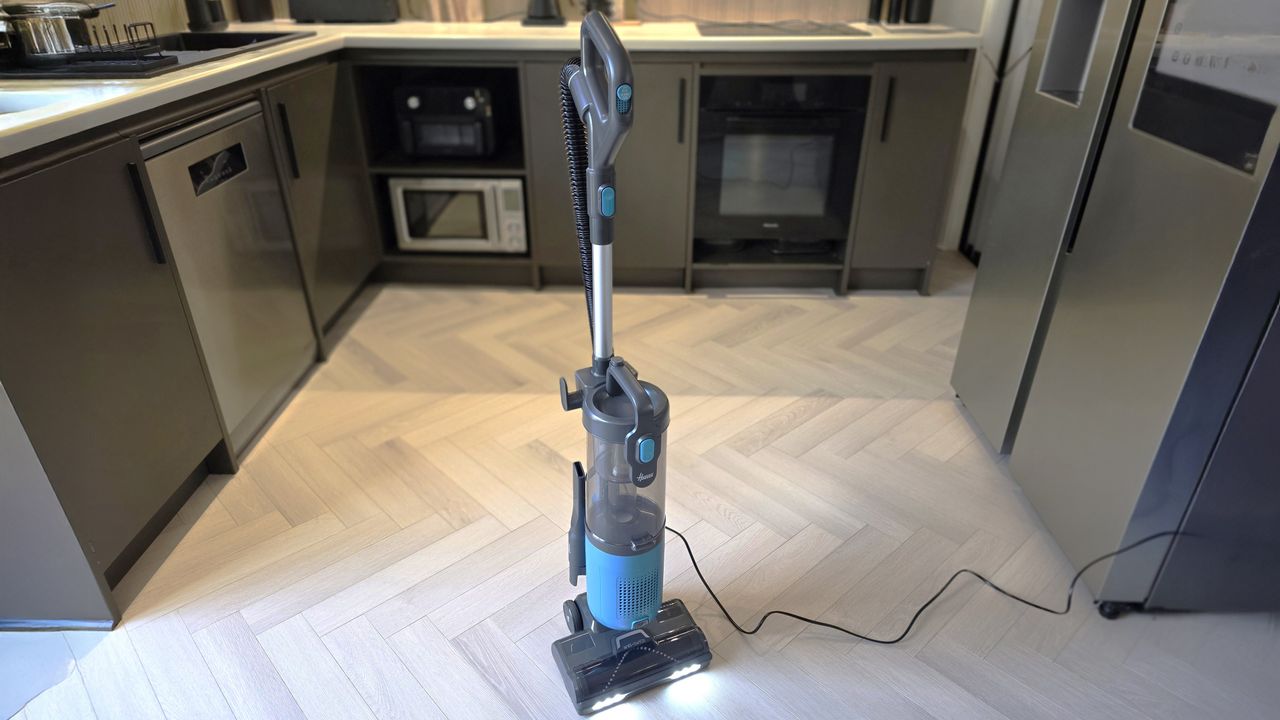
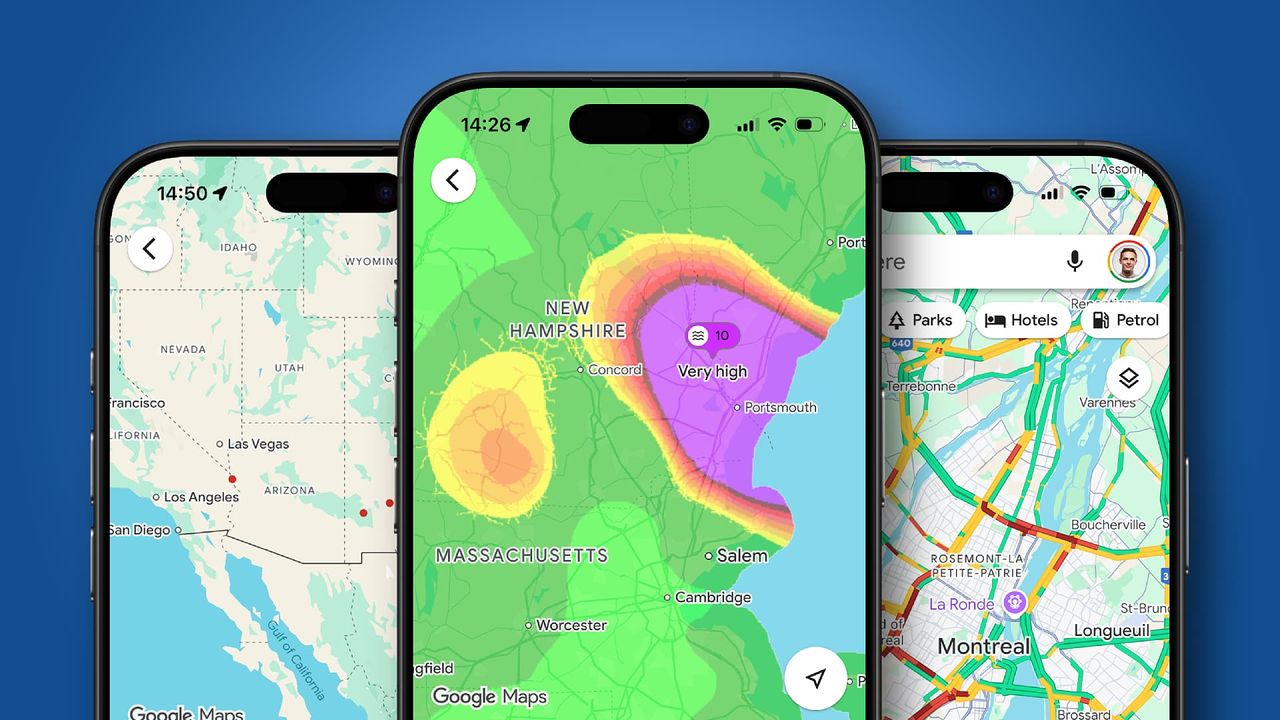









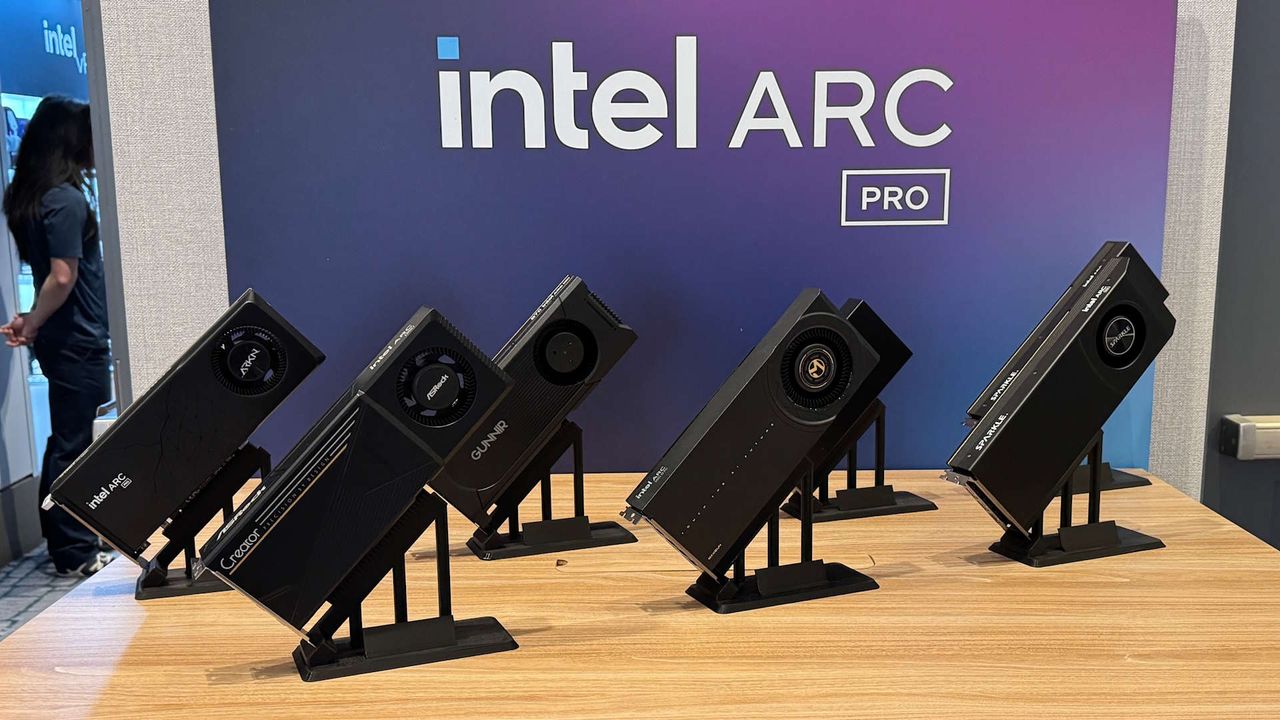


 The Google for Startups Accelerator offers mentorship and technical support to companies using AI to disrupt the energy sector.