With the Iran conflict once again in full swing and demand for AI chips booming, industry sources expect that semiconductor raw material prices will only increase. Earlier this month, China created some turmoil in the semiconductor manufacturing raw materials supply chain when it announced that it would suspend Helium exports due to the supply chain turmoil. While China is not a key Helium exporter in terms of capacity, its role nevertheless could create trouble down the road if there is further disruption. Semiconductor Manufacturing Raw Materials Providers Raise Prices As Demand, Supply Dynamics Bite The complexity of semiconductor fabrication, which […]
NVIDIA has unveiled its brand-new Jetson Thor solutions, expanding into mainstream robotics, humanoids & Edge AI with the T3000 & T2000. NVIDIA Jetson Thor T3000 Offers 865 TFLOPs of AI Compute For Humanoids & Robotics, While T2000 Pushes 400 TFLOPs For Edge AI We already told you that some big news was coming on the Physical AI side of things when Jensen landed in Japan yesterday, and the first of these announcements has been revealed in the form of the NVIDIA Jetson Thor T3000 and T2000. Kawasaki Heavy Industries provides technology designed to improve the overall efficiency of hospital operations, including […]
AMD's Ryzen 7 7800X3D 3D V-Cache CPU is now available at a fantastic price of just $299, which makes it cheaper than the upcoming Ryzen 7 7700X3D. Microcenter Offers Ryzen 7 7800X3D At An Absolutely Fantastic $299 Price While AMD's Upcoming Ryzen 7 7700X3D 3D V-Cache CPU Would Cost $329 Tomorrow, AMD will finally launch its brand-new Ryzen 7 7700X3D 3D V-Cache CPU for the AM5 platform. This chip promises to offer the same 3D V-Cache goodness to gamers for a lower price point than what the 7800X3D retails for. But it looks like Microcenter is spoiling the fun of […]
EU regulators are expected to rule that Google illegally favored its own shopping, travel, and other specialized services over rivals in search results.
The European Commission is expected to issue the decision next week under the Digital Markets Act, according to the Financial Times (subscription required), citing people familiar with the matter and internal Commission documents.
Google search changes possible. The case focuses on how Google displays its own vertical services in search results compared with competing services. Google owns some of the most valuable commercial search real estate. An order requiring changes could affect visibility for comparison sites, travel platforms, shopping services, and other businesses competing for organic traffic.
Why we care. Google’s treatment of its own services influences which businesses users see first in high-intent searches. Required changes could create new visibility opportunities in competitive commercial categories.
Fines add pressure. The Commission is expected to fine Google hundreds of millions of euros across two DMA decisions. Google could also face daily penalties if it fails to comply with parts of the orders within 60 days.
Search data access. The Commission is also expected to decide whether Google must give third-party search engines access to search data, including ranking, query, click, and view data. Google argues that sharing the data would threaten user privacy and exceed the Commission’s authority.
The Commission is also considering whether Google must give third-party AI providers access to the same features available to Gemini.
Google’s AI Mode showed text ads on 29.45% of commercial queries in a new SE Ranking study, less than a year after ads began appearing in AI-generated search answers.
Ads appeared on 14,733 queries in the study, which analyzed U.S. commercial searches where text ads could appear, excluding product carousels.
AI Mode ad adoption accelerated.SE Ranking said ads began appearing in AI Mode responses in late 2025. By mid-2026, nearly one in three commercial queries in its data set showed a text ad. SE Ranking said the real ad rate may be higher because AI Mode results are inconsistent across sessions.
Two advertisers often appeared together. Most AI Mode ad blocks included more than one advertiser. SE Ranking found that 71.1% of ad-triggering queries showed two ads in the same AI Mode response, while 28.9% showed only one.
CPC best predicted ad visibility. Higher-cost keywords were much more likely to trigger AI Mode ads.
Ad presence was 24.33% for keywords with CPCs below $2.
It rose to 32.45% for keywords between $2 and $10, then jumped to 53.56% for keywords at $10 or more.
SE Ranking said search volume and keyword difficulty did not show the same relationship with ad frequency.
Ad presence varied across categories. Pets had the highest rate, with ads appearing on 72.38% of analyzed keywords. Healthcare had the lowest, at 2.64%.
Higher-ad categories were typically lead-generation markets with clear paths to paid conversions.
Lower-ad categories were more likely to involve informational or YMYL intent, where commercial demand may be lower or Google may be more cautious.
Advertisers were rarely cited. Buying an AI Mode ad didn’t make advertisers more likely to be cited as a source in the same response. Only 11.53% of advertiser domains appeared among the cited sources for the keywords they advertised on. At the URL level, overlap fell to 1.95%.
This held true even after comparing advertisers with similar non-advertising domains based on domain strength, backlinks, referring domains, and organic visibility, SE Ranking said.
Organic overlap was limited. Advertisers also rarely ranked organically for the same keywords. Only 2.32% of advertised URLs ranked organically for the queries where their ads appeared. At the domain level, overlap increased to 15.35%.
About 85% of advertisers didn’t appear in organic results for the same keywords where they showed AI Mode ads, according to the study.
Why we care. Buying visibility in AI Mode doesn’t increase your chances of being cited or ranking organically. Treat AI Mode ads, cited sources, and organic rankings as separate visibility channels.
About the data. SE Ranking analyzed 50,032 commercial keywords across 20 niches, averaging about 2,500 keywords per niche. The data reflects U.S. AI Mode results collected on June 30. SE Ranking noted that ad behavior may change as Google expands AI-specific formats.
Korean chip giant Samsung is reportedly considering outsourcing orders to design a portion of Google's Tensor Processing Unit (TPU) AI chips. Samsung is believed to be Google's manufacturing partner for the TPU chip's input/output (I/O) die. While the TPU's compute tile is expected to be manufactured by TSMC, the part on which the tile will be connected, called the I/O, is said to be Samsung's responsibility. For the I/O, Samsung is considering outsourcing the back-end design for the chip in order to ensure that Google's design is fit for its manufacturing facilities, says the Korean press. Several Korean Firms in […]
Polish developer Rebel Wolves has revealed today that their debut game, the action RPG The Blood of Dawnwalker, is officially gold. That means the physical disc is being printed, though of course, in this day and age, the studio will continue to work on day-one patches and the like up to the launch date of September 3. I suppose this saying will have to be updated if Sony's planned end of PlayStation disc sales from January 2028 goes ahead. Anyway, the gold status effectively confirms there will be no delays. The studio worked quite swiftly on its debut game; Rebel […]
You would have to be wholly fatuous to leak the details of an ongoing negotiation with a company as private as Apple, and from the mouth of the CEO no less, as PrismML appears to have done recently, indicating that the tidbit about its impending acquisition by Apple was nothing more than a glorified PR campaign. You don't leak details of an ongoing negotiation, especially when a company as sensitive as Apple is involved, if those talks have even a snowball's chance in hell of succeeding While speaking with CNBC earlier this week, PrismML's CEO casually lobbed a bombshell: Apple […]
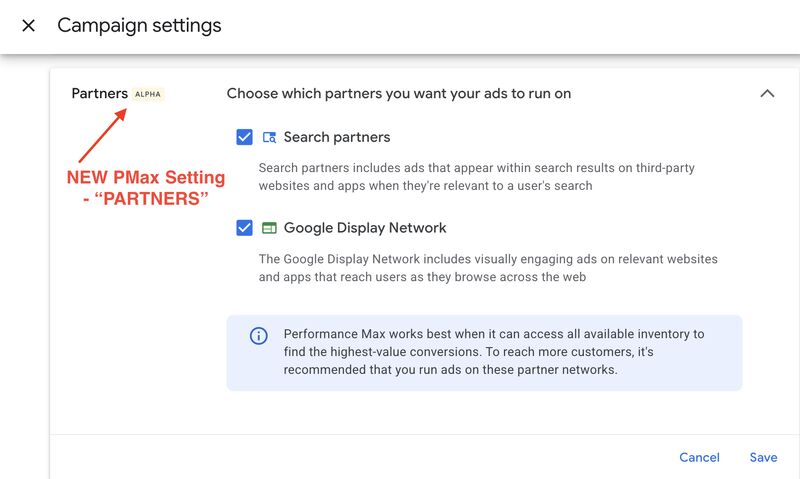
Google is testing a new Partners (Alpha) setting in Performance Max that gives advertisers the ability to opt in or out of Search Partners and the Google Display Network—a level of control that hasn’t previously existed in the automated campaign type.
What’s happening. Some advertisers are seeing a new Partners (Alpha) setting within Performance Max campaigns that lets them choose whether to include:
Search Partners
Google Display Network (GDN)
Until now, both networks were automatically included in Performance Max with no option to exclude them.
Why we care. The update gives advertisers greater control over where Performance Max ads appear, making it easier to align inventory with campaign objectives. Those focused on efficiency metrics such as ROAS or CPA can now test whether excluding certain networks improves performance.
What we’re watching. The feature is currently labelled Alpha, indicating it is only available to a limited number of advertisers. Google has not announced when—or if—it plans to roll the setting out more broadly.
The bottom line. Google’s new Partners (Alpha) setting could give Performance Max advertisers one of their most requested controls: the ability to decide whether campaigns run across Search Partners and the Display Network, rather than relying entirely on Google’s automation.
Spotted. This update was spotted by PPC Growth Strategist Saquib Syed, who shared spotting it on LinkedIn.
Google’s AI Mode increased citations to google.com by 8.4x in about two months, making it the No. 2 cited domain in Profound’s tracking.
The increase came almost entirely from Google Business Profiles and Product Knowledge Panels, according to Profound. Those Google-hosted cards now appear within AI Mode answers for many local and product searches.
Google cards moved up. AI Mode now surfaces Google Business Profiles as inline panels for local-intent queries.
These panels can display a business’s hours, photos, location, and reviews before users reach the company’s website. Profound said the shift makes the Google-hosted profile the first page many users see.
Local categories led. The change was strongest in industries where local intent drives revenue, including:
Hospitality and travel
Home services
Restaurants and dining
Real estate
Healthcare
Product panels gained ground. Product searches also shifted toward Google-hosted results. Queries about comparisons, compatibility, or specifications increasingly surfaced Product Knowledge Panels instead of direct links to ecommerce or brand websites, Profound said.
Why we care. Your Google-hosted profile may shape a user’s first impression before they ever reach your website. Missing hours, outdated photos, incomplete information, or poor reviews can cost you the click before users visit your site.
About the data. Profound tracked AI Mode citation share from April 15 through June 30, analyzing more than 32 million google.com/searchviewer instances.
Xbox's planned 3,200 layoffs by July 2027 are already easily the biggest round of layoffs the industry has ever seen if taken at mere face value, but Bloomberg's Jason Schreier argues that's just the proverbial tip of the iceberg. In a new YouTube video, the journalist highlights the "hidden cuts" of the many contractors that were linked to a canceled project. Nowadays, triple-A game development involves several studios working together, some of which are external. For example, he reveals that the Perfect Dark reboot wasn't developed solely by The Initiative and Crystal Dynamics: sister studio Eidos Montréal was also involved, […]
In a development that comes on the proverbial heels of China's formal approval of Apple Intelligence features for the country's consumers, Alibaba has notified that its Qwen family of AI models will be integrated into Apple Intelligence, bringing AI-powered experiences for iOS, iPadOS, macOS, and visionOS users. Users in China will now be able to access Qwen’s entire range of AI capabilities, including text, image, and content generation, directly on Apple devices Alibaba has now officially confirmed that users in China will be able to access its Qwen AI models via Apple devices, going on to note in a statement: […]
Although FromSoftware is known for keeping a very tight lid on its projects, the silence surrounding the Nintendo Switch 2 exclusive The Duskbloods is getting deafening. After resurfacing during last month's Nintendo Direct, we have learned that a closed network test is scheduled for this Summer, and today we have finally learned when the Japanese development studio, will lift the veil from the game it reportedly spent the most time on to date. "We will be hosting a network test for The Duskbloods on Nintendo Switch 2 from Aug. 21 (Fri.) - Aug. 24 (Mon.). Participant registration will begin on […]
Back in 2023, T-Force by TeamGroup introduced its first Gen5 SSD solution, the CARDEA Z540. Based on the Phison E26 controller, this SSD offered up to 12.4 GB/s speeds, making it a solid option back then. At the moment, there are plenty of Gen5 SSD controllers in the market, Phison has its new E28 and E31T, the SMI SM2508 is doing great, and InnoGrit, along with Samsung, has its own solutions offering really fast storage capabilities on NVMe products. TeamGroup has also streamlined its product family over the years, now leveraging the G-series branding in "GE", "GC", and "GA". The […]
A former TSMC executive, suspected of taking the firm's trade secrets to Intel, has had his records on Taiwan's research institute's body removed, according to reports in the local media. The executive, Wei-Jen Lo, was TSMC's senior vice president for corporate strategy and development and he played a role in helping the firm mass produce its 5-nanometer, 3-nanometer and 2-nanometer chip manufacturing process technologies. Authorities began investigating Lo last year in November after he left TSMC following allegations that the former executive took proprietary company data to Intel. Taiwan's Industrial Technology Research Institute (ITRI) Removes Former TSMC Executive's Page Amidst […]
NVIDIA CEO, Jensen Huang, has arrived in Japan and will be holding key meetings with robotics partners to advance the Physical AI era ahead. Jensen Huang Arrives In The Birthplace of Humanoid Robots To Kickstart The Physical AI Era AI is a multi-domain market, and while Agentic AI is all the buzz these days, there's one other key market that is growing at a rapid pace with the evolution of AI: Physical AI. Robots are to Physical AI what humans are to Agentic AI. And NVIDIA has a vast robotics platform ready for the future. It is mainly powered by […]
ZeniMax Online Studios was among the first-party studios most affected by the Xbox layoffs in both July 2025 and 2026. Last year, the team saw its sci-fi online game Project Blackbird (with related layoffs of a few hundred employees who had been working on it for years) canceled despite then-Xbox CEO Phil Spencer reportedly loving it. The end of Project Blackbird also directly led to the resignation of ZeniMax Online Studios founder Matt Firor, who would later label it as a missed opportunity for Xbox. Following the cancellation of Blackbird, ZOS refocused on its prize jewel, the popular MMORPG The […]
The MacBook Neo has turned into an instant hit, and even with the price bumps that Apple introduced that made the company’s most affordable notebook $100 more expensive for both configurations, the bigger figure isn’t what’s derailing the portable Mac’s momentum. It’s the lack of chip supply for the A18 Pro, and according to an analyst, Apple’s MacBook Neo shipments are expected to suffer considerably, with up to a whopping 40 percent drop. It appears that AI firms gobbling up the entire supply have made the situation quite uncomfortable for both TSMC and Apple. Updated shipment forecast states the MacBook Neo will […]
CXMT's DDR5 memory has some major drawbacks versus DRAM modules from the big three, as ASUS highlights poor overclocking and worse performance. Motherboard Vendors Have Unlocked Over 8000 MT/s Speeds On CXMT-Based DDR5 Memory Modules, But The DRAM Is Inferior In Performance & Overclocking With the ongoing DRAM shortages, China's DIY PC market has started relying heavily on domestic memory solutions. We have seen brands such as Kingbank, Gloway, Lexar, and many more utilize CXMT DDR5 memory. As such, motherboard vendors have started offering optimized support for these modules. With strengthened BIOS support, these memory modules can now surpass 8000 […]
In a rare incident, a user found himself with the same problem as before, even though MSI was supposed to get the motherboard repaired properly. User Sends His Motherboard With Bent Pin for Repair; MSI's Service Partner, ASK, Sent It Back With Another Pin Bent Not everyone has the same luck when it comes to repairs, especially RMA under warranty. We have seen multiple times how vendors fail to provide proper repairs and replacement for products that are sent for the RMA service under their warranty periods. Similarly, a user expected MSI to repair his damaged motherboard, which was under […]
GTA 6 is without a doubt the most anticipated game of 2026 for many, but only PlayStation 5 and Xbox Series X|S owners will be able to experience Rockstar Games' open-world title this November, as the game will not hit PC at the same time. Although many have long suspected this staggered release strategy is meant to get players to purchase multiple versions of the game, veteran GTA 5 producer John Ricchio (who worked at the studio from 2003 to 2014) confirmed there are other reasons behind this strategy, mostly technical. Speaking in an interview with Kiwi Talks, Ricchio emphasized […]
The rollout of Siri AI wouldn’t have mattered in China or the EU since strong regulatory checkups would mean Apple needed to expose itself to another headache that could take months, if not years, to complete. Fortunately, one tipster reveals that the Cupertino giant has crossed that bridge because Apple Intelligence has received its regulatory filing in the region. New progress with Apple Intelligence in China means talks over potential localized partnerships with the likes of Alibaba and Baidu were fruitful The image below, shared by prolific tipster Ice Universe, is an official Cyberspace Administration of China (CAC) registration list […]
China's DFSX is working on fueling its domestic AI supply chain with next-gen 3.5D "Infinity Chiplet" architectures & 3D DRAM technologies. DFSX Is Working on China's First DF1000 AI Accelerator With 3D DRAM Technology, Also Unveils 3.5D+ Packaging DFSX recently hosted a presentation where they announced China's first 3D AI chip that is built entirely using China's domestic supply chain. There is a lot to unpack here, but the key product is the DF1000, which is a software-defined near-in-memory computing AI accelerator that will be used by domestic AI and tech firms. DF1000 - China's First 3D DRAM-Powered AI Accelerator […]
The games industry is still reeling from Sony's switch to a digital-only PlayStation future starting in January 2028, but after fierce backlash from fans and developers, Sony may now face opposition from politicians, too. In Mexico, two Movimiento Ciudadano legislators stated that the Japanese corporation may be crossing into monopoly territory with its planned move, following a broader wave of criticism around Sony's abandonment of physical media and its growing control over PlayStation's storefront economy. According to Mexican website Ovaciones, Movimiento Ciudadano senator Luis Donaldo Colosio and federal deputy Iraís Reyes plan to file a complaint with Mexico's antitrust authority […]
There's no other way to describe the latest Microsoft Xbox layoffs under parent company Microsoft Gaming than tragic. With 3,200 jobs getting cut by July 2027, it's no surprise that studios from Bethesda Softworks to Obsidian Entertainment have been significantly impacted, but it feels like few have been hit as hard as id Software, the legendary development studio behind the DOOM and Quake series. An official statement released a few days ago downplayed the brutal reset, but it seems like the situation is as dire as it looked like when the first reports came in, as the cuts may have […]
The newest and flagship ASUS Tandem OLED monitors have been officially released, including full specifications. ASUS Officially Launches ROG Swift OLED PG32UCWM and PG27UCWM Tandem OLED Monitors, Featuring Tandem OLED Coupled With TrueBlack Glossy Surface Popular hardware and peripheral manufacturer, ASUS, has officially released two of its best 4K OLED gaming monitors for retail, alongside revealing their full specifications. These are the ROG Swift OLED PG32UCWM and ROG Swift OLED PG27UCWM, which were introduced several months ago along with more OLED models. Both gaming monitors boast 4K resolution and offer dual mode configuration for enthusiasts, including 4K@240Hz and FHD@480Hz. The […]
NVIDIA & SEGA are celebrating 30 years of collaboration, as SEGA's "Legendary" gaming titles are announced for RTX Spark PCs. There Would've Been No NVIDIA Without SEGA, & Both Brands Celebrate Their 30 Long Years of Collaboration, Starting With NV1 To RTX Spark PCs NVIDIA's first graphics accelerator, before the term GPU existed, was the NV1. The 3D/2D chip was released back in 1995 and enabled the porting of classic SEGA games such as Virtua Fighter over to PC. From Troubled Beginnings to a 3-Decade-Long Collab The NV1 was the first and only chip to feature quadratic texture mapping, a […]
The PlayStation 5 liquid metal cooling system has rapidly become infamous following the system's launch in 2020. Not only did the system prove to be somewhat unreliable in launch units, often leading to overheating issues, but the liquid metal itself would leak onto the system's APU and motherboard components, leading to widespread malfunctions that are still getting reported in droves. For the next-generation PlayStation 6, however, Sony Interactive Entertainment plans to handle cooling differently, judging from a new patent that recently surfaced online. As reported by Tech4Gamers, the PlayStation 6 may not use liquid metal cooling as its predecessor, but […]
It's crazy how a six-year-old CPU can sell incredibly well, given it's based on an older platform. AMD Ryzen 7 5800X3D Grabs Fourth Spot In Best Selling CPUs List On Amazon Despite Selling For $349 It's hardly been a month since the launch of AMD's Ryzen 7 5800X3D 10th anniversary edition, and we are already seeing the CPU in the best-selling CPUs list at major retailers. It was obvious since the Ryzen 5000 series witnessed a good demand due to a large section of PC builders transitioning to the previous-gen AM4 platform due to the current RAMpocalypse. However, we didn't […]
ASML has confirmed that Intel is leveraging its High NA EUV technology to produce its Panther Lake chips on its most advanced 18A process node. ASML's High NA EUV Enters High-Volume Logic Production With Intel's "18A" Panther Lake Chips Today, ASML announced that its first High NA EUV "EXE" equipment has been installed at Intel Foundry and is being used to make the first Panther Lake 18A products. The first of these High NA EUV lithography machines was installed at Hillsboro, Oregon, R&D site back in 2024, making Intel the first company to install and pass acceptance testing of the […]
NVIDIA hosts a giveaway for Gears of War fans, offering custom wrap on the GeForce RTX 5080 Founders Edition. NVIDIA to Giveaway an RTX 5080 Founders Edition Inspired by Gears of War: E-Day Instalment Another Gears of War game is about to be released in a few months, which will be based on the origin story of the franchise. While the Gears of War: E-Day is scheduled to launch on October 6, 2026, we have NVIDIA is already preparing for its launch by offering a free GPU to the lucky winner in the latest giveaway. The giveaway is a part […]
On the heels of the early success of Black Flag Resynced, which sold 2 million units on launch day and pushed the total franchise sales to over 250 million, Ubisoft is now focused on delivering the next big entry in the IP: the mysterious Assassin's Creed Hexe. First teased nearly four years ago, Hexe will be a classic Assassin's Creed-style installment that follows the RPG-style game Shadows, according to Ubisoft's formula, which alternates between the two experiences to satisfy two fairly diverse audiences. Now, Ubisoft leaker Rogue has shared a lot of details about Hexe in a lengthy X thread. […]
In a move that is likely aimed at curbing the rampant abuse of what was until now a fairly generous policy, Apple will no longer sell you unlocked iPhones that have been financed either by T-Mobile or Verizon. Apple has just updated its FAQ related to carrier-financed iPhone 17 Pro purchase, disclosing that your "iPhone will be locked to the carrier until paid in full" As first spotted by a Reddit user and delineated in a dedicated post, Apple has just updated its FAQ for buying a carrier-financed iPhone 17 Pro, disclosing the following policy change: "If you choose to […]
With just around a week left till Samsung formally unveils its latest lineup of foldables, the South Korean tech giant has now removed the wraps from one of the biggest mysteries of the upcoming launch galore: how the Galaxy Z Fold 8 and Fold 8 Ultra will keep the dreaded display crease at bay. Samsung's Titanium Flex involves an extremely thin titanium-alloy film that sits just beneath the OLED panel, and bolstered by an underlying titanium plate Samsung's Titanium Flex is an inventive solution to the display crease problem that has plagued nearly every foldable till now, and involves 2 […]
John Mueller responded to a plan to hide homepage links from Google in hopes only one internal anchor text would count, known as "first-link priority."
Apple's damning lawsuit against OpenAI appears to have had a profound impact on the latter's product launch cadence, with the latest report indicating that the maker of ChatGPT is now prioritizing a screen-free, mobile smart speaker, which is something that Apple currently does not have. OpenAI's planned smart speaker will have "mechanical elements" to help it move, and it will be able to connect with users on a human-like level As we detailed recently, Apple filed a damning lawsuit against OpenAI last week, accusing it of stealing its proprietary technology, circuit designs, and component architecture for a slew of upcoming consumer-geared AI […]
In a first-of-its-kind move, New York State Governor Kathy Hochul has declared a state-level moratorium on data center construction. Hochul's decision follows growing concerns about the resource-intensive computing centers that are necessary to power what is being dubbed the next industrial revolution. Most AI data centers are powered by NVIDIA Corporation's GPUs, with the average data center requiring millions of gallons of water daily to perform efficiently. New York State Data Center Construction To Be Paused In Moratorium Being Signed Tomorrow In her statement, Governor Hochul outlined that the resource-intensive nature of data centers was at the center of her […]
OpenAI rolled out an update for its ChatGPT app for Apple’s macOS, and while one user claims that the previous chat layout and project history were “completely messed up,” the update introduced what appears to be a terrifying shift in the AI agent’s behavior that could discourage other users who value their privacy. Apparently, when asked where the missing projects were, ChatGPT showed an exact local directory path, which, according to the user, shouldn’t be possible without proper authorization. Based on this incident, it appears that the app is accessing and indexing local files on its own, which is a […]
OpenAI’s ad revenue forecast is on pace to miss its 2030 target by 90%, according to Emarketer.
OpenAI projected $2.5 billion in ad revenue this year and $100 billion by 2030. Emarketer estimates the entire U.S. market for standalone chatbot ads will generate less than $1 billion this year and $5.41 billion by 2030.
OpenAI’s target. OpenAI began testing ChatGPT ads in February. By April, the company projected that ad revenue would grow to $100 billion within five years. But that forecast is larger than Emarketer’s 2030 estimate for the full U.S. chatbot ad market.
What Emarketer measured. Emarketer’s estimate covers standalone chatbots in the U.S., including ChatGPT, Microsoft Copilot, Google AI Mode and Amazon Alexa for Shopping, formerly Rufus. The research firm’s forecast puts the 2030 market ceiling at $5.41 billion, far below OpenAI’s target for its ad business alone.
Why we care. Chatbot ads are still a small market, despite growing interest in AI search and shopping. The gap between OpenAI’s target and Emarketer’s forecast shows ChatGPT Ads have a long way to go.
Assumptions vs. reality? OpenAI’s forecast assumes the company will capture search ad budgets at scale, dominate a mature chatbot ad market, and outperform every ad format in history, Adweek reported. Emarketer’s data points to a much smaller market.
In what is likely to be the first of many such lawsuits that target Silicon Valley bigwigs, a number of Meta employees who were recently laid off are now accusing an AI-powered algorithm of disproportionately targeting workers with pre-existing medical conditions. Around 26 Meta employees are now alleging that the tech giant relied on factors such as productivity and AI use in deciding which workers get axed, disadvantaging those who missed work due to medical complications As many as 26 Meta employees have now anonymously filed a lawsuit in a federal court in Oakland, California, accusing the company of disproportionately […]
Amid all the problems that besiege Microsoft's Xbox division, the studio divestitures, the layoffs, the declining business, and even the loss of a few million Game Pass subscribers, lies one lingering question: what actually is Xbox? A platform or the biggest third-party publisher? Microsoft certainly tried its damnedest to confuse consumers with its constantly shifting strategy regarding first-party content, as well as the delirious "This Is an Xbox" campaign. Xbox CEO Asha Sharma quickly tossed it in the trash after taking over from Phil Spencer, seeking a return to the brand's core values. But even she admitted that there's a fundamental […]
Intel has reportedly secured some big wins with its 18A, 14A, and EMIB process / advanced packaging technologies, signaling massive interest in its Foundry business. Tech Heavyweights Are Lining Up To See What Intel Foundry Has To Offer As 18A, 14A & EMIB Technologies See Heightened Interest TSMC has so far been the only semiconductor manufacturer to offer bleeding-edge processes and packaging technology, but Intel has quickly emerged as a fierce competitor. Intel has only launched its 18A node, which is already achieving volume ramp, and is working towards its more advanced 18A-P (In Risk Production) and 14A nodes (Risk […]
TikTok will test detection for accounts posting AI-generated spam in politics, financial advice, and medical content, and has joined C2PA's steering committee.
NVIDIA's H200 AI GPUs are finally shipping to China, as reported by U.S. officials, marking the return of the banned chip. China Softens Its Position on NVIDIA GPUs As First H200 Shipments Now Headed To Chinese AI Firms The NVIDIA Hopper story in China has been a roller coaster ride so far. When Hopper was launched, US export restrictions for the Chinese market were in full swing. These pushed NVIDIA to release an export-compliant variant called the H20 for China, which ended up being severely cut down, but still a viable option against what China's domestic chipmakers had to offer. […]
Google Image Search has turned 25 years old and with that, Google has decided to completely revamp the Google Image Search home page at images.google.com from a clean search box, to a gallery of image collections.
“Today, we’re introducing a brand new browseable home for Google Images, featuring a dynamic, immersive gallery of images from across the web — updated in real time and intelligently tailored to your unique interests,” Brad Kellet, Senior Engineering Director, Search announced.
What it looks like. Here is a screenshot of the new Google Image Search homepage:
This is what the old Google Image Search home page looked like:
Features as well. Google is not only showing a gallery of images on its new image search home page but there are search features as well. The search box is at the top, where you can search by text, voice, by image and so forth.
You can also browse and save ideas to your collections on Google Image Search. Those images will appear as tabs above the main gallery, making it easy to jump back in and continue exploring based on what inspires you, Google explained.
Here are screenshots of how that works:
Availability. Google said this new Google Images home page will roll out over the coming weeks on desktop in the U.S. in English. You will need to sign in to your Google Account to try it out.
Google will let you create images directly within AI Overviews in Google Search. “To help bring those unique ideas to life, we’re bringing image generation directly into AI Overviews in Search,” Google announced.
This uses Google’s latest Nano Banana AI model within AI Overviews to create these images.
Google said, “This update transforms a simple text prompt into a high-quality, custom visual made completely from scratch, seamlessly bridging the gap between imagination and reality.”
What it looks like. Here is a video of this in action:
Availability. Google will roll out this image generation feature within AI Overviews over the coming weeks in English, for all regions that currently support image creation in AI Mode.
Why we care. This may have an impact on traffic to publishers, as it will add more AI-generated content (the images) to the AI Overview, potentially discouraging clicks from Google Search. Plus, if people get the image they want in the AI Overview, it might even discourage some use of Google Image Search – maybe?
In any event, it is wild to know that Google Image Search is now 25 years old.
Google is adding AI image generation to AI Overviews and rolling out a redesigned Google Images homepage. Both start rolling out over the coming weeks.
With the AI race in full swing, Samsung Foundry has reportedly secured a contract to manufacture Anthropic's AI chips. Anthropic has slowly shaped up to be one of the most important players in the AI industry courtesy of its advanced AI models. As the AI semiconductor sector remains highly concentrated, with the bulk of chips designed and sold by NVIDIA, major players such as Google, OpenAI and Amazon are designing custom chips. Samsung's deal with Anthropic is expected to allow the foundry business to return to growth, say the sources, and allow it to reverse a deficit. Anthropic to Purportedly […]
Despite NVIDIA's removal of the Hotspot temperature measurements, CPUID developers have deployed the feature to their popular hardware monitoring utility. NVIDIA Killed RTX 50 Hotspot Readings, but HWMonitor 1.65 Just Brought Them Back With Two Sensors While NVIDIA may have dropped the Hotspot temperature measurements from the Blackwell GeForce RTX 50 series graphics cards, the sensors reportedly do exist. We saw how modders brought back the hotspot monitoring through modding, which revealed how some GPUs were thermal throttling despite showing normal average GPU temperatures. The GPUs, therefore, were affected by high hotspot temperatures, resulting in inferior gaming performance. The experiment […]
Apple's sales cadence benefited enormously from its relatively attractive pricing regime that it chose to maintain until the tail-end of Q2, when the Cupertino-based tech giant finally gave in to the oncoming margin-related pressures by hiking prices of its Mac and iPad offerings. Now, however, with the hype around the iPhone 17 series fizzling out, and the upcoming iPhone 18 Pro series expected to debut with material price hikes, a new research report has just found worrying evidence of Apple's slowing sales momentum. A KeyBanc analyst now believes the consensus estimate for Apple's iPhone growth of 8 percent in 2027 […]
If you were waiting to buy AMD Ryzen's 10th Anniversary edition Ryzen 7 5800X3D, now is the best time. AMD Ryzen 7 5800X3D is Now Available for $349 on Newegg, Coupled With a Free MSI 240mm AIO Valued at $70 Right after the launch of AMD's Ryzen 10th Anniversary Ryzen 7 5800X3D edition, they started appearing on eBay for over $500. Even though the processor was officially launched for $349, scalpers tried to take advantage of this situation and started earning hundreds of dollars on the launch by relisting the CPU on eBay. Since the launch, the availability of the […]
CAPCOM is among the third-party publishers that is supporting the Nintendo Switch 2 the best, delivering incredible ports of games such as Street Fighter 6, Resident Evil Requiem, PRAGMATA and Devil May Cry 5. Although the base game is remembered alongside Monster Hunter Wilds as one of the games powered by the RE Engine with the worst performance, Dragon's Dogma 2 Dark Arisen is already exceeding expectations on the system, running at 30 FPS and higher in its current state, which bodes incredibly well for the game ahead of its release on October 9. "We've been working not only to […]
Finally, a good change. This should now make the search content more relevant and less like a promotional window. Microsoft is Finally Cleaning up Windows Search, Removing Promotional Content Nobody loves the annoying promotional content in the Windows Search tab, which exists to solve users' queries. Thankfully, Microsoft is now removing it, addressing one of the biggest complaints about Windows Search. This will make users find the apps, files, and settings easier as this redesigns the experience to focus on what users actually want. The updated Search experience will now prioritize local results, allowing users to easily find the apps, […]
Today, NVIDIA announced a technical partnership with Gears of War: E-Day developer The Coalition to bring its RTX technologies to the upcoming third-person shooter game. DLSS Super Resolution, Dynamic Multi Frame Generation, NVIDIA Reflex, and Ray Tracing (for shadows, Lumen global illumination, and ambient occlusion) will all be supported for GeForce RTX Series owners. NVIDIA hasn't provided frame rate estimates yet, but early access to the multiplayer Open Beta begins on Thursday, August 6, so it's not too far off from being available to the public. It's likely that most, if not all, of these technologies will already be there. […]
Montréal-based developer Compulsion Games is among the studios that were officially divested from Microsoft's Xbox last week. Indeed, Compulsion Games (like Double Fine Productions) was sold back to its own management and has therefore returned to full independence, but that does not mean they won't need partners. In fact, they haven't wasted any time at all in opening the search. A few hours ago, the official LinkedIn account of the studio posted the following call-out message to fellow industry members: With Compulsion Games returning to its roots as an independent developer, we are expanding opportunities to collaborate with studios across […]
The company just dropped another connector-less motherboard, but with the micro-ATX form-factor for compact builds. GIGABYTE Releases B850M AORUS Stealth Motherboard, Featuring 12 Power Phase VRM, 4x DIMMs, Dual PCIe x16 Slots, While Keeping the Rest of the Connectors at the Back Popular hardware maker GIGABYTE is silently expanding its Stealth lineup with more motherboard models. GIGABYTE's Project Stealth was introduced back in 2022, and since then, it has added several motherboard models in the series, including 600 and 800 series motherboards with different chipsets. The company has now introduced a new Stealth motherboard called B850M AORUS Stealth, which introduces […]
The latest special edition ROG Swift OLED gaming monitor is now available in both standard and stand versions in China. Popular Chinese Platform JD Lists ROG Swift OLED PG27AQWP-GR Edition 20 Gaming Monitor for Sale, Starting at $1327 Some of the ASUS ROG Special Edition 20 products are now getting listed for sale. We recently saw ASUS listing its ROG Astral RTX 5090 Edition 20 graphics card for a whopping $5,499 on the official store, making it one of the most expensive, if not the most expensive, RTX 5090 from the company. While all the hardware in the lineup is […]
Assassin's Creed Black Flag Resynced does a lot of things right, enhancing the visuals of the fourth entry in the series to new heights while introducing choice combat and parkour changes for a more engaging experience, and new content allowing players to delve deeper into Edward Kenway's story, which remains as engaging as it has always been. For some, myself included, one of the highlights of the experience is underwater exploration, which I feel is one of the best ever seen in video games to date. However, having created what's one of the best features of the game wasn't enough […]
MSI has become one of the first motherboard makers to offer optimized CXMT DDR5 memory support on its Intel Desktop platforms. After AMD AM5, MSI Brings CXMT DDR5 Memory Support To Intel LGA 1851 Platforms, With Speeds Topping Past 8000 MT/s China is rapidly adopting its domestically produced memory to reduce reliance on offshore brands that are charging heavy prices for their DRAM solutions. As such, CXMT (ChangXin Memory Technologies) has become the go-to choice as it is the country's premier DRAM manufacturer. While there have been reports that CXMT has started supplying DRAM to global markets, those aren't true […]
Despite being an iconic game which gave rise to the Soulslike phenomenon, the original Demon's Souls was never released from its PlayStation 3 prison, much like the remake developed by Bluepoint Games likely won't from its PlayStation 5 prison. However, thanks to the RPCS3 emulator, the game is fully playable on PC, and soon enough, fans will be able to enjoy the now-classic action RPG developed by FromSoftware with significant visual improvements from the PC Remaster mod. Developed by fromsoftserve, the developer behind the stunning Bloodborne Remaster Project, this visual overhaul "modifies the game's models to now react to light sources […]
NVIDIA Corporation is taking strict action to ensure that its AI GPUs only land in the hands of the right customers, reports the Financial Times. The action is to ensure that its chips do not reach China, and it follows increasing scrutiny by Taiwanese authorities on firms allegedly involved in shipping the chips to the Asian country. Previous reports have suggested that the Chinese government is interested in granting exemptions to some local firms to buy NVIDIA chips, even as firms such as Huawei claim to be able to achieve parity with Western technology in the future. NVIDIA Is Working […]
Following the release of Resident Evil VII Biohazard, the survival-horror series by CAPCOM has entered a new golden age which has culminated this year with Resident Evil Requiem on PC, PlayStation 5, Xbox Series X|S and Nintendo Switch 2. A few months back, CAPCOM confirmed a story expansion is in the works, and it is reportedly going to be as substantial as Resident Evil 4 remake’s Separate Ways expansion, signaling the beginning of a new strategy for the Japanese publisher. Bigger Story Expansions To Fill The Gaps Between Major Titles "I want to share something I heard which I think […]
Rumors about a Nintendo Switch 2 OLED version have swirled even before Nintendo's latest console launched in June 2025. In April 2024, a Samsung leaker suggested that the unit was actually already in production for a launch slated at a later time. That turned out to be incorrect, but the rumor that Samsung is pushing for an OLED version persisted into May 2025. That wouldn't be surprising, as Samsung supplied Nintendo with the OLED panel for the first Switch. Now, the Korean edition of the business technology website ZDNET has learned that Nintendo is actively evaluating the possibility. They cited […]
Since the surprise announcement of Dragon's Dogma 2 Dark Arisen at the June Nintendo Direct, CAPCOM has maintained a steady pace of news and updates. We've learned about the many new dungeons and the brand-new Relic hunting loop, for example. Now, in a series of interviews, the studio has shared even more as we inch closer to the October 9 launch of the expansion. Speaking to Automaton, producer Naoto Oyama revealed that Dragon's Dogma 2 Dark Arisen will be quite sizable for a DLC: The new story takes place in a new region called Norgan. We expect players to spend around […]
A bombshell report from the Bank of America has just demolished the fallacy that new memory supply is just around the proverbial corner, with SK hynix now likely to bring online just around one-sixth of its initially envisaged production capacity additions by 2028. According to a Taiwanese memory chip industry insider, Samsung and SK hynix will only be able to bring their massive new fabs at Gwangju and Jeolla fully online after a decade We already know that South Korea's President, Lee Jae-myung, wants the country's memory capacity doubled by 2030, and has touted massive new fabs that Samsung and […]
Google's Ginny Marvin explains AI Search eligibility, Qualified Future Conversions, and Creator Partnerships, adding context to key Google Marketing Live announcements.
The U.S. smartphone market is currently dominated by Apple, with a small but important chunk occupied by Samsung. The remaining brands have been offered breadcrumbs in terms of market share, refusing to let any other manufacturer grow out of their shadow. Unfortunately, the AI boom had to arrive at an inopportune time, because the aforementioned reason and rising memory prices have forced one company out of the U.S., plus one other market. OnePlus is preparing to bid farewell to the U.S. and European markets, with an announcement expected in the coming days The writing was practically on the wall, and […]
My 8-year-old daughter desperately wanted a Nintendo Switch. Her evil parents refused to buy it for her.
She was too young to get a job, so she did what any resourceful kid would do: she set up a lemonade stand in front of our house.
But she didn’t just put out a table and a pitcher. She ran a high-stakes A/B test.
Her hypothesis was simple: if she could get more people to stop, she could sell more lemonade and buy her Nintendo Switch faster.
Variant A was her two-year-old sister, Julie, stationed out front to attract attention.
Variant B was our dog, Ginger.
I know what you’re thinking.
The dog. Obviously, the dog.
But her sister won. It wasn’t close.
The only metric that mattered
Actually, my daughter didn’t care about the outcome of the A/B test. She didn’t care how many people stopped by the stand.
She cared about one thing, and one thing only:
Did she make enough money to buy the Nintendo Switch?
Marketers have a similar problem right now.
Generative engine optimization (GEO) is the practice of increasing your brand’s visibility in AI-generated answers from platforms like ChatGPT, Gemini, Perplexity, and AI Overviews.
We’re tracking AI visibility, citation share, impressions, rankings, and every other signal we can find.
Meanwhile, leadership is asking a much simpler question:
Is any of this helping the business grow?
I use a simple test I call the Dollar Rule: If I can’t put a dollar sign in front of a metric, it’s a channel metric, not a business metric.
That’s the challenge with GEO.
Most of the metrics we’re tracking are useful operational signals. They tell us what’s happening inside the channel.
Leadership wants something different.
They want to understand business impact.
GEO arrived at exactly the moment attribution started becoming less reliable.
Traditional SEO measurement was built around a straightforward model: someone searched, clicked, visited your website, and converted. You could trace the path and measure the outcome.
AI search changed that.
Buyers are making decisions before they ever reach your website and AI influence is hard to measure with traditional attribution models.
AI search broke attribution
Buyers now discover brands through AI-generated answers, citations, publishers, forums, reviews, videos, and other sources that influence decisions before a click ever happens. Much of that influence never shows up cleanly in analytics.
That’s why so many teams are struggling to justify GEO investments. The visibility is real. The influence is real. But the attribution is often incomplete.
Waiting for perfect attribution is becoming a convenient excuse for inaction.
If you want buy-in for GEO, you need a way to connect that influence to business outcomes, even when you can’t connect every interaction to a conversion.
Making the case for GEO using financial impact
The biggest mistake marketers are making right now is trying to prove attribution before proving value.
Before you worry about attribution, ask whether you’re measuring something that matters to the business.
That’s where the Dollar Rule comes in.
We’ve found that justifying GEO usually comes down to three things:
Align metrics to business outcomes.
Verify that the metrics reliably point you in the right direction.
Translate the metrics into language your CFO understands.
The Dollar Rule is simple:
If a number doesn’t translate into dollars, it’s a channel metric, not a business metric.
Consider revenue opportunity, revenue at risk, payback period, and customer acquisition cost. These are the metrics that live on a P&L, and they’re the ones your leadership team actually cares about.
CFOs don’t allocate budget based on attribution models. They allocate budget based on expected financial outcomes.
Here’s what that looks like in practice.
Influence over attribution
AI search didn’t just change discovery. It changed measurement.
Traditional organic attribution assumes a simple path: search, click, visit, convert.
AI platforms increasingly answer questions before a click happens, influence buyers across multiple touchpoints, and often remove the referral data marketers depended on.
The result is a strange situation: your GEO campaigns may be influencing pipeline while your analytics platform struggles to prove it.
Loamly estimates that roughly 70% of AI-influenced traffic appears as Direct traffic in GA4, making a large portion of AI’s contribution difficult to trace through traditional attribution models.
That doesn’t mean measurement is impossible. It means we need to broaden where we look for evidence.
Instead of asking, “How many clicks do we get from AI search?” ask:
Is branded search growing?
Are prospects arriving already familiar with our positioning?
Are we cited in AI answers for revenue-driving questions?
None of these signals is definitive on its own. Together, they create enough confidence to make investment decisions.
This is how GEO measurement differs from traditional SEO. You’re not measuring a click path. You’re measuring market influence.
The marketers who adapt fastest will stop treating attribution as a traffic sorting exercise and start combining quantitative signals with qualitative evidence. The goal isn’t certainty. The goal is confidence that your GEO investment is moving the business in the right direction.
You’re measuring the wrong thing
The problem isn’t that SEO or GEO metrics are wrong. The problem is that they’re often precise without being relevant to the business outcome you’re trying to influence. They tell you exactly what happened in a channel, but not whether the business is moving in the right direction.
SEO tools are full of precise numbers. The challenge is that many of those numbers aren’t closely connected to business outcomes.
Precise = exact
Accurate = connected to business outcomes
Leadership would rather have a roughly correct estimate of revenue impact than a perfectly precise count of clicks.
I studied engineering in school. We spent a lot of time talking about precision, as in, how exact and repeatable your measurements are, down to the decimal point. In marketing, those precise metrics look like organic clicks, rankings, impressions, and click-through rate. You can get extremely precise numbers from tools like Google Search Console.
The problem is they aren’t accurate. Accurate measurements tell you whether you’re moving closer to a business outcome that matters. Even if they’re not precise, accurate measurements are more useful because they point you toward the bullseye: business outcomes your leadership cares about.
Knowing you got 40 organic clicks to a page is precise. It tells you almost nothing about whether you’re winning or losing in the market, or in my daughter’s case, whether she’s getting close to buying that Nintendo Switch.
That’s a practical application of the Dollar Rule. When attribution is incomplete, translate the evidence you do have into business impact.
Revenue beats attribution
A rough number tied to revenue beats an exact number tied to channel metrics every time.
When accurate attribution isn’t available, build your case from signals you can actually get your hands on and do the math from there.
Fuzzy math doesn’t replace SEO metrics or attribution. It sits alongside them when a traffic-based attribution metric isn’t available.
Here’s an example:
One of our healthcare clients had a problem.
Prospects were showing up to sales calls already convinced of things that weren’t true.
The source was a competitor’s comparison page that was shaping buyer perceptions long before our client had a chance to tell their side of the story.
We recommended publishing content to counter the narrative, but leadership wasn’t convinced there was enough evidence to respond. So we had to make the case.
SEO tools estimated roughly 40 organic visits per month. Whether that number was right or wrong didn’t matter. It wasn’t measuring influence.
So we looked at something more meaningful.
We talked to our client’s salespeople. They told us that roughly 10% of their qualified B2B discovery calls included unprompted mentions of specific claims from the competitor’s page.
It wasn’t a clean number we could do exact math with, but we couldn’t ignore it. It was real. It was happening on live sales calls.
So we did fuzzy math:
10% mention rate on discovery calls
× 1,200 qualified B2B sales calls per year
× $500,000 average contract value
× 20% average win rate
= $12 million in annualized revenue being influenced by the competitor’s narrative
This wasn’t a forecast, and it wasn’t an attribution model. It was a directional estimate of the amount of pipeline influenced by the competitor’s messaging.
We stopped talking about 40 clicks a month and started talking about $12 million in influenced pipeline.
That’s the number we brought to leadership. Not impressions or citation shares. We brought them twelve million dollars of pipeline being influenced by a page our client was refusing to counter. That is a number a CFO understands.
Lead with the value metrics
If you walk into a GEO campaign review and lead with citation share going up or impressions growing, your CMO is going to yawn. Your CFO is going to wonder what language you’re speaking. In the worst case, they’re going to cut your budget because they don’t see the return.
Here’s how we framed the situation for our client’s leadership:
Leadership funds marketing campaigns with business impact. Translating the problem into dollars changes the conversation.
The decision makers didn’t need certainty. They needed a credible story: leading indicators and momentum that build trust, all tied to dollars.
Focus on what matters
That’s what my eight-year-old intuitively understood at the lemonade stand. Her goal was never to count lemonade stand visitors. Her goal was to buy the Nintendo Switch.
GEO has created a lot of anxiety because it broke the attribution models we relied on for years. But attribution was never the goal.
The real goal: business growth.
If you can connect your GEO efforts to revenue opportunity, revenue at risk, pipeline influence, or customer acquisition, you don’t need perfect certainty to make the case.
You just need evidence that your GEO campaigns are moving the business in the right direction.
Precise metrics tell you what happened. Relevant metrics tell you whether you’re winning.
Before your next GEO report, take every metric on the page and ask one question:
If this metric doubled tomorrow, would the business care?
Then ask the follow-up:
Can I translate this metric into revenue opportunity, revenue at risk, pipeline influence, or customer acquisition cost?
If the answer is no, you’re probably reporting on channel impact, not business impact.
Sometimes, as rabbits waste their time on petty feuds and habitual sloth, the tortoise can win the sprint. This is exactly what appears to have happened with StepX and its just-teased Neo AI phone, as Apple and OpenAI remain locked in a high-stakes battle over alleged technology theft related to their upcoming consumer-facing AI devices. StepX Neo clinches the first-mover advantage on the AI phone as Apple and OpenAI remain mired in a technology theft feud As we detailed recently, Apple filed a damning lawsuit against OpenAI last week, accusing it of stealing its proprietary technology, circuit designs, and component […]
A storm passed through many internal Xbox studios between studio divestitures and mass layoffs, but Activision Blizzard largely emerged unscathed this time around, likely because it's the main money-maker at present. We know that Call of Duty prints money even in off years, for example. But even the Blizzard side has been doing well lately, thanks to a resurgence of its core IPs: Overwatch, Warcraft, and Diablo. That's what Bloomberg's Jason Schreier confirmed in his latest video, while teasing that the company has "a ton" of projects underway, including the rumored StarCraft shooter game. So right now, Blizzard is kind […]
Korean memory gains SK hynix is considering buying South Korean government bonds, according to a senior official. The report follows earlier news that had claimed that the memory company would bring back a portion of the funds generated through its American Depository Receipt (ADR) listing last week to its home country in order to invest in memory chip manufacturing facilities. The executive's comments come as the firm is expected to experience slower high bandwidth memory (HBM) price growth stemming from long-term supply agreements. SK hynix is Open to Shifting Some of Its Capital Into Korean Government Debt, Says Report SK […]
At Cursor Vibe Jam 2026, an iOS developer with nine years of experience showed how it’s possible to rely entirely on AI as he showcases a Capybara food delivery game that he successfully made in only two weeks. Using Claude Code, the developer reveals that all lines of code were written entirely by AI, while also providing a detailed guide on how everything came to life in this virtual world that consists of both single-player and multiplayer elements. Using $100 to upgrade from the Claude Code Opus 4.7’s 5x plan to the 20x one, the developer used a combination of […]
Assassin’s Creed Black Flag Resynced introduces plenty of new features to the game, including some optional cosmetics that allow you to customize Edward, your crewmates and the Jackdaw ship. While some of these cosmetics can only be purchased with real money via the game's criticized microtransactions, there are a few active codes available that will grant you access to both new cosmetics and Animus Keys which can be used in the Animus Hub Exchange to buy some cosmetics. Active Codes and Free DLC (July 2026) Codes ACBF-PHGN-SYBJ-RTRF ASC-BFR-PMK-000 Free DLC Red Bull is running a promotional campaign which rewards players […]
The upcoming firmware update will increase the CPU and GPU temperature threshold to reduce false overheating alerts. Valve Raises Steam Machine Red LED Temperature Warning to 100°C for Both CPU and GPU in the Upcoming BIOS Update Some reports suggested that users were reportedly seeing the Steam Machine's red LED indicator while stress testing or playing demanding games. While the built-in feature exists to protect the device from overheating and thermal throttling, the current limit is way lower than the max operating temperature of the hardware. As per a user's report, the light bar on his Steam Machine turned red […]
Samsung takes particular pride in its OLED tech, which spans the globe's most advanced display-related offerings. Even so, given the volumes that Samsung produces at scale, some shortcomings are bound to emerge, as is the case with a troubling red tint issue that some Galaxy S26 Ultra units are now apparently contending with. What's more, this issue has gained added significance in the wake of Samsung's ambitions related to a rollable phone. The Galaxy S26 Ultra's red tint issue places Samsung's reputation and its rollable phone-related ambitions at stake The South Korean publication Newsway is now reporting that some users […]
Both SSDs are now at a much lower price than they were selling three months ago, and make more sense than buying the previous-gen drives. Samsung 9100 PRO 1 TB SSD Drops from $320 to $249 in the Last Three Months; 2 TB Capacity Drive Also Received Nearly $100 Discount The current state of the SSD market is quite volatile. You never know when the prices might suddenly jump by another 20%. There is no stability in both the DRAM and SSD markets, and we continuously witness a rise in their prices, yet some SSDs are seeing noticeable price drops […]
Intel has invested €5 billion at its Ireland Fab34 to expand manufacturing of its "Intel 3" tech that will be used in Xeon 6 & Next-Gen Xeon chips. Intel's Key Data Center Fab In Ireland Gets €5 Billion Invested Towards Manufacturing, Will Be Used To Scale "Intel 3" For Xeon 6 & Next-Gen Xeon CPUs Today, Intel is announcing a €5 billion investment at its Leixlip campus, which is based in Ireland. This investment is part of a broader manufacturing expansion plan for the European region. The investment comes as the need for AI and high-performance chips is growing at […]
Japanese developer PocketPair has just released version 1.0 of Palworld, the game that became an overnight sensation when it launched in early access in January 2024, breaking sales records left and right for a while. Judging by Steam data, it seems like the fever is back. While the game's full version did not go anywhere near the all-time peak of 2.1 million concurrent users registered at the early access launch (a figure that's still the third highest ever recorded on Valve's platform), Palworld nonetheless lured a lot of people back, with the weekend's peak reaching 855K concurrent users. Version 1.0 […]
Another one bites the dust, but this one didn't die due to the common 16-pin connector burning out. Redditor Reports Unexpected Loud Pop and Crackling on His RTX 5090, Followed by Smoke Caused by a Short Circuit The NVIDIA RTX 5090 is one of the biggest victims of damage in the whole RTX 50 series GPU stack. It's power-hungry and mostly heavy when it comes to the AIB designs. While these are only a few factors that cause problems for the GPU, there are more flaws, especially on the connector side, which usually causes physical damage. Another report surfaced on […]
Furiosa AI is all set to double its chip production to 50,000 units as it preps its 2nm "Stork" chip to break NVIDIA's inference dominance. Furiosa AI Claims Its 3rd Gen "Stork" 2nm Chip To Feature The Best Inference Capabilities On The Market, Will Also Double The Production of 2nd Gen Chips Next Year To Break NVIDIA's Monopoly Back in May, Furiosa AI announced its third-generation AI accelerator chip called Stork for its RNGD (Renegade) platform. The chip is built on Broadcom's 2nm technology, and the startup claims it will challenge NVIDIA with leading efficiency and the lowest cost per […]
You don't need to buy the components separately if you are building a PC from scratch, or upgrading a few components. Get Ryzen 5 9600X, B650 Motherboard, and 16 GB DDR5 RAM for Just $544 on Newegg It might be one of the worst times to build a gaming PC, but you can still save some decent cash by shopping smart. If you opt for a bundle deal instead of purchasing the components separately, you can save a noticeable amount of cash, which you can invest in other hardware. For users who are looking to upgrade their processor and motherboard, […]
The Pixel 11 family is being prepped for a launch next month, and with it, Google will announce its brand-new Tensor G6 silicon. Irrespective of whether Mountain View titan cannot be included in the same conversation as Apple, Qualcomm, and MediaTek regarding chipset advancements, there’s one area in which Google excels, but that doesn’t necessarily mean that the company has the upper hand. Pixel 11’s Tensor G6 to be TSMC’s first 2nm chipset, obtaining a one-month lead over Apple’s A20 Pro While Apple, Qualcomm, and MediaTek will be busy unveiling their chipsets in September, Google has an upper hand because its […]
As advantageous as aluminum is, Apple probably believes that the material won’t sit well with its vision of what its 20th-anniversary iPhone launch should be, which is why the latest rumor claims that the iPhone 20 will ditch the current chassis and go with something that screams ‘next generation.’ However, you’ll have to be extra careful with it. The rear glass back could make a return to the iPhone 20, making it extra brittle, but offering a more premium feel After Weibo’s Fixed-focus digital cameras claimed that the iPhone 20 won’t move away from aluminum, he arrives with a fresh […]
The Witcher 1 Remake has been announced a while back, but nothing is known about the Unreal Engine 5 remake of the first entry in the series outside the fact that it is in development by Fool's Theory under the supervision of CD Projekt Red, and that some of the original's most controversial elements that haven't aged well will be changed. According to Artur Ganszyniec, lead story designer of the original, the biggest challenge the remake faces is fitting the open-world structure into the game's narrative pace, as just making the game's world bigger may not be the answer to […]
Tesla is all set to begin production of its AI5 chip on Samsung's 2nm process technology after a successful tapeout back in April. Samsung & TSMC To Produce Tesla's AI5 Chip With The Former Leveraging Its 2nm Capabilities Last month, Elon Musk announced the successful tape-out of its AI5 AI chip. Elon shared pictures of the chip, featuring a large primary die in the middle that will handle all of the compute and 12 DRAM modules on the outskirts, offering high capacity and efficiency-optimized bandwidth. The DRAM modules in the picture are from SK hynix, and while the DRAM SKU […]
Although Final Fantasy VII Revelation stole the spotlight during last month's Summer Game Fest showcases, Square Enix pleased JRPG fans with the announcement of Final Fantasy Resonance, a new turn-based HD-2D game based on the mobile game Final Fantasy Brave Exvius. Everything the Japanese publisher is doing with the game seems to be hitting the highest notes, as the game is setting out to be one of the most stunning HD-2D games to date, judging from what producer Kiseki Nakashima revealed during a recent panel at Japan Expo 2026. "We did a lot of experiments, including voxel representations (3D cubic […]
Intel has unveiled its latest SoCs, codenamed Starfire, that offer space-grade survivability and are based on the 18A process technology. Intel Rolls Out Space-Grade "Starfire" Chips With 8 Cores, 18A Tech, & 10+ Years of Lifetime Space-grade platforms require extra engineering as they are built to withstand various aspects of space, such as exposure to radiation and extreme temperatures. Plus, these chips need to offer utmost levels of stability as space systems need to retain a steady operation throughout their life-cycle. As such, Intel has new space-grade chips ready for the market. Codenamed Starfire, the SoCs are manufactured in the […]
With PlayStation 4 emulation advancing at a rapidly thanks to the incredible efforts of the ShadPS4 development team, it was only a matter of time before other developers would begin working on PlayStation 5 emulation. Funnily enough, emulation of the current-generation system is following a similar trajectory, being fueled by emulating a console exclusive, the remake of a game originally developed by FromSoftware: Demon's Souls. SharpEmu is the name of an experimental PlayStation 5 emulator whose current status and development progress is tracked publicly on GitHub. "SharpEmu is an emulator project currently in its early stages of development. Our goal […]
Ubisoft has confirmed that Assassin's Creed Black Flag Resynced is performing very well so far, having sold two million units on its launch day. The game also ranked Top 1 on Twitch on the release date (July 9) and peaked at 104K concurrent Steam users yesterday, by far the highest of any game in the franchise. Assassin's Creed Black Flag Resynced was also received positively by critics, with an 85% review score on Open Critic and 84% review score on Metacritic, making it the highest rated Assassin’s Creed game since the launch of the original Assassin's Creed IV Black Flag. Here on Wccftech, the game got an 8.6/10 score from Kai Tatsumoto, who wrote: While there is […]
The family of TSMC’s first 2nm chipsets is yet to grace the industry, and the Taiwanese giant is already experiencing unprecedented advancements with its next-generation lithography, A14, or 1.4nm. Previously, it was Samsung that would obtain bragging rights over introducing the first cutting-edge technology, but that title now seemingly belongs to its foundry rival, which will reportedly complete the construction of its first fabrication plant for the new process in 2027, with trial production happening shortly after. First fabrication plant reported to be completed in April 2027, with mass manufacturing of the 1.4nm process starting in 2028 Construction of the […]
Halo Studios leaker Rebs Gaming, who previously delivered several reports on upcoming Halo titles, has now dedicated his latest video to the alleged mismanagement of the studio's leadership. Rebs Gaming's sources blame specifically studio head Pierre Hintze, who reportedly has created a hostile environment and mismanaged projects, while Microsoft HR and senior Xbox leadership allegedly failed to intervene. Hintze was promoted from production lead to studio head on September 13, 2022, amid a company-wide restructuring that followed Halo Infinite. Rebs Gaming received accounts from current and former Halo Studios staff, who spoke anonymously because they are constrained by NDAs or […]
The proliferation of AI has certainly caused a long-term crisis in the computing landscape, but if there’s one positive to gain from all of this, it’s that companies are aggressively pushing towards designing chips of superior capabilities to tackle the competition at a fiercer pace. Unsurprisingly, one of those companies is Apple, which reportedly taped out the M7 just six months after the same process was completed for the M6. This would explain why the M6 Pro and M6 Max won’t arrive at all, as they will instead be replaced by the M7 Pro and M7 Max. The M7 will […]
Building a gaming PC in 2026 has become considerably more expensive than it was only a year or so ago, and graphics cards are not solely responsible this time. The ongoing memory shortage has driven up the cost of all DRAM and NAND flash-based products, such as memory kits, SSDs, and graphics cards. For that reason, we consider approximately $1,000 to be the realistic starting point for a decent new gaming PC in July 2026. Even then, some compromises are unavoidable. Moving up to higher pricing tiers allows progressively stronger CPUs and GPUs, not to mention higher system memory and […]
Apple has tossed its heretofore predictable M-series chip launch cadence into the air, adding a hefty dose of unpredictability into the proverbial mix. Now, however, the legendary tipster Mark Gurman is out with yet another scoop, disclosing an early 2027 launch window for the M6 iPad Pro and a redesigned Apple Pencil. Apple's early 2027 launch window is already becoming crowded with a growing array of products We reported recently that Apple has significantly revamped its silicon-related plans, settling on the launch of the M5 Ultra and the base M6 later this year, and then jumping straight to the base M7, […]
Apple is planning to skip the M6 Ultra launch, instead choosing to launch the M5 Ultra later this year, followed by the M7 Ultra after it unveils the M7 Pro and M7 Max sometime in 2027. Fortunately, the new workstation-class silicon will be worth the wait, especially for those who aspire to run multi-billion-parameter AI models on their systems but are limited by memory constraints. This is because a new report states that the M7 Ultra will feature double the unified memory of the M5 Ultra, and you’ll want to know how much RAM you can pack for the top-end […]
In 2026, we live in the worst kind of memory crisis that the consumer market has ever faced. Some people call it the RAMmageddon, and others call it the RAMpocalypse. Whichever way you want to call it, one thing is set: shortages created by massive demand in the AI and data center segment have led to a severe hike in prices across all memory segments. This came at a time when memory speeds were seeing rapid updates. We saw speeds surge past 9000 MT/s, and some kits were hitting close to 10,000 MT/s. We saw the launch of CUDIMMs and […]
In the AI race, Apple isn’t the first name that you’d expect to be ahead of its rivals, but when it comes to chipsets that are tailor-made to tackle the aforementioned workloads, we doubt other names come to mind. While we have reported that the M7 is being designed to bring even better on-device AI performance to the table, the M8 is expected to surpass its predecessor in this aspect, while also being one of the company’s first silicon ranges to leverage a new manufacturing process. M8 could be Apple’s first 1.4nm SoC designed for powerful computing, bringing superior efficiency […]
AMD's latest Radeon drivers silently added Multi-Frame Generation (MFG 8x) modes along with other FSR overrides, as exposed in RadeonTuner. AMD Seems To Be Cooking FSR MFG 8x (Multi-Frame Generation) Tech, Surpassing NVIDIA's MFG 6x Mode AMD has been teasing FSR Multi-Frame Generation (MFG) support for its Radeon GPU in the latest drivers for a while. The last FSR Redstone update saw preliminary support added to the ADLX FidelityFX SDK. Although MFG is not available across any Radeon GPU yet, the listed feature will allow users to select a desired frame generation ratio for "optimal performance & visual quality". This was […]
TSMC is facing a surge in AI chip orders using its advanced packaging technology, such as CoWoS, but competitors such as Intel are benefiting as the Taiwanese semiconductor powerhouse is unable to keep up with demand. Intel & Other Advanced Packaging Chip Manufacturers See Surge In Orders From TSMC Customers As CoWoS Unable To Meet Industry Demand AI and HPC chip demand has reached an unprecedented level, and the chips that are being built are based on some of the most advanced packaging technologies that the world has ever seen. Leading this advanced packaging race is none other than TSMC, […]
SK Hynix CEO has warned that memory shortages will be at their worst in 2027 as it celebrates its trading debut on Nasdaq in Times Square. Memory Supply Won't See Any Sign of Relief Beyond 2030 As SK Hynix Signals 2027 To Be The Worst Year In Terms of Shortages Well, memory shortages have gripped all aspects of the tech industry, and it seems to have become the norm these days. As the supply crunch continues, the CEO of SK Hynix, one of the three largest DRAM producers, has said that things are about to get much worse for the […]
Elon Musk was never the gracious sort to let an opportunity to take a jab against his fiercest opponent pass him by. And now that Apple has lobbed a figurative thermonuclear warhead on OpenAI in the form of a damning lawsuit, Musk is using the ensuing social media buzz to land a few choice punches on his nemesis number one, OpenAI's Sam Altman. Elon Musk now believes SpaceX will start deploying AI1 satellites by next year, but wonders if Sam Altman would be able to see the launch, strongly implying that OpenAI's CEO would be in jail by then While […]
TennoCon 2026 delivered another big Warframe reveal by Digital Extremes, headlined by a brand-new Narrative Chapter that pushes the game beyond the Origin System for the first time, a new Chimera Warframe voiced by Matthew Mercer, and a full slate of cosmetic, seasonal, and endgame content confirmed for the rest of 2026. Tau Takes Players Beyond the Origin System Warframe's next major Narrative Chapter, Tau, sends the Tenno to an entirely new Star Chart called (you guessed it) the Tau System, marking the first time the game has expanded beyond its long-running Origin System setting. The chapter launches free on […]
Digital Extremes used its TennoCon 2026 Devstream to reveal a wave of new content for Soulframe, its upcoming free-to-play fantasy action RPG, currently available in early development through Soulframe Preludes. The Canadian studio is once again opening access to Preludes during TennoCon: anyone who creates an account on the official website, Soulframe.com, and signs up by July 12 at 11:59 PM Eastern Time will receive permanent access to the current build. Once that window closes, latecomers can still sign up, but will need to wait for weekly raffle invites to get in. Players who gain access can claim an Envoy […]
A smart tactic currently employed by companies to minimize the DRAM shortage risk is bringing in as many suppliers as possible, just like how Apple is doing by testing CXMT’s memory chips. However, Huawei has formed a different strategy, and with the help of various entities, the Chinese firm aims to circumvent the U.S. trade sanctions and the pitfalls of the AI boom by establishing its own memory manufacturing facility. With the help of the government and Swaysure, Huawei could introduce its own DRAM manufacturing plant with a capacity of 140,000 wafers per month Crucial details shared by @SemiconductorsX reveal that […]
In 2026, we live in the worst kind of memory crisis that the consumer market has ever faced. Some people call it the RAMmageddon, and others call it the RAMpocalypse. Whichever way you want to call it, one thing is set: shortages created by massive demand in the AI and data center segment have led to a severe hike in prices across all memory segments. This came at a time when memory speeds were seeing rapid updates. We saw speeds surge past 9000 MT/s, and some kits were hitting close to 10,000 MT/s. We saw the launch of CUDIMMs and […]
It doesn't happen that easily, but if it does, you are one of the luckiest members of the PC Master Race. Redditor Orders Ryzen 7 7800X3D for an Upgrade, Retailer Sends Him Ryzen 7 9800X3D Instead It has been a while since we have published surprising hardware stories, but since these are occasional, we don't get to hear about them much. Many reports we published previously show how some users get extremely lucky in securing a free piece of hardware or a much better one than they ordered. This is exactly what happened to u/jackinets, who was confused between the […]
Several new monitors were debuted, featuring different display technologies with high refresh rates for gamers. HKC Reveals Specs for RGB Mini LED Gaming Monitors at BW2026, Offering Dual Mode Configuration; Also Debuts an IPS Dual Mode Monitor for the Budget Segment In the ongoing Bilibili World 2026 event, popular display maker HKC has introduced several new gaming monitors for enthusiasts. The company has revealed the specifications of its first RGB mini LED gaming monitors, which it debuted at the Computex 2026 event. These were two displays that were based on the RGB Mini LED technology, offering exceptional color volume. RGB […]
While GPUs are selling for nearly 20-30% higher than their official MSRPs, the RX 9070 GRE is the only one for below MSRP. GIGABYTE Gaming RX 9070 GRE 12 GB Drops Below MSRP on Newegg Through $50 Discount Code Graphics cards have become pricier due to RAMpocalypse, and almost every store now sells them at least 15-20% higher than their official MSRPs. The DRAM situation has made things worse for the GPU market, but you may still find a great deal once in a blue moon. The Radeon RX 9070 GRE that launched last month was met with criticism due […]
A lawsuit from Apple’s end has unraveled, claiming that OpenAI not only poached 400 employees, but also obtained hardware samples that would be used to fulfill the AI firm’s consumer hardware goals. As the relationship between the two companies begins to sour over this legal skirmish, an analyst believes that the lawsuit will become a thorn in OpenAI’s path as it tries to leapfrog the iPhone and attempt to construct a direct relationship with customers. OpenAI has said that it has “no interest in other companies’ trade secrets,” with Apple alleging that a former employee had access to confidential hardware […]
It's been three years since the AMD AM5 motherboard platform and the 600-series motherboards launched. Since its launch, the platform has seen the launch of several CPUs in the Ryzen 7000, Ryzen 8000, and Ryzen 9000 families. While the 600-series motherboards provide great features & compatibility with newer Zen 5 CPUs, motherboard makers are always looking to enhance user experiences through the latest technologies, so AMD has introduced a new chipset line called the 800-series. AMD also introduced both X870 and B850 series chipsets for high-end and mainstream AM5 motherboards. Both of these chips provide brand-new designs and brand-new features […]
Team Red has unveiled limited edition products for Valorant fans and eSports enthusiasts at BW2026. AMD Unveils VCTCN 2026 Collector's Edition, Including 9800X3D, RX 9070 XT, a Gaming Laptop and a Desktop PC at Bilibili World 2026 AMD has officially introduced a new collection of limited-edition gaming hardware at the Bilibili 2026 event, which is currently being held in Shanghai. The new hardware set is inspired by the Valorant Champions Tour China, aka VCTCN 2026. This was announced during the AMD Carnival Hour presentation at the event, where AMD collaborated with TJ Sports to reveal several game-themed hardware products for […]
Assassin's Creed Black Flag Resynced is a rather faithful remake of the fourth entry in the series. Even so, the remake does feature plenty of new content to sink your teeth into, including a late-game new questline called A World Without Gold, which comprises eight new quests. Here's how you can unlock this new questline tying all of the remake's new content together. How to Unlock A World Without Gold The A World Without Gold questline is unlocked after completing Sequence 11: Everything is Permitted, so you will have to play through most of the game's story before you can access the new […]
Anybody who knows me knows I am a sucker for Sci-Fi, and two of my favourite space-based series are Star Trek and Battlestar Galactica. While this is a late review of the game, it's one that was sitting in my inbox and one that I felt that I should do for a few reasons: I'm a fan of the series, I enjoyed Star Trek Voyager: Across the Unknown when I reviewed it four months ago, and I am a fan of FTL-like games. Not picking up Battlestar Galactica: Scattered Hopes and covering it, whatever it turned out like, would clearly […]
Mods have unlocked NVIDIA's GPU Hotspot measurement on the RTX 50 series, which can give you a clue why your latest card is running at lower performance. NVIDIA Removed GPU Hotspot Measurement From RTX 50, Focusing On Average Temperatures, But The Latter Masks Your Thermal Throttling Problems Starting with the NVIDIA GeForce RTX 50 "Blackwell" generation, NVIDIA dropped GPU Hotspot measurements. According to reports from TechPowerUp and the creators of the GPU-Z tool, NVIDIA had allegedly removed the Hotspot sensor from its latest GPU, which led to incorrect readings in popular diagnostic and real-time monitoring tools such as HWMonitor, HWiNFO, […]
AMD presented new research at the I3D Symposium titled "PEPS: Positional Encoding Projected Sampling", introducing a new method for positional encoding that can improve neural texture compression. How Does Neural Texture Compression Work? Neural Texture Compression works by training what are known as INRs, or “Implicit Neural Representations,” to learn coordinate-to-signal functions. By projecting texture coordinates into a higher-dimensional embedding and feeding this information to a multi-layer perceptron, it's possible to represent and compress textures significantly. PEPS: Positional Encoding Projected Sampling PEPS introduces a new method to improve the efficiency of this process by changing how positional encoding is used. […]
The industry is hyping up the alliance between Chinese memory manufacturer CXMT and Apple, with the latter previously reported to have begun testing the company’s DRAM chips for use in future products. Unfortunately, a new rumor buries any hope that these modules will be found in the upcoming iPhone 18 Pro and iPhone 18 Pro Max, and it’s not due to any political pressure. Apparently, it’s a technological limitation involving the A20 Pro’s Wafer-Level Multi-Chip Module Packaging (WMCM). All hope isn’t lost because Apple’s standard A20 found in the iPhone 18 and iPhone 18e could still be paired with CXMT DRAM For […]
OpenAI has been relentlessly poaching talent from Apple, including from its core design team, ever since the maker of ChatGPT acquired Jony Ive's startup, called io. Now, however, it seems Apple has had enough, and has lobbed its own volley via a high-profile lawsuit, accusing OpenAI of stealing trade secrets related to a slew of its upcoming AI devices. Apple: "Recently, significant evidence has emerged suggesting individuals employed by OpenAI wrongfully took Apple's secret and confidential information regarding our unreleased technologies, processes, and products" As per the information that is just trickling in, Apple has filed a civil lawsuit against […]
Google updated its canonicalization troubleshooting guide with new guidance on how long pages can stay in a duplicate cluster after you fix the content.
Looking to take the next step in your search marketing career?
Below, you will find the latest SEO, PPC, and digital marketing jobs at brands and agencies. We also include positions from previous weeks that are still open.
Remote (Toronto HQ) | Full-time About Windscribe Windscribe is a Toronto-based privacy pioneer founded in 2016, dedicated to building reliable, easy-to-use tools that protect online privacy for 100M+ users worldwide. Windscribe is unlike most other companies. We’re 100% privately owned and bootstrapped. We build products that people want to use, pay for, and tell others […]
US-based candidates only and only candidates that do not now and/or will not in the future require H-1B sponsorship About New Media Advisors: At New Media Advisors, we don’t just deliver modern SEO, AI Search and content strategies, we empower in-house marketing teams to build and sustain digital growth. As former in-house leaders with 125+ […]
Company Overview Tree Care Marketing Solutions (TCMS) is an award-winning digital marketing company based in Tucson, AZ, that specializes in marketing for tree care companies across North America. We are a premium provider in this space – clients come to us for a comprehensive online marketing solution, including a custom website, in-depth content, PPC, SEO, […]
Remote opportunity. U.S. based applicants only. If you’re looking for a place where you can sharpen your SEO skills, push your expertise to the next level, and work alongside a team that genuinely loves testing, learning, and winning, we’d love to meet you. Honest Digital is one of the fastest-growing digital marketing agencies in the […]
Perrill is an award-winning digital marketing agency that helps businesses grow through tailored digital marketing, development, and design solutions that drive successful business outcomes. We partner with organizations that are serious about performance and expect their marketing to deliver. Our culture is grounded in four core values that define how we work and win: Get […]
About the role Accolade Solutions is a Finnish AI & growth agency and technical delivery partner. This role is the engineering side of our technical web and SEO infrastructure work — where technical SEO meets real software development. Your job is to make complex, JavaScript-heavy websites genuinely crawlable, fast, and render-parity-clean: making sure what a […]
About the company Place Digital is a boutique, mission-driven marketing agency dedicated to helping therapy practices and rehab centers grow in sustainable, ethical, and genuinely life-changing ways. We’re not a traditional agency — we exist because the mental-health industry deserves better than burnout culture, predatory marketing tactics, and one-size-fits-all strategies. We help practitioners build profitable, […]
About North Star Network North Star Network (NSN) is a global sports and betting media group that builds and operates leading digital brands connecting sports fans and bettors across 30+ countries. Our mission is to turn passion for sports and gaming into trusted information, data-driven insights, and responsible entertainment. We’re a multicultural and fully remote […]
Botify’s leading agentic AI search technology and seasoned experts ensure every brand has the power to be found, both in traditional and AI search. With one powerful platform, brands achieve visibility, relevance, and greater control across Google, Bing, ChatGPT, Perplexity, and more. Botify’s technology powers agentic workflows, AI-driven recommendations, and automated cross-platform indexation and deployment. […]
VP / Head of Search & AI Visibility Location: United States (Remote / Hybrid Preferred) Reports To – President/Founder Company: Milestone Inc. (direct hire) Term: Full-time About Milestone Milestone Inc. is a leading Digital Experience Software and Services company dedicated to providing comprehensive solutions across all touch points that enhance customer engagement and drive business growth. […]
Directive Consulting is the leading B2B marketing agency for companies that are done optimizing for metrics that don’t move the business. With over a decade of expertise and 420+ B2B brands behind us, we know what real results look like. We operate through 3 divisions: Performance, Communications, and Commerce, each built to share intelligence and […]
Manager, Paid Search (SEM) Manager, Paid Search (SEM) Job Description Company description: Spark Foundry was built during the most transformative time in the history of advertising and marketing. We deliver everything a traditional media agency has to offer and have grown into one of the world's most successful agencies by helping brands evolve their marketing […]
Paid Search Manager The role of the Paid Search Manager is to be the day-to-day steward of search media for assigned brands and lead search campaign development, activation, and innovation. The Paid Search Manager is expected to apply search mastery to deliver against client goals. The Paid Search Manager will work closely with the Associate […]
Medium seeks a Digital Advertising Manager to plan, launch, optimize, and scale paid campaigns that generate new patient leads and appointments for pediatric dentistry and orthodontics. The role focuses on Google Ads and Meta Ads while exploring YouTube, Reddit, display, and emerging platforms. The ideal candidate combines strong analytics with hands-on campaign management and a […]
We're looking for the next PPC Manager to join a Marketing and Digital Advertising company The PPC Manager is responsible for implementing Pay Per Click media strategies for clients, and can quickly understand, manage, and support initiatives that will contribute to the goals and success of client campaigns. Key Functional Areas of Responsibility Manage, review, […]
Develop and implement comprehensive marketing strategies covering traditional and digital channels to achieve regional objectives and enhance brand visibility.
Plan and execute integrated marketing campaigns, incorporating traditional and digital elements, to generate leads and drive sales.
Own and scale Talkiatry’s paid search program end-to-end, including forecasting, budgeting, pacing, bidding strategies, account structure, and creative testing for Google, Bing, and ZocDoc.
Develop and execute a rigorous testing roadmap, including ad copy, keyword strategy, landing page variants, and automation/algorithmic controls; quantify impact using sound experimental design.
[UPDATE - July 11, 2026] The Verge's Tom Warren has now chimed in to say that despite the big layoffs, id Software is not, in fact, a support studio and work has already begun on a new DOOM game. [ORIGINAL STORY] Following the mass layoffs enacted by Xbox CEO Asha Sharma as part of her "big reset" of the division, Texan developer id Software repeatedly made headlines as evidence mounted that it may no longer be fully operational. A WARN (Worker Adjustment and Retraining Notification) filed in Texas revealed that 136 of around 185 employees had been laid off, raising serious concerns […]
The CXMT DDR5 memory chips appear to be mature enough to be pushed beyond 8000 MT/s easily. Colorful Pushes CXMT-Based iGame Shadow II DDR5 Memory Kit to 8600 MT/s on iGame X870E Vulcan Motherboard In the past few days, a few memory and motherboard makers have tried to push DDR5 memory kits using the CXMT memory chips beyond what they would usually operate at. Previously, CXMT-based DDR5 memory kits would often max out at 6000 MT/s, and this cap was recently removed, beginning with MSI, which unlocked up to an 8200 MT/s speed on a B850 chipset motherboard, thanks to […]
In a surprising move, China has decided to restrict global helium supplies. The export ban appears to be blanket, but given China's limited market share of the global helium industry, it is unlikely to cause significant disruption in the semiconductor fabrication industry. Estimates from the US Geological Survey suggest that the US is the world's leading helium producer and is followed by Qatar, Russia, Algeria, and Canada. China's Helium Export Ban Could Create Tightness In Global Semiconductor Fabrication Industry Helium is used in several key phases of semiconductor fabrication. These include different categories of deposition, cooling the wafers, and etching. […]
AI chatbots are notorious for hallucinating, but what about the companies behind those Large Language Models like Anthropic? One Korean software developer could add to that, given he just faced a soul-crushing experience where he was billed a ludicrous $16.6 million for using its Claude API. The horrifying part about this ordeal was that it wasn’t a sophisticated phishing attempt or an elaborate scam; the source was a verified Anthropic billing domain. What’s even more perplexing is that the developer’s dashboard stated that there were zero incurred bills, and yet, the developer was charged a mammoth sum. The billing history […]
OpenAI is discontinuing ChatGPT Atlas, its standalone desktop browser. The browser-based AI features are moving to the new ChatGPT desktop app, which includes ChatGPT Work, OpenAI’s work-focused agent, alongside ChatGPT Codex.
The end of Atlas. James Sun of OpenAI confirmed on X Atlas will be deprecated Aug. 9.
“The current targeted date for deprecation is 8/9, and we’ll share more information in the upcoming days both in-app and via email,” Sun said.
One desktop app. The new ChatGPT desktop app becomes OpenAI’s primary desktop product with built-in browser capabilities. Instead of maintaining a separate AI browser, OpenAI is combining browsing, work-agent features, and Codex into a single app.
Chrome users can keep Chrome. OpenAI also offers a ChatGPT and Codex extension for Chrome. That lets Chrome users access ChatGPT in their existing browser without switching to an OpenAI browser.
Why we care. OpenAI is moving AI browsing from a standalone browser into the main ChatGPT app, where more users can ask questions, research brands, and complete tasks. That gives ChatGPT another way to shape discovery beyond traditional search results.
Google updated the canonicalization troubleshooting guide to clarify how long it may take for Google to reflect those fixes within the Google search results. Google said “after fixing content issues, Google might hold pages in a duplicate cluster for up to two weeks.”
What was changed. Google added a whole new section of content to the top of the page specifying the timing of canonicalization fixes, i.e. up to two weeks. Google also spoke about clustering and how pages need to be different enough to be clustered or canonicalized as one.
Here is what was added:
Why we care. Knowing canonicalization fixes can take up to two weeks after Google processes your fix is good to know. This way, you don’t keep trying to make changes to the page until Google has had the full two weeks to handle your update.
ChatGPT Ads has sent out an email to advertisers announcing new ChatGPT Ads Manager updates and ChatGPT Ads experience updates. The updates include custom audiences, new overview tab, suggested ad drafts, as well as a refreshed ad card format and expanding ads in Japan and South Korea.
Overview tab: You can monitor account health, review recommended tasks that can help improve campaign performance, and analyze key performance metrics in a larger, more flexible trend chart.
Suggested ad drafts: If your campaign could benefit from broader content coverage to optimize delivery, you may see the option to select ‘Add new ad’ in your campaign view. This feature uses existing website metadata to prefill an ad draft with an image, title, and description for you to review, edit, and assign to a campaign and ad group. It does not generate new copy or imagery with AI. We covered this in more detail over here earlier this week.
ChatGPT Ads are live in Japan and South Korea: Campaigns can now target users in Japan and South Korea, expanding reach for advertisers doing business in those markets.
Refreshed static ad card format: OpenAI is starting to roll out a refreshed static ad card format across web and mobile that is more compact and easier to read, with larger visual elements. This actually rolled out in late June. Here is the before and after:
Why we care. ChatGPT Ads are new, and OpenAI continues to add new features, expand to new markets and test new ad formats and treatements.
Make sure you stay on top of these changes, experiment and continue to fine-tune your ad creatives and campaigns.
YouTube expanded Ask YouTube to signed-in U.S. desktop viewers 13 and older, moving its conversational search experience beyond a Premium-only test.
What is Ask YouTube? Ask YouTube lets users type natural-language questions into the YouTube search bar and receive responses that combine text, video clips, long-form videos, and Shorts. Users can also ask follow-up questions to refine results.
Access expands. When YouTube announced the test in April, Ask YouTube was limited to U.S. YouTube Premium members 18 and older who opted in through youtube.com/new. On July 6, YouTube expanded it to signed-in U.S. viewers 13 and older using English-language searches on desktop.
Signed-out viewers and supervised accounts remain excluded.
YouTube said it will roll out the feature to more devices, languages, and users worldwide in the coming months.
YouTube standard Search isn’t going away. Users can switch back to traditional video results by clicking All on an Ask YouTube results page or by returning to the Home page. Ask YouTube remains a separate search option rather than a replacement for standard YouTube Search.
Views count for creators. YouTube said videos featured in Ask YouTube responses give creators another way to be discovered.
Views from Shorts, videos, and previews shown in Ask YouTube responses count toward total view metrics and YouTube Partner Program eligibility. Featured videos also display the video title and channel name.
YouTube said creators can improve their chances of appearing by publishing unique, high-quality content with clear chapters and descriptive titles. Those signals help its systems match video segments to viewer questions.
Why we care. YouTube is putting conversational search in front of a much larger group of U.S. desktop users. Your videos may need clear titles, chapters, and segments that answer specific questions well enough to appear in Ask YouTube responses.
What it looks like. Here’s a GIF of Ask YouTube in action:
[UPDATE - July 10, 2026] Jason Schreier is essentially backing Avellone's rumor in his latest YouTube video: By the way, quick side note is that Obsidian actually have a small team that was working on Avowed 2 that is still going to keep working on Avowed 2 even though it is canceled while they wait for other projects like Fallout to be ready for them. And maybe in hopes of getting it uncancelled. Maybe it was actually farther along than I think people would expect for a sequel to a game that came out last year. So, I think their […]
Google Ads expands its Travel campaign beta to Things to Do and Events, giving eligible advertisers a new campaign type for attractions and ticket sales.
Google is adding platform properties to Search Console, letting creators track how their Instagram, TikTok, X, and YouTube posts perform in Search and Discover.
Advanced architecture is no longer just technical structure. It determines whether your content can be found, understood, and surfaced by search engines and AI systems.
Our next SMX Now on July 15 features Shari Thurow, co-founder, information scientist, and search director at the Information Architecture Gateway. She’ll explain how advanced architecture works and where most AI, SEO, and site development workflows fall short.
The session introduces a five-phase framework Thurow has tested through decades of client work with organizations including Microsoft, Google Cloud, Abbott Laboratories, CVS Pharmacy, WebMD, Sony Music, the Library of Congress, Best Buy, and Merriam-Webster. You’ll learn how architecture decisions shape labeling systems, wayfinding networks, taxonomy, wireframes, and AI access to valuable content.
It also challenges long-standing misconceptions, including the three-click rule, the idea that taxonomy is only a hierarchy, and the belief that AI can generate effective wireframes without a deeper architectural model.
You’ll leave with a practical framework for building sites that communicate more clearly with users, search engines, and human-centered AI systems.

 Login
Login