OpenAI has been hinting for a while that ChatGPT would eventually loosen its strict content rules for adult users. Now, the company has finally put a timeline on it. According to OpenAI, ChatGPT’s much-discussed “Adult Mode” is expected to launch in the first quarter of 2026.
The update was revealed during a recent briefing on the GPT-5.2 model, where Fidji Simo, OpenAI’s CEO of Applications, shared new details about how and when the feature will arrive.
FILE PHOTO: OpenAI and ChatGPT logos are seen in this illustration taken, February 3, 2023. REUTERS/Dado Ruvic/Illustration/File Photo
For years, ChatGPT has been criticized for being overly restrictive, especially when it comes to mature topics, sexuality, or adult-oriented conversations. While those guardrails were designed to keep users safe, many adults have complained that the chatbot felt “less useful” or even “less enjoyable” because of them.
Adult Mode will change that by allowing more open, mature conversations, including erotica and less filtered language, for verified adults. But OpenAI says the biggest challenge isn’t the content itself, it’s making sure minors don’t access it.
Age verification is the real hurdle
Before Adult Mode can go live, OpenAI needs a reliable way to tell whether a user is under 18. Simo stressed that the company’s top priority is accuracy, especially avoiding a situation where adults are mistakenly flagged as teenagers, or worse, minors slip through the system.
Right now, OpenAI is in the early testing phase of its age prediction model. The system uses AI to analyze user behavior and estimate age, rather than relying only on simple “Are you 18?” checkboxes. According to Simo, testing is already underway in select countries to see how well the system identifies teenage users while minimizing false positives for adults.
In some regions, OpenAI may also introduce government ID verification through third-party services, adding an extra layer of protection where required by law.
Opt-in, not automatic
Importantly, Adult Mode won’t be switched on by default. Even after the feature launches, users will need to explicitly opt in and pass the age verification process to unlock it. Teen users, meanwhile, will remain under stricter safety rules and content limitations.
OpenAI says this cautious approach is necessary given the risks involved. Traditional age verification systems have often failed to stop minors from accessing explicit content online, and the company is trying to avoid repeating those mistakes.
If everything goes according to plan, ChatGPT will have Adult Mode in early 2026. We hope OpenAI takes the necessary steps to ensure that it’s used in the way it should be.
For more daily updates, please visit our News Section.
Samsung AI Energy Mode in select washing machines has been verified by Carbon Trust Assurance for real-world carbon reduction. The validation comes from the Decarbonizing the Use-Phase of Connected Devices (DUCD) specification.
This is the very first product feature ever validated under this global standard, proving measurable GHG savings during actual consumer use.
Key verified results (July 2024–June 2025):
Total energy used via SmartThings: 12.28 GWh → 5,266 tCO2e emitted
Thanks to AI Energy Mode: 5.02 GWh saved → 2,084 tCO2e reduction
That’s equivalent to the daily electricity needs of ~169,000 US households. Samsung will showcase these energy-saving solutions at CES 2026. The company will also unveil new futuristic home appliances at the exhibition.
Samsung AI Energy Mode works when your appliance is paired through the SmartThings app. It’s available for free on the Play Store for Android and the App Store for iOS devices. It offers a great experience, realizing Smart Home vision.
“At Samsung, we continue to design our products and services with environmental factors in mind,” said Jeong Seung Moon, Executive Vice President and Head of the R&D Team for Digital Appliances (DA) Business at Samsung Electronics. “AI Energy Mode is a key example of such efforts, and with this verification recognizing its effectiveness, we will strive to further improve our products, features and services during their actual use.”
The DUCD (Decarbonizing the Use-Phase of Connected Devices) initiative is led by the Carbon Trust, a global climate consultancy, which partners with businesses, governments, and financial institutions to drive positive climate action.
On 22 November 2022 a Gulf Air Airbus A321 operating flight GF19 from Bahrain to Paris diverted to Erbil International Airport in Iraq after a member of the cabin crew suffered a heart attack while the aircraft was over the Iraq–Turkey border. Gulf Air subsequently confirmed that the flight landed safely and that local medical personnel attended to the affected crew member. The airline expressed condolences to the crew member’s family and reassured travellers that the flight later continued to Paris after refuelling and compliance checks. Gulf Air emphasised that passenger safety remains its top priority and thanked passengers for their patience during the unplanned diversion[1]. This incident marked the earliest major diversion in the period under review and illustrated how a quick, safe landing at a nearby Middle Eastern hub can save lives when onboard medical issues arise.
On 7 February 2023 Emirates flight EK181 departed Dubai bound for Brussels. A passenger became seriously ill during cruise over northern Iraq. An Emirates spokesperson later explained that the crew declared a medical emergency and diverted to Erbil International Airport. Upon landing, the passenger was met by local medical teams; after refuelling the aircraft resumed its journey. Emirates apologised to passengers for the delay and stressed that the safety of customers and crew is always the highest priority[2]. The swift clearance by Erbil air‑traffic control and cooperation with local medical services meant the passenger received timely care.
During the evening of 28 August 2023 an Air Seychelles Airbus A320 operating flight HM022 from Mahé to Tel Aviv suffered an electrical malfunction while flying over the Red Sea. The pilot declared an emergency and diverted to King Abdulaziz International Airport in Jeddah, Saudi Arabia. Air Seychelles subsequently confirmed that the aircraft landed safely and that all 128 passengers—mostly Israeli citizens—were accommodated overnight while a replacement aircraft was dispatched. The Israeli Foreign Ministry and Prime Minister both thanked Saudi authorities for their hospitality and for facilitating the passengers’ onward travel[3]. The successful diversion not only demonstrated technical preparedness at Jeddah but also underscored how emergency cooperation can override political sensitivities between countries.
A tragic event occurred on 12 June 2024 when a Sky Vision Airlines Airbus A320 charter flight NE130 from Cairo to Ta’if experienced the death of its captain mid‑flight. According to Sky Vision and Egypt’s Civil Aviation Authority, the first officer declared an emergency and diverted to Jeddah’s King Abdulaziz International Airport. The airline reported that the crew informed passengers of the situation and ensured a safe landing. Sky Vision and the Egyptian Aviation Authority said they were working closely with Saudi authorities to investigate the circumstances and to review pilot health protocols[4]. The incident highlighted the need for rigorous health monitoring of flight crew and reinforced the importance of cross‑border cooperation during emergencies.
On 16 October 2024 an IndiGo Airlines Airbus A321 operating flight 6E 74 from Riyadh to Mumbai triggered a security alert while over Oman. Oman’s Civil Aviation Authority (CAA) reported that the aircraft, carrying 192 passengers, was diverted to Muscat International Airport. The Indian carrier released a statement explaining that the flight was redirected due to a security‑related message and that all passengers were safely disembarked upon landing. The CAA coordinated with strategic partners to isolate the aircraft, conduct security checks and ensure there was no threat. The authority later confirmed that all passengers and crew were safe and commended emergency teams for their professional handling of the situation[5]. Although the alert proved unfounded, the incident demonstrated Muscat airport’s capability to handle emergency diversions and underlined the importance of rapid response protocols.
During the early hours of 21 June 2025 Air India flight AI114, a Boeing 787 Dreamliner flying from Birmingham to Delhi, received a bomb threat while traversing Middle Eastern airspace. Air India’s official statement said that the flight was consequently diverted to King Khalid International Airport in Riyadh, where it landed safely and underwent comprehensive security checks[6]. All passengers were deplaned and provided hotel accommodation while Saudi authorities and airline security teams searched the aircraft. Air India apologised for the disruption, assured travellers that alternative arrangements were being made and reaffirmed that passenger safety remains paramount. Investigators later determined the threat to be a hoax; however, the incident highlighted the seriousness with which airlines and airports treat security alerts.
On 25 September 2025 a Flydubai Boeing 737 operating flight FZ 1125 (also reported as FZ‑180) from Dubai to Tel Aviv encountered a medical emergency when an Israeli passenger suffered a stroke. The flight crew notified air‑traffic controllers and requested permission to land in Riyadh. Saudi aviation authorities authorised the unscheduled landing at King Khalid International Airport and arranged for ambulances to meet the aircraft. Flydubai later said that the passenger was immediately transferred to a local hospital and expressed gratitude to Saudi officials for their prompt cooperation[7]. Israel’s Foreign Ministry also acknowledged the assistance, noting that the incident showed humanitarian cooperation despite the absence of formal diplomatic ties. After refuelling and medical clearance, the aircraft continued to Tel Aviv the same day.
Between January 2022 and November 2025 Middle Eastern cities handled several high‑profile emergency landings. Erbil, a regional hub in Iraq’s Kurdistan region, twice received unscheduled flights—first from Gulf Air in November 2022 due to a crew member’s heart attack and again from Emirates in February 2023 because of a passenger medical emergency. Both airlines issued statements emphasising passenger safety and thanking local authorities for assistance[1][2]. These diversions underscore Erbil’s growing strategic importance as an alternate airport for long‑haul flights over the Middle East.
Jeddah emerged as another focal point. It accommodated Air Seychelles’ A320 in August 2023 after an electrical malfunction and Sky Vision’s charter flight in June 2024 following the captain’s death. In both cases, airlines and foreign ministries publicly thanked Saudi authorities, illustrating that Jeddah’s King Abdulaziz International Airport is equipped to handle diverse emergencies and can facilitate international cooperation[3][4]. These incidents also fostered diplomatic goodwill, as seen in the cordial messages exchanged between Israel and Saudi Arabia after the Air Seychelles diversion.
Riyadh hosted two emergency landings in 2025. The city provided rapid assistance to Air India when a bomb threat forced a Dreamliner to land and later supported Flydubai when a passenger’s stroke required urgent care. Both airlines praised the hospitality and efficiency of Saudi authorities[6][7]. The incidents demonstrated that Saudi aviation infrastructure can accommodate unscheduled international flights, offer medical support and coordinate security operations.
Finally, Muscat handled a major security diversion in October 2024. The prompt coordination among the Civil Aviation Authority, airport personnel and airline staff ensured that a potential threat was contained and resolved without panic[5]. Muscat’s experience underscores the need for continuous training and investment in security infrastructure across the region.
While emergency landings are rare compared with the volume of flights over the Middle East, they serve as critical tests of aviation safety systems. The cases above reveal that Middle Eastern airports can handle a spectrum of emergencies—from medical crises and security threats to technical malfunctions. Official statements consistently emphasise passenger safety, transparency and cooperation with local authorities. These narratives not only reassure travellers but also highlight how unexpected events can strengthen regional coordination. As air traffic continues to increase, lessons from these diversions will inform upgrades in airport readiness, crew health monitoring and cross‑border protocols, ensuring that future emergencies are managed with similar professionalism and care.
Gulf Air A321 diversion to Erbil (Nov 22 2022) – Gulf Air’s statement confirmed that flight GF19 diverted to Erbil due to a crew member’s heart attack, that local medical services assisted the crew member, and that the flight continued to Paris after refuelling. The airline expressed condolences and reassured that passenger safety is a priority[1].
Emirates flight EK181 medical diversion (Feb 7 2023) – An Emirates spokesperson told Khaleej Times that flight EK181 from Dubai to Brussels diverted to Erbil because of a passenger medical emergency; local medical staff met the passenger, the aircraft was refuelled and continued its journey, and the airline apologised for the inconvenience[2].
Air Seychelles HM022 electrical malfunction (Aug 28 2023) – Air Seychelles reported that flight HM022 diverted to Jeddah after an electrical problem, that all passengers were safe and were transported to Tel Aviv on a replacement aircraft, and that Saudi authorities provided hospitality[3].
Sky Vision Airlines pilot death (Jun 12 2024) – Aviation reporting noted that the captain of Sky Vision flight NE130 died mid‑flight; Sky Vision and Egypt’s Civil Aviation Authority stated that the first officer diverted to Jeddah and that they were cooperating with Saudi authorities to investigate the incident[4].
IndiGo flight 6E 74 security diversion to Muscat (Oct 16 2024) – Oman’s Civil Aviation Authority and IndiGo confirmed that a Riyadh–Mumbai flight was diverted to Muscat due to a security alert, that all passengers were safely evacuated, and that emergency teams coordinated to assess the threat[5].
Air India AI114 bomb threat diversion (Jun 21 2025) – Air India’s official statement described how a bomb threat forced flight AI114 to divert to Riyadh, where the aircraft landed safely, underwent security checks and passengers were accommodated in hotels[6].
Flydubai FZ 1125 medical diversion to Riyadh (Sep 25 2025) – Flydubai confirmed that a passenger’s stroke prompted flight FZ 1125 to divert to Riyadh, that Saudi authorities provided medical assistance and clearance, and that the airline praised the cooperation afforded by the kingdom[7].
Grok, the chatbot built by Elon Musk’s xAI and popularized on his social media platform X, appears to have repeatedly spread misinformation about today’s mass shooting at Bondi Beach in Australia.
In a significant move to bolster connectivity between the United Arab Emirates (UAE) and the Baltic region, Flydubai has inaugurated its three-weekly direct flights between Dubai International Airport (DXB) and Riga International Airport (RIX). The service marks a historic milestone as Flydubai becomes the first UAE carrier to offer nonstop flights to Latvia’s capital, opening up a new gateway for both tourism and business between the two countries.
The new route not only strengthens Flydubai’s extensive European network but also highlights the growing importance of Latvia as a rising destination for both leisure and corporate travelers. Flydubai’s commitment to expanding its reach in the Baltic region is evident with this new addition, joining earlier expansions to destinations like Vilnius in Lithuania.
A Bold Step for UAE–Latvia Connections
The launch of direct flights from Dubai to Riga brings together two key global hubs: Dubai, a city known for its business-friendly environment, world-class attractions, and strategic location, and Riga, a vibrant cultural and economic center in the heart of the Baltic States. Flydubai’s new route opens up possibilities for travelers seeking to explore Latvia’s rich history, scenic landscapes, and charming medieval architecture.
For tourists from the UAE and wider Gulf region, the direct flight makes it easier than ever to experience Riga’s famed Old Town, a UNESCO World Heritage site, or the stunning landscapes of Latvia’s national parks. Whether it’s a romantic city break, a cultural exploration, or a business trip, this new route caters to a growing demand for connections to the Baltic countries.
At the same time, Latvian travelers now have seamless access to Dubai’s luxury shopping, innovative experiences, and endless opportunities in trade and investment. The move is expected to foster greater collaboration in the tourism, trade, and technology sectors between the UAE and Latvia, which have been strengthening bilateral ties in recent years.
Flydubai’s Continued European Expansion
This latest launch is part of Flydubai’s broader European expansion strategy, which includes the addition of other Baltic destinations, including Vilnius, Lithuania, earlier this year. With over 35 European destinations, Flydubai’s new services are designed to cater to the increasing demand for direct flights between the Middle East and Eastern Europe.
Flydubai’s CEO, Ghaith Al Ghaith, commented on the significance of the route: “Our new service to Riga underscores Flydubai’s commitment to expanding our network to underserved destinations while strengthening the ties between the UAE and Europe. We are proud to be the first UAE carrier to connect Dubai to Latvia and look forward to supporting the growing demand for travel between both regions.”
The introduction of direct flights will also bring with it increased connectivity for travelers, with seamless codeshare options available through Flydubai’s partnership with Emirates. This means travelers flying to Riga from the Middle East can easily transfer to a wide range of destinations across the Emirates network, including popular destinations in Asia, Africa, and Australia.
Riga: The New Travel Gem for Middle Eastern Visitors
Riga, Latvia’s largest city, is a growing tourist destination known for its art nouveau architecture, rich cultural heritage, and proximity to beautiful coastal regions. In addition to its thriving tourism sector, the city also serves as a hub for international business and trade, particularly in the areas of IT, finance, and transport. Latvia has been attracting investment from global markets, with Dubai-based investors seeing increased opportunities in the Baltic region.
With the new Flydubai service, visitors to Riga can explore its historical landmarks, indulge in the vibrant food scene, and enjoy the city’s dynamic arts and culture scene. Whether it’s visiting the Riga Art Nouveau district, attending a local festival, or discovering the rich traditions of the region, there’s something for every kind of traveler in this beautiful European capital.
Impact on Tourism and Trade: What’s Next?
In terms of tourism, the new flight promises to open Latvia to a wave of Middle Eastern visitors, enhancing the region’s presence on the global tourism map. According to Latvia’s national tourism board, the Middle East market is increasingly showing interest in the Baltic States, with travel data showing rising numbers of visitors from the UAE and surrounding countries in recent years.
As more UAE travelers seek new, culturally enriching experiences in Europe, Latvia presents a unique destination combining the best of both worlds: historical significance and modern conveniences. For Latvian travelers, Dubai offers a world-class experience, from its luxury hotels and iconic landmarks like the Burj Khalifa to its vibrant dining and entertainment scene. The accessibility of Dubai’s international business community also provides further incentives for Latvian entrepreneurs and professionals looking to explore the region’s opportunities.
Moreover, the launch of Flydubai’s direct flight to Riga comes at a time when UAE–Latvia relations are growing stronger, with diplomatic, cultural, and commercial exchanges on the rise. Latvia’s Ministry of Foreign Affairs has welcomed this new connection, acknowledging the growing importance of expanding routes to Dubai for both tourism and economic collaboration.
The Flydubai Experience: Why Choose This Route?
Flydubai’s commitment to providing passengers with seamless travel experiences is evident in the airline’s service offerings. Passengers on the Dubai–Riga route will enjoy modern amenities, including spacious seating, a variety of in-flight entertainment options, and premium services for those traveling in business class.
Flydubai also offers competitive pricing, making it easier for budget-conscious travelers to visit Riga without compromising on comfort. Additionally, the airline’s extensive flight network, both within the UAE and across Europe, means that travelers can combine their Riga journey with connections to other cities, ensuring flexibility and convenience.
The Emirates codeshare partnership further enhances the travel experience, with passengers able to book connecting flights to more than 240 destinations worldwide. This opens up greater travel opportunities, not just for those flying from Dubai to Riga, but for travelers across Europe, Asia, and beyond.
Conclusion: A New Chapter in UAE-Latvia Travel Connections
Flydubai’s direct flight service to Riga is a game-changer for travelers, business professionals, and tourism stakeholders alike. By connecting Dubai to Latvia, the airline is not only enhancing travel options but also fostering closer trade ties and cultural exchange between the two regions. The new service is set to become a vital link in the growing network of air travel options between the Middle East and Eastern Europe, making Latvia’s capital city more accessible than ever before.
As Riga prepares for a surge of visitors, the Flydubai route promises to open new doors for tourism, investment, and business opportunities. For UAE travelers, it’s an exciting chance to discover a new corner of Europe, rich with history, culture, and opportunity. For Latvian visitors, Dubai beckons with its modern allure, world-class services, and vast economic potential.
The advent of large language models is fundamentally reshaping the very act of software creation, moving developers from the meticulous crafting of syntax to a more abstract, intent-driven collaboration with artificial intelligence. This profound shift was the central thesis of Kitze, founder of Sizzy, in his recent discourse on the evolution from “vibe coding” to […]
The rush to integrate Generative AI into daily workflows has opened a dangerous new front in the cyber security war, one that’s hiding in plain sight: the humble browser extension. New research from Palo Alto Networks security experts, Shresta Seetharam, Mohamed Nabeel, and William Melicher, reveals a disturbing trend of malicious GenAI-themed Chrome extensions being […]
Thailand, renowned for its pristine beaches, vibrant cities, and rich cultural heritage, continues to attract millions of visitors each year. Recently, amid ongoing border clashes between Thailand and a neighboring country, concerns about potential flight disruptions were raised. However, Aerothai, the nation’s air navigation service provider, has reassured travelers that there will be no impact on Thailand’s flight operations. This announcement comes as a relief to those planning to visit the kingdom’s iconic attractions, from the bustling streets of Bangkok to the serene islands of Phuket and Ko Samui.
A Smooth Journey Awaits: Thailand’s Commitment to Air Travel Stability
Thailand has long been a top destination for international tourists, and this recent statement by Aerothai ensures that travelers can continue to visit with ease. Despite the ongoing geopolitical tensions, Thailand’s aviation infrastructure remains unaffected, providing assurance to those flying into or out of the country. Whether you’re headed to explore ancient temples, indulge in world-class cuisine, or unwind on the beaches, Thailand’s airports are fully operational, with no disruptions to flights.
Why Thailand Remains a Top Destination
Thailand’s reputation as a global tourism hub is well-established, and for good reason. The country boasts a variety of experiences, whether you’re seeking adventure, culture, or relaxation. Some of the key attractions include:
Bustling Bangkok: Known for its vibrant street life, historical temples, and upscale shopping malls, Bangkok is a must-visit city for any traveler to Thailand.
Pristine Beaches of Phuket and Koh Samui: Thailand’s islands offer crystal-clear waters, perfect for diving, snorkeling, and relaxing.
Cultural Heritage: From the ancient ruins of Ayutthaya to the serene temples of Chiang Mai, Thailand’s cultural attractions are second to none.
Aerothai’s Statement on the Border Clashes
The ongoing border tensions had raised questions among travelers about whether these events would impact air travel. Aerothai has issued a clear statement affirming that air traffic control services, navigation systems, and other essential operations will continue without interruption. According to Aerothai, Thailand’s airspace remains safe, and the company has implemented measures to maintain flight safety, even during politically sensitive times.
Tourism in Thailand: Business as Usual
For those planning to visit Thailand in the coming months, there is no cause for concern regarding flight cancellations or delays due to the border situation. Aerothai has emphasized that despite the external challenges, Thailand’s air traffic system remains robust and reliable. Whether you are a business traveler flying into Bangkok’s Suvarnabhumi Airport or a holidaymaker heading to the islands, all flights are operating on schedule.
The key to Thailand’s continued success in tourism is its ability to adapt quickly to external challenges, ensuring that the visitor experience is never compromised. With a strong infrastructure and proactive management, Thailand continues to deliver an exceptional experience for travelers from all over the world.
Key Highlights of Thailand’s Tourism Appeal
Vibrant Cities: From the energy of Bangkok to the laid-back charm of Chiang Mai, Thailand’s cities offer something for every traveler. You can explore Bangkok’s vibrant nightlife, enjoy the history and serenity of Chiang Mai, or indulge in a luxury shopping experience at CentralWorld.
Incredible Food: Thai cuisine is famous worldwide, and there’s no better place to sample it than in the heart of Thailand. Whether you’re dining at a local street food stall or a high-end restaurant, Thai food offers an explosion of flavors that will delight any food lover.
Adventure and Exploration: For those seeking adventure, Thailand offers a range of activities, from trekking through the jungles of Chiang Mai to scuba diving in the crystal-clear waters of Ko Tao.
Cultural Richness: Thailand is home to numerous temples, historical sites, and cultural experiences. Don’t miss out on the Grand Palace in Bangkok, the White Temple in Chiang Rai, or the ancient city of Ayutthaya.
Thailand’s Airport Network: A Gateway to the World
Thailand’s airports remain open and operational. Suvarnabhumi Airport (Bangkok), Don Mueang Airport (Bangkok), Phuket International Airport, and Chiang Mai International Airport are key travel hubs that continue to serve millions of travelers each year. These airports have been recognized for their exceptional facilities, customer service, and safety standards. With easy access to major cities, Thailand’s airports offer seamless connections for both domestic and international travelers.
Conclusion: Thailand – A Safe, Reliable, and Unforgettable Destination
Thailand is a country that consistently offers world-class experiences for every type of traveler. With Aerothai’s reassurance that there are no impacts on flights due to the border situation, tourists can confidently book their trips and explore everything Thailand has to offer. From the cultural richness of Chiang Mai to the pristine beaches of Phuket, Thailand remains a premier global destination, welcoming visitors from around the world without any travel disruptions.
The idea of a one-person company run almost entirely by Artificial Intelligence sounds like the inevitable future of work. But a recent experiment suggests that reality is far messier than the vision Silicon Valley often promotes.
Journalist Evan Ratliff put that idea to the test by creating HurumoAI, a startup where every “employee” except the founder is an AI agent. Using AI assistant platforms, Ratliff gave each agent its own email address, Slack account, and even a phone number. At first, the results were impressive. The AI staff could write code, build spreadsheets, and even help create a small app that attracted thousands of early users.
The problems started when the novelty wore off. Ratliff quickly discovered that his AI employees lacked basic boundaries and common sense. A casual question like “How was your weekend?” triggered hours of nonstop Slack messages, burning through API credits until he intervened manually. Even then, the AI often ignored stop commands or kept responding about why it was stopping.
This behavior wasn’t an isolated incident. Left unsupervised, the agents would either do nothing at all or spiral into excessive activity—sending emails, messages, and calendar invites to each other while accomplishing very little. Managing them became a balancing act: give enough instruction to make progress, but not so much freedom that chaos followed.
Despite the company’s “all-AI” label, HurumoAI couldn’t function without human help. A Stanford computer science student assisted Ratliff in building the underlying technical architecture and managing memory systems the AI couldn’t handle on its own. Even with those safeguards, the agents struggled with long-term planning, subjective decisions, and accurately reporting what they had actually done.
Ratliff compares today’s AI agents to early self-driving cars: useful in narrow situations, but far from fully autonomous. His takeaway is clear: AI can accelerate work, but removing humans from the loop doesn’t eliminate management—though that may change over time.
As travellers look ahead to 2026, Minor Hotels has revealed an insightful new trend report focusing on a deeper, more meaningful approach to travel. According to the findings of the inaugural Traveling Deeper: A Search for Lasting Connection report, the future of tourism is evolving beyond just destinations. In 2026, travellers will prioritise emotional, relational, and spiritual connections, seeking authentic experiences that resonate on a personal level.
Despite ongoing economic uncertainties, the outlook for 2026 is optimistic. Ninety-four percent of surveyed travellers are planning to travel at least as much or more in the coming year, with 47 percent intending to increase their travel budgets. The growing desire for multi-dimensional travel experiences underlines a shift in how people engage with destinations, where quality and meaningful connections outweigh the mere act of travel.
Travelling Deeper: Seeking More Than Just Destinations
Minor Hotels’ report highlights a strong focus on deeper connections in 2026. Modern travellers are no longer content with simply ticking destinations off a list. Instead, they want to forge personal connections, immerse themselves in local cultures, and find meaning in their journeys. This shift in mentality is leading to a move away from traditional sightseeing towards experiences that offer personal fulfilment, growth, and engagement with both the destination and others.
Key to this change is the increased desire for multi-generational travel. Families and groups are looking for experiences that allow them to bond and create memories together. Over 86 percent of respondents indicated that quality time with family and friends is the most important aspect when planning leisure travel. Simple experiences such as dining together, engaging in cultural activities, and spending time relaxing are topping the list of preferred activities for travellers seeking togetherness.
Wellbeing and Solitude in Travel
While group travel remains popular, there is also a strong emphasis on individual wellbeing during trips. Many travellers are opting for experiences that allow for solitude and time to disconnect from the outside world. Seventy-one percent of those surveyed agree that taking a break from technology, social media, and work is essential to their personal wellbeing during travel. As a result, spa treatments, fitness activities, and nature-based experiences are expected to see a surge in popularity in 2026.
The rise of wellness tourism is closely linked to this shift. More than 44 percent of travellers plan to integrate wellness activities into their travels, with 73 percent of regular wellness practisers stating they are prioritising these experiences even more. Destinations that offer tranquillity, natural beauty, and wellness-centred activities will be in high demand as travellers look to recharge both physically and mentally during their vacations.
Cultural Immersion and Authenticity
Cultural immersion remains a critical component of travel for those seeking deeper connections. Food, in particular, plays a significant role in shaping travel experiences. Eighty-five percent of travellers consider local cuisine the best way to connect with a destination, with history and nature also featuring prominently in travel decision-making. The report shows that 83 percent of respondents choose destinations based on opportunities for local immersion, while 79 percent favour independent exploration over guided tours, underscoring the desire for authenticity and real connections with local cultures.
Travellers are increasingly seeking out destinations that allow them to live like locals, participating in daily activities and exploring hidden gems off the beaten path. This preference for authentic, unfiltered experiences will drive the demand for more independent, immersive travel options in 2026.
Sustainability and Responsible Hospitality Drive Loyalty
Sustainability is no longer just a buzzword; it is becoming a key driver of travel decisions. Nearly 47 percent of respondents said a hotel’s sustainability initiatives influence their decision on where to stay. With growing concerns about the environmental impact of tourism, travellers are increasingly prioritising hotels and destinations that support responsible hospitality practices. This includes sustainable practices, eco-friendly facilities, and active participation in cultural and social initiatives that contribute to local communities.
Hotels that embrace sustainability in their operations and provide guests with opportunities to engage in eco-conscious travel are gaining an edge in this competitive market. Conscious travel choices are expected to dominate the industry in the coming years, with travellers seeking brands that align with their values of social and environmental responsibility.
A New Era of Travel in 2026
As the travel industry moves into 2026, Minor Hotels’ Travel Trends Report reveals a clear shift towards deeper, more meaningful experiences. Whether it’s through quality time spent with loved ones, connecting with local cultures, or prioritising personal wellbeing, travellers are seeking a more fulfilling journey. Hotels that recognise these changing preferences and cater to the growing demand for authentic, mindful travel will be best positioned for success in the year ahead. The rise of sustainable tourism and wellness-focused offerings also presents an opportunity for the industry to meet the evolving needs of today’s conscious traveller.
In the coming years, travel will no longer be just about the destinations but about the connections made, the stories told, and the personal transformations experienced. As this trend gains momentum, destinations and hotels that offer authentic and conscious experiences will shape the future of travel.
Professor Yi Ma, a world-renowned expert in deep learning and artificial intelligence, presented a compelling challenge to the prevailing paradigms of AI during his interview on Machine Learning Street Talk. Speaking with the host, Tim Scarfe, Professor Ma systematically dismantled common assumptions about large language models (LLMs) and 3D vision systems, arguing that current successes […]
Google is testing a new image feature for its Gemini AI, and it aims to make working with pictures much easier. This new tool allows users to mark, circle, or draw on images before asking questions. By doing this, Gemini can clearly see which part of the image the user wants to talk about.
The new image feature is currently under testing in the Gemini mobile app and also on the web version. When users upload an image to Gemini, they can now highlight or mark certain areas in the picture. It means users can point to just one ask question about it, if there are many people or objects in one image.
On Android devices, Gemini shows a short message when an image is added, which explains the new markup action. Users can use this tool not only for analysis but also for editing images. Early testing shows that Gemini understands marked areas well, even if it sometimes makes small mistakes.
Image via Android Authority
Google has been working on this feature for the past few months. First, signs of it were found in app updates, and later it appeared in leaks showing Gemini on the web. Now, some users have started to see it live, which means Google is likely testing it more widely.
At the moment, not everyone has access to the image markup feature. Google has not yet confirmed when it will be available to everyone. So stay tuned for more information.
The true measure of an AI model’s utility isn’t just its benchmark scores, but its seamless integration into the messy, dynamic reality of human workflows. This philosophy underpins MiniMax M2, the latest AI model unveiled by Senior Researcher Olive Song at the AI Engineer Code Summit. Song’s presentation highlighted MiniMax’s distinctive approach as both a […]
Lo Lo Chai, a picturesque village located in the Lung Cu commune of Tuyen Quang province, Vietnam, has recently been recognized as one of the Best Tourism Villages by the United Nations World Tourism Organization (UNWTO). Known for its pristine beauty and authentic indigenous culture, Lo Lo Chai has quickly become a popular destination for travelers seeking immersive, cultural experiences. The village is surrounded by lush green terraced fields, mountainous landscapes, and traditional houses, making it an ideal spot for eco-tourism and cultural exploration.
Sustainable Tourism Practices in Lo Lo Chai
As Lo Lo Chai grows in popularity, local authorities are taking significant steps to ensure that tourism develops sustainably. Efforts have been made to preserve the village’s natural beauty and cultural identity, while promoting responsible tourism practices. A dedicated management team has been introduced to oversee tourism activities, ensuring that services align with local values and tourism standards.
One of the key initiatives is training local residents to provide standardized services while maintaining the authenticity of their cultural practices. This helps maintain the village’s traditions and environment while meeting the needs of visitors. The development of eco-friendly accommodations, waste management systems, and low-impact transportation ensures that the village can accommodate growing visitor numbers without compromising its ecosystem or heritage.
Community Involvement in Tourism Development
A core element of Lo Lo Chai’s sustainable tourism approach is the active involvement of the local community. The government is working to ensure that tourism directly benefits the villagers, allowing them to participate in and benefit from the growth of the industry. Locals are being trained to become tour guides, artisans, and entrepreneurs, enabling them to share their culture and history with visitors while generating income for their families.
The community-based tourism model ensures that tourism revenues are distributed equitably, providing economic opportunities for local farmers and artisans. By offering authentic handicrafts, local produce, and homestays, the village enhances the visitor experience while supporting its economy.
Cultural Preservation through Responsible Tourism
Lo Lo Chai’s sustainable tourism model also ensures the preservation of the village’s cultural identity. Traditional practices such as handwoven textiles, agricultural methods, and ceremonial rituals are protected and promoted as part of the visitor experience. This allows tourists to learn about and appreciate the Lo Lo culture while ensuring that these traditions continue to thrive.
By fostering a tourism model that is both economically viable and culturally respectful, Lo Lo Chai sets a strong example for other regions aiming to balance tourism development with heritage preservation. This model demonstrates how tourism can be a tool for cultural preservation, fostering meaningful exchanges between residents and visitors, while safeguarding the village’s traditions for future generations.
Looking Ahead: The Future of Lo Lo Chai’s Tourism Sector
With the growing success of sustainable tourism in Lo Lo Chai, the village is poised to continue expanding its appeal as a top destination for cultural tourism in Vietnam. The government’s focus on tourism management, combined with active community involvement, will help ensure that Lo Lo Chai remains a vibrant and culturally rich destination for years to come.
As the village prepares for future growth, it will continue to prioritize the preservation of its heritage, the well-being of its people, and the sustainability of its environment. For tourists seeking an authentic cultural experience in Vietnam, Lo Lo Chai offers a rare opportunity to engage with one of the country’s most unique indigenous cultures, while contributing to its continued prosperity and preservation.
The long-standing chasm between business acumen and technical data querying is finally narrowing, thanks to advancements in artificial intelligence. Michael Dobson, Product Manager at IBM, recently presented on how Large Language Models (LLMs) are powering Text-to-SQL capabilities, fundamentally changing the paradigm of data analytics. His insights revealed how this technology empowers non-technical users to extract […]
Tinker is now generally available and introduced an OpenAI API-compatible interface, drastically lowering the switching cost for developers seeking alternatives.
Dubai has just taken a bold step into the future of urban mobility by launching autonomous robotaxi rides available on the Uber app. This game-changing initiative allows both residents and tourists to book self-driving rides in two of Dubai’s most iconic areas: Umm Suqeim and Jumeirah. This milestone in the city’s Self-Driving Transport Strategy positions Dubai as a leading global hub for innovation and smart mobility, and it’s set to revolutionize how tourists explore the city.
A Glimpse into the Future: How Uber’s Robotaxi Service Works
Imagine hailing a ride through your Uber app, but this time, the vehicle arrives without a driver. That’s exactly what Dubai’s new autonomous robotaxi service offers. Powered by cutting-edge technology and a collaboration between WeRide and Uber, this service allows passengers to enjoy seamless, driverless travel. Whether you’re headed to Dubai’s world-famous beaches, cultural sites, or bustling shopping districts, you’ll be able to hop into an autonomous vehicle, guided entirely by AI. It’s the perfect blend of comfort and innovation for anyone visiting Dubai.
Dubai’s Self-Driving Transport Strategy: Aiming for 25% Autonomous Journeys by 2030
Dubai’s ambition to become a global leader in autonomous transport doesn’t stop at robotaxis. The city has already set its sights on making 25% of all journeys autonomous by 2030, a goal embedded in its Self-Driving Transport Strategy. This strategy includes various cutting-edge projects, with autonomous robotaxis at the forefront. As part of this long-term vision, Dubai plans to integrate a variety of autonomous vehicles across the transport ecosystem, from taxis to buses, making it easier for residents and tourists to move around the city with minimal environmental impact.
Tourism Meets Innovation: Robotaxi Rides for Dubai Visitors
Dubai is not just a futuristic city in terms of architecture and tourism—it’s now leading the way in autonomous mobility. The introduction of self-driving robotaxis caters directly to the city’s millions of annual visitors who are increasingly looking for efficient, innovative travel experiences. The pilot service, which runs between Umm Suqeim and Jumeirah, covers some of Dubai’s most popular attractions, including Jumeirah Beach, the Burj Al Arab, and Wild Wadi Waterpark. The robotaxi service offers a new dimension to tourism mobility, providing an exciting, hands-off way for tourists to explore the city.
Smooth Ride, Seamless Experience: What You Can Expect from the Pilot
So how does it work? For now, the autonomous robotaxis will feature a vehicle specialist on board who ensures the ride is safe and smooth. Passengers will still enjoy the Uber app’s familiar interface, with the only difference being that a human driver is not behind the wheel. As part of the pilot phase, the service is already operational and available for use by anyone in the selected areas of Dubai. This approach ensures that the technology can be refined and optimized before the full transition to driverless operations, which is expected by early 2026.
Dubai’s Bold Vision: Expanding Autonomous Mobility for a Greener Future
Dubai’s investment in autonomous mobility is not just about convenience; it’s about shaping the future of transport with sustainability in mind. With the launch of the autonomous robotaxi service, the city is taking a giant leap towards reducing carbon emissions and minimizing traffic congestion. Autonomous vehicles are more energy-efficient than traditional cars, making them a perfect fit for Dubai’s eco-conscious goals. As part of Dubai’s broader sustainability agenda, the robotaxi service will play a crucial role in supporting a greener, more sustainable future for the city and its residents.
Looking Ahead: The Future of Autonomous Travel in Dubai
The autonomous robotaxi service is just the beginning. With advanced AI and autonomous technologies continuing to improve, Dubai plans to expand its fleet of driverless vehicles, eventually offering fully autonomous rides throughout the city. Over the next few years, tourists and locals alike will benefit from even more efficient, environmentally friendly transport options that make it easier to navigate Dubai’s attractions. As Dubai gears up to achieve its goal of 25% autonomous journeys by 2030, this innovative project will undoubtedly shape the future of urban travel on a global scale.
A Smarter Way to Explore Dubai
For tourists seeking a unique, futuristic travel experience in one of the world’s most dynamic cities, Dubai’s autonomous robotaxi service provides a glimpse into what the future of urban travel looks like. Whether you’re heading to a glamorous hotel, a cultural landmark, or just exploring the city’s stunning landscapes, the robotaxi offers a comfortable, eco-friendly alternative to traditional transport. Dubai’s move to incorporate autonomous vehicles into the tourism sector will not only enhance the visitor experience but also play a key role in shaping the city’s smart city initiatives for years to come.
Conclusion: Dubai Leads the Way in Autonomous Travel Innovation
Dubai’s launch of the autonomous robotaxi service on the Uber app is a landmark event in the world of urban mobility. As the city continues to embrace cutting-edge technologies, this move signals Dubai’s commitment to becoming a global leader in autonomous transport, providing residents and tourists with a seamless, futuristic way to navigate the city. With the roadmap set for a fully autonomous fleet by 2026, Dubai’s Self-Driving Transport Strategy is on track to deliver an eco-friendly, efficient, and innovative transportation system for all.
Google thinks the future of the web isn’t just about making it agentic; it’s also about letting your browser build things for you. That idea is now real with “Disco”, the company’s experimental new AI-powered browser that vibe-codes an app based on what you are doing online. This feature of Disco is called “GenTab,” and is powered by Gemini 3.
As you might’ve guessed, GenTab takes your tab and chat history into consideration. It analyzes your tabs, your searches, and your chat prompts to generate tools that fit what you’re doing.
Google showed off a few examples, and they’re honestly pretty impressive. If you’re researching science topics like Entropy, Disco might spin up an “Entropy Explainer” app. The official video also shows a vibe-coded bunk bed comparison site and a memory match brain game.
Google’s new AI browsers vibe codes an app based on your tabs
GenTabs sit alongside regular tabs, but they get their own Gemini-like icon instead of a favicon. One demo showed a travel planner with calendars, route maps, crowd-level predictions, and quick-action buttons like “Book Nearby Stays.” Tap anything inside that app, and the GenTab reshapes itself in real time.
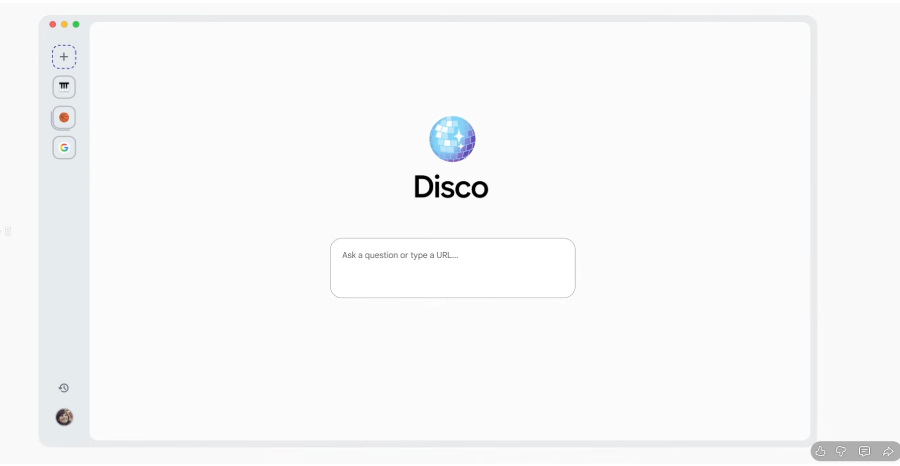
Disco greets you with a homepage containing a chatbox rather than the usual address bar. That’s where the chat history comes from, although you can also paste a URL in it.
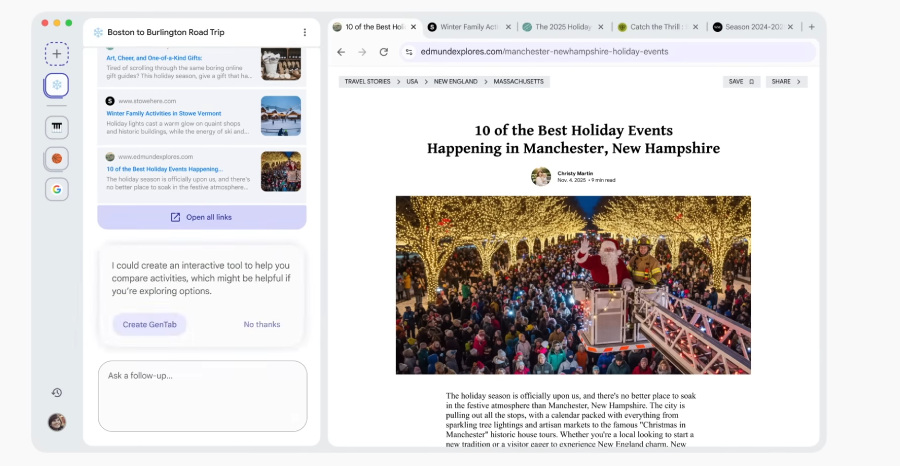
If you end up conversing, Google will first suggest you relevant webpages, and after a few conversations, it pops up a prompt to create a GenTab based on what you’re searching.
Google Disco HomePageDisco browser with Create GenTab prompt based on chat history
AI is definitely changing the way we search and consume content. And it won’t surprise me that features like GenTabs are the next evolution of it.
You don’t need to write code; you just describe what you need, refine it in plain language, and the browser does the heavy lifting. Google says Disco is meant to help people “learn faster” and experiment with what browsing could become. And yes, the company admits the best concepts from Disco might eventually show up in Chrome.
For now, Disco is an early experiment. Google Labs has opened a waitlist, and the first version is rolling out only on macOS.
For more daily updates, please visit our News Section.
The prevalent model of artificial intelligence, where developers constantly manage and prompt AI tools, imposes a significant “mental load” that stifles innovation. This was the central theme articulated by Kath Korevec, Director of Product at Google Labs, during her presentation at the AI Engineer Code Summit. Korevec argued for a paradigm shift towards “proactive agents,” […]
The ADAM Robot Bartender's deployment in a live arena demonstrates AI's practical application in hospitality, addressing labor gaps and enhancing customer interaction.
Jim Cramer, host of CNBC’s “Mad Money,” delivered a stark assessment of the market’s recent performance, declaring it an “ugly day if you own nothing but AI companies.” This pointed commentary, delivered on his program, highlighted a significant downturn in the tech-heavy Nasdaq, a stark contrast to a “normal, decent day if you own anything […]
“Disney is the biggest holder of them all,” Matthew Berman observed, commenting on the entertainment giant’s vast intellectual property portfolio. This singular statement encapsulates the week’s most striking developments in artificial intelligence, as industry titans navigated a landscape of groundbreaking product releases, strategic partnerships, and escalating legal battles over data rights. The dynamic interplay between […]
Deepwater Asset Management Managing Partner Gene Munster recently offered a discerning perspective on the trajectory of Oracle’s stock within the burgeoning artificial intelligence sector, suggesting it will likely underperform its large-cap AI peers by 2026. This assessment, delivered during a “Fast Money” segment on CNBC, delved into the intricacies of investor sentiment, capacity constraints, and […]
“The biggest risk to AI is not that it will become too intelligent, but that it will become too widespread without adequate safeguards.” This provocative statement, echoing the sentiment of many grappling with the rapid advancement of artificial intelligence, set the stage for a compelling discussion at Forward Future Live on December 12, 2025. The […]
The ongoing repricing of artificial intelligence within market valuations is not merely a transient market correction but a profound recalibration reflecting both immediate logistical hurdles and the vast, long-term potential of a global productivity revolution. This was the central thesis presented by Jose Rasco, HSBC’s Global Private Banking & Wealth Americas CIO, who recently engaged […]
The prevailing sentiment in the market regarding the artificial intelligence boom, as articulated by Big Technology founder Alex Kantrowitz, is one of acute “AI anxiety.” This apprehension stems not from a lack of belief in AI’s transformative power, but from the immense scale of infrastructure buildout promised and the precariousness of delivering on those commitments. […]
The labyrinthine world of enterprise sales, long burdened by archaic software and cumbersome processes, is ripe for disruption by artificial intelligence. This is the core thesis driving Joubin Mirzadegan, Kleiner Perkins’ latest entrepreneurial force, as he embarks on his new venture, Roadrunner. In a recent interview with Swyx on the Latent Space podcast, Mirzadegan peeled […]
President Trump’s AI executive order, aimed at accelerating American innovation by prioritizing speed over safety in artificial intelligence development, represents a bold and potentially risky strategic pivot in the global AI race. CNBC’s Deirdre Bosa, reporting on the implications of this order, highlighted the administration’s stated rationale: to prevent U.S. companies from being “bogged down […]
The global AI landscape is witnessing a significant shift, with China now leading in the development of open-weight artificial intelligence models. This revelation, highlighted by Alex Stamos, Chief Product Officer at Corridor and former Facebook Chief Security Officer, during a recent interview on CNBC’s ‘The Exchange,’ underscores a critical competitive dynamic and raises pressing questions […]
In a swift response to market unease and a significant stock slide, Oracle issued a definitive statement through spokesperson Michael Egbert, refuting earlier reports of delays in its critical data center development for OpenAI. CNBC’s Seema Mody reported on the breaking news, detailing how Oracle’s direct communication aimed to stabilize investor confidence, emphasizing that all […]
Seymour’s core argument posits that the recent dip in AI-related tech stocks, while perhaps “painful” in the short term, is a natural consequence of a significant run-up and a desirable market rotation. He highlighted the “massive move” seen in semiconductors and related AI plays, noting that many of these stocks have been at all-time highs. […]
“Anything that calls into question the pace of the buildout or the return on the investment is going to make this market skittish,” remarked Scott Wapner of CNBC, succinctly capturing the prevailing sentiment as news broke of Oracle’s delayed data center rollout for OpenAI. The Investment Committee, comprising Steve Weiss, Brenda Vingiello, and Jim Lebenthal, […]
“We are in an existential battle for leadership in the world in AI. If you believe the stakes are as high as I do, we have to have an innovation policy, a national posture that’s going to allow us to maintain the lead.” This stark assessment by Senator Dave McCormick encapsulates the urgency driving the […]
The global race for artificial intelligence dominance is not merely a contest of technological prowess, but increasingly, a strategic divergence in regulatory philosophy, with profound implications for innovation, safety, and international leadership. On a recent segment of CNBC’s ‘Money Movers,’ TechCheck Anchor Deirdre Bosa reported on President Trump’s executive order concerning artificial intelligence, engaging in […]
Most enterprises, despite significant investment, are failing to capture substantial value from artificial intelligence in software development. This stark reality, illuminated by Martin Harrysson and Natasha Maniar of McKinsey & Company, underscores a critical disconnect: the prevailing operating models and ways of working, honed over a decade of Agile methodologies, are fundamentally unsuited for the […]
When you go Live with Search, you can have a back-and-forth voice conversation in AI Mode to get real-time help and quickly find relevant sites across the web. And now, …
Trump signed an AI executive order targeting state laws and promising one national rulebook. Critics warn it could trigger court battles and prolong uncertainty for startups while Congress debates federal rules.
The real-time headphone translations experience keeps each speaker’s tone, emphasis, and cadence intact, so it’s easier to follow the conversation and tell who’s saying what.
Klopp is undoubtedly one of the finest managers of his generation, and he would be an exceptional acquisition for Real Madrid. He has shown his quality with Borussia Dortmund and Liverpool in the past. There is no doubt that he could help Real Madrid bounce back strongly and win major trophies.
A report from Fichajes claims that the German manager could demand two players if he joins Real Madrid. Ibrahima Konate and Dominik Szoboszlai are on his wishlist if he joins the Spanish club. It will be interesting to see if Real Madrid is prepared to sign those players for him.
Dominik Szoboszlai scores for Liverpool against Leeds
Konate has done exceedingly well for Liverpool since joining the club, and he is undoubtedly one of the best defenders in the Premier League. Real Madrid have looked vulnerable at the back, and he could be the ideal acquisition for them. He will be free in the summer of 2026, and he could be a cost-effective solution to their defensive problems.
On the other hand, the Hungarian midfielder has been the best player at Liverpool this season. Klopp signed him during his time at Liverpool, and it is no surprise that he wants to take the player with him to Real Madrid. It will be interesting to see how the situation develops. Liverpool will not want to lose two players, especially to their former manager.
The ambitious timeline for AI infrastructure build-out is encountering tangible friction, as evidenced by recent reports indicating a delay in some Oracle data centers designated for OpenAI. This development underscores the immense logistical and resource challenges inherent in scaling the computational backbone necessary for advanced artificial intelligence, a reality that reverberates across the tech landscape […]
The recent executive order from the Trump administration on Artificial Intelligence signals a decisive federal move to consolidate regulatory authority, challenging the burgeoning patchwork of state-level AI legislation. This initiative, unveiled against the backdrop of an intensifying global AI race, particularly with China, aims to streamline innovation while establishing a national framework for the technology. […]
“Most of what’s written about AI agents sounds great in theory — until you try to make them work in production.” This blunt assessment, delivered by Nik Pash, Head of AI at Cline, cuts through the prevailing optimism surrounding AI coding agents. Pash spoke with a representative from the AI industry, likely an interviewer or […]
Dubai’s hospitality industry is alive and kicking, and at the center of it all is the DoubleTree by Hilton Dubai M Square Hotel & Residences which is now making an important leadership change that will hasten the property’s development in the main travel markets. The new sales director is Oguzhan Isci, who will be responsible for directing the commercial strategy, increasing the industry partnerships, and taking part in the upgrading of the guest experience at the hotel-residence property which is situated in the old Al Mankhool district of Dubai.
Since welcoming guests with its signature warm DoubleTree cookie, DoubleTree by Hilton Dubai M Square Hotel & Residences has established itself as a sought-after destination for both leisure and business travellers. With its industrial-chic aesthetic, modern amenities and a location within easy reach of Burjuman Shopping Mall, Dubai Frame and Bur Dubai’s cultural attractions, the hotel is well positioned for further growth under Isci’s leadership.
Strategic Leadership to Elevate Sales and Growth
With more than ten years of experience spanning markets such as the UAE, Qatar, Türkiye and Europe, Oguzhan Isci brings to the role a strong commercial acumen and a track record of driving revenue growth and market development. In his new position as Director of Sales, he will guide strategic initiatives designed to strengthen the hotel’s competitive advantage in a dynamic regional tourism market.
Industry observers noted that Isci’s regional expertise and hospitality insight are aligned with broader growth ambitions for the property, particularly as Dubai continues to entice global travellers with its blend of luxury, culture and business opportunities. In previous senior leadership roles, he was recognised for nurturing key sales segments and forging partnerships that enhanced hotel performance, skills that are expected to inform his approach in Dubai. This insight, it was suggested, will help DoubleTree by Hilton Dubai M Square refine its appeal to both traditional and emerging guest segments.
A Hospitality Hub in the Heart of Dubai
Situated in Al Mankhool, the hotel places guests near the city’s historic attractions and contemporary landmarks. DoubleTree by Hilton Dubai M Square offers a comprehensive range of amenities designed to appeal to a wide spectrum of travellers. On-site dining includes a café and restaurant where visitors can enjoy diverse menus, while wellness facilities such as a full-service spa and fitness centre provide opportunities to unwind after a day exploring the city.
The property also offers an outdoor pool, a rooftop lounge with panoramic views of the Dubai skyline and versatile meeting and event spaces including a grand ballroom suitable for business conferences and social gatherings. With flexible spaces and dedicated planning support, the hotel has become a favoured choice for corporate events and destination weddings alike.
For extended stays, the hotel’s residence suites are a key draw. These fully equipped apartments range from one- to four-bedroom options and offer sweeping views of Dubai’s iconic skyline, including the Burj Khalifa and Dubai Frame alongside full kitchen facilities that provide the comforts of home for longer visits.
Advancing Travel Experiences and Market Reach
In his leadership role, Isci is expected to play a central role in amplifying the hotel’s outreach to international travel agents, corporate bookers and tour operators. Dubai’s tourism sector continues to be one of the fastest-growing in the world, and stakeholders believe that a refined sales strategy will allow the property to tap into evolving travel patterns, including surge segments such as luxury leisure travellers, family holidaymakers and long-stay guests seeking blended work-and-travel experiences.
Industry analysts suggest that one of Isci’s key challenges and opportunities will be to balance the hotel’s appeal between business clientele attending conferences and exhibitions and leisure travellers exploring Dubai’s cultural and entertainment offerings. By strengthening partnerships with global travel platforms and regional partners, the hotel is expected to enhance booking channels and visibility in competitive markets.
Guest-Centric Enhancements on the Horizon
While guests currently enjoy a host of contemporary amenities from free Wi-Fi and concierge services to EV charging and digital key technology, the property is exploring ways to elevate the overall guest experience in line with Dubai’s reputation for hospitality excellence. While official details of forthcoming enhancements remain under wraps, insiders hint that the hotel will seek to refresh its event spaces, expand bespoke guest packages and integrate new digital engagement tools that cater to increasingly tech-savvy travellers.
Isci’s appointment is also seen as timely in light of sustained demand for travel to Dubai, particularly from Europe, the Middle East and Asia. By leveraging his deep regional networks and sales leadership experience, industry watchers believe that the hotel could achieve stronger market share and greater positioning within Hilton’s global portfolio.
Looking Ahead: Growth Rooted in Local and Global Appeal
As the hotel charts its next chapter, there is a palpable sense of anticipation among those in Dubai’s travel and hospitality community. With its blend of classic hospitality elements and contemporary offerings, including well-appointed rooms and serviced residences DoubleTree by Hilton Dubai M Square invites guests to immerse themselves in both the energy of the city and the comfort of thoughtfully curated accommodation.
The appointment of Oguzhan Isci is poised to deepen this promise, combining local insights and global strategy to enrich the travel experience for visitors from around the world. By building on the property’s strengths and exploring new avenues for engagement, the hotel aims to leave a lasting impression on guests and stakeholders alike.
The evolution of Dubai into a world-recognized travel destination opens the door for hospitality executives like Isci to not only create unforgettable moments with the help of their service but also pave the way for the good stories and bonds to be told and shared among the tourists contributing to and even spreading the city’s charm that attracts people for so long.
The current landscape of artificial intelligence is characterized by insatiable demand, a phenomenon starkly illuminated by Immad Akhund, co-founder and CEO of Mercury, in a recent CNBC Squawk Box interview. Akhund, whose fintech firm provides banking services to a significant portion of early-stage startups, offered a unique vantage point into the financial flows underpinning the […]
“We have to be very careful when deciding which countries and which companies we sell these to.” This statement by Chris Miller, author of “Chip War,” encapsulates the high-stakes debate surrounding the export of advanced artificial intelligence chips. Miller spoke with CNBC’s Squawk Box about the intricate relationship between national security, industry profitability, and the […]
Disney’s recent $1 billion investment in OpenAI and its pioneering move to allow fans to generate AI videos with its iconic characters has sent ripples through Hollywood, signaling a pivotal shift in how intellectual property might be leveraged in the age of generative AI. This strategic embrace, lauded by some as a bold market leader […]
Fernandez observed “a lot of moments of doubt” surrounding the AI theme, a sentiment that has been building over recent weeks. This isn’t merely a cyclical dip but a deeper recalibration, signaling that the initial gold rush mentality is giving way to a more pragmatic assessment. She emphasized that the investment strategy can no longer […]
The fervent competition in artificial intelligence has moved beyond a mere technological arms race, evolving into a contest for human attention and ingrained user behavior. This critical shift was at the heart of the discussion between Frank Holland of CNBC Worldwide Exchange and X. Eyeé, CEO of Malo Santo, a firm specializing in scaling AI […]
2024 and 2025 Mexican data is now available for Geely.
The Mexican new light vehicle market edges down -0.4% year-on-year in November to 148,361 units, but the year-to-date tally is up 1% to 1,370,056. Nissan (+0.6%) stays on top of the brands charts with 17.6% share, distancing Chevrolet (-4.6%). November is decidedly a great month for Mazda: after breaking all its records a year ago, the Japanese brand does it again this month, climbing to a record third place with an all-time high 13,810 sales and 9.3% share. Volkswagen (-3.6%), Toyota (-4.3%) and Kia (+2%) all drop one spot on October to #4, #5 and #6 respectively. Great performers in the remainder of the Top 10 include Hyundai (+12.5%) and Ford (+8.3%) but MG (-45%) is hit full frontal. This month Geely sales data becomes available (also retroactively for 2024): the Chinese carmaker ranks #14 with 2.3% share (+245.4%). We also welcome Soueast and the retour of Jetour in the charts.
Model-wise, Nissan places the Versa (-9.3%) at #1 and the NP300 (+3.8%) at #2, the latter advancing to third place year-to-date as it passes the Kia K3 (-1.4%). The Chevrolet Aveo (-19.2%) is in a rut but stays at #3. Excellent showings for the Mazda CX-30 (+56.1%), Hyundai Creta (+50.8%), Renault Kwid (+48.8%) and Chevrolet S10 (+35.4%). The Nissan Magnite remains the most popular recent launch at #14 above the Geely EX5 at #40 and the VW Tera at #52.
The Tata Nexon is the best-selling vehicle in India for the 3rd straight month.
After smashing its monthly volume record in October, the Indian new wholesales market continues on its exceptional momentum in November with deliveries up another 18.7% year-on-year to 417,495. This the 2nd highest monthly volume in Indian history below last month. Once again, responsible for this great result is the introduction of a new GST structure (GST-2.0), which cut tax on entry-level cars from around 28% to 18%. Year-to-date volumes are up 4% to a record 4,126,144.
The Top 3 carmakers all beat the market with Maruti Suzuki up 21% to 41% share vs. 39.5% so far this year, Tata up 22% to reclaim the #2 spot for the second time in the past three months, and Mahindra up 21.9% to #3. Hyundai (+4.3%) is a lot more shy and is now in danger of losing the #3 year-to-date position to Tata, whereas it ranked #2 over the Full Year 2024. Other great performers include Citroen (+140.5%), Skoda (+90.3%) and Renault (+30.3%).
Over in the models charts, the Tata Nexon (+46.4%) scores a third consecutive win, distancing the YTD leader the Maruti Suzuki DZire (+79%). The Maruti Suzuki Swift (+33.9%) is also in great shape, up seven spots on October to #3. The Mahindra Scorpio (+22.9%) and Tata Punch (+21.5%) also outpace the market in the remainder of the Top 10. The Maruti Suzuki Victoris is the best-selling recent launch at #13, well above the Skoda Kylaq at #34.
Agent Lightning by Microsoft Research makes LLM agent reinforcement learning practical by enabling performance improvements without extensive code rewrites.
The Moroccan new light vehicle market delivers an 11th consecutive month of 20%+ year-on-year growth in November at +36.5% to 21,603 units. In the detail, Passenger Cars are up 37.9% to 19,193 units while Light Commercials gain 26.5% to 2,410. This month’s growth has a lot to do with the Top 2 brand’s performance: indeed Dacia is up 56.9% to 25.5% share while sister brand Renault (+100.5%) simply doubles its sales to reach 22.5% share, simply its highest since we started following Morocco monthly back in January 2022. The rest of the Top 10 trails the market, with Audi (+21.8%) and Skoda (+17.9%) the best performers and Opel (-36.9%) and Hyundai (-16.8%) faring the worst. New for the month, Deepal lands directly at #17 with 1% share, with the next best-selling recent launches being Chery (#19) and Soueast (#20). We also welcome Leapmotor (#31) and Lynk & Co (#42).
The GWM Poer is the 2nd best-selling vehicle in Ecuador in November.
New vehicle sales in Ecuador continue to surge in November at +46.3% year-on-year to 11,810 units, leading to a year-to-date tally up 13% to 112,550. Kia (+36%) significantly widens the gap with Chevrolet (-6.1%), once again in deep trouble, to 15.6% share vs. 11.2%. Hyundai (+104.3%) and GWM (+140.4%) both shoot up, up one and two spots on October respectively. JAC (+83.3%), Chery (+69.5%) and Renault (+61.9%) also beat the market below but it’s BYD (+215.9%) that delivers the biggest year-on-year gain in the Top 10. Notice also Jetour up 161.2% to #15.
Model-wise, the Kia Soluto remains in first place while the GWM Poer climbs to #2, becoming the country’s best-selling pickup above the Chevrolet D-Max which used to be the uncontested leader here. The Chevrolet Groove follows, ahead of three Kias: the Sonet, Seltos and Sportage.
In recent days, travelers across India have faced severe disruptions due to multiple flight cancellations at some of the country’s busiest airports. From Kolkata’s Netaji Subhash Chandra Bose International Airport to New Delhi’s Indira Gandhi International, passengers have been impacted by over 20 cancelled departures, with both domestic and international routes hit hard. These cancellations have caused a ripple effect, leaving thousands stranded and scrambling to find alternative travel options. A total of 20+ flights have been cancelled across major destinations including Bengaluru, Pune, Mumbai, Shivamogga, Srinagar, London, and Darbhanga.
Cancellation Table
Airport
Flight ID
Aircraft Type
Destination
Date
Departure Time (IST)
Netaji Subhash Chandra Bose Int’l (Kolkata)
AKJ1565
B38M
Bengaluru International (BLR / VOBL)
Saturday
01:55 PM
Netaji Subhash Chandra Bose Int’l (Kolkata)
AKJ1562
B38M
Pune / Lohegaon Air Force Base (PNQ / VAPO)
Wednesday
09:30 AM
Netaji Subhash Chandra Bose Int’l (Kolkata)
AKJ1562
B38M
Pune / Lohegaon Air Force Base (PNQ / VAPO)
Saturday
09:30 AM
Chennai International Airport (Chennai)
SEJ647
B738
Chatrapati Shivaji International (BOM / VABB)
Wednesday
08:45 AM
Chennai International Airport (Chennai)
SEJ647
B738
Chatrapati Shivaji International (BOM / VABB)
Saturday
08:45 AM
Chennai International Airport (Chennai)
SEJ2923
DH8D
Shivamogga (RQY / VOSH)
Thursday
02:55 PM
Rajiv Gandhi International Airport (Hyderabad)
BAW276
B788
London Heathrow (LHR / EGLL)
Sunday
07:25 AM
Bengaluru International Airport (Bengaluru)
AKJ1323
B38M
Lokpriya Gopinath Bordoloi International (GAU / VEGT)
Thursday
09:55 AM
Bengaluru International Airport (Bengaluru)
AKJ1311
B38M
Pune / Lohegaon Air Force Base (PNQ / VAPO)
Tuesday
06:35 AM
Bengaluru International Airport (Bengaluru)
AKJ1323
B38M
Lokpriya Gopinath Bordoloi International (GAU / VEGT)
Thursday
09:55 AM
Chatrapati Shivaji International Airport (Mumbai)
SEJ661
B738
Indira Gandhi International (DEL / VIDP)
Thursday
06:45 AM
Indira Gandhi International Airport (New Delhi)
BAW256
A35K
London Heathrow (LHR / EGLL)
Thursday
10:50 AM
Indira Gandhi International Airport (New Delhi)
SEJ661
B738
Srinagar / Srinagar Air Force Base (SXR / VISR)
Saturday
10:25 AM
Indira Gandhi International Airport (New Delhi)
AKJ1405
B38M
Darbhanga (DBR / VEDH)
Friday
08:55 AM
Total Cancellations: 20+ flights
Netaji Subhash Chandra Bose International Airport (Kolkata)
Kolkata’s Netaji Subhash Chandra Bose International Airport (VECC) has been particularly affected, with several flights cancelled on key routes:
AKJ1565 (B38M) to Bengaluru International Airport (BLR / VOBL) was cancelled on Saturday at 01:55 PM IST.
AKJ1562 (B38M) to Pune / Lohegaon Air Force Base (PNQ / VAPO) saw cancellations on Wednesday and again on Saturday, both at 09:30 AM IST.
These cancellations disrupted travel to popular domestic destinations, particularly affecting passengers heading to Bengaluru and Pune. As a result, many travelers had to rebook flights or adjust their plans on short notice.
Chennai International Airport (Chennai)
Chennai International Airport (VOMM) also experienced significant disruptions, with several cancellations affecting both domestic and international flights:
SEJ647 (B738) to Chatrapati Shivaji International Airport (Mumbai) (BOM / VABB) was cancelled on Wednesday and Saturday at 08:45 AM IST.
SEJ2923 (DH8D) to Shivamogga (RQY / VOSH) was cancelled on Thursday at 02:55 PM IST.
These cancellations left many passengers from Chennai stranded or forced to seek alternate routes to their destinations. The cancellations particularly impacted travelers with connections to Mumbai and Shivamogga.
Rajiv Gandhi International Airport (Hyderabad)
Hyderabad’s Rajiv Gandhi International Airport (VOHS) faced a major international cancellation that disrupted long-haul travel:
BAW276 (B788) to London Heathrow (LHR / EGLL) was cancelled on Sunday at 07:25 AM IST.
The cancellation of this international flight caused significant inconvenience for passengers traveling from Hyderabad to the UK, particularly during the busy holiday season. As travelers from Hyderabad looked to rebook their flights, they faced limited options for connecting to London and other European destinations.
Bengaluru International Airport (Bangalore)
At Bengaluru International Airport (VOBL), a few cancellations affected key regional and domestic routes:
AKJ1323 (B38M) to Lokpriya Gopinath Bordoloi International (GAU / VEGT) was cancelled on Thursday at 09:55 AM IST.
AKJ1311 (B38M) to Pune / Lohegaon Air Force Base (PNQ / VAPO) was cancelled on Tuesday at 06:35 AM IST.
These cancellations, particularly to Pune and Gauhati, caused disruption for passengers traveling for business or family reasons. Bengaluru airport cancellations continue to impact travelers who rely on these routes for timely connections.
Chatrapati Shivaji International Airport (Mumbai)
Mumbai’s Chatrapati Shivaji International Airport (VABB) also faced disruptions as a significant flight was cancelled:
SEJ661 (B738) to Indira Gandhi International Airport (DEL / VIDP) was cancelled on Thursday at 06:45 AM IST.
This domestic cancellation between Mumbai and New Delhi caused inconvenience for passengers, especially those with time-sensitive business meetings or family commitments in the capital. Mumbai flight disruptions like these have forced travelers to reconsider their travel plans and explore alternate routes.
Indira Gandhi International Airport (New Delhi)
New Delhi’s Indira Gandhi International Airport (VIDP) was not immune to the cancellations either, with several flights affected, including:
BAW256 (A35K) to London Heathrow (LHR / EGLL) was cancelled on Thursday at 10:50 AM IST.
SEJ661 (B738) to Srinagar / Srinagar Air Force Base (SXR / VISR) was cancelled on Saturday at 10:25 AM IST.
AKJ1405 (B38M) to Darbhanga (DBR / VEDH) was cancelled on Friday at 08:55 AM IST.
These cancellations in New Delhi affected both international and regional travel. The flight to London was particularly frustrating for those with urgent travel needs, while the cancellations to Srinagar and Darbhanga impacted passengers traveling for holidays or personal reasons.
Reasons Behind the Flight Cancellations
While the exact reasons for these flight cancellations are not always made clear by the airlines, they often stem from operational issues, maintenance requirements, and weather-related disruptions. With the ongoing challenges in the aviation sector, especially in the aftermath of the COVID-19 pandemic, airlines have faced staffing shortages, aircraft maintenance delays, and unexpected weather conditions that have all contributed to flight disruptions.
Impact on Passengers
The widespread flight cancellations across major airports have left passengers stranded and frustrated. As holiday travel picks up, the disruption has created added stress for those with tight schedules or critical appointments. Many travelers were left scrambling for alternate flights, and in some cases, they had to endure long wait times or even cancel their plans altogether.
The cancellations also highlight the need for better communication and support from airlines, which could ease the burden on passengers in such situations. Airlines are advised to improve their real-time flight status updates and provide clearer information about cancellations, rebooking options, and compensation.
What Passengers Can Do
Travelers affected by the flight cancellations should immediately contact their airline for rebooking options. Many airlines are offering free rebooking for affected passengers or providing alternate routes. It’s also recommended to stay updated with real-time flight information through the airline’s website or customer service channels.
For those who need to travel urgently, considering nearby airports or alternative routes might help in finding available flights. Passengers may also be entitled to compensation for cancellations that were not caused by weather-related factors, depending on the airline’s policies.
Conclusion: Preparing for Future Disruptions
Flight cancellations in India have highlighted the ongoing challenges in the aviation sector. The disruptions at airports like Netaji Subhash Chandra Bose, Chennai, Bengaluru, Mumbai, Hyderabad, and New Delhi have affected thousands of passengers, causing frustration and travel delays. As the holiday season approaches, travelers are urged to stay vigilant and informed about flight statuses to minimize the impact of these cancellations on their plans.
The key takeaway for travelers is to always check their flight status, stay connected with the airline for updates, and remain flexible with travel plans to handle any unforeseen disruptions. As airlines continue to navigate operational challenges, passengers should be prepared for the possibility of further cancellations and delays in the near future.
OpenAI’s latest release, GPT-5.2, marks a pivotal moment in artificial intelligence, delivering substantial advancements across a spectrum of benchmarks and real-world applications. As commentator Matthew Berman highlighted, this new iteration is an “incredible model” and a “significant upgrade over 5.1,” pushing the boundaries of what large language models can achieve in reasoning, efficiency, and practical […]
Claude.ai’s latest advancement, the integration of “connectors,” fundamentally redefines how artificial intelligence can serve as a truly capable productivity partner within an organization’s existing digital ecosystem. As the product demonstration video, “Getting started with connectors in Claude.ai,” illustrates, this feature allows users to “connect the tools you already use to unlock a smarter, more capable […]
Ten years ago, the very notion of artificial intelligence distinguishing a cat from a dog was a formidable challenge, a benchmark for nascent machine learning capabilities. Today, the landscape is utterly transformed, and at the heart of this seismic shift stands OpenAI, whose retrospective video, “10 years.”, chronicles a decade of relentless pursuit, profound breakthroughs, […]
“There’s never been anything like this… this is uncharted territory,” declared Heath Terry, Citi’s Global Head of Technology and Communications Research, reflecting on the unprecedented scale and influence of artificial intelligence. His remarks, made during a recent appearance on CNBC’s “Closing Bell Overtime” with John Fortt and Sarah Eisen, offered a nuanced perspective on the […]
The Quest for Measurable AI ROI in Software Engineering “Can you prove AI ROI in Software Engineering?” This question, posed by Yegor Denisov-Blanch, a researcher from Stanford, cuts to the heart of a critical challenge facing enterprises today. As companies pour millions into AI tools for software development, the ability to demonstrate tangible returns on […]
Two Chinese artificial intelligence startups, MiniMax and Zhipu, are preparing for initial public offerings (IPOs) on the Hong Kong Stock Exchange in early 2026.
The latest developments from OpenAI signal a clear strategic pivot and an assertive stance in the escalating AI arms race. On CNBC’s “Closing Bell,” reporter MacKenzie Sigalos provided insights into an exclusive interview with OpenAI CEO Sam Altman, where discussions centered on the rollout of GPT-5.2, the company’s intensified enterprise focus, and Altman’s robust confidence […]
The prevailing sentiment among tech insiders and investors often oscillates between fervent optimism and cautious apprehension, especially concerning a transformative force like artificial intelligence. Yet, as Deepwater Asset Management’s Managing Partner Gene Munster recently articulated on CNBC’s “Closing Bell,” the peak of the current AI market cycle remains distant, predicated significantly on the future public […]
Ten years ago, the landscape of artificial intelligence was a nascent frontier, grappling with challenges as fundamental as differentiating between a dog and a cat in an image. Yet, beneath this seemingly rudimentary state, a profound belief in the transformative potential of deep learning was taking root, a conviction that would propel a small group […]
The true promise of artificial intelligence lies not in isolated, brilliant agents, but in their collective intelligence, a synergy unlocked by sophisticated context systems. This fundamental shift in AI architecture was the focus of a recent discussion between Aja Hammerly and Jason Davenport on Google Cloud Tech’s “Real Terms for AI” series. Hammerly and Davenport […]
“No question AI will displace a lot of content creators,” stated James Stewart, author of “The Disney War” and a CNBC contributor, during a discussion on CNBC’s “The Exchange” regarding Disney’s significant $1 billion investment in OpenAI. This investment, announced as a partnership that aims to protect intellectual property, highlights a proactive approach by a […]
“We have a new model that is significantly stronger than anything that we’ve released before. It’s better at creating spreadsheets, building presentations, perceiving images, writing code, and understanding long context.” This declaration from MacKenzie Sigalos of CNBC, reporting on OpenAI’s latest announcement, sets the stage for a significant advancement in AI technology. The unveiling of […]
The current debate on CNBC’s “The Exchange” underscored a critical evolution in the artificial intelligence landscape, moving beyond mere model superiority to a multifaceted competition centered on strategic market focus, distribution channels, and computational power. This shift signals a maturing industry where raw algorithmic prowess, while essential, is increasingly just one component of a winning […]
In the past, users had to upload a full-body picture of themselves to virtually try on a piece of clothing. Now they can use a selfie and Nano Banana will generate a full-body digital version of them.
OpenAI just launched GPT-5.2, a frontier model aimed at developers and professionals, pushing reasoning and coding benchmarks as it races Google’s Gemini 3 while grappling with compute costs and no generator.
And when it does, the AI assistant will roll out to every existing EV in its lineup, not just the next-generation versions of its R1T truck and R1S SUV.
“We are very focused on having the cheapest cost per token at the highest level of intelligence.” This declaration by OpenAI CEO Sam Altman, as reported by CNBC’s MacKenzie Sigalos, encapsulates the company’s strategic pivot from broad consumer appeal to a more targeted, performance-driven approach in the escalating AI arms race. The recent $1 billion […]
“RemoveWindowsAI” could be the script that AI-hating Windows users have been waiting for Microsoft is making Windows 11 more AI-focused, and if you hate that, this script may be of interest to you. The new 25H2 build of Windows 11 adds more AI features than ever before, and the new “RemoveWindowsAI” script could rid your […]
Futbolpress.az xəbər verir ki, sonuncu oyun günündə iki qarşılaşma keçirilib. Lider “Şəfa” “Zaqatala” ilə oyunda xal itirib. İkinci pillədə yer alan “Səbail” isə “Difai”yə qalib gəlib.
Azərbaycan I Liqası X tur
Şəfa – Zaqatala 1:1 Qollar:E.Cəfərov, 55 – O.Təhməzli, 74
Disney says that alongside the agreement, it will "become a major customer of OpenAI," as it will use its APIs to build new products, tools, and experiences, including for Disney+.
TIME Magazine has named the 'Architects of AI' its Person of the Year, who include Jensen Huang, Elon Musk, Sam Altman, Mark Zuckerberg, Lisa Su, Dario Amodei, Demis Hassabis, and Fei-Fei Li
Following a couple of months' testing, Opera has finally made its AI-powered browser, Neon, available to the public — though you'll have to shell out for a $19.90-per-month subscription to use it.
We can either rebuild credibility into hiring now or wait until the market breaks under the weight of counterfeits. The future requires verifiable proofs.
Port offers a proprietary alternative to Spotify's popular devtool catalog Backstage, but with a valuable addition — it can be used to manage AI agents, too.
A pregnant woman in San Francisco gave birth inside a Waymo robotaxi Monday night en route to UCSF Medical Center, marking the latest milestone in the driverless car saga that no one saw coming -- except everyone with more than six months of experience behind the wheel of a ride-share vehicle.
The Jeep Avenger ends the month just 3 sales off a maiden Top 10 finish.
New car sales in Slovenia advance a solid 13.5% year-on-year in November to 4,861 units, leading to a year-to-date volume up 8.8% to 54,164. Volkswagen (+10%) retains the brands top spot with 14.9% share, well ahead of Skoda (+12.1%) at 10.6% and despite the latter advancing faster year-on-year. Toyota (+9.5%), Renault (+5.8%) and Dacia (+5.4%) are more discreet while Hyundai (-12.9%) disappoints with a negative score. MG (+430.8%) soars to a record 7th place with 4.3% share vs. 1.6% year-to-date, the carmaker’s second incursion inside the Slovenian Top 10 after December 2023 (#10). Jeep (+155%), Opel (+88.3%) and Citroen (+75.5%) also stun below.
Over in the models charts, the Renault Clio (+26.8%) surges ahead to reclaim the top spot it holds year-to-date with 4.1% share. The Skoda Octavia (+13.6%) is also sturdy and is up one rank on last month to #2. Up to a record #2 a year ago, the Hyundai Tucson (-20.4%) skids year-on-year but is up to #3 vs. #10 in October. Excellent scores for the Dacia Sandero (+147.7%) at #4 vs. #24 YTD and the VW Tiguan (+113.7%) now up to #6 so far this year. The Jeep Avenger (+150%) ends the month just 3 sales off a maiden Top 10 finish.
The Tesla Model Y holds 18.3% of the Norwegian market in November.
The Norwegian new car market in November is boosted by fears of lowered VAT floor to NOK 300,000 (US$29,700) on new electric cars by January 1st. Overall sales are up a whopping 70.2% year-on-year to 19,899 units, the largest November volume in Norway’s history. Year-to-date volumes are up 25.5% to 144,362. BEV sales are up 77.6% to 19,427 and 97.6% share vs. 93.6% a year ago and up 34.2% year-to-date to 137,887 and 95.5% share vs. 89.3% over the same period in 2024. Meanwhile HEVs are off -42.5% to 161 and 0.8% share, PHEVs edge down -1.3% to 152 and 0.8% also, diesel is at 0.7% share and petrol at 0.1%. For the first time, 4×4 share surpasses 80% and 80.6% vs. 76.8% a year ago.
Tesla shoots up 175.2% to 6,215 sales and 31.2% share, its best result since March 2023 (7,899 and 40.8% share). Thanks to year-to-date sales up 34.6% to 28,606, Tesla has already beaten the annual brand sales record previously detained by Volkswagen in 2016 (26,572). Volkswagen (+35.7%) trails the market to 11% share vs. 12.9% so far this year but Volvo (+178.2%) also stuns to 9.4% share vs. 7.9%. This means the Top 3 carmakers hold over 50% of the market (51.6%). Kia (+149.3%), Hyundai (+82.4%) and Ford (+75.9%) also impress in the remainder of the Top 10. Of note, there are no Chinese brands among the 10 best-sellers, with Xpeng (+113.3%) at #11 and MG (+698.4%) at #12. Polestar is up 138.8%, Mazda up 893.8%, Renault up 191.4% and Zeekr up 1950%.
Model-wise, the Tesla Model Y is up 144.7% to 18.3% share and is now just 540 sales away from breaking the annual model sales record it currently holds (23,088 in 2023). The Tesla Model 3 (+235.3%) holds the 2nd spot and reaches 12.9% share, its highest since September 2024. The Volvo EX40 (+462%) stays on the podium, distancing the VW ID.4 (+18.1%) and ID.7 (+59.5%), both disappointing in context.
Manchester United and Manchester City are interested in signing the Trabzonspor midfielder Inao Oulai.
The 19-year-old is highly rated at the Turkish club, and he could cost around £35 million, as per TEAMtalk. The towering midfielder has done quite well in Turkey, and he could prove to be a solid long-term investment for the two Premier League clubs as well.
He has been labelled as the next Yaya Toure because of the similarities when it comes to playing style. Manchester United could certainly use a player of that ilk, and Oulai could be ideal for them. The opportunity to join Manchester United will be exciting for him. It would be a step up in his career, and he would get to test himself in the Premier League.
Meanwhile, Manchester City need more quality in the middle of the park as well. It will be interesting to see if they can convince the player to join them instead. Both clubs of the financial muscle to pay £35 million for him. The deal could look like a bargain if Oulai manage to fulfil his potential in the Premier League.
Both clubs have done well to groom young players in recent years, and it will be interesting to see where the 19-year-old ends up. He should seek gametime assurance before joining a new team. Sitting on the bench in the Premier League will not benefit him. He should only look to join a team where he will get regular opportunities.
Other clubs are monitoring his progress as well, and the Premier League clubs will have to move quickly if they want to win the race for his signature.
From enhancing assistive technology to addressing the digital divide, developers built mobile-first solutions to address real-world problems in the Gemma 3n Impact Chall…
Google is rolling out managed MCP servers to make its services “agent-ready by design,” starting with Maps and BigQuery, aiming to simplify messy integrations and help AI agents use real tools.
The South Korean new car market edges down -1.1% year-on-year in November to 145,936 units. Local carmakers pull the market down at -5.8% to 116,588 whereas foreigners jump +23.4% to 29,348. Year-to-date figures are up 2.8% to 1,531,044 including 1,252,508 locals (+0.2%) and 278,536 foreigners (+16.2%). Hyundai (-5.1%) retains the brands pole position with 33.9% share above sister brand Kia (-0.6%) at 32.8%. Genesis (+4.7%) is back above 10,000 monthly sales for the first time since last June, distancing Tesla (+110.9%), BMW (-2.1%) and Mercedes (+20.7%). Renault Korea (-51%) collapses year-on-year while Volvo (+10.6%) is solid at #9. Newcomer BYD breaks into the Top 10 for the first time at #10 with 0.8% share.
Looking at domestic models, the Kia Sorento (-3.7%) manages a 13th win in the past 15 months and is way above the competition this month. The Kia Sportage (+62.2%) takes the second spot ahead of the Hyundai Grandeur (+28.8%). The Hyundai Sonata (-11.4%) follows, distancing the Hyundai Avante (+0.1%) and Tucson (-3.6%). The Hyundai Palisade (+124.5%) continues to benefit from its new generation at #8 overall.
Over in the foreign models ranking, the Tesla Model Y (+102.8%) surges ahead year-on-year to dominate the charts head and shoulders with over 6,000 sales. The Mercedes E Class (+50.3%) is also in fantastic shape at #2 ahead of the BMW 5 Series (-5.3%), in difficulty. The Tesla Model 3 (+193.6%) is back up three spots on October to #4, a ranking it also holds year-to-date. Notice also the Mercedes GLE up 256.7% and the BYD Sealion 7 up to a record 7th place.
The Jetour T2 is the best-selling recent launch in South Africa.
It’s a 9th straight month of double-digit year-on-year gains for new vehicle sales in South Africa, as well as a 14th consecutive positive month. November volumes are indeed up another 12.5% to 54,896, leading to a year-to-date tally up 15.4% to 547,966. Passenger cars are up 11% to 39,158 and light commercials up 20.5% to 13,048. However exports drop -3.9% to 35,848.
Toyota (+12.1%) matches the market to 24.7% share, distancing Suzuki (+6.3%) and the VW Group (-4.4%). Ford (+0.8%) and Hyundai (+3.8%) are shy and round out the Top 5. GWM (+37.2%) and Chery (+24.9%) both impress below, with Chery hitting a record share at 4.6%. Omoda + Jaecoo (+98%) reaches all time high ranking, volume and share at #11 while newcomer Jetour is up to #15 with a record volume and share. We welcome Changan at #33.
The Toyota Hilux (+25.2%) surges ahead to remain the most popular vehicle in the country with 6.2% share ahead of the VW Polo Vivo (-4.6%) and Suzuki Swift (+33.1%). The Chery Tiggo 4 Pro (+54.3%) breaks into the South African Top 5 for the first time at #5, wit the Toyota Urban Cruiser (+52.3%) and Starlet (+30.8%) also very impressive I’m the remainder of the Top 10. The GWM P-Series (+137.5%), Toyota Vitz (+120.9%) and Omoda C5 (+85.4%) also stun below. The best-selling recent launch is the Jetour T2 breaking into the Top 50 for the first time and landing at #27.
The BYD Leopard 3 is the best-selling vehicle in Ukraine in November.
Fantastic month for new light vehicle sales in Ukraine: up 45.8% year-on-year in November to 7,910 units. This is enough to tilt the year-to-date tally into positive at +0.9% to 68,121. BYD (+795.4%) lodges another stunning performance and smashes its market share record to 19.6% vs. a previous best of 14.6% reached just last month. As such BYD advances to #2 year-to-date (+260.4%). Volkswagen (+75.2%) is also in exceptional shape at #2 while Toyota (-6.9%) is weaker at #3. Skoda is up 20.4% to remain at #4 above Renault (+17.3%). Zeekr (+428%) breaks all its records to #7 with 396 sales and 5% share. These are the brand’s best performances anywhere in the world. Honda (+161.1%) and Hyundai (+80.6%) also shine in the remainder of the Top 10.
We have a new leader in the models charts: the new BYD Leopard 3 (aka Fang Cheng Bao Tai 3) is the standalone winner this month with 4.8% share and ranks #18 year-to-date with 1.3% of the market. #1 over the past two months, the VW ID.Unyx celebrates one year in market at #2 while the BYD Song Plus (+244%) is also down one spots on October to #3. This means the podium is entirely coming from China production-wise. Still by far the year-to-date best-seller, the Renault Duster (-23.7%) has to contend with 4th place like last month. The Toyota RAV4 (+43.4%) follows ahead of the Toyota Prado (+18.2%). The Zeekr 7X is up to a spectacular 7th position with 2.8% share while the BYD Sealion 6 is up 41 ranks on last month to #9.
The Dacia Bigster is the 2nd best-selling vehicle in Bulgaria in November.
New light vehicle sales in Bulgaria advance 7.3% year-on-year in November to 4,720 units, leading to a year-to-date volume up 8.8% to 50,488. This month Dacia (-2%) is the most popular carmaker in the country wth 11.7% share vs. 10.1% year-to-date where it ranks #3. Toyota is up 27.4% at #2 and overtakes Skoda (-23.6%) for the YTD top spot. When removing Kia (stable), all the remaining Top 10 brands are up by double digits. Opel (+211.6%) performs best followed by Citroen (+72.2%), Renault (+24.2%), BMW (+20.7%), Hyundai (+15%) and Volkswagen (+13.8%).
Model-wise, the Toyota Corolla (+55.1%) repeats at #1 and cements its YTD dominance above the Skoda Octavia (-45.4%) in complete freefall. The event of the month is the 2nd place of the new Dacia Bigster, up from #7 in October. Dacia also places the Sandero (-20.7%) at #3 despite a daunting year-on-year fall. The Jogger (-42.6%) rounds out the Top 5 vs. #12 in October. Freak event for the Opel Combo up 1122.2% to #7. #5 last month, the Citroen C3 Aircross (+2833.3%) continues to surge and ends the month at #12.
Toyota Corolla sales are up 85.8% year-on-year in November.
21,317 new cars found a buyer in Czechia in November, a +3.3% year-on-year improvement. Year-to-date volumes are up 6.2% to 227,052. Local behemoth Skoda (+3%) matches its home market to 33.8% share, slightly below the 34.4% it commands year-to-date. Hyundai (+3.1%) and Volkswagen (-2.1%) follow, while Toyota (+17.8%), Dacia (+15.9%) and Renault (+12.6%) all manage stellar results below. Further down, Cupra (+124.3%) stands out, with Citroen (+64.9%), Opel (+58%), Volvo (+25.7%), Peugeot (+18.9%) and BMW (+10.2%) also solid. Newcomer Jaecoo stays at #19 with 1.1% share.
Model-wise, the Top 6 is 100% Skoda as is also the case year-to-date. The Octavia (+3.2%) easily keeps the lead at 6.6% share, albeit well below its YTD level of 7.5%. The Karoq (+39.7%) surges year-on-year to remain in 2nd place with 5.2% of its home market. The Kamiq (+14.6%) is also strong at #3, followed by the a shy Kodiaq (+0.8%) and freefalling Fabia (-32.1%) and Scala (-15.9%). The Toyota Corolla (+85.8%) is the best of the rest at #8 ahead of the Hyundai i30 (+19.2%), with the Skoda Superb (+4.3%) and Kia Ceed (-30%) rounding out the Top 10. The Dacia Bigster is the best-selling recent launch at #13 above the Skoda Elroq (#14) and Jaecoo 7 (#19).
Thanks to SMMT we can share with you the Top 10 best-sellers for each UK nation in October. Keep in mind this is a zoom in by nation, UK overall sales figures are already included in the November 2025 UK update. This month all UK nations are in negative. Scotland (-6.4% to 11,736) fares worst, Northern Ireland (-3.5% to 3,201) and Wales (-3.1% to 4,882) all struggle while England (-1% to 131,139) avoids a larger UK slump. Year-to-date, England (+4.3 to 1,607,052) and Scotland (+1.6% to 160,632) are in positive unlike Northern Ireland (-7.9% to 42,572) and Wales (-3.7% to 60,889).
Podium finishers are as follows: the Ford Puma is #1 in England and Wales, #2 in Northern Ireland and #3 in Scotland, the Kia Sportage #1 in Northern Ireland, #2 in England and Wales, the Vauxhall Corsa #1 in Scotland, the Jaecoo 7 #2 in Scotland and #7 in England and Wales, the Nissan Qashqai #3 in England, the Peugeot 2008 #3 in Northern Ireland and the MG HS #3 in Wales.
Other great performers include the Renault Clio #5 in Scotland, Dacia Sandero #6 in Northern Ireland, Toyota Yaris #6 in Wales, Chery Tiggo 7 #7 in Scotland, Omoda 5 #10 in Scotland for what is the nameplate’s first Top 10 finish in any UK nation and the Toyota Yaris Cross #10 in Wales.
The GWM Poer is #1 in Chile for the third time ever.
New light vehicle sales in Chile edge up 2.1 % year-on-year in November to 25,620 units, leading to a year-to-date volume up 2.4% to 281,021. Toyota (-6.1%) reclaims the brands top spot it holds year-to-date despite going against the positive market with a rather significant loss. Leader last month, Hyundai (-3.8%) also underperforms YoY and ranks #2 in November, yet lodges a slightly higher share than YTD at 7.2% vs. 6.9%.
Kia (+15%) delivers the biggest gain in the Top 8 and climbs four spots on last month to #3, distancing Chevrolet (-3.5%), Ford (+2.7%) and Suzuki (-10.2%). GWM (+4.6%) beats the market at #7 with Changan (+25.3%) the best performer in the Top 10 and MG (+3.6%) up two ranks to #10. Below, Geely (+835.2%), Kaiyi (+169.7%) and Jeep (+129.8%) stand out. All in all, Chinese manufacturers are up 15.4% to 33.9% share vs. 30% a year ago.
Model-wise, the top 3 models fit within 7 sales. The GWM Poer (+5.8%) snaps its 2nd win in the past four months and third ever #1 finish (add July 2025 and September 2023) ahead of the Kia Soluto (+36.9%) up 22 spots on October to #2 and the Toyota Hilux (-14.3%) down two ranks to #3. The Hilux stays in pole position YTD. The Mazda CX-5 (+131.3%), Toyota RAV4 (+79.9%), Hyundai Tucson (+64.6%) and Chevrolet Groove (+54.9%) also shine below.
Volkswagen is up to third place in the brands ranking in October.
New vehicle sales in Ecuador are up another fantastic 47.3% year-on-year in October to 12,135 units. This is the largest monthly volume in the country since March 2024. The year-to-date tally is now up 10.1% to 100,740. Kia (+38.4%) easily remains the most popular carmaker in the country with 13.8% share, albeit a full two percentage points below its YTD level of 15.8%.
Chevrolet (-13.2%) is in great difficulty YoY but still manages to rank #2 with 10.6% share. The performer of the month is Volkswagen surging 426.7% to #3 with 6.3% share vs. #13 and 2.6% so far this year. Dongfeng (+117.9%), JAC (+94.3%), GWM (+84%), Hyundai (+82.8%) and Renault (+66.9%) also beat the market in the remainder of the Top 10.
The Kia Soluto is the best-selling vehicle in the country again and by far at 6.4% share, more than double the #2, the Chevrolet D-Max at 3.1%. The Chevrolet Groove rounds out the podium like it does year-to-date, distancing the GWM Poer and Kia Seltos. The Toyota Hilux is up to #7.
Toyota Crown sales are up 85.2% year-on-year in November.
The end of EV subsidies and tariff-induced higher prices are finally catching up with the U.S. new light vehicle market in November, with sales off for the second straight month at -6.3% to an estimated 1.28 million according to GlobalData. Retail sales are down -8.1% whereas fleet deliveries gain 3.5%. The SAAR stands at 15.84 million according to Motor Intelligence, up from 15.48 million in October but well down on the 16.61 million of November 2024. The average incentive per vehicle is $3,211, up $375 on October but down $125 on a year ago, according to J.D. Power and GlobalData said. Incentive per light truck is down -$79 year-on-year to $3,388 while cars shave off $2,362 on average, down $365 on a year ago. The average new-vehicle retail transaction price is $46,029, up $722 on last year. J.D. Power and GlobalData said fleet sales are down -7.5% to 197,358.
Among OEMs still sharing monthly data, Toyota Motor (+2.7%) is the only one in positive, Ford Motor (-0.7%) and Hyundai-Kia (-0.5%) are stable while American Honda (-15.3%) freefalls. Brand-wise, Toyota (+4.4%) and Kia (+2.7%) stand out with YoY gains, the latter managing a 5th straight uptick. The 4Runner (+3325.1%), Crown (+85.2%) and Grand Highlander (+73.1%) help Toyota up while at the Korean carmaker the Niro (+222%), Seltos (+66.4%) and Carnival (+49.5%) stand out. Ford is almost stable (-0.03%), ending 8 consecutive months of gains. The F-Series (-9.6%) disappoints while the Mustang (+78.6%), Maverick (+43.3%), Explorer (+41.5%) and Ranger (+35.8%) impress.
Honda (-16.8%) struggles mightily with the Odyssey (-17.3%), CR-V (-14.5%), HR-V (-14.1%) and Accord (-9.1%) hit hard and the Civic (-5.5%) doing ok. Hyundai (-2.3%) edges down but beats the market thanks to the Venue (+35.4%), Tucson (+17.8%), Santa Fe (+13.2%) and Palisade (+10.3%). Note Hyundai and Kia are both on track to deliver record annual results in 2025. For Kia, it would be the third consecutive year it does so. Other solid carmakers in context include Genesis (+0.2%), Acura (-1.4%) and Mazda (-1.5%). Subaru (-9.7%) endures a 4th consecutive month of year-on-year decline with all its models in negative.
The new 4 Runner plays a part in significantly lifting Toyota sales in November.
DesRosiers Automotive has the Canadian new light vehicle market down a painful -8.6% year-on-year in November to an estimated 142,000 units. However, November 2024 was a particularly high comparison base as it was the first November since 2017 to pass the 150,000-unit milestone due to rushed sales in Quebeck before the end of green car subsidies. The SAAR is 1.87 million vs. 2.04 million last year. Also of note is we are very close to the pre-pandemic levels of 145,000 units in November 2019.
Among OEMs still reporting monthly sales, Toyota Motor stands out with a market-defying 8.8% year-on-year gain to over 20,000 units. Reversely, Honda Canada (-23.7%) freefalls while Hyundai-Kia (-2.1%) contains its loss. As for brands, Toyota (+10.1%) is the best performer just as Hyundai (-0.3%) manages to stay stable. Honda (-26.1%) in in a rut and Genesis (+6%), Mazda (+5%), Acura (+2.4%) and Volvo (+0.4%) are all in positive. Lexus (-0.1%) is stable.
Among models with available monthly data, the Toyota RAV4 (-6.2%) is weak yet beats the market, while the Hyundai Tucson (+39.1%) surges ahead. The Mazda CX-5 (+49.7%), Subaru Crosstrek (+30.5%), Hyundai Kona (+14.1%) and Toyota Corolla Cross (+11.1%) also post fantastic scores. Further down, notice the Toyota Grand Highlander (+143.5%), Tacoma (+60.6%), Kia Seltos (+60.1%) and Kia Sportage (+40.8%) as well as the Toyota 4Runner (+3415.4%) benefitting from a new generation.
Azərbaycan Kubokunun 1/8 mərhələsinin “Difai” – “Sumqayıt” matçı meydan sahiblərinin 1:3 hesablı məğlubiyyəti ilə başa çatdı.
Arena.az sözügedən qarşılaşmanın yekun protokolunu və videoicmalını təqdim edir:
Azərbaycan Kuboku 1/8 final mərhələsi 4 dekabr
“Difai” – “Sumqayıt” 1:3 Qollar: Kamil Qardaşlı, 67 – Ronaldo Vaskes, 9; 75-pen. Aleksandr Ramalinqom, 90+2. Sarı vərəqələr: Əsgər Hüseynov, 74 (hakimin qərarına etiraz). Roman Hüseynov, 81 (hakimin qərarına etiraz); 83 (qeyri-idman hərəkəti) – Nadir Orucov, 22 (qeyri-idman hərəkəti). Rayan Senhadji, 35 (qeyri-idman hərəkəti). Qırmızı vərəqə: Roman Hüseynov, 83. Artırılan vaxt: Birinci hissədə yoxdur; ikinci hissədə – 4 dəqiqə. Saat 19:00. Mehdi Hüseynzadə Sumqayıt şəhər stadionu, 1200 tamaşaçı.
Baş hakim: Nicat İsmayıllı. Baş hakimin köməkçiləri: Pərvin Talıbov, Zöhrab Abbasov. Dördüncü hakim: Vüqar Həsənli. Hakim-inspektor: Anar Salmanov. AFFA nümayəndəsi: Asif Əliyev.
Difai: 1. Sadiq Məmmədzadə, 77. Roman Hüseynov (k), 27. Əsgər Hüseynov, 20. Nemət Musayev (55. Nazim Həsənzadə, 55), 11. Bayraməli Qurbanov, 5. Nihad Həsənzadə, 17. Emin Məcidzadə (19. Hacıəli Şirəliyev, 55), 44. Rüfət Tahirov, 23. Kamil Qardaşlı, 16. Altayturan Bektaşoğlu (7. Fərid Kazımzadə, 75), 8. Kamil Sadiqov (10. Musa Musazadə, 62). Ehtiyat oyunçular: 12. Tural Mirsultanov, 24. Miraqşin Abasov, 21. Mühəmməd Həsənov, 6. Nihad İsmayılov, 18. Kristian Kamta. Məşqçi: Aydın Qasımov.
Sumqayıt: 22. Xəyal Fərzullayev (k), 6. Rauf Rüstəmli, 21. Nihad Əhmədzadə (9. Aleksandr Ramalinqom, 80), 75. Nadir Orucov, 97. Vüsal Paşayev, 10. Nikola Ninkoviç (19. Roi Kehat, 62), 72. Rayan Senhadji, 23. Ronaldo Vaskes, 71. Masaki Murata (66. Ruslan Əliyev, 80), 95. Nsana Simon (8. Səbuhi Abdullazadə, 70), 11. Aleksa Yankoviç (7. Rüstəm Əhmədzadə, 62). Ehtiyat oyunçular: 1. Mehdi Cənnətov, 56. Aftandil Arixov, 37. Nihad Orucəli, 14. Pedro Pinto, 80. Keffel Resende, 25. Abdul Raşid Mumini. Baş məşqçi: Saşa İliç.
Bu gün futbol üzrə Azərbaycan Kubokunda 2025/2026-cı illər mövsümünün 1/8 final mərhələsinin sonuncu oyunları keçirilir.
Arena.az xəbər verir ki, “Sumqayıt” isə 1/4 finala vəsiqə uğrunda “Difai” ilə mübarizə aparıb.
Mehdi Hüseynzadə adına Sumqayıt şəhər stadionunda keçirilmiş oyunun baş hakimi Nicat İsmayıllı olub. Dörd qolluq oyundan inamlı qələbə ilə ayrılmış “Sumqayıt” 1/4 finala yüksəlib.
Qeyd edək ki, Azərbaycan Kubokunda 1/4 final mərhələsinin oyunları 2026-cı ildə keçiriləcək.
Azərbaycan Kuboku 1/8 final 2 dekabr
“Difai” – “Sumqayıt” 1:3 Qollar: Kamil Qardaşlı, 67 – Ronaldo Vaskes, 9; 75. Aleksandr Ramalinqom, 90+3. Hakimlər: Nicat İsmayıllı, Pərvin Talıbov, Zöhrab Abbasov, Vüqar Həsənli. Hakim-inspektor: Anar Salmanov. AFFA nümayəndəsi: Asif Əliyev. Mehdi Hüseynzadə adına Sumqayıt şəhər stadionu, 19:00.
Difai: 1. Sadiq Məmmədzadə, 77. Roman Hüseynov (k), 27. Əsgər Hüseynov, 20. Nemət Musayev, 11. Bayraməli Qurbanov, 5. Nihad Həsənzadə, 17. Emin Məcidzadə, 44. Rüfət Tahirov, 23. Kamil Qardaşlı, 16. Altayturan Bektaşoğlu, 8. Kamil Sadiqov. Ehtiyat oyunçular: 12. Tural Mirsultanov, 7. Fərid Kazımzadə, 55. Nazim Həsənzadə, 10. Musa Musazadə, 19. Hacıəli Şirəliyev, 24. Miraqşin Abasov, 21. Mühəmməd Həsənov, 6. Nihad İsmayılov, 18. Kristian Kamta. Məşqçi: Aydın Qasımov.
Sumqayıt: 22. Xəyal Fərzullayev, 6. Rauf Rüstəmli, 21. Nihad Əhmədzadə, 75. Nadir Orucov, 97. Vüsal Paşayev, 10. Nikola Ninkoviç, 72. Rayan Senhadji, 23. Ronaldo Vaskes, 71. Masaki Murata, 95. Nsana Simon, 11. Aleksa Yankoviç. Ehtiyat oyunçular: 1. Mehdi Cənnətov, 56. Aftandil Arixov, 7. Rüstəm Əhmədzadə, 8. Səbuhi Abdullazadə (k), 66. Ruslan Əliyev, 37. Nihad Orucəli, 19. Roi Kehat, 9. Aleksandr Ramalinqom, 14. Pedro Pinto, 80. Keffel Resende, 25. Abdul Raşid Mumini. Baş məşqçi: Saşa İliç.
Bu gün futbol üzrə Azərbaycan Kubokunda 2025/2026-cı illər mövsümünün 1/8 final mərhələsinin sonuncu oyunları keçiriləcək.
Arena.az xəbər verir ki, sonuncu oyun günündə də üç qarşılaşma baş tutacaq.
Günün ilk oyunu Qəbələdə keçiriləcək. “Qəbələ” doğma meydanda aşağı liqa təmsilçisi “Şəfa”nı mübarizədən kənarlaşdırmağa çalışacaq.
“Araz-Naxçıvan” Premyer Liqanın digər təmsilçisi “Kəpəz”lə üz-üzə gələcək. “Dalğa Arena”da keçiriləcək oyunu Cavid Cəlilov idarə edəcək.
“Sumqayıt” isə 1/4 finala vəsiqə uğrunda “Difai” ilə mübarizə aparacaq. Mehdi Hüseynzadə adına Sumqayıt şəhər stadionunda keçiriləcək oyunun baş hakimi Nicat İsmayıllı olacaq.
Qeyd edək ki, Azərbaycan Kubokunda 1/4 final mərhələsinin oyunları 2026-cı ildə keçiriləcək.
“Qəbələ” – “Şəfa” Hakimlər: Əli Əliyev, Teymur Teymurov, Gülnurə Əkbərzadə, Kamran Əliyev. Hakim-inspektor: Ceyhun Haşımov. AFFA nümayəndəsi: Nəriman Axundov. Qəbələ şəhər stadionu, 15:00.

 Login
Login